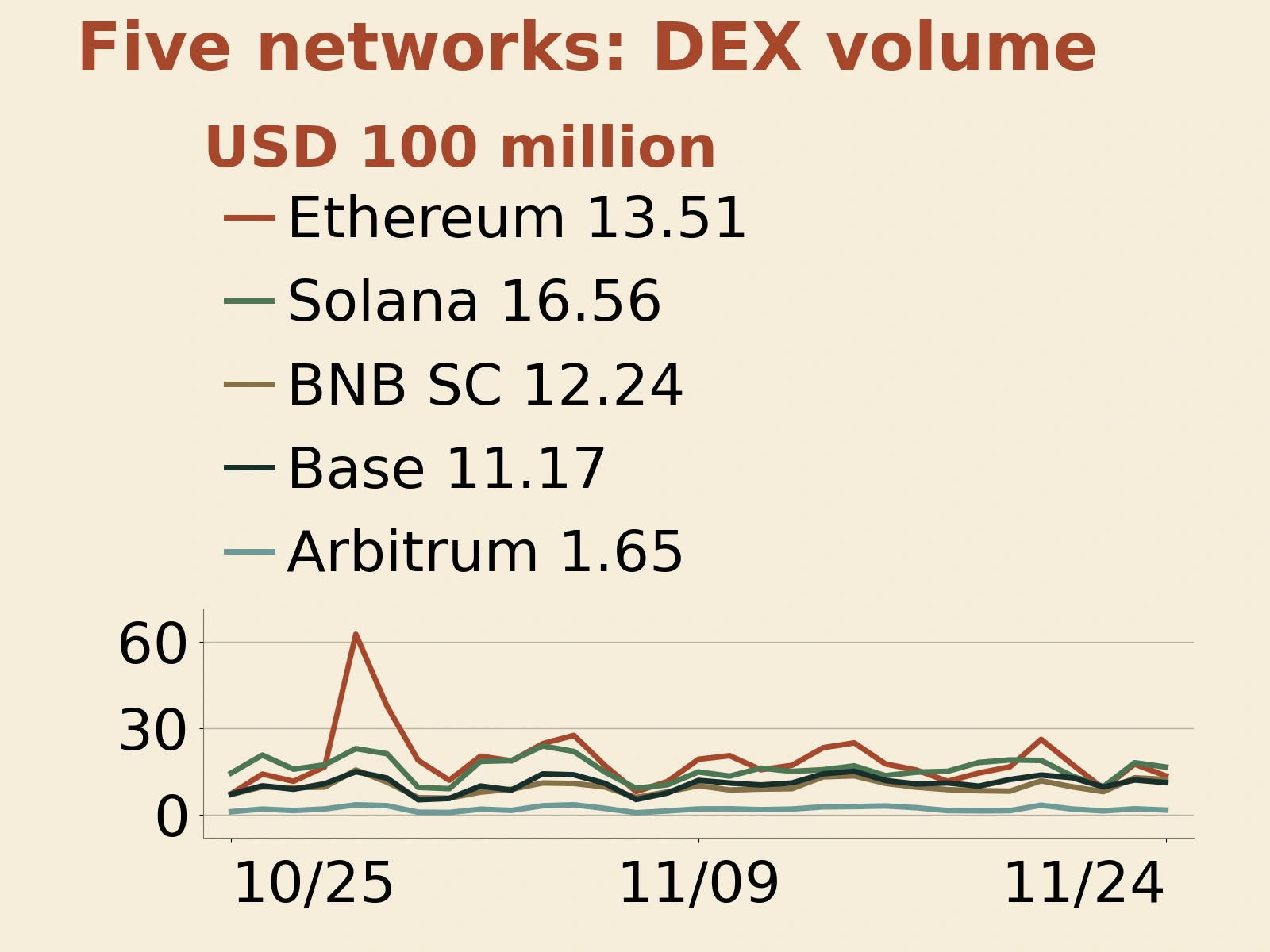
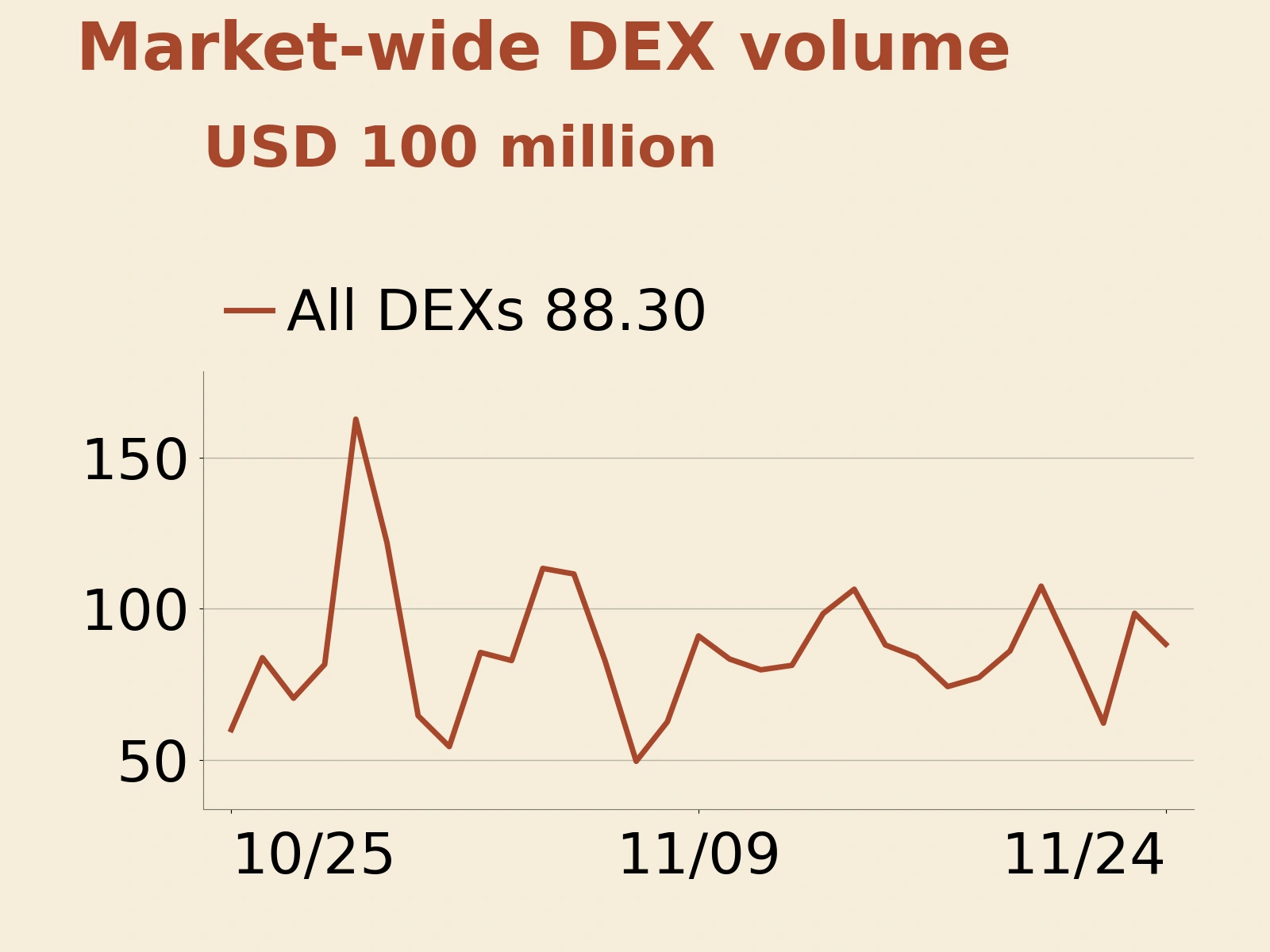
On November 24, decentralized exchanges (DEXs) tracked by DefiLlama recorded combined trading volume of $8.830 billion, down 10.4% from the previous day. Volume fell across all five networks in the sample: Ethereum mainnet, Solana, BNB Smart Chain, Base and Arbitrum. The decline affected different revenue streams unevenly: according to the same data provider, trading volume across all Uniswap versions fell 23.5%, fees paid by traders declined 24.1%, and revenue retained by the protocol dropped 41.0%.
Ethereum mainnet accounted for roughly 40% of the decline in volume

Measured by UTC calendar day, combined volume on Tuesday fell $1.027 billion from Monday. Ethereum mainnet accounted for $407 million of that decline, with volume falling to $1.351 billion, or roughly 40% of the total reduction. Solana volume fell from $1.806 billion to $1.656 billion, but remained the highest among the five sampled networks. BNB Smart Chain and Base recorded $1.224 billion and $1.117 billion, respectively, down 4.7% and 7.6%. Arbitrum fell 21.4% to $165 million; its smaller base limited the effect on the aggregate.
Monday's reported trading volume was revised between the two data downloads. On the morning of November 24, DefiLlama showed Monday's volume as $8.439 billion; by the morning of November 25, the figure for the same date had been revised to $9.857 billion. All day-over-day comparisons in this article use the same version of the data series downloaded on the morning of November 25. Comparing Tuesday against the figure downloaded on November 24 would show an increase, reversing the direction of the decline in the revised series.
Over a different time horizon, Tuesday's total volume was 18.9% above the previous Tuesday and also exceeded the $8.361 billion median daily volume for the preceding 30 days. These on-chain volume figures record asset swaps that have already taken place. They do not measure net capital inflows or identify why traders changed their positions.
Who retains a dollar of trading fees?
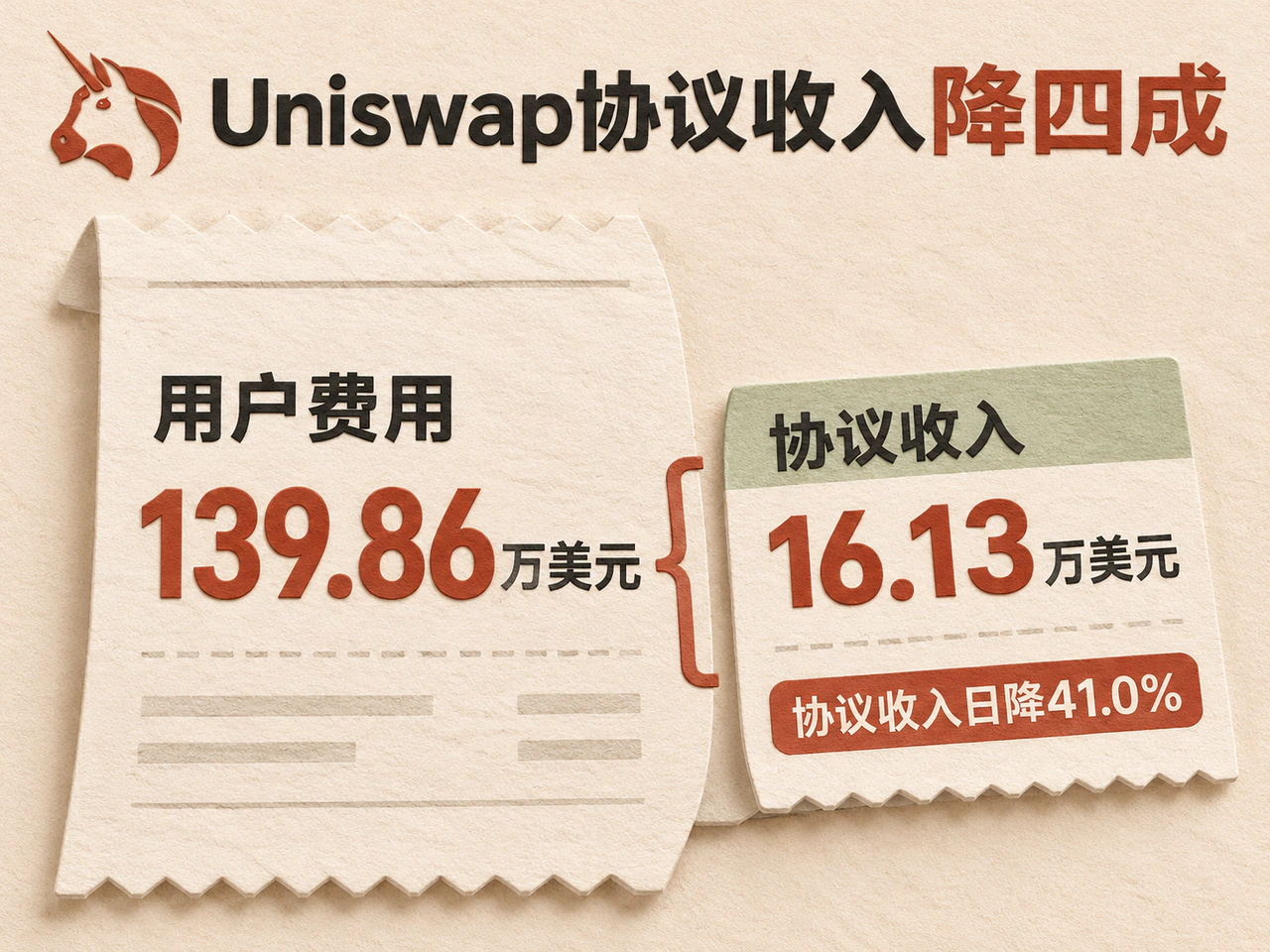
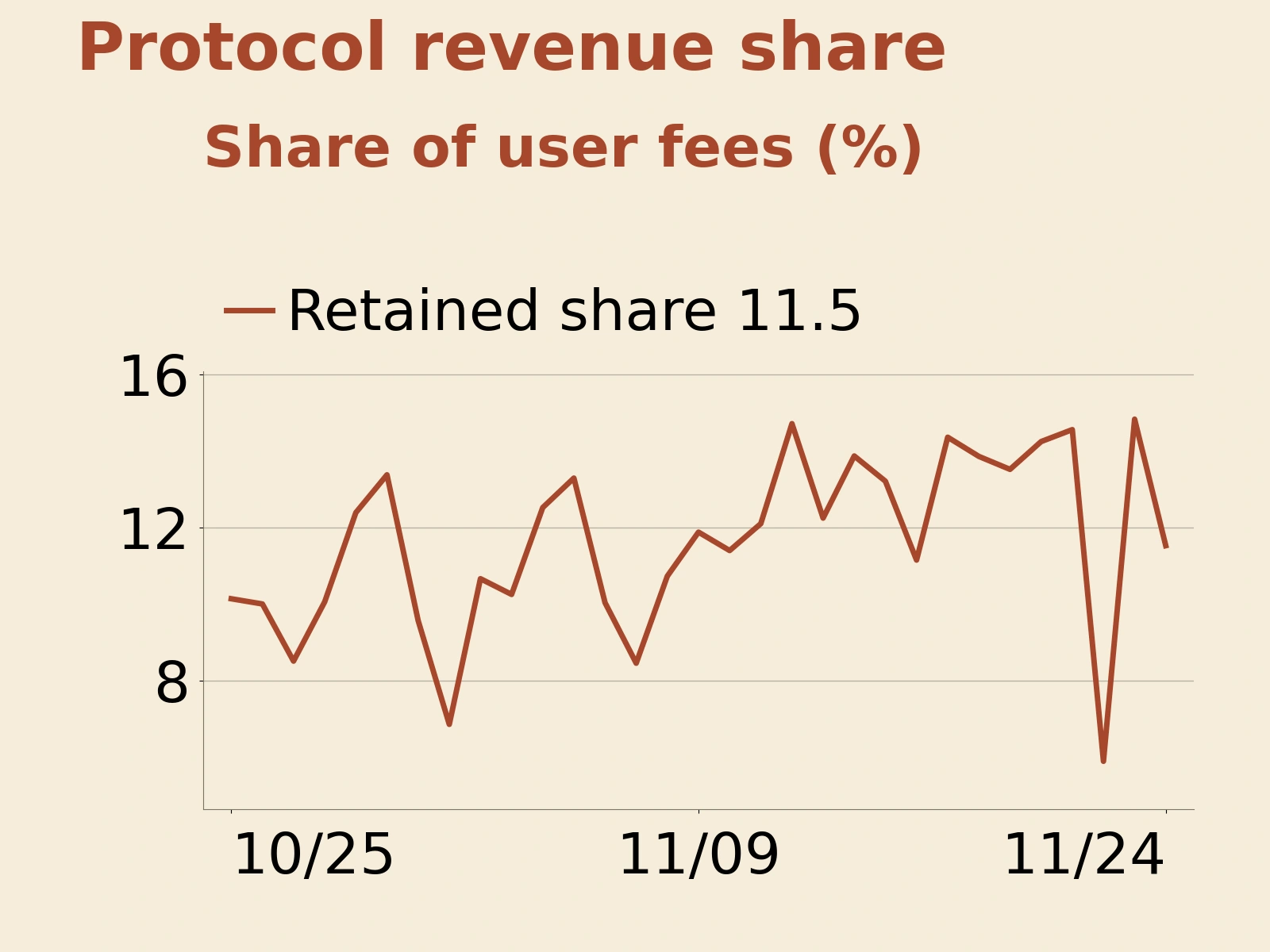
Across networks and versions, Uniswap recorded total volume of $1.608 billion on Tuesday, down $493 million from Monday. Fees paid by users fell from $1.8439 million to $1.3986 million, a decline similar to that in volume. Revenue retained by the protocol, which DefiLlama reports separately based on revenue allocation, fell from $273,600 to $161,300, reducing its share of user fees from 14.8% to 11.5%. User fees also include amounts allocated to liquidity providers and other participants; revenue retained by the protocol is not equivalent to dividends received by token holders that day.
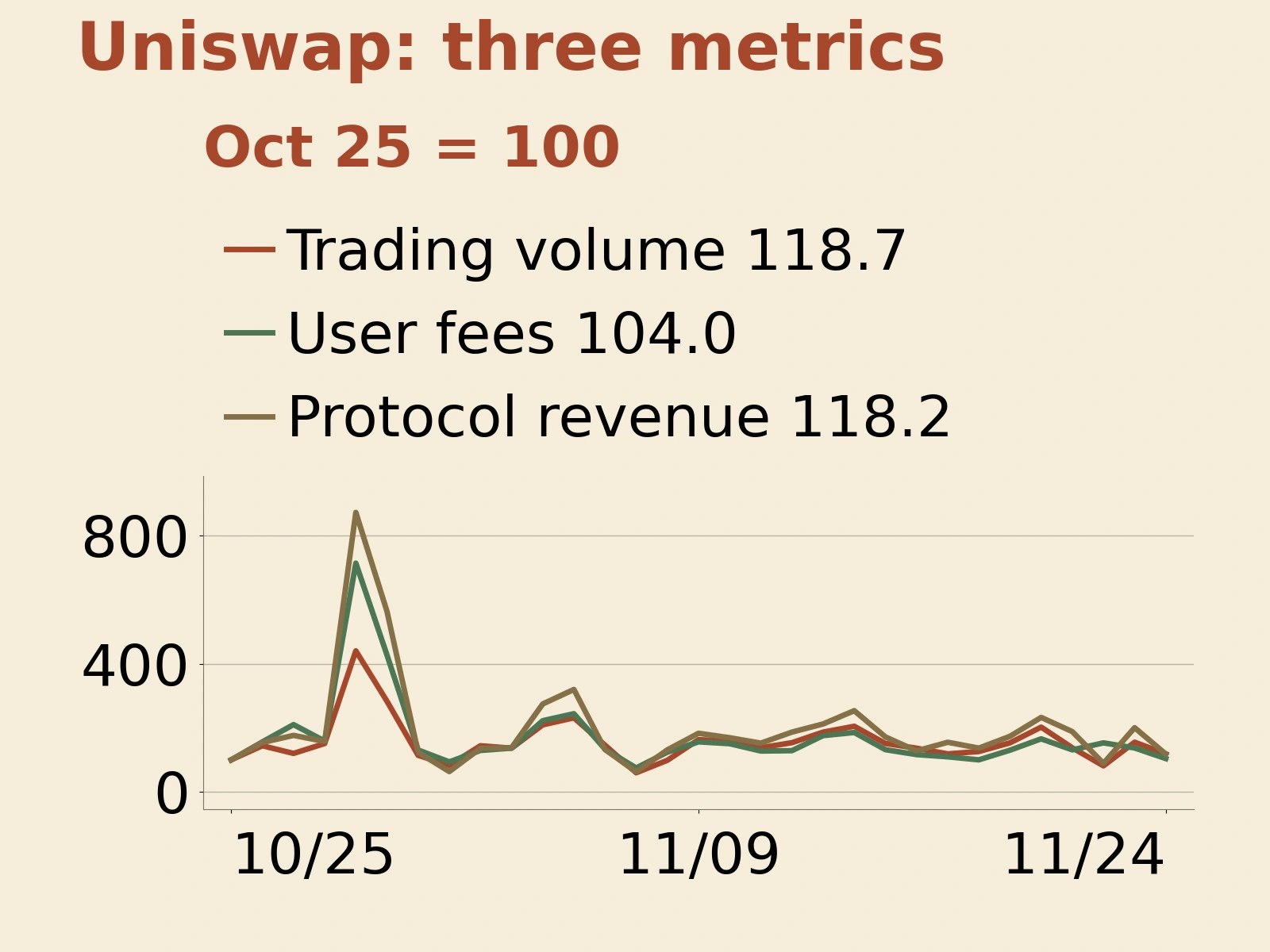
The breakdown by version helps explain the difference. In DefiLlama's figures for these two days, all protocol revenue was attributed to v3. On November 24, v3 generated $744,100 in user fees; v4 also generated $616,800 in fees, but the data provider recorded zero protocol revenue for it. On Tuesday, v3 user fees fell approximately $270,300 from Monday, while protocol revenue fell $112,300. The different rates of decline depend both on which pools trades reach and on how the fees generated by those pools are distributed. Multiplying total platform volume by a fixed percentage therefore cannot readily reconstruct the amount actually retained by the protocol on a given day.
Liquidity providers also face a trade-off between returns and risk. Publicly listed BTCS disclosed on November 23 that, after the sharp market sell-off on November 20, it sold approximately 27,300 ETH and repaid $43.80 million of Aave borrowings, while its Imperium operation temporarily withdrew from liquidity pools. The company said these steps reduced the risk of its collateral being liquidated. Once the capital left the pools, however, Imperium stopped earning market-making fees for that period. This case illustrates that, even when participants continue swapping assets in a trading pool, an institution's ability to earn a share of fees still depends on how much price and financing risk it is willing to bear. BTCS made these adjustments before November 24, so they cannot explain the overall decline in DEX volume that day.
One development to watch is whether protocol revenue as a share of user fees recovers alongside a rebound in volume. If aggregate volume recovers while that share remains low, order flow and fee allocation will explain the protocol's operating performance better than headline trading volume.
Click “Read the original” for full details.