On October 30, 2026, a Qatari mediation delegation returned to Tehran with a revised ceasefire proposal, even as successive reports emerged that tankers had been attacked and set ablaze in the Strait of Hormuz that same day. Diplomatic engagement continued alongside attacks at sea: Iran sought to pressure the United States by controlling passage through the strait, while the U.S. military maintained that the southern route remained safe and open. For shipowners, the succession of commercial vessels in distress, crew rescues and rising freight rates has more immediate consequences than either side's statements about control of the shipping lanes. With average daily crude exports in the week through Wednesday already well below the October monthly average, the concentrated attacks on October 30 are intensifying upward pressure on logistics costs and downward pressure on shipping volumes.
Multiple Tankers Attacked and Set Ablaze in Hormuz; Crude Exports Averaged 7.3 Million bpd in Week Through Wednesday
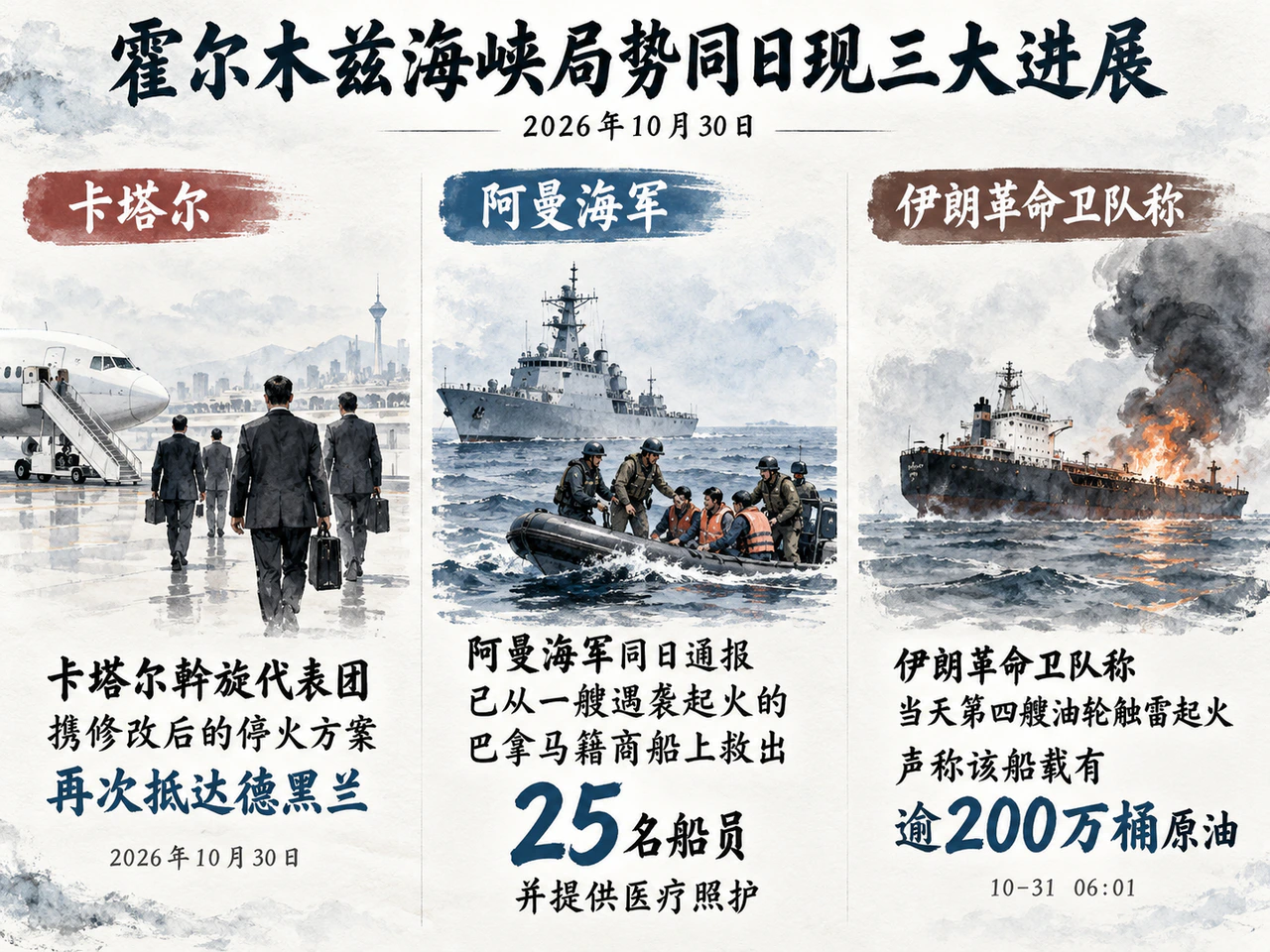
On October 30, the naval arm of Iran's Islamic Revolutionary Guard Corps initially reported that two tankers had suffered incidents and halted operations on what it described as an “unauthorized route.” It later raised to four the number of tankers it said had struck mines and caught fire that day, claiming that one carried more than 2 million barrels of crude. It also accused the vessels concerned of switching off navigation and positioning equipment and ignoring radio warnings.
Shipping advisories from several parties provided details of the day's attacks through different channels. The United Kingdom Maritime Trade Operations (UKMTO) received a report that a vessel had been struck by an unidentified airborne object and caught fire about 40 nautical miles south of Iran's Lavan Island. The crew were safe, and no environmental pollution had been reported. Another advisory concerned a crude tanker attacked while leaving the strait. The Royal Navy of Oman said the same day that it had rescued 25 crew members from a Panama-flagged merchant vessel that had been attacked and caught fire, and had provided medical care. There has so far been no cross-confirmation of whether these incidents overlap with the four mine-struck tankers cited by Iran.
Attack methods at sea have also taken a more covert turn. Reuters reported on October 30, citing maritime security sources, that in an incident on October 29, attackers in a small boat attached two limpet mines to the hull of the tanker Louise 1, causing an engine-room fire and briefly halting the vessel. British authorities subsequently said the fire had been extinguished, the crew were safe and the vessel was continuing to its next port. The use of low-cost small boats to approach tankers under way and attach explosives means escort forces must guard against close-range attacks on vessels' hulls as well as clear mines laid in advance, making protection substantially more difficult.
The United States and Iran offered conflicting accounts of shipping-lane security and military encounters. On October 30, U.S. Central Command commander Brad Cooper reiterated that the strait's main shipping routes had been cleared of Iranian mines and that the southern route remained safe and open. Central Command denied Iran's claim that day to have destroyed a U.S. unmanned vessel, saying all U.S. unmanned surface vessels in the region remained under its control. The divergence between official statements, alongside actual attacks on commercial vessels, has made it harder for shipowners to assess navigation risks.
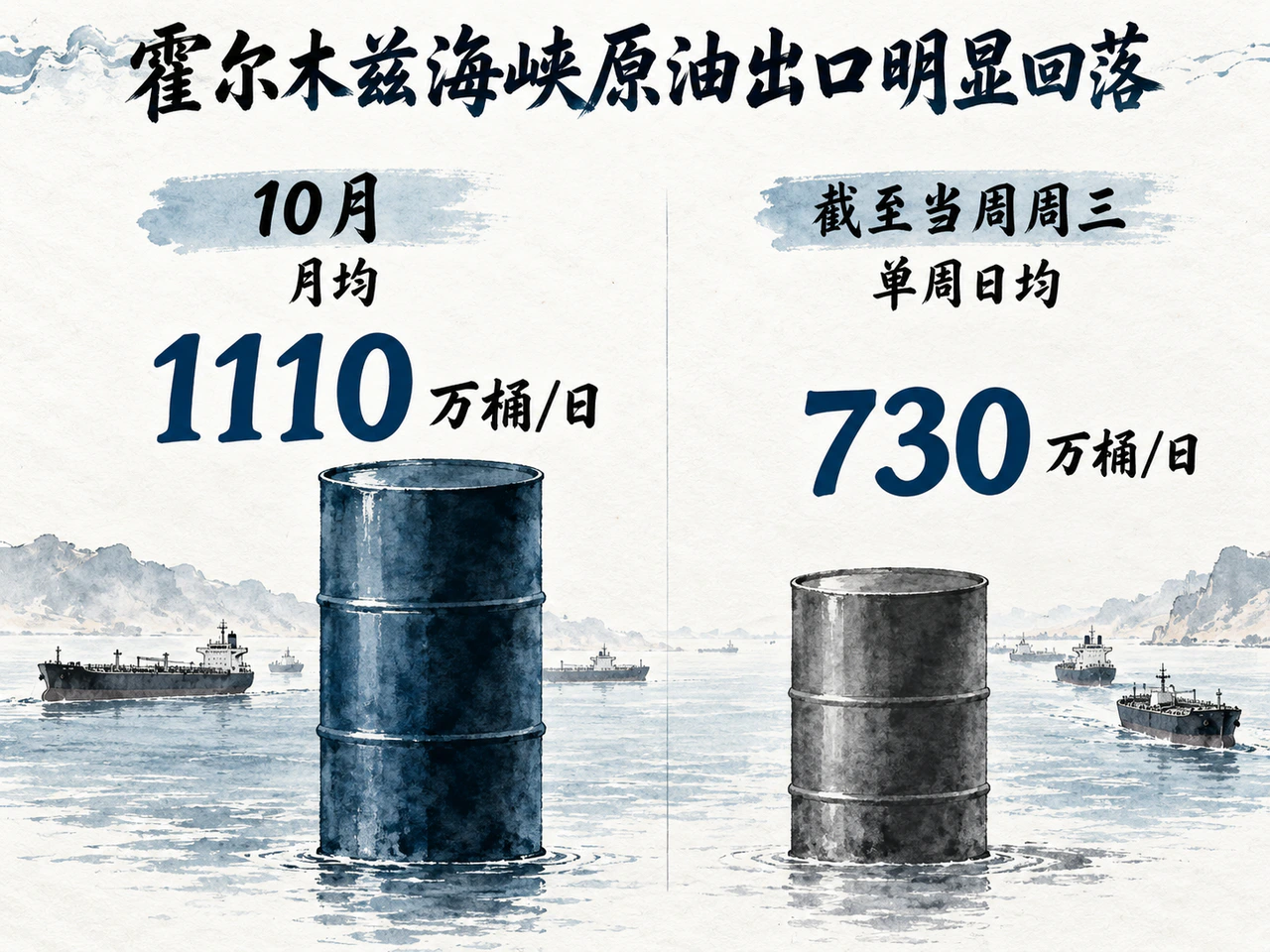
Physical trade flows through the strait had, in fact, already begun to weaken before the wave of attacks on October 29–30. CNBC reported on October 30, citing Kpler data, that crude exports through the Strait of Hormuz averaged nearly 11.1 million barrels per day in October, down only about 2% from September. In the week through that Wednesday, however, average daily exports had fallen to 7.3 million barrels per day, markedly below the October monthly average. Shipowners are currently sustaining operations mainly through transfers between vessels inside and outside the strait and higher freight charges. Security risks are initially showing up in tied-up shipping capacity, longer logistics chains and higher transport costs. With the latest attacks on October 30 adding to these pressures, a persistent decline in weekly average daily exports would make the maritime conflict's impact on physical crude supply more apparent.
Qatar Returns to Tehran with Revised Proposal as U.S. and Iran Remain Divided over Nuclear Issues and the Sequence for Lifting Restrictions
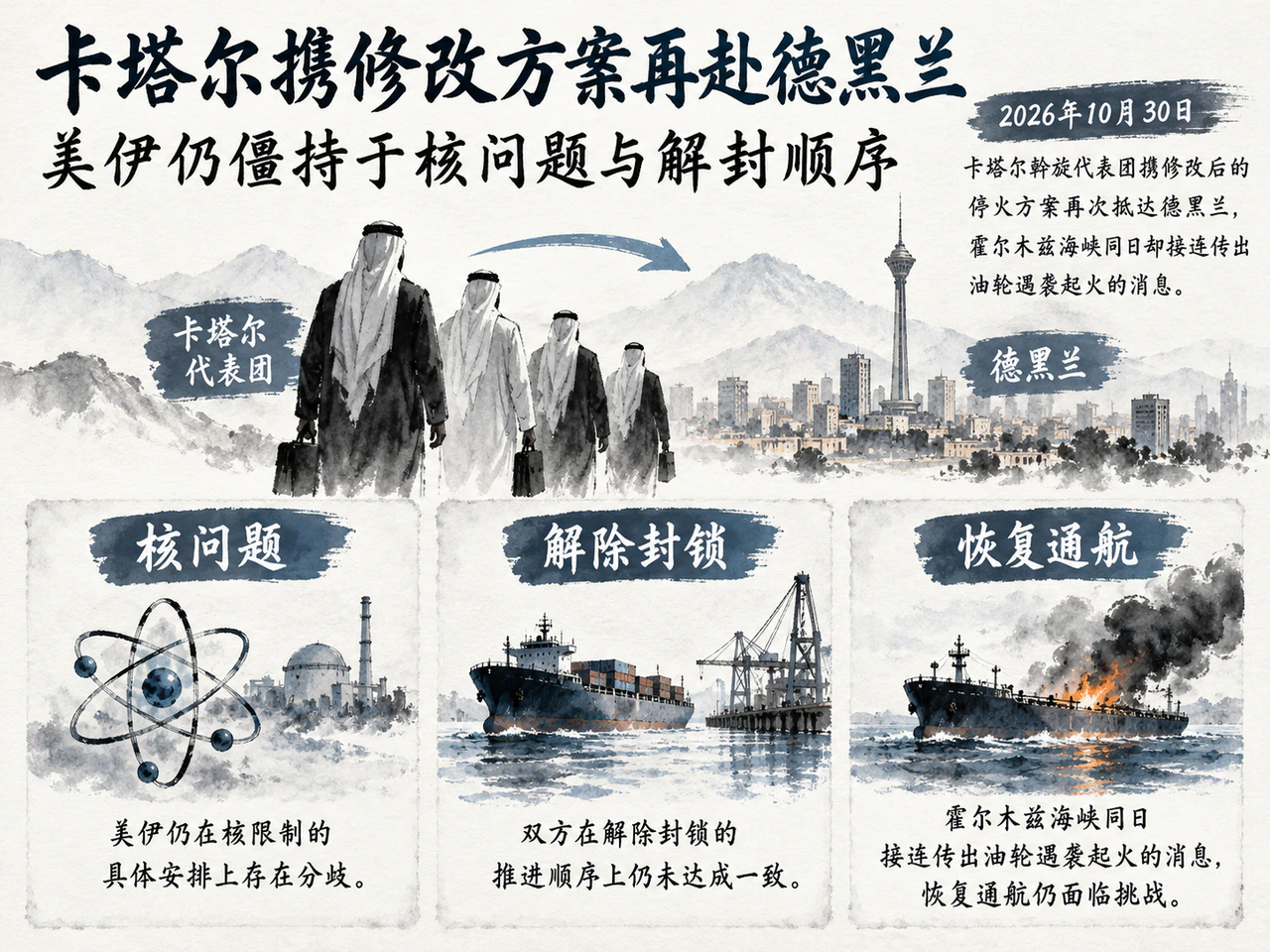
As maritime friction escalated, the Qatari delegation traveled to Tehran on October 30 with the latest revisions to a proposal to end the war. People familiar with the matter told media outlets that the mediation effort was showing signs of progress. In an interview with Reuters that same day, Pakistani military spokesperson Ahmed Sharif Chaudhry also expressed “cautious optimism” about mediation between Iran and the United States, while warning that forces seeking to sabotage the effort remained active.
In a radio interview that day, U.S. President Trump said the war would end “very soon” and stressed that Iran must guarantee it would never possess nuclear weapons, without specifying how this would be achieved. The sequence for addressing the nuclear issue and lifting sanctions remains the central sticking point in negotiations: Washington wants nuclear issues included from the outset, while Iran insists that the port blockade be lifted and oil and gas sanctions eased first. The Qatari delegation's return to Tehran shows that proposals are still being exchanged. Whether those exchanges can produce concrete, workable arrangements depends on whether the two sides can compromise on the sequence for nuclear restrictions, lifting the blockade and restoring shipping.
Houthi Missiles Target Aden Presidential Palace; UAE Seals Leak from Attacked Tanker
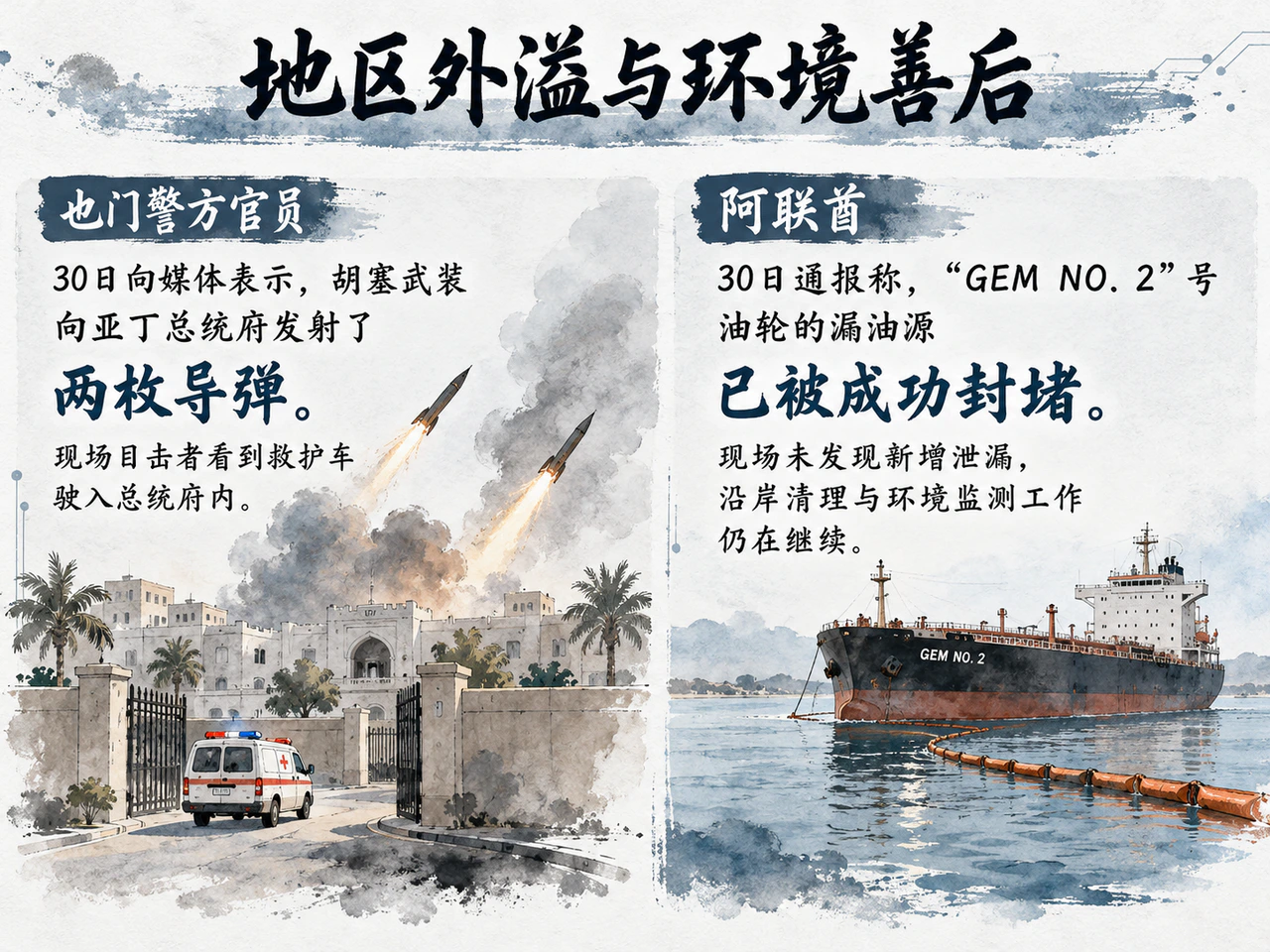
The conflict's regional spillovers have not eased in step with the mediation contacts in Tehran. A Yemeni police official told media outlets on October 30 that the Houthis had fired two missiles at the presidential palace in Aden; witnesses saw ambulances entering the compound. Saudi Arabia also reported that day that it had intercepted multiple drones and ballistic missiles, identifying the Houthis as the launchers. The Houthis denied taking action against areas around Mecca and Medina.
The environmental aftermath of earlier attacks at sea is also still being addressed. The United Arab Emirates reported on October 30 that the source of the oil leak from the tanker GEM NO. 2 had been successfully sealed. No new leakage had been detected at the site, while coastal cleanup and environmental monitoring continued.
Key Developments
| Key Developments |
|---|
| 10-31 06:01Iran's Revolutionary Guard said a fourth tanker had struck a mine and caught fire that day, claiming the vessel carried more than 2 million barrels of crude. |
| 10-31 03:50A Yemeni police official told media outlets that the Houthis had fired two missiles at the presidential palace in Aden; witnesses said they saw ambulances entering the compound. |
| 10-31 02:10Media reports citing data from a British maritime agency said more than 30 attack reports had been received in October for the Strait of Hormuz and surrounding waters, roughly twice the September total. |
| 10-31 00:52The UAE said the source of the oil leak from GEM NO. 2 had been sealed, with no new leakage detected; coastal cleanup and monitoring continued. |
| 10-31 00:26The Saudi-led coalition said it had intercepted drones near Riyadh and ballistic missiles in southern Saudi Arabia, identifying the Houthis as the launchers. |
| 10-30 23:38Media reports citing judicial sources said a Lebanese military court had charged 13 people in a case involving the transport of explosives to Hezbollah; two were in custody. |
| 10-30 23:09The Royal Navy of Oman said it had rescued 25 crew members from a Panama-flagged merchant vessel that had been attacked and caught fire, and had provided medical care. |
| 10-30 21:29Iran's navy said two tankers had struck mines and caught fire, and claimed it had destroyed hostile unmanned equipment east of the strait. |
| 10-30 20:47In a radio interview, Trump said the Iran war would end “very soon” and stressed that Iran must guarantee it would never possess nuclear weapons. |
| 10-30 20:31U.S. Central Command commander Cooper reiterated that the main shipping routes through the Strait of Hormuz had been cleared of mines and that the southern route remained safe and open. |
| 10-30 20:00People familiar with the matter told media outlets that Qatari mediators had arrived in Tehran to deliver the latest revisions to a proposal to end the war, and said the mediation was showing signs of progress. |
| 10-30 19:30Iran's Revolutionary Guard said two tankers had suffered incidents and halted operations on what it described as an “unauthorized route.” |
| 10-30 19:07The Saudi-led coalition said it had intercepted Houthi drones in the Mecca region; the Houthis denied taking action against that area. |
| 10-30Pakistan's military spokesperson expressed “cautious optimism” about mediation between Iran and the United States, while noting that forces seeking to sabotage the effort remained active. |
| 10-30Reuters, citing maritime security sources, said the October 29 attack on the tanker Louise 1 involved limpet mines attached from a small boat. British authorities said the fire had been extinguished, the crew were safe and the vessel was continuing its voyage. |


