On October 28, 2026, diplomatic contacts continued over reopening the Strait of Hormuz and securing a regional ceasefire. Iranian Foreign Minister Abbas Araghchi said Tehran remained in close contact with intermediaries and was exploring ways to implement its “seven-day plan” in less than a week. The parties nevertheless remained divided over the core terms of an exchange. The United States again advised ships that day to avoid unnecessary entry into areas around the strait, while Aden International Airport in Yemen came under another missile attack. De-escalation requires progress on both reopening conditions and surrounding conflicts. A single negotiating signal is unlikely to remove actual transport risks.
Iran suggests cutting the reopening wait to four days; inspections and sanctions remain disputed

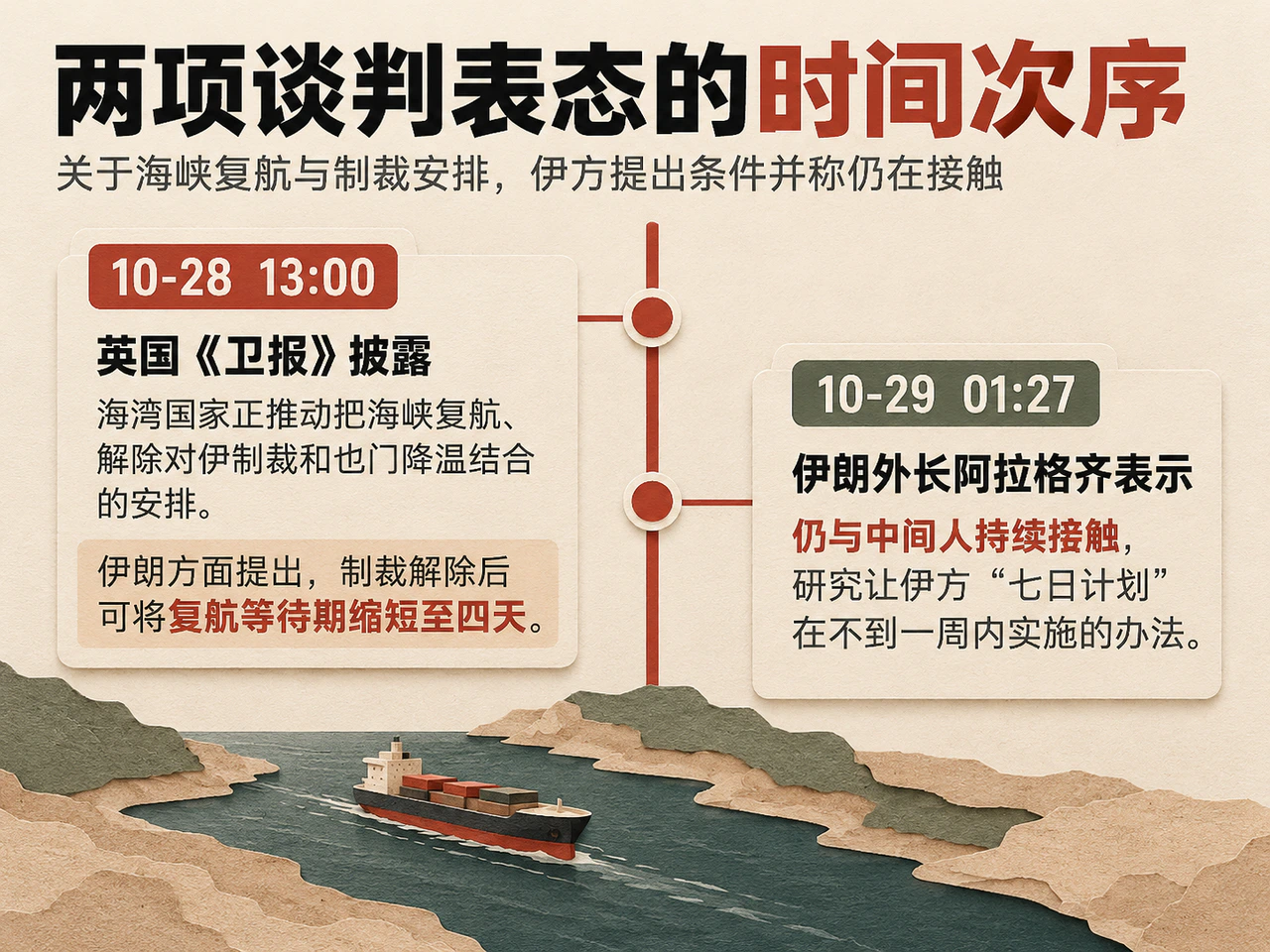
The Guardian reported that Gulf states were promoting a package linking the reopening of Hormuz, the lifting of sanctions on Iran and a partial Houthi withdrawal in Yemen. Within that framework, Iranian national security official Bagheri said the waiting period between the lifting of economic sanctions and reopening the strait could be reduced from seven days to four. Araghchi's later comments about accelerating the “seven-day plan” provided another indication of flexibility on the reopening timetable.
The parties were far from agreeing on either the nature of the mediation proposal or the conditions of an exchange. Reuters cited an official familiar with the negotiations as saying Qatari mediators had delivered a new draft agreement to end the war on Sunday, with Tehran expected to respond before the weekend. Senior Iranian officials subsequently denied receiving a new peace proposal, describing Qatar's contribution as unacceptable ideas and emphasizing that Iran would not compromise on the nuclear issue. The Guardian also reported that European diplomats considered allowing UN inspectors to return to Iran and inspect bombed nuclear facilities an important condition for securing U.S. acceptance.
The technical waiting period for reopening may be negotiable, but renewed inspections and guarantees around sanctions relief remain central to any deal. A shorter nominal wait can translate into restored shipping capacity only after the parties agree on the sequence of implementation. Whether inspections resume, how sanctions are lifted and how guarantees are put into practice will determine whether contacts move beyond statements of principle.
U.S. shipping warnings continue alongside Yemen fighting and military pressure

Despite continued diplomacy, risks to shipping and neighboring fronts remained high. Bloomberg reported that U.S. Naval Forces Central Command issued guidance through the Joint Maritime Information Center on October 28, advising vessels without essential transit needs to stay away from relevant areas of the Gulf of Oman and the Strait of Hormuz to avoid unnecessary delays. For cargo owners and shipowners, mediation and navigation warnings coexist. Vessel scheduling still requires workable transit arrangements, and restored delivery times depend on security conditions after an agreement takes effect.
Yemen, another central component of the Gulf mediation package, saw fresh attacks that evening. A Yemeni military spokesperson said the Houthis launched two ballistic missiles at Aden International Airport, injuring civilians and damaging facilities. Before the attack, the Houthis had ordered airport personnel to evacuate, claiming that a Saudi military cargo aircraft there was transporting weapons. AFP cited local police as saying one missile landed within the airport, while the aircraft was not hit and subsequently departed. Houthi television also said Saudi airstrikes on a market and petrol station in Al-Jawf province had initially left 14 people dead and 10 wounded. Repeated pressure on transport hubs and civilian facilities complicates any arrangement linking an end to the strait blockade with withdrawals in Yemen.
Discussion of U.S. and Israeli military pressure on Iran also continued. Media reports citing people familiar with the matter said Washington had warned Gulf allies to prepare for possible military action against Iran after the midterm elections. In Israel, where a government had yet to be formed following the election, political disagreements over action against Iran became public. Opposition leader Gadi Eisenkot urged the military to resist political pressure from Benjamin Netanyahu, while Defense Minister Israel Katz publicly rebuked him. Araghchi warned the same day that any Israeli-driven military action in the Persian Gulf would severely disrupt international markets. With military preparations and diplomacy both continuing, the decisive next development remains whether a ceasefire, inspections and reopening can be combined in implementation arrangements acceptable to both sides.
Key developments · Beijing time (UTC+8)
| Key developments · Beijing time (UTC+8) |
|---|
| October 29, 02:51 · Beijing timeHezbollah leader Naim Qassem said the organization would continue resisting for as long as occupation and attacks persisted, regardless of the Israeli election result. |
| October 29, 01:27 · Beijing timeAraghchi said contact with intermediaries was continuing and Iran was exploring how to implement its “seven-day plan” in less than a week. |
| October 29, 01:03 · Beijing timeKuwait summoned Iran's ambassador over the Iranian embassy's response to a ruling in an assassination case. The embassy denied that an Iranian citizen had participated in the alleged plot. |
| October 29, 00:14 · Beijing timeA Yemeni military spokesperson said the Houthis fired two ballistic missiles at Aden airport that evening, injuring civilians and damaging facilities. |
| October 29, 00:13 · Beijing timeIsraeli Defense Minister Katz criticized Eisenkot's call for the military to resist Netanyahu's political pressure, as potential military action against Iran became a focus of post-election controversy. |
| October 28, 23:05 · Beijing timeA spokesperson for Iran's atomic energy organization said Iran and Russia were finalizing an agreement to accelerate joint development of small modular nuclear reactors. |
| October 28, 22:29 · Beijing timeAraghchi warned that any Israeli-driven military action in the Persian Gulf would severely disrupt international markets. |
| October 28, 21:24 · Beijing timeThe Houthis said Saudi airstrikes hit a market and petrol station in Al-Jawf province, with an initial toll of 14 dead and 10 wounded. |
| October 28, 20:52 · Beijing timeMedia reports citing people familiar with the matter said the United States had warned Gulf allies to prepare for a possible short, forceful operation against Iran after the midterm elections and was adjusting air-defense and personnel deployments. |
| October 28, 19:40 · Beijing timeThe Houthis demanded the immediate evacuation of Aden airport, saying a Saudi military cargo aircraft there was carrying weapons. |
| October 28, 18:54 · Beijing timeReuters cited senior Iranian officials as saying Qatar had brought unacceptable ideas rather than a new peace proposal. An official familiar with the talks had earlier said Qatar delivered a draft agreement. |
| October 28, 18:31 · Beijing timeBloomberg reported that U.S. Naval Forces Central Command, through the Joint Maritime Information Center, advised vessels without essential transit needs to avoid relevant areas of the Gulf of Oman and Hormuz to prevent delays. |
| October 28, 13:00 · Beijing timeThe Guardian reported that Gulf states were promoting an arrangement combining the reopening of the strait, sanctions relief and de-escalation in Yemen. Iran proposed reducing the reopening wait after sanctions relief to four days. |