The Job Openings and Labor Turnover Survey (JOLTS), released by the U.S. Bureau of Labor Statistics on November 3, 2026, showed that seasonally adjusted job openings rose to 7.523 million in September, an increase of 333,000 from August's revised level. Hiring increased, layoffs declined, and the number of workers voluntarily quitting their jobs also recovered. The figures eased market concerns about a rapid deterioration in employment, allowing the Federal Reserve to keep its policy focus on curbing inflation.
Job openings rate rises to 4.5%, with uneven labor demand across industries

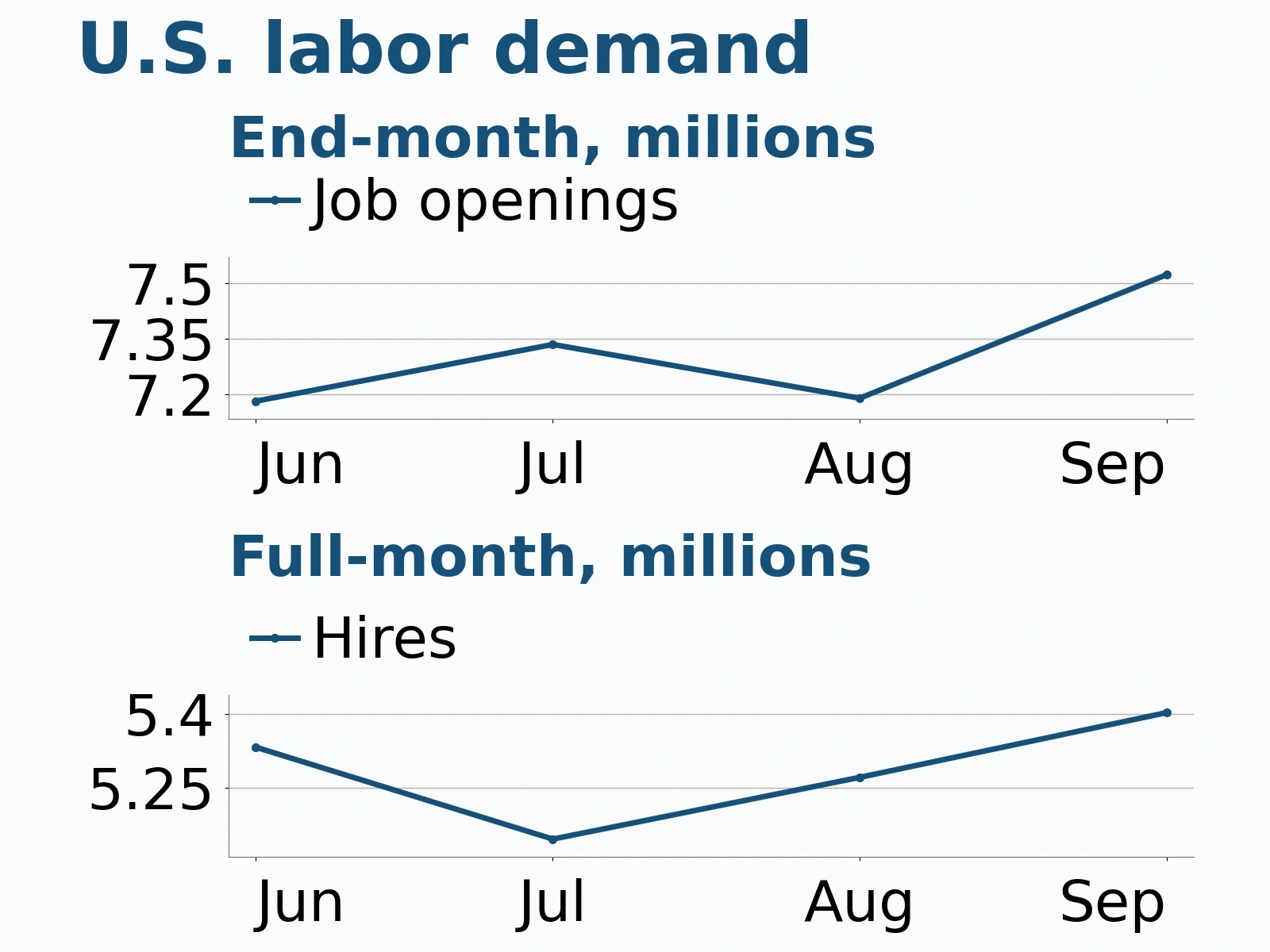
The job openings rate rose from 4.3% in August to 4.5% in September, but the recovery in labor demand was uneven across industries. State and local government, excluding education, added 104,000 openings during the month. Private-sector openings increased by 236,000, led by professional and business services, up 106,000; manufacturing, up 54,000; and construction, up 36,000. By contrast, openings declined in financial activities, health care and social assistance, and leisure and hospitality.
Actual hiring showed a different pattern of divergence across industries from job openings. Total hires rose from 5.271 million in August to 5.402 million in September, while the hiring rate edged up from 3.3% to 3.4%. Hires in accommodation and food services increased by 158,000 during the month, exceeding the net increase across all industries. Actual hiring fell, however, in manufacturing and professional and business services, despite increases in their openings, and also in financial activities. This suggests that employers' preference for retaining existing employees or advertising vacancies has yet to translate into broad-based expansion across industries.
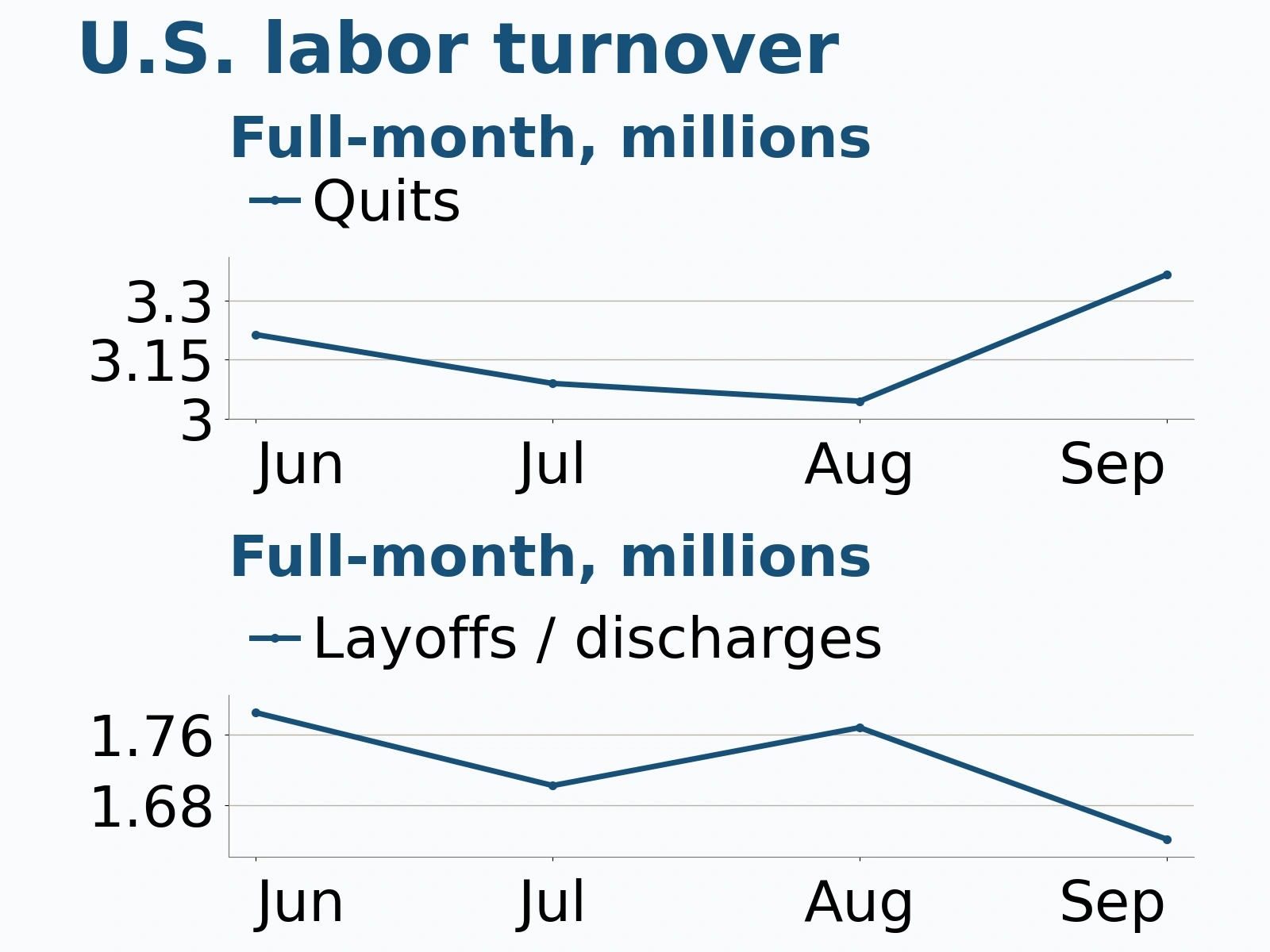
Other measures of labor turnover also pointed to a resilient labor market. Layoffs and discharges fell from 1.768 million to 1.641 million in September, indicating relatively limited pressure on employers to cut positions. Voluntary quits rose from 3.044 million to 3.365 million, reflecting a recovery in workers' willingness and ability to find new jobs. The Bureau of Labor Statistics nevertheless described the month's changes in job openings, hires, and layoffs and discharges as "little changed." Over a longer horizon, hires from June through September were 5.332 million, 5.146 million, 5.271 million, and 5.402 million, respectively. September's improvement was a modest rebound within recent monthly fluctuations, rather than a sustained acceleration.
Labor-market resilience reduces the urgency to ease as early-November data test the case for rate increases

At its October 28 policy meeting, the Federal Reserve kept the target range for the federal funds rate unchanged at 3.75%–4% and stressed that inflation remained elevated. Two voting members dissented from the decision to hold rates steady, favoring a 25-basis-point increase. The improvement in September's labor-market data further reduced the need for the Fed to pivot quickly toward easing in response to labor-market weakness, while giving it room to maintain a restrictive policy stance amid high inflation.
Reuters cited Matthew Martin, senior U.S. economist at Oxford Economics, as saying that a broadly solid labor market would keep the Fed focused on inflation. He expected the Fed to raise rates at its meetings in December this year and March next year. Whether that forecast is borne out will depend on how labor-market resilience and price pressures evolve.
The coming week will bring a key test of that outlook. The preliminary third-quarter productivity and costs report is scheduled for November 5, the October employment report for November 6, and the October Consumer Price Index (CPI) for November 10, all on U.S. Eastern Time dates. Nonfarm payrolls, the unemployment rate, and wage growth will directly test the positive signals from September's JOLTS report. An improvement in productivity would help cushion the upward pressure that wage increases put on unit labor costs, while the CPI trajectory will directly influence the Fed's choice between holding steady and tightening further. Stable employment alongside slow disinflation would lend greater support to the debate over further tightening. Conversely, rising productivity accompanied by easing price pressures would strengthen the case for keeping rates unchanged while the Fed continues to assess incoming data.