Over the past 24 hours, from 17:28 on July 27 to 17:28 on July 28 Beijing time, no new direct exchanges were reported on the main US–Iran battlefield. The confrontation moved into a stalemate dominated by unilateral statements and shuttle diplomacy. Trump claimed that strikes had been paused at Iran's request and scheduled successive White House meetings on Tuesday with Zelensky and Netanyahu. Tehran publicly denied any contact with Washington, saying the current situation could not be called a ceasefire.
Although the main battlefield had fallen temporarily quiet, new risks were building rapidly on its flanks. Saudi Arabia intercepted drones launched from Iraq toward its eastern oil facilities; the Houthis announced a blockade of Saudi-linked shipping in the Bab el-Mandeb Strait; and commercial shipping data for Hormuz indicated more clearly that Iran had unilaterally taken control of the rules governing passage.
Two White House Meetings in One Day: Aligning the Parties' Interests During the Pause

Speaking to reporters aboard Air Force One on Monday, Trump said the United States had paused strikes at Iran's request: they had politely asked it to stop so the sides could meet and talk. He also warned that if negotiations produced no result, US forces would resume their previous pace of strikes.
Even as Washington maintained its deterrent posture, nearly two weeks of military operations exposed pressure on US readiness from munitions consumption. Trump acknowledged tight stocks of advanced precision munitions, saying the United States would certainly like more of its more advanced weapons. He blamed the gap on the previous administration's military aid to Ukraine, while insisting that overall US military readiness remained good.
Tuesday's White House schedule was unusually full: Trump was to meet Ukrainian President Volodymyr Zelensky and Israeli Prime Minister Benjamin Netanyahu in succession. The US–Israel talks were to focus on the war in Iran, progress in Lebanon negotiations and expansion of the Abraham Accords. Trump acknowledged small differences over Iran but said their positions were very close overall. Before departing, Netanyahu said at Nevatim Air Base that Iran was the foremost item on his agenda. In addition to the formal meeting, the two were to attend the funeral of the late Senator Graham together.
On Ukraine, Zelensky accused Russia of providing Iran with satellite reconnaissance intelligence on US bases in Bahrain, Jordan and Kuwait. Trump played down the accusation, saying he did not think Russia was doing so, at least not on instructions from senior officials.
Tehran's Position: No Talks, No Acknowledged Ceasefire, and Dialogue Confined to the Region
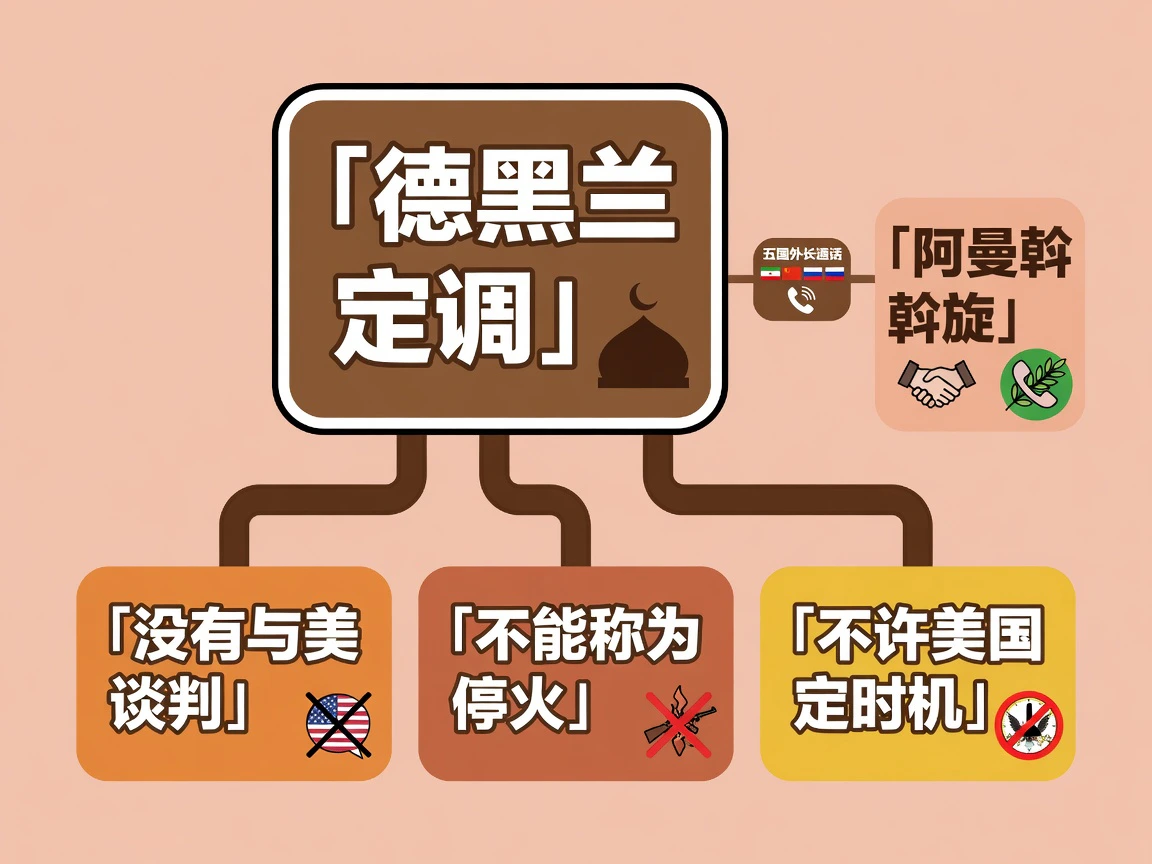
Tehran categorically rejected the US account that it had sought peace and maintained a hard line. At a televised press conference, Foreign Ministry spokesman Baghaei emphasized that no negotiations with the United States were taking place. He said Iran would never allow Washington unilaterally to dictate the timing of war and peace, and would hold it accountable for military aggression. He also condemned Britain, France and other countries as accomplices to that aggression.
While closing off direct contact with Washington, Tehran confined its dialogue channels strictly to the region. Baghaei confirmed that Iran and Oman were holding deputy-foreign-minister-level discussions in Tehran on managing the safety of passage through Hormuz. He deliberately characterized these as practical consultations between two coastal states, unrelated to the United States.
Oman's role in shuttle diplomacy consequently became more prominent. A traditional neutral intermediary that had facilitated the early secret talks leading to the 2015 Iran nuclear agreement, Oman sought a practical, fair and sustainable understanding on safe navigation. Foreign Minister Badr al-Busaidi held a series of calls on Monday with his counterparts in five countries—Iran, Saudi Arabia, Qatar, Kuwait and Egypt. Iranian Foreign Minister Araghchi then spoke directly with the Omani and Saudi foreign ministers separately. The contacts came at a sensitive point: an Omani delegation had just concluded a visit to Iran, while Saudi Arabia was facing successive attacks by pro-Iran groups from Yemen and Iraq. The shuttle diplomacy aimed to prevent an uncontrollable chain of escalation.
Risks Build on the Flanks: Attacks on Saudi Facilities and a Renewed Red Sea Blockade
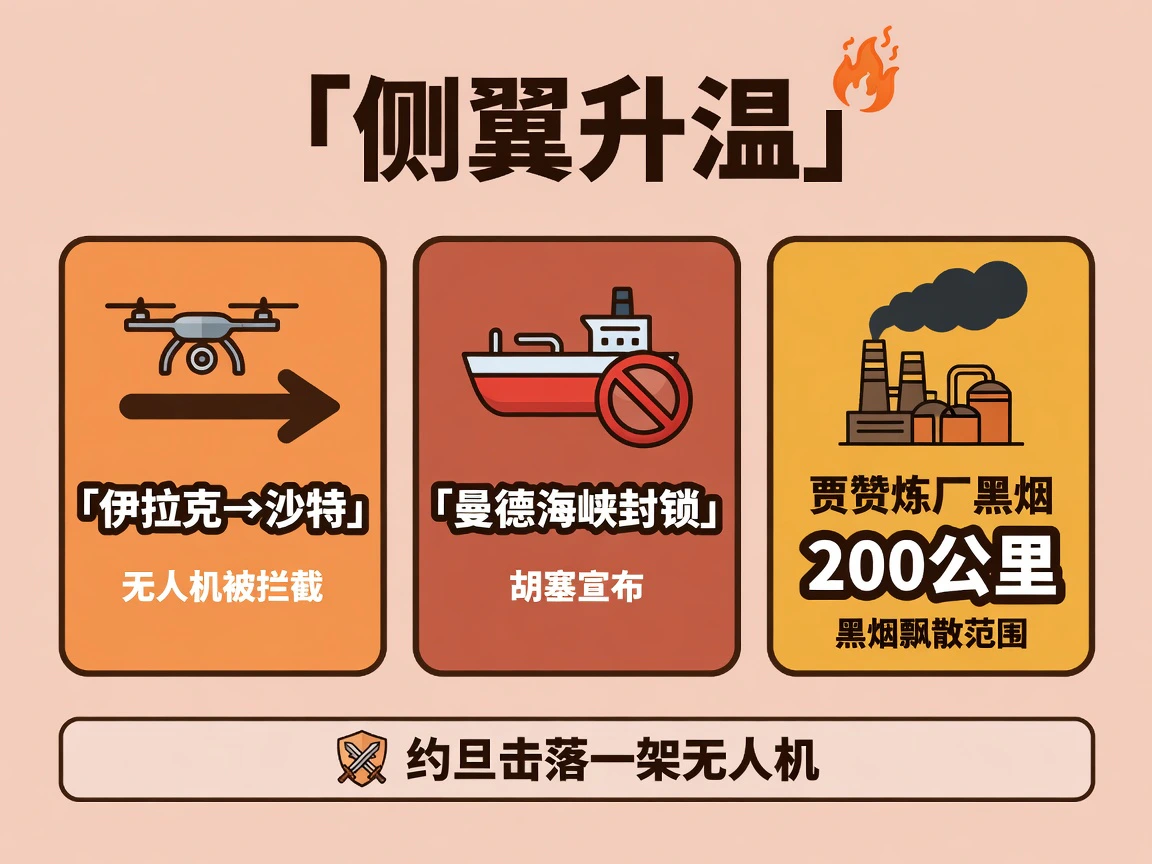
Saudi Arabia's Defense Ministry said on Monday that its air defenses had intercepted several drones launched from Iraq toward oil facilities in the Eastern Province and urban Riyadh. Spokesman Major General Turki al-Maliki blamed pro-Iran Iraqi militias and reiterated Saudi Arabia's right to respond at the appropriate time and place. Iraq's military said it would investigate the Saudi evidence; the Islamic Resistance in Iraq rejected the accusation as fabricated. Such cross-border harassment was not unprecedented: Saudi Arabia had also intercepted drones entering from Iraq on May 18.
Confrontation in the Bab el-Mandeb Strait and along the Red Sea coast intensified abruptly. The Houthis announced an end to their earlier informal ceasefire with Saudi Arabia, imposed a blockade on all Saudi-linked shipping through Bab el-Mandeb and claimed to have hit two Saudi tankers. Saudi Arabia confirmed an attack on at least one merchant vessel and retaliated with airstrikes on the Houthi-controlled port of Hodeidah. NASA satellite thermal imagery showed a black-smoke plume extending nearly 200 kilometers near the Jazan refinery on Saudi Arabia's Red Sea coast. Jordan's military also reported on Tuesday that it had intercepted and shot down an incoming drone over its eastern desert at dawn.
Compared with tensions in the Gulf and Red Sea, implementation on the Lebanon–Israel front remained relatively steady. Officials were scheduled to continue work on the US-mediated framework agreement in Rome on August 4–6, with defense handovers in pilot areas of southern Lebanon already getting under way.
Hormuz in Practice: Commercial Traffic Plummets as Iran Sets the Passage Rules
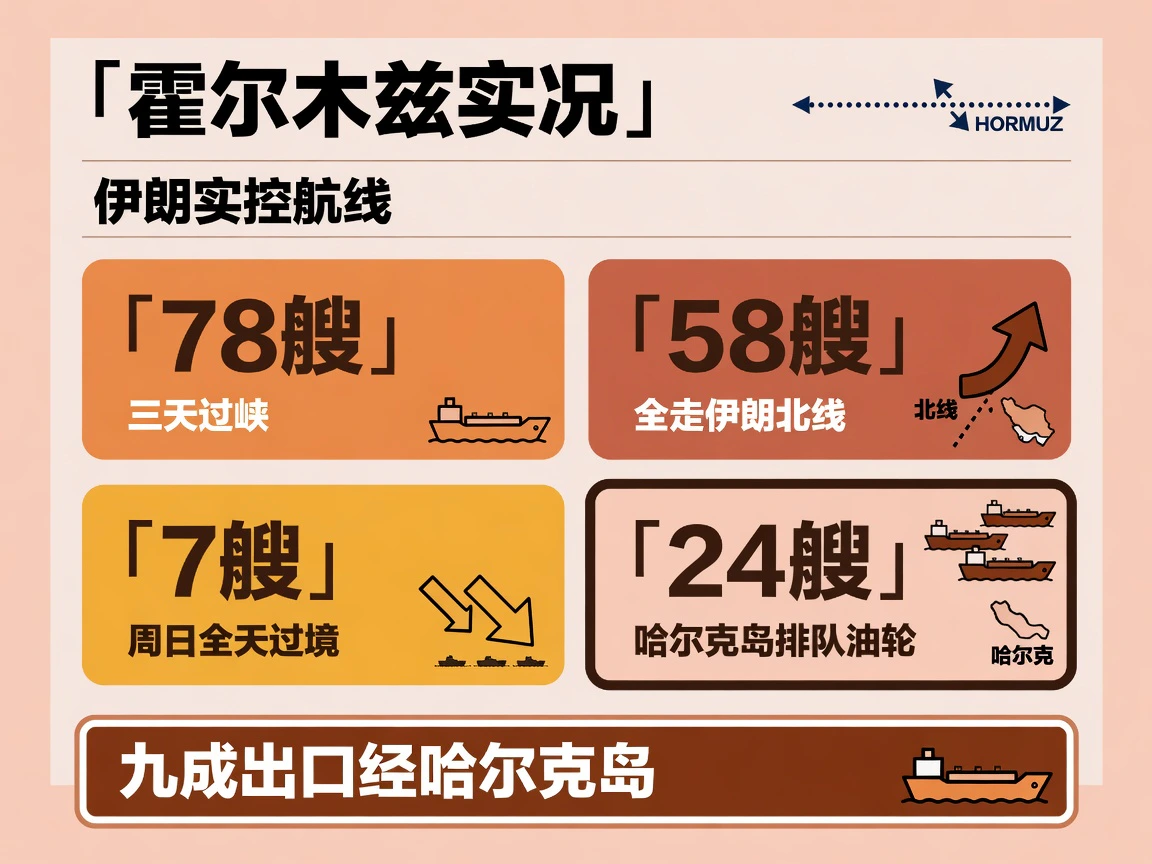
Commercial shipping data clearly reflect the practical balance of power in Hormuz. Ship-tracking organization Marisks counted 78 vessels passing through the strait since Saturday. All 58 non-Iranian merchant vessels obeyed Tehran's instructions and used Iran's designated northern route; none chose the southern route near Oman recommended by the US military. Windward separately recorded only seven crossings throughout Sunday, far below normal prewar traffic.
Iran's state broadcaster IRIB, citing informed sources, said the Iranian navy had driven six merchant ships back into the Persian Gulf after they switched off their AIS tracking systems and attempted to force passage along the allegedly illegal and unsafe southern route. One ship reportedly experienced an unspecified incident. So far, this account comes solely from Iran and has not been independently confirmed by a third party.
As the rules for passage through the strait were being reshaped, the effects of the US blockade of Iranian ports continued to emerge. Data showed the number of tankers waiting off the main loading port at Kharg Island rose to 24 on Sunday, three more than the previous day. Kharg handles more than 90% of Iranian crude exports according to tracking by Kpler and other organizations, so the severe accumulation of shipping capacity offshore indicates substantive disruption to Iran's seaborne crude exports. International oil prices nevertheless shed a large premium in a single day on hopes of easing associated with the pause in strikes on the main battlefield. Today's Oil Special examines the detailed data and causal chain.
Live Timeline: The Past 24 Hours
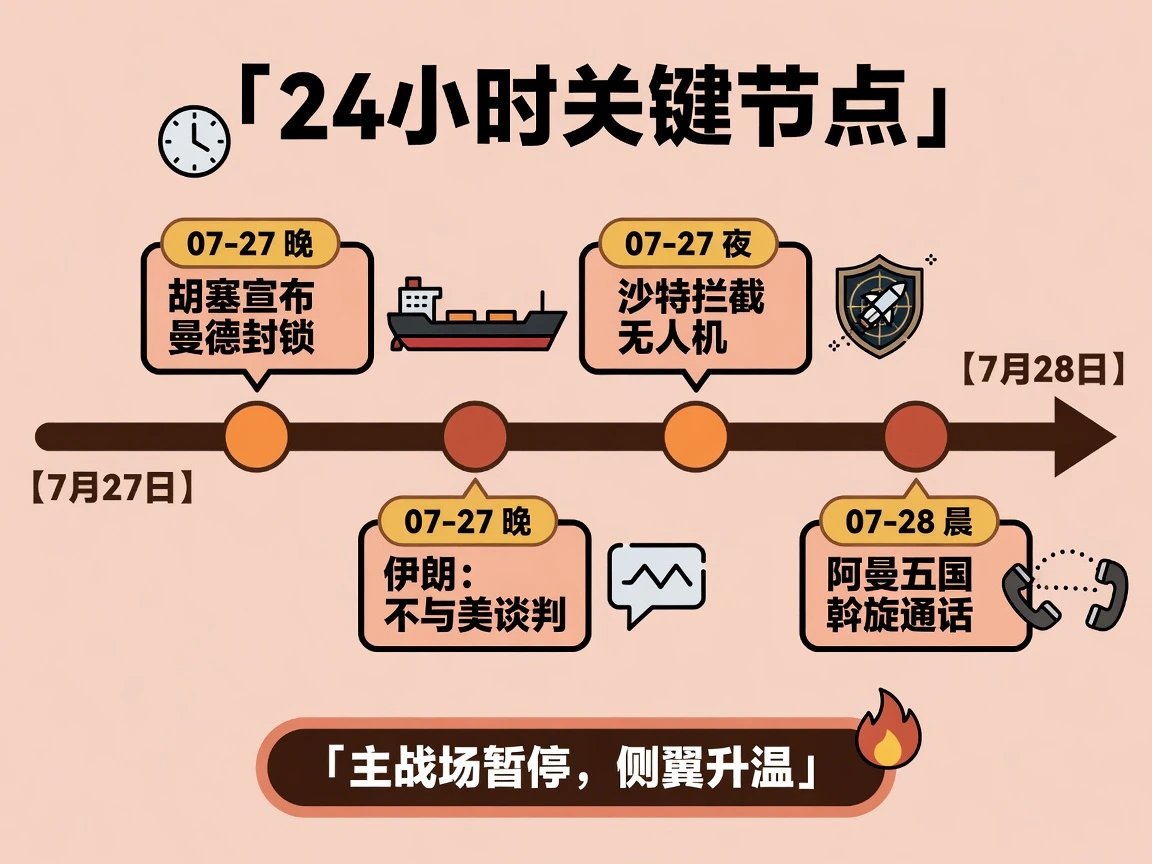
Key developments within the reporting window, in reverse chronological order by Beijing time:
| Key Developments |
|---|
| 07-28 14:45Iran's foreign minister speaks with his Omani and Saudi counterparts in shuttle consultations on regional stability and passage through Hormuz. |
| 07-28 14:12Jordan's military reports shooting down an incoming drone over the eastern desert at dawn. |
| 07-28 12:10Oil prices plunge in a single day: Brent closes at $85.87, down 11.3%, and WTI at $82.61, down about 7%. Fewer than 10 ships cross Hormuz in a day. |
| 07-28 12:10The White House confirms that Trump will meet Zelensky and Netanyahu in succession on Tuesday. |
| 07-28 08:48Israeli and Lebanese officials will resume framework-agreement talks in Rome on August 4–6, focusing on defense handovers in southern pilot areas. |
| 07-28 01:32Oman launches navigation-safety diplomacy with five foreign ministers. Iraq begins investigating Saudi accusations, which Iraqi militias deny. |
| 07-28 01:11Trump plays down accusations that Russia is providing Iran intelligence on US bases, saying this has had no substantive impact. |
| 07-28 01:01Responding to controversy over F-35 sales to Turkey, Trump says no one can dictate his arms-trade decisions. |
| 07-28 00:54Trump acknowledges tight stocks of advanced munitions but says readiness is sound. He unilaterally claims that communications with Iran are under way. |
| 07-28 00:44Trump says airstrikes were paused at Iran's request and would resume at any time if negotiations collapse. |
| 07-27 21:34Background comparison: Saudi Arabia also intercepted drones crossing from Iraq on May 18. |
| 07-27 21:24Marisks reports 78 crossings in three days, with all non-Iranian vessels using Iran's designated route. Twenty-four tankers wait off Kharg Island. |
| 07-27 20:55Saudi Arabia's military reports intercepting drones launched from Iraq and blames pro-Iran militias. Netanyahu departs for the United States. |
| 07-27 19:41Iran's Foreign Ministry says it will never let Washington determine when fighting stops and resumes, and that no negotiations with the United States are taking place. |
| 07-27 19:23An attack on a Caspian vessel triggers a Ukraine–Iran diplomatic dispute. Zelensky accuses Russia of providing satellite intelligence on US military locations. |
| 07-27 19:10Houthi–Saudi friction opens a new front: a blockade of Saudi-linked vessels at Bab el-Mandeb is announced, tankers are damaged, and a fire breaks out near the Jazan refinery. |
| 07-27 18:00IRIB says Iran's navy drove away six merchant ships attempting to use the illegal southern route; one reportedly experienced an unspecified incident. |