Over the past 24 hours, Hormuz diplomacy and frontline conditions diverged sharply. Washington promoted easing: Treasury Secretary Bessent said a reopening deal could arrive today or tomorrow, Rubio described significant progress, and Qatar confirmed circulation of a draft. Markets quickly priced optimism, sending Brent below $80 intraday and all three major U.S. indices strongly higher.
Physical risks offshore told a different story. Tehran rejected direct Washington contact and insisted on Oman-only talks, while the supreme leader's military adviser threatened U.S. warships in an illegal corridor. An unidentified projectile hit a Liberian bulk carrier's engine room, causing total blackout, fire and abandonment. Diplomatic hopes and physical interruption confronted each other within the same window.
Diplomacy: U.S. says today or tomorrow; Iran insists on Oman only

Bessent told CNBC Tuesday a U.S.-Iran Hormuz deal could be finalized today or tomorrow and said numerous cargo ships were leaving despite recent setbacks. Shipping analysts challenged that optimism: current passages remained a small fraction of normal capacity and far from recovery.
Markets nevertheless moved first. Long liquidation and shrinking geopolitical premiums drove Brent more than 5% lower intraday to $79.50, its first sub-$80 price since July 13. WTI fell over 5.5% to $75.77, a near-three-week low, before narrowing losses toward 4%. The Dow surged about 800 points, roughly 1.5%; the S&P 500 and Nasdaq closed up 1.2% and 1.7%.
Rubio was more qualified, saying progress had not yet produced a conclusion and hoping for agreement soon. He said Washington indirectly joined Iran-Oman discussions to secure more safe passage and claimed the strait remained open with oil flowing. He also set a high final threshold: reopening was only an initial step, with complete Iranian denuclearization the non-negotiable ultimate agreement.
Qatari spokesperson al-Ansari said mediation was substantively advanced and a core draft was circulating, but acknowledged no scheduled face-to-face U.S.-Iran meeting. Qatar, Oman and Pakistan were conveying messages and fostering indirect contact. Emir Tamim called Trump about containing the conflict, without disclosed details.
Trump said at the White House that he faced no time pressure, unlike Republican legislators facing midterms. Defending his weekend decision to stop strikes, he said an attack would have left almost nothing and he would allow a peace opportunity while lives could still be saved.
Iranian negotiating committee member Ajorlou said its sole counterpart was Oman. Tehran sought a 1–3-month technical transition under full Iranian control, with jurisdiction and clearance never returning to prewar conditions. He accused the U.S. southern corridor of violating Article 5 of June's memorandum and insisted that Washington must first correct that violation and immediately fulfill its commitments: an end to hostilities, a permanent Lebanon ceasefire, oil-export sanctions relief, release of funds frozen in the United States and full removal of the Iranian-port blockade; otherwise, there could be no talks. Spokesperson Baghaei confirmed technical Oman talks on safe entry/exit routes and described an exclusive Iran-controlled one-way corridor rather than the previously imagined two-way route.
The dispute rested on June's broken framework. On June 17, representatives secretly signed a fourteen-point Islamabad memorandum, later published by Washington, allowing 60 days to negotiate final peace. The U.S. promised to lift key port blockades within 30 days, allow 60 days' free passage, issue oil waivers and gradually unfreeze assets. In early July, route deviations and broken trust brought Iranian seizures and attacks on unauthorized ships, retaliatory U.S. airstrikes and renewed full port blockade in mid-July. Central Command's Monday figures showed 44 diverted ships, two disabled for violations and two forcibly boarded cargo vessels since renewal. The contest over Article 5, guaranteeing passage, followed that collapse.
Iranian opinion was divided. Hardliners and veterans demanded defending Hormuz sovereignty at any cost, while pragmatists and businesses hoped for U.S. withdrawal and sanctions relief through technical contact. Former foreign minister Zarif urged leaders to use a fleeting diplomatic window and turn control of Hormuz into bargaining leverage rather than permanent self-isolation.
Physical conditions: Cargo vessel loses power after attack; Iran threatens U.S. ships
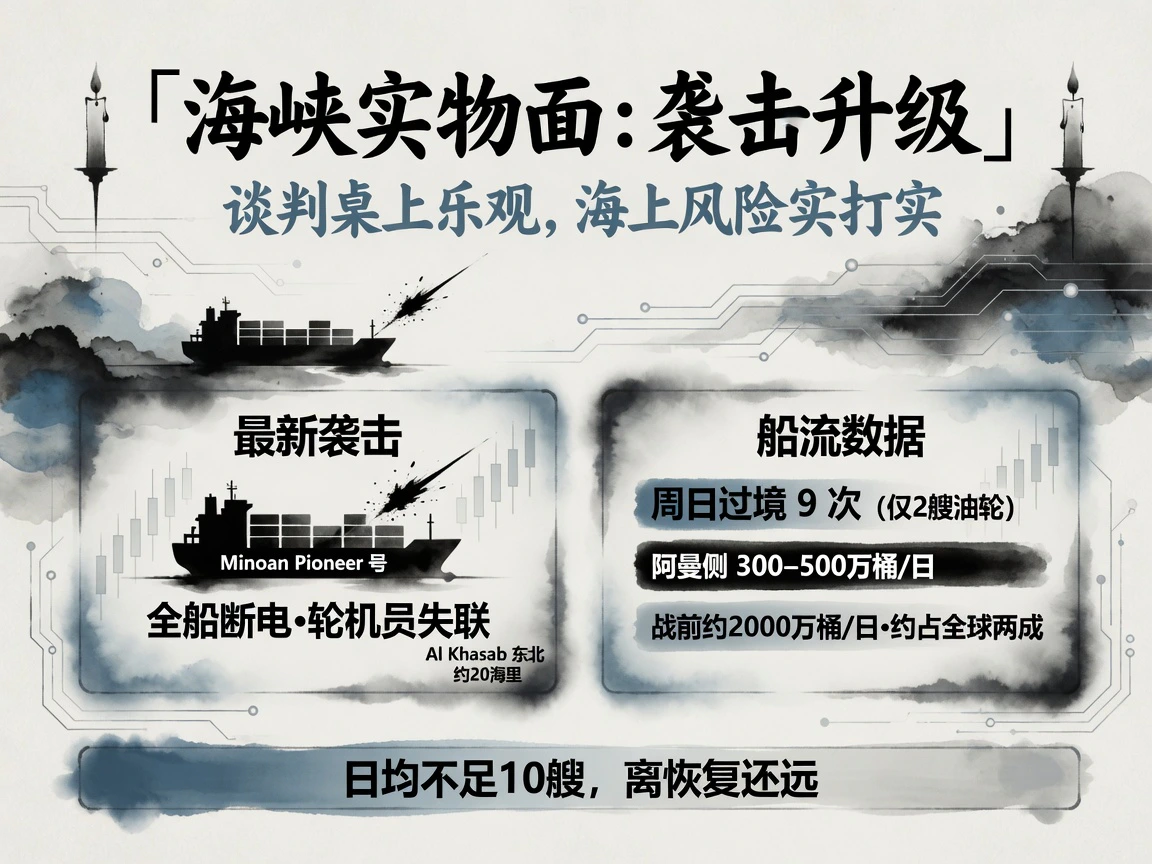
Late August 4 to early August 5 Beijing time, UKMTO issued alerts for a cargo ship struck by an unidentified aerial projectile around 20–23 nautical miles northeast of Al Khasab, Oman. It issued a highest-level distress call.
Marisks identified Liberian bulk carrier Minoan Pioneer. The projectile reportedly penetrated its lower engine room, destroyed generators and main switchboard, cut all power and propulsion and spread fire toward accommodation. An engineering watchkeeper went missing and crew abandoned amid fire and sinking risk. This followed a disabled tanker hit about 12 nautical miles northeast of Oman Friday and another captain seeing large waterspouts and explosions Saturday. The International Chamber of Shipping called the series another major escalation in worsening Hormuz and adjacent-sea security.
At nearly the same time, military adviser Rezaei warned on state television that continued U.S. port blockade would end Iranian restraint. He rejected any U.S. security route without Iranian authorization and threatened coastal missiles and attack aircraft against warships entering it. He demanded full memorandum compliance, return of frozen funds, a public non-hostility statement and an end to provocation.
Kpler recorded only nine verified Hormuz passages Sunday, including two crude/product tankers, both sanctioned or shadow-fleet vessels; seven passages used routes close to Iranian territorial waters. Marisks estimated Oman-side southern-corridor crude exports at only 3 million–5 million barrels a day. Against EIA's prewar roughly 20 million daily and one fifth of global crude trade, actual capacity was over 70% lower. Claims of an open strait and normal oil flows stood far apart from owners and crews seeing fewer than ten hazardous daily transits.
U.S. military: Interceptors depleted; casualty accounting questioned by Congress

Two sensitive issues emerged over the past 24 hours as confrontation became prolonged war, revealing heavy U.S. costs.
Pentagon sources described near-four-fifths, roughly 80%, depletion of THAAD and more than half of PAC-3 stocks after sustained missile and drone attacks. Commanders warned ammunition was dangerously low. Earlier CSIS estimates put prewar global stocks at around 2,200 modern Patriot rounds and 452 THAAD interceptors. Gulf allies formally expressed alarm that new Iranian saturation attacks could expose critical energy infrastructure as U.S. defenses struggled to protect themselves.
House Oversight Democrats Robert Garcia and Suhas Subramanyam wrote Hegseth announcing an investigation into alleged concealment of casualties. They cited DCAS totals of 18 dead and 687 wounded since February 28, including four dead and 270 wounded from July 7 onward assigned to a vague new Special Overseas Operations category. July 7 coincided with a War Powers reporting deadline; they alleged the category could circumvent congressional checks and mandatory legal constraints to prolong the war. A Pentagon spokesperson had cited tactical secrecy when CNN repeatedly asked about it.
Political and economic backlash grew. Trump accused oil companies of amoral wartime profits and demanded immediate retail-price cuts from refiners and distributors. Regular gasoline averaged about 37% above prewar levels, distressing wage earners. Just over a hundred days remained until November midterms, Republicans held only a narrow House majority, and a major-media aggregate poll gave Democrats an 8-percentage-point national lead.
Aramco's earnings contrasted with White House pressure. Second-quarter net profit rose about 33% year on year to $33.4 billion. CEO Nasser warned the conflict had cost 2.6 billion barrels of global supply and Hormuz capacity was one tenth of normal. Each additional blocked week permanently removed over 100 million barrels. Even immediate reopening, with spare capacity of 2.1 million barrels daily fully used for rebuilding, would require at least 18 months to restore strategic and commercial stocks to safety.
Flanks: Netanyahu focuses on Gaza; Iran issues a Ukraine warning

Unusual behavior by other regional actors supplied further signals.
After Washington halted strikes and announced a Hamas disarmament framework, Netanyahu gave a televised address focused entirely on Gaza, mentioning neither U.S.-Iran confrontation, Hormuz talks nor halted strikes. He promised no withdrawal from current positions until Hamas fully disarmed and authorized all necessary means to protect territory, civilians and troops.
Israeli sources said U.S. pressure was already limiting Gaza operations to immediate defensive threats and moving major targeted-strike approval from Southern Command to the chief of staff. After last Thursday's U.S. statement of Hamas disarmament commitments, three days of intense Israeli bombing killed at least 28 Palestinians, civilians and militants. Two White House envoys arrived in Jerusalem Monday with strong de-escalation demands; only one later strike was recorded, with casualties falling to two.
Rezaei also claimed Iran had prepared precision strikes on three Ukrainian strategic targets in retaliation for alleged late-July special-forces attacks on Iranian merchant ships in international Caspian waters. He said Kyiv secretly called it a technical mistake, prompting a last-minute pause, but demanded full compensation and apology or renewed retaliation. Neither Kyiv nor independent intelligence sources had confirmed or officially commented on this unilateral allegation.
Live highlights

| Key developments |
|---|
| August 5, 04:48 Beijing timeNetanyahu broke his silence with a Gaza-only address, omitting U.S.-Iran issues; major targeted-strike authority moved to the chief of staff. |
| August 5, 04:12 Beijing timeSources reported near-four-fifths THAAD depletion and more than half of Patriot stocks consumed; commanders warned of dangerously low reserves. |
| August 5, 01:27 Beijing timeTwo House Democrats jointly wrote to Hegseth to investigate actual U.S. casualties in the Iran war; DCAS showed 18 dead and 687 wounded. |
| August 5, 01:19 Beijing timeIran confirmed continued technical Oman talks; Qatar urged a regional consensus for navigation and its emir called Trump. |
| August 5, 00:15 Beijing timeTrump criticized oil-company war profits; Aramco quarterly profit rose 33% to $33.4 billion and U.S. gasoline was about 37% above prewar. |
| August 4, 23:37 Beijing timeBessent suggested a deal today or tomorrow; Brent reached $79.50 below $80, WTI a three-week low of $75.77, while U.S. equities rallied. |
| August 4, 23:06 Beijing timeRubio cited progress but no conclusion, hoping for agreement soon and calling reopening an initial step toward complete denuclearization. |
| August 4, 22:54 Beijing timeZarif urged use of the diplomatic window, treating Hormuz as leverage rather than permanent self-isolation. |
| August 4, 21:45 Beijing timeShipping data showed only nine Sunday passages, two tankers; southern-corridor crude remained 3 million–5 million barrels daily. |
| August 4, 20:21 Beijing timeQatar said a draft was circulating but no direct U.S.-Iran meeting scheduled; mediators coordinated indirect contact. |
| August 4, 18:07 Beijing timeRezaei rejected a U.S. unauthorized route and threatened direct strikes on entering warships if blockade continued. |
| August 4, 17:22 Beijing timeIranian negotiators insisted on Oman-only talks and a 1–3-month Iran-led technical route, accusing the U.S. of breaching Article 5 of June's memorandum and urging Washington to fulfill its commitments first. |
| August 4, 17:20 Beijing timeMaritime sources identified Minoan Pioneer, with an engine-room hit, blackout and fire, a missing engineer and all crew forced to abandon ship. |
| August 4, 16:30 Beijing timeUKMTO reported a projectile-hit merchant vessel about 20 nautical miles northeast of Al Khasab issuing distress signals. |
| August 4, 15:53 Beijing timeAramco CEO warned of 2.6 billion barrels of lost supply and at least 18 months to rebuild safe stocks even after immediate reopening. |