July's payroll report, released Friday US Eastern time, was the first key hard labor-market evidence after the July 29 Fed meeting. Payrolls unexpectedly fell 23,000, with May and June revised down a combined 103,000. September hold pricing rose sharply. Richmond Fed President Barkin described a weak balance, neither loose nor tight. Cooling employment reduced the urgency of immediate tightening, but the key second-half test remained CPI on August 12. If inflation resurged, the committee retained the option of prioritizing inflation and hiking when appropriate.
Economic data
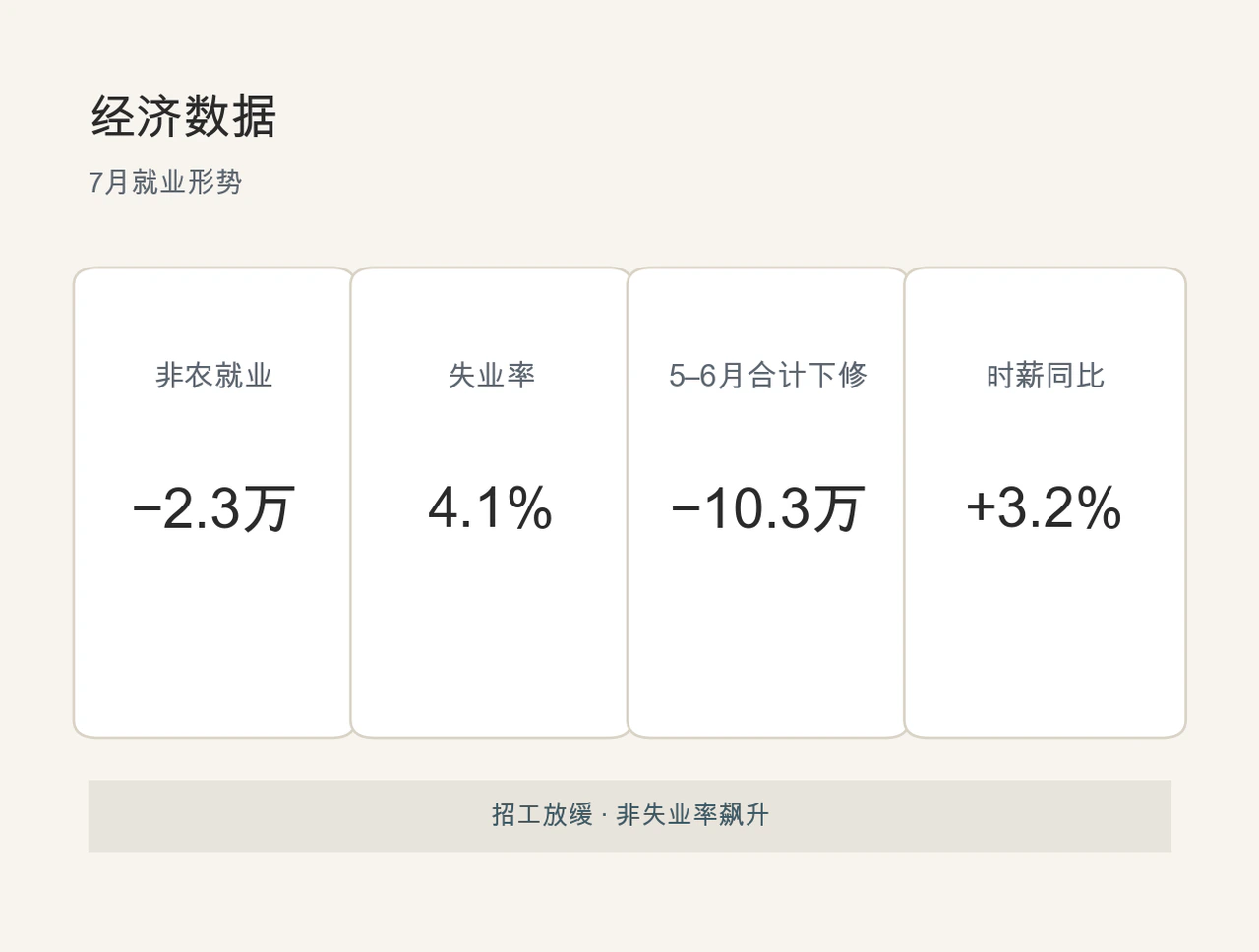
BLS released July's Employment Situation at 08:30 US Eastern on August 7. Key readings:
- Payrolls unexpectedly turn negative: July seasonally adjusted employment fell 23,000 (−23,000), substantially weaker than expected;
- Unemployment holds at 4.1%: about 6.9 million people unemployed, broadly unchanged;
- Industries diverge: local-government education lost 50,000 jobs (−50,000), retail 19,000 (−19,000), while resilient health care added 22,000 (+22,000);
- Wage growth remains moderate: average hourly earnings for all private-sector employees were $37.62, up 2 cents (+2 cents) monthly and 3.2% (+3.2%) annually, with no wage-inflation acceleration;
- Large historical revisions: May additions fell from +129,000 to +63,000, a −66,000 revision; June from +57,000 to +20,000, down −37,000. Together they were 103,000 below prior preliminary estimates;
- Labor supply eases at the margin: July participation was 61.4% and the employment-population ratio 58.9%. Monthly changes were limited, but participation had declined 0.7 percentage points since January.
Weakness chiefly reflected slower hiring and substantive removal of overstatement in prior data, rather than layoffs causing a surge in unemployment. July's central policy debate concerned another hike against inflation. This weak report increased the weight of employment downside risk and reduced immediate urgency. One month's slower hiring could not eliminate inflation-persistence concerns, however, so attention would quickly turn to next week's prices.
Official communication

By publication, the Fed Board's public-speech calendar showed no new Board remarks since August 7; the most recent was Governor Cook on August 5, outside this window. The only substantively new official commentary in the window came from Richmond's Thomas Barkin.
At a Friday NABE online seminar, Barkin said July's report fit his recent view very well: the labor market was in a delicate neither-loose-nor-tight range. Business contacts were not hiring aggressively, but fortunately were not laying off widely either. Media further quoted him describing low hiring and low layoffs, strong corporate profits, and close Fed monitoring of how profits translated into actual employment.
Barkin neither exaggerated the 23,000 loss into a collapse nor used it to promote hikes. His weak-balance framing softly constrained aggressive hike expectations without signaling a dovish pivot. Anonymous claims that Warsh was ready for a September hike if inflation ran hot were recirculating, but reflected an earlier stance outside the window and lacked a formal official text, so were not the dominant new information.
Policy expectations
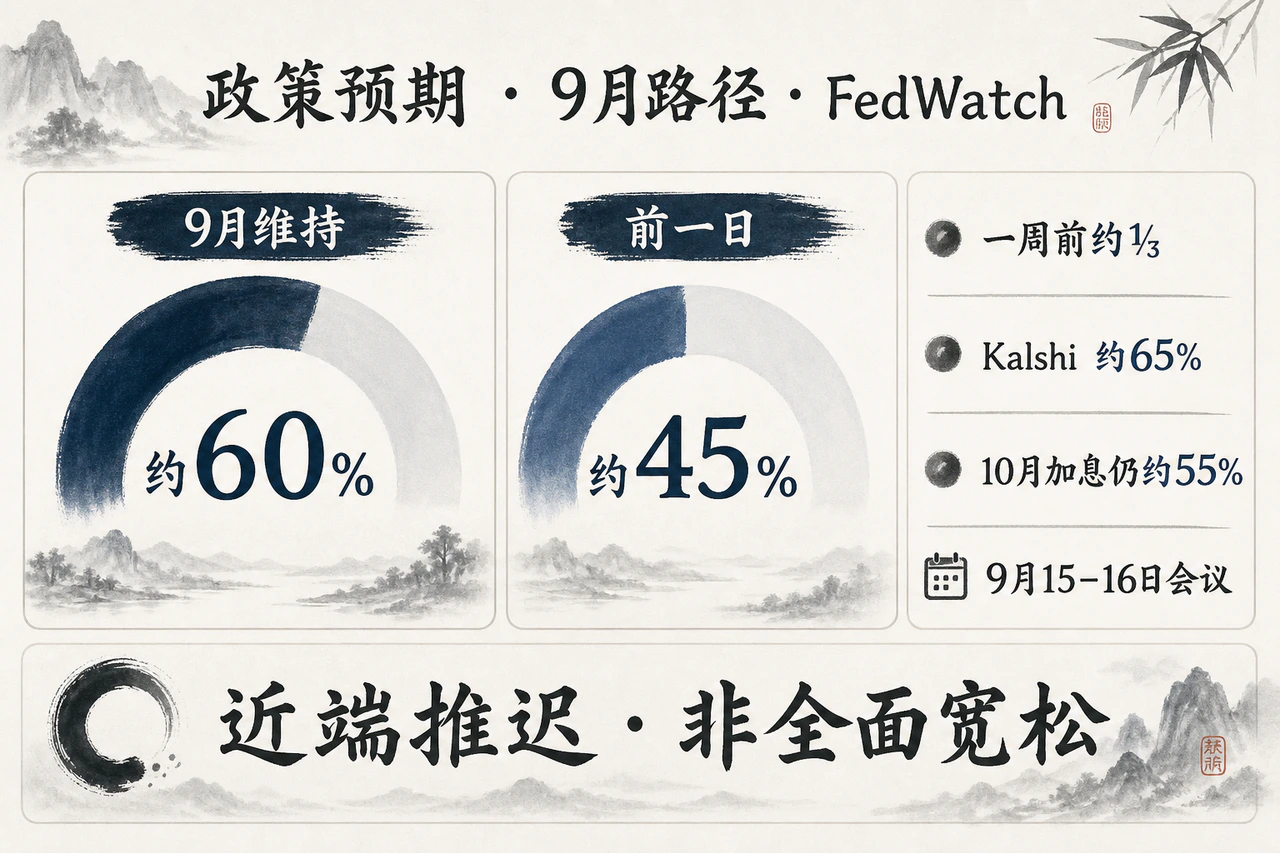
Weak payrolls sharply reduced September hike bets. CNBC reported intraday August 7:
- September's baseline reverses: CME FedWatch hold odds rose to about 60%, from roughly 45% the previous day and only about one-third a week earlier;
- Prediction markets agree: Kalshi's September hold probability rose toward 65%;
- Sources point the same way: CBS cited FedWatch hold odds rising from 45% to about 56%.
Readings differed modestly, but capital shifted consistently from a hiking bias to a holding bias. The curve did not embrace broad easing: FedWatch still implied about 55% cumulative hike probability by October and about 75% by December. Markets were delaying and reducing near-term urgency, not opening a cutting cycle. Morgan Stanley Wealth Management chief economic strategist Ellen Zentner said weak jobs and wages eased September tightening pressure, but next week's inflation could still decide the outcome.
Next tests

Before the mid-September meeting, markets would face several sequential data checks:
- Wednesday, August 12: July CPI. This was the most immediate test. Employment cooling offered breathing room, but renewed core CPI increases would still justify an inflation-first, hike-if-needed stance. Continued moderate inflation would strengthen the September hold case.
- August 28: BLS preliminary benchmark revision estimate. It could reveal systematic bias in the previous employment period, with expectations of further large downward revisions potentially disrupting the macro narrative.
- September 15–16 FOMC. The debate was expected to evolve from July's question of an immediate hike into a contest over whether weakening employment or sticky inflation was more urgent.


