Over the past 24 hours, direct US–Iran exchanges did not dominate headlines. A deeper shift was Saudi Arabia bringing Pakistan and Turkey into collective defense while the Houthis launched repeated attacks in eastern Yemen and southern Saudi border areas. Hormuz arrangements moved from nearly finalized to awaiting senior approval through Iran's parliament. Oil held the previous day's roughly 4% gain because even an Iran–Oman accord might not satisfy Washington. Trump publicly stressed ample conventional ammunition to counter reports of depleted air defenses, while Joint Chiefs chairman General Dan Caine privately warned that Washington urgently needed an exit from the increasingly entrenched Iran war.
The Mecca Pact: An Attack on One Is an Attack on All Three

On Friday, Saudi Crown Prince and Prime Minister Mohammed bin Salman, Turkey's President Erdogan and Pakistan's Prime Minister Shehbaz Sharif signed a mutual-defense pact in Mecca. Their joint statement treated an attack on any member as an attack on all, seeking collective deterrence and deeper military cooperation. The location carried major political and religious significance: Saudi Arabia is a core oil producer, Pakistan the Muslim world's only nuclear-armed state, and Turkey NATO's second-largest conventional military force. Turkey insisted the pact was purely defensive and targeted no country. Geopolitical analysts nevertheless broadly judged that, if Saudi Arabia suffered a devastating attack, both Ankara and Islamabad would be forced into a war they had deliberately tried to avoid, sending Tehran a severe deterrent signal.
Iran reacted quickly. Parliamentary security and foreign-policy committee member Ebrahim Rezaei said a paper pact with Turkey and Pakistan would not secure Riyadh any more than decades of reliance on Washington, urging fundamental regional-policy changes rather than outside protection. Araghchi then praised Iranian forces' readiness, capability and strength against the United States on social media and called for Muslim unity against hostile outside threats. It remained unclear whether this directly answered the Mecca pact or reflected routine mobilization amid spreading proxy warfare.
Houthi Escalation: Marib–Hadramout and Saudi Arabia's Najran Border

Yemen's front escalated sharply. After Thursday missile salvos on government positions in Marib and Hadramout killed at least 30 troops, Friday's attacks widened. Government Health Minister Qassem Buhaibeh confirmed Houthi artillery on eastern Marib settlements and displacement camps killed at least 2 civilians and injured 14; his ministry condemned violations of humanitarian law. The Saudi-led coalition said a cross-border Najran attack injured at least 11 civilians and security personnel. Houthi spokesman Yahya Saree claimed precision ballistic-missile and aerial strikes on Saudi troops, logistics stores and armored convoys at Sahn al-Jinn north of Marib, promising escalation in response to escalation. Saudi forces had not confirmed camp damage, but renewed full-scale civil-war risk rose sharply.
Other flanks also shifted. Intelligence warnings of coordinated Iraqi Shiite militia and Houthi attacks under direct Iranian direction prompted urgent Saudi–Iraqi consultation. Iraqi Prime Minister Ali Falih al-Zaidi met Saudi intelligence chief Khalid al-Humaidan Friday, agreeing deeper counterterrorism intelligence sharing and security coordination. Zaidi said Iraqi territory would not be a springboard against neighbors such as Saudi Arabia. The pro-Iran Islamic Resistance in Iraq then temporarily postponed retaliation against US and Saudi targets out of respect for some upright domestic leaders, while saying it remained ready to defend sovereignty. This tactical delay offered respite rather than lasting restraint; the fuse remained intact.
Hormuz: Broad Agreement, Senior Review and Restrictive Legislation Proceed Together

Navigation mediation advanced substantively. IRIB cited a parliamentary security-committee spokesman saying Iran and Oman had broadly agreed a technical management framework, submitted for higher-level final approval, with details expected soon. Fars described parallel channels in Iranian and Omani waters during transition, then gradual consolidation into the central deepwater channel. Iran would inspect inbound ships; Oman or joint authorities would oversee outbound traffic. Oman had not endorsed the plan officially, and US acceptance of Iranian checkpoints and fees remained uncertain.
Hardliners' transit bill also proceeded. The latest draft would bar Israel-linked vessels and cargo from designated countries deemed harmful to Iranian interests until compensation was paid. Unauthorized passage could incur fines up to 20% of cargo value; approved neutral ships would pay navigation and service fees in rials. The bill remained under consideration without legal force, but set out a hard negotiating floor.
Oil remained alert to Hormuz news. Friday intraday Brent slipped 0.4% near $82 and WTI 0.1% around $77, retaining the preceding session's nearly 4% rise. Traders focused on whether any Iran–Oman rules would meet Washington's and international owners' standard of unobstructed free navigation. Deutsche Bank said restrictions on US-flagged ships alone had limited direct capacity effects, but Washington would not accept incremental Iranian erosion of the navigation freedom it upheld.
Washington: Ammunition Accounts and an Exit Signal
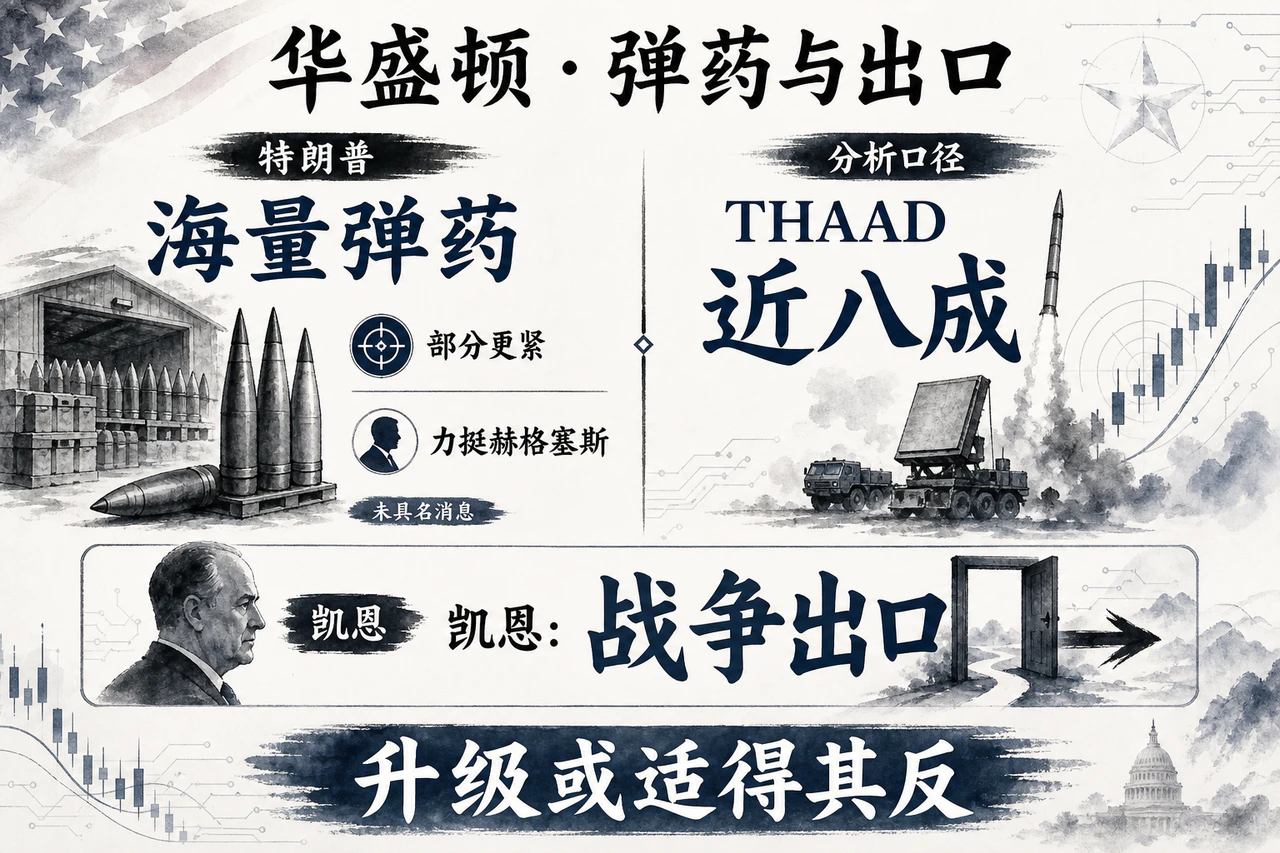
Internal differences over readiness and strategy became clearer. Against reports of rapidly dwindling air defenses, Trump insisted conventional ammunition was abundant but conceded some advanced types were tighter, while supporting Defense Secretary Pete Hegseth. Security specialist Nicholas Pliatsikas warned that reports of nearly 80% of THAAD interceptor stocks being consumed were politically damaging, sending Tehran a misleading signal that US air defenses were under pressure and weakening deterrence.
A more revealing signal came from command. Pentagon sources said Caine told a closed senior meeting that the administration urgently needed a clear exit strategy. Remaining escalation options had diminishing returns and could provoke an uncontrollable backlash. This anonymous account was not White House policy, but showed professional commanders' concern over prolonged entrapment in the Middle East.
Live Highlights

Key developments over the preceding 24 hours, in reverse Beijing-time order:
| Key Developments |
|---|
| 08-08 05:24 Roundup: Saudi–Pakistani–Turkish defense pact; Houthi claims against Saudi forces; Caine privately urges an exit from the Iran war. |
| 08-08 03:29 Araghchi praises Iranian forces and urges Muslim unity after the Mecca agreement. |
| 08-08 02:41 Houthis claim a strike on Saudi forces at Sahn al-Jinn in Marib; no Saudi confirmation. |
| 08-08 02:00 Iraq's prime minister meets the Saudi intelligence chief; pro-Iran militias say retaliation is postponed. |
| 08-07 23:18 Yemen's health minister says Houthi shelling in Marib killed at least 2 civilians and wounded 14; the coalition reports 11 injured in Najran. |
| 08-07 22:30 IRIB says the Iran–Oman Hormuz framework is broadly agreed and awaits higher-level final approval. |
| 08-07 20:33 Rezaei says a paper agreement will not bring Saudi security. |
| 08-07 20:04 Analysis: Saudi Arabia uses Pakistani and Turkish military power to reinforce deterrence as Iran's war approaches the kingdom. |
| 08-07 19:36 Key developments: proxy fighting spreads and regional leaders strengthen defense. |
| 08-07 19:22 Official announcement: Saudi Arabia, Turkey and Pakistan sign a NATO-style mutual-defense agreement, treating an attack on one as an attack on all. |
| 08-07 18:48 Oil holds the previous day's approximately 4% gain: Brent around $82 and WTI $77, with caution over reopening conditions. |
| 08-07 18:16 Roundup: repeated Houthi attacks cause dozens of casualties as regional confrontation escalates. |
| 08-07 17:27 Fars says Iranian and Omani channels will operate in parallel temporarily before shifting centrally, with separate inbound and outbound oversight. |
| 08-07 16:56 Pakistani and Turkish leaders arrive in Saudi Arabia as defense-pact expectations increase. |
| 08-07 15:57 Lawmakers draft a bill to bar hostile vessels and cargo from Hormuz, with fines up to 20% of cargo value. |
| 08-07 15:17 Analysts say ammunition-shortage reports could embolden Iran; risk of a two-front war. |
| 08-07 12:20 Trump claims abundant ammunition while acknowledging some types are tighter. |
| 08-07 12:19 Saudi officials watch for coordinated Iraqi-militia and Houthi attacks. Trump calls low-end munitions almost unlimited while advanced stocks require attention. An Iranian deputy foreign minister says the Oman framework does not mean automatic reopening. |
| 08-07 12:18 Qalibaf criticizes Trump's performative diplomacy; Iran denies direct US talks; roundup of Iran–Oman navigation discussions. |