Scope: This is the fourth article in the Warsh Federal Reserve reform series. Part one examined communication, part two quantitative tightening and balance sheets, and part three inflation measurement and frameworks. This article addresses AI, productivity and judgments of potential output and employment. Later articles will cover meeting frequency and committee governance.
Nature: In-depth research on macroeconomic policy and central-bank reaction mechanisms.
Introduction: Has the Economy's Speed Limit Really Increased?
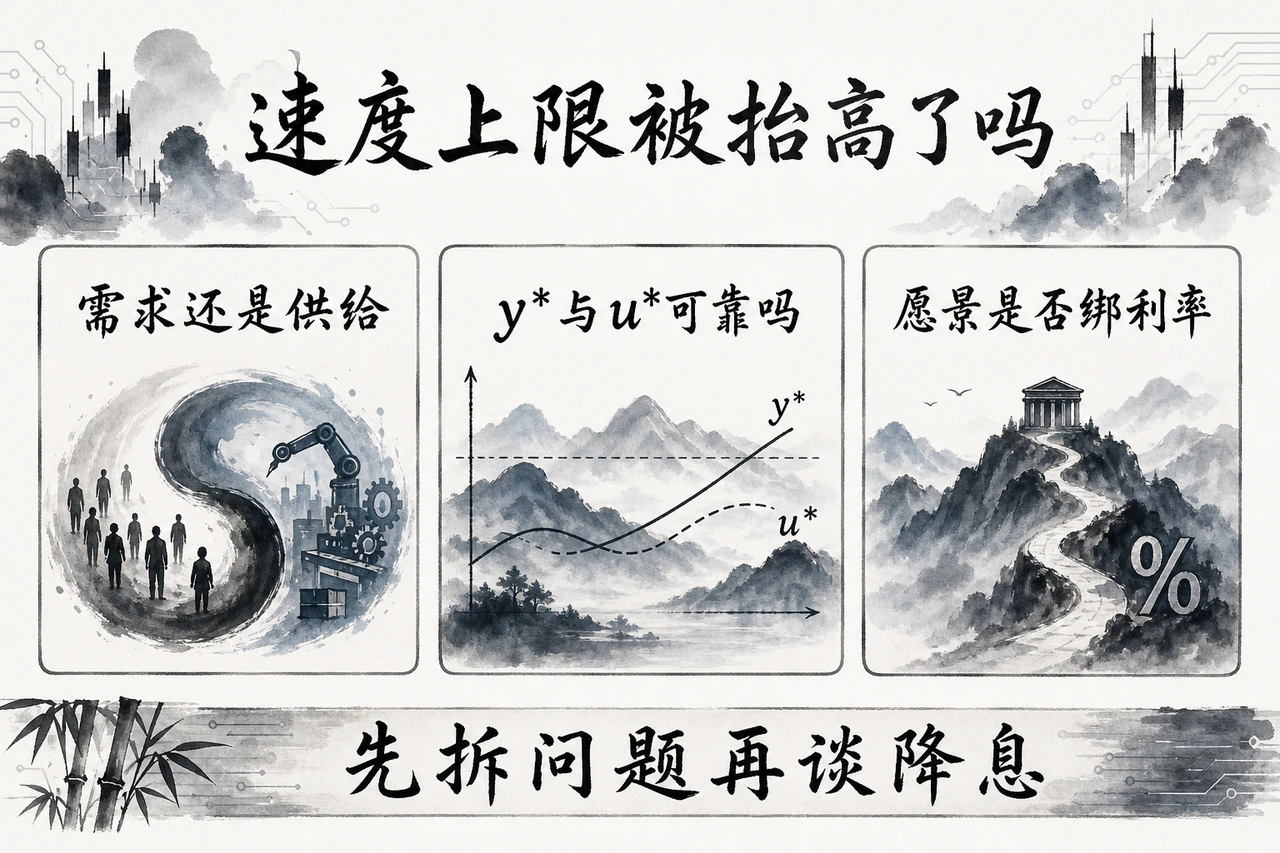
Daily monetary debate focuses on whether rates should rise or fall. Yet the deeper anchors determining what policy should respond to are two prior judgments: where the economy's speed limit lies and whether the labor market still has slack that can be absorbed sustainably.
Central banks associate the first with potential output, y*, and the second with the natural unemployment rate, u*. Neither is directly observable, but both are embedded like invisible foundations in policy rules, SEP narratives and debates over overheating versus recession.
Generative AI has moved these concepts from academic models and econometric black boxes to the center of the chair's agenda. After taking office, Kevin Warsh emphasized potentially substantial total-factor-productivity gains and embedded a dedicated Productivity and Jobs task force in the Fed's top-level institutional design.
Wall Street and bond desks quickly assembled a smooth, one-way argument: if AI lifts potential growth and lowers unit labor costs, the Fed gains permission to ease sooner and keep rates low longer.
That apparently perfect story rests on fragile assumptions. Assessing whether AI can rewrite the reaction function requires separating three connected operational questions:
- Do current data show a front-loaded demand pulse or already-realized supply gains?
- Even if productivity gains materialize, are real-time filtered estimates of y* and u* robust enough for major changes to rate rules?
- Are Warsh's institutions and cautious FOMC voices building long-term monitoring channels or intending to price distant visions directly into current rates?
This article follows that chain step by step.
1. What Has Warsh Institutionalized?

After his May 22, 2026 swearing-in, Warsh divided his reform agenda into five task forces. On July 9, the Fed published their goals and external leadership. Productivity and Jobs would assess the macroeconomic effects of new general-purpose technologies, including AI, directly supporting monetary deliberation and forecasts. External co-leads were Marc Andreessen, Andreessen Horowitz cofounder; Stanford economist Charles I. Jones, then on academic leave at Anthropic; and Microsoft executive vice president and Xbox CEO Asha Sharma.
This went beyond technology-celebrity public relations. It elevated subjects scattered across regional papers, closed seminars and fragmented market narratives into an institutional information channel with a statutory input obligation to the FOMC. Warsh said the economy had changed profoundly over a generation, especially now, requiring review of whether tools, frameworks and rate paths remained fit for purpose.
His public comments were more cautious than market enthusiasm. At the July 14, 2026 House Financial Services hearing, he described AI as an extraordinary historical opportunity and stressed employment and inflation implications. But he also acknowledged uncertainty over how much technology could become actual output gains.
His labor baseline was restrained: recent evidence showed no widespread structural unemployment from AI, mainly somewhat higher productivity among existing workers. Substantial longer-term TFP gains might eventually lift real wages and competitiveness, but the vision could be distant. The Fed needed rigorous monthly and quarterly monitoring.
He posed a central uncertainty for the next 12–18 months: are the intelligence tokens being generated in huge quantities complementing human labor, or will they produce intense temporary substitution and disruption?
The underlying logic is institutional acknowledgment of technological uncertainty, rather than presuming a productivity boom as a script for cuts. The task force's value is not predicting AI's ultimate ceiling but shortening the lag between technological change and committee awareness, warning which decades-old anchors are becoming distorted during the transition.
2. The Potential-Output Trap: Two Costly Ways to Misjudge y*
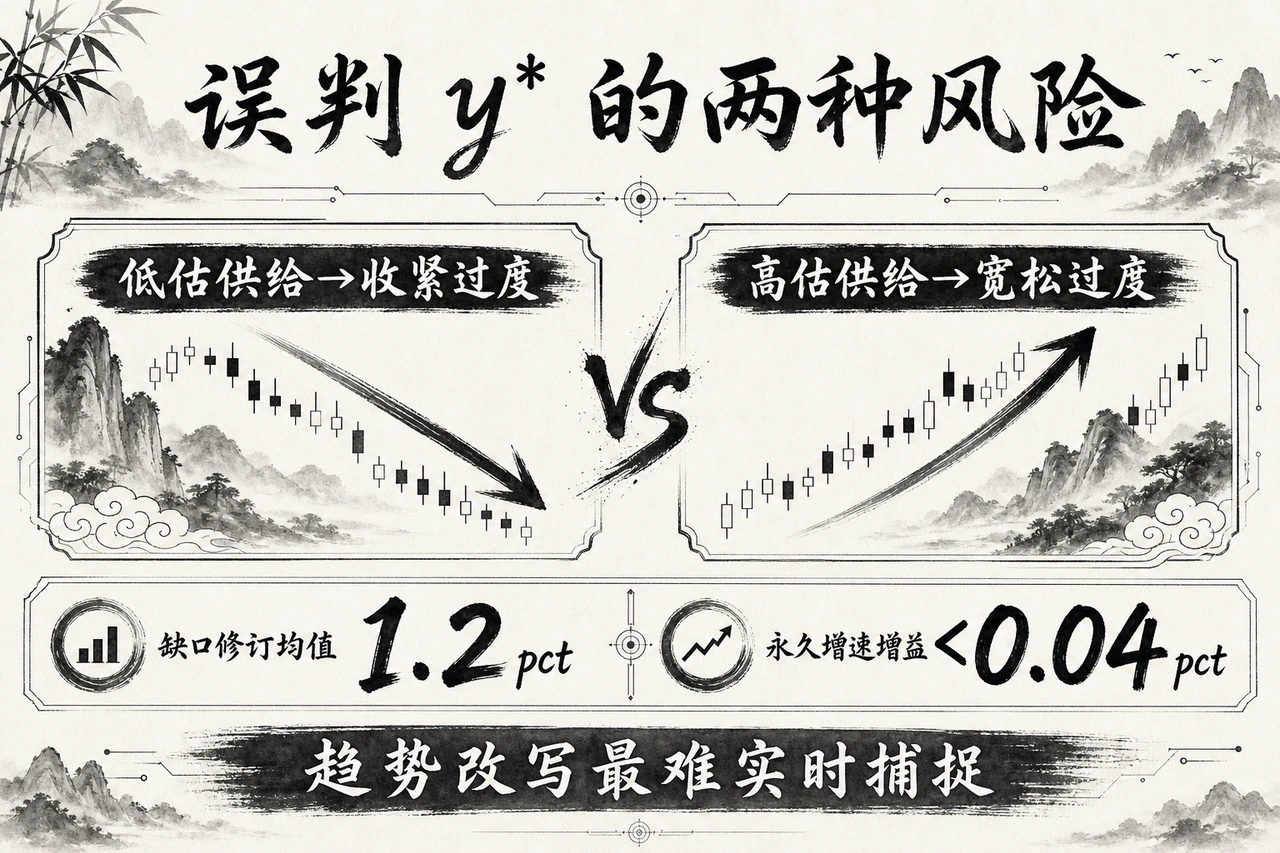
Higher y* means the existing capital-and-labor combination can sustain faster growth without destabilizing inflation.
Underestimating this ceiling misdiagnoses supply-driven output as excess demand, causing unnecessary restraint when policy should remain easy or at least avoid tightening. Overestimating it under an optimistic technology narrative—while capex and valuations anticipate gains absent from productivity statistics—produces excessive ease when overheating demand requires vigilance.
These mistakes point in opposite directions, but AI enthusiasm simultaneously increases both temptations exponentially.
History shows particularly severe damage from the second. Athanasios Orphanides' pioneering reassessment of the 1970s Great Inflation found policymakers believed substantial slack remained because they failed to recognize slowing trend productivity in real time.
Modern econometrics gives a similar warning. In historical samples exceeding 100 quarters, real-time output-gap estimates underwent average absolute revisions of 1.2 percentage points. Errors often persisted in the same direction for years, rather than averaging to random white noise. Filters such as HP perform worst at the endpoint—the current moment when policy needs guidance most. Structural-stability assumptions provide almost no defense against abrupt general-purpose technology changes.
A one-off efficiency pulse would eventually be absorbed by statistical filters over several quarters. The harder problem is potentially changing trend growth itself: a shifting center can distort y* for years.
Expert scenarios for 2050 show widely separated median annual TFP-growth forecasts of 2%, 3% and 4% under different AI paths. These imply permanent divergence in endogenous growth, not merely a one-time production-function level shift.
More conservative models differ sharply. PWBM estimates generative AI adds only about 1.5% cumulatively to US productivity and GDP by 2035, nearly 3% by 2055 and around 3.7% by 2075. Reallocation frictions and renewed cross-sector mismatch could leave the permanent annual productivity-growth increase below 0.04 percentage point.
The conflicting models reveal a difficult reality: AI may rewrite potential output over long horizons, but its scale and timing remain highly uncertain within the central bank's actionable 1–3-year window.
The central question is therefore not whether AI eventually changes y*, but whether the Fed can identify and separate that transition promptly and symmetrically while it unfolds. Anchoring rates to untested potential-output assumptions before evidence is established stakes credibility on the weakest statistical foundations.
3. Employment's Paradox: Aggregate Unemployment Responds Slowly to Structural Change

AI diffusion also disrupts the Fed's definition of full employment under its other mandate.
If early diffusion mainly augments skills rather than automates jobs away, aggregate unemployment may stay unusually stable even as output accelerates, without a Phillips-curve overheating warning. If tasks within jobs are reshuffled, broad employment classifications can show a deceptive steady state while matching efficiency, bargaining and factor-income shares change underneath.
Warsh's hearing baseline favored augmentation: labor supply appeared broadly solid, payroll gains roughly matched immigration and natural workforce growth, and AI had not caused a systemic employment shock. Company fieldwork likewise suggested most changes involved redesigned workflows inside existing jobs, rather than widespread cross-industry unemployment.
Microeconomic fractures were emerging. Stanford tracking found entry-level employment absorption among 22–25-year-olds in highly AI-exposed white-collar and technical occupations relatively lower by about 13%, suggesting hiring displacement. Yale Budget Lab and others, by contrast, found overall job transitions and separations within historical norms.
The disagreement is itself important: during disruptive technology's introduction, reliance on one aggregate unemployment rate can make central-bank responses systematically slow.
Scenarios for 2030 illustrate this bluntness. Even when economists consider sharply different AI paths from basic assistants to advanced collaborators and super-exponential evolution, median forecasts of unemployment, employment and participation differ little. Labor's national-income share shows a much more marked trend decline, but over decades.
If unemployment and participation are insensitive to AI, the existing Labor Department dashboard cannot tell the FOMC which technology path the economy is following.
More informative measures include AI-assisted hours in actual business operations, computing infrastructure's electricity intensity, youth employment flows sliced by exposure, and the breakdown and reallocation of tasks inside white-collar jobs, rather than waiting for an unemployment cliff.
This constrains policy in both directions. Stable near-term unemployment cannot establish that AI is harmless and justify aggressively higher potential-growth estimates. Nor can a few technology firms' layoffs be inflated into a collapsing business cycle.
Warsh's focus on possible disruption in 12–18 months shows that employment restructuring may occur much faster than macro productivity gains are finally recognized by the national accounting system, NBER.
4. Testing the Macro Story: Demand Pulse or Supply Dividend?
Before rigorously distinguishing demand from supply shocks, attractive claims about room for cuts risk becoming dangerous mistakes.
Demand expansion raises output and prices together; pure supply expansion raises potential output while restraining inflation. Mistaking demand overheating for supply gains causes excessive easing and reinflation; mistaking supply expansion for demand overload causes unnecessary tightening.
Nearly all the clearest quantifiable current evidence concerns a strong demand pulse.
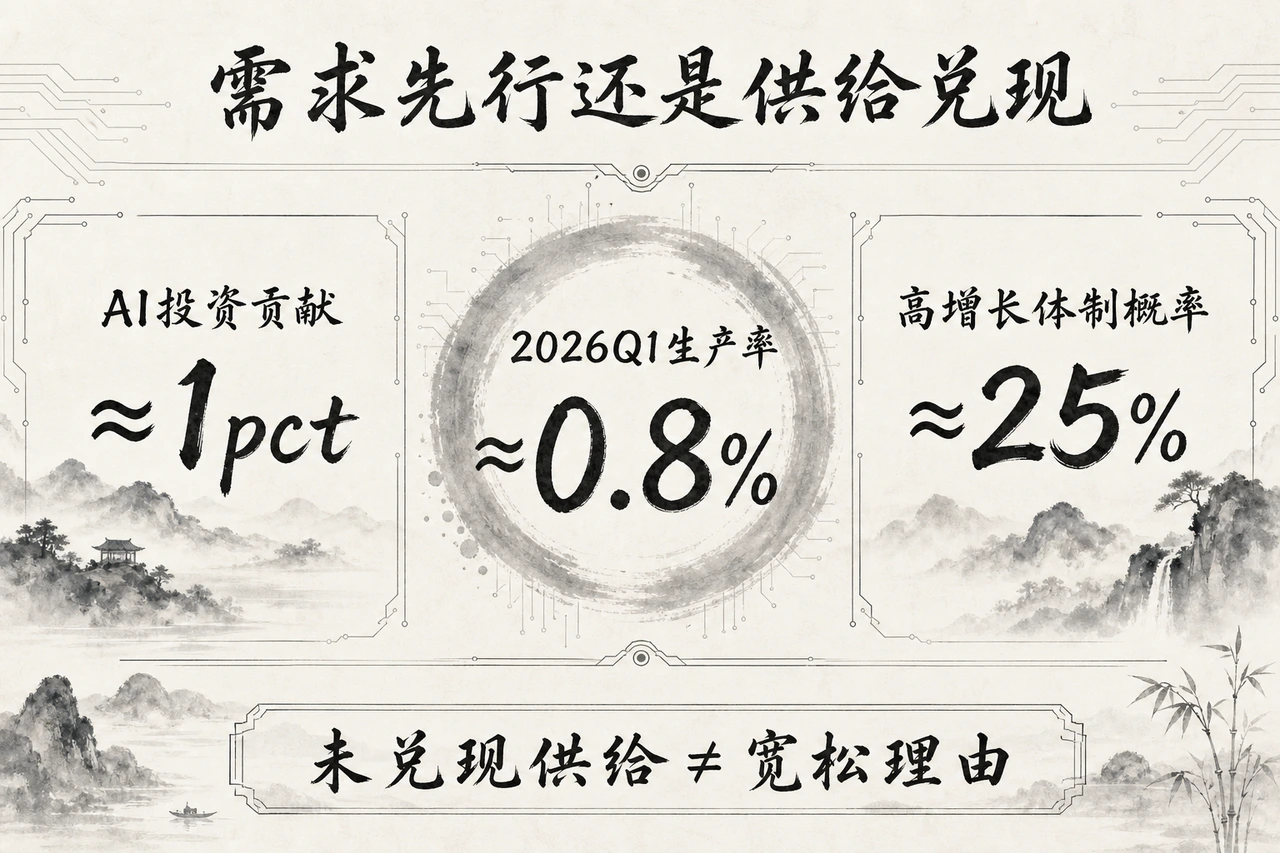
New hyperscale data centers, advanced-chip purchases, hardware replacement and enormous private-model capex have strongly supported real GDP since 2024. Authoritative estimates put this technology chain's marginal growth contribution near 1 percentage point by early 2026, approaching the scale and intensity of the late-1990s internet-infrastructure boom.
Wealth effects from technology valuations and premiums from grid connections and HBM bottlenecks reinforce that AI currently first represents enormous real capital consumption. In the classic news-shock mechanism, optimism over future TFP is capitalized immediately into highly excited investment and demand.
On the supply side, nonfarm labor-productivity growth has rebounded since 2023, but its composition and timing cannot establish a sustainable high-productivity regime.
At the 2026 Reykjavík Economic Conference, St. Louis Fed President Alberto Musalem explained that labor productivity and TFP had recovered from pandemic lows toward postwar averages. But the bank's Markov regime-switching model put the posterior probability of a genuine high-productivity-growth regime in first-quarter 2026 at only about 25%, well below a coin flip.
High-frequency growth was slowing too. After brief strength in second- and third-quarter 2025, annualized quarterly nonfarm productivity growth fell to about 1.6% in the fourth quarter and 0.8% in first-quarter 2026.
Musalem's policy conclusion was clear. With real policy rates below the committee's long-term neutral estimate, core inflation above 2%, possible upward drift in long expectations and resilient jobs, relying on expected future productivity to defeat inflation creates substantial policy-control risk. He would change position only when unequivocal micro and macro evidence showed higher productivity naturally bringing prices to target; that moment had not arrived.
This echoes Robert Solow's 1987 paradox: computers—today, AI—are visible everywhere except the productivity statistics.
General-purpose technologies initially follow a long, painful productivity J-curve. Hardware and software reorganization, workflow redesign and organizational learning require intangible investment first; measurable output gains follow later. Statistics may initially understate growth because quality improvements and time savings are hard to measure.
Failure of official data to capture takeoff does not academically disprove AI's long-run potential. But it cannot authorize the Fed, legally responsible for price stability, to spend prospective easing room in advance.
5. When Can the Fed Rewrite Its Reaction Function?

Translating these mechanisms into operational rules is more useful than one-way bets on a narrative. In Warsh's reforms, four hard thresholds must be crossed:
First, separate distant visions from the benchmark rate path.
Warsh can consistently believe AI is the most disruptive macroeconomic change of his adult life and that TFP and real wages will improve, while respecting monthly and quarterly inflation and jobs and rejecting complacency before confirmation.
Treating long-run optimism as approval for lower policy rates advances a check the committee never signed. FOMC academic warnings are rigorous: faster long-run growth often requires a higher equilibrium real rate, r*, through intergenerational saving and capital returns. Higher productivity potential may lift neutral rates and invalidate the crude shortcut from productivity to cuts.
Second, revising y* and u* requires falsifiable evidence rather than subjective bets.
Systematic reassessment requires robust relationships in the dashboard:
- Is capex-led equipment growth giving way to sustained declines in unit labor costs, ULC, and broad spontaneous moderation in goods and services prices?
- Do employment flows across industries and ages show reallocation consistent with AI exposure, with adjustment frictions effectively absorbed?
- Does companywide AI-assisted-hour penetration coincide with expanding margins without higher final prices?
- Have historical filtered output-gap and u* estimates escaped years of same-sign revisions?
If the task force produces grand technology outlooks without specifying which data thresholds should change committee probability weights, its marginal policy contribution will be limited.
Third, reduce excessive dependence on unobservable starred variables during transition.
When y*, u* and r* face historically extreme estimation errors, mechanically matching absolute Taylor-rule gaps converts econometric noise into policy mistakes.
A robust path reduces sensitivity to starred variables' absolute levels and increases weight on nominal inflation anchors and actual expectations. It responds more to marginal changes in output and employment, or second-order changes, than elusive absolute gaps. Present restraint preserves option value against irreversible future errors until technological paths become clearer. This matches Warsh's pursuit of higher-frequency real data and cleaner underlying-inflation measures: calibrate the instruments before redesigning the accelerator and brake.
Fourth, prepare the employment mandate for a two-speed world.
Stable aggregate unemployment can coexist with broken entry-level ladders, restructuring in highly exposed occupations and rapid task turnover. Focusing on tiny rate movements risks mechanically declaring labor healthy after substantial structural and generational costs accumulate.
Bringing venture capital, frontier growth theory and leading technology operations into Productivity and Jobs serves this purpose: force the FOMC to confront real labor-factor reallocation as well as supply narratives from Wall Street and regional macro researchers.
6. It Will Be Rewritten, but Not Yet
Return to the central question: will AI productivity rewrite the Fed's benchmarks for potential output and employment?
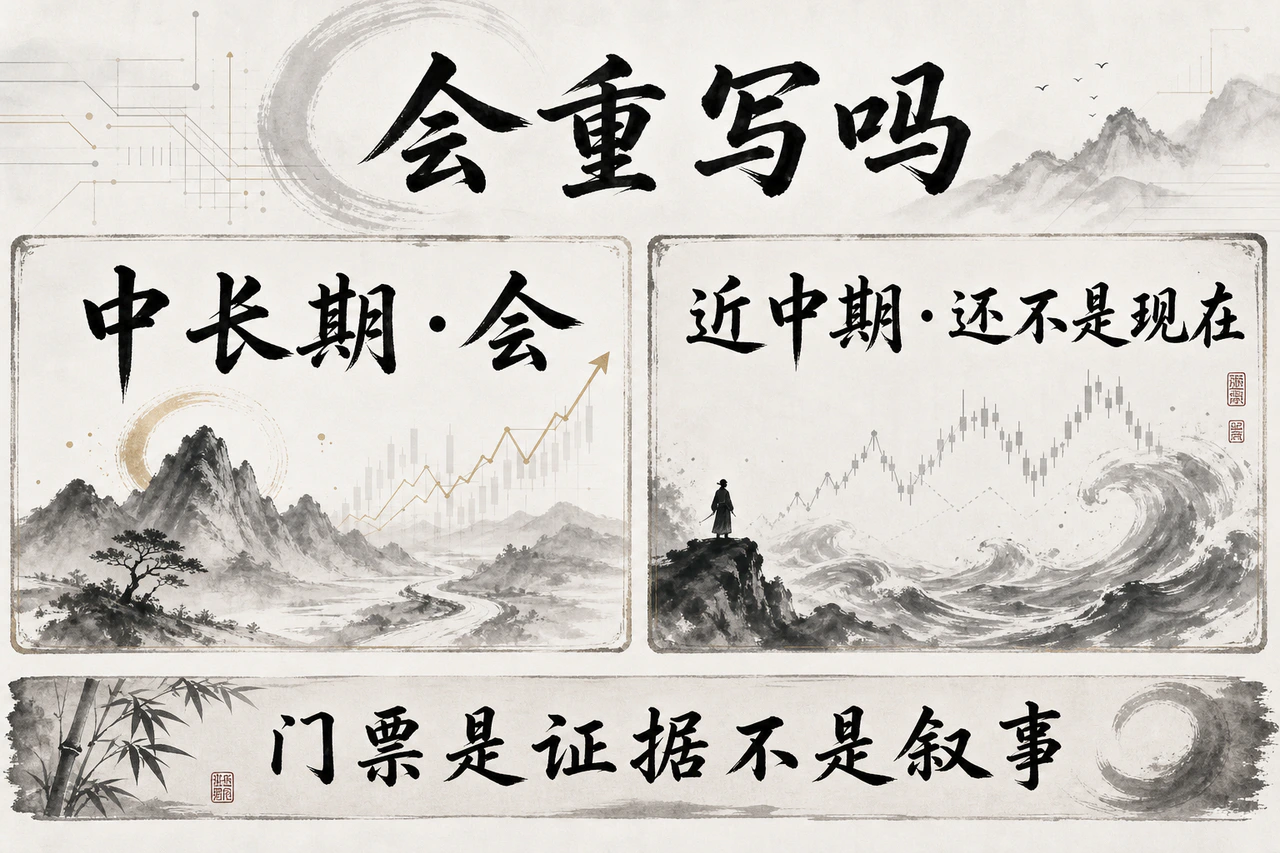
Over five to ten years, the answer clearly leans yes. Once a true general-purpose revolution permeates industry, higher potential growth and changed labor matching cannot leave old central-bank reference points untouched.
Within the more constrained next one or two policy years, the rigorous answer is: AI is competing to explain the macroeconomy, but has not yet earned the right to rewrite the interest-rate reaction function.
Warsh's pioneering institutional work legitimizes the question while pairing vision with strict hearing testimony on monitoring. Technology investment's demand pulse is clear, statistical confirmation of a lasting high-productivity regime weak, employment dashboards too blunt, and potential-output and natural-rate estimates near their lowest signal-to-noise ratios in structural upheaval.
Compressing these frictions into the trading slogan that higher AI potential output requires immediate large cuts skips a lengthy and demanding verification chain.
Across the reform series, this article's place is clear:
- Communication reform changes how markets listen to and understand forward policy;
- Balance-sheet and quantitative-tightening reform clarifies powers over base money, liquidity and unconventional tools;
- Inflation-measurement reform calibrates the gauge of underlying prices and the 2% target;
- The AI-productivity debate concerns the deepest absolute reference points used to distinguish overheating from depressed slack.
Central banks' macro reference frames can and must evolve. The only currency that opens the door to rewriting them is robust, testable evidence, rather than cheap technology narratives.
Main sources from the original research:
Federal Reserve task-force release dated 2026-07-09 and task-forces page; FedScoop coverage of Warsh's 2026-07-14 House hearing; Alberto Musalem's Reykjavík Economic Conference 2026 speech; Stephen Cecchetti and Kermit Schoenholtz, Productivity and Employment: AI’s Promise and Pitfalls, 2026-08-02; PWBM generative-AI productivity estimates, 2025-09-08; Charles Schwab, Fed Watch: Can AI Productivity Gain Cut Inflation?, reviewing Warsh and committee disagreements; and Orphanides' 1999 research on potential-output mismeasurement and the Great Inflation.