No new specifically identified airstrikes on US or Iranian territory occurred in the past 24 hours, but the war's costs and strategic pressures were spreading through global defense arrangements and key maritime chokepoints. In Washington on Sunday, Trump explicitly linked US–South Korea exercise spending to the Iran war. After Seoul refused involvement in Iran's denuclearization, and citing his claimed good personal relationship with Kim Jong Un, he ordered a sharp reduction in Ulchi Freedom Shield, scheduled to begin August 17. He also praised the recent Saudi–Turkish–Pakistani mutual-defense agreement in Mecca as an important first step toward regional security autonomy.
Alongside political maneuvering, fighting on peripheral fronts and risks to energy routes intensified. Yemen's government forces claimed 181 strikes on Houthis in 24 hours; repeated attacks shut the strategic Red Sea port of Mocha. Israel killed two Hezbollah commanders in targeted southern Lebanon operations, with the local daily death toll reaching 11. Shipping monitors recorded an unusual day with no obvious vessel movement through Hormuz, while at least 40 merchant ships crossed Bab el-Mandeb. The apparent physical lull contrasted sharply with official accounts and monitoring definitions.
Seoul Says No Thanks; Ulchi Drills Are Sharply Cut

Trump complained on social media that the exercises were extremely expensive and often paid for by the US alone, calling them an inappropriate and hostile signal to a country that he said had posed no threat during his term and had remained respectful. He then turned to Iran, saying he had asked South Korea's president to join Iran's denuclearization and received the answer No, thanks!
The resulting controversy centered on the annual 10-day Ulchi Freedom Shield exercise scheduled for August 17. Foreign media reported Trump saying it was too late to cancel entirely but that he had instructed the Pentagon to reduce it substantially. Reuters said the original schedule ran through August 27 with approximately 18,000 South Korean troops participating, against a long-term US troop presence around 28,500.
South Korea's Joint Chiefs confirmed to Reuters on Monday that the exercise had started as scheduled. The Blue House said it was carefully assessing Trump's remarks and hoped the US and North Korean leaders' good relationship could create room for dialogue. Explaining No, thanks!, Seoul said consultations continued on possible practical and military contributions, but peninsula readiness and constitutional procedures must take priority. Neither the Pentagon nor Seoul had issued a written list of canceled activities or reduced days.
That same morning, Trump strongly endorsed the Mecca defense pact, saying it showed Middle Eastern unity and more meaningful self-defense. Saudi Crown Prince Mohammed, Turkish President Erdogan and Pakistani Prime Minister Shehbaz signed it around August 7. Its central provision treats an armed attack on one as an attack on all, closely resembling NATO Article 5. Turkish Foreign Minister Fidan clarified that the attacked party must first request assistance and specify whether it needs intelligence, logistics or combat troops. Signing had not yet produced any substantive commitment to additional forces or escorts in the current US–Iran conflict.
Yemen Claims 181 Strikes; Mocha Port Shuts after Attacks

Colonel Majid Abdullah al-Nuzaili, spokesman for Yemen's internationally recognized government forces, claimed 181 military operations against Houthi positions over 24 hours using drones, artillery and rocket systems, causing dozens of casualties. The 181 figure was a unilateral government account, reflecting an intent to counterattack as the US–Iran conflict intensified.
Mocha's security deteriorated rapidly. Its port authority head confirmed on Saturday that more than 25 Houthi missiles had struck recently, killing seven and causing approximately $16 million in damage, forcing all cargo operations to stop. Yemen's government separately said the Houthis fired six ballistic missiles at the port on Friday alone. Houthi spokesman Yahya Saree claimed responsibility, saying the targets were Saudi military forces and equipment and military vessels used by proxies and mercenaries.
Friday's six missiles and the recent cumulative 25 missiles and seven deaths use different periods and must not be added. The Houthis were mobilizing to take more Red Sea coastal territory and threatened all Saudi-linked vessels. Tankers and bulk carriers with Saudi ownership or carriage links therefore faced a dilemma, avoiding both Hormuz and Bab el-Mandeb. Mocha's closure removed an alternative logistical buffer. Even limited negotiated Hormuz passage would leave carriers without an important Red Sea turnaround and sea-access point.
Southern Lebanon Strikes Kill 11 in One Day; Israel Targets Two Hezbollah Commanders

Lebanon's Health Ministry confirmed at least 11 dead and 19 wounded in heavy Israeli strikes on southern areas Saturday morning, including women and children. It was the deadliest day there since the fragile ceasefire was renewed in late June. The National News Agency said a house strike in Ansar killed seven, including three children and two women; a subsequent strike in Deir Zahrani killed four.
Israel's prime minister's office accused Hezbollah of breaking the ceasefire first and said three Israeli soldiers were seriously wounded. The military claimed a precision strike on a key Radwan Force command post killed battalion commander Ali Samir Hajj Hassan and accompanying personnel, accusing him of using relatives present as human shields. On Sunday it announced the killing of senior commander Abu Hassan Alaa, accusing him of planning raids including suicide-drone attacks on Israeli positions. Reports placed Alaa in Hezbollah's Badr Unit and the strike near Deir Zahrani.
Hezbollah condemned a brutal massacre of innocent civilians, accusing Netanyahu's government of escalating for domestic and electoral advantage and the US of providing support and cover. Prime Minister Nawaf Salam called for an immediate ceasefire, saying any southern military facilities belonged exclusively to the Lebanese sovereign state and had to be handled by its army. President Aoun called the strikes a dangerous provocation to negotiations. This month's Rome consultations on ceasefire implementation ended early after the killings. Reports suggested further contacts might slip to early next month, without a settled schedule.
An Unusual Zero-Vessel Window in Hormuz: Physical Shipments and Official Accounts Diverge
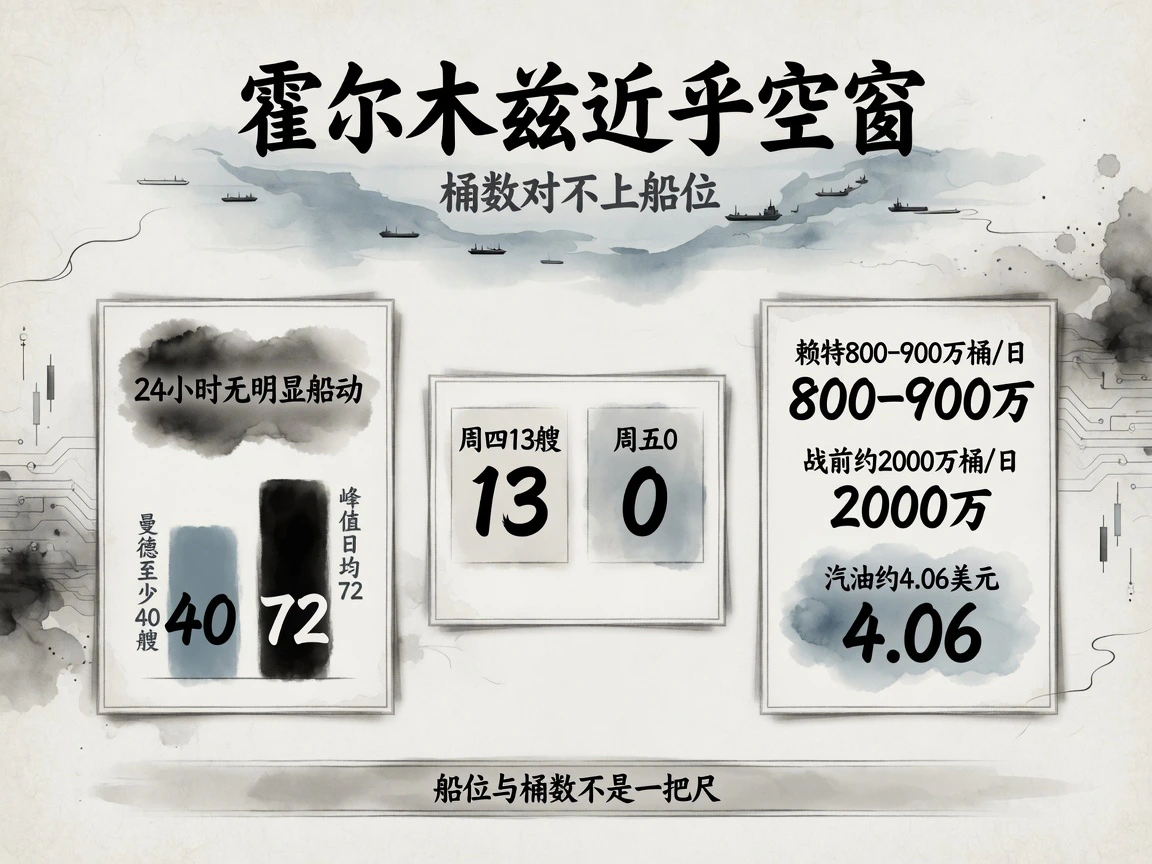
MarineTraffic real-time data showed a rare 24-hour period of no obvious vessel movement through Hormuz. Bab el-Mandeb recorded at least 40 merchant crossings, maintaining basic operations but more than 40% below Kpler's normal peak of 72 per day in 2023. Political negotiations on full Hormuz reopening remained stalled. Oil futures were broadly flat in narrow Sunday trading, while US retail gasoline stayed above $4 a gallon: AAA's August 17 national average was approximately $4.06.
Frequent AIS shutdowns and ship-to-ship transfers obscure actual delivered oil volumes. Windward recorded 13 Thursday crossings, four inbound and nine outbound. Four outbound vessels deliberately turned off tracking signals, including a tanker carrying 2 million barrels of Saudi crude. By Friday, public systems showed no visible crude-tanker transit. Yet Energy Secretary Chris Wright claimed that same day that rolling average flows still reached 8 million–9 million bpd, citing classified sources unavailable to commercial trackers. Near-empty visible seas on Sunday and official claims of millions of barrels illustrated a striking split between data systems.
EIA's prewar baseline put crude and liquid-fuel movements through Hormuz near 20 million bpd, approximately one-fifth of global daily crude production, with little alternative pipeline capacity. Trump nevertheless said Friday that after finishing Iran, which he claimed would happen soon, he intended an executive order declaring Hormuz US territory. On Wednesday he had claimed complete control and ownership of the waters. Deputy Foreign Minister Kazem Gharibabadi rejected this, saying sovereignty could not be removed by a tweet, carrier, executive order or campaign speech, and that only Iran's authority governed opening and closure.
Windward also observed a significant change: a VLCC began loading at the western Kharg Island terminal the previous week for the first time in nearly a month, while more than 10 tankers remained anchored nearby. Pezeshkian acknowledged economic pressure in Saturday cabinet remarks, saying revenues had fallen and oil that could previously be sold could no longer be sold. Washington's priorities also differed: Vice President Vance's Thursday policy essay put stable global energy prices first and preventing an Iranian nuclear weapon second; press secretary Leavitt said Friday that both mattered equally to the president.
Gaza Talks End Empty-Handed; USS Abraham Lincoln Remains at Sea after More Than 240 Days
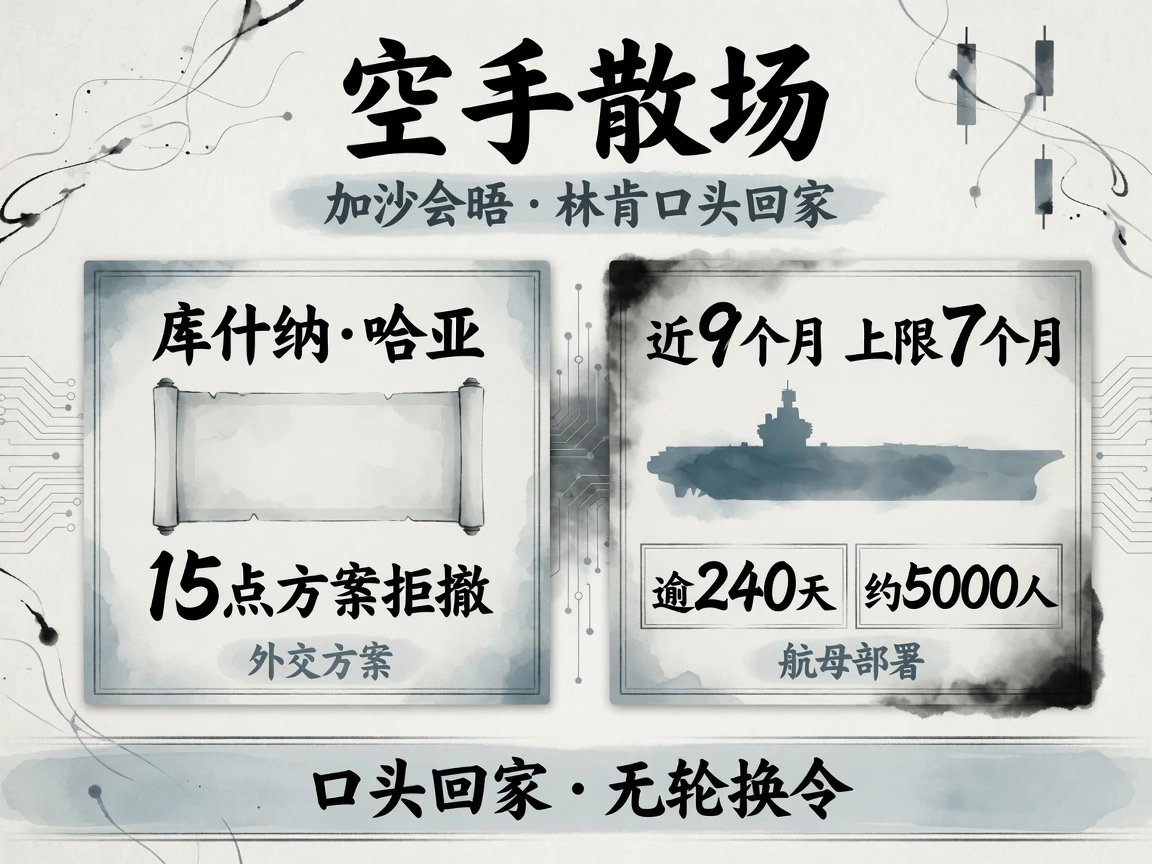
Sources said Sunday's face-to-face El Alamein talks between White House envoy Jared Kushner and senior Hamas leader Khalil al-Hayya ended without a written outcome ready for signing. Former UN envoy and Board of Peace director Nickolay Mladenov attended throughout. The meeting sought to rescue Trump's Gaza initiative after Israel's cabinet rejected it. Egypt's intelligence chief, senior Qatari and Turkish diplomats and former UK prime minister Tony Blair also attended the mediation venue. Kushner then met Sisi separately. Diplomatic sources confirmed he reached Israel Monday for talks with Netanyahu.
Trump's 15-point plan, proposed late last month, called for phased cessation of regular Israeli operations, full Hamas disarmament and gradual Israeli withdrawal in exchange. After more than a week of silence, Netanyahu rejected it and insisted on no withdrawal before complete disarmament. Hamas accepted a disarmament framework in principle but required prior Israeli compliance with ceasefire duties and urged mediators and the Board of Peace to press Israel. On Sunday, foreign ministers of Jordan, the UAE, Indonesia, Pakistan, Turkey, Saudi Arabia, Qatar and Egypt jointly condemned Israel's rejection.
As diplomacy came away empty-handed, deeper logistical strain in US Red Sea and Gulf deployments emerged. CENTCOM commander Brad Cooper revisited USS Abraham Lincoln during a 10-day regional tour, his second visit this year. The carrier, central to the blockade, had not berthed at a friendly port for maintenance and leave since arriving in January amid sustained fighting. Its nearly nine-month deployment exceeded the Navy's recommended seven-month limit. About 5,000 personnel had spent more than 240 days at high readiness, while intended replacement USS George Washington was still crossing the ocean. Maryland Governor Wes Moore, a Democratic Army veteran, said Trump's dismissive treatment of fatigue made him angry. Trump had said Friday that eight and a half months at sea was nowhere near long enough.
Cooper told the crew Saturday that history would regard this as one of the era's most operationally intense and consequential carrier deployments. On Sunday he sought to calm controversy, saying Lincoln's reported mental-health cases were among the lowest across 11 active US carriers, while acknowledging that did not mean everything was perfect. He wished the crew a smooth journey home. These reassurances had not become a formal Pentagon rotation order.
A wartime extradition dispute also remained unresolved in Doha. General Seyed Mohammad Bagherzadeh, head of Iran's missing-service-personnel search committee, told Tasnim that Qatar was deliberately delaying a joint investigation into three missing airmen and had prevented an Iranian expert team entering for months. He said two Iranian Su-24 bombers were shot down after attacking US bases in Qatar, with one crew member killed and three ejecting: Javad Salehi, Abdulmajid Dashtian and Omran Beh Rouhia. Qatari spokesman Majed al-Ansari categorically denied the allegation, saying Qatar had arranged return of one dead pilot's remains and invited Iran in April to hear investigative details without receiving a response. Two weeks earlier Iran had still said it was checking their whereabouts; the named accusation of detention showed further erosion of fragile trust with Gulf neighbors.
Key Developments

The following entries are in reverse chronological order, Beijing time.
| Key Developments |
|---|
| 08-17 08:43Controversy over reduced US–South Korea drills continues; Trump praises the Mecca defense pact. Hormuz shows no obvious movement in 24 hours; Bab el-Mandeb at least 40 crossings versus the 2023 peak average of 72. Oil futures are flat and US gasoline remains above $4 a gallon. |
| 08-17 05:58Trump calls the Saudi–Turkish–Pakistani Mecca pact an important first step; its core provision treats an attack on one as an attack on all. |
| 08-17 05:42Trump announces major exercise cuts, citing his relationship with Kim Jong Un and Seoul's No, thanks! to involvement in Iran's denuclearization. Ulchi Freedom Shield was scheduled for 10 days from August 17. |
| 08-17 05:17Maryland Governor Moore says Trump's response to Lincoln's fatigue makes him angry. Trump had said Friday that eight and a half months at sea was nowhere near long enough. |
| 08-17 04:39Kushner makes rare contact with Hamas representatives in Egypt. Direct US–Iran fire temporarily pauses, but regional conflict involving Iranian-backed forces continues. |
| 08-17 03:13Cooper says Lincoln's mental-health cases are among the lowest across 11 active carriers and wishes the crew a smooth return home. Continuous deployment is nearly nine months. |
| 08-17 01:30Kushner–Hayya closed talks in El Alamein end without written consensus, with Mladenov attending. Eight foreign ministers condemn Israel's rejection of the Gaza roadmap. |
| 08-16 22:59Kushner finishes talks with Sisi; diplomatic sources confirm a Monday visit to Israel for Netanyahu talks. The 15-point framework is blocked by Israel's refusal to withdraw and Hamas's conditional acceptance of disarmament. |
| 08-16 22:28Yemen's government claims more than 180 strikes on Houthi positions in 24 hours. Israel conducts targeted strikes in southern Lebanon and kills a Radwan commander. |
| 08-16 21:02Hormuz's importance: approximately 20 million bpd of prewar crude exports, one-fifth of global daily production. Gharibabadi sharply rejects Trump's proposed declaration of US territory. |
| 08-16 19:53Cooper visits Lincoln for the second time this year, calling the deployment among the most intense and consequential of the era. |
| 08-16 19:20Yemeni spokesman Nuzaili reports 181 operations using drones, artillery and rockets, claiming dozens of militant casualties. |
| 08-16 19:16Windward: 13 Thursday passages, four inbound and nine outbound; four outbound ships switch off AIS, including one carrying 2 million barrels of Saudi crude. Friday visible crude-tanker traffic falls to zero. Wright claims rolling flows of 8 million–9 million bpd. Kharg sees its first large-tanker loading in nearly a month. |
| 08-16 18:23Trump claims complete control and ownership of Hormuz; Gharibabadi says its opening and closing follow only Iranian authority. |
| 08-16 16:52White House priorities differ: Vance puts energy-price stability first and nuclear prevention second; Leavitt says both are equally important. |
| 08-16 16:30Bagherzadeh accuses Qatar of delaying investigation of three missing pilots. Qatar denies detention and says Iran previously failed to coordinate. |
| 08-16 14:46Israel says it killed Badr Unit commander Abu Hassan Alaa, accusing him of organizing suicide-drone attacks. |
| 08-16 13:35More than 25 Houthi missiles hit Mocha recently, killing seven and causing $16 million in damage, with all operations suspended. Lebanon confirms 11 dead and 19 wounded in southern strikes; Israel confirms killing a Radwan battalion commander. |


