HKEX launched 5-year Chinese government-bond futures on August 3, 2026. The design is offshore trading and clearing anchored to onshore prices: contracts trade in Hong Kong, are quoted in offshore RMB and cash-settled. Clearing participants must meet at least half their initial margin with RMB cash, while final settlement is linked entirely to onshore interbank 5-year cash sovereigns.
This is neither a derivative on offshore dim sum bonds nor a physically deliverable cash-bond substitute in Hong Kong. It is a standardized duration tool, allowing foreign investors to trade China's 5-year sovereign DV01—the value change from a 1 basis-point yield move—without entering mainland futures markets.
Low RMB rate volatility does restrain high-frequency speculation and volatility-option demand, and Hong Kong cannot soon replicate Treasury futures' enormous turnover. It does not imply a shallow potential market. The ceiling depends on actual offshore RMB assets, cash and repo depth, cross-border arbitrage and multi-asset clearing's capital efficiency, rather than a few extra basis points of daily movement.
A relaunch after nine years, rather than a first introduction
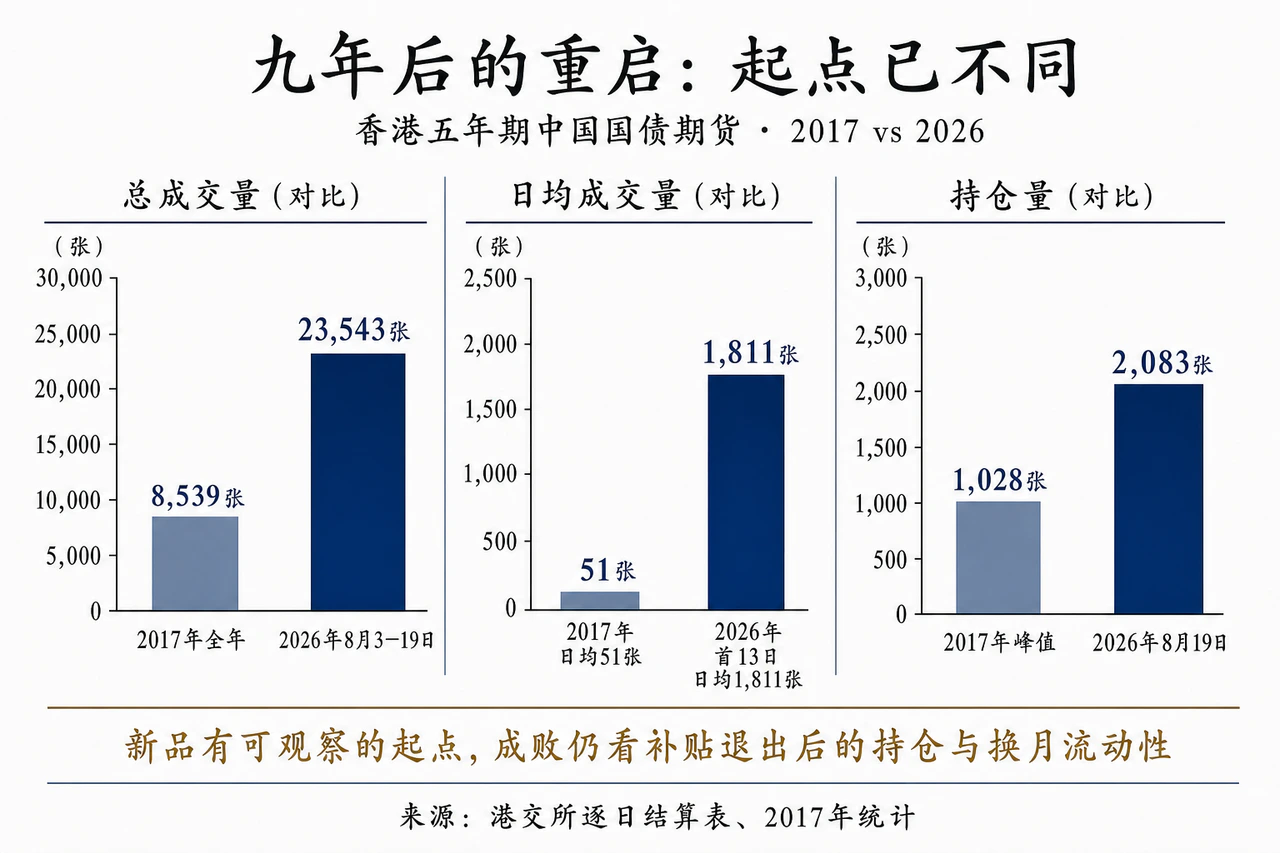
Hong Kong tested 5-year Finance Ministry futures in April 2017, also with RMB 500,000 face value and RMB cash settlement. Over 168 trading days, volume was only 8,539 contracts, averaging 51 daily; peak open interest was 1,028. Trading was suspended from December 8 that year. The dormant contract was formally delisted only with the new 2026 launch. HKEX 2017 statistics; HKEX 2026 introduction circular.
The new start is very different. Calculations from HKEX daily statements show 23,543 contracts traded over the 13 sessions from August 3–19, averaging 1,811, or RMB 905.5 million daily face value. August 19 open interest was 2,083, representing RMB 1.0415 billion. In just 13 sessions, volume was 2.76 times the old contract's entire 2017 total, daily turnover 35.5 times higher, and open interest more than twice the old peak. First-day volume: 3,755 contracts; August 19 volume: 1,011.
This is a substantive first step, far from proof of success. HKEX temporarily cut trading fees from RMB 5 to RMB 2.5 per side and introduced market-maker and active-trader incentives through July 30, 2027. The real stress test comes afterward: retaining genuine non-market-maker business, building lasting open interest and smoothly rolling quarterly contracts.
The underlying environment has changed fundamentally since nine years earlier. HKEX says foreign holdings of Chinese interbank bonds grew from around RMB 0.8 trillion in June 2017 to RMB 3.2 trillion at end-May 2026. The SFC puts sovereign holdings near RMB 2 trillion. Bond Connect, Swap Connect, offshore repo and RMB clearing now provide holders, cash access and hedging infrastructure largely absent then. HKEX announcement; SFC announcement.
Three 5-year sovereign futures, three market structures
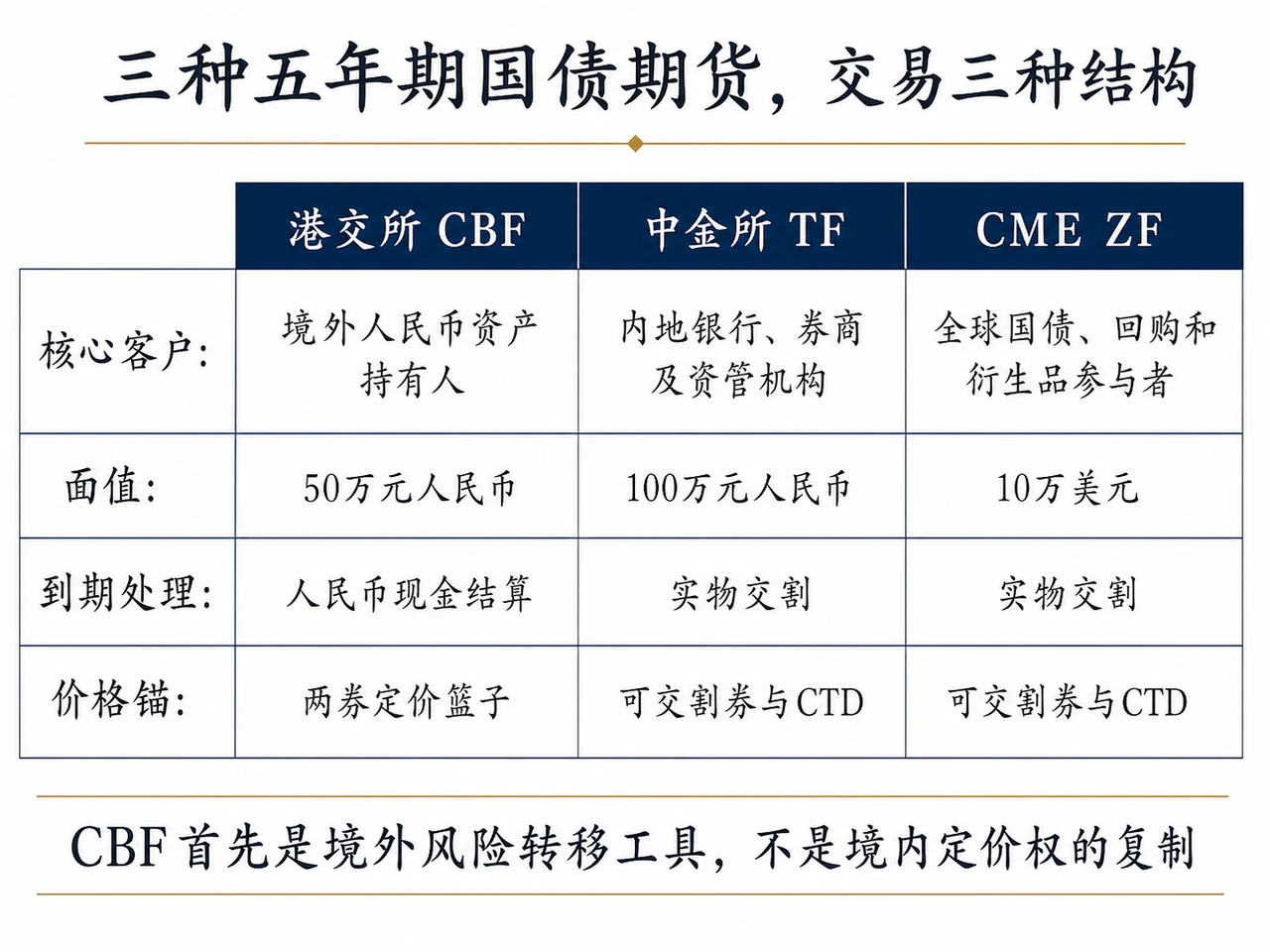
HKEX CBF references a hypothetical onshore sovereign with a 3% annual coupon. Face value is RMB 500,000, with the nearest two quarterly months listed. Minimum tick is 0.005 price point, or RMB 25 per contract, and trading runs 9:30–16:30 Hong Kong time. There is no physical delivery. From eligible onshore bonds, HKEX uses liquidity over the preceding ten interbank sessions to select the two most actively traded securities as its pricing basket. At expiry, cash settlement uses the basket's combined reference price published by ChinaBond Valuation Center. Full contract specifications.
Comparing HKEX, CFFEX and CME 5-year contracts reveals larger structural differences than their similar names suggest:
| Dimension | HKEX 5-year CBF | CFFEX 5-year TF | CME 5-year ZF |
|---|---|---|---|
| Core clients | Foreign RMB asset holders | Mainland banks, brokers and asset managers | Global Treasury, repo and derivatives participants |
| Contract face value | RMB 500,000 | RMB 1 million | US$100,000 |
| Expiry treatment | RMB cash settlement | Physical delivery of eligible bonds | Physical delivery of eligible bonds |
| Price anchor | Basket of two most active onshore 5-year sovereigns | Deliverables, conversion factors and cheapest-to-deliver bond | Deliverables, conversion factors and cheapest-to-deliver bond |
| Listed months | Nearest two quarterly months | Nearest three quarterly months | Quarterly cycle |
| Regular trading hours | 9:30–16:30, no night session | 9:30–11:30 and 13:00–15:15 | Nearly 23 hours daily |
CFFEX already covers 2-, 5-, 10- and 30-year sovereign futures. In 2025 its four contracts traded 78.7627 million lots, averaging 324,100 daily and RMB 399.023 billion daily turnover. Year-end open interest was 647,900 and average volume grew 41.65%. Hong Kong's first-13-day average face value of RMB 905.5 million, or around RMB 969 million market value at a price near 107, was about 0.24% of CFFEX's all-maturity daily turnover. The comparison locates the offshore starting point rather than equating absolute scales. CFFEX 2025 market statistics.
Hong Kong is not simply replicating offshore CFFEX. Physical delivery binds mainland futures to eligible cash bonds. Shorts choose delivery securities, with CTD emerging from relative cash prices; basis converges at delivery through carry and conversion factors. This depends heavily on deep local securities lending and repo. Cash settlement bypasses offshore lending shortages and cross-custodian delivery complications, lowering access and trading friction, but leaves basis between the pricing basket and actual holdings. CFFEX remains the underlying price-discovery center; CBF standardizes offshore risk transfer.
Access differs too. Even after mainland rules admitted qualified foreign investors (QFI) to CFFEX sovereign futures in April 2026, activity remained strictly limited to hedging. Hong Kong uses established offshore custody, brokerage and multicurrency margin. Its strategic role is to reduce the institutional cost of crossing separate account infrastructures to adjust the same RMB duration, rather than contest onshore benchmark pricing. CSRC notice.
The US comparison: An entire cycle, rather than one missing contract
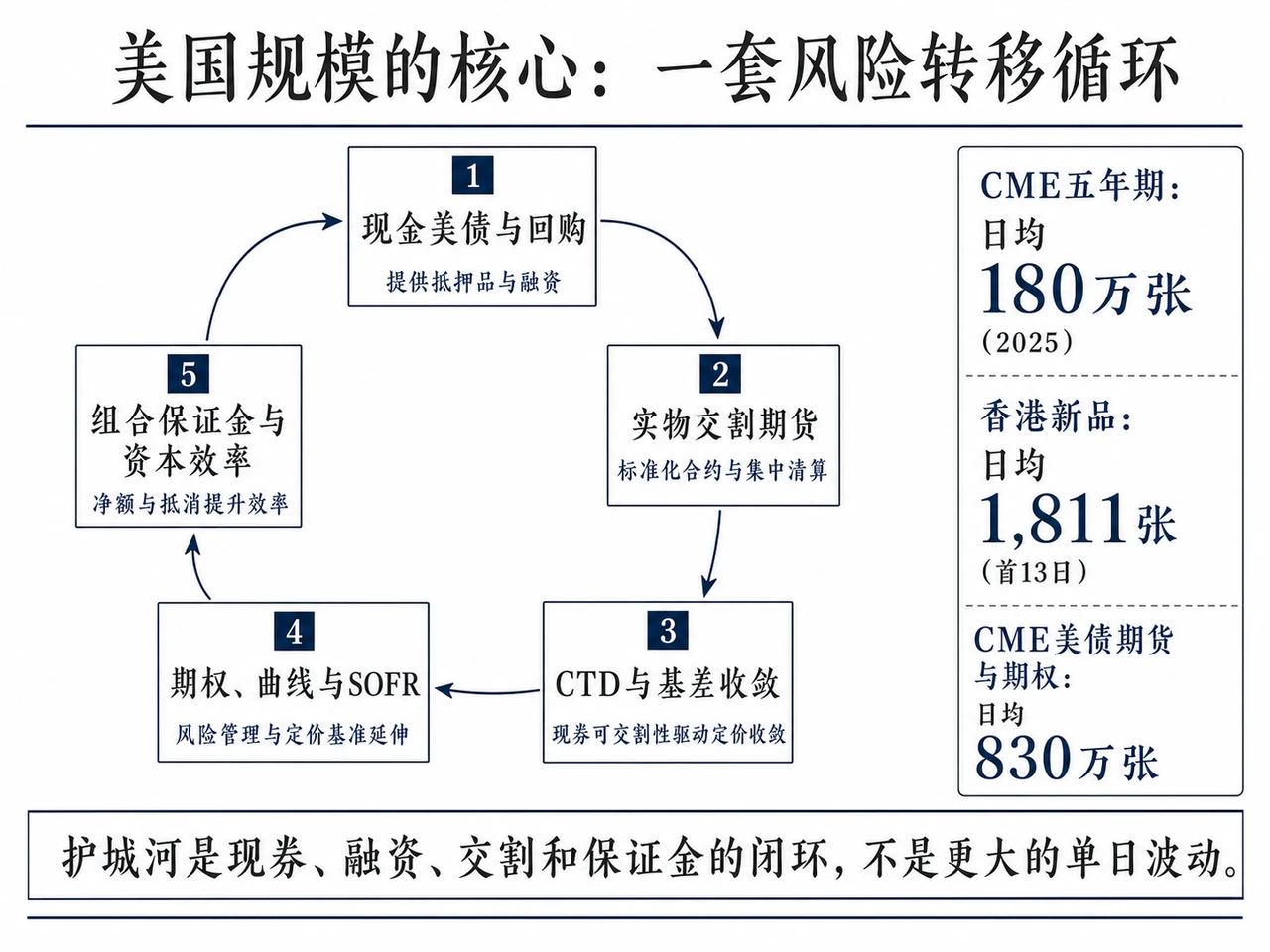
The sovereign-derivatives scale gap is undeniable. CME 5-year Treasury futures averaged 1.8 million contracts daily in 2025, around 1,000 times Hong Kong's initial 1,811. Across Treasury futures and options, volume averaged 8.3 million and open interest a record 29.6 million. CME 2025 statistics.
Liquidity depth is more informative. Treasury futures averaged around $774 billion daily notional in 2024, 109% of TRACE cash-market turnover. High-frequency hedging means notional turnover is not equal net risk, but the scale shows a mature futures market functioning as a core liquidity pool and risk-transfer hub comparable with cash bonds. CME interest-rate liquidity report.
Four mutually reinforcing ecosystem flywheels support Treasury futures:
First, a cash market trading near $1 trillion daily, transparent auctions and vast tri-party and bilateral repo. CME builds on this with 2-, 3-, 5-, 10-, Ultra 10-, 20-year and ultralong maturities, concentrated around major 2-, 5-, 10-year and long-end anchors. Hong Kong currently has only an isolated 5-year point.
Second, broad-basket physical delivery lets shorts find CTD dynamically from cash prices, conversion factors and repo costs. Basis must converge toward carry near delivery, linking cash, repo borrowing and futures arbitrage. Hong Kong's two-bond basket is only a cash-valuation sample and lacks physical delivery's forced convergence.
Third, diverse real institutions provide both sides. Mutual funds and pensions add duration while freeing cash; leveraged funds buy cash bonds, sell futures and finance through repo. Fed estimates put Q4 2023 mutual-fund Treasury-futures longs around $500 billion and other asset managers around $650 billion. Leveraged-fund notional shorts at times exceeded $1 trillion. Notional shorts do not equal net arbitrage, but estimated actual September 2023 net basis-trade exposure was still $260 billion–$574 billion. Fed research on asset managers' futures use; Fed basis-trade estimates.
Fourth, integrated clearing permits broad portfolio margining across futures, options, calendar spreads, SOFR derivatives, cash and repo. Offsetting cross-market risks reduce capital use. Treasury futures' true barrier is therefore optimized balance-sheet and capital efficiency as well as dollar volatility.
Hong Kong need not target millions of daily contracts. A practical objective is tight quotes, continuous depth and stable rolls for each unit of offshore RMB 5-year sovereign DV01, linked effectively to cash bonds, IRS and repo.
Do lower RMB rate swings make futures unnecessary?
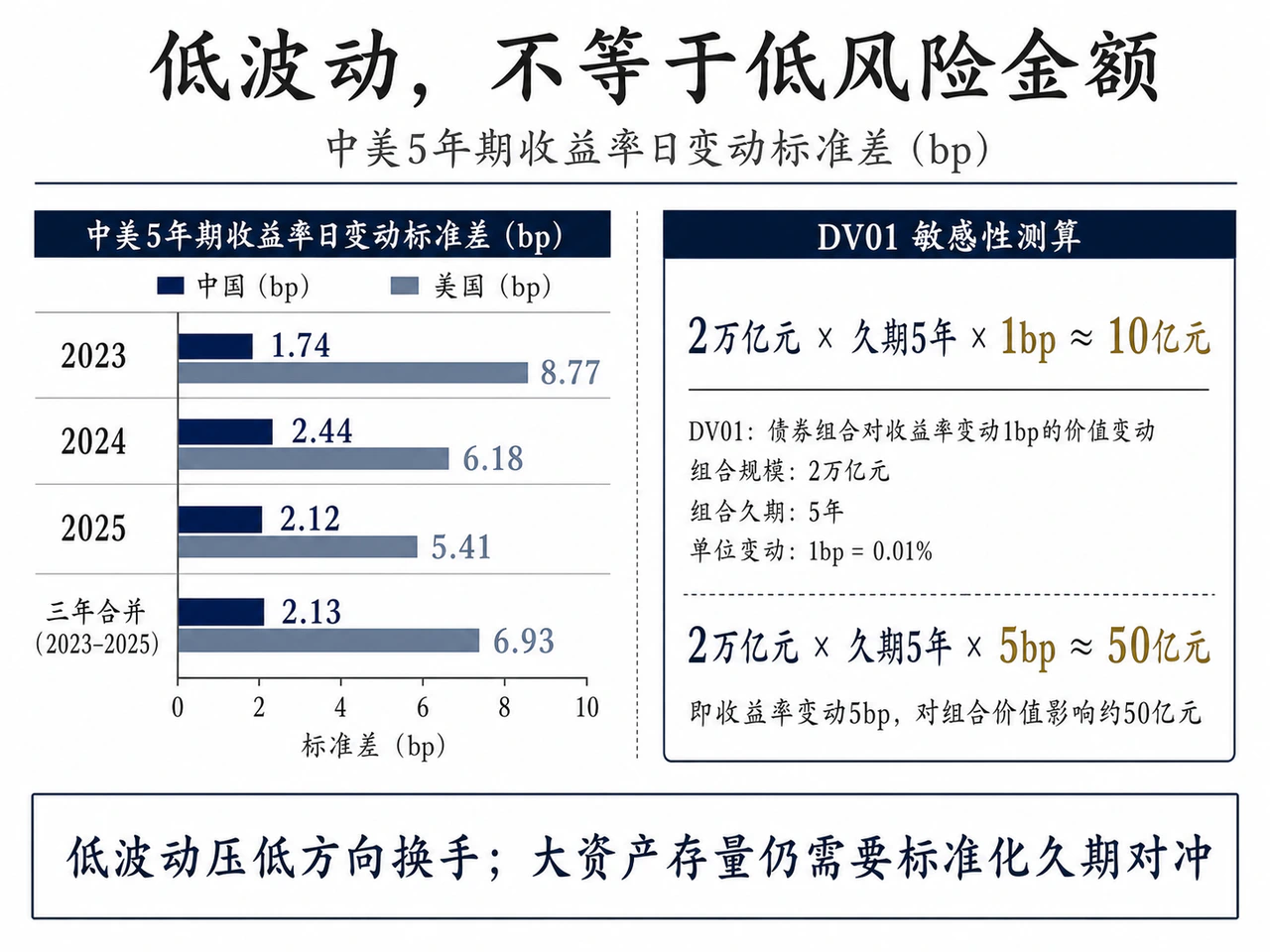
Daily RMB rate volatility is materially lower than dollar volatility.
Compare ChinaBond 5-year YTM with US Treasury 5-year par yields using differences along each market's own trading-day sequence, without interpolation, and the sample standard deviation of absolute daily moves, in basis points. Effective Chinese observations for 2023–2025 are 250, 251 and 248; US counts are 250, 250 and 249:
| Year | China 5-year daily yield volatility | US 5-year daily yield volatility | US/China multiple |
|---|---|---|---|
| 2023 | 1.74 | 8.77 | 5.0 times |
| 2024 | 2.44 | 6.18 | 2.5 times |
| 2025 | 2.12 | 5.41 | 2.6 times |
| Combined three years | 2.13 | 6.93 | 3.3 times |
Over the three years, the mean absolute daily 5-year move was only 1.55 bp in China versus 5.25 bp in the US. Sources: ChinaBond historical curves and US Treasury daily yields. Pricing definitions and holidays differ, so 3.3 times is not a fixed ratio, but it clearly indicates different volatility environments.
Low volatility imposes real constraints: weak intraday directional payoffs, dealer margins easily consumed by fees and ticks, and limited OTC option premiums. But low volatility is not low exposure. Unhedged mark-to-market equals notional times modified duration times yield movement. On RMB 2 trillion of foreign-held sovereigns with assumed 5-year duration, 1 bp changes valuation by about RMB 1 billion; 5 bp creates around RMB 5 billion of P&L. Large asset holdings outweigh low volatility.
At RMB 500,000 face value, a clean price around 107 and modified duration near 4.5 years, one CBF contract has DV01 around RMB 241. An overseas institution holding RMB 10 billion at similar duration has DV01 of RMB 4.5 million and theoretically needs around 18,700 short contracts for a full hedge, approaching Hong Kong's standard 22,000-contract single-client position limit. Narrow daily ranges do not eliminate large sovereign investors' sensitivity.
CFFEX's trajectory confirms this. Despite low volatility, its 2025 sovereign-futures average volume grew 41.65%. Low volatility did not stop demand; it reshaped users, discouraging short-term retail speculation and encouraging institutional hedging, allocation, curve trading and cash-futures basis arbitrage.
Hong Kong's roadmap: Build depth, extend maturities, then add complexity
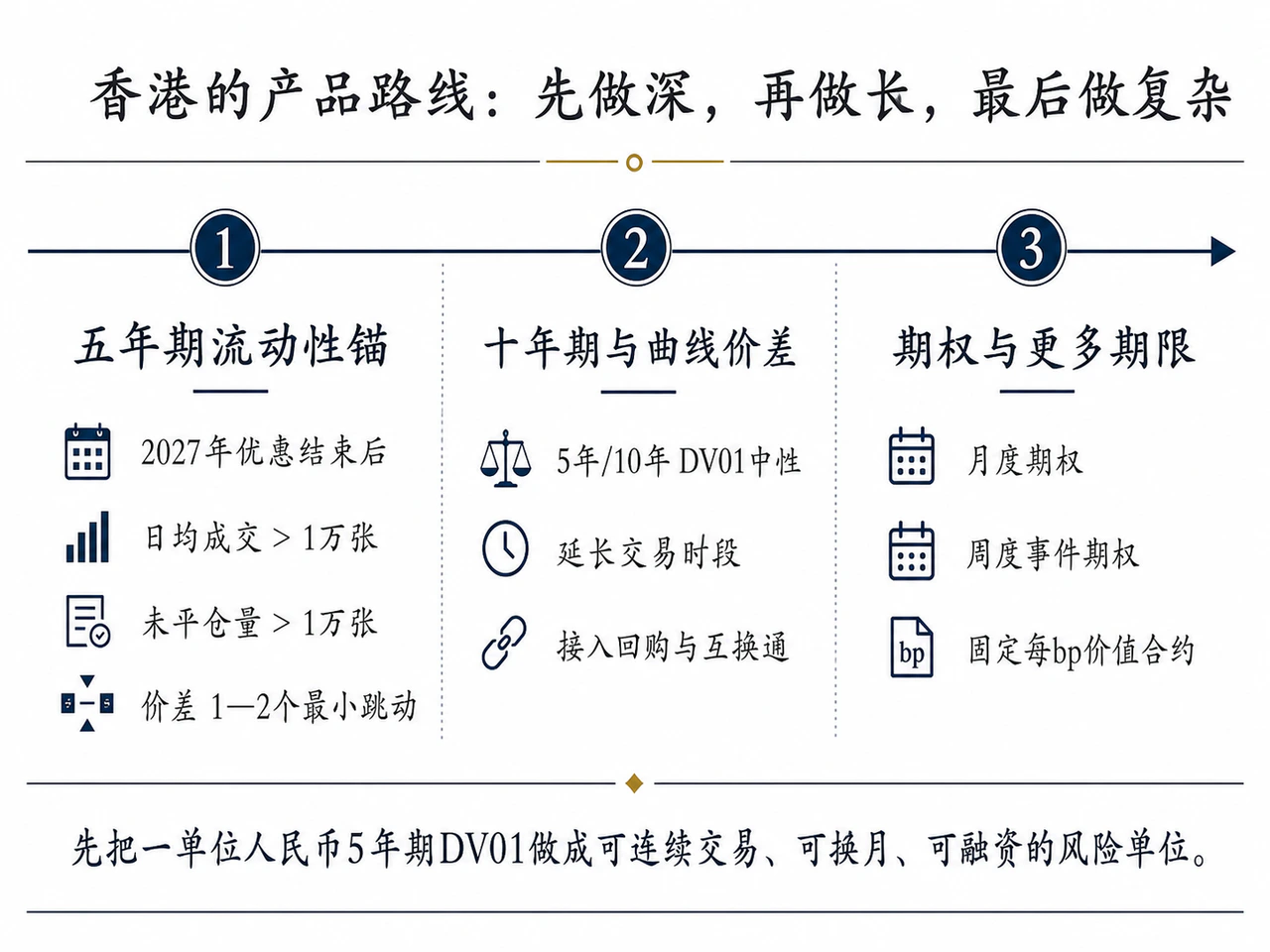
HKEX considered a 10-year product but chose 5 years after weighing demand, explicitly leaving 10-year expansion dependent on reception. Onshore and overseas market development suggest three steps:
First, establish 5 years as the offshore RMB liquidity anchor. After 2027 fee and market-making incentives end, reasonable tests are volume rising from around 1,800 to sustainably above 10,000 daily, open interest regularly above 10,000, spreads of 1–2 ticks during onshore hours, and more than 80% of positions rolling smoothly into deferred quarters. Ten thousand daily means RMB 5 billion face value, or around RMB 5.35 billion market value at 107, only 1.34% of CFFEX's 2025 all-maturity daily turnover: practical and attainable.
Second, introduce 10-year futures once the 5-year base is deep, alongside DV01-neutral 5-year/10-year curve spreads, then extend toward 2 and 30 years. Trading should reach European/US overlap and add block trades and exchange-for-physical (EFP) links. Institutional integration matters more: HKEX is working on FDR007 in Swap Connect settlement, an electronic bond hub and possible eligibility of Bond Connect holdings as collateral. These connections matter more than listing extra contracts. HKEX ecosystem explanation.
Third, add options and fixed-value derivatives. Once quotes and investor diversity are deep, monthly standard options could precede weekly options around important macro events. CME-style cash yield futures with fixed DV01 offer another way to separate complex delivery and CTD decisions. Broad US-style physical baskets should not be copied before offshore cash circulation, collateral lending and cross-system clearing are sufficiently mature.
Dim sum implications: Hedge sovereign rates, without eliminating credit or basis
At launch, Hong Kong's Financial Secretary said the offshore RMB pool exceeded RMB 1.1 trillion, monthly average interbank clearing approached RMB 48 trillion and dim sum outstanding exceeded RMB 1.6 trillion. Full government speech. HKMA's broad debt-securities statistics including CDs show 2025 issuance of RMB 1.1009 trillion and year-end outstanding RMB 1.6073 trillion, up 2.7% and 27.6%. A credit market above RMB 1.6 trillion urgently needs a benchmark-rate hedge usable frequently. HKMA half-year report.
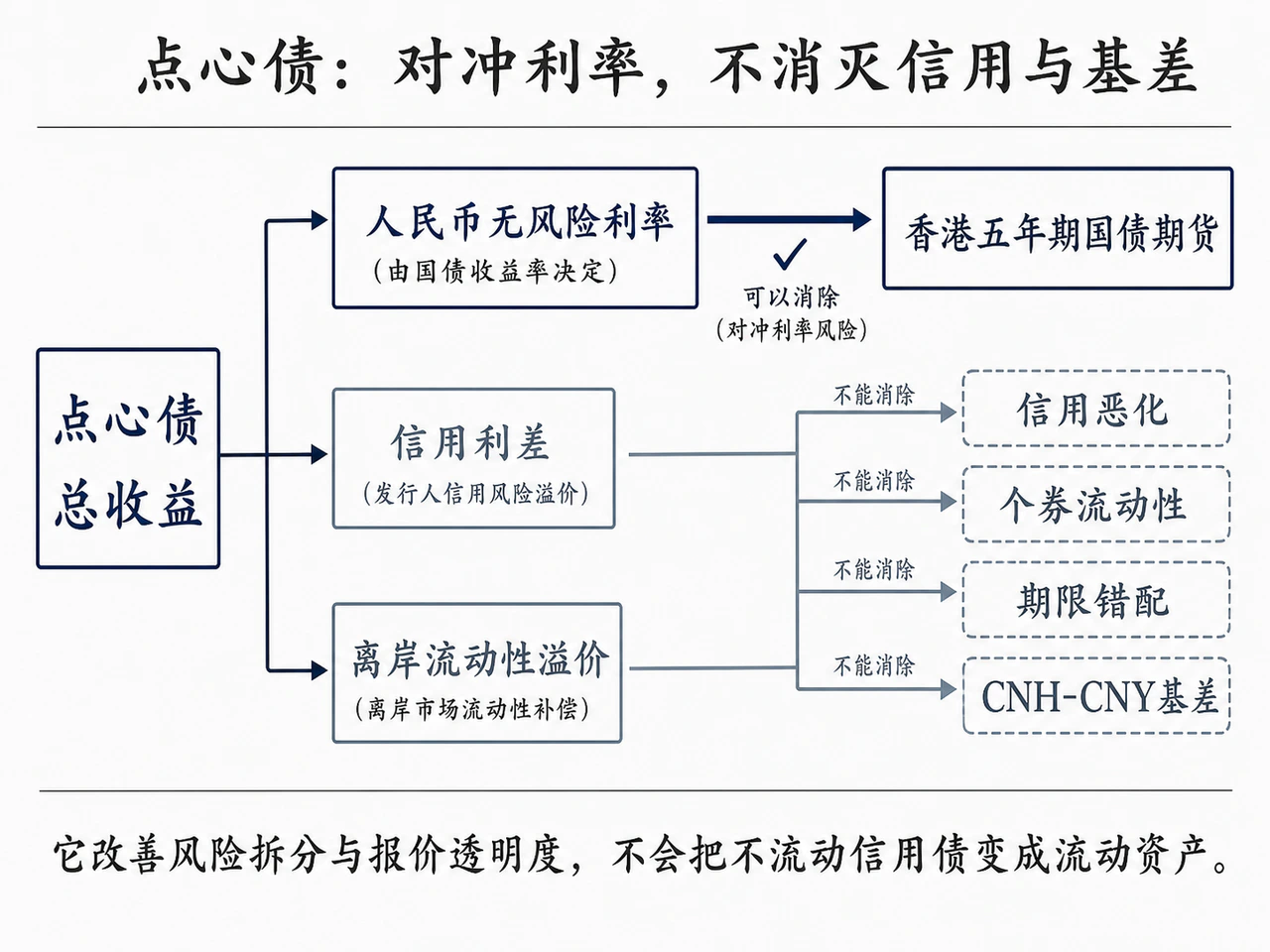
Futures help in three ways. Underwriters can sell them between bookbuilding and payment to lock sovereign benchmarks. Dealers can hedge inventory duration rather than dump cash bonds as yields rise. Asset managers can change pure RMB duration without changing credit issuers. As these trades normalize, dim sum pricing separates more clearly into onshore sovereign benchmark plus issuer spread plus offshore liquidity premium, improving transparency and cross-product relative value.
The boundary is equally important. CBF tracks the onshore sovereign risk-free curve and hedges only systematic RMB sovereign-rate movement. It cannot absorb worsening issuer default risk, liquidity discounts, maturity mismatch or the CNH–CNY currency basis. Five-year high-grade fixed bonds benefit most. Short paper, floaters, weak local-government financing vehicles and ultralong dim sum can face substantial hedge slippage from basis mismatch. Better factor separation cannot turn an illiquid weak credit into a liquid asset.
Currency effects: No one-way answer, but faster transmission
A futures contract is symmetric between longs and shorts and contains no inherent bet on currency appreciation or depreciation. Launching sovereign futures therefore mechanically guarantees neither a stronger RMB nor a depreciation run.
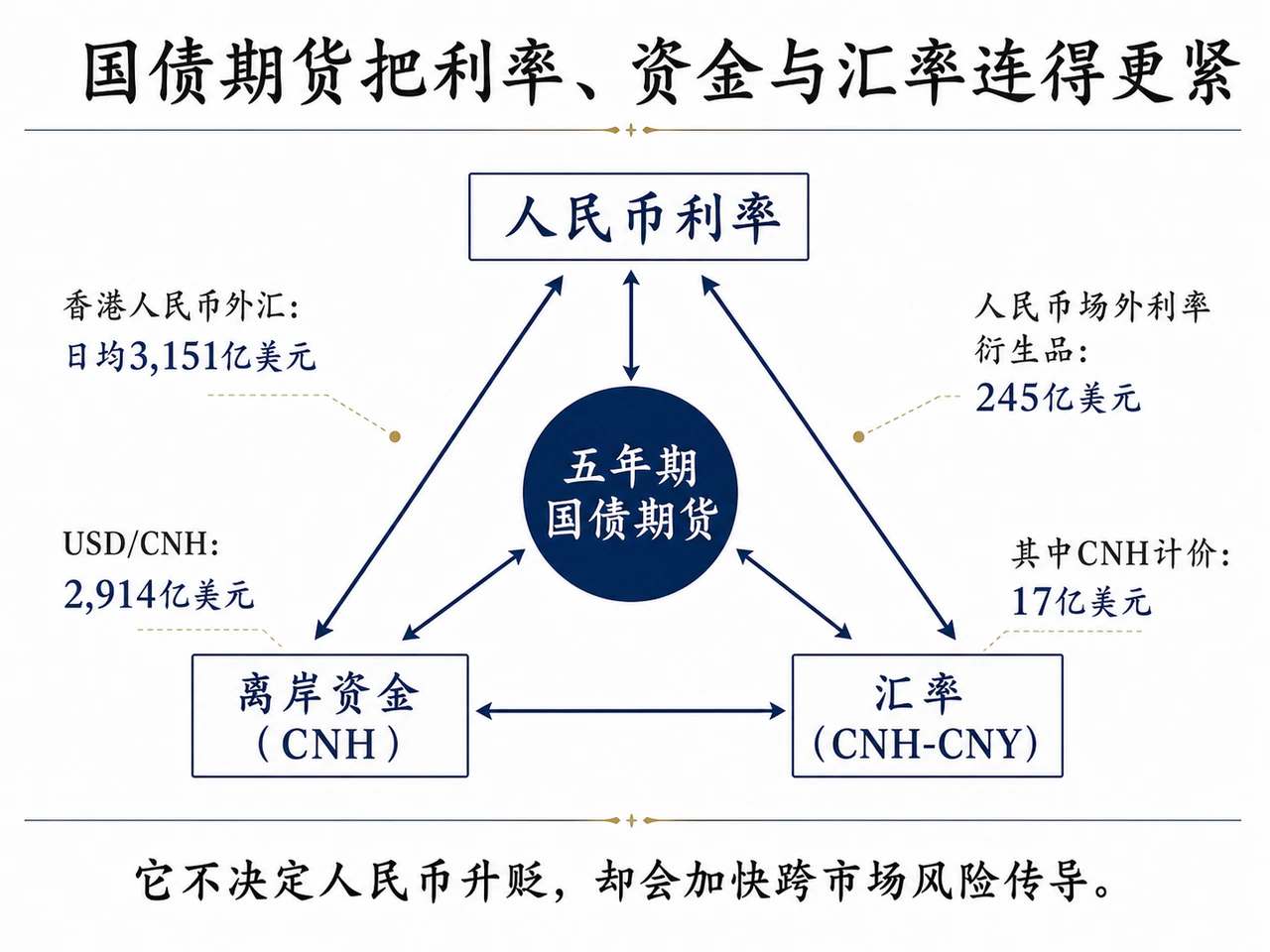
The structural depth gap is central. HKMA's global FX/derivatives survey showed Hong Kong RMB FX-derivative volume averaging $315.1 billion/day in April 2025, including $291.4 billion USD/CNH. Offshore RMB OTC rate derivatives averaged only $24.5 billion, of which just $1.7 billion was genuinely CNH-denominated notional. Hong Kong has mature currency-risk depth but long-shallow offshore rate hedging. HKMA survey tables.
Futures fundamentally change multidimensional risk management. Global RMB-bond holdings face rates and FX together. Without offshore rate tools, investors facing rate volatility had no hedging option other than selling cash bonds in the secondary market and converting the proceeds out of RMB. CBF lets them retain bonds and hedge duration with shorts, while forwards, swaps or options manage separately identified currency risk. This substantially reduces the total risk budget required for RMB allocation.
Short-term cross-market transmission will accelerate. HKEX's August 20 margin-reference table set both listed months' long and short margin at RMB 7,980 per contract, 1.596% of face or around 1.49% of market value at 107; brokers generally charge more. Clearing requires at least 50% of initial margin in RMB cash and 100% of daily variation margin in RMB cash. HKEX margin table; HKEX operational FAQ. As positions multiply, sudden onshore rate moves instantly create offshore cash-margin demand. During depreciation pressure, margin calls can temporarily tighten CNH liquidity, raise overnight rates and widen CNH–CNY differences. With ample normal liquidity, hedges instead prevent cash-bond dumping and forced currency conversion.
The useful FX lens is therefore the opened micro transmission chain among RMB rates, offshore funding and currencies, making both price discovery and risk spillovers more sensitive and direct.
The real goal: An offshore RMB rate-risk hub
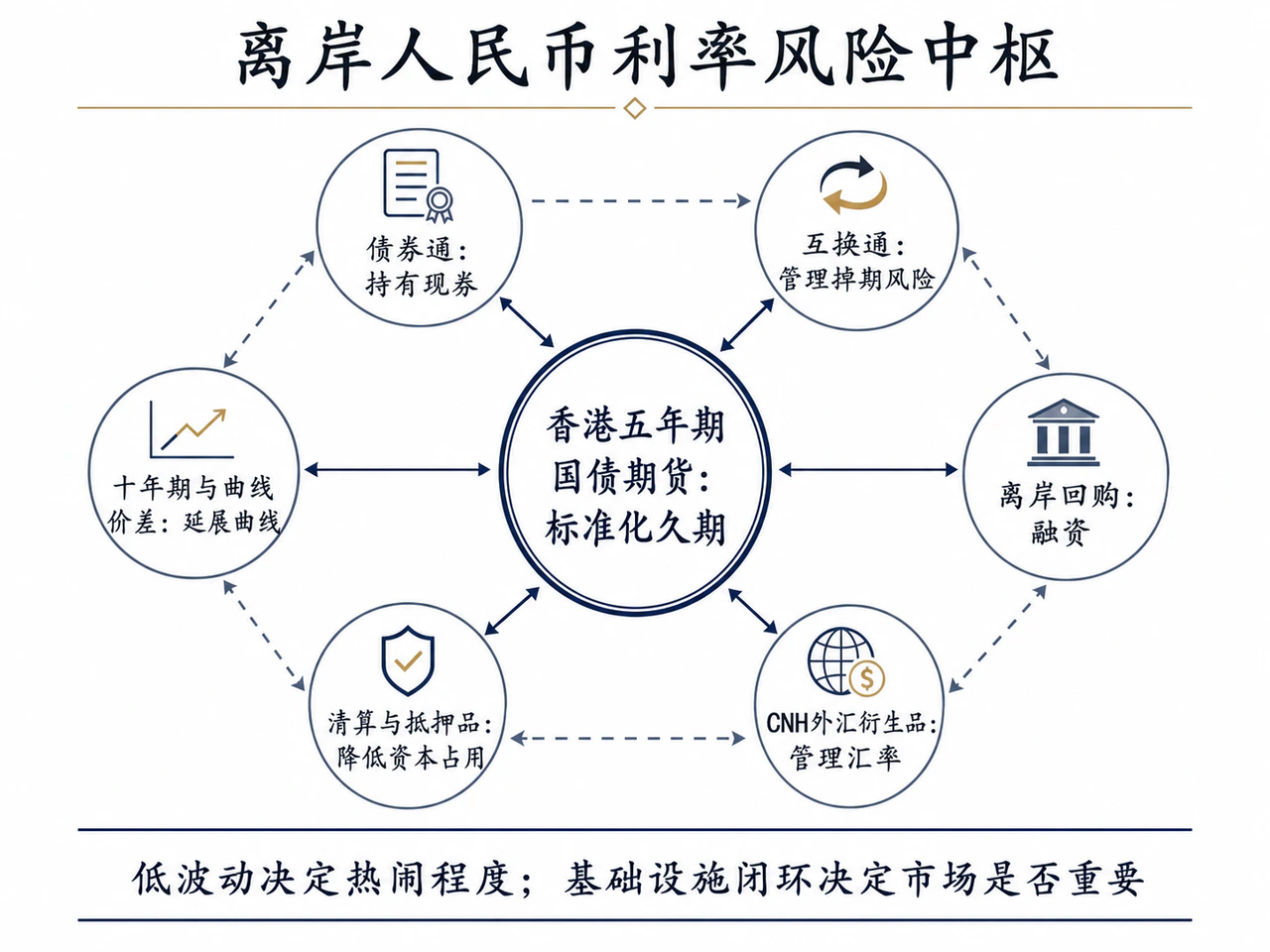
Hong Kong need not and cannot quickly replicate CME's 8.3 million daily contracts. Its immediate mission is a useful complete RMB risk chain: Bond Connect cash allocation, Swap Connect customized IRS, futures standardized duration, offshore repo financing, CNH FX hedges and multi-asset clearing/collateral that releases capital.
If, after 2027 subsidies end, trading again becomes market-makers crossing among themselves, large unarbitrageable basis persists against cash and swaps, and 10-year expansion stalls, the product could repeat 2017 as a policy-supported display rather than a commercially viable market.
Conversely, durable cross-cycle 5-year open interest, orderly 10-year and curve-product launches, and genuine cross-system hedging and margin recognition across Bond Connect, swaps, repo and futures would create much more than a new listing: a core offshore center for RMB sovereign pricing and risk management.
Low volatility limits Treasury-style rapid turnover. Whether cash, futures, repo, swaps, FX and clearing form a working loop determines whether this becomes an indispensable global financial foundation.