In the summer of 2026, Wall Street received two confidential prospectuses.
Anthropic confidentially filed for a U.S. listing on June 1; a week later, OpenAI confirmed the same process. According to Reuters, OpenAI could file publicly as early as September, targeting a valuation up to $1 trillion. Anthropic's late-May financing had already raised its post-money valuation to $965 billion, while OpenAI's March round valued it at $852 billion. Before either rang the bell, capital markets had placed both at the threshold of the trillion-dollar club.
Unlike the stage a few months earlier, when frontier narratives alone carried valuations, both now have substantial revenue support. By end-July, Anthropic's latest monthly revenue annualized to more than $65 billion; OpenAI's latest run rate was about $40 billion. Their combined roughly $105 billion revenue scale is a large commercial engine, supported by global users, long-term enterprise contracts, mature developer ecosystems and brand premiums. The weakness remains the income statement: OpenAI is still consuming cash rapidly, while Anthropic has only just crossed quarterly break-even on an adjusted basis.
Coding is the most compelling professional paid use case within this revenue machine. Model-based monitoring by TickerTrends estimated August 10 annualized revenue of about $15.1 billion for Claude Code and $8.8 billion for Codex, totaling $23.9 billion, or 23% of the two U.S. leaders' run rate. Including code-related revenue generated by third-party applications such as Cursor and Lovable calling underlying APIs, coding may already account for 30%–40% of their actual business. This is a cautious estimate based on task characteristics and API usage, not audited disclosure, but it better fits actual industry cash flows than the claimed 17.9% identifiable in accounts.
That raises harder questions. With the two specialist model companies already valued at nearly $2 trillion together, how much more penetration can coding deliver? Can digital content, everyday office work and enterprise agents take over? Will their new budgets remain with underlying model companies, or be captured by IDEs, office suites, distributors and cloud platforms?
This article focuses on narrowly defined large-model companies whose core revenue and valuation come from foundation models, APIs and owned AI-native applications. Diversified giants including Google, Microsoft, Amazon, Meta, Alibaba, Tencent and ByteDance are excluded from the core valuation sample and used only as market-size and commercial-pricing benchmarks. Data run through August 24, 2026. Listed values use August 21 closes; private values use the latest completed financing's post-money valuation. Proposed rounds are reference only.
A global valuation divide: the top two operate on a different scale
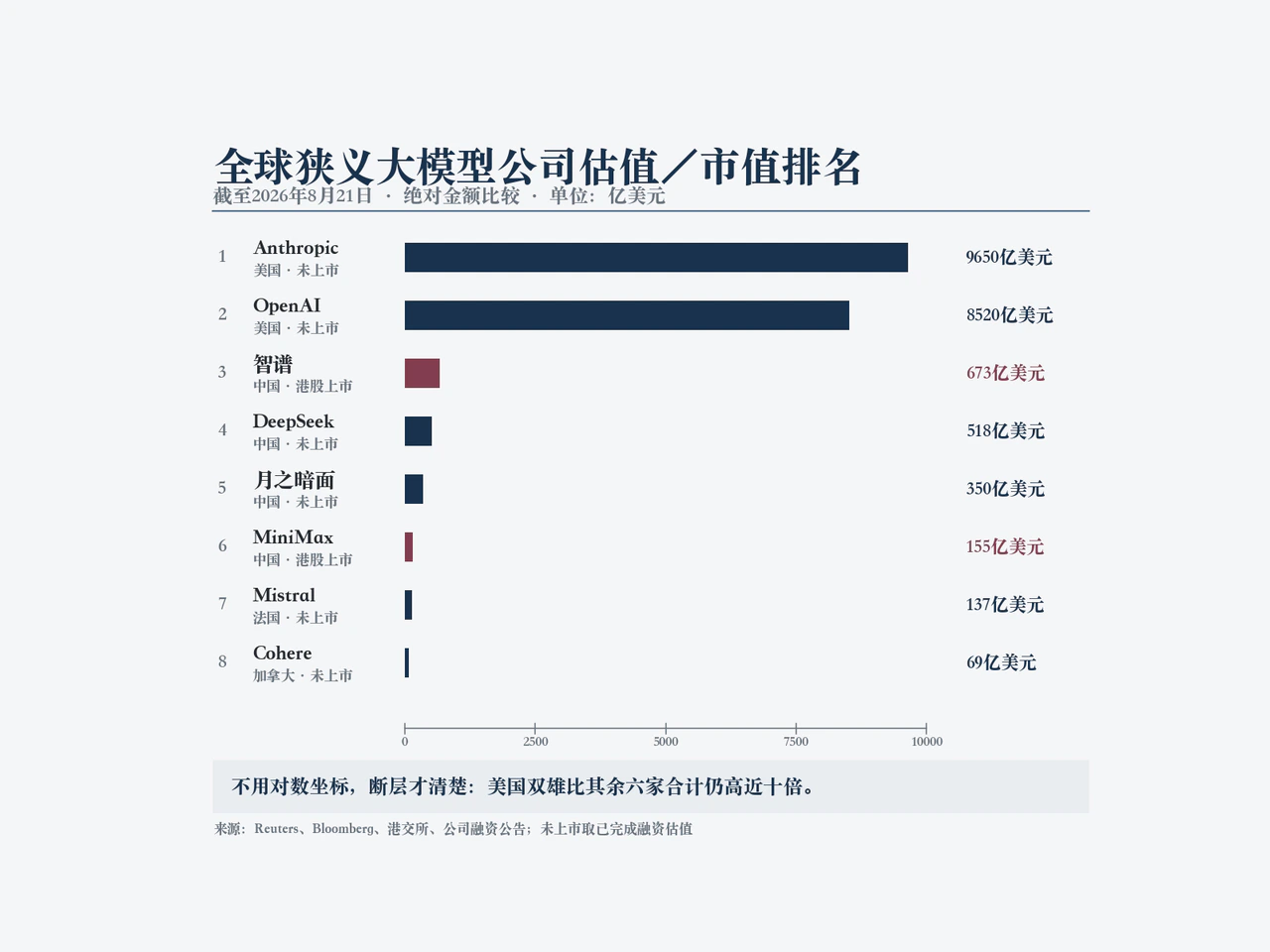
A single linear valuation axis makes the divide clear. Anthropic is worth $965 billion and OpenAI $852 billion. Third-ranked Zhipu's roughly $67.3 billion is less than 7% of Anthropic's value. The leaders total $1.82 trillion, against only about $190 billion for the next six combined, a gap approaching tenfold.
Chinese model developers form the second group. As of August 21, Zhipu was worth about HK$525.7 billion, or $67.3 billion. DeepSeek's latest completed round valued it near $51.8 billion; a rumored $74 billion remained a negotiating target. Moonshot AI's latest closed post-money valuation was $35 billion, with a proposed $50 billion also uncompleted. MiniMax's value was about HK$121.3 billion, or $15.5 billion.
European and Canadian representatives ranked further back. France's Mistral completed financing at €11.7 billion, about $13.7 billion; Canada's Cohere was valued near $6.9 billion. On a nonlogarithmic chart, the next six companies' bars almost hug the axis. This stark contrast captures the reality: the independent global model ecosystem has not developed a graduated hierarchy; it has split into two giants and a group of regional pursuers.
Capital monetization paths differ as well. U.S. firms use deep private liquidity to reach the trillion-dollar threshold before public scrutiny. China's Zhipu and MiniMax listed earlier and face daily pricing of growth, losses and new-product commercialization. China gained two strictly audited pure-model financial statements earlier, while U.S. peers achieved global revenue scale first.
The U.S. leaders: commercialization is established, profitability is not
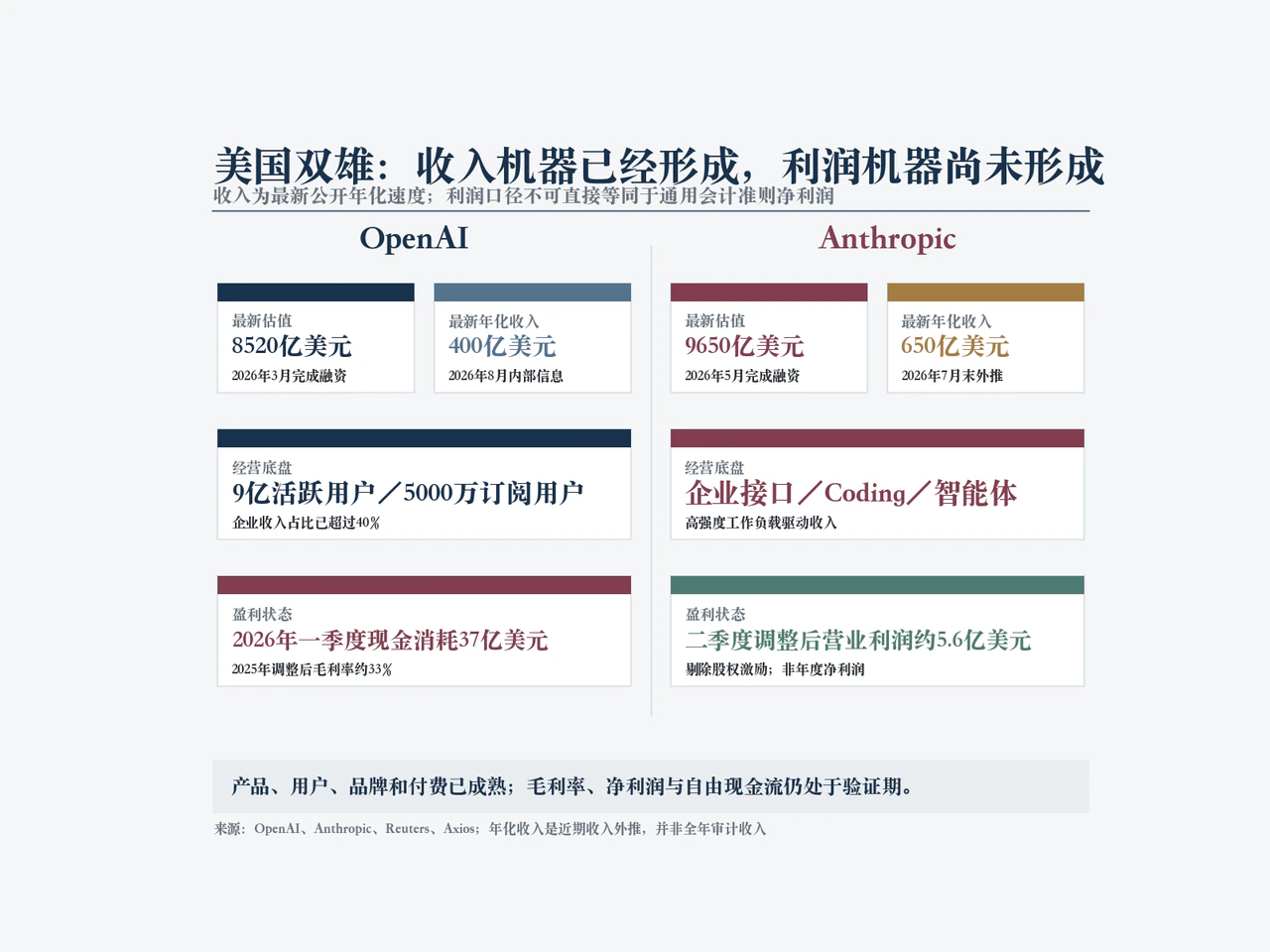
OpenAI's foundation remains a consumer internet product. Actual 2025 revenue was about $13 billion and first-quarter 2026 revenue $5.7 billion. In March it reported about 900 million active users and 50 million paying subscribers. Enterprise revenue has passed 40%, with management expecting nearly half by year-end. In mid-August, cofounder Greg Brockman told staff the latest run rate had exceeded $40 billion (Axios; OpenAI business update).
Scale and brand awareness have not produced healthy costs. OpenAI's 2025 net cash burn was about $8 billion, inference spending increased fourfold and adjusted gross margin fell from 40% to 33%. It burned another $3.7 billion in the first quarter of 2026. Management estimated cumulative computing-infrastructure spending around $600 billion by 2030 and told investors accounting profitability was unlikely before then (Reuters).
Anthropic lacks ChatGPT's mass traffic funnel but established an early position in heavy enterprise API, coding and agent workloads. Annualized revenue rose from $9 billion at end-2025 to $14 billion in February 2026, $47 billion in May and more than $65 billion by end-July (Reuters). Actual first-quarter revenue was about $4.8 billion and second-quarter estimated revenue above $11.5 billion. The second quarter recorded roughly $560 million in adjusted operating profit, excluding stock compensation. This was not GAAP net profit, much less positive free cash flow (Reuters).
The $65 billion run rate also contains measurement amplification. Anthropic multiplies the latest 28 days' consumption by thirteen and monthly subscriptions by twelve. It recognizes third-party cloud resale gross, while OpenAI deducts channel revenue shares. With Anthropic's total recognized 2023–2025 revenue only more than $5 billion, annualizing one explosive month to $65 billion demonstrates remarkable growth but carries linear-extrapolation risk.
Commercialization by the two leaders is therefore established within limits. They have validated products globally, built brands and cultivated payment behavior, leaving pure narrative fundraising behind. Yet gross margins, true net profit and free cash flow have not formed a stable self-funding loop. OpenAI seeks to use mass traffic to support enterprise software and Codex; Anthropic emphasizes high-ARPU corporate customers. One must prove traffic can keep converting into high-priced workflows; the other must prove intense short-term usage becomes sustainable annual retained cash.
China's four leaders: competitive products, but revenue still catching up globally
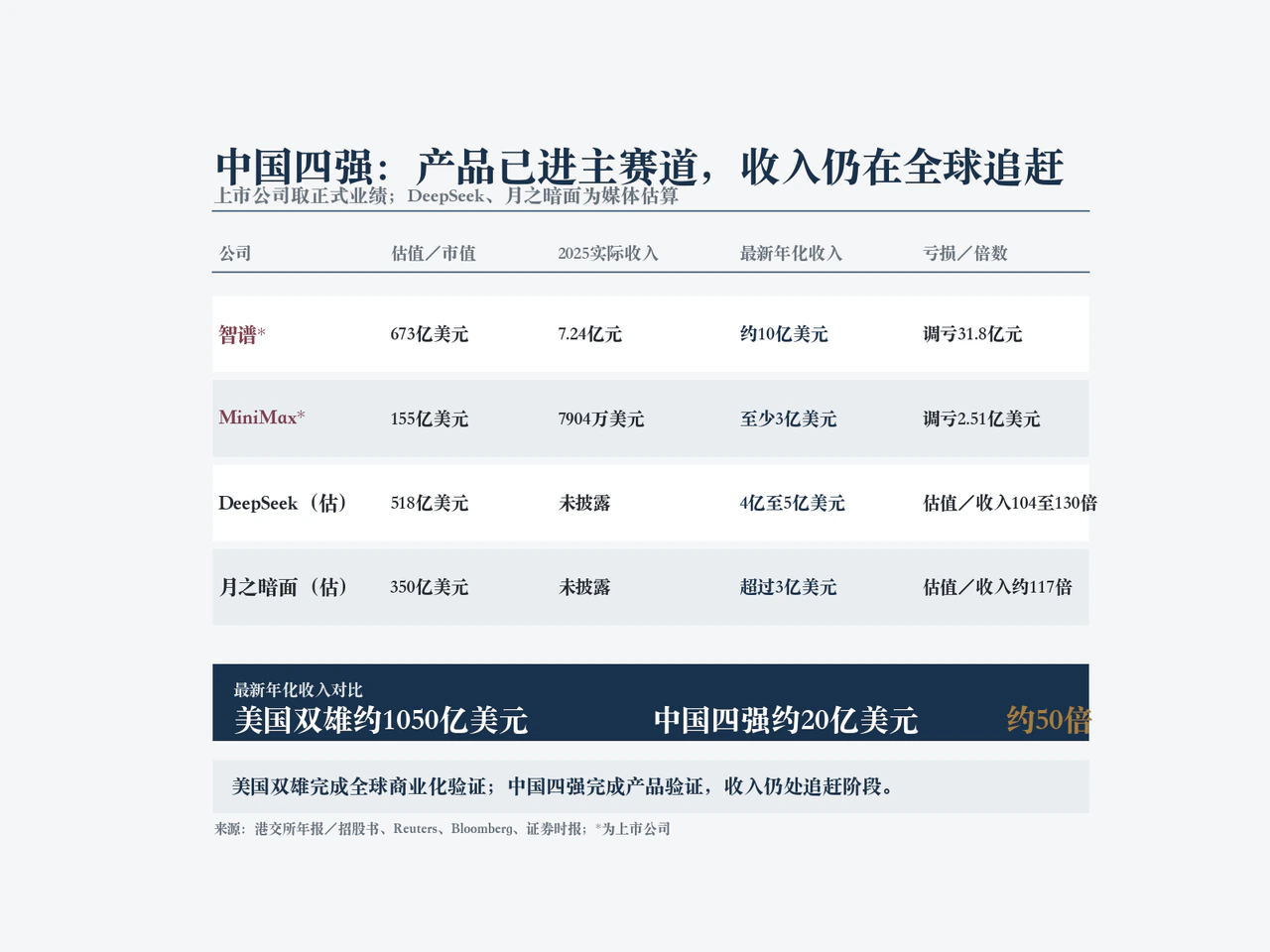
Chinese teams are present in the main product and technology contests. Zhipu has established a coding-community position, DeepSeek penetrates overseas developer circles with open models, Moonshot grows rapidly in long text and APIs, and MiniMax monetizes multimodal, speech and overseas apps. On financial scale, however, the gap remains an order-of-magnitude issue.
Zhipu's 2025 accounts show RMB724 million in revenue, up 132%; 41% gross margin; RMB4.718 billion net loss and RMB3.182 billion adjusted net loss. R&D was RMB3.18 billion, 4.4 times revenue. Local private deployment supplied RMB534 million, or 74%, versus RMB190 million from standardized cloud and model APIs. At end-2025 it was closer to a customized privately deployed software-solutions provider built around large models than a high-margin global SaaS platform (Zhipu annual report; Reuters).
Expansion in 2026 is breaking out of that old account. In March, Zhipu disclosed MaaS ARR of about RMB1.7 billion, up 60-fold over twelve months. First-quarter usage grew 400% despite an 83% API price rise. Bloomberg reported in July that its monthly run rate annualized to roughly $1 billion. A monthly annualization is not cash booked for a half-year, but helps explain a public valuation of $67.3 billion.
MiniMax's 2025 revenue was $79.04 million, up 159%, with 25% gross margin, $253 million R&D and a $251 million adjusted net loss. AI-native applications supplied 67% of revenue and open platforms and enterprise services 33%; overseas markets contributed more than 70% (Company results). In May it told Bloomberg ARR had passed $300 million, with more than 1 million enterprise and developer users.
DeepSeek has not publicly disclosed unaudited income statements. The Information reporting and Reuters Breakingviews put recent annualized revenue at $400 million–$500 million, mainly cloud model usage and API distribution. Its completed $51.8 billion valuation implies 104–130 times sales. Discussion of a single model's cheap training cannot obscure the total bill for continuing inference infrastructure.
Moonshot also lacks public financial statements. Aggregated reports put annualized revenue above $100 million in March, $200 million in May and $300 million by mid-June, with APIs supplying more than 70%. A $35 billion post-money valuation implies about 117 times sales (Bloomberg; Securities Times). Its API workloads include extensive general search, routine reading and agents and cannot all be assigned to coding.
On the latest annualized basis, the U.S. pair totals about $105 billion versus roughly $2 billion for China's four, a difference around 50-fold. Even allowing for reporting lags in China, the absolute scale gap remains a short-term reality.
The U.S. leaders have established global monetization in the tens or even hundreds of billions of dollars. China's leading teams have demonstrated internationally competitive models, but are still scaling monetization in domestic and selected overseas markets. Chinese valuations price the potential to move annual revenue from billions to tens of billions of renminbi; U.S. valuations bet that a $100-billion revenue base can keep doubling and eventually deliver cash flows worthy of trillion-dollar giants.
Unpacking U.S. revenue: web chat, enterprise seats, APIs and coding
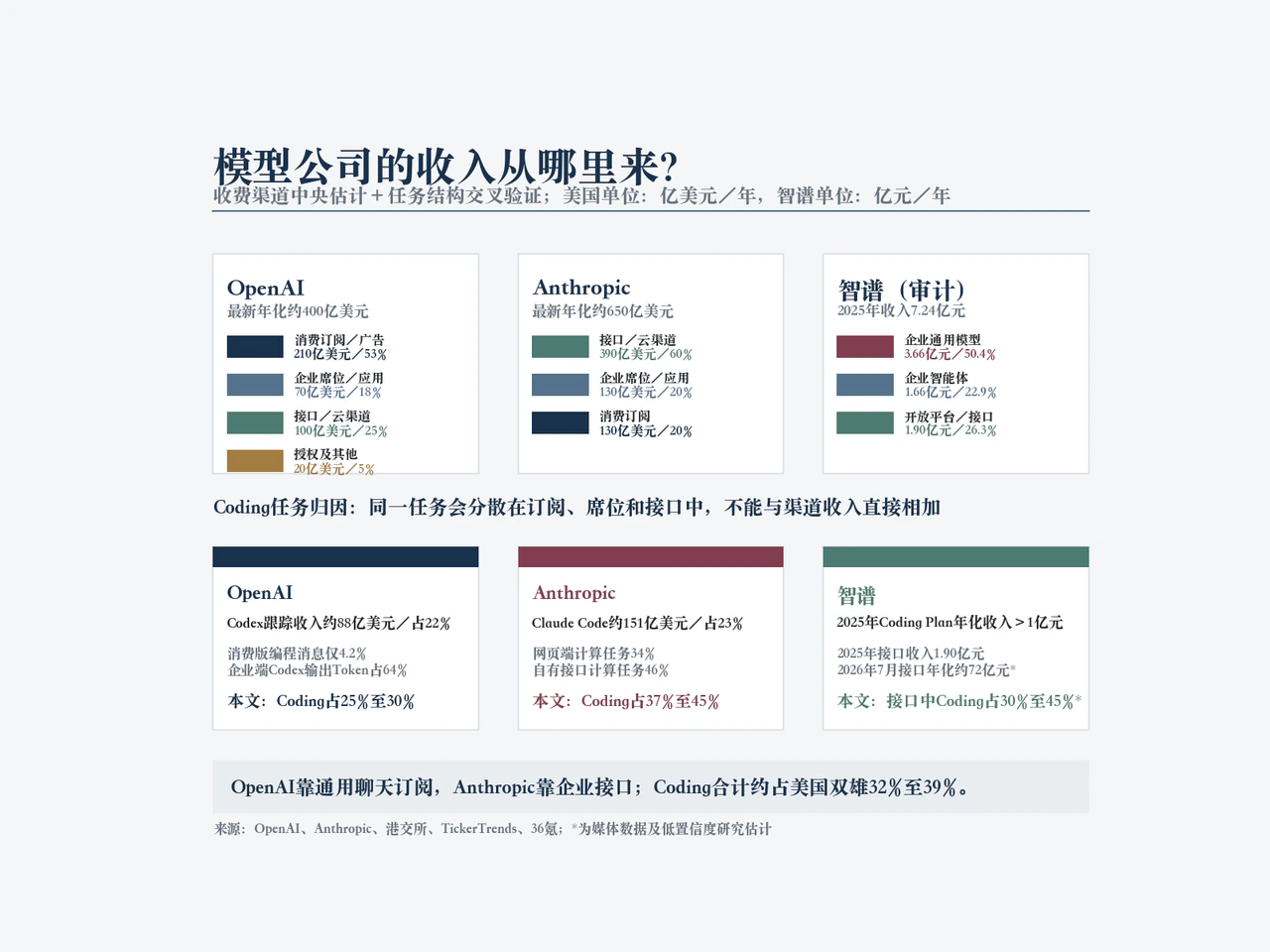
Assessing coding's contribution requires separating three easily confused dimensions: the payer, individual or enterprise; the charging channel, SaaS subscriptions, metered tokens, cloud resale shares or private deployment; and the task, casual chat, writing, research, code development or process execution.
These dimensions overlap. A ChatGPT Plus subscriber may mainly use Codex; a Cursor customer consumes Claude tokens underneath; an enterprise Claude seat may cover legal review and coding together. Adding subscriptions, APIs and coding as parallel categories creates severe double-counting. A financially coherent reconstruction first separates billing channels, then attributes underlying tasks across them.
The following table uses public evidence and estimation models through August 24 to give central estimates and ranges for the companies' latest annualized revenue:
| Latest annualized basis | Consumer subscriptions and advertising | Enterprise seats and owned applications | APIs and cloud channels | Licensing and other |
|---|---|---|---|---|
| OpenAI: about $40 billion | About $21 billion ($18 billion–$23 billion) | About $7 billion ($5 billion–$9 billion) | About $10 billion ($7 billion–$12 billion) | About $2 billion ($0–$3 billion) |
| Anthropic: about $65 billion | About $13 billion ($10 billion–$13 billion) | About $13 billion ($10 billion–$16 billion) | About $39 billion ($36 billion–$42 billion) | Included in the first three categories |
The central estimates sum to each total run rate, while ranges allow shifts in channel boundaries. Confidence is relatively high in OpenAI's consumer-subscription estimate and moderate in the enterprise-seat/API division. Anthropic's 80% enterprise contribution has explicit support, but exact internal API versus suite shares require inference. Cloud-settlement accounting differences are another potential error source.
OpenAI: web chat remains the cash cow, while coding reshapes enterprise revenue
Management supplies the main dividing line. Its chief revenue officer said in April that enterprise contribution had exceeded 40%, with a year-end target of half (OpenAI). Applied to the latest $40 billion run rate, that means at least $16 billion from enterprise and a maximum $24 billion from consumers and other sources. The CFO also said 95% of ChatGPT's roughly 900 million weekly active users were free (AP). Alongside March's 50 million subscribers, this remains an internet platform converting a small group of heavy users from vast free traffic.
At 50 million subscribers paying the standard $20 monthly, annual revenue would be $12 billion. This article's $21 billion consumer central estimate implies substantially higher spend: about $35 monthly ARPU on a static 50 million users. That premium is reasonable given the $200 Pro tier, Go subscriptions, advertising trials and e-commerce referral shares. Without detailed tier distribution, $18 billion–$23 billion is a reasonable estimation range.
Enterprise revenue divides into seat software and APIs. ChatGPT enterprise work seats exceeded 7 million at end-2025. At $25–$60 per seat monthly, annual list-price revenue would be $2.1 billion–$5 billion (OpenAI enterprise report). Growing seats and additional token charges for Codex make a current $5 billion–$9 billion run rate for enterprise seats and first-party tools well supported.
Throughput also checks API scale. OpenAI says its API processes more than 15 billion tokens per minute, around 7.9 quadrillion annually. An effective $0.9–$1.5 per million tokens, allowing for distilled small models, prompt-cache discounts, input/output differences and major-account agreements, implies annual API revenue of $7.1 billion–$11.8 billion, closely matching this article's $7 billion–$12 billion range. Approximately $7 billion of seats plus $10 billion of APIs would contribute about 43% of the total.
Channels identify where funds pass; tasks identify what customers pay for. OpenAI's consumer ChatGPT research puts pure coding at only about 4.2% of messages, with most traffic in everyday questions, search and writing (OpenAI research). Its foundation remains broad general interaction rather than coding alone.
Enterprise evolution is different. By June, Codex accounted for 64% of all output tokens from enterprise customers. Codex weekly usage growth in legal, sales, HR and marketing roles outpaced that among traditional software engineers (OpenAI Enterprise Signals). Longer outputs and higher computing cost do not directly equal revenue share, but clearly show business growth shifting from general conversation toward code-executing workflow agents.
TickerTrends estimated Codex annualized revenue around $8.8 billion on August 10, about 22% of total revenue and 45% of enterprise revenue. Including hidden underlying-model revenue from independent tools such as Cursor that is not labeled Codex, this article estimates OpenAI's total coding-driven business at $10 billion–$12 billion, or 25%–30%. Mass chat subscriptions underpin OpenAI, while coding is central to its transition into high-value enterprise software.
Anthropic: APIs are the engine, with coding embedded in APIs, seats and subscriptions
Anthropic's focus is almost the reverse. More than 300,000 business customers contribute about 80% of total revenue, according to Reuters. By April 2026, more than 1,000 customers spent over $1 million annually on its platform. It did not build free-chat territory first and slowly convert it to business. From the outset it has been infrastructure driven by developer workflows, cloud channels and underlying APIs.
Earlier management plans envisaged about two-thirds of 2027 revenue from APIs, mainly through public clouds such as AWS (The Information). Claude is now available across AWS, Google Cloud and Microsoft Azure. Anthropic recognizes cloud resale gross: the full customer payment to the cloud vendor counts as revenue, with the cloud share in cost of sales. This gives headline revenue greater elasticity than OpenAI's net method and has prompted questions about how much substance lies behind the $65 billion figure.
On that basis, this article divides the $65 billion run rate into about $39 billion, or 60%, for APIs and cloud; $13 billion, or 20%, for organizational seats and applications such as Claude Enterprise, Team and Cowork; and $13 billion, or 20%, for consumer Pro and Max subscriptions. The 80% enterprise share effectively caps consumers near $13 billion.
This channel account still does not capture coding's full reach, because Claude Code is not a separate financial segment. Individuals upgrading Pro/Max, teams buying Team and developers paying by use through AWS Bedrock, Vertex AI or outside IDEs may all be funding the same engineering-code demand. Coding tasks are dispersed across three billing funnels.
The first anchor is first-party products. Anthropic confirmed Claude Code passed $2.5 billion annualized in February; TickerTrends estimates roughly $15.1 billion by August, directly providing 23% of total revenue. The second anchor is underlying tasks. Anthropic's Economic Index puts computer and mathematical tasks at 34% of Claude web interactions and 46% of first-party API usage, noting that most are closely tied to development (Anthropic Economic Index).
Weighting 60% APIs and 40% subscriptions/seats yields an underlying computer-and-code task share of 41%. Some is mathematical analysis, but coding generally produces denser outputs and deeper computing use, raising its revenue weight. This article therefore estimates total coding-driven annualized business at $24 billion–$29 billion, or 37%–45%. Beyond the identifiable $15.1 billion Claude Code product revenue, nearly half the contribution is dispersed across external IDEs such as Cursor, internal enterprise scripts and unlabeled coding workloads.
Noncode revenue is not simply casual chat. Routine administration and office automation—email, document cleaning, CRM collaboration and scheduling—already account for 13% of API activity. Education and R&D, writing, knowledge search and other agents share the rest. The business is AI infrastructure with model APIs as its engine, coding productivity as its load-bearing pillar and deeper enterprise operations as its expansion path.
Zhipu provides an actual template: four revenue types and two delivery methods
Zhipu's Hong Kong disclosures provide a rare pure-model segment-finance benchmark. Its 2025 accounts divide RMB724 million of revenue into four categories:
| Zhipu 2025 audited basis | Revenue | Share | Gross margin |
|---|---|---|---|
| Open platform and APIs | RMB190 million | 26.3% | 18.9% |
| Enterprise agents | RMB166 million | 22.9% | 52.3% |
| Enterprise general-purpose large models | RMB366 million | 50.4% | 47.0% |
| Technical services and other | RMB2.54 million | 0.4% | 92.0% |
By delivery, cloud subscriptions and usage contributed RMB190 million, 26.3%, and private deployment RMB534 million, 73.7% (Zhipu annual results). This maps to the U.S. pair: platforms correspond to metered APIs and cloud distribution; agents to workflow suites such as Cowork and Workspaces; general models to basic enterprise licenses; and Coding Plan and ChatGPT/Claude to standardized subscriptions. The fundamental difference is overseas customers' strong preference for cloud-native delivery versus China's historically private-deployment-led government and enterprise market.
The account also shows a harsh gross-margin divide. Zhipu's API revenue nearly tripled in 2025 but gross margin was only 18.9%, versus 52.3% for enterprise agents and 47.0% for privately deployed general models. Standardized token wholesaling scales revenue easily, but computing and bandwidth consume margins. Customized enterprise solutions have higher margins but depend heavily on sales, implementation and long collection periods, creating natural scaling limits.
In 2026, revenue began departing from those old accounts. GLM Coding Plan passed RMB100 million annualized and 150,000 paying developers in December 2025 (Shanghai Securities News). By March 2026 developers reached 242,000 and prices rose 30%. With stable user segmentation, those changes alone imply roughly RMB210 million annualized. Against platform MaaS ARR around RMB1.7 billion, direct code subscriptions represented about 12% of API revenue.
June's GLM-5.2 release marked a turning point. 36Kr cited shareholder-side data putting May API annualized revenue at $500 million–$600 million and July near $1 billion, about RMB7.2 billion; the company declined comment (36Kr report). Coding is GLM-5.2's key use case. Vercel monitoring ranked its year-to-date usage growth first, while frontline cloud sales confirmed a large shift in demand toward it.
The latest Coding Plan split is not public. Starting from March's roughly RMB210 million run rate and allowing for later pricing and GLM-5.2, this article estimates July direct individual code subscriptions at RMB200 million–RMB500 million, only 3%–7% of the RMB7.2 billion total. Much larger volumes are packaged as general tokens and third-party usage. Product positioning, developer growth and supply-chain checks support a low-confidence estimate: coding tasks may provide 30%–45% of July API annualized revenue, about RMB2.2 billion–RMB3.2 billion, mostly large-scale enterprise and aggregator token consumption rather than individual monthly subscriptions.
Together, the three companies place coding's share more precisely around 30%–40%
The central U.S. estimates are $10 billion–$12 billion for OpenAI and $24 billion–$29 billion for Anthropic, totaling $34 billion–$41 billion. Against their $105 billion combined run rate, direct and indirect coding penetration is 32%–39%. This combines channel reconstruction, seat pricing, token throughput and underlying tasks, rather than one isolated third-party estimate.
Dependence differs. OpenAI remains a global general-chat gateway, with coding supplying a quarter to 30% and lifting enterprise spend. Anthropic is API-led, with coding close to 40% and a core valuation pillar. Zhipu changed course in 2026 from labor-intensive private deployment toward scaled MaaS led by code capability.
This explains why Claude Code ARR alone is incomplete. Trillion-dollar expectations depend on code generation evolving from an isolated personal copilot into industrial workloads spanning subscriptions, organizational seats, APIs and cloud distribution. Current penetration indicates that the first positioning stage is complete.
Trillion-dollar valuations in U.S. stocks: already high in value, still low in financial scale
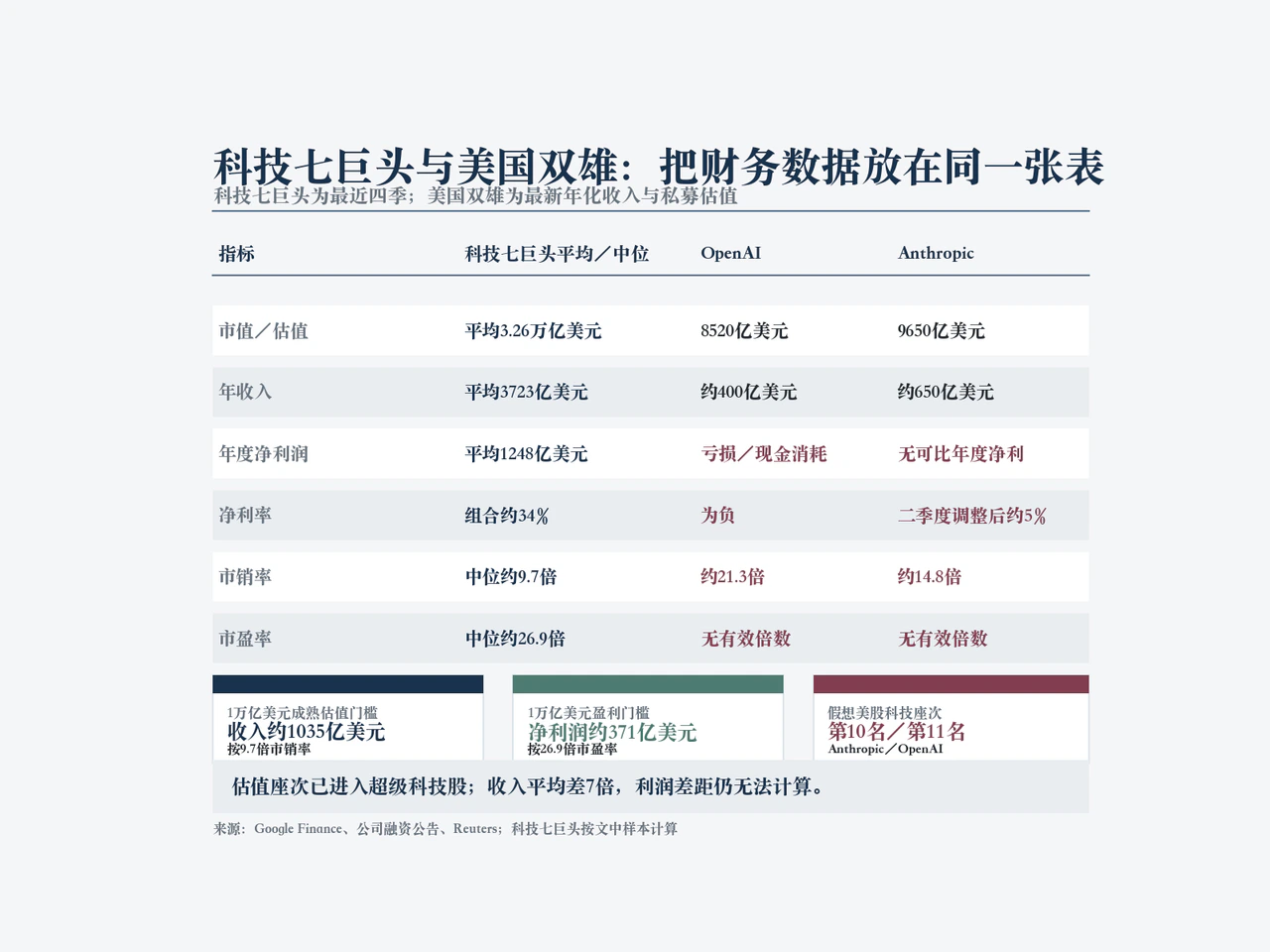
At August 21 closes, leading U.S. platform values were Nvidia $5.20 trillion, Apple $4.51 trillion, Alphabet $4.20 trillion, Microsoft $3.59 trillion, Amazon $2.79 trillion, SpaceX $1.86 trillion, Broadcom $1.75 trillion, Meta $1.40 trillion and Tesla $1.14 trillion. Transferring current private values directly into that ranking places Anthropic tenth and OpenAI eleventh, above only Oracle near $422 billion and Palantir $418 billion.
Even at exactly $1 trillion each, they would remain below Tesla and outside the strict Magnificent Seven. A trillion is now only an entry threshold for top U.S. technology platforms. The Seven average $3.26 trillion and have a median near $3.59 trillion.
The financial-statement gap is more striking:
-
The Magnificent Seven generated about $2.61 trillion revenue over the latest four quarters, averaging $372.3 billion each. The model pair's latest combined annualized revenue is only $105 billion, averaging $52.5 billion. The former's per-company revenue is more than seven times greater.
-
The Seven generated about $873.7 billion net profit, averaging $124.8 billion, with a combined margin around 34%. OpenAI is still burning cash heavily and Anthropic is only slightly profitable on adjusted operating terms. Neither has established annual GAAP net profitability.
-
The Seven's median P/S is about 9.7 and median P/E 26.9. On the latest run rates, Anthropic is about 14.8 times sales and OpenAI 21.3, with a weighted average 17.3. Persistent losses leave neither with a meaningful P/E anchor.
Working backward, a $1 trillion technology company valued at 9.7 times sales requires annualized revenue above $103.5 billion; at 26.9 times earnings it needs $37.1 billion annual net profit. Anthropic must expand its $65 billion ARR another 60%, and OpenAI its $40 billion by another 1.6 times, to reach the revenue threshold. For the tens of billions of net profit required, neither has yet laid firm foundations.
This does not make current values entirely imaginary; fast-growing firms deserve a premium for credible growth. But markets have prepaid three difficult options: very rapid compounding on a $100-billion revenue base; computing and distribution costs not further consuming gross margin; and model makers building durable workflow barriers rather than becoming interchangeable pipes. Failure on any could contract multiples much faster than revenue slows.
Coding's ceiling: seats are insufficient; software labor budgets are the next market
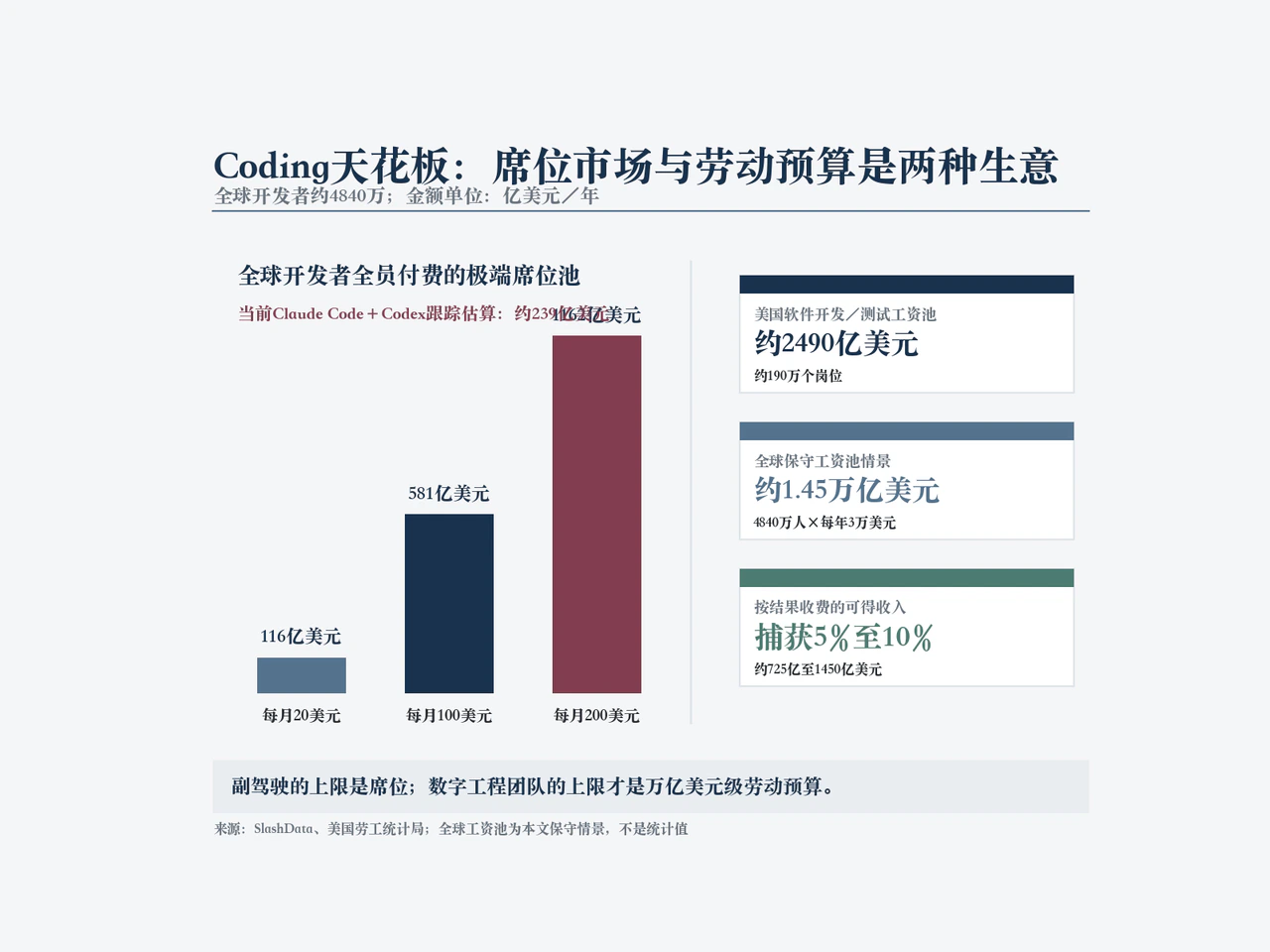
SlashData estimates 48.4 million global developers in 2025. In an extreme scenario where every developer buys the same AI tool, $20 monthly gives an industry ceiling of only $11.6 billion. Even $100 produces $58.1 billion; $200 reaches just $116.2 billion.
Two conclusions follow. The estimated $23.9 billion already generated by Claude Code and Codex exceeds the theoretical $20-per-developer seat pool, confirming that enterprise consumption and API integration support much of the bill. Even universal $100 subscriptions would generate only $58.1 billion, roughly half the revenue required for a trillion-dollar valuation, before claims by VS Code, JetBrains, agent wrappers and cloud giants.
Coding must therefore move beyond selling SaaS seats into trillion-dollar software labor budgets. U.S. development and QA employ about 1.9 million people, with median annual pay near $131,000 and total pay around $249 billion. Charging by task, delivered functionality or outcomes could unlock $25 billion from replacing just 10% of that labor budget in the United States. Globally, 48.4 million workers at a conservative all-in $30,000 annual cost imply $1.45 trillion. Capturing 5% gives $72.5 billion and 10% $145 billion annually.
That demands capabilities far beyond single-line completion. Real engineering agents must understand million-line codebases, run tests and diagnose bugs, manage access and secrets compliantly, submit changes for security audit, and provide rigorous rollback and human takeover. Only control of code context, runtime sandboxes, engineering audit and end-to-end delivery can turn a tool costing tens monthly into participation in hundreds of billions of labor spending.
Coding has two distinct ceilings: copilot seats, a market approaching saturation in the tens of billions, and digital-engineer labor replacement, a trillion-dollar employment budget. Current revenues demonstrate rapid penetration of the first, while nearly $2 trillion in valuations prepaid the probability of the second.
Beyond coding: the largest new opportunities are content, office work and executable services, rather than film alone
Coding alone cannot sustain expansion of a trillion-dollar empire. Three parallel curves are more likely: digital production makes creators and marketers frequent buyers; office agents compete for hundreds of millions of white-collar workflows; and process and service agents target heavy outsourcing and operating labor costs. All require moving from generating text and images to delivering defined business outcomes.
Digital content: professional creators are a much larger market than filmmaking
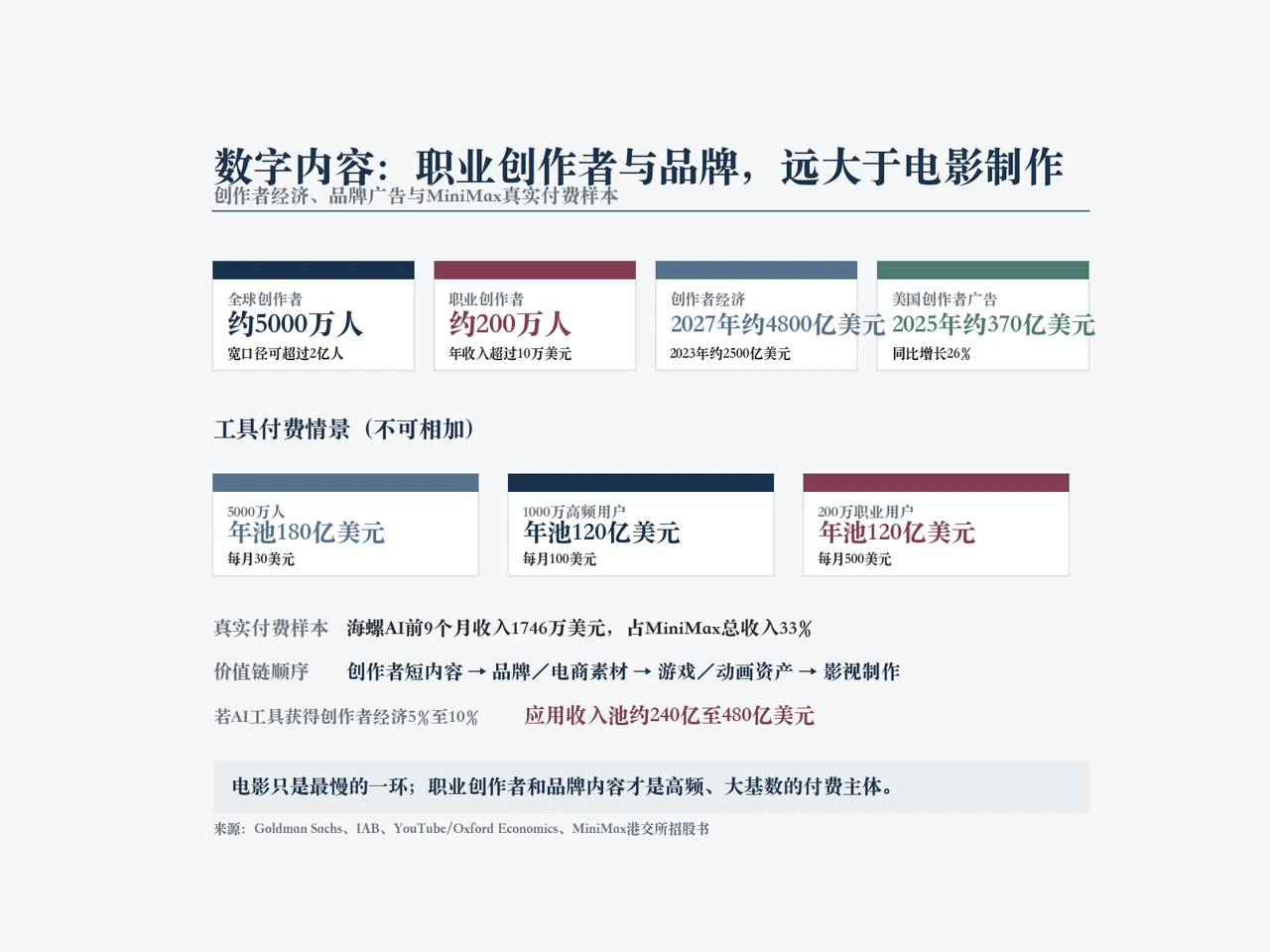
Equating multimodal AI narrowly with replacing Hollywood understates the opportunity. Theatrical film has long production chains, complex rights, strict review and slow adoption. Frequent payments already come from tens of millions of creators updating YouTube, TikTok, Xiaohongshu, Douyin and cross-border e-commerce, and brands continually needing large volumes of marketing material.
Goldman Sachs estimates about 50 million creators and a creator economy expanding from roughly $250 billion to $480 billion by 2027. About 4%, or 2 million, earn more than $100,000 annually and are professional creators with strong willingness to pay. Broader definitions exceed 200 million audiovisual creators, but occasional amateurs are unlikely to form a stable business-payment foundation.
Three alternative scenarios illustrate professional tools: 50 million creators paying $30 monthly produce $18 billion annually; 10 million frequent core users paying $100 produce $12 billion; 2 million leading professionals paying $500 for a toolkit also produce $12 billion. These cannot be added. They locate potential creator tools in the tens of billions, well above the existing multibillion-dollar film-postproduction and effects-software market.
Brand marketing provides a deeper revenue stream. U.S. brand budgets flowing to creators reached $37 billion in 2025, up 26% (IAB). YouTube's U.S. ecosystem alone contributed roughly $55 billion to GDP and supported about 490,000 full-time-equivalent jobs (YouTube/Oxford Economics reporting). Brands and professional creator networks need industrial pipelines rather than a dazzling fifteen-second demo: topics, storyboards, key images, audiovisual composition, localization, covers, A/B edits and post-distribution data feedback.
MiniMax offers a paid example. Hailuo AI generated $17.46 million in the first nine months of 2025, one-third of total revenue, with 5.65 million average monthly users, 311,000 converted paying users and ARPPU of $56 (HKEX prospectus). Its video models had generated more than 600 million videos by end-2025. The new H3 offers native 2K output, spatial stereo and fine camera-motion editing for advertising, e-commerce and game assets (Reuters).
Multimodal adoption will likely progress from short social-video material to e-commerce ad clips, games and 3D assets, film storyboards and effects, then industrial long-form production. Film is the crown jewel, but frequent everyday marketing sustains cash. AI production tools capturing 5%–10% of the $480 billion creator economy could create a $24 billion–$48 billion application ecosystem. Model makers' share depends entirely on controlling workbenches and distribution rather than becoming rendering APIs in the background.
Office work: Microsoft establishes the ceiling while China tests payment conversion
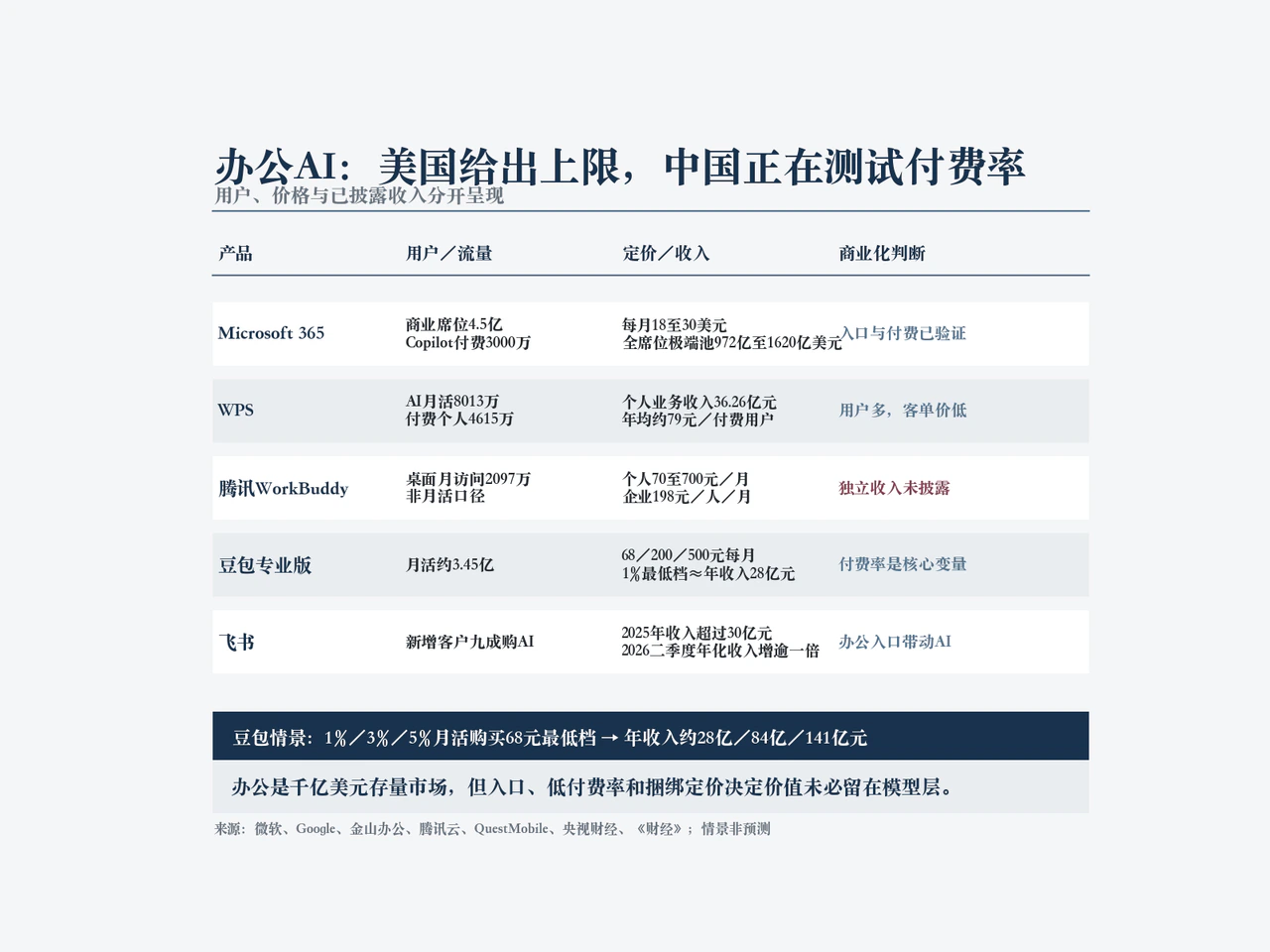
Unlike specialized coding, general office work serves hundreds of millions. Email, minutes, document extraction, presentation outlines, spreadsheet cleaning and cross-application approvals do not always require full frontier reasoning. The core challenge is integration with organizational mail, cloud drives, calendars, permissions and office workflows, turning isolated text generation into completed enterprise tasks.
Microsoft supplies a market-scale benchmark. Microsoft 365 commercial paid seats exceed 450 million, with just over 30 million paying for Copilot, penetration below 7%. At $18–$30 monthly, those seats imply annual list-price revenue of about $6.5 billion–$10.8 billion. Full conversion of all 450 million would imply $97.2 billion–$162 billion. Against around $140 billion annual revenue in Microsoft's Productivity and Business Processes segment, including roughly $103 billion from M365 commercial products and cloud services, office software is already a $100-billion-plus ecosystem.
Google's pricing defense matters. In 2025 it bundled Gemini throughout Workspace. AI previously priced separately near $20 added only about $2 over the old basic fee within the new package (Google announcement). This reveals SaaS platforms' strategy: AI defends retention and their franchise rather than serving only as a separate surcharge. Price wars to protect software gateways strongly constrain pure-model vendors.
China's monetization is more locally specific. Kingsoft Office reported 678 million global monthly active WPS Office devices, more than 80.13 million domestic WPS AI monthly users and 46.15 million annual individual paying members. Personal subscriptions generated RMB3.626 billion in 2025, roughly RMB79 per paying user annually (Kingsoft Office annual report). Personal software spending is far below mature North American levels.
Tencent is moving quickly in enterprise workbenches. WorkBuddy desktop visits reached 20.97 million in June 2026, first among seventeen mainstream Chinese office agents (Analysys data reporting). Individual plans cost RMB70, RMB140 and RMB700 monthly; enterprise flagship pricing is RMB198 per person monthly (Tencent Cloud pricing; WorkBuddy). Visits differ from actual MAU, but revenue sensitivity is clear: each 1 million consumers at RMB100 monthly means RMB1.2 billion annually; each 1 million enterprise seats at RMB198 means about RMB2.4 billion.
ByteDance's Doubao has a large traffic reservoir. Third-party figures put first-quarter 2026 MAU near 345 million. On June 24 it launched RMB68, RMB200 and RMB500 professional plans for development, data processing, design and automation (CCTV Finance reporting). At only 1% of 345 million subscribing to the cheapest plan, annualized revenue would be RMB2.8 billion; 3% gives RMB8.4 billion and 5% RMB14.1 billion. The challenge is overcoming habitual free use and establishing durable paid conversion of a few percentage points, rather than finding traffic.
ByteDance's integration of Doubao with Feishu product development is especially significant. Reports put Feishu's 2025 revenue above RMB3 billion, second-quarter 2026 ARR growth above 100%, and AI upgrades among more than 90% of new customers (Caijing reporting). The triangle of foundation model, collaboration software and sales organization structurally squeezes independent vendors. Gateways, organization structures, approvals and trust remain with platforms. A model supplier relegated to APIs risks a trap in which users belong to applications, profit to distributors and computing costs to the model maker.
A third growth curve: customer service and enterprise processes scale before medicine and law
Beyond desktop work, the next scalable areas after coding are customer service, sales operations automation, accounting and reconciliation, and procurement follow-up, rather than medicine and legal judgments with stringent ethical and error requirements. These back- and middle-office tasks recur frequently, have defined error-handling and measurable results, and already carry large labor and outsourcing budgets.
Gartner predicts autonomous agents will resolve 80% of common service issues without humans by 2029, reducing associated operating costs 30%. Global BPO was about $221 billion in 2024 and is forecast near $268 billion by 2029 (Gartner forecast). Annual wages for roughly 2.6 million U.S. service representatives alone exceed $120 billion. Capturing 10%–20% of existing cost reductions could sustain tens of billions in direct software monetization.
The logic closely resembles coding. Resolved issues, transferred tickets, compliant refunds and returns, and accurately matched accounts have clear evaluation standards. Charging per successfully resolved problem, delivered automated process or share of savings escapes cheap-token cost-plus pricing and aligns directly with existing labor and BPO budgets. Secure ERP/CRM connections, permissions and audit compliance can form strong barriers to competition.
All these estimates assume computing costs and architectures evolve gradually, without a disruptive technical break. Token prices for equivalent inference capability are falling by factors of 5 to 10 annually and mainstream AI-chip energy efficiency improves about 40% yearly. Yet installed computing infrastructure expands at 3.4 times annually, while frontier-model training compute grows about fivefold (Epoch AI; Related research). Unit costs fall while the frontier's total bill grows exponentially. Near-zero marginal computing costs are highly unlikely over the next few years. The IEA projects data-center electricity use from 415TWh in 2024 to 945TWh in 2030. McKinsey estimates $5.2 trillion in new global data-center investment by 2030 just to support AI computing.
This is the central premise of the valuation framework, beyond cost forecasting. If frontier training costs collapse, many more teams could compete and capital moats would vanish. If consumer devices cheaply run near-frontier open models offline, much inference could move from clouds to endpoints, fundamentally rebuilding the centralized API business. Cheaper computing can accelerate applications while triggering price wars that shift profit to devices, vertical-workflow integrators and durable customer relationships. This model excludes that extreme transition; an early technical break would require rebuilding all market-size and valuation scenarios.
The final account: growth opportunities exist, but today's valuation prepays three years
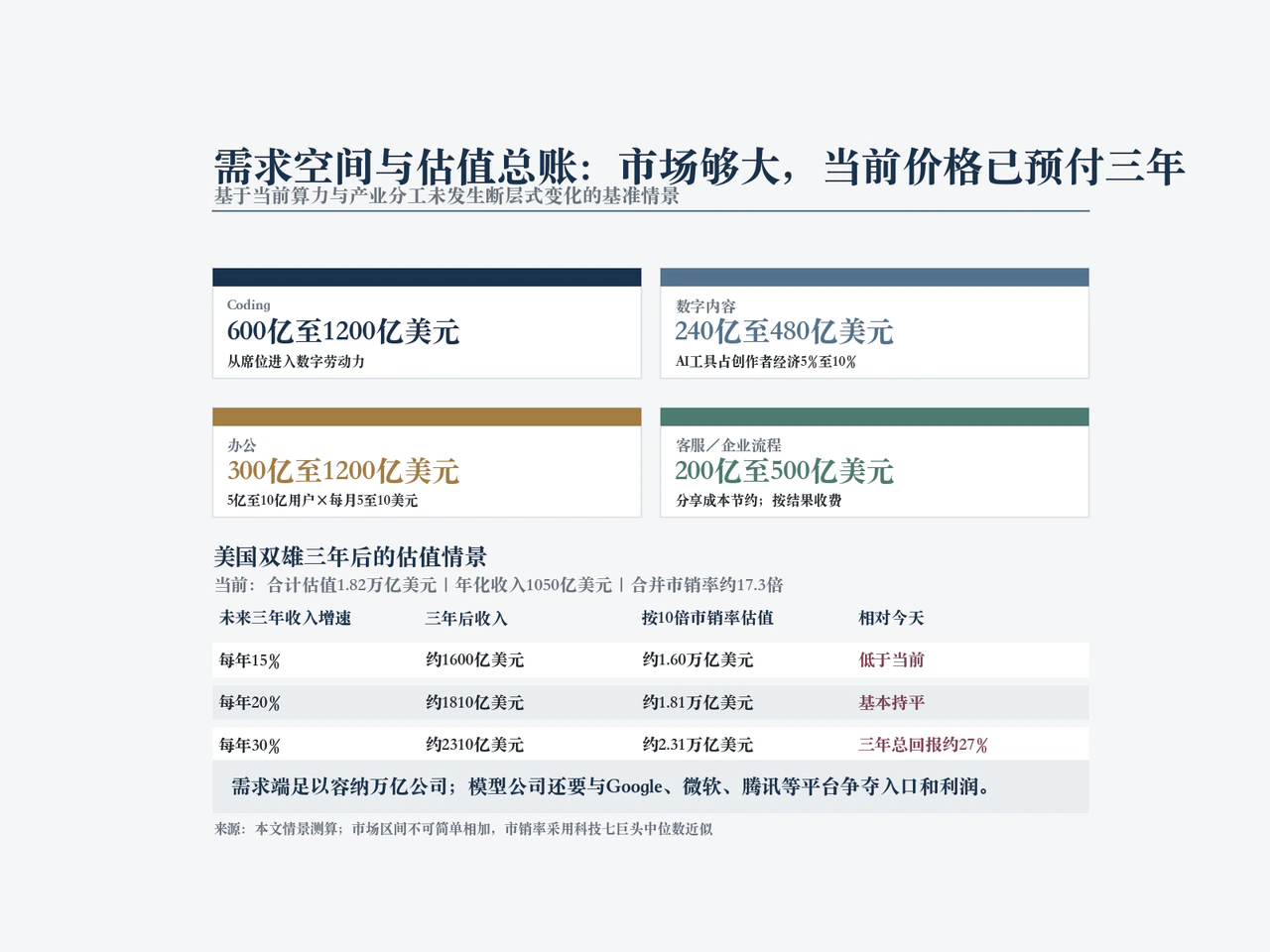
Assuming steady progress within existing architectures, application demand has four pillars:
-
Coding and software engineering: directly identifiable code ARR is about $23.9 billion; including hidden APIs and third parties gives $34 billion–$41 billion. Deep penetration into software labor replacement could lift the total model-and-agent opportunity to $60 billion–$120 billion.
-
Digital production: the creator economy is expected at $480 billion in 2027. AI tools capturing 5%–10% create a $24 billion–$48 billion application market. Model profits depend on control of end-to-end creation and distribution.
-
General collaborative office work: M365 validates an existing market above $100 billion. At 500 million–1 billion frequent workers paying $5–$10 monthly, the theoretical AI-office ceiling is $30 billion–$120 billion. Bundling, low net conversion and channel shares substantially reduce independent model makers' actual receipts.
-
Customer service and enterprise outsourcing: the global business-process market exceeds $200 billion. Agents sharing 10%–20% of labor-cost savings could create a new $20 billion–$50 billion revenue pool for models and delivery layers.
These opportunities cannot simply be added. The same engineer also uses office and content services; one IT budget may shift from legacy maintenance to agents rather than being entirely incremental. Nevertheless, end demand can plausibly support one or two trillion-dollar companies. The central challenge is how much true economic surplus independent model companies can retain across this long chain.
Return to a strict capital-market framework. Combined post-money value is about $1.82 trillion and latest annualized revenue around $105 billion, giving P/S of 17.3. Assume both are listed in three years and multiples converge toward a roughly ten-times-sales center for the Magnificent Seven:
-
At 15% compound annual revenue growth, combined revenue reaches $160 billion in three years, implying $1.60 trillion of value, below today's level.
-
At 20% growth, revenue reaches $181 billion and value about $1.81 trillion, barely preserving today's post-money paper value.
-
At exceptional 30% growth, combined revenue reaches $231 billion and value about $2.31 trillion. The cumulative three-year paper return is only 27%, before IPO dilution and large employee-option realization reduce per-share value.
An earnings-based test is harder. With mature-software net margins of 30% and a 27-times P/E, the pair would need $225 billion annual revenue and $67.5 billion after-tax profit to support today's $1.82 trillion. That requires near-30% compounding for three years plus a transformation from annual cash burn in the tens of billions into Microsoft-like cash generation.
Today's trillion-dollar pricing is internally coherent, but its margin of safety is extremely thin. Coding must keep expanding through high-value workflow replacement, not cheap metered usage. Content, office and process agents must supply nearly half of incremental revenue within three years. More demanding still, unit computing costs must fall much faster than prices decline and total usage expands. Failure of any of these conditions could force violent multiple mean reversion even while revenue grows.
The deeper paradox is that the closer an application is to everyday work, the lower independent model companies' barriers become. Coding requires extreme reasoning, large context and demonstrable engineering evaluation, giving top foundation models a substantial capability lead. Minutes, email, routine service, marketing and approvals rely more on accounts, historical data, organizational permissions and habitual gateways than on the world's strongest reasoning. Google owns Workspace, Gmail, Android and Chrome; Tencent WeChat, WeCom and Tencent Meeting; Microsoft Windows and Office; ByteDance Feishu, Doubao and major content traffic. They can bundle good-enough models freely or at low margins while naturally obtaining the context and permissions needed for end-to-end tasks.
The hundreds of billions in office, content and automation opportunities therefore cannot be treated as equivalent revenue territory for OpenAI, Anthropic or Zhipu. Deeper applications encounter stronger incumbent customer relationships, diluting technical leads into replaceable APIs. Without the final delivery interface, proprietary enterprise data and complex workflows, rapidly growing AI adoption could produce an industry with enormous revenue but only thin computing-service compensation for model suppliers.
The outcome will not simply be a world in which the top two take everything. Frontier pretraining will remain concentrated, perhaps with only two or three laboratories able to sustain annual computing capex in the tens of billions. Inference distribution and vertical applications will be diverse, driven by open source, sovereign-data compliance, edge computing and dynamic model routing. A barbell is more likely: a few frontier infrastructure providers at one end and open-model integrators and vertical services embedded throughout industries at the other. Midtier general-model vendors lacking both frontier funding and native distribution or unique enterprise data face the greatest squeeze.
The answer to the opening question is clear: coding can launch the trillion-dollar valuation story, but cannot alone deliver its eventual market value. Coding must move from isolated generation into software labor budgets; digital content must embed throughout creators' production and distribution; office agents must win hundreds of millions of workers' daily interactions; and process automation must monetize measurable reductions in business burdens.
Together these markets offer large potential, but today's valuation has already prepaid three years of perfect growth. Investors are no longer mainly betting on a few more benchmark points. They are betting that specialist model builders can escape becoming interchangeable pipes amid Google, Microsoft, Tencent and ByteDance, and become a new generation of platforms controlling customer trust, workflow gateways and the distribution of industry profit.