Understanding the Fed: Article 5/20
At 2 p.m. Eastern time, the rate decision appears online on schedule. Global currencies, Treasury yields and stock indexes jump instantly as algorithmic trades pour out within milliseconds. Screens move so quickly that observers can mistake the result for a decision made by the Fed chair at the last moment behind closed doors.
The institutional reality is quite different from a chair's one-person verdict. A rate decision emerges from a large bureaucratic and academic machine that starts weeks earlier, involves hundreds of professional researchers and combines Washington with twelve regional Reserve Banks. Information accumulated by the Board and regional banks, staff simulations of global financial conditions and macroeconomic scenarios, and the New York Fed desk's close monitoring of liquidity all shape the process. Roughly nineteen participants have built their own reasoning within complex real-world constraints before entering the room.
On meeting day, participants first debate the economy, then weigh policy instruments, before statutory voting members cast their votes. The statement and press conference reveal only the immediate compromise. Minutes three weeks later, the quarterly Summary of Economic Projections, and transcripts released after five years gradually uncover the fuller contest. Watching the chair alone will never reveal the foundations of Fed decision-making.
1. Many can speak; only some can vote

Where the twelve formal votes come from
The FOMC's statutory voting structure comprises twelve votes: seven Board governors, the New York Fed president and four regional presidents rotating annually. Political disputes or transitions can leave Board vacancies and fewer than twelve actual votes, but the statutory baseline of this balancing arrangement remains.
The New York Fed president has a permanent vote and traditionally serves as FOMC vice chair. This is not regional favoritism: the bank conducts the system's open-market operations through the System Open Market Account, SOMA. Its trading desk connects directly with Wall Street primary dealers and the global offshore dollar system, serving as the only channel through which written policy becomes actual market liquidity. The permanent vice-chair position closes the loop between top-level decisions and underlying funding conditions.
The other eleven regional presidents rotate within four fixed groups:
- Boston, Philadelphia and Richmond;
- Cleveland and Chicago;
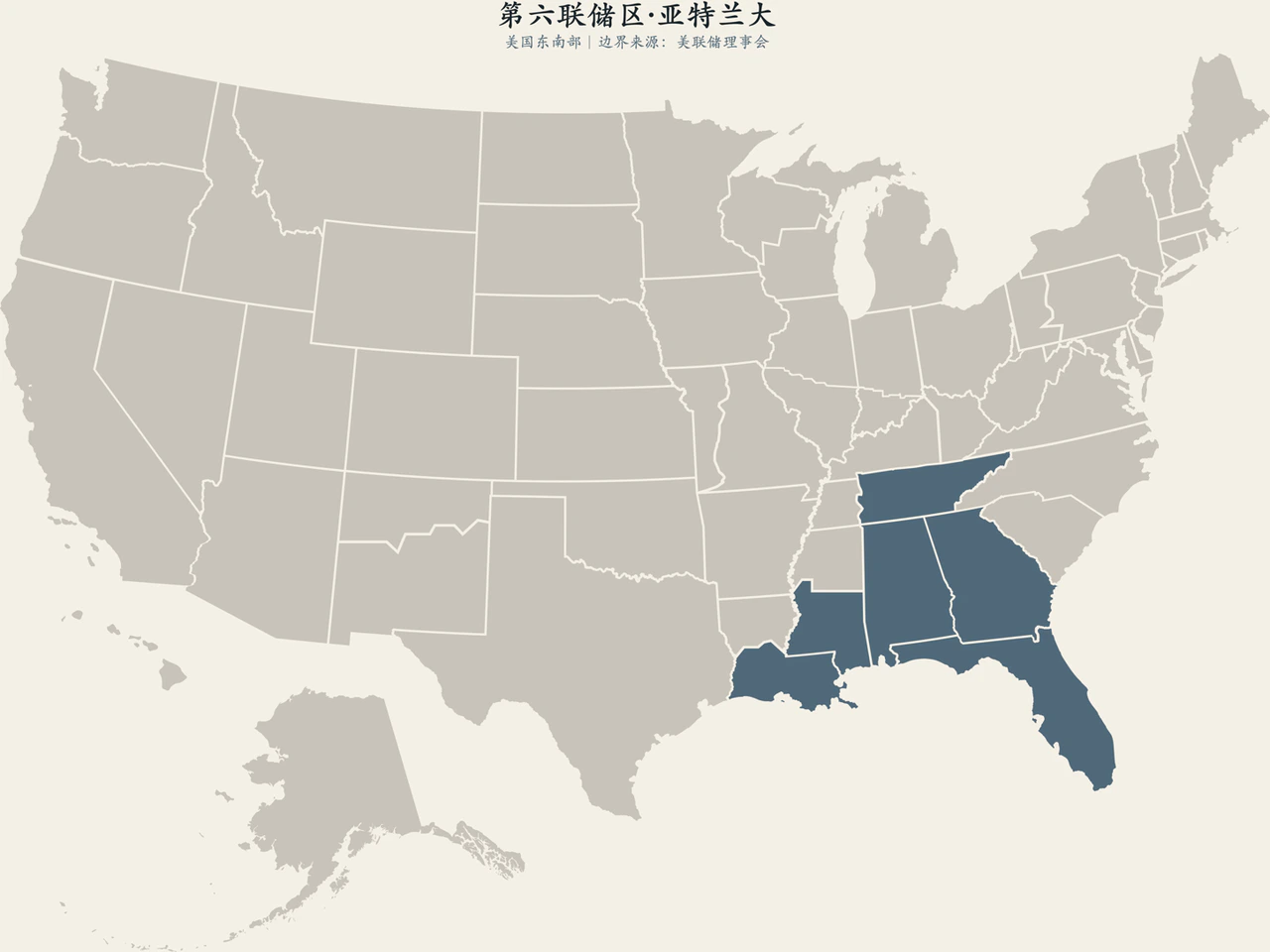
- Atlanta, St. Louis and Dallas;
- Minneapolis, Kansas City and San Francisco.
Each group supplies one voting president per year, with rotation effective at the year's first regular meeting. Checking that year's rotation is the first step in assessing the committee's annual policy inclination.
Nonvoters should never be treated as spectators. All twelve regional presidents attend the full closed-door agenda, participate equally with governors in economic and policy discussions, and submit independent quarterly SEP projections. A nonvoting president with strong field research or a rigorous framework can reshape the debate and directly influence statement wording. Focusing on voting members' speeches helps predict the immediate vote but can miss the ideas that generate future policy shifts.
National statistics need regional field evidence
Payrolls and core inflation are important, but naturally lag and are often substantially revised. The twelve Reserve Banks across the country form a capillary network for sensing real-economy conditions.
Through standing boards, industry advisory committees and frequent company visits, regional banks track orders, hiring difficulty, wage bargaining, credit access and end-market pricing power. These contacts are not strict random samples and cannot replace aggregate official statistics. They nevertheless provide valuable sensitivity, helping distinguish a localized supply-chain price disturbance from systemic inflation spreading across industries.
Washington governors emphasize overall policy balance, macroprudential supervision and theoretical models. Regional presidents bring different industrial interests and geographic conditions. New York continuously monitors the microstructure of dollar settlement and financing markets. The FOMC brings all three knowledge streams to one oval table, repeatedly testing top-down aggregate analysis against bottom-up evidence.
2. Discussion begins weeks before the statement

Pre-meeting materials lay out choices and risks
Weeks before each two-day formal meeting, headquarters economists and staff begin intensive analysis. Documents have evolved—the historical Greenbook and Bluebook are now combined in the Tealbook—but their purpose is unchanged: develop baseline forecasts, simulate tail risks, design policy alternatives with dovish, central and hawkish orientations, and draft statements for discussion.
Meanwhile, the New York desk submits assessments of reserve balances, EFFR, the standing repo facility, overnight reverse-repo take-up and Treasury market-making depth. The Reserve Bank system compiles the Beige Book from direct feedback by hundreds of executives nationwide.
These extensive briefing files never provide a standard answer. Models depend on assumptions, business interviews naturally contain survivorship bias, and asset prices reflect counterparties' reflexive expectations of central-bank behavior. Policymakers must see through the charts and noise and judge precisely when monetary policy's long and variable lags will reshape the real economy.
From go-arounds to the final vote
Regular meetings follow a disciplined rhythm, with closed-door discussions largely organized around two extensive go-arounds:
The economic go-around comes first. Nineteen participants speak in turn about growth momentum, labor-market tightness, inflation persistence and financial vulnerabilities.
The policy go-around follows, addressing the target interest-rate range, the pace of quantitative tightening and external guidance.
The chair acts essentially as a consensus builder, rather than a commander. After absorbing the positions around the table, the chair formulates a proposal and accompanying statement reflecting the broadest agreement, followed by individual votes from the twelve statutory members.
Formal dissent carries high institutional and political costs, so it is a visible sign of intense disagreement. Apparent unanimity can conceal deeper differences: some members support a rate change but dislike ambiguous guidance; others favor hiking but oppose the timing; still others submit personal paths very different from the decision. The vote captures a binary yes or no, while the underlying debate is much more nuanced.
3. Reconstructing one meeting requires four kinds of documents

The statement arrives first and compresses the most
The policy statement is the most immediate basis for global asset pricing. It condenses rate settings, operational guidance and the outlook into a short text, with every word and comma a product of compromise. The accompanying Implementation Note specifies technical settings such as interest on reserve balances, IORB, and discount-window rates.
The chair's press conference follows half an hour later. Its main purpose is to explain the committee's collective thinking and address misunderstandings. The chair cannot disclose every unresolved disagreement and will defend data-dependent flexibility when asked about the future, preventing conditional judgments from hardening into market expectations of unconditional delivery.
Markets use redlines to examine every wording change, but overemphasizing one adjective can obscure the wider picture. A more mature framework follows an order: first assess substantive changes in instruments and funding-operation settings; next examine the committee's reassessment of risks between maximum employment and price stability; then use changes in guidance tone to judge the threshold for future action.
What minutes, the SEP and five-year-later transcripts each add
Successive disclosure layers fill the immediate statement's gaps:
Minutes are released three weeks after the meeting. Carefully calibrated expressions such as 'a few,' 'several,' 'some,' 'many' and 'almost all' outline the extent and intensity of disagreement. They disclose much more reasoning than the statement but remain a balanced text reviewed and approved by all participants.
The SEP accompanies the March, June, September and December meetings. Its anonymous dot plot shows all nineteen participants' projections for year-end policy rates over coming years, under each person's appropriate-policy assumptions. Each dot is one individual's judgment at a specific moment, not a collectively endorsed path. It is nevertheless useful for assessing dispersion around the future policy center.
The clearest exchanges remain sealed in full transcripts until five years after the meeting. Only then can researchers identify who held firm, who compromised, which warnings proved prescient and which confident judgments became mistakes. This layered-disclosure philosophy creates a considered barrier between necessary immediate policy room and long-term institutional transparency.
One of the most dangerous approaches to Fed analysis is searching a press conference for a sentence that fixes the date of a future cut or hike. Data can be revised and external shocks recur; central banking is dynamic risk management with incomplete information. Understanding who participates, who votes, what each document reveals and whether the conditions triggering policy adjustment have changed is the professional way through Washington's monetary uncertainty.