Understanding the Fed, article 14 of 20
Families and businesses moving south bring immediate demand for consumption, homes and expansion, but also workers and potential capacity. Which grows faster determines whether the Sun Belt migration becomes real output or persistent increases in rents, pay and local services. The Sixth District sits at the forefront of this tension.
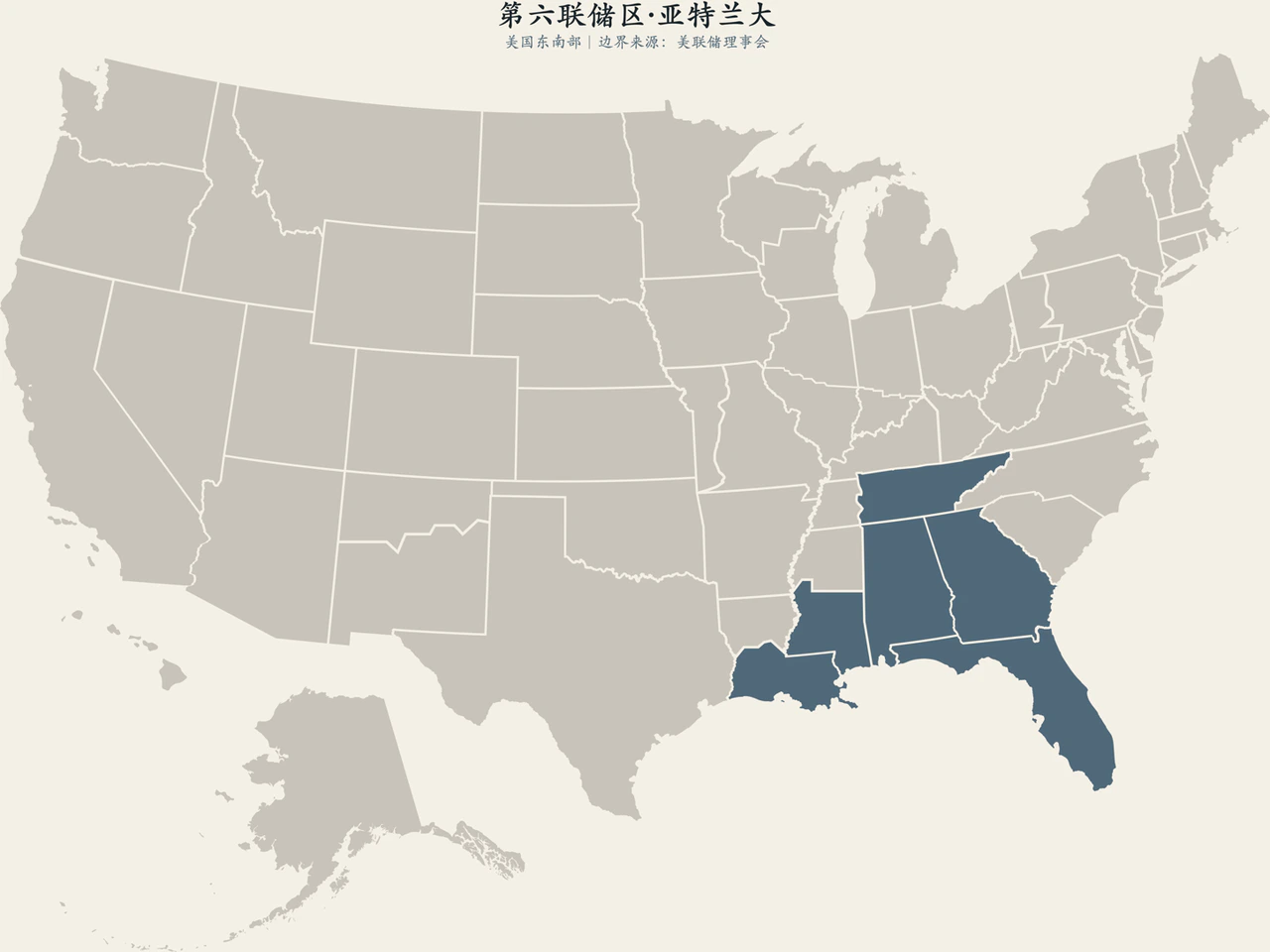
Atlanta is known for two quantitative tools: GDPNow tracks current-quarter output, and the Wage Growth Tracker measures wage changes for comparable workers. Its southeastern district covers all Alabama, Florida and Georgia; 74 eastern and central Tennessee counties, 38 southern Louisiana parishes and 43 southern Mississippi counties. Five branches in Birmingham, Jacksonville, Miami, Nashville and New Orleans make it one of the system's densest networks.
1. Population inflows bring new demand and new supply
The South is expanding, but unevenly
Atlanta, Miami, Orlando, Tampa and Nashville attract firms and residents through taxes, business conditions and climate, supporting manufacturing, logistics, tourism, healthcare, professional and financial services and property. The district is heterogeneous: the Gulf coast depends on energy extraction, ports and petrochemicals while facing hurricanes and reduced commercial-property coverage. Many inland Alabama and Mississippi counties still face population loss and weak investment, with lower incomes and activity than fast-growing metros.
Inflow has both sides. It rapidly raises housing, durables, healthcare and service demand, then expands labor and entrepreneurship over time. Inflation versus potential output depends on supply responsiveness: planning approvals, infrastructure, housing delivery and skill matching. Housing shortages allow rents and land prices to erode nominal wages. Timely construction and corporate capital spending are needed to expand supply effectively.
The Sixth District thus tests whether U.S. strength reflects overheating or supply expansion. Strong retail and employment need not mechanically require tightening: if capacity and labor supply rise together, robust growth can coexist with steadily lower inflation.
Extreme weather and unavoidable insurance costs reach households before macro indexes
Florida and Gulf hurricanes and floods damage assets and multiply commercial and household insurance premiums. These mandatory costs shape home purchases, migration and capital spending. Their transmission has a statistical lag relative to CPI and PCE collection, so smooth macro components can miss the cash-flow shock at policy renewal.
Rebuilding can temporarily raise construction wages, contract bids and materials demand for several quarters, creating an apparent local boom. A rebound replacing destroyed capital is not equivalent to improved household welfare.
Atlanta's extensive business contacts often detect premium increases, contractor prices and tourism bookings months before national official data. Such frictions are hard to isolate in one CPI category but reshape pricing intentions and squeeze disposable income.
2. Three popular tools measure different things

GDPNow: a mechanical real-time model, not an official discretionary forecast
GDPNow recombines incoming monthly consumption, fixed investment, trade and inventory data under BEA accounting to update annualized quarterly real GDP growth. Its mathematical, transparent algorithm does not use subjective smoothing. Atlanta explicitly says it is an objective tracking model, not management's discretionary policy forecast.
Early-quarter hard-data coverage is low, so individual releases can cause normal large swings. Inventories and net exports particularly amplify short-run changes. Analysis should identify the component behind each revision instead of treating one jump as a final quarterly judgment. An increase driven by involuntary inventories means something very different from broadly stronger final demand.
Wage tracking and business inflation expectations: comparable workers and front-line pricing
The Wage Growth Tracker uses individuals precisely matched twelve months apart in Census microdata to calculate median annual wage changes for comparable workers. It removes composition bias in average hourly earnings from high- or low-paid jobs entering or leaving employment and separates job switchers from stayers.
It does not cover all employment costs: health benefits, bonuses, self-employed income and unmatched sample changes are absent. A shrinking switching premium usually indicates cooler turnover and weaker bargaining power, rather than collapsing total labor demand.
The monthly Business Inflation Expectations survey, BIE, asks Sixth District businesses about future unit costs and intended final prices. It is closer to actual commercial pricing than consumer expectations swayed by food and fuel or derivatives expectations distorted by liquidity. Combining GDPNow's output momentum, wage tracking's bargaining evidence and BIE pricing intentions completes the transmission picture.
3. Label the interim president correctly and read indicators in sequence

Cheryl Venable's interim role has specific temporal and legal boundaries
After Raphael Bostic's departure, First Vice President Cheryl L. Venable became interim Atlanta president and CEO on March 1, 2026. Pending selection of a permanent president, she oversees operations and performs the role's legal duties. Atlanta is an alternate in the 2026 FOMC rotation; as interim president, Venable attends all meetings and participates fully in debate.
In 2026 remarks, Venable emphasized patience and observation amid macro uncertainty, connecting national statistics with firsthand business and community intelligence. Her interim status has formal institutional meaning: its temporary nature does not diminish her legal role representing the Sixth District, nor justify predicting the permanent selection outcome.
The analytical sequence: output composition, labor bargaining and price pass-through
An effective framework for the district and its tools follows three steps:
First, decompose GDPNow contributions, removing inventory and trade noise to identify genuine domestic final consumption and investment.
Second, use the WGT to assess comparable workers' wage growth and switching premiums, judging easing labor imbalances and bargaining power.
Finally, use BIE to test whether firms face substantial input-cost pressure and whether it is being irreversibly passed to consumers.
Strong output, a falling switching premium and stable pricing expectations often indicate supply and productivity improvement. If all three accelerate together out of control, they warn of overheating and a developing price spiral.
Add the South's population inflows, rigid housing stock and rising climate and property-insurance bills to this framework. If prosperity rests only on passing on higher living and housing costs, real purchasing power and supposed consumption resilience are overstated. Only housing starts, infrastructure and productivity keeping up with migration can genuinely expand national potential supply.
Atlanta's value extends beyond maintaining a few high-frequency nowcasts for markets. Rooted in a dynamic center of population and industrial relocation, it offers a rigorous way to decompose the vague claim that growth is strong into the interactions among effective demand, potential supply, labor bargaining and final pricing.