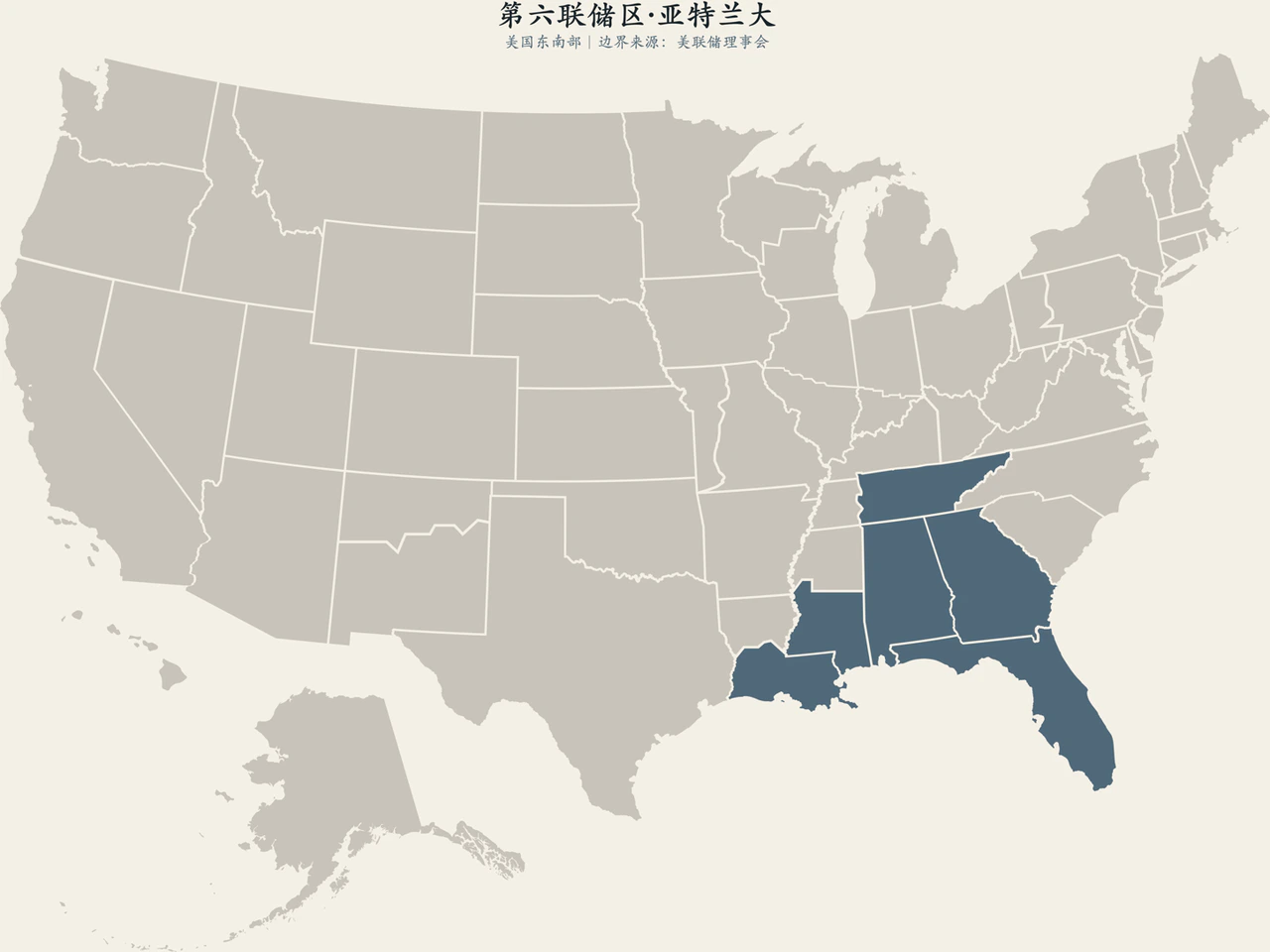
Understanding the Federal Reserve, article 13/20
If federal hiring slows or procurement is delayed, Washington-area law firms, IT consultants and contractors often feel it first. At the same time, North Carolina banks and technology parks may still add staff, while South Carolina auto plants and ports follow global shipping. Combining these different dynamics into one average can create a Fifth District that exists nowhere in reality.
The Richmond Fed covers Maryland, Virginia, North and South Carolina, Washington, D.C., and most of West Virginia—49 counties—with branches in Baltimore and Charlotte. Federal budgets, deepwater-port cargoes, defense capex and migration into southeastern cities generate opposing cyclical signals within one jurisdiction.
1. Three growth engines at different speeds
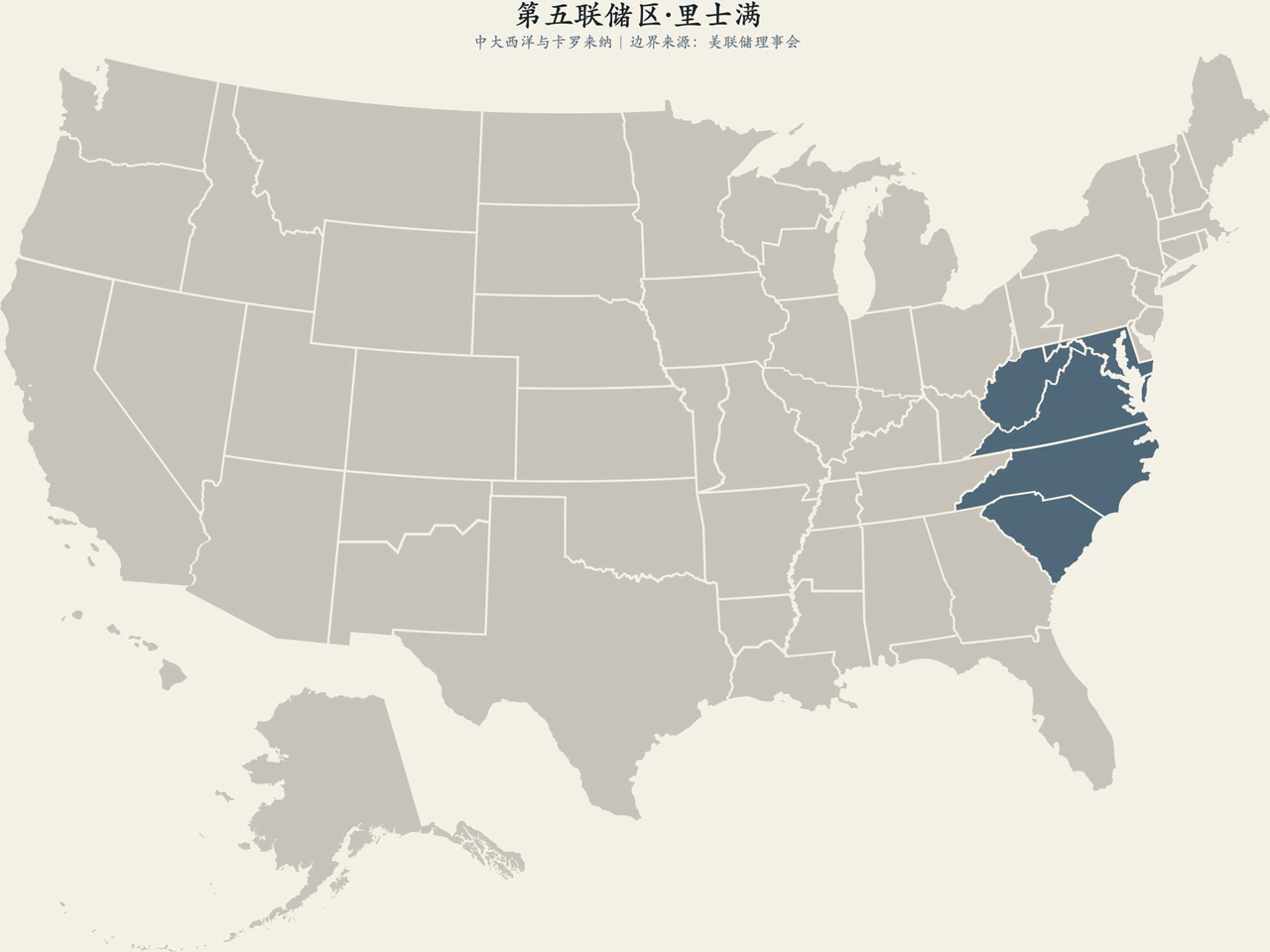
The capital, ports and new southern cities have their own cycles
Washington depends on federal agencies, defense contractors, lobbyists and advanced professional services, making appropriations and administrative spending central. Baltimore combines bulk and roll-on/roll-off vehicle shipping with healthcare, universities and logistics. Northern Virginia's data-center corridor concentrates computing and fiber, while Hampton Roads hosts the country's largest military shipbuilding operations. Charlotte is the second-largest U.S. banking-capital center; Raleigh-Durham's Research Triangle Park (RTP) concentrates biopharma and technology research; South Carolina manufacturing and coastal resorts attract migrants nationwide.
A uniform federal funds rate produces different restraint through this industrial and balance-sheet mosaic. Government orders follow fiscal budgets; data centers and shipbuilding need long-term inexpensive capital; housing and regional banks respond to mortgage rates and short lending/deposit spreads; freight agents and export manufacturers watch the dollar and overseas procurement.
West Virginia's Appalachian coal areas and inland farming regions also face depletion, industrial hollowing and youth outmigration. Stable aggregate unemployment does not imply uniform job quality, commuting or pay growth. Richmond's institutional value is to confront Washington's abstract macro narrative with complex regional reality.
What should a central bank watch after a fiscal shock?
Debt-ceiling disputes, shutdown threats, delayed budgets and agency cuts often hit the Fifth District first. They do not mechanically require monetary adjustment. Policymakers must distinguish short payment delays from lasting demand contraction spreading through subcontractors, disposable income, property vacancies and local consumption.
Business contacts provide that distinction. Weak capital-area hiring alongside strong Carolina retail and orders may leave national data looking healthy. Longer payment arrears, broadly tighter credit and cross-industry layoffs indicate fiscal contraction spreading beyond local boundaries. The central bank does not set budgets but must estimate their effects on its price-stability and maximum-employment mandate.
2. Turning business experience into comparable series

Read manufacturing and nonmanufacturing components before the headline
Richmond surveys executives monthly on output, orders, shipments, jobs, pay and prices. Most manufacturing and service measures are diffusion indices: positive readings mean more respondents report improvement than deterioration. They measure breadth, not the absolute percentage change in output, and are limited by voluntary participation and representativeness.
One monthly headline plunge or rebound is insufficient; component relationships matter. Falling activity with high input-price indices may indicate supply friction or poor cost pass-through. Deep contractions in both orders and employment signal weaker aggregate demand. Poor current conditions with optimistic six-month expectations require checking whether optimism actually becomes capex.
Regional surveys are frequent and sensitive, but vulnerable to sentiment and coverage bias. Careful analysis cross-checks them with actual container traffic, rail freight, regional payroll gains and national manufacturing data, rather than declaring turning points from one questionnaire.
Bank research reveals which layer is tightening credit
Richmond has long researched bank governance, intermediation, clearing infrastructure and monetary evolution. The district hosts global systemic banks such as Bank of America alongside hundreds of local lenders dependent on commercial-property collateral. Supervisory experience supplies research questions. Academic findings are not enforcement rules, but reveal how capital requirements, liquidity rules and mergers reshape credit supply.
If smaller regional banks tighten standards or withdraw facilities to protect deposits or asset quality, small firms' actual conditions tighten even with unchanged FOMC rates. Multinationals can use public bonds or nonbanks; local contractors, merchants and family manufacturers usually cannot. Differences across borrower creditworthiness are a crucial contribution to national policy assessment.
3. Regional differences matter more than labeling presidents
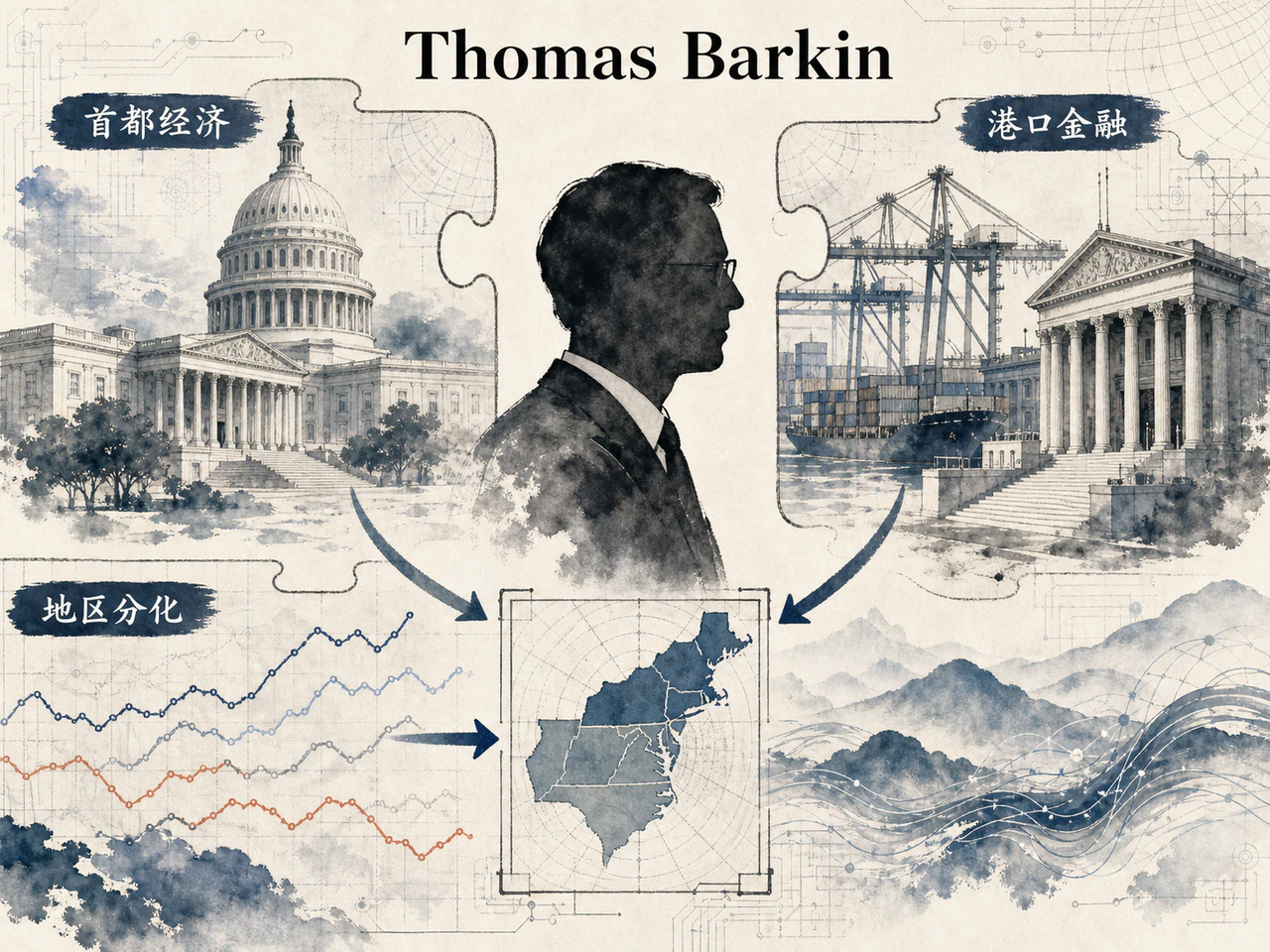
Thomas Barkin checks statistics against business experience
Thomas I. Barkin has led Richmond since 2018. In the 2026 FOMC rotation he is an alternate without a regular vote, but attends all meetings and participates in forecasts and policy discussion. His consulting background informs communication grounded in factory visits and executive interviews, checking firsthand evidence against quantitative scenarios to assess demand resilience, labor frictions and sticky inflation.
Barkin often describes macroeconomic puzzles: official aggregates and managers' experience can disconnect. The value is showing how contacts penetrate statistical uncertainty, rather than assigning hawk or dove labels. A firm freezing hiring without collapsing orders may be hoarding labor; that differs fundamentally for policy from bankruptcy-driven layoffs after an order collapse.
Three dividing lines clarify the district
Three axes reveal Fifth District structure:
First, separate public and private sectors to test whether fiscal restraint has spread into normal business cycles.
Second, separate metropolitan centers and inland Appalachia to assess widening gaps in migration benefits, housing starts and credit.
Third, separate traded-goods manufacturing and knowledge-intensive services to identify mismatched cycles in shipping, exports and professional services.
Monthly surveys, long-term expectations and industry reports deserve attention within their statistical and sample limits. Richmond is not a proportional miniature of the U.S.; it is a cross-section showing the different temperatures a common rate produces through agencies, multinational banks, container ports and growing southern cities.
Its greatest value is spotting structural fractures while national averages still look steady. The FOMC needs more than whether aggregate output looks hot or cold: it must know which sectors contain momentum, where risks accumulate and which transmission chains are obstructed.
That is the irreplaceable strength of regional surveys and fieldwork. They may not forecast the exact GDP decimal before statistical agencies, but can locate weakness among federal contractors, exporters or vulnerable small retailers. Identifying the shock determines whether rates can address it directly or only indirectly.