On August 24, 2026, Treasuries broke from Friday's parallel curve rise: short yields held firm while long yields reversed all of Friday's increase. Markets were testing whether the Treasury genuinely intended to spend cash to restrain long rates. Traders assigned bullish option value to rumors of larger buybacks funded from the Treasury General Account, without trading them as an established fact.
Fixed income: Two years unchanged, long maturities each retrace 4bp
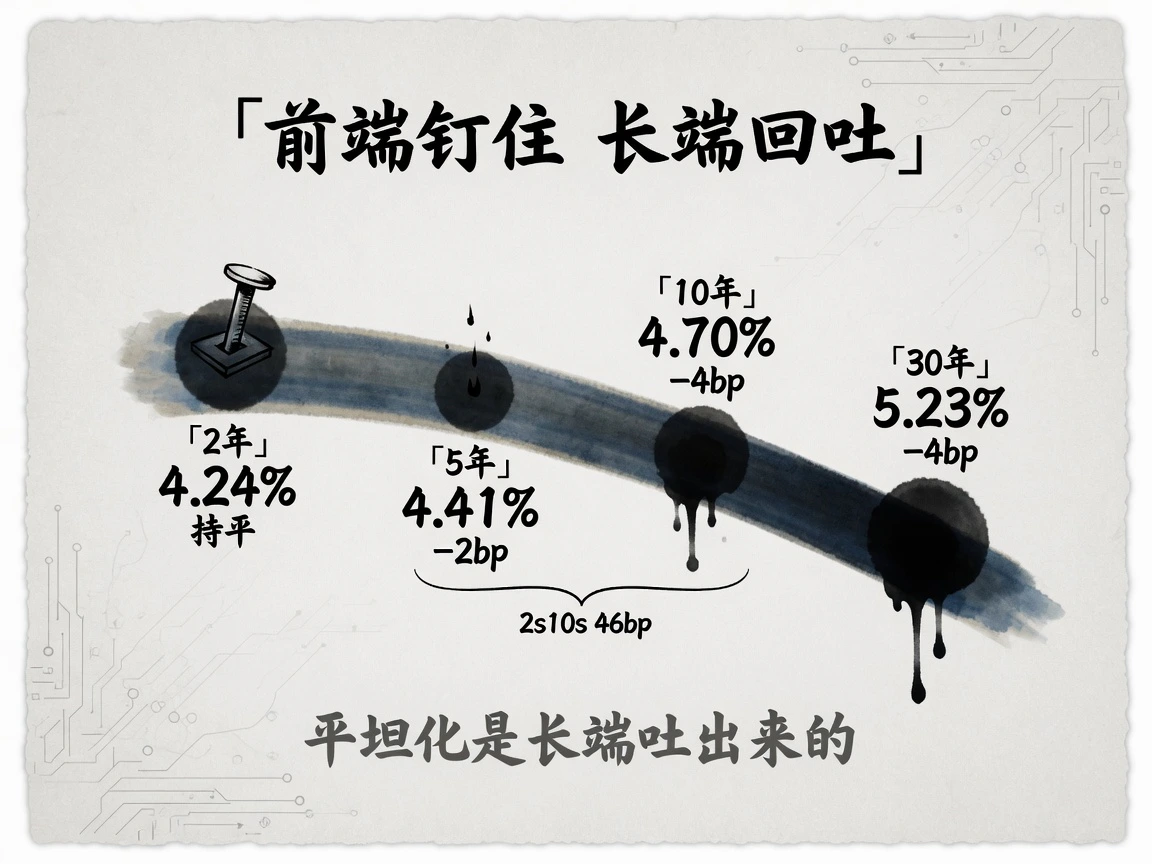
The Treasury's official daily par curve, August 24 versus August 21 closes, showed the split clearly:
| Maturity | August 24 close | Change |
|---|---|---|
| 2-year | 4.24% | Unchanged |
| 5-year | 4.41% | −2.0 bp |
| 10-year | 4.70% | −4.0 bp |
| 30-year | 5.23% | −4.0 bp |
The 2-year gave up none of Friday's rise, while 10- and 30-year yields each fell 4bp, narrowing 2s10s from 50bp to 46bp. This bull flattening was entirely long-end-led rather than a parallel decline. The 10-year breakeven fell only 2bp to 2.32%, accounting for half the nominal move; the rest reflected real rates and term-premium compression. This directly contradicted an interpretation of markets front-running cuts: active September policy repricing would not leave the short end so calm.
Fiscal policy was the pricing center before US stocks opened. CNBC cited two senior Treasury officials saying about $950 billion of TGA cash could support long-bond buybacks. Bloomberg put it at $935 billion on August 20, well above the prior term's $550 billion–$600 billion target. Expanded buybacks were an existing August 19 policy: from September 9 to November 4, maximum liquidity-support operations in 10–20- and 20–30-year buckets would double from $2 billion to $4 billion each. The debate concerned funding, not the stated cap. Morgan Stanley estimated $80 billion–$200 billion potentially available depending on the definition of excess cash; RBC thought TGA support extremely unlikely, while Citi called expanded buybacks financial repression.
Trading followed a classic buy-the-rumor, sell-the-fact pattern. At 14:00 Eastern, the Treasury secretary partly stepped back, saying no bonds had yet actually been bought under the current buybacks, auction schedules were unchanged and the next quarterly refunding announcement was in November. The 10-year had touched 4.65%–4.69% but rebounded after the remarks to 4.70%, still below the prior official close. The fiscal episode did not change the Fed's 3.50%–3.75% target. Early August 24 futures priced about 64% odds of a hold on September 16 and 36% of a 25bp hike. The 2-year fixed at 4.24% left the September decision to Jackson Hole and later hard data.
Macro: Softer activity and divided labor-market signals
Monday's data calendar was light, but two indicators made an interesting combination.
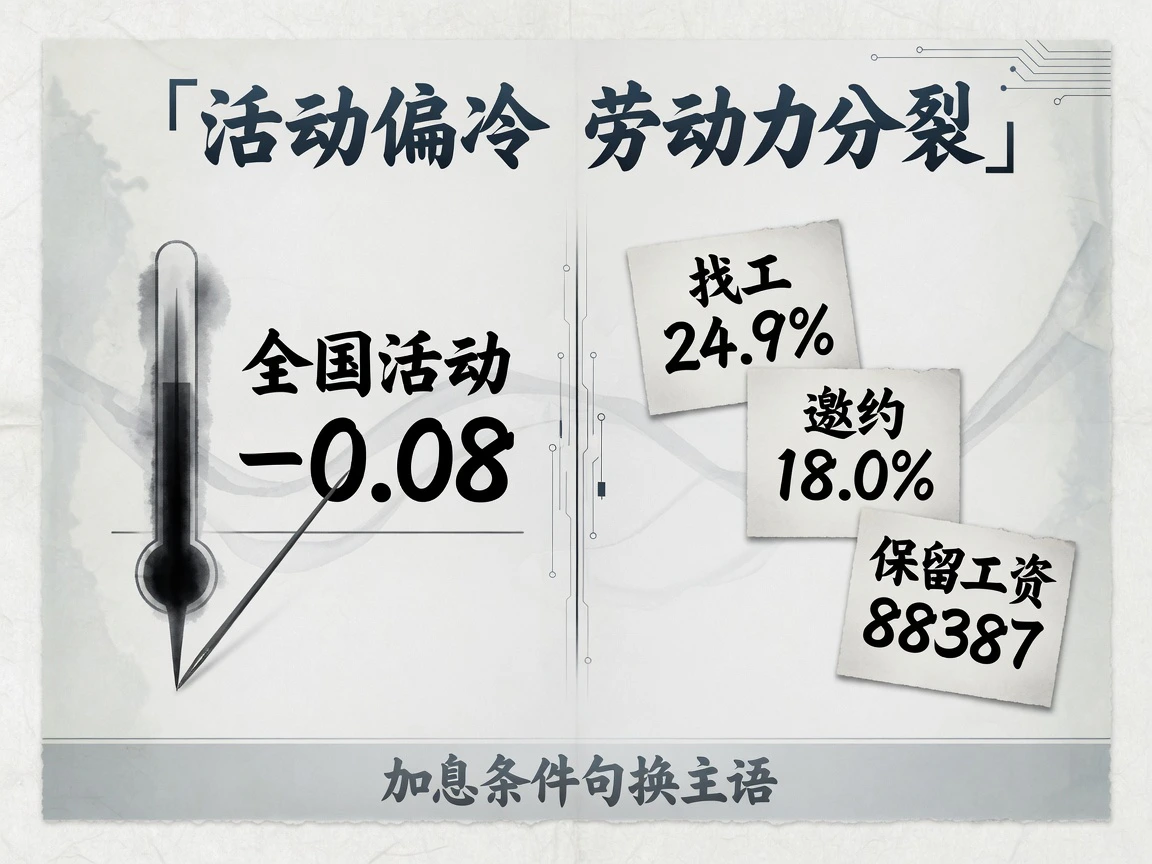
July's Chicago Fed National Activity Index turned negative at −0.08, with June revised slightly to +0.06. Zero represents historical trend growth; −0.08 was modestly below potential trend and far from a recession threshold. Consumption and housing contributed −0.09, weakest since May 2025, while production and orders/inventories barely remained positive. This did not contradict the previous week's 56.8 flash Markit services PMI: one combined 85 prior-month hard indicators, the other surveyed businesses midmonth. Bonds evidently prioritized slower July momentum, lowering long yields while the front end held.
The New York Fed's July labor-market SCE was divided: active job search over four weeks rose from 22.5% to 24.9%, but expected job-offer probability over four months fell to 18.0%, lowest since March 2021, indicating weaker demand. Nominal reservation wages reached a record $88,387 despite cooler hiring. More search, fewer expected offers and record wage demands suggested the September FOMC would not abandon tightening because of a modest −0.08 activity index. The argument shifted from overheating to continued obstacles to 2% inflation. Atlanta GDPNow still projected strong 4.0% annualized third-quarter growth, next updated August 26; Cleveland estimated August core PCE at 3.34% annually. Official July PCE was also due August 26.
Commodities: Oil discounts sanctions while gold prices credit risk
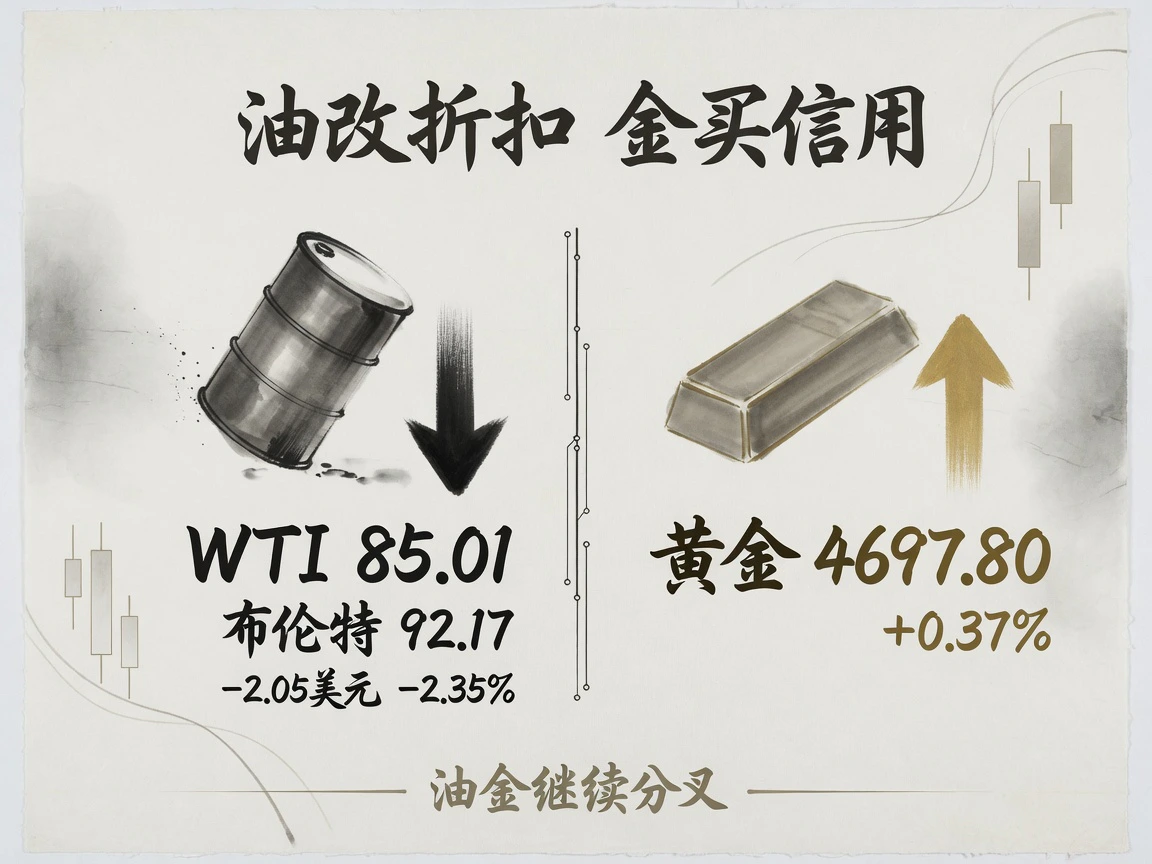
Monday crude repriced Washington's sanctions escalation from a geopolitical premium toward an implementation discount. October WTI closed $85.01 a barrel, down $2.05 or 2.35% for the same contract. Reported October Brent settlement was about $92.17, also down 2.35%. Nearby backwardation narrowed around 19 cents: the physical-shortage premium had not collapsed but could no longer steepen.
The pullback shortened the expected duration of geopolitical premiums without reversing fundamentals. No new EIA weekly report appeared in the window; limited deliverable storage capacity and tight distillates persisted. Sanctions were formalized, but major international banks potentially settling oil trades were not directly listed and implementation deliberately allowed time. Markets no longer paid heavily for an announce-tonight, cut-clearing-tomorrow extreme. Asked why threats outweighed sanctions, the Treasury secretary asked why he would blow up the global financial system. Futures priced that stance with more than 2% prompt losses.
Gold followed another logic. COMEX December settled at $4,697.80 an ounce, up 0.37%, then gained around $40 in Asian overnight trading. A 4bp fall in nominal 10-year yields provided traditional support, but independent demand reflected gold's inclusion among five sanctionable Iranian sectors, compliance premiums on safe-haven settlement and potential dollar-asset credit discounts. Silver did not strengthen, undermining a generalized precious-metals inflation interpretation. After US stocks closed, oil stayed constrained by secondary sanctions remaining threats and major banks being spared, while gold continued trading long-term dedollarization and credit-discount themes.
Equities: A 4bp rate decline fails to revive technology hardware

Monday tested whether lower long yields would revive long-duration growth technology. The answer was no: S&P 500 −0.28% to 7,652.86, Nasdaq Composite −0.77% to 25,980.19, Dow +0.26% to 53,417.16, Russell 2000 −0.76%, VIX up slightly to 15.85. Eight of 11 S&P sectors rose, led by staples +1.76% and financials +1.24%; technology was last at −1.59%. Nvidia closed $208.48, down 2.91% for a seventh loss, and Micron fell about 5.8%. Semiconductor equipment and memory discounted risk before Wednesday's Nvidia results. Apple, Google, Amazon and Meta mostly rose, but chips weighed on indices. Slightly better discount rates favored defensive and high-dividend assets, while unproven AI commercialization payback left hardware discounted. Volume below its 20-day average indicated moderate rotation rather than panic deleveraging.
Asian markets closed earlier and were driven mainly by specific supply shocks rather than following Wall Street. KOSPI fell 3.12%, yet advancers outnumbered decliners and KOSDAQ rose 1.42%. Selling concentrated in Samsung: Samsung Electronics fell 8.7% because its shareholder-return plan lacked a buyback schedule. Broad Korean risk appetite had not collapsed. Hang Seng fell 1.89% and Hang Seng Tech 3.61%, mainly after Alibaba placed about $10.2 billion of shares at HK$112.70, an approximately 8.4% discount, for full-stack AI. Shares fell as much as 10.5% and ended near the placement price, with sovereign and long-term investors mainly absorbing discounted stock. Nikkei 225 fell 0.74%, dragged by SoftBank and chip equipment. US trading carried Asia's chip-discount sentiment into memory and Nvidia, while resilient financial and consumer weights kept the Dow positive.
Catalysts were clear: Nvidia's second-quarter report after Wednesday's close, July core PCE Wednesday, Jackson Hole August 27–29 and Alibaba's placement settlement Wednesday. The Kansas City Fed website listed the symposium theme as financial innovation and its implications for payments and monetary policy, with the Fed chair's keynote at 10:00 Eastern Friday. By early Tuesday in Asia, the same cross-asset pattern persisted and technology futures remained pressured.
Geopolitics: A longer barrel, but no trigger pulled

The Treasury launched Operation Economic Exile, designating digital assets, technology, gold, aviation and shipping as sanctionable Iranian sectors and naming nearly 60 entities, individuals and tankers. The secretary then called secondary sanctions on third-country clearing banks a warning shot with a nonpublic remediation period, acknowledging abrupt punishment could destabilize global finance. Unchanged 2-year yields, a 4bp 10-year decline and only a 0.28% S&P 500 loss reflected this softer stance: traders valued the compliance grace period rather than immediate supply shock.
After the close, Stan Druckenmiller called long Treasury yields America's remaining fiscal-discipline constraint, arguing that converting routine liquidity buybacks into intervention to suppress rates subsidized fiscal expansion and delayed deficit adjustment. This was market commentary, not new policy, but raised a pointed signal: if the Fed chair remained unclear about monetary and fiscal responses at Jackson Hole, bonds would need to price a new institutional premium for friction between a Treasury seeking long-end control, a Fed holding the overnight end and a lack of coordination.