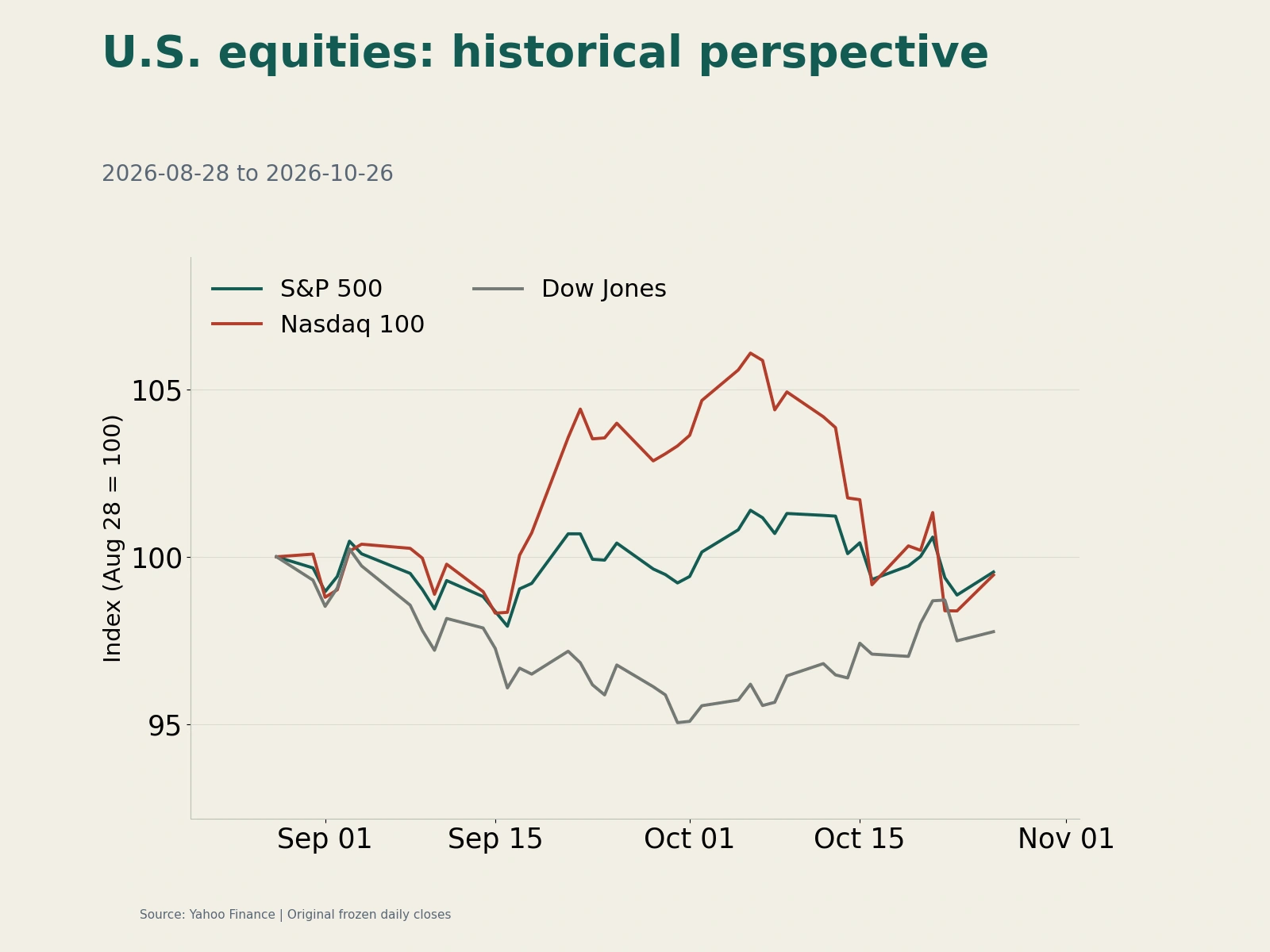
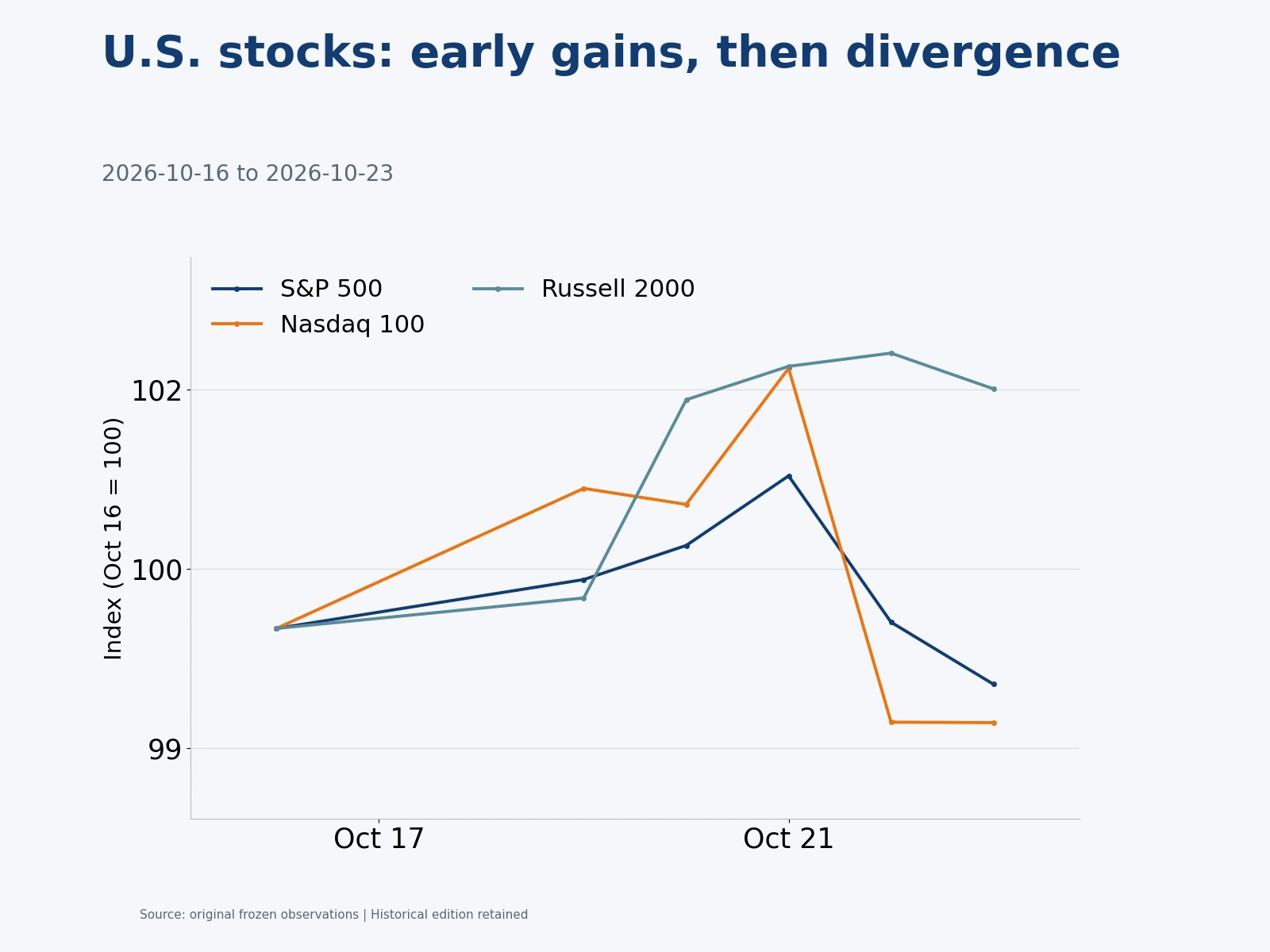
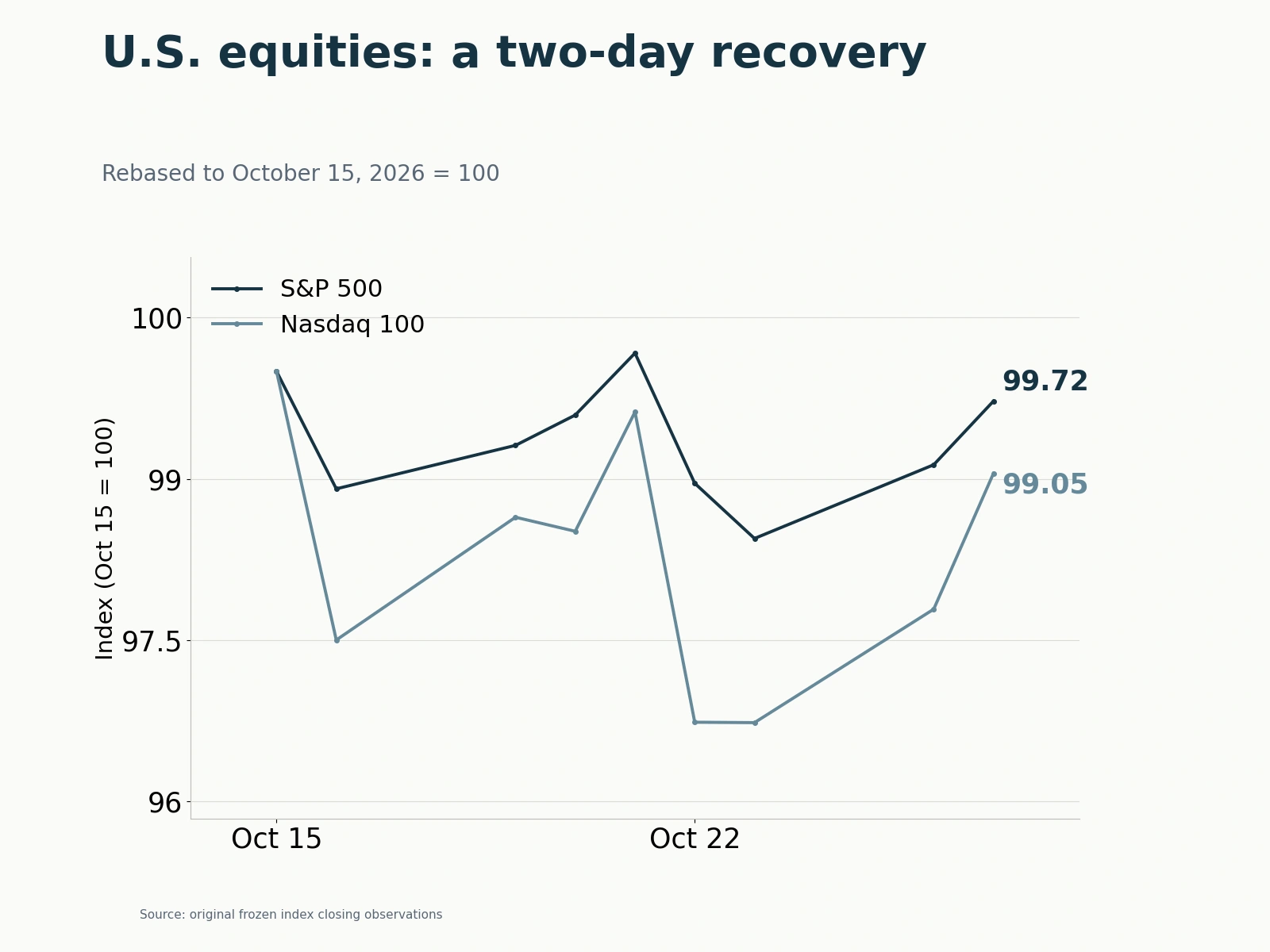
On October 27, 2026, U.S. stocks rose for a second consecutive trading day as lower oil prices and progress in financing AI computing capacity lifted sentiment. The S&P 500 gained 0.60% to 7,722.60 and the Nasdaq 100 rose 1.29% to 29,651.44, while the Dow added only 0.03% to 52,377.57. The small-cap Russell 2000 gained 1.16%, and the VIX fell to 17.52. As growth stocks led the advance, short-dated Treasury yields rose and the dollar strengthened, leaving financing costs an unavoidable constraint.
The rebound revolved around two questions: how much relief lower energy costs could bring to inflation and household spending, and whether vast AI investments could secure funding and turn into revenue. The former shapes demand recovery; the latter affects technology orders and valuations. As earnings reports arrived, markets were also distinguishing more closely between companies positioned to receive revenue and those bearing greater financing costs.
US$63 billion compute financing takes shape; chip stocks lead
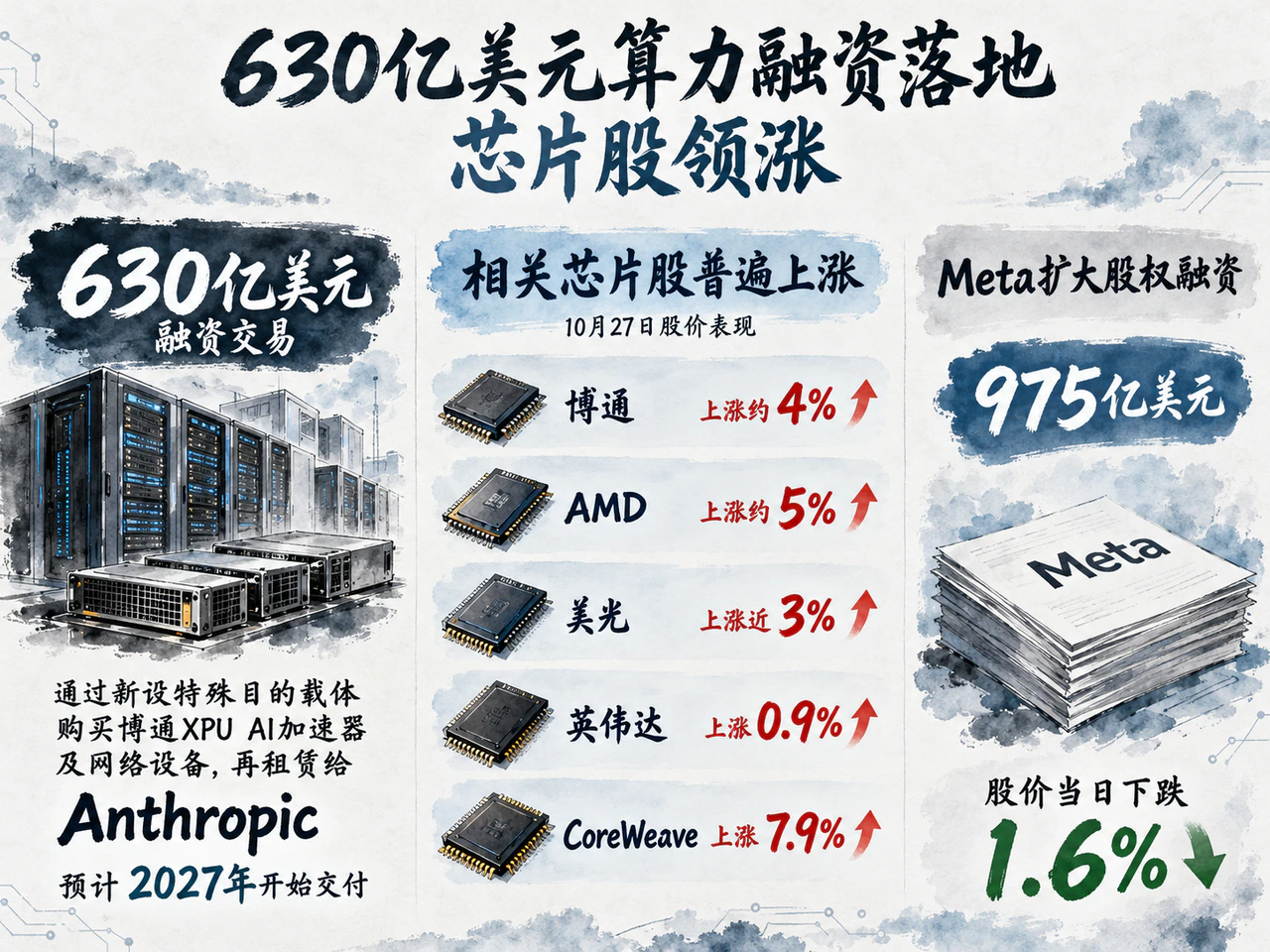
After the U.S. close on October 26, Bank of America, Blackstone, Citi and Morgan Stanley announced a US$63 billion financing transaction. A newly established special-purpose vehicle would purchase Broadcom XPU AI accelerators and networking equipment and lease them to Anthropic, with deliveries expected to begin in 2027. Bank of America, Citi and Morgan Stanley arranged first-lien financing, while Blackstone provided committed second-lien financing. Broadcom supplied residual-value support for an amount equal to the first-lien financing.
The arrangement secured funding for future computing-equipment purchases and improved expectations that equipment orders would be fulfilled. On October 27, Broadcom rose about 4%, AMD about 5%, Micron nearly 3%, Nvidia 0.9% and CoreWeave 7.9%. Anthropic’s earlier filing for a public listing also strengthened expectations for AI-industry financing channels.
The financing progress affected participants in the supply chain differently. Equipment makers gained orders, buyers needed future operating cash flow to cover financing expenses, and Broadcom’s residual-value support left part of the equipment-value risk with the supplier. Reuters reported that Meta expanded its largest equity financing to US$97.5 billion, while its shares fell 1.6% that day. Revenue opportunities, funding costs and equity dilution from expanding AI investment were being reflected separately in share prices.
Earnings season displayed similar divergence. Boeing reported a larger-than-expected third-quarter loss and fell 10.7%; Sherwin-Williams missed earnings expectations and declined 2.7%, weighing on the Dow. UPS raised its full-year revenue and earnings guidance and rose 5.8%; Royal Caribbean lifted its full-year earnings outlook and gained 5.5%. JetBlue rose 19% on its margin and earnings-recovery outlook despite a larger-than-expected quarterly loss. LSEG data showed that nearly half of S&P 500 companies had reported third-quarter results, with 83% beating earnings expectations. Forward guidance, alongside current results, was determining how markets priced companies.
The advance broadened, but significant internal differences remained. Advancing-to-declining stock ratios on the New York Stock Exchange and Nasdaq were 1.83 and 1.86, respectively. The Associated Press also noted that most S&P 500 constituents fell, with heavyweight AI shares offsetting the drag. Nasdaq stocks hitting 52-week lows numbered 239, well above the 62 reaching new highs. Reuters’ Philadelphia semiconductor index figures remained more than 20% below its June 22 record close, although its year-to-date gain was 62.1%. Chip stocks benefited from better order expectations while also rebounding from a previous sharp selloff. Results from Microsoft, Alphabet and Amazon later in the week would provide more evidence on cloud growth and investment returns.
Brent falls to US$113.88; transport costs still constrain supply recovery
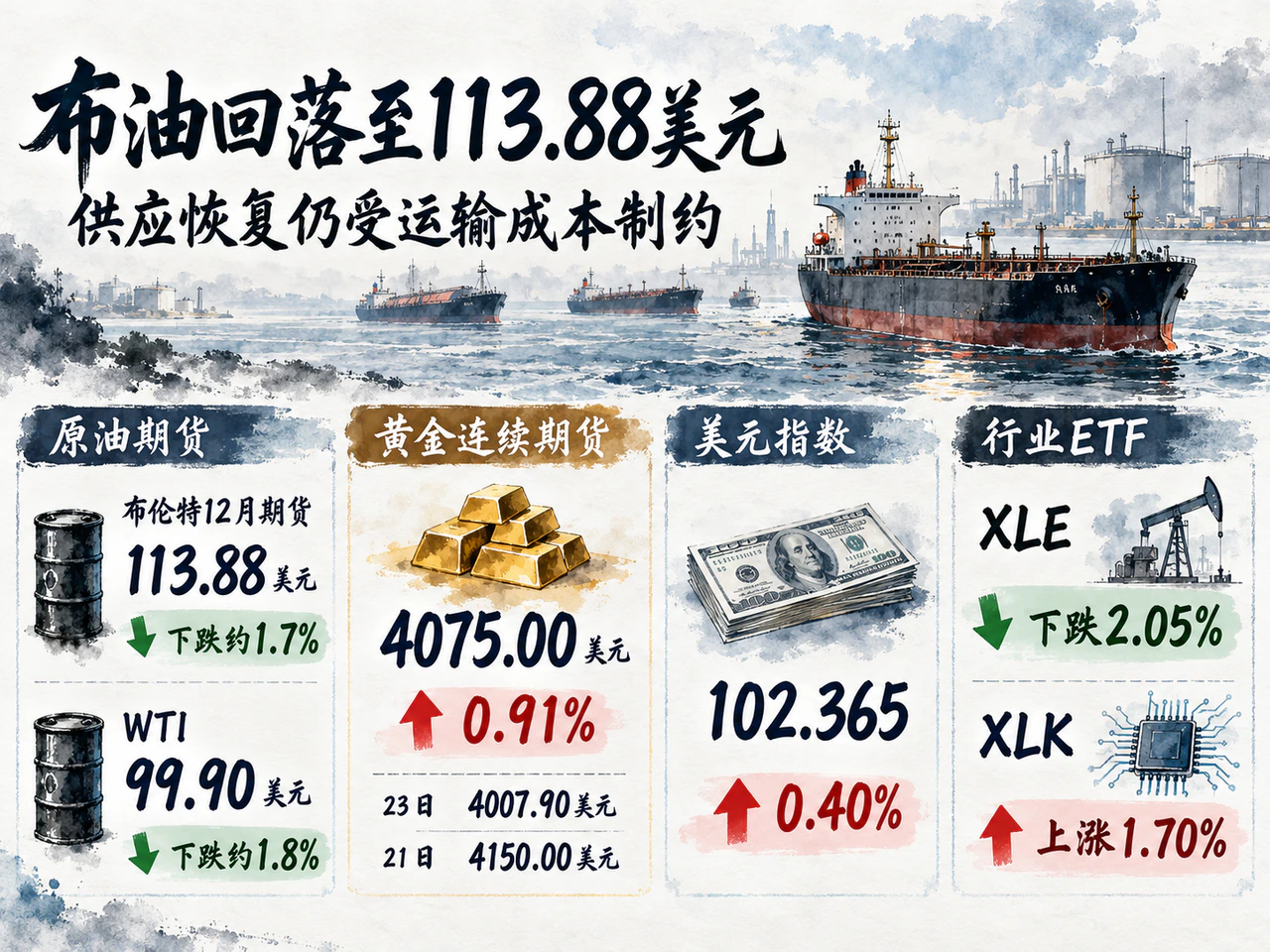
CNBC’s closing report put December Brent futures at US$113.88 a barrel, down approximately 1.7%, and WTI futures settlements at US$99.90, down about 1.8%. The energy ETF XLE fell 2.05%, while the technology ETF XLK rose 1.70%. Lower oil prices weakened earnings expectations for energy companies while easing cost and inflation pressures elsewhere, widening the divergence among sectors.
Qatar’s foreign ministry said on October 27 that messages and proposals continued to pass between the United States and Iran through its mediation channel. Markets were watching whether diplomatic communication could improve safe passage through Hormuz and reduce the energy-supply risk premium.
Physical supply recovery remained constrained by transport and inventories. UBS analyst Giovanni Staunovo said Middle East exports had risen from the early stages of the war, but insurance, freight and ship-to-ship transfers continued to raise costs and tie up tanker capacity. UBS consequently raised its year-end Brent forecast from US$100 to approximately US$110. Diplomatic progress could affect prices quickly, while transportation costs would take longer to fall.
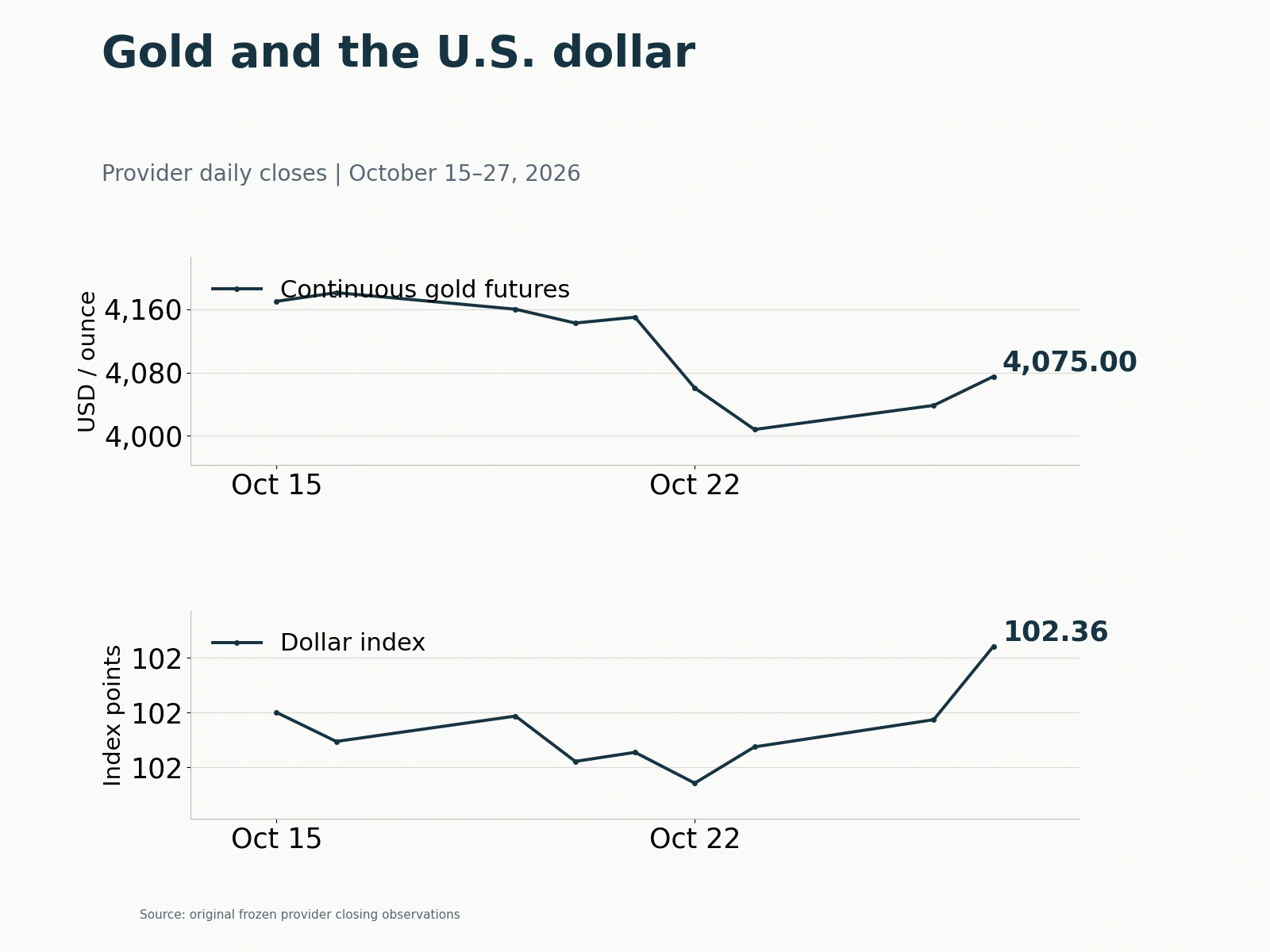
Gold recovered alongside a stronger dollar. Using the provider’s daily closing series, continuous gold futures rose US$36.60, or 0.91%, to US$4,075.00 an ounce, while the dollar index on the same basis gained 0.40% to 102.365. Gold had risen for two days from US$4,007.90 on October 23 but remained below US$4,150.00 on October 21. A stronger dollar increased gold-purchasing costs for investors using other currencies, while softer oil prices helped ease concerns about further policy tightening. Energy prices’ effect on inflation and rate expectations remained central to assessing the durability of gold’s recovery.
Long Treasury yields decline; short rates remain tied to further-hike expectations
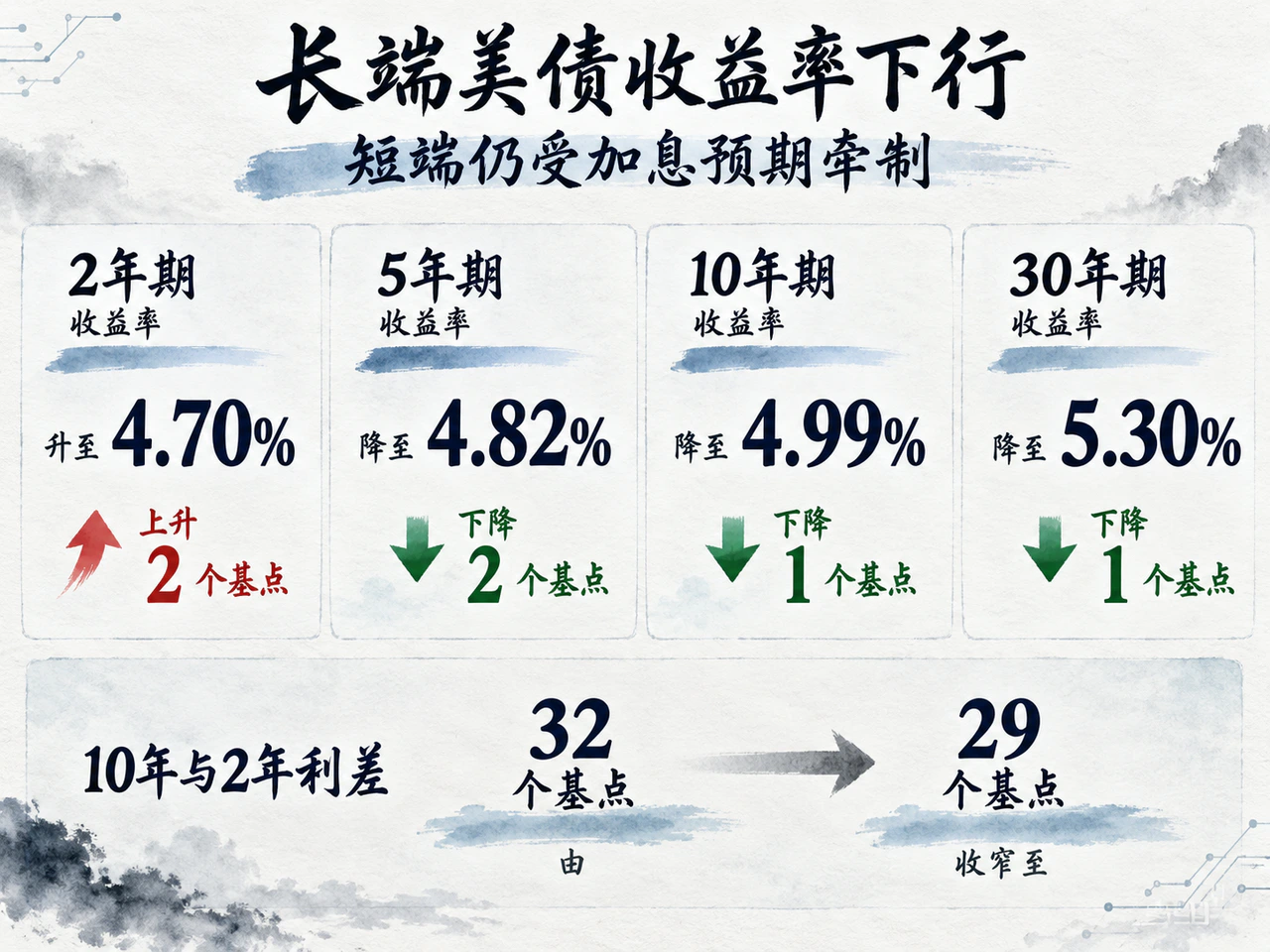
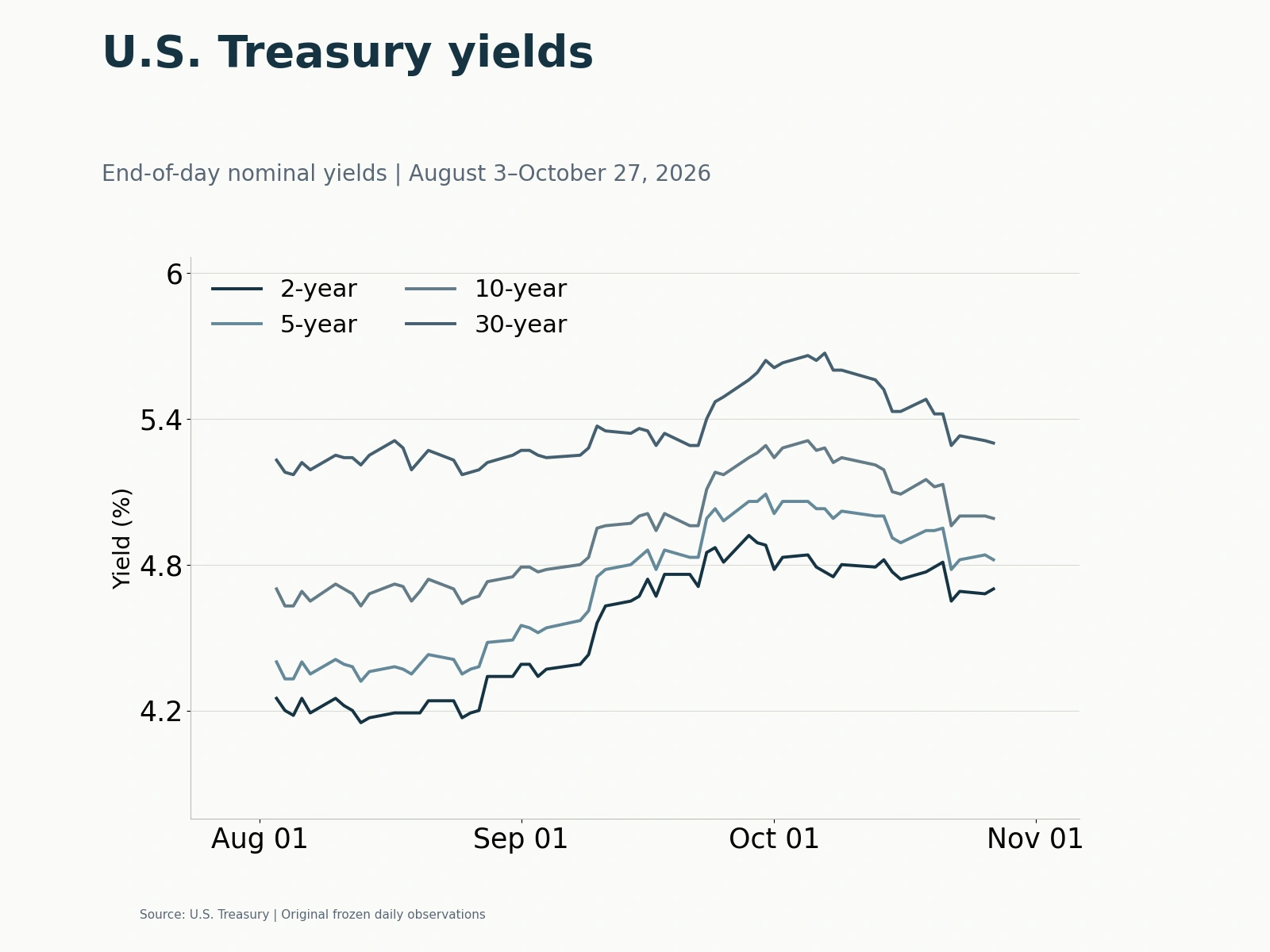
The U.S. Treasury’s daily yield curve on a consistent basis showed the two-year yield rising 2 basis points from October 26 to 4.70% on October 27. The five-year yield fell 2 basis points to 4.82%, while the 10-year fell to 4.99% and the 30-year to 5.30%, each down 1 basis point. The 10-year/two-year spread narrowed from 32 to 29 basis points.
The decline in long yields had been under way for some time. Relative to October 7, 10-year and 30-year yields had fallen 29 and 37 basis points, respectively, while the two-year had declined only 7 basis points. Easing oil prices supported the long end. The US$70 billion five-year Treasury auction on October 27 also showed demand remaining around normal levels: its high yield was 4.845%, and the bid-to-cover ratio of 2.33 was close to the preceding 10-auction average of 2.32. Benchmark-rate pressure on long-duration assets had eased, while short-term financing costs remained elevated.
Short rates were more constrained by the policy path. During European trading on October 27, Dow Jones cited LSEG data putting the probability of unchanged rates at the current Fed meeting at about 89.5%, while markets still anticipated a possible December increase. Pimco economist Tiffany Wilding also viewed a 25-basis-point hike in December as the likelier next step. Expectations of a pause at this meeting alongside a subsequent hike limited the short end’s ability to follow long yields lower.
High coupons attracted allocation capital, but prospective returns still depended on the direction of rates. On October 27, J.P. Morgan Asset Management’s global fixed-income head Bob Michele said he expected policy rates and the Treasury curve eventually to converge around 4.5%. Coupon income and price appreciation could produce U.S. bond-market returns of 7%–8% over the following 12 months. Further substantial Fed increases to restrain inflation would be a tail risk to that assessment.
Improvement in credit markets was more selective. The published U.S. high-yield option-adjusted spread on FRED was 330 basis points on October 26, 8 basis points narrower than October 23. The latest published investment-grade spread was 91 basis points for October 23. BNY’s October 27 analysis said the year’s high-yield spread widening had been concentrated among lower-quality issuers. BondbloX’s morning note that day put year-to-date U.S. investment-grade corporate issuance at US$1.76 trillion, with AI infrastructure financing an important driver. High-quality companies could still raise funds, while lower-quality issuers’ repayment capacity faced greater scrutiny.
U.S. dollar bonds in Hong Kong also required assessment of specific recovery arrangements. Sullivan & Cromwell disclosed on October 27 that China SCE Group’s US$2.3 billion offshore debt restructuring had completed on October 23. Existing debt was exchanged for upfront cash, new notes, mandatory convertible bonds and shares. Completion clarified the path to creditor recovery; subsequent value would depend on payments under the new debt and equity performance. Valuation support from lower benchmark rates also had to be assessed against specific cash flows and recovery structures.
U.S. consumer confidence reaches 91.7; major purchases remain cautious

October U.S. consumer confidence, released on October 27, rose to 91.7, an increase of 7.5 points from September’s upwardly revised 84.2 and above the Econoday survey forecast of 80.4. The Present Situation Index rose to 120.4 and the Expectations Index to 72.6. The share of respondents saying jobs were plentiful minus the share saying jobs were hard to get rose to 5.3 percentage points. Average household inflation expectations for the next 12 months fell from 6.0% to 5.8%. The Conference Board linked the recovery in confidence to lower retail gasoline prices from September to October: declining energy costs were improving households’ perceptions.
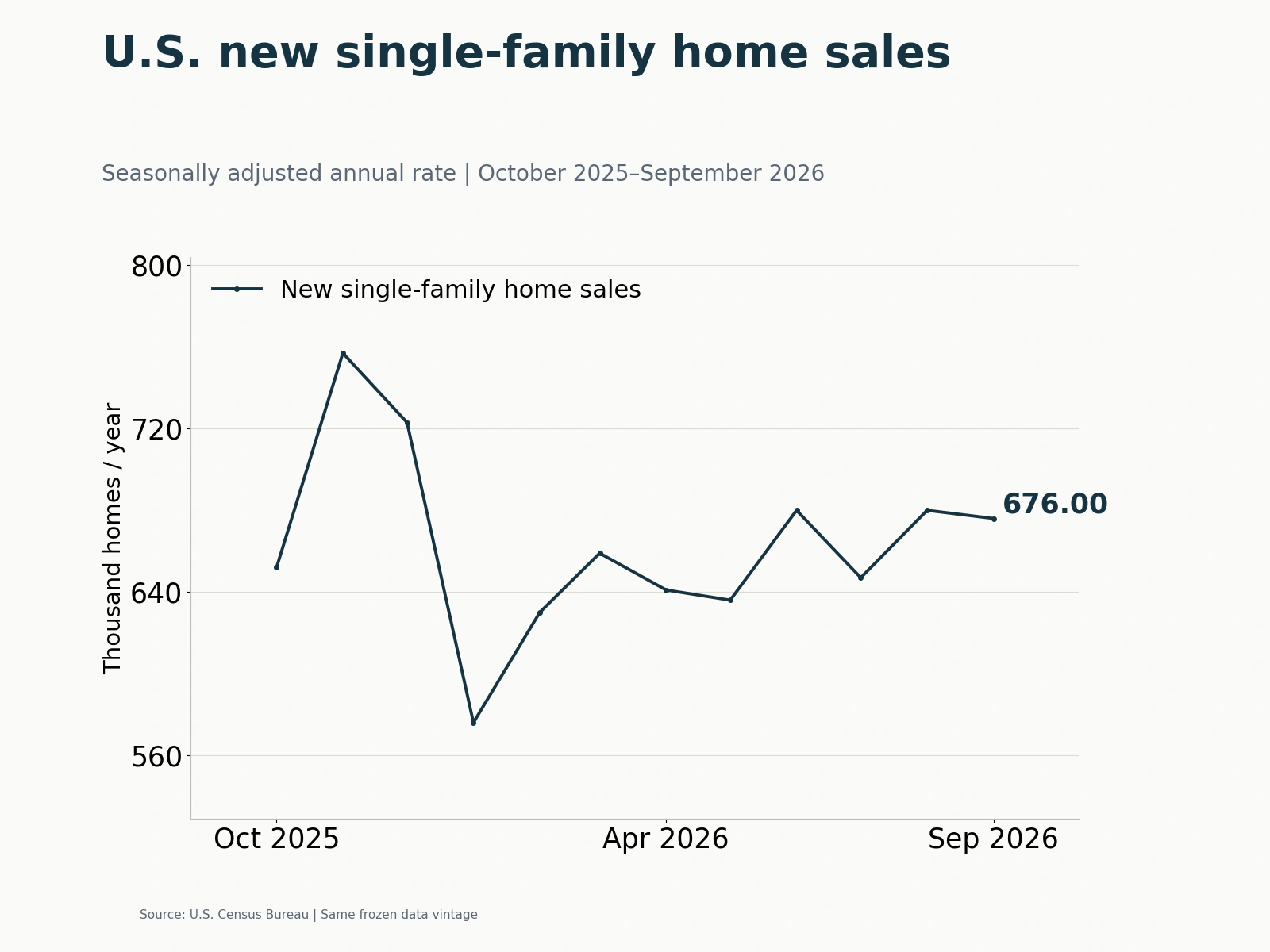
Stronger confidence had yet to bring a corresponding improvement in plans for major purchases. The survey showed lower intended spending on durable goods and most services over the next six months. Six-month moving averages of plans to buy vehicles and homes also edged lower. September new single-family home sales, released the same day, were a seasonally adjusted annualized 676,000, broadly unchanged from August’s revised 680,000. There were 476,000 new homes for sale, representing 8.4 months of supply. High financing costs continued to restrain housing demand and affect orders at downstream companies such as Sherwin-Williams.
Businesses faced both weak orders and cost pressure. The Richmond Fed’s Fifth District manufacturing composite index was −2 in October, unchanged from September. The new-orders index fell from −6 to −8, and the employment index declined from 7 to 3. Average price increases paid over the preceding 12 months were 7.12%, while increases in prices received rose from 4.19% to 5.27%. This regional sample showed that weak orders and price pressure could coexist. A single month’s improvement in confidence was insufficient to remove policymakers’ inflation concerns. The advance third-quarter GDP estimate and September personal income and outlays report due October 29 would provide further evidence on real consumption, income and prices.
Asian electronics profits grow; cash collection and policy execution remain in focus
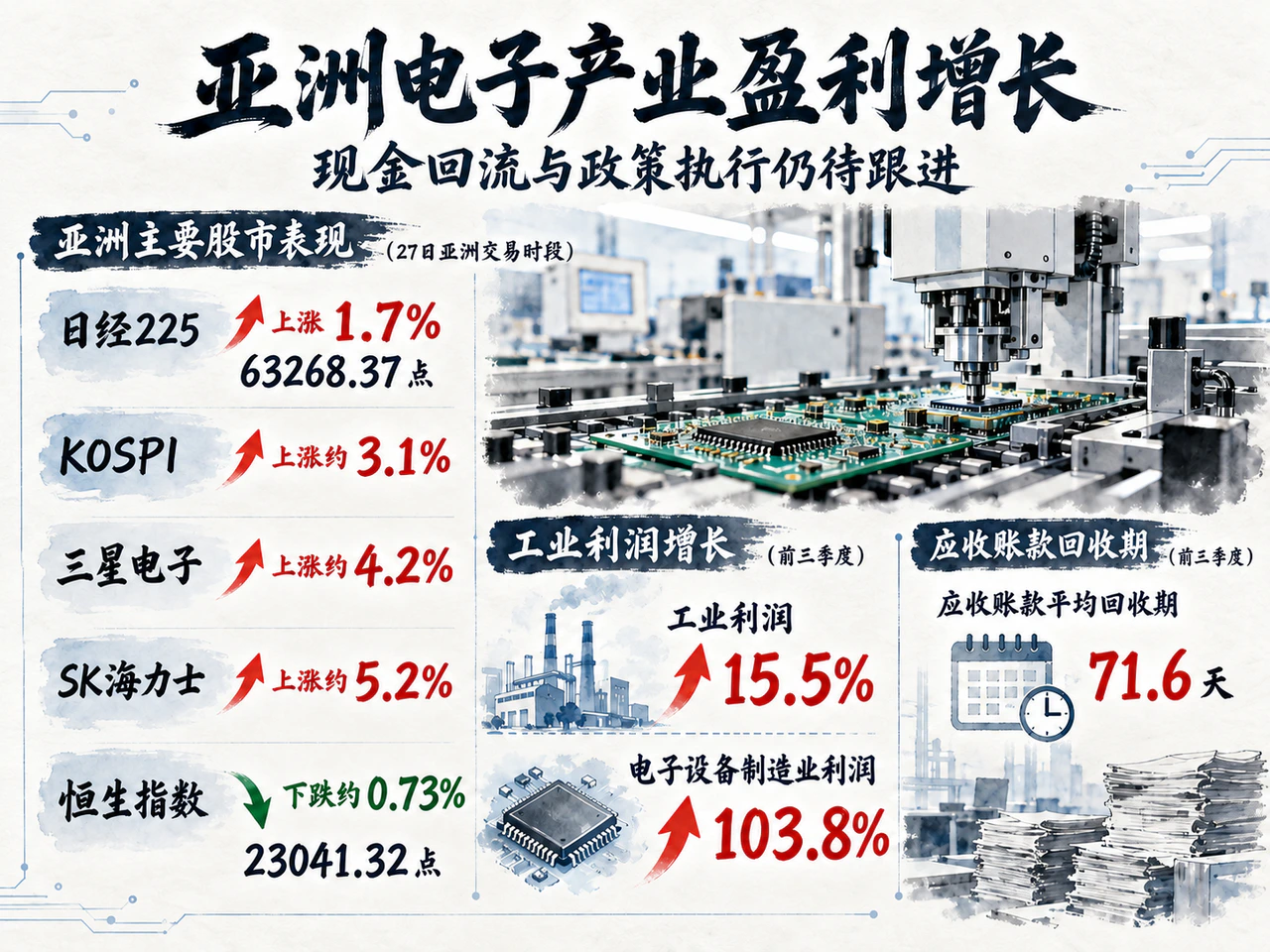
AI demand’s effects on Asian supply chains were already visible in market performance. During Asian trading on October 27, the Nikkei 225 rose 1.7% to 63,268.37 and South Korea’s KOSPI gained about 3.1%. Samsung Electronics and SK hynix rose approximately 4.2% and 5.2%, respectively, while the Hang Seng fell about 0.73% to 23,041.32. These moves followed the earlier U.S. technology rebound and news of Anthropic’s listing plans. Natixis economist Gary Ng said that if Anthropic’s earnings prospects proved sufficiently convincing, AI infrastructure expenditure could translate into stronger sales and pricing across Japanese and Korean semiconductor supply chains. Different markets’ exposure to equipment, testing, memory and other stages also produced different reactions to the same news.
China’s industrial profits likewise showed a prominent contribution from electronics. The National Bureau of Statistics reported on October 27 that profits at industrial enterprises above the designated size totaled RMB 6.03374 trillion in the first three quarters, up 15.5% from a year earlier. September profits rose 14.4%, accelerating from 4.2% in August. First-three-quarter profits in computer, communications and other electronic equipment manufacturing increased 103.8%, contributing 9.6 percentage points to aggregate industrial profit growth. High-technology manufacturing profits rose 52.0% and represented 25.5% of the total. By comparison, automotive manufacturing profits fell 22.8%, leaving the earnings recovery uneven across industries.
Revenue growth exceeding cost growth supported profits, but cash collection remained under pressure. Industrial revenue rose 6.6% in the first three quarters, compared with a 6.1% rise in operating costs, lifting the revenue profit margin to 5.68%. At the end of September, accounts receivable were up 10.0% and finished-goods inventories up 11.6%, both faster than revenue. The average collection period lengthened by 1.3 days to 71.6 days. Whether profit growth could support broader capital expenditure still depended on better collection and turnover. An Economic Daily commentary on October 27 emphasized accelerating the use of bond proceeds and turning them into completed physical work. Policy funding would help demand spread to more industries when projects generated orders and payments reached corporate cash flow.
Overseas policy developments were also moving from negotiations and approvals toward implementation. Global News reported an acceleration in political-level U.S.–Canada trade negotiations. Honda U.S. executive Jennifer Thomas nevertheless warned on October 27 that North American supply chains would face a severe shock if the United States followed through on its earlier threat to raise tariffs on Canadian vehicles and parts from 25% to 50% on January 1 of the following year. The existing 25% tariff applied to non-U.S. content; cross-border movement of parts meant the formal terms directly affected automakers’ margins and investment locations. Although Russian diesel imports had received some administrative sanctions exemptions, reports on October 27 indicated that U.S. lawmakers had raised legal questions for banks and ports. Their willingness and ability to handle the business would affect actual supply.
The UK’s October 28 budget would reflect high financing costs in its fiscal arrangements. Reuters reported economists’ estimates that the roughly £24 billion of fiscal headroom available in March had shrunk to £8.5 billion–£20 billion, focusing attention on borrowing plans for the coming 12 months and sector-specific taxes. Lower oil prices and long yields had already relieved some pressure. A broader market recovery still depended on purchases turning into revenue, revenue turning into cash, and policy commitments becoming executable arrangements.