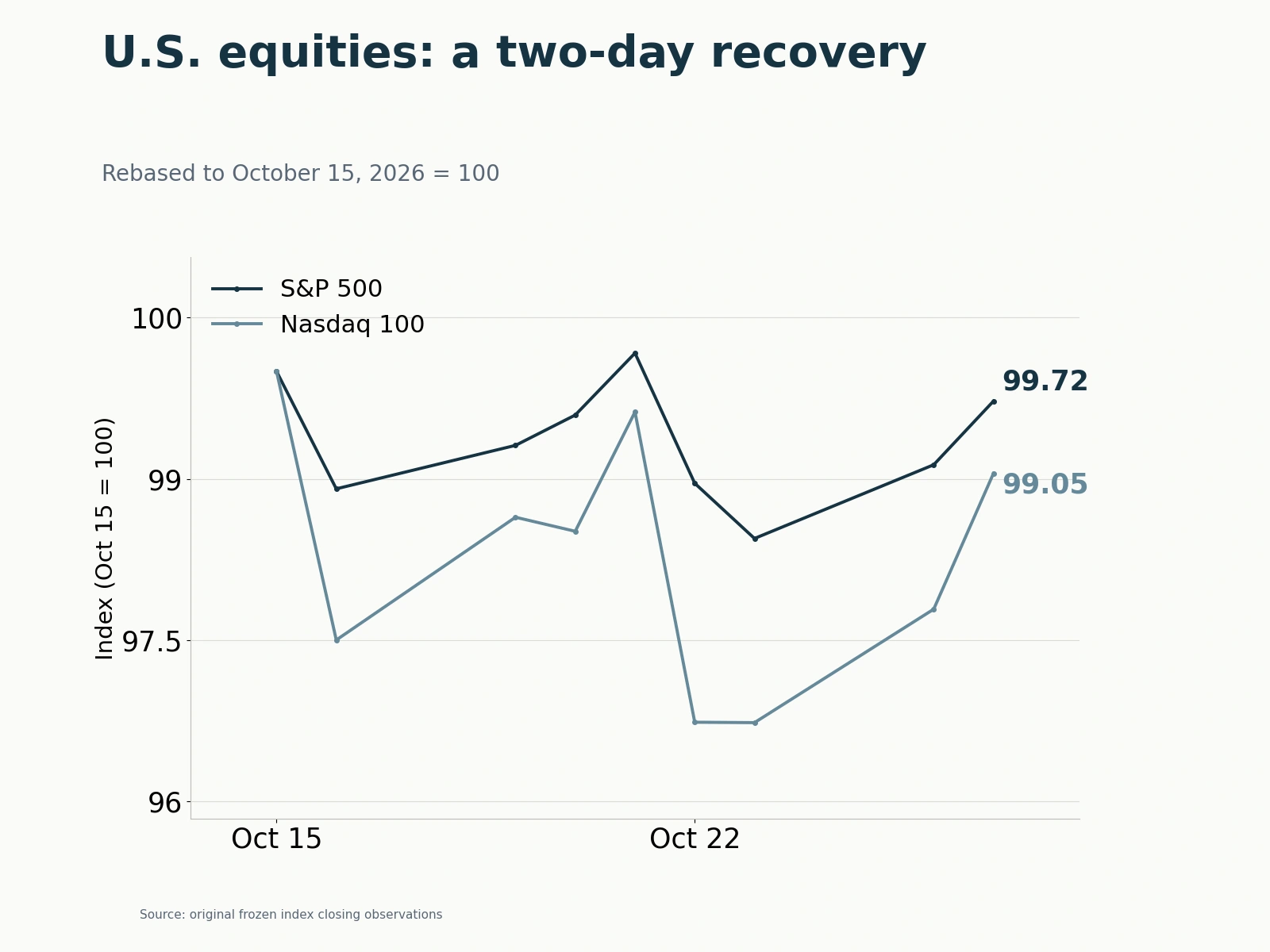
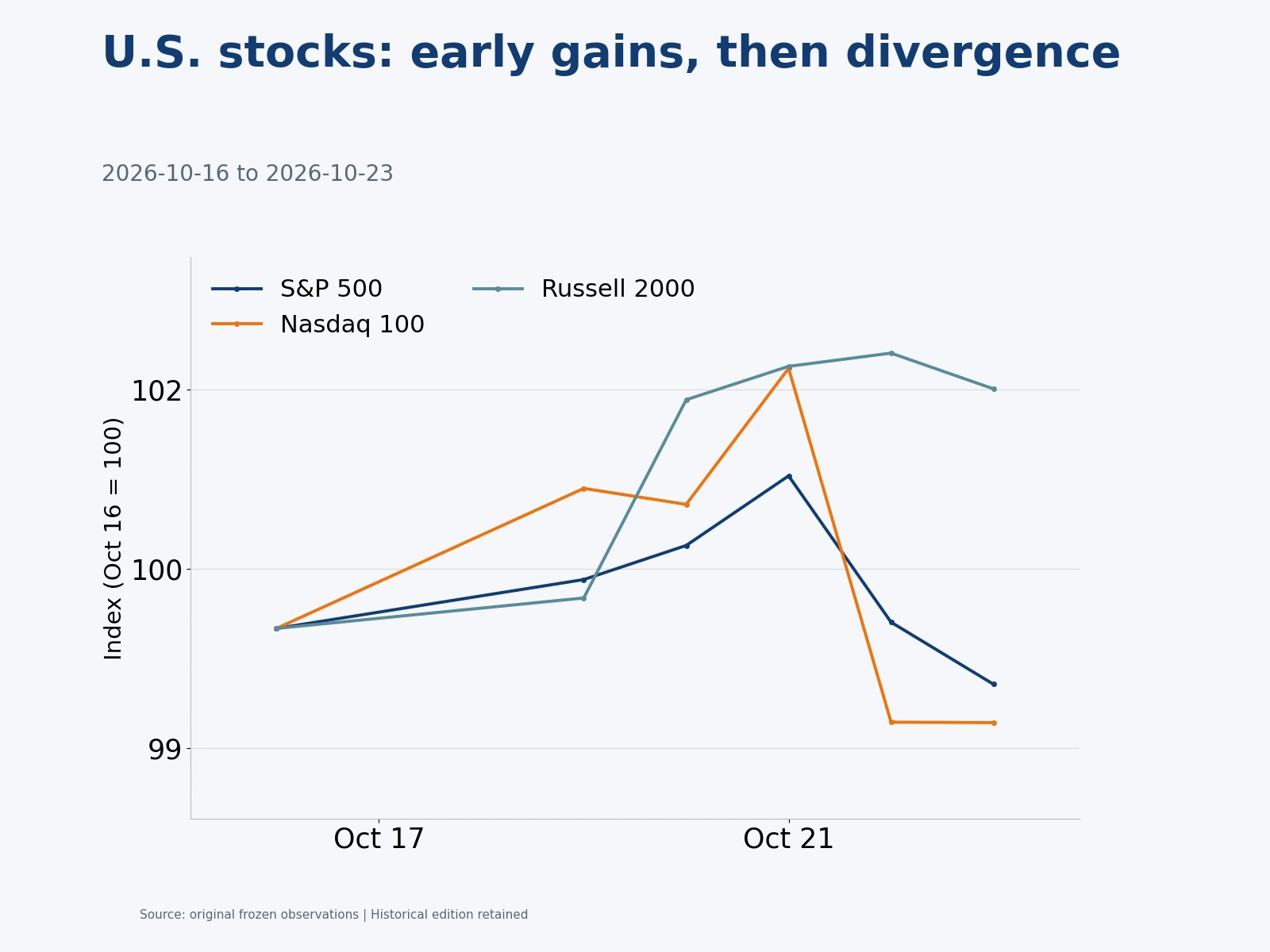
On October 26, 2026, strong AI revenue growth and chip-demand news drove a rebound in U.S. shares, while lower oil prices eased energy-cost pressure. The S&P 500 closed up 0.70% and the Nasdaq 100 gained 1.09%, but the 10-year Treasury yield remained elevated at 5.00% and the dollar was firm. Corporate financing burdens did not ease broadly alongside share prices. By the morning of October 27 Beijing time, the divergence between realized growth and financing constraints had extended from AI companies’ equity and bond performance to different economies: U.S. technology led, Brazilian equities and the currency adjusted sharply to the presidential election result, China supported real-economy financing through liquidity instruments and fiscal funds, and offshore issuers continued facing distinct refinancing and covenant-default risks.
AI revenue growth lifts semiconductor ETF nearly 3%; compute expansion adds equity supply and consumes cash
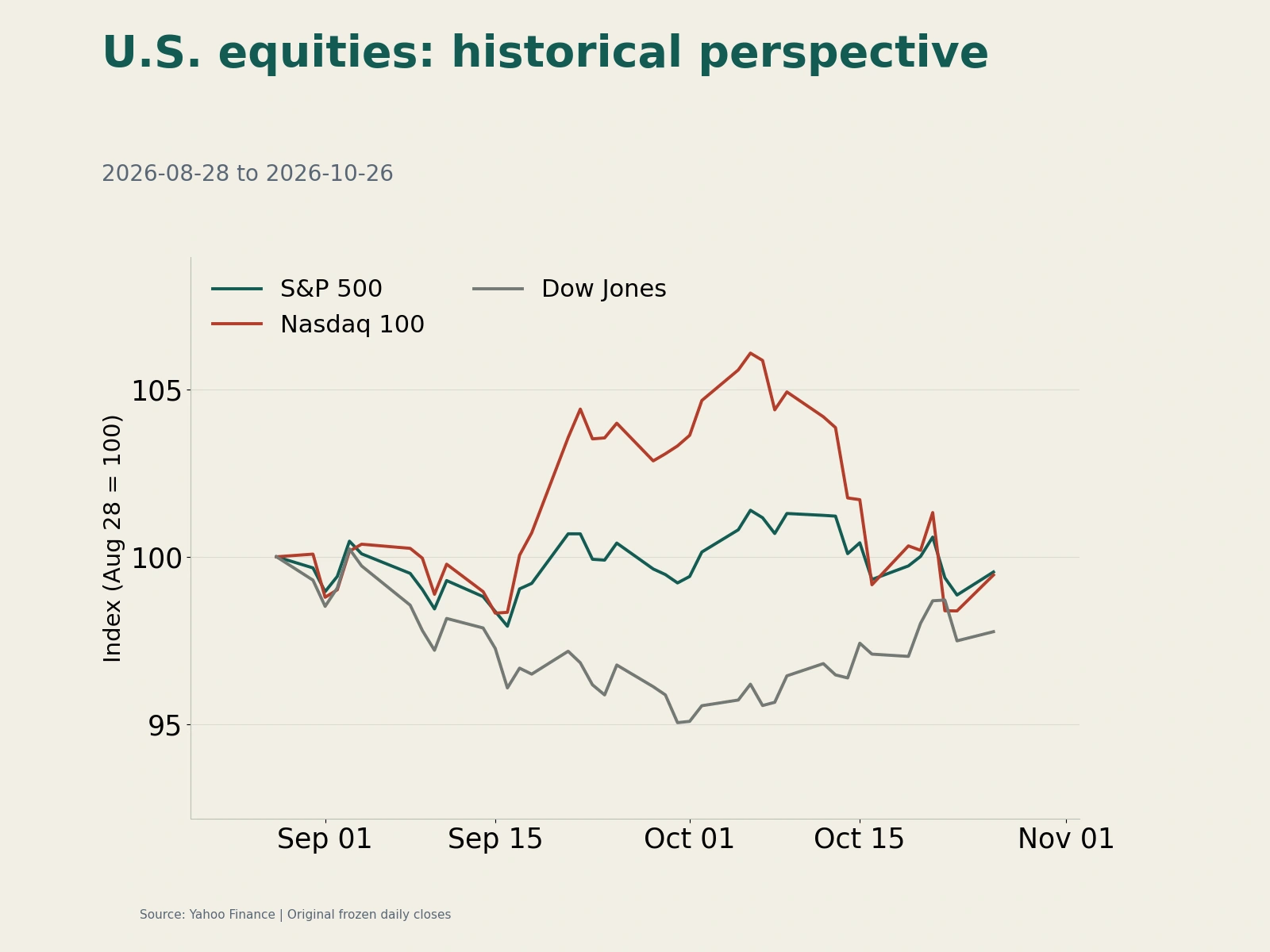
At Monday’s U.S. close, the S&P 500 stood at 7,676.77 and the Nasdaq 100 at 29,273.40. The Dow rose 0.28% to 52,361.58, while the Russell 2000 gained 0.38% to 2,786.42. Among sector ETFs, technology rose 1.69%, financials 0.21% and energy 0.45%. The VIX fell from the preceding session’s 19.45 to 18.39, with improved risk appetite most evident in large technology stocks.
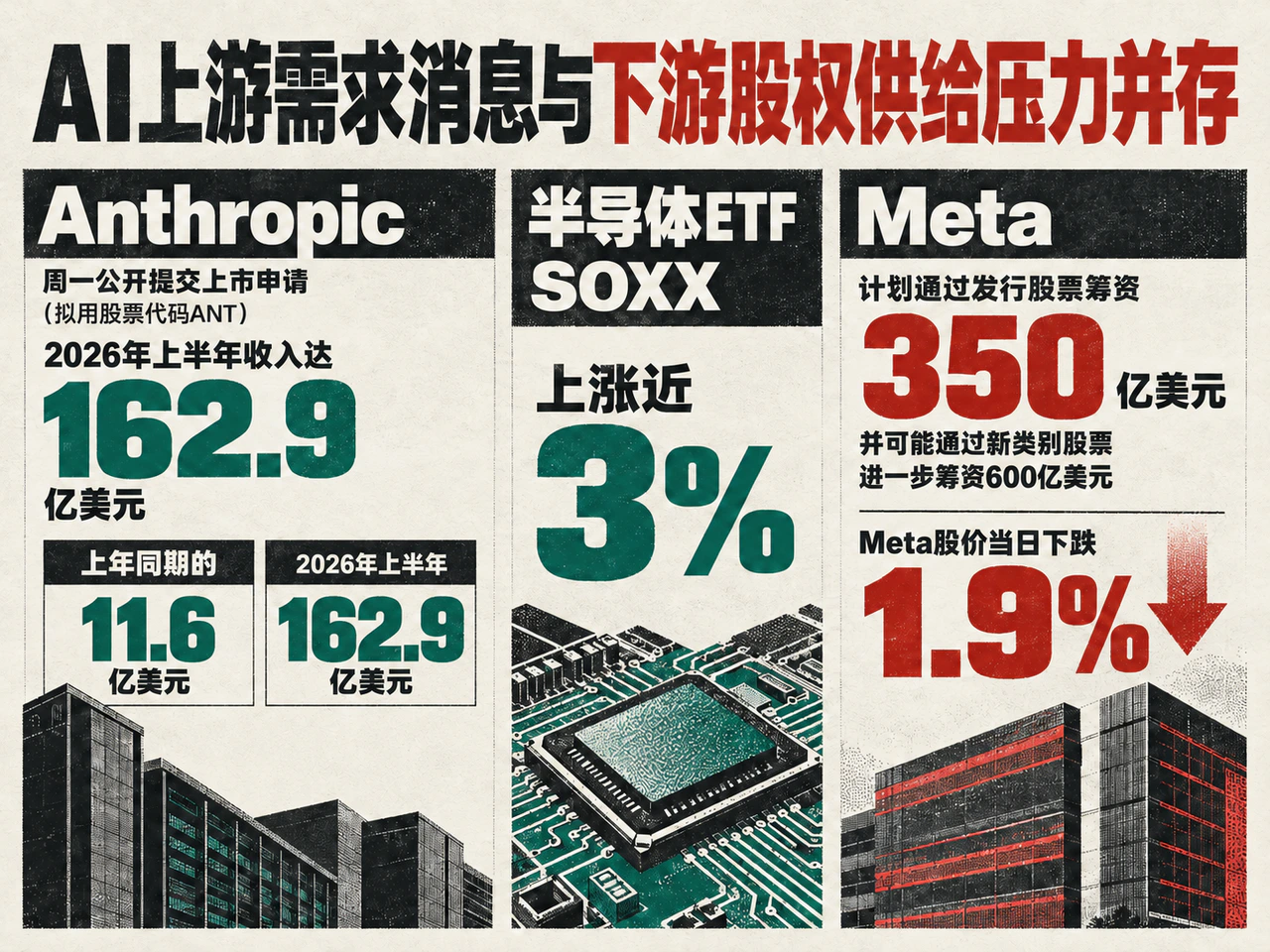
Rapid AI application revenue growth prompted a reassessment of compute demand. CNBC reported that Anthropic publicly filed for a listing on Monday, proposing the ticker ANT, and disclosed first-half 2026 revenue of US$16.29 billion, sharply above US$1.16 billion a year earlier. The semiconductor ETF SOXX rose nearly 3%, with Micron up about 3%, AMD 2.8%, Nvidia 2.4% and Broadcom 2.3%. Following discussions with Micron management, Bank of America became more positive about tightening memory-chip supply in 2027–2028.
Further downstream, equipment purchases brought financing burdens and equity dilution. The Associated Press reported that Meta planned to raise US$35 billion through share issuance, with a possible further US$60 billion through a new share class. Nvidia, AMD and Broadcom had expressed interest in subscribing for a combined US$5 billion. Increased equity supply and suppliers investing in customers attracted attention, while Meta fell 1.9%. Compute lessor CoreWeave at one point fell 5.5%, later traded as much as 6.6% higher and ultimately gained 1.8%, showing continued disagreement about high financing costs and project returns.
Celestica’s after-hours results further illustrated how expanding orders tie up funds. Third-quarter revenue was US$5.83 billion, up 83% year on year; adjusted earnings per share were US$3.30, up 109%; and adjusted operating margin rose from 7.6% to 8.5%. Connectivity & Cloud Solutions revenue reached US$4.87 billion, up 102%. Management raised 2026 revenue guidance from US$20.5 billion to US$21 billion and issued its first 2027 outlook of US$40 billion in revenue and a 9% adjusted operating margin. However, it cut full-year free-cash-flow guidance from US$600 million to US$460 million to build working capital for faster 2027 growth. Alphabet and Microsoft were due to report after Wednesday’s close, followed by Amazon on Thursday. Markets would continue comparing cloud companies’ AI revenue delivery, capital expenditure and cash recovery. Outside technology, Verizon fell 3.5% after quarterly profit beat expectations but revenue missed.
The U.S. technology rebound occurred after Monday’s Asian close. The Associated Press reported that during Asian trading the Nikkei 225 fell 0.8% to 62,189.65 and South Korea’s KOSPI declined 1.5% to 5,469.47. Advantest, Tokyo Electron and Samsung Electronics fell 3.9%, 3.7% and 1.1%, respectively. The Hang Seng instead rose 0.5% to 23,211.81. The subsequent U.S. chip rebound and Celestica’s after-hours results provided fresh demand signals for Japanese and Korean semiconductor equipment and memory supply chains.
Ten-year Treasury yield holds at 5.00%; manufacturing costs and AI debt concerns pressure credit spreads
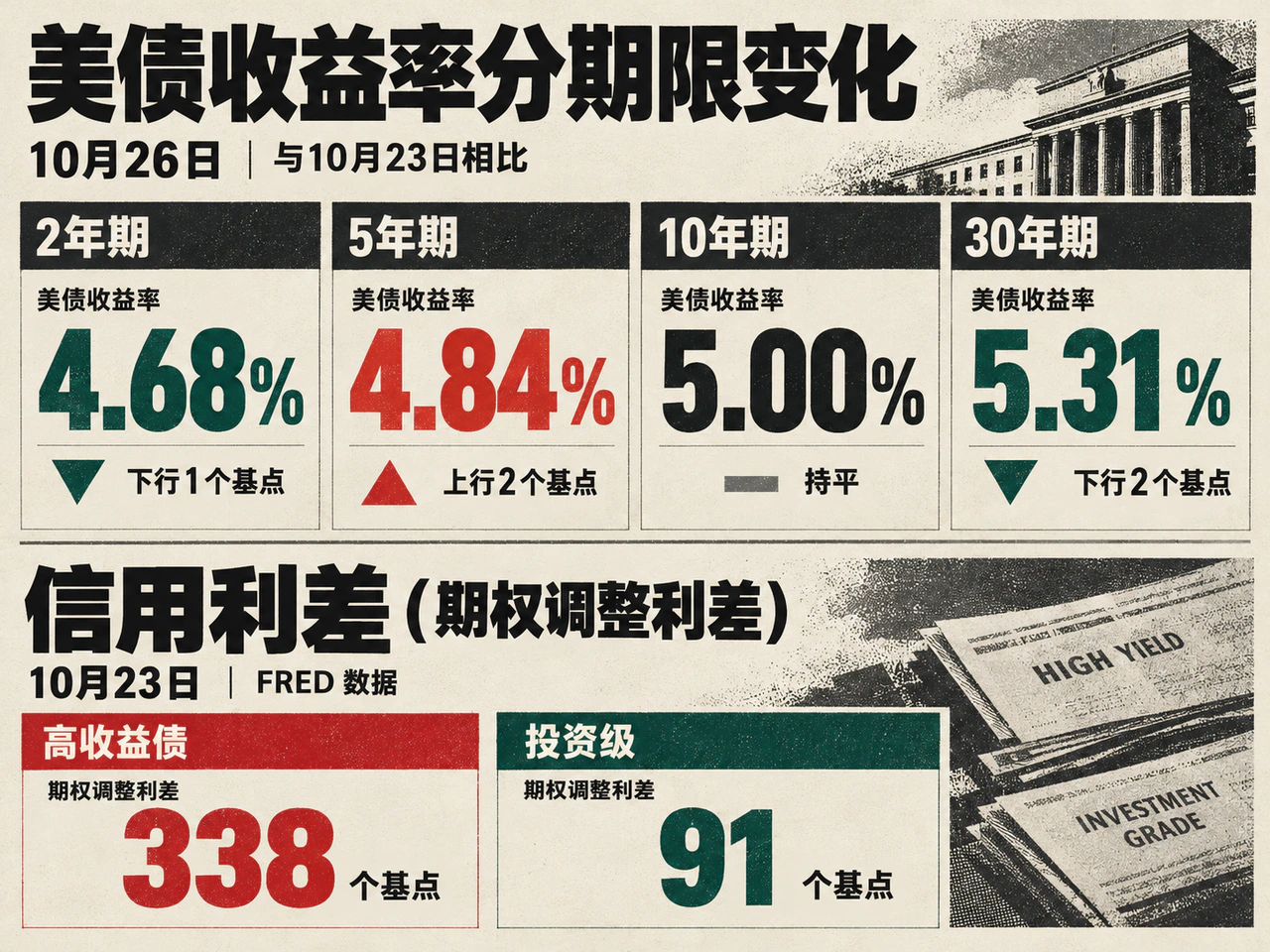
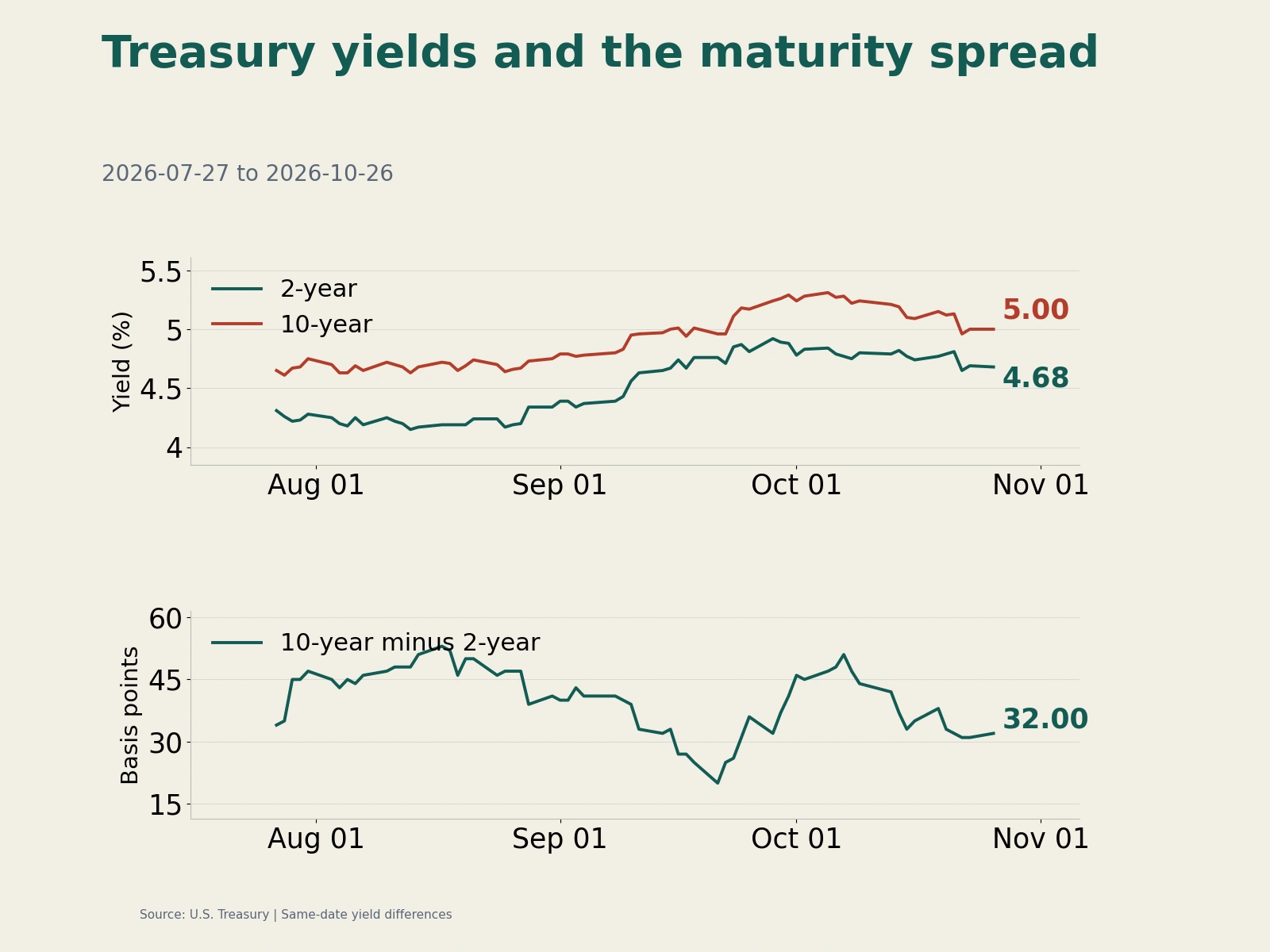
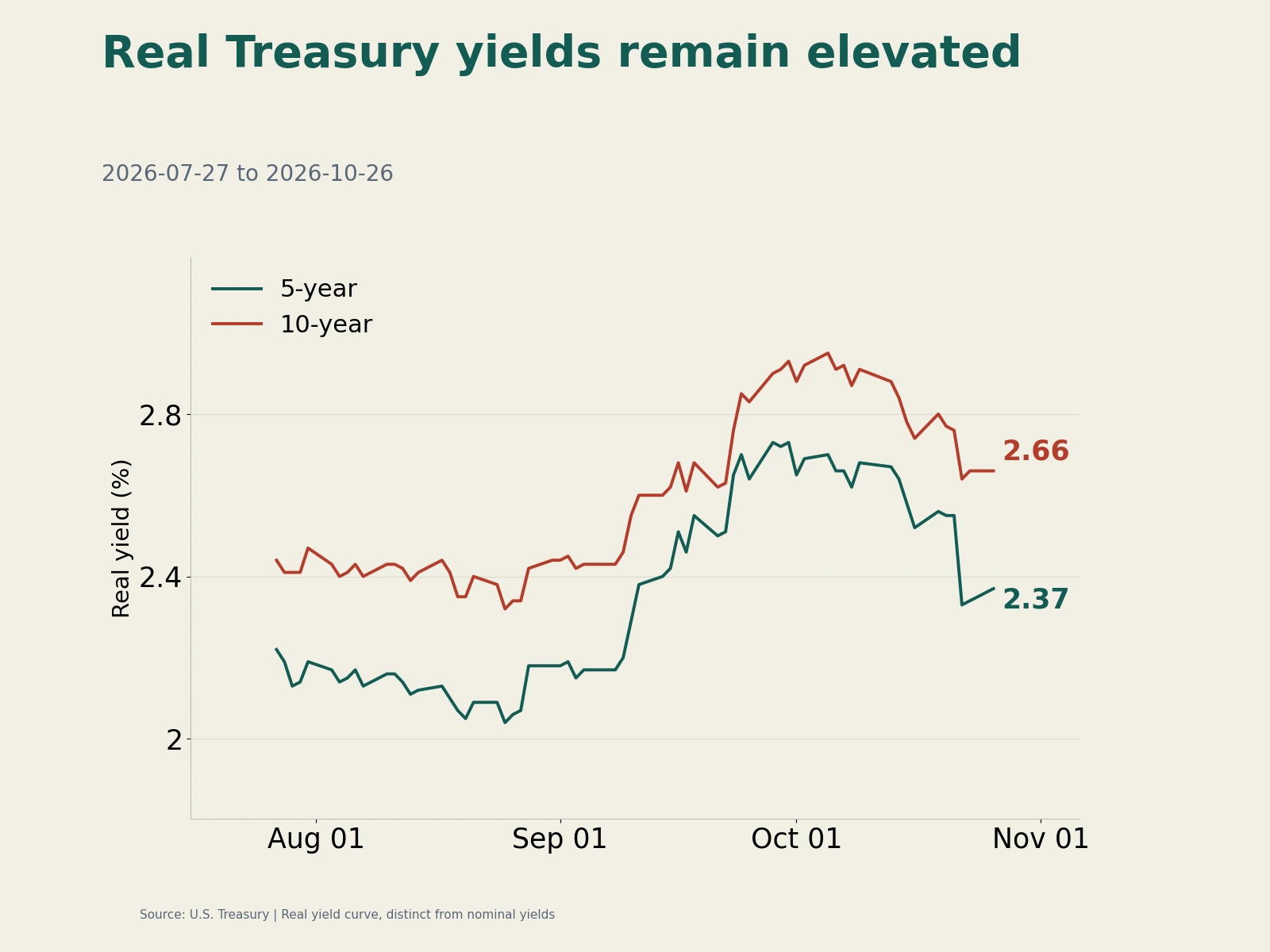
Treasury yields changed only slightly as equities recovered. The U.S. Treasury’s October 26 end-of-day par yield curve showed the two-year yield down 1 basis point from October 23 to 4.68%, the five-year up 2 basis points to 4.84%, the 10-year unchanged at 5.00% and the 30-year down 2 basis points to 5.31%. The 10-year/two-year spread widened to 32 basis points. Corresponding real yields showed the five-year up 3 basis points to 2.37%, the 10-year unchanged at 2.66% and the 30-year down 1 basis point to 3.07%.
The slightly lower short end and unchanged 10-year reflected caution ahead of the October Fed meeting, while intermediate maturities faced heavy Treasury supply. The week included US$183 billion of two-, five- and seven-year fixed-rate notes plus US$30 billion of two-year floating-rate notes, with the US$70 billion five-year auction scheduled for October 27. The US$69 billion two-year auction completed October 26 had a high yield of 4.708%, 0.3 basis points above the pre-auction secondary-market yield. Dow Jones reported a bid-to-cover ratio of 2.59, down from 2.63, and an indirect-bidder allocation of 45.7%, down from approximately 57.7%. Econoday commentary carried by CME noted that the bid-to-cover ratio remained near its annual average: demand was slightly weaker, but supply was absorbed in an orderly way overall. Algebris said in October 26 commentary that tighter financial conditions and debt concerns surrounding AI capital expenditure supported widespread expectations of an October Fed hold, favoring Treasury duration over high-yield credit.
Recent regional and monthly data had yet to signal growth and inflation cooling together. Dallas Fed October manufacturing diffusion indices, measured as shares of firms reporting increases minus decreases, showed general business activity rising from 9.8 to 13.4 and expectations six months ahead from 20.8 to 38.1. Production nevertheless fell from 29.5 to 15.8, still above its 9.7 long-run average; new orders dropped from 30.7 to 9.3; and shipments fell from 24.8 to 8.4, slowing September’s strong expansion. Cost persistence remained pronounced: raw-material prices rose from 44.1 in August to 52.2 in September and 55.3 in October, while finished-goods prices increased from 27.6 to 29.9. Employment fell from 15.1 to 11.6 and wages and benefits from 27.4 to 20.8, but hours worked rose from 5.6 to 10.1. Firms were extending working hours while facing more widespread input-price increases.
Trading Economics reported that the Chicago Fed National Activity Index rose from −0.08 in August to 0.07 in September. Its three-month moving average was 0.03, near historical trend growth. Production’s contribution improved, while consumption and housing shifted from +0.02 to −0.08. Industrial resilience, uneven household demand and input-cost pressure would receive a broader test in the advance third-quarter GDP estimate and September personal income and outlays data due October 29.
Credit markets had already responded to financing pressure at asset-heavy businesses. FRED’s latest October 23 observations showed the ICE BofA high-yield option-adjusted spread at 338 basis points, versus 340 previously, and investment-grade spreads at 91 basis points, versus 89. Penn Mutual’s October 26 commentary noted substantial high-yield widening from roughly 270 basis points in mid-September, with pressure concentrated among highly indebted AI infrastructure companies. Citing J.P. Morgan, it said that as of October 23 the spread on Oracle’s 2066 bond exceeded that of 88% of BB-rated bonds.
Brent eases to US$115.81; spot gold returns above US$4,000
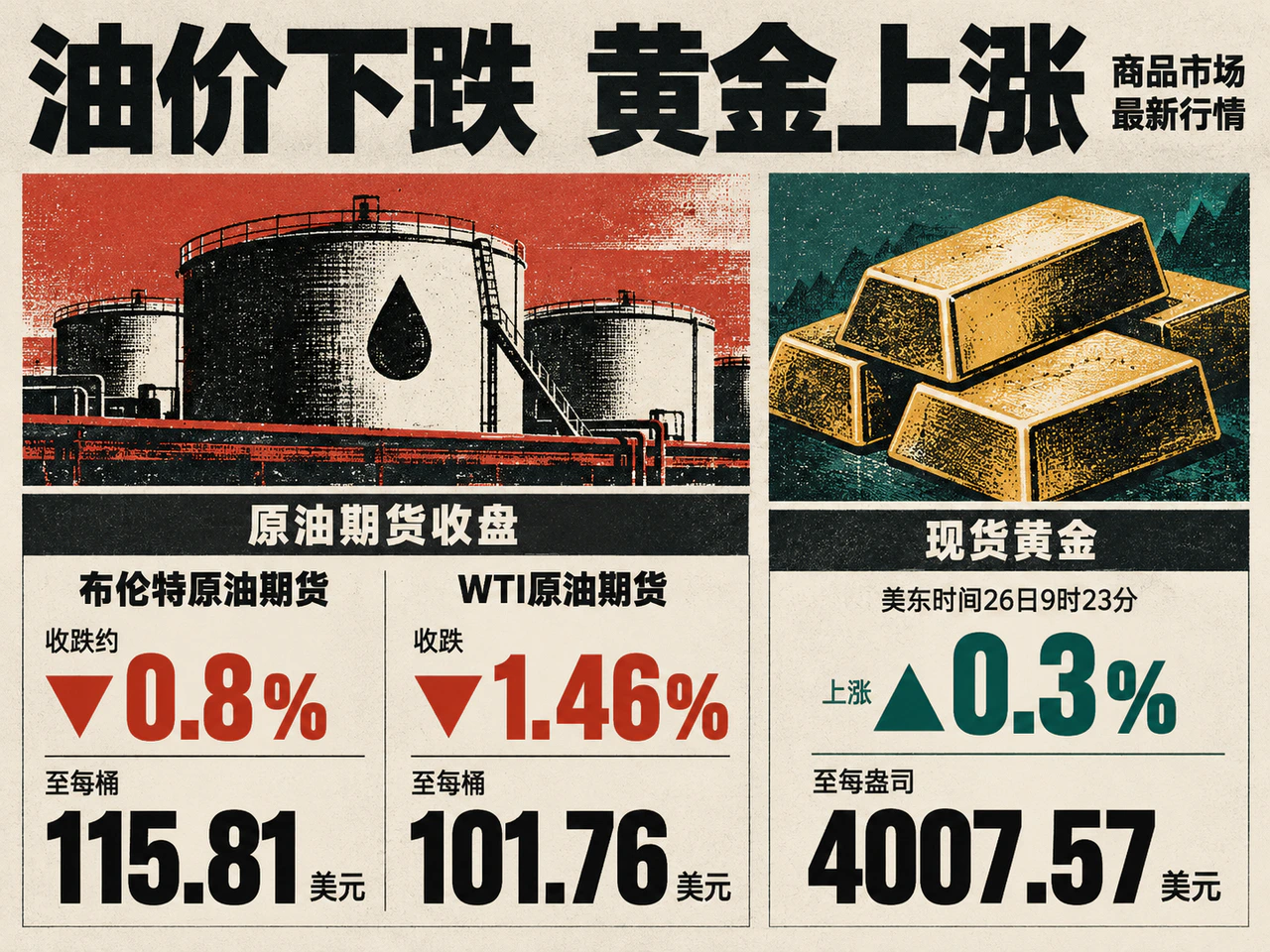
In commodities, Reuters’ October 26 closing report put Brent crude futures down about 0.8% at US$115.81 a barrel and WTI down 1.46% at US$101.76. Middle East mediation brought some hopes of de-escalation, but Iran-related constraints on regional energy routes remained unresolved. Oil stayed elevated above US$100, leaving only marginal relief in energy-cost pressure.
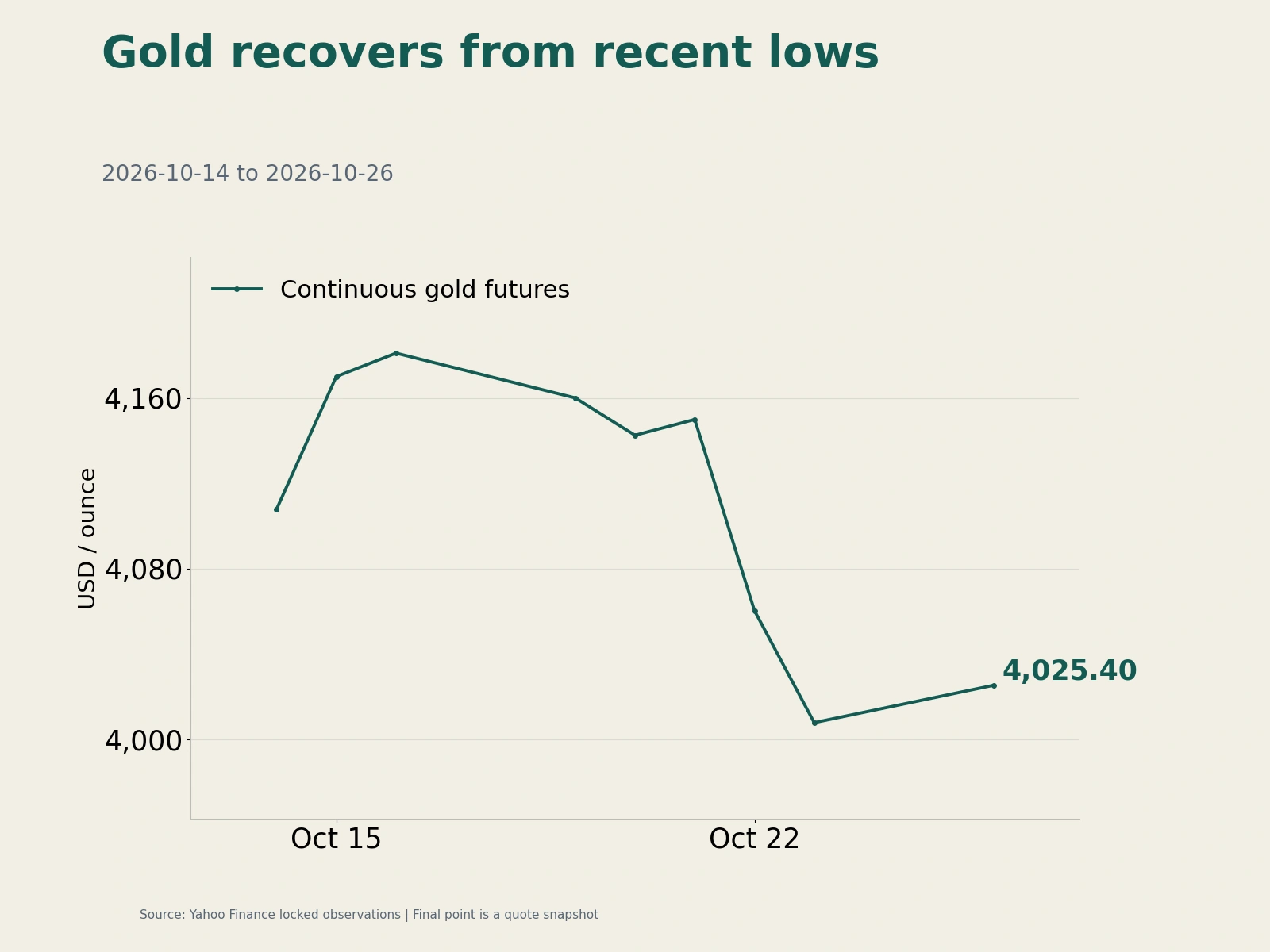
Lower oil prices eased concern about further energy-driven inflation and helped gold recover from recent lows. Reuters reported spot gold up 0.3% to US$4,007.57 an ounce at 09:23 U.S. Eastern time on October 26, with December gold futures up 0.4% to US$4,021.80. Spot gold had touched US$3,975 in the preceding session, its lowest since July 20. StoneX strategist Bob Haberkorn attributed the recovery to lower oil and buying on dips and expected quieter trading before the Fed decision. By the morning of October 27 Beijing time, the provider’s continuous gold-futures quote snapshot was US$4,025.4, up 0.44% from the October 23 record. The provider’s dollar-index daily observation rose about 0.22% to 102.03. Gold’s recovery remained moderate under the constraint of a stronger dollar and high real yields.
China’s announced October medium-term tools imply RMB 200 billion net injection; Shimao defaults on about US$9.07 billion of restructured debt
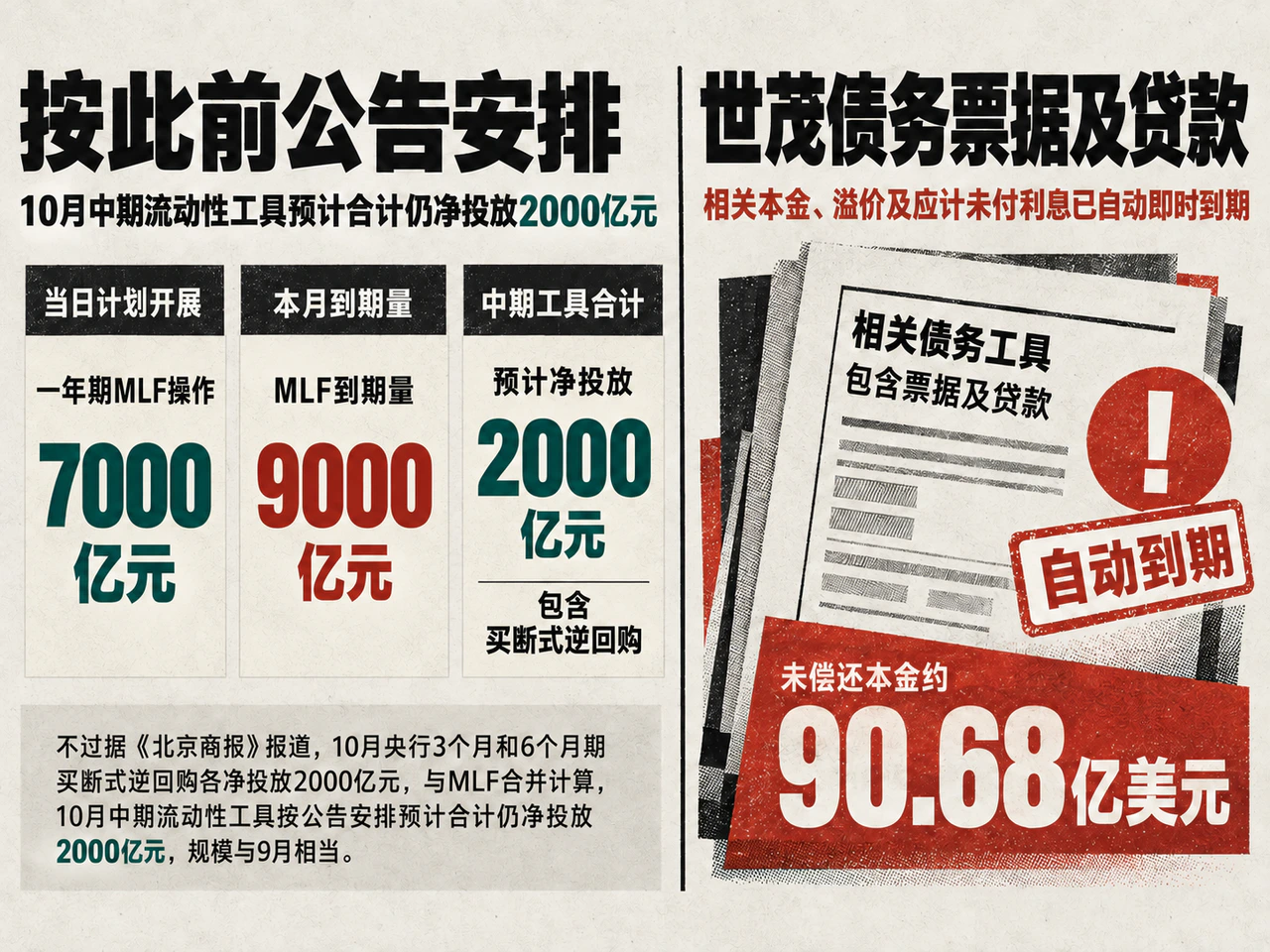
China’s central bank liquidity tools and fiscal policy continued jointly shaping financing conditions. On October 26, the People’s Bank of China conducted RMB 56 billion of seven-day reverse repos and RMB 398 billion of overnight reverse repos. Its earlier announcement scheduled RMB 700 billion of one-year MLF operations that day. Against RMB 900 billion maturing during the month, MLF alone implied a net RMB 200 billion withdrawal. Beijing Business Today nevertheless reported net October injections of RMB 200 billion each through three- and six-month outright reverse repos. Combined with MLF, the announced medium-term tools still implied an aggregate net RMB 200 billion injection for October, similar to September. CITIC Securities’ Ming Ming said the combination substituted outright reverse repos for MLF across the maturity structure and stabilized banks’ medium-term funding sources.
Fiscal funds were being deployed to lower companies’ working-capital costs and support project construction. An Economic Daily analysis of first-three-quarter fiscal operations published October 26 said that, since working-capital loans to micro, small and midsize firms became eligible for fiscal interest subsidies in August, the program had supported over RMB 1.8 trillion of new relevant loans in two months. New special-purpose bond issuance totaled RMB 3.5608 trillion from January through September, or 81% of the annual allocation. September alone saw RMB 633.9 billion issued, RMB 214.8 billion more than a year earlier.
Offshore credit remained highly differentiated, with financing conditions depending on issuer quality and contractual performance. Meituan announced on October 26 a proposed renminbi senior-note offering to professional investors, with net proceeds intended mainly for refinancing existing offshore debt and general corporate purposes. Principal amount, interest rate and other terms were still to be determined. Shimao Group disclosed the same day that a winding-up petition remaining neither dismissed nor stayed for 60 consecutive days had triggered an event of default under affected offshore restructured debt instruments when the October 25 deadline expired. The instruments included notes and loans with approximately US$9.068 billion of outstanding principal. Under the applicable terms, principal, premiums and accrued unpaid interest automatically became immediately due. Shimao said it had received no notice or demand for immediate repayment and intended to oppose the winding-up petition.
Lula’s victory drives a Brazilian equity and currency selloff and canceled auctions; trade costs show some easing signals
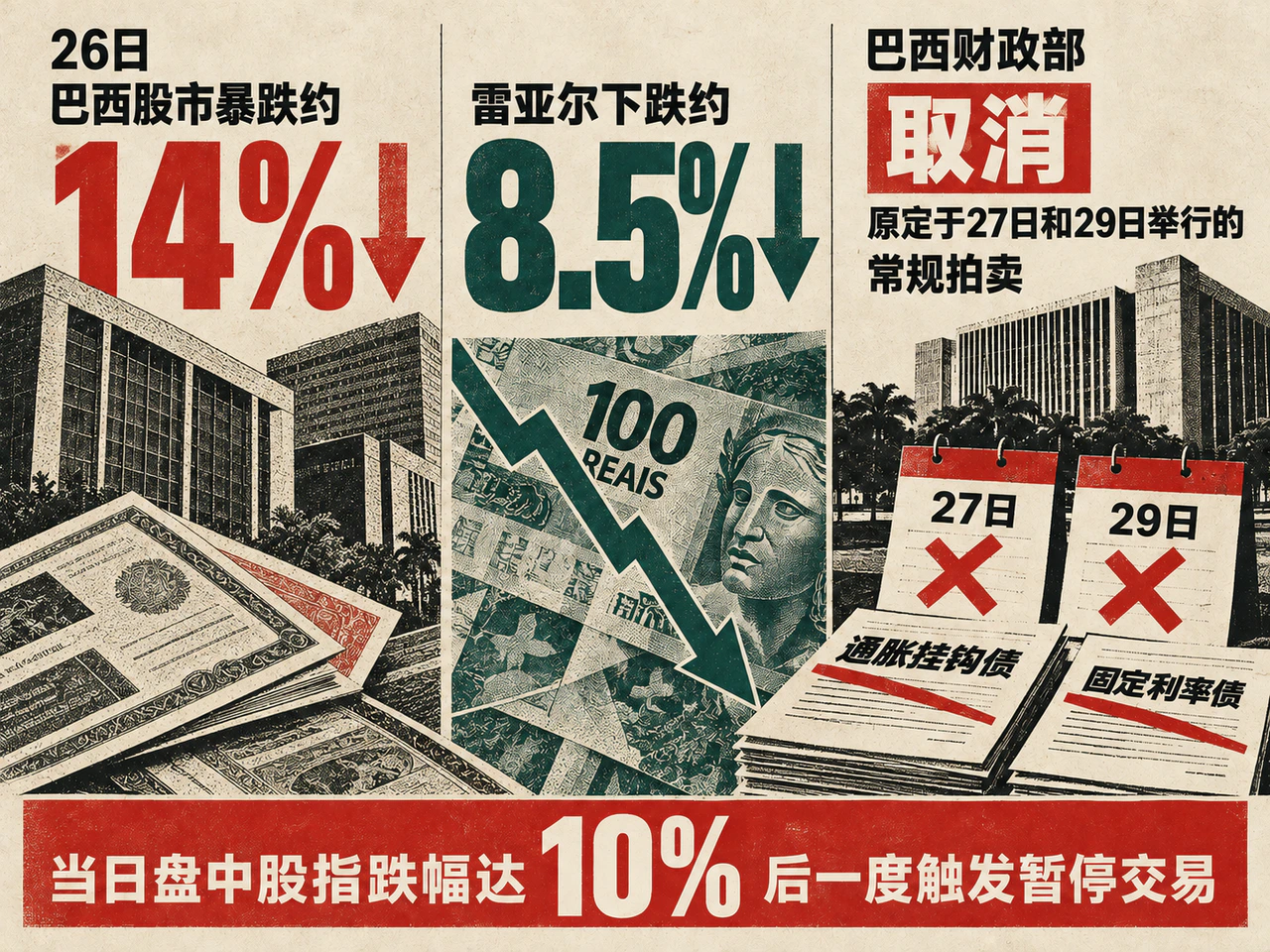
Brazil’s sharp Monday moves highlighted sovereign financing constraints in emerging markets. Lula’s victory in the October 25 presidential runoff reversed market bets on fiscal tightening and a shift toward business-friendly policy. By October 23, Brazilian stocks had gained nearly 7% and the real almost 5% from before the first round. Following the result, crowded positions reversed quickly. Reuters’ post-close review put October 26 equity losses at about 14% and the real’s decline at roughly 8.5%. A 10% intraday equity-index decline triggered a temporary trading halt. The Treasury then canceled regular inflation-linked and fixed-rate bond auctions scheduled for October 27 and October 29, as secondary-market selling directly interrupted near-term government issuance. RBC BlueBay’s Graham Stock identified fiscal-discipline commitments and the finance-minister appointment as key next signals, with congressional composition also affecting implementation.
Cross-border trade policy showed some signs of lower costs. Reuters on October 26 cited sources saying the United States and Canada were discussing cuts to U.S. tariffs on Canadian steel and vehicles. The same day, the Office of the U.S. Trade Representative formally published a request for comments proposing another two-month extension of the suspension of Section 301 measures against China’s maritime, logistics and shipbuilding sectors, to January 9, 2027. The existing suspension was scheduled to end November 9, and comments were due October 30. Adoption would defer the near-term pressure of resumed charges on vessel operators and cargo owners.