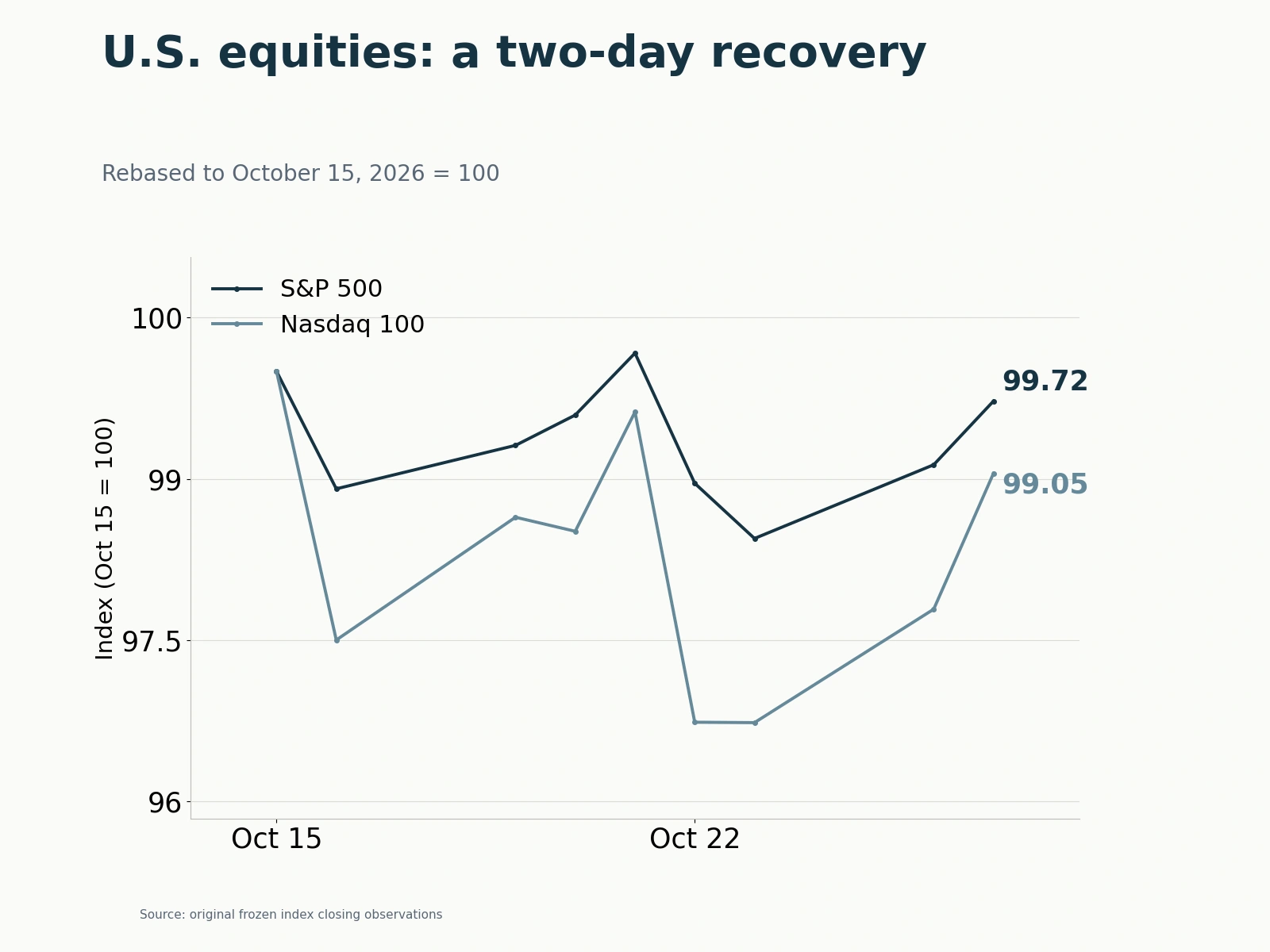
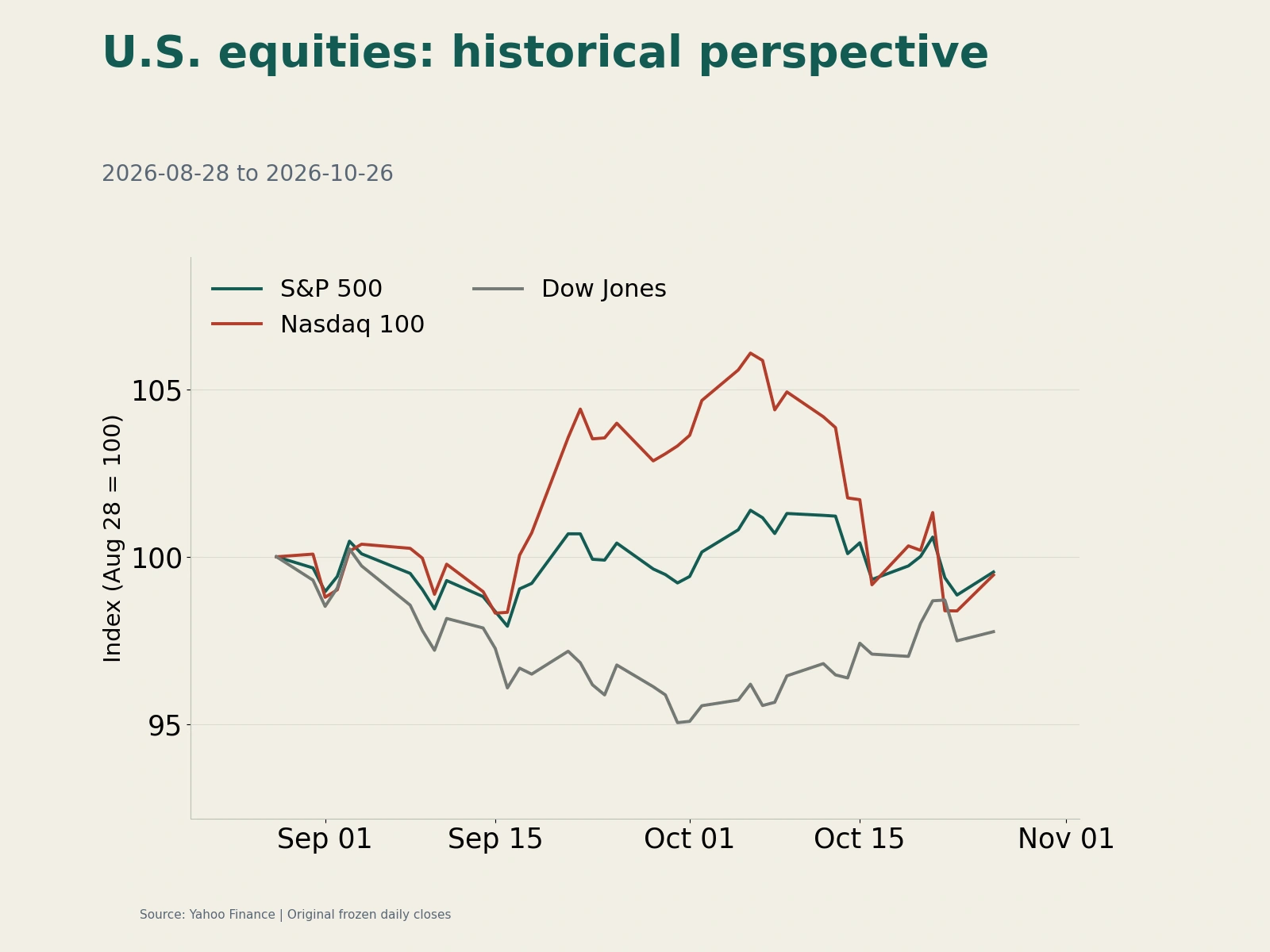
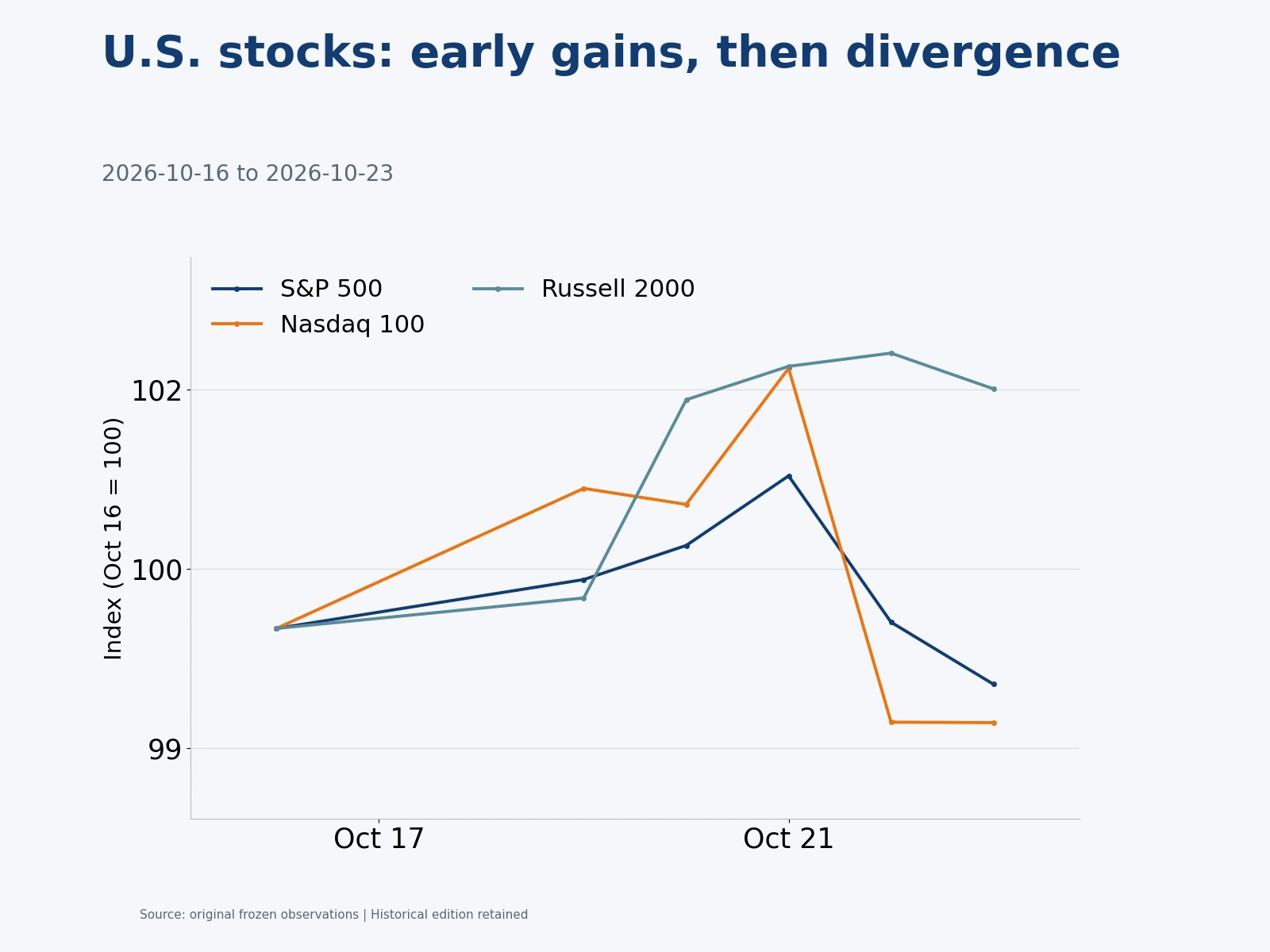
On October 28, 2026, U.S. equities advanced for a third consecutive session, led by technology. The S&P 500 gained 0.28% and the Nasdaq 100 rose 0.55%. U.S. Treasury yields diverged, falling at the short end and rising at the long end. The 10-year yield reached 5.05%, while December Brent crude futures settled at US$115.32 a barrel.
Demand for computing capacity and hardware earnings continued to support risk appetite, but high long-term financing and energy costs raised the hurdle for corporate expansion. The same divide ran through U.S. macroeconomic releases and technology earnings: capital goods imports kept growing in September while mortgage financing remained weak; AI suppliers benefited from orders converting into revenue, while cloud giants faced closer scrutiny of cash flow. Markets increasingly focused on whether revenue could generate enough free cash flow to cover capital spending and financing costs.
The Fed holds rates; the 10-year Treasury yield rises to 5.05%

The Fed voted 10–2 to keep the federal funds target range at 3.75%–4.00%, with two officials favoring a 25-basis-point increase. According to the Associated Press, the two-year Treasury yield briefly exceeded 4.79% after the announcement before falling to around 4.69% during the press conference. Chair Warsh said higher borrowing costs and more cautious lending and investment showed that policy restraint was beginning to work. Traders subsequently reduced bets on the scale of further increases by next summer.
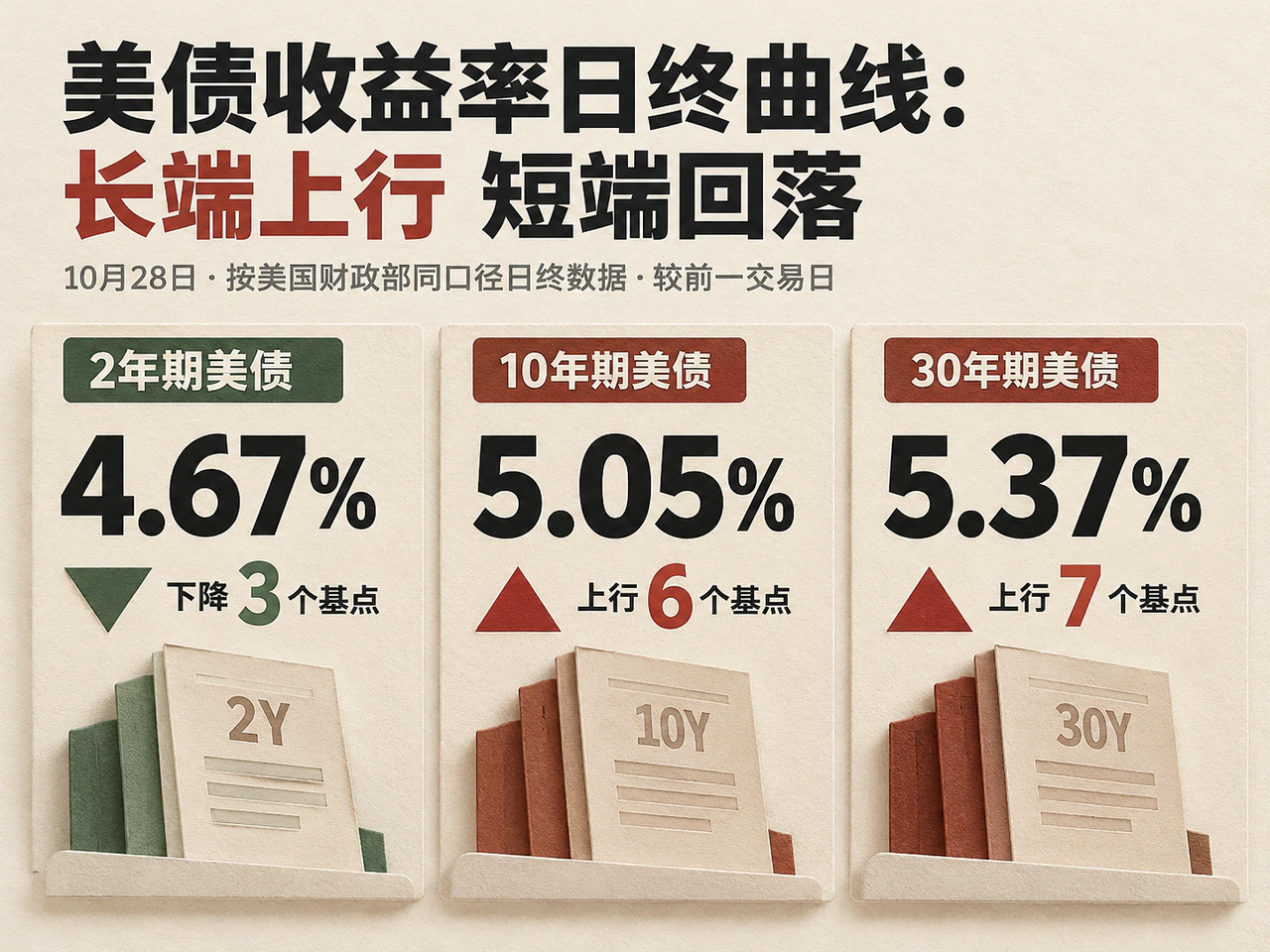
The easing of near-term policy expectations did not extend to the long end. On the U.S. Treasury's consistent end-of-day curve, the two-year yield closed at 4.67%, down 3 basis points from the previous trading day. The five-year rose 3 basis points to 4.85%, the 10-year gained 6 basis points to 5.05%, and the 30-year climbed 7 basis points to 5.37%. The 10-year/two-year spread widened from 29 to 38 basis points. Over a longer period, the 10-year and two-year yields remained below their September 30 levels of 5.29% and 4.88%, respectively; the 10-year was down a cumulative 24 basis points. After the earlier decline, energy prices and prospective funding needs were pushing long-term yields higher again.
Discussing the coexistence of high rates and expanding investment, PIMCO economist Tiffany Wilding argued that day that the recent rise in Treasury yields mainly reflected a reassessment of expected real short-term rates, with relatively limited changes in the model-estimated term premium. In her view, AI investment is less interest-rate-sensitive than housing, small businesses and highly leveraged companies, so the restraining effects of high rates should first appear in those latter sectors.
Credit markets also combined recovery with divergence. The ICE BofA U.S. High Yield option-adjusted spread fell to 318 basis points on October 27, narrowing 12 basis points from October 26 and 22 basis points from October 22. PIMCO nevertheless noted that lower-rated borrowers' spreads remained under pressure and October high-yield issuance had slowed markedly from September. Higher secondary-market prices had not broadly improved primary financing conditions. Cash flow, credit quality and refinancing dependence still determined the terms available to individual issuers.
AI hardware leads; Microsoft and Alphabet diverge after hours on cash flow
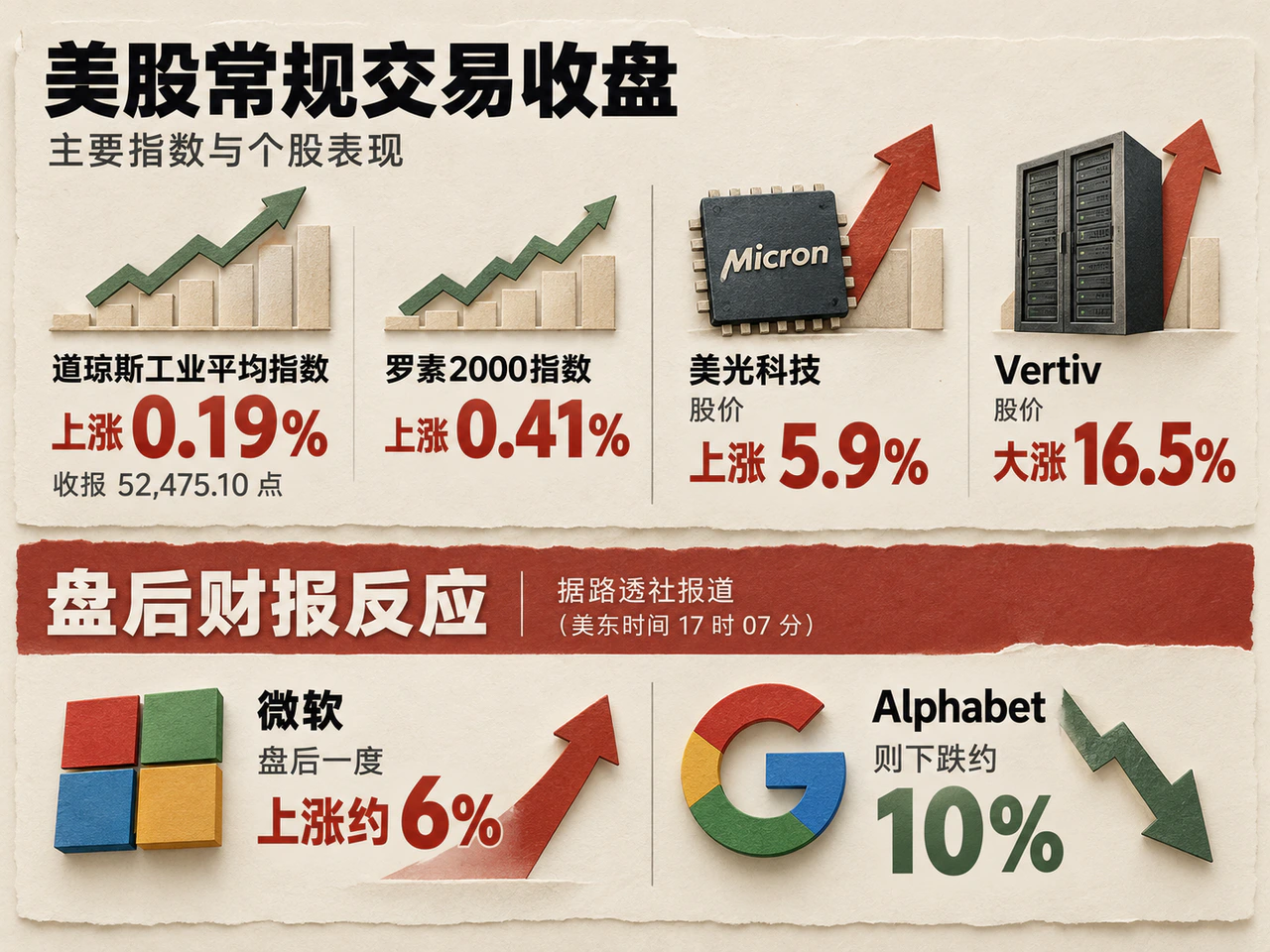
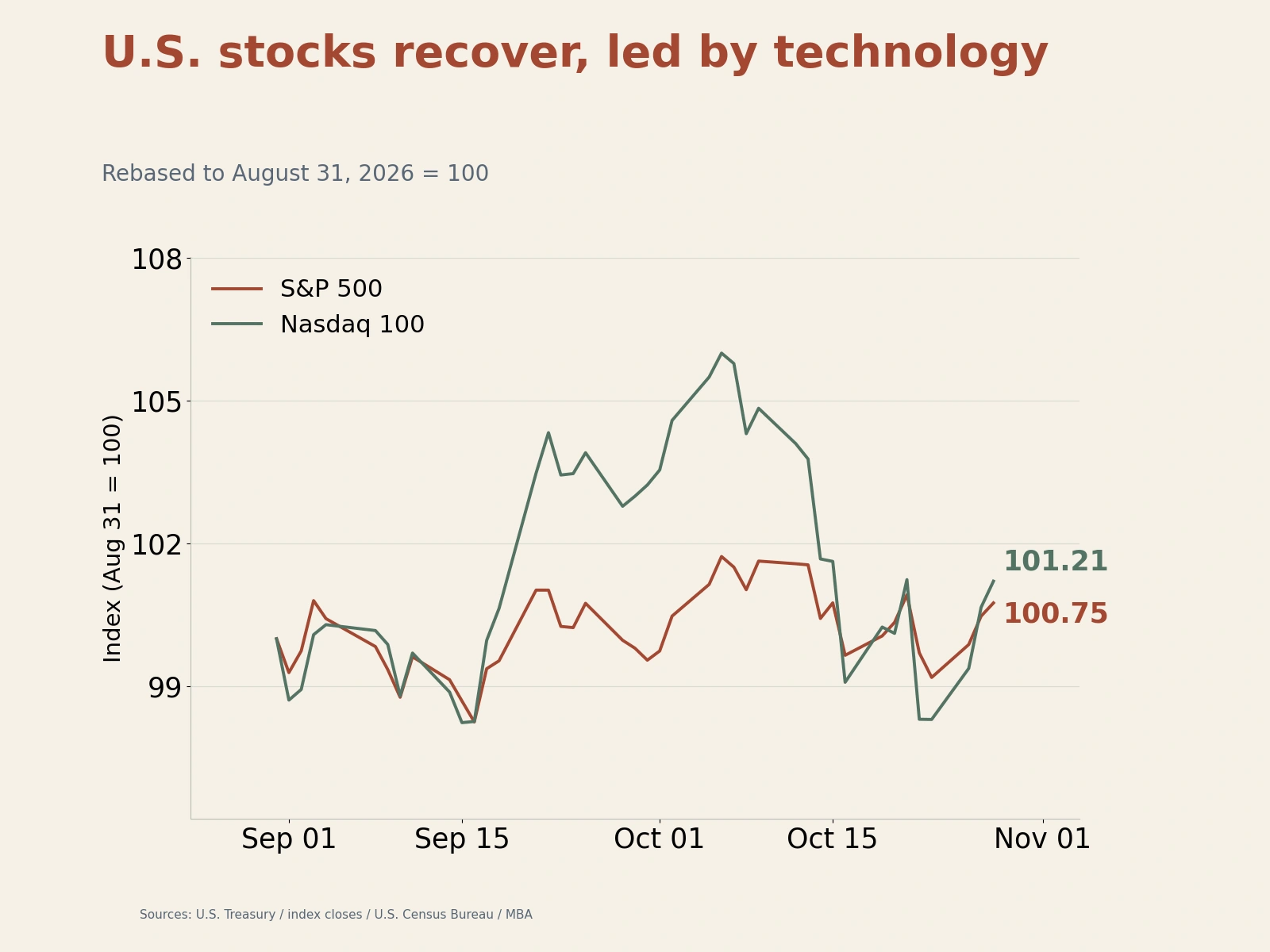
In regular U.S. trading, the S&P 500 closed at 7,743.98 and the Nasdaq 100 at 29,813.16. The Dow Jones Industrial Average rose 0.19% to 52,475.10, while the Russell 2000 gained 0.41%. Technology, financial and energy sector ETFs rose 0.80%, 0.45% and 0.35%. The VIX fell from 17.52 to 16.91, below its October 23 level of 19.45. The S&P 500 had recovered for three consecutive sessions from 7,623.68 on October 23, but remained slightly below 7,757.17 on October 21. Reuters put the ratios of advancing to declining shares at 1.05:1 on the NYSE and 1.48:1 on Nasdaq. New lows still exceeded new highs on both exchanges, suggesting that the index recovery relied on sectors with stronger earnings while a broad set of individual stocks remained under pressure.
Memory chips and data-center equipment led the day's gains. Reuters reported that Micron rose 5.9% after SK Hynix announced a more than sixfold year-on-year increase in quarterly profit. The Philadelphia Semiconductor Index gained 1.8%, its fourth consecutive advance. Data-center infrastructure supplier Vertiv surged 16.5% after beating earnings expectations and raising its full-year profit and revenue forecasts.
At its investor day, Oracle focused on how it would finance its large computing investments. The company expected free cash flow to turn positive in the second half of fiscal 2028 and exceed US$30 billion in fiscal 2029. It put its remaining AI financing requirement before fiscal 2030 at no more than US$20 billion and planned to reduce upfront cash spending through supplier financing, customer-provided hardware and prepayments. Those targets eased concern about its funding gap. Reuters's daily wrap reported an approximately 11% gain in Oracle shares. Subsequent valuation performance will depend on delivery against those targets.
Cloud earnings released after the U.S. close further highlighted the gap between revenue growth and cash returns. Microsoft reported revenue of US$92.279 billion for the first quarter of fiscal 2027, ended September 30, up 19% year on year. Operating income rose 21% to US$45.915 billion, and Azure revenue increased 48% to US$33.165 billion. Commercial remaining performance obligations grew 73% to US$677 billion, indicating continued expansion in contracted business. Operating cash flow was US$58 billion. After US$39.367 billion in cash purchases of property and equipment, the remainder was US$18.633 billion, below US$25.663 billion on the same basis a year earlier. Infrastructure investment is absorbing more cash.
Also after the close, Fortune reported that Alphabet's third-quarter revenue rose 25% to US$127.6 billion, including US$30.7 billion from Google Cloud, double the year-earlier figure. Growth in core search revenue slowed from 17% in the second quarter to 12%. With quarterly capital expenditure reaching US$51.4 billion, free cash flow was negative US$9.1 billion, deteriorating from negative US$5.9 billion in the second quarter. A Reuters update at 5:07 p.m. U.S. Eastern time recorded Microsoft up approximately 6% after hours and Alphabet down around 10%. The divergence illustrated differing market judgments on legacy-business growth and the cash absorbed by capital spending.
Capital goods imports rise 7.5%; a 7.37% mortgage rate continues to weigh on home demand
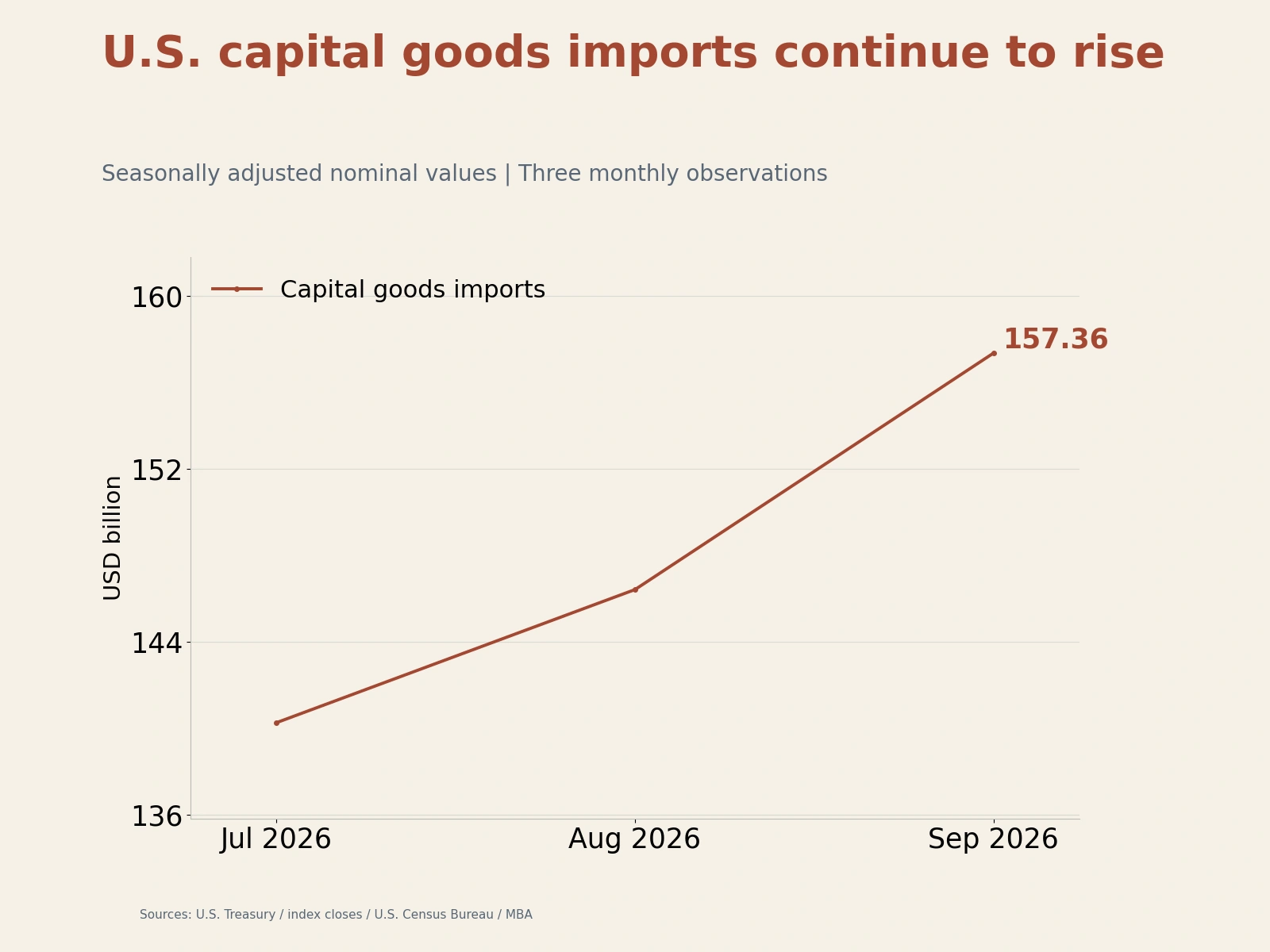
Data released by the U.S. Census Bureau on October 28 showed the September goods trade deficit widening to US$134.904 billion, from US$132.069 billion in August and US$118.856 billion in July. September goods exports were approximately US$209.2 billion and imports US$344.1 billion, up about US$5.3 billion and US$8.1 billion from August.
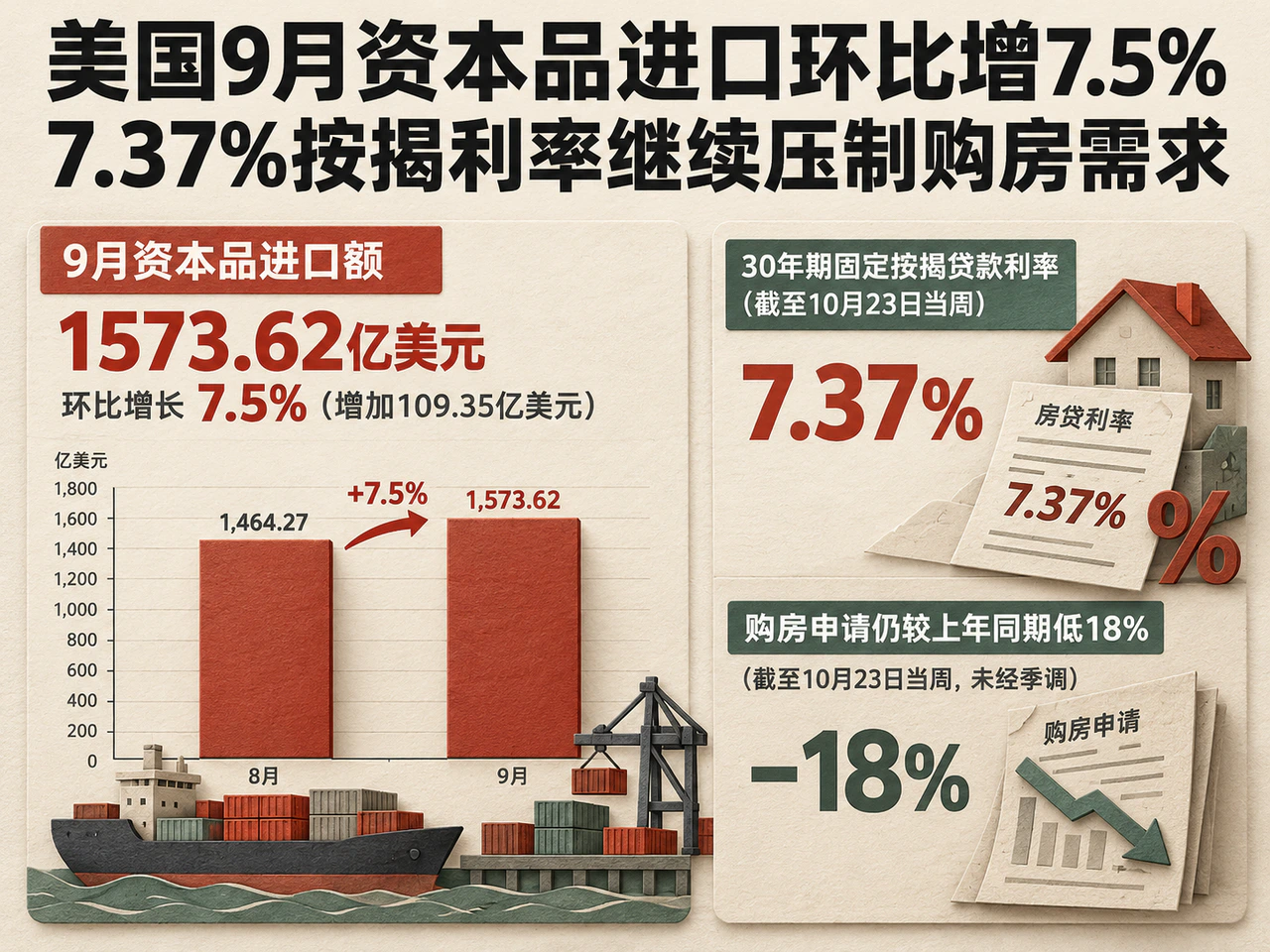
Import growth was heavily concentrated in capital goods. Their value reached US$157.362 billion in September, up 7.5% month on month, or US$10.935 billion—more than the net increase in all goods imports. Imports of industrial supplies and of vehicles and parts fell 6% and 4%, respectively. Capital goods exports also rose 5.4%, showing resilient equipment-related demand without an even expansion across other goods categories.
Imports subtract from net exports in GDP accounting, but imported equipment often corresponds to domestic business investment. Meanwhile, seasonally adjusted nominal wholesale inventories rose 0.6% in September and retail inventories increased 0.3%. For the advance third-quarter GDP estimate and September personal income and outlays due on October 29, the market will need to assess private final demand, equipment investment, inventory contributions and the PCE price index together. Strong final demand and core prices would continue to limit the scope for lower long-term financing costs.
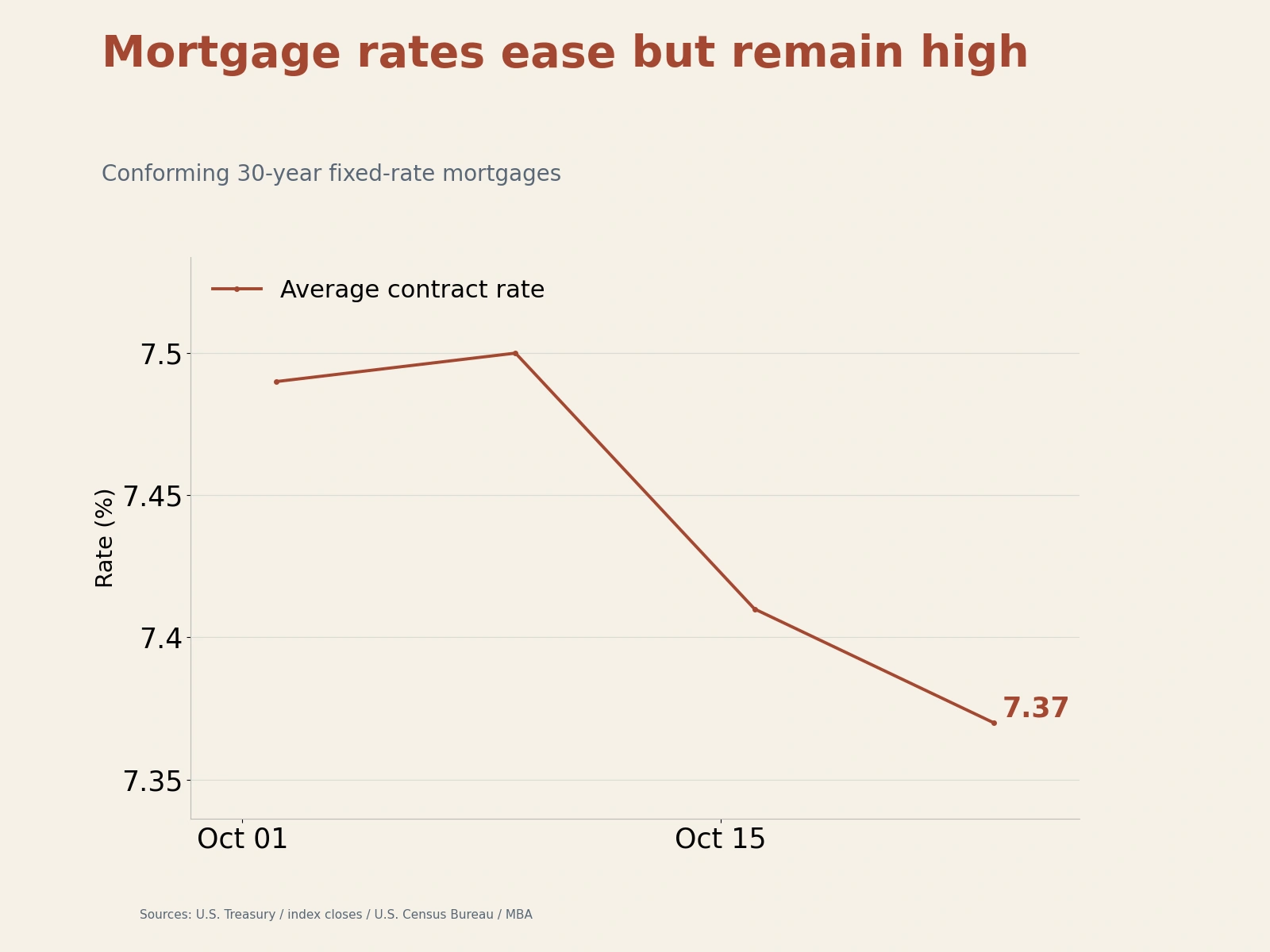
Compared with business equipment investment, interest-rate-sensitive housing remained directly constrained by expensive financing. The Mortgage Bankers Association reported that seasonally adjusted mortgage applications rose 3.4% in the week ended October 23, following a 5.3% decline. The average contract rate on conforming 30-year fixed mortgages edged down from 7.41% to 7.37%, compared with 7.50% in the week ended October 9. Seasonally adjusted purchase applications rose 4%, and the refinancing index increased 3%.
Unadjusted purchase applications were nevertheless 18% below a year earlier, and refinancing applications were down 61%. Mortgage rates were more than 1 percentage point above the year-earlier level and well above rates on outstanding mortgages. High monthly payments and the cost of financing a move continued to suppress demand. Adjustable-rate mortgages rose to 11.3% of total applications, the highest share in more than a year, suggesting that some borrowers were seeking lower initial rates to ease current payments.
U.S. crude draws lift Brent above US$115; higher long-term yields weigh on gold
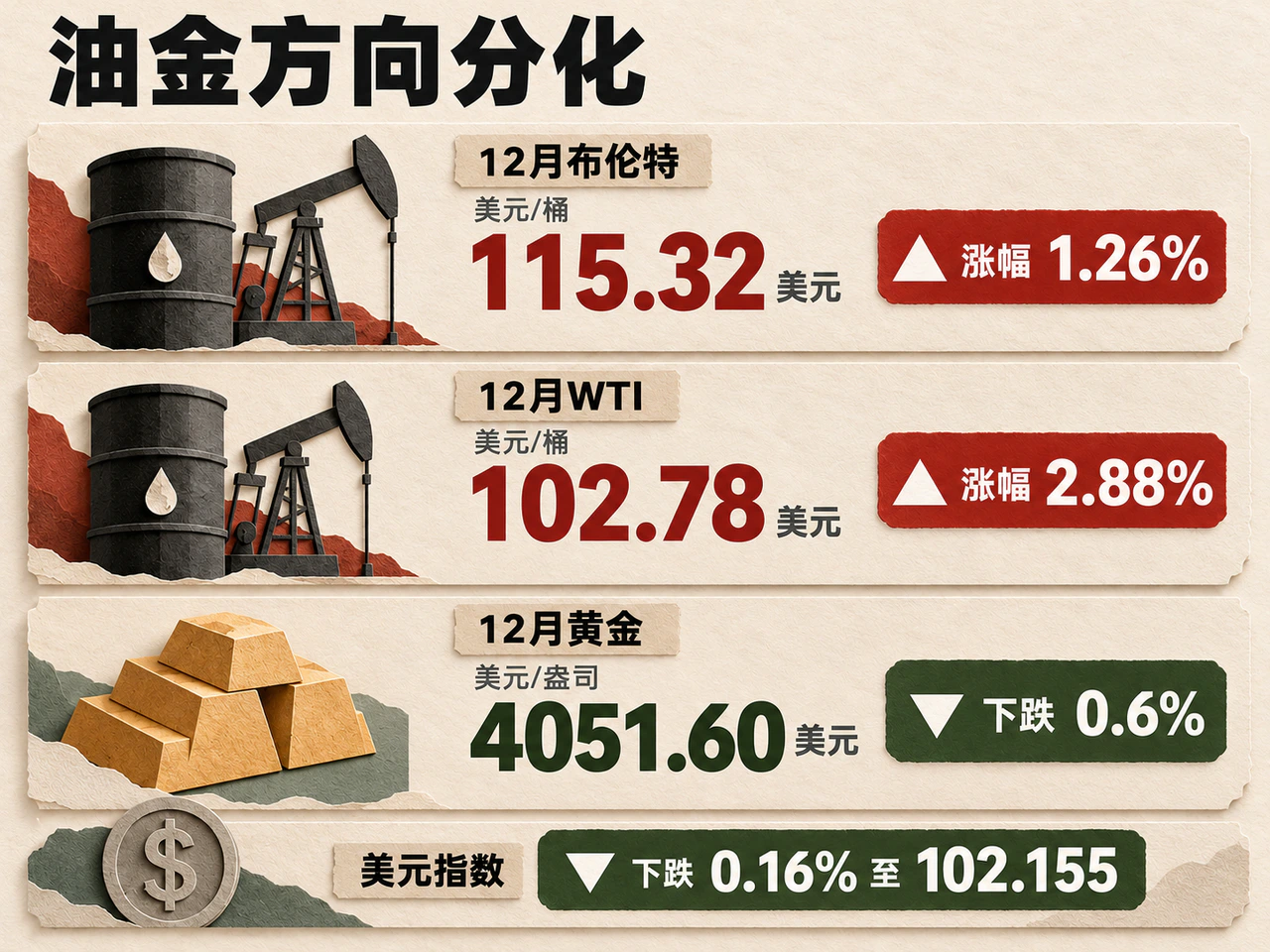
In commodities, supply risks and falling U.S. inventories jointly pushed oil higher. December Brent settled at US$115.32 a barrel on October 28, up US$1.44, or 1.26%. December WTI settled at US$102.78, up US$2.88, or 2.88%.
Investing.com's economic calendar showed U.S. commercial crude inventories falling by 1.892 million barrels in the week ended October 23, against an expected 100,000-barrel build and following a 3.06-million-barrel draw. Continued draws reduced the physical inventory buffer. Fixed-month quotations on the same Oilprice page showed December Brent at a US$3.68 premium to the following January, indicating backwardation. Mediation involving Iran had not yet produced an agreement. Energy-supply and shipping risks continued to reach inflation and corporate margins through oil prices and logistics costs.
Gold was constrained by rising long-term Treasury yields. Reuters reported that December gold futures settled 0.6% lower at US$4,051.60 an ounce. Although the dollar index fell 0.16% to 102.155 on the provider's daily closing basis, dollar weakness did not offset higher long-term yields. Trader Tai Wong said higher long-term rates could limit gold's upside. In physical demand, Reuters reported that China's September net gold imports through Hong Kong rose more than 28% month on month to a five-month high, supported by pre-holiday restocking and investment demand. The interaction of interest-rate pressure and recovering physical buying left gold unable to follow oil higher.
Britain proposes a moderate bank surcharge increase and cuts its 2027 growth forecast to 1.0%
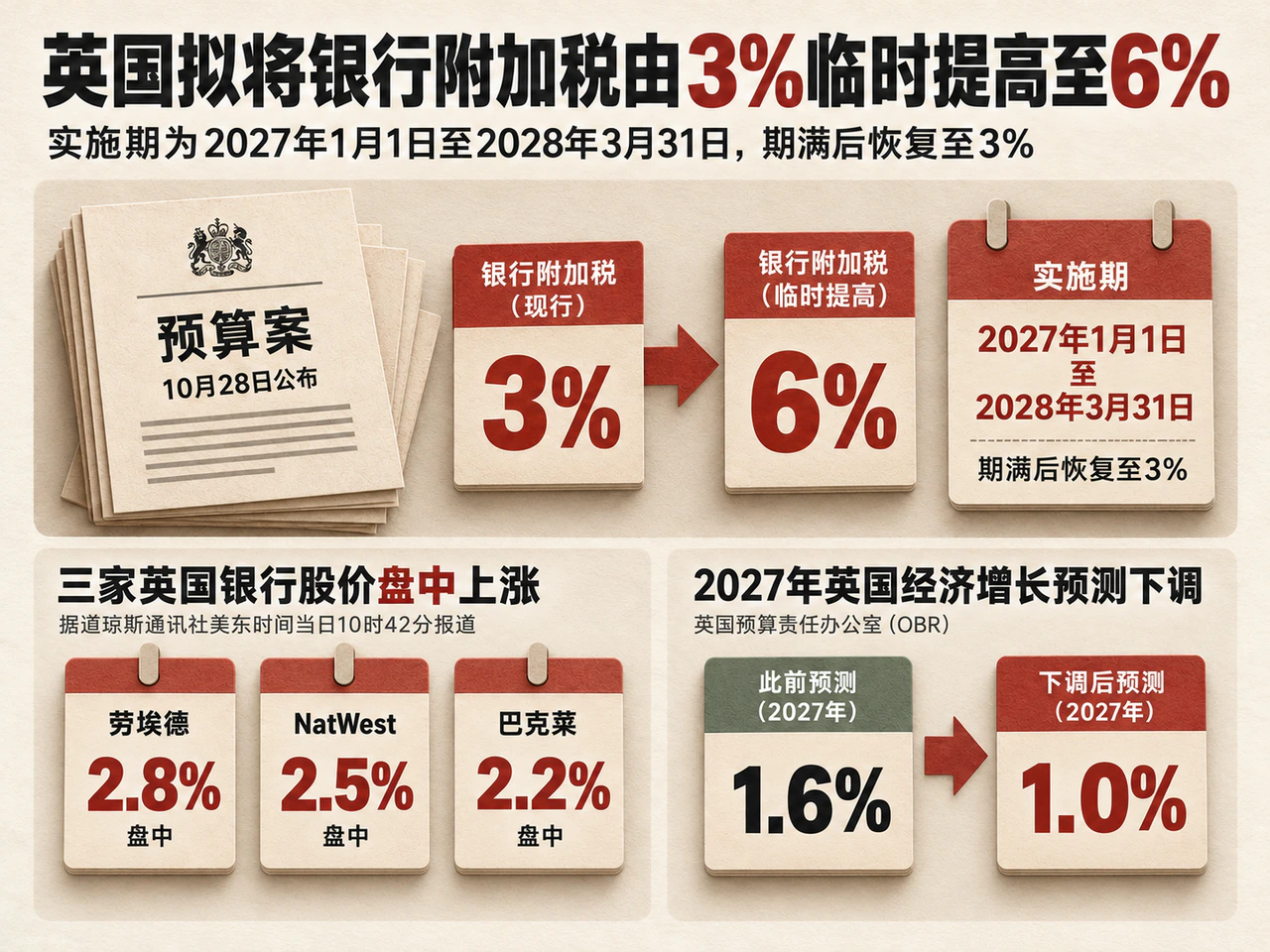
High energy costs were also reshaping European fiscal policy. In its October 28 budget, the UK government proposed temporarily raising the bank surcharge from 3% to 6% between January 1, 2027 and March 31, 2028, before returning it to 3%. Tax documents said the surcharge applies to relevant banking profits above a £100 million allowance, with the measures to be included in the Finance Bill.
UK bank shares rose against the broader trend after the plan was announced. Dow Jones Newswires reported at 10:42 a.m. U.S. Eastern time that Lloyds, NatWest and Barclays were up 2.8%, 2.5% and 2.2% intraday. Investors had feared a return to 8%. The more moderate increase and explicit end date eased pessimism about future profits. IG analyst Angeline Ong said the clear expiry date mattered as much as the rate itself. Quilter Cheviot analyst Will Howlett cautioned that a previously time-limited windfall tax on energy companies had been extended, so whether this temporary increase ends on schedule will still affect sector valuations.
Budget coverage carried by The Edge said approximately 20 million UK households would receive £100 in energy support. The £2.6 billion program would be financed through tax arrangements affecting banks, gambling, savings and landlord income. Meanwhile, the Office for Budget Responsibility cut its 2027 growth forecast from 1.6% to 1.0%. Fiscal headroom narrowed from £24 billion to £15 billion, underlining the pressure energy subsidies place on fiscal space and tax policy.
Asian AI hardware stocks surge; China completes RMB800 billion in policy financing disbursements
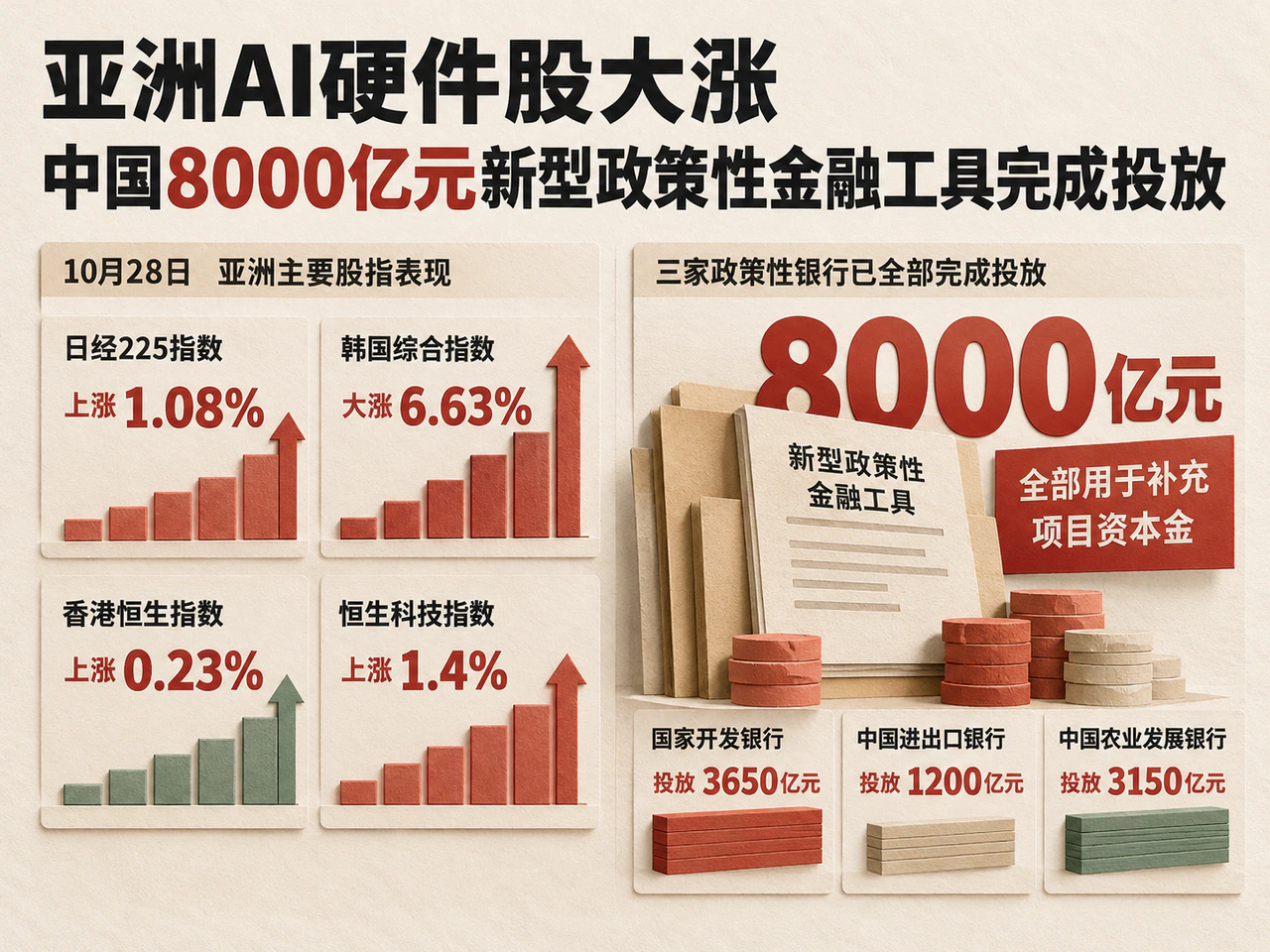
AI hardware demand had already lifted related Asian equities during October 28 trading. The Nikkei 225 rose 1.08% to 63,954.19, with Kioxia up 13.76% and Tokyo Electron gaining 4.42%. South Korea's KOSPI surged 6.63% to 6,012.44, while SK Hynix and Samsung Electronics rose 10.89% and 9.01%. Hong Kong's Hang Seng Index gained 0.23% and the Hang Seng Tech Index rose 1.4%, led by memory, semiconductor and optical-communications shares. Those sessions preceded the U.S. after-hours cloud earnings. Microsoft's strong cloud growth provided a demand reference for Asian hardware and memory suppliers, while Alphabet's free-cash-flow pressure raised the bar for judging downstream customers' spending durability, purchasing schedules and payment quality. The sharp rally in Korean memory stocks had also already priced in part of the expected earnings improvement.
Domestic investment in China received additional project-equity support. On October 28, three policy banks confirmed that all RMB800 billion of a new policy-based financing instrument had been disbursed to supplement project capital. China Development Bank provided RMB365 billion, the Export-Import Bank of China RMB120 billion, and the Agricultural Development Bank of China RMB315 billion. China Development Bank disbursed RMB179.01 billion to projects in AI, the digital economy, green and low-carbon development, biomedicine and consumption. Projects involving private investment or private capital received RMB127.99 billion, or 35.1% of its total disbursements. Third-quarter lending also showed targeted support: outstanding green loans reached RMB49.22 trillion, up 13.0% year on year; inclusive small and micro business loans reached RMB38.50 trillion, up 6.7%; and 51.1% of technology-focused small and medium-sized enterprises had obtained loans, up 0.9 percentage points from the end of the previous year. Follow-on lending, construction starts and equipment procurement will determine how quickly this funding becomes orders and cash flow for businesses.
Chinese companies' offshore financing showed pronounced credit differentiation. According to Guandian, Meituan signed an RMB8 billion offshore renminbi note purchase agreement on October 27, comprising RMB4.5 billion of five-year notes with a 2.50% coupon and RMB3.5 billion of 10-year notes at 3.10%. Proceeds were intended for refinancing existing offshore debt and general corporate purposes. Separately, 21st Century Business Herald reported on October 28 that Road King had announced the previous day a November 23 creditors' meeting to discuss restructuring approximately US$2.4 billion of offshore debt. With long-term funding still expensive, businesses with sound operations and financing access can extend debt maturities by choosing favorable currencies. Repayment by distressed issuers remains heavily dependent on restructuring execution and cash released from assets.