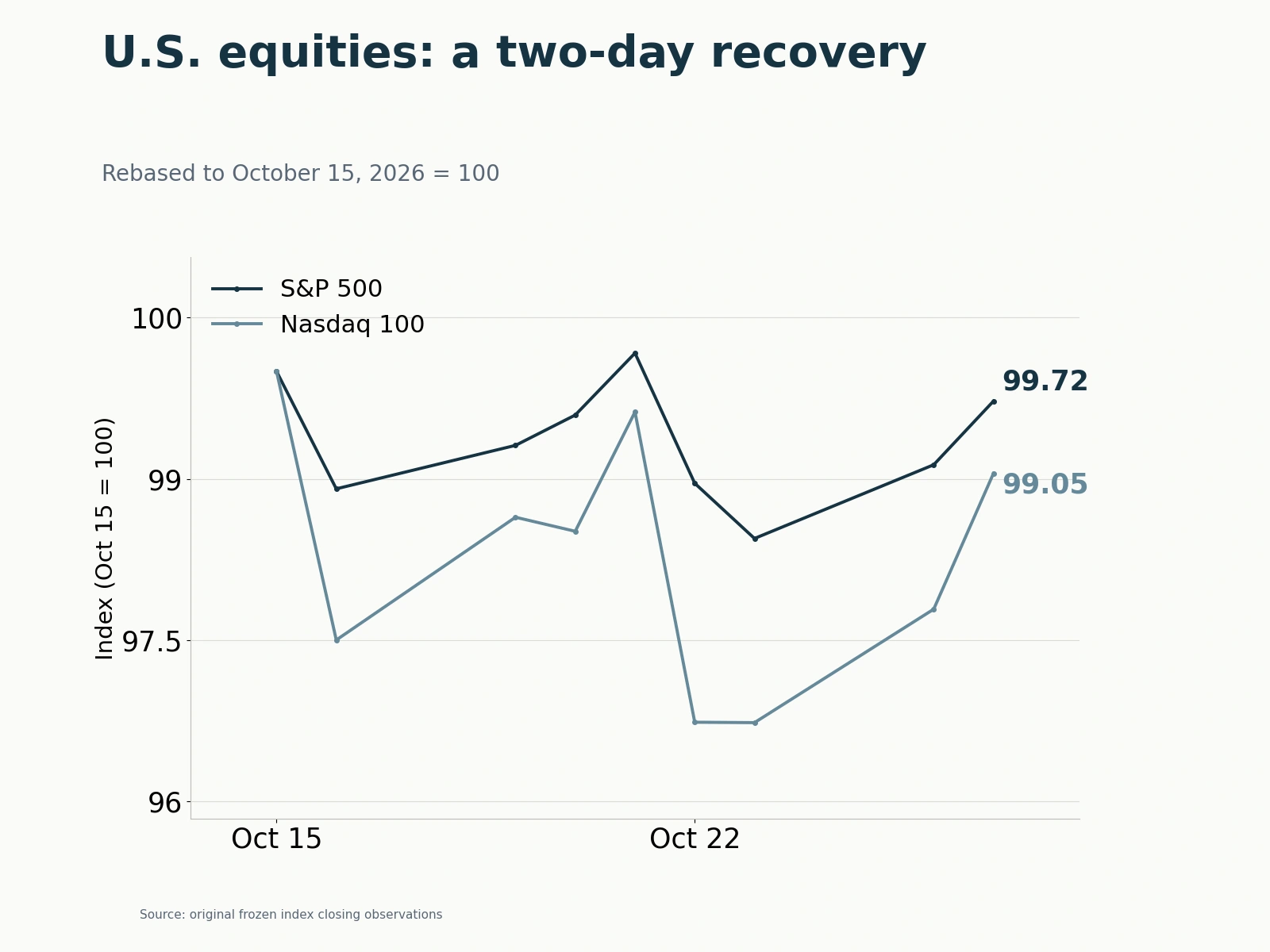
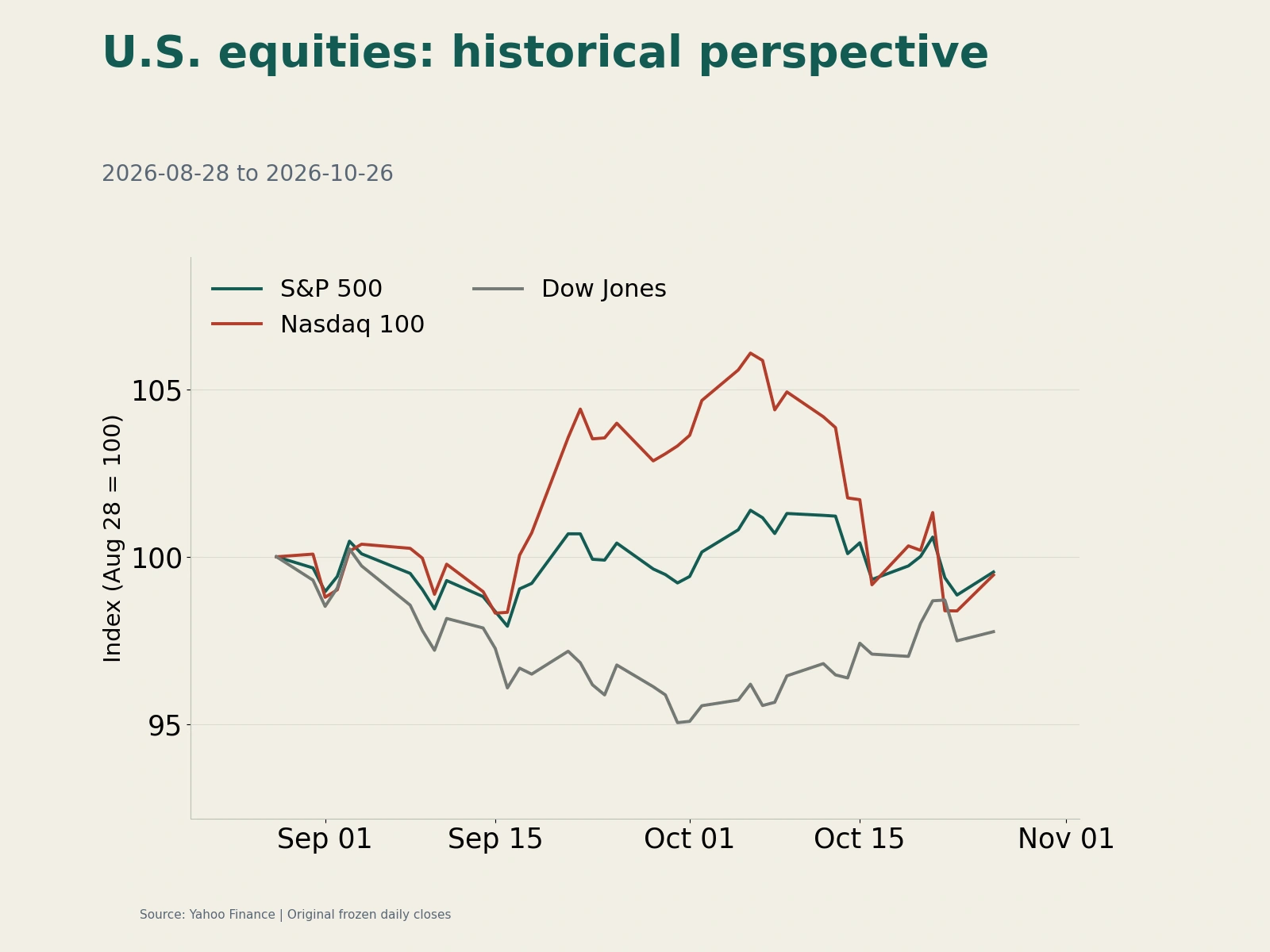
On August 25, 2026, overnight global cross-asset pricing presented a consistent cooling narrative. Oil settlements plunged, August U.S. consumer expectations fell below the recession-warning level of 80, July new-home sales hit a year-to-date low, and two regional Fed presidents independently characterized hikes as a low-probability tail risk. Prices converged on one logic: collapsing crude eased imported inflation, growth cooled at the margin, and the need for further Fed restraint weakened materially. Nominal Treasury yields fell 6-7 basis points across maturities, led by the policy-sensitive 2-year at 4.17%. Major U.S. indices rose moderately, with the S&P 500 up 0.32% and VIX down more than 2.5%.
Beneath that optimism, three disconnects stood out. The 10-year breakeven stayed unchanged at 2.32%, with oil's more-than-5% decline over nearly a week producing no meaningful reduction in inflation expectations. CME futures still implied a 41.4% chance of a 25-basis-point September hike, asymmetric with the broad yield decline. Spot gold barely fell and overnight electronic prices recovered above $4,710, while Bitcoin broke $80,000 intraday. This was not a comprehensive risk-on recovery. Bond buying chiefly reflected oil spillovers and slower-growth expectations: investors traded a pause in additional restraint, without excluding future tightening.
Treasuries: yields fall across maturities, led by the short end as the curve steepens
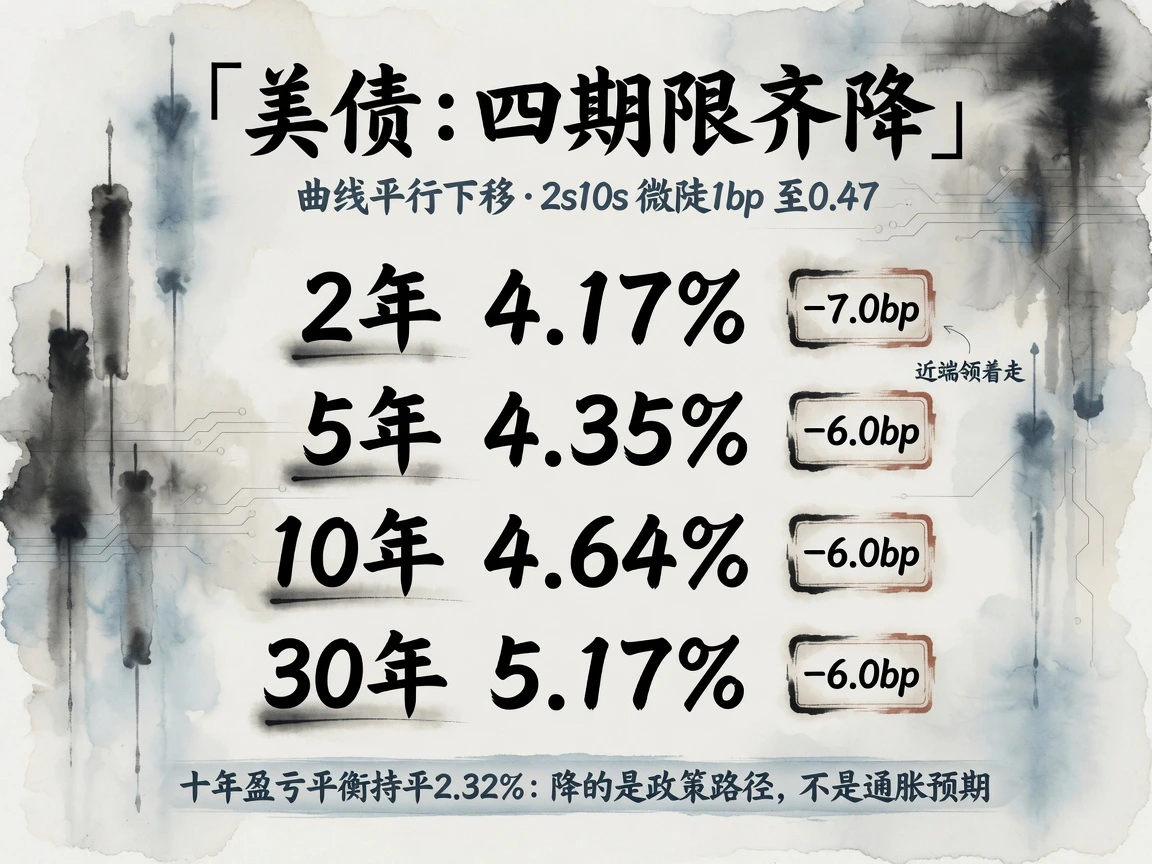
The curve shifted almost parallel lower, with 2s10s steepening 1 basis point to 0.47 percentage points, or 47 basis points. The official Treasury end-of-day par curve, measured close to close, showed:
| Maturity | August 25 close | Change from previous session |
|---|---|---|
| 2-year | 4.17% | -7.0 bp |
| 5-year | 4.35% | -6.0 bp |
| 10-year | 4.64% | -6.0 bp |
| 30-year | 5.17% | -6.0 bp |
Inflation compensation merited closer attention. An unchanged 10-year breakeven of 2.32% meant almost all the nominal 6-basis-point fall mapped into lower real yields, with the implied 10-year real rate falling from about 2.38% to 2.32%. This structure suggested the core repricing removed a premium for unexpectedly higher policy rates rather than lowering the long-term inflation trend. Long-end supply pressure also eased: the 30-year had reached 5.31% on August 17, its highest since 2007, but closed Tuesday at 5.17%, about 14 basis points below that peak. Its stabilization closely coincided with the Treasury's August 19 expansion and increase of long-end liquidity buybacks.
Two marginal fundamental and policy shifts drove the decline. Brent fell from Friday's $94.39 to $88.58, about 6.1% in two sessions and roughly 5%-6% during the adjustment, chiefly as Tehran talks initially confirmed a phased temporary navigation corridor and joint minesweeping framework, prompting geopolitical-premium liquidation. Short-rate tail risk also narrowed: Boston Fed President Collins said hikes would be needed soon unless inflation kept falling; Richmond's Barkin warned $40 trillion of federal debt would eventually face a reckoning but currently favored a hold. Both were framed as maintaining the status quo with hikes a tail risk, consistent with FedWatch's September 15-16 hold probability of 58.6% and 25-basis-point hike probability of 41.4%, versus OIS around 36%-40%. The 2-year's 7-basis-point fall rapidly discounted that tightening tail risk.
The real primary-market test lay in the next three sessions. The August 25 $69 billion 2-year issue cleared at a high yield of 4.204% with bid-to-cover 2.60; the secondary close of 4.17% was below the auction yield, suggesting smooth short-end absorption, though hardly insatiable buying. Upcoming $70 billion 5-year and $44 billion 7-year sales were tougher tests. The August 13 30-year auction had needed 5.216%, its highest clearing yield since 2001, highlighting fragile long-end digestion. Investment-grade and high-yield spreads were 81 and 269 basis points at the August 24 close, still historically very tight. Year-to-date investment-grade issuance was about $1.7 trillion, including over $220 billion of technology/AI debt, twice a year earlier, with more than $200 billion due in September. Tight spreads plus high absolute coupons sustained carry demand, leaving risk-free rates the likely main driver of future price volatility.
Cutoff snapshot for live reference, not closing values: August 25 at 20:16-20:27 Eastern time, 2-year 4.191%, 5-year 4.346%, 10-year 4.635%, 30-year 5.169%. Overnight trading had not deepened the day's declines.
Macro: multiple indicators weaken together as growth momentum cools
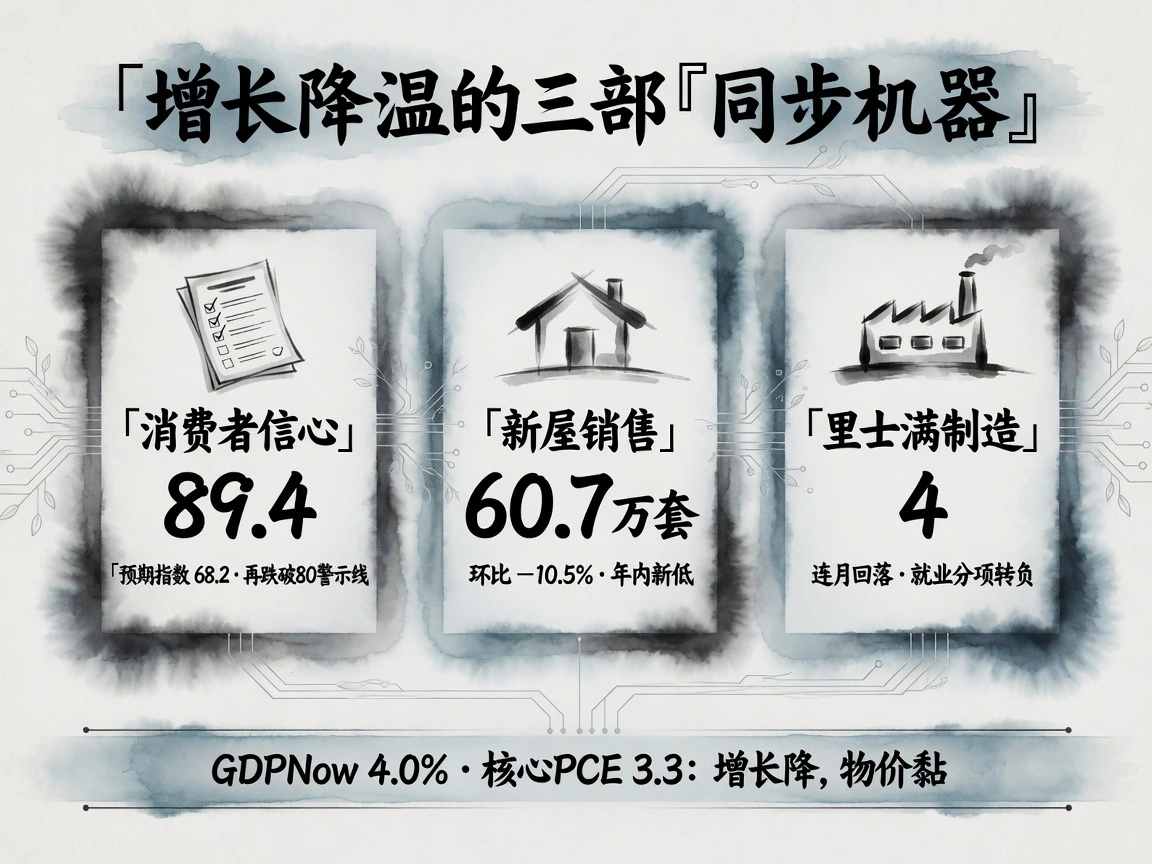
Tuesday lacked one dominant release, but several indicators jointly showed slowing U.S. momentum. Conference Board August confidence fell to 89.4, its lowest since January 2026. Expectations dropped 5.8 points to 68.2, again below the traditional recession warning of 80, with six-month business, job and income expectations all weaker. Meanwhile, 12-month expected inflation edged up from 5.6% to 5.8%, and 61.3% expected rates to rise over the next year.
Rate-sensitive sectors corroborated cooling. July new-home sales fell 10.5% to an annualized 607,000, the lowest since January. Supply rose to 9.6 months and the median price fell 2.3% monthly to $393,800. The June S&P CoreLogic Case-Shiller 20-city index rose 2.1% annually but was negative in real terms for a 13th consecutive month. Richmond's August manufacturing composite fell from July's 5 to 4, with employment turning negative at -2, consistent with the CFNAI employment component being negative for a third month.
The monetary-policy anchor remained firm at 3.50%-3.75%. July's 9-3 hold was the first since 2016 with three dissenters favoring hikes, and no cuts this year remained the pricing baseline. Atlanta GDPNow projected 4.0% annualized Q3 growth as of August 18; Cleveland nowcasts pointed to July core PCE around 3.3% annually and August core CPI about +0.20% monthly. Official July PCE was due August 26. If consensus 3.3% materialized amid cooling growth and sticky prices, short yields' decline might lack follow-through, with reversal pressure concentrated near-term. U.S.-Canada reciprocal tariffs had entered list implementation but did not yet dominate dollar-bond or oil pricing.
Commodities: geopolitical premiums unwind as oil falls again and gold holds near $4,700
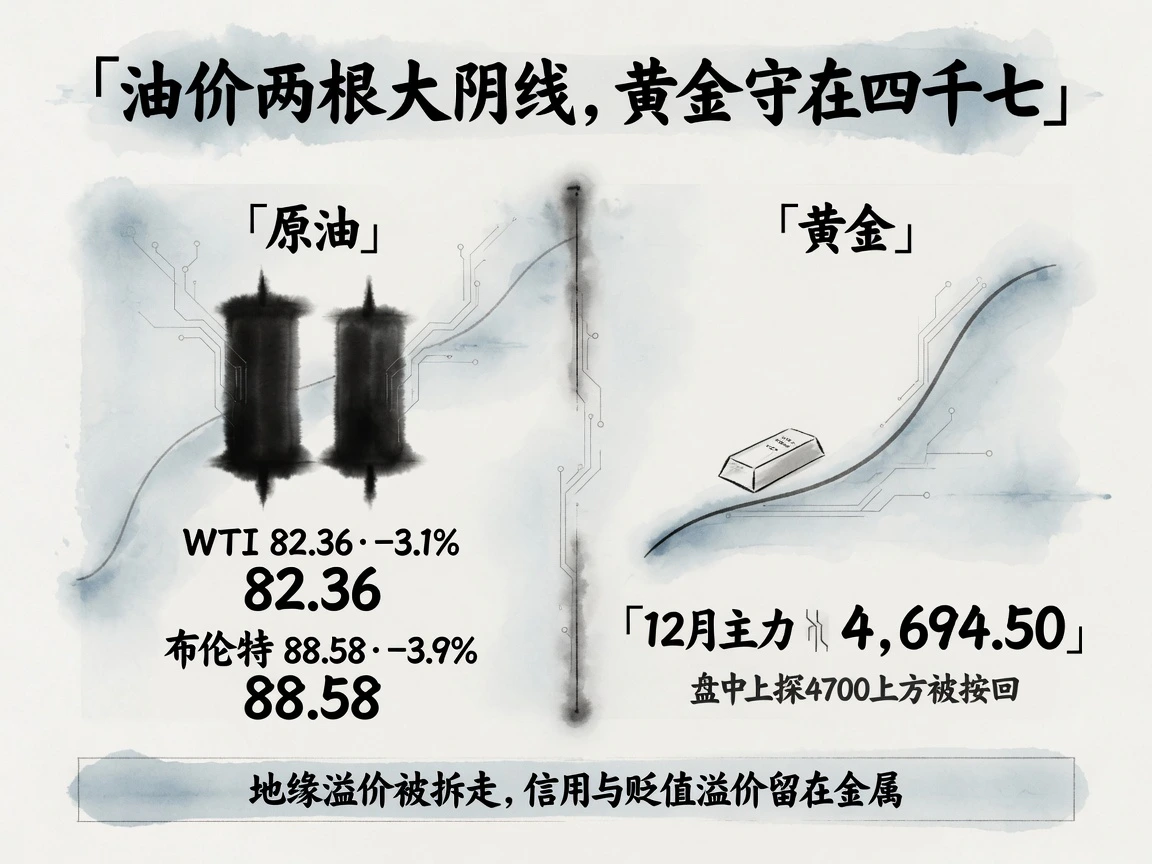
Crude accelerated the removal of previously excessive geopolitical premiums, posting a second large down day. October WTI settled at $82.36 a barrel, down $2.65, or 3.1%; October Brent at $88.58, down $3.59, or 3.9%, both two-week lows. Brent lost about 6.1% from Friday's $94.39 in two sessions and WTI roughly 5.4%. The prompt Brent-WTI spread narrowed from $7.16 to about $6.22. Electronic trading later weakened to roughly $85.77 for Brent; this was not a settlement.
The main driver was diplomacy moving ahead of physical transit, not a surge in actual supply. Iran and Oman held detailed Tehran talks Tuesday on a phased temporary joint navigation corridor and joint minesweeping; Oman's foreign minister hoped for an announcement soon. The U.S. said mines in international waters had been cleared and renewed mining would face zero tolerance. Markets rapidly priced a shift from military confrontation toward economic pressure and compromise, removing extreme prolonged-disruption tails from spot pricing. Actual bottlenecks remained severe: only two merchants crossed Hormuz Monday, against a ten-day average of fourteen, and a tanker had lost power after an unidentified projectile hit offshore Oman. The market structure was converging rather than collapsing: October-November backwardation narrowed from $1.71 at settlement to $1.36-$1.41 in trading. Buyers still paid a premium for current-quarter physical delivery, although it had shrunk sharply for two days. After-hours API data showed crude up 4.2 million barrels, above expectations; gasoline down 3.2 million; distillates down 500,000; and SPR releases of another 3.7 million. The curve had not moved into contango and builds had not overturned prompt tightness.
Precious metals followed different pricing logic. Main December COMEX gold settled at $4,694.50 an ounce, down just 0.07%, after a broad $4,659.50-$4,755 range. Gold briefly exceeded $4,700 before retreating, showing profit-taking near a psychological level after a week of gains rather than a trend reversal. Support remained firm: a further 6-basis-point fall in 10-year nominal yields and expanded Treasury buybacks reinforced sovereign-credit hedging and currency-debasement narratives. Global physical gold ETFs gained $6.38 billion, about 47 tonnes, in the week of August 21, the strongest weekly addition in ten months and fifth consecutive inflow. Oil-gold divergence reflected differentiated premium repricing: disruption premiums left commodities rapidly, while sovereign-credit and long-term debasement hedges remained in precious metals.
Equities: chip gains look more like short covering as divergent earnings prospects constrain risk appetite
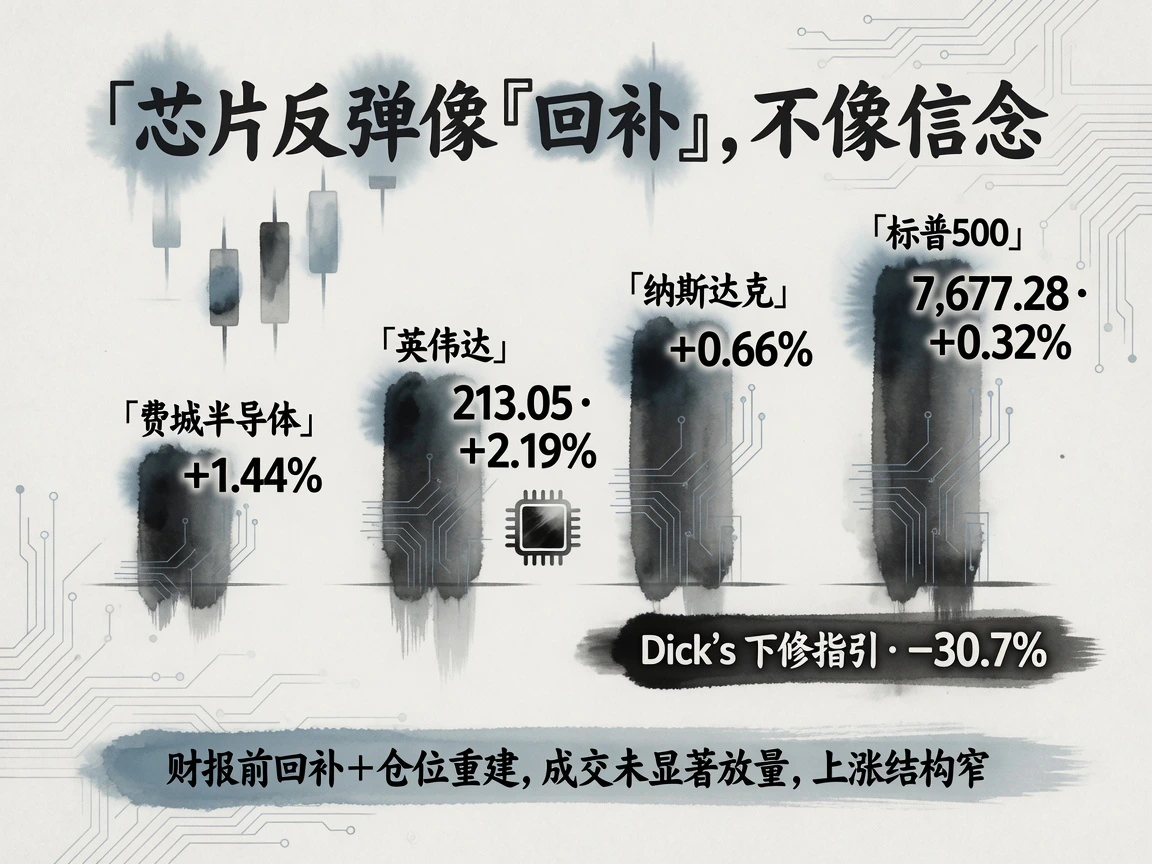
Tuesday's rebound traded both oil's two-day decline as disinflation progress and position adjustment before key earnings. S&P 500 closed at 7,677.28 (+0.32%), Nasdaq Composite 26,151.30 (+0.66%), Dow 53,577.40 (+0.30%), Russell 2000 3,010.02 (+0.50%), and VIX fell 2.52% to 15.45. Technology led: Philadelphia Semiconductor +1.44%; Nvidia ended seven losses at $213.05 (+2.19%); AMD gained 4%-5% after an upgrade; SMCI rose 9.35% after announcing cooperation with Cisco on Nvidia AI rack architecture. Falling oil made energy ETF XLE the weakest, down about 1.7%.
Higher indices did not mean broad risk-on sentiment. Dick's Sporting Goods plunged 30.7% after cutting annual guidance; Nike fell 3.12%, leading Dow losses, with sportswear and consumer supply chains lower together. NYSE advancers only moderately exceeded decliners, 1,586 to 1,147, and volume did not increase materially. The advance was relatively narrow and structural.
Oil's repeated plunge offered technology discount-rate relief. The previous session's divergence of falling rates without chip gains gave way as oil lost around 5% in two days, consumer expectations hit 68.2 and the 2-year fell 7 basis points, prompting a temporary easing of bets on another hike before end-2026. Markets translated a lower discount rate and fading inflation source into a technology rebound. But the concerns behind Nvidia's seven losses—sustainable hyperscaler AI spending and memory-price pressure on system margins—did not vanish with cheaper oil. Its roughly 2.2% rebound looked more like pre-earnings short covering and position rebuilding: technical entry rather than renewed long-term allocation conviction before guidance. After-hours software showed almost no tolerance for weak outlooks: Intuit beat quarterly results but fiscal-2027 EPS guidance was about $4 below consensus, sending shares down 8%-11%; Zoom beat Q2 but uninspiring Q3 guidance led to a 3%-4.5% fall.
Asia-Pacific Tuesday closes preceded the U.S. open: Nikkei 225 65,856.43 (+0.50%); Kospi 6,742.74 (+0.68%, after recovering from a 2.4% intraday drop); Hang Seng 25,511.10 (-0.02%). Wednesday morning was more cautious: Nikkei 65,589, about -0.41% from Tuesday, in an 08:13 Beijing snapshot. Overnight U.S. chip and Nvidia gains did not produce a higher Tokyo open. Regional money waited for Wednesday evening's July PCE and Nvidia's after-hours guidance, declining to call Tuesday's stabilization a bottom.
Policy and geopolitics: buybacks support the long end as markets await Warsh's Jackson Hole debut
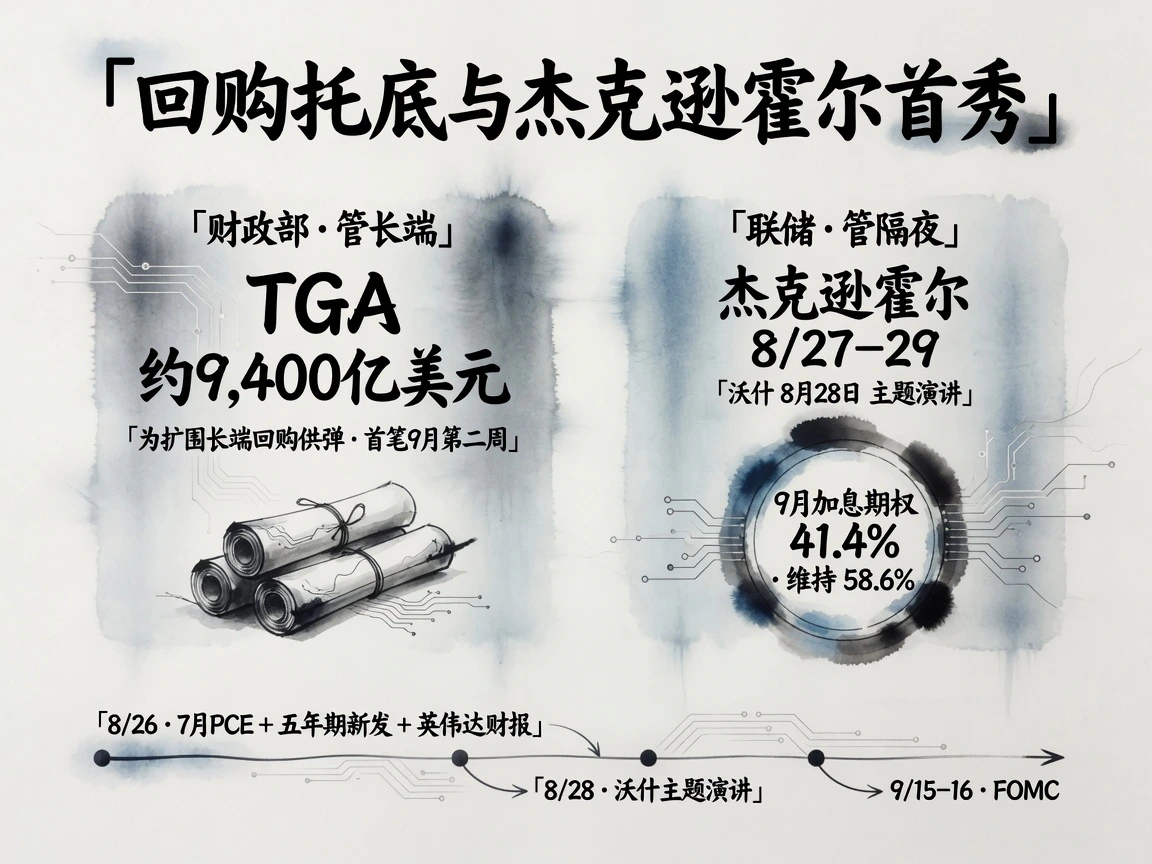
Fiscal and monetary tools were influencing their respective maturities. About $940 billion-$950 billion in the Treasury General Account (TGA) provided resources for expanded long-end buybacks. Officials confirmed none had yet been purchased and the issuance schedule was unchanged, with the first operation expected in September's second week, while markets digested criticism that buybacks used liquidity to subsidize fiscal delay. Investors were developing and buying a regime premium in which Treasury supported long rates and the Fed anchored overnight liquidity. The dollar weakened and the renminbi reached its strongest against it since February 2023.
Jackson Hole was scheduled August 27-29 under the theme 'Financial Innovation: Implications for Payments and Policy.' Warsh, chair since May 2026, would deliver Friday August 28's keynote at 10:00 Eastern, 22:00 Beijing, without live questions. His first annual central-bank gathering as chair was management's key public opportunity before the September 5 blackout. Roughly 40% September-hike pricing was closely tied to the speech: a clear commitment to contain inflation could rapidly reprice that tightening option; a focus on long-run institutions without near-term reaction guidance would make recent long-yield declines look more like payment for expected verbal intervention.
Middle Eastern markets remained in a tug-of-war between a diplomacy discount and pending execution. Recent sanctions texts did not name specific states or institutions and were interpreted by some as weaker than feared, but Treasury officials' promised designation of a major financial institution that week remained in process. The Iranian rial hit an unofficial record low around 205,000 tomans per $1, the window's only fully observable domestic economic-war transmission signal. Over the next 48 hours, July PCE, the $70 billion 5-year auction and Nvidia Q2 earnings, all due August 26, would determine whether the 6-7-basis-point Treasury rally remained or was fully reversed.