On August 26, 2026, macro data, major earnings and geopolitics intersected without a one-way asset-price breakout. July US PCE appeared warmer at the headline level—nominal PCE rose 0.2% month on month versus 0.1% expected—but core monthly inflation matched consensus. Markets reacted calmly, largely treating it as temporary noise. The 2-year and 10-year Treasury yields rose only 2 basis points each. CME-implied September 25 bp hike odds briefly reached around 44% but closed at 36.5%, below the previous 41.4%. After the US close, Nvidia beat across its second-quarter results and incorporated roughly 70% revenue compound growth for fiscal 2028 and memory shortages through end-2028 into longer-term guidance. S&P 500 futures rose around 0.5%, while Korea, with the greatest memory-sector weight, opened sharply higher in Asia. Macro uncertainty remained unresolved and pricing attention shifted entirely to Jackson Hole, where new Fed Chair Warsh would make his policy debut on August 28.
Treasuries: Warm data move yields only slightly, while hike expectations fall
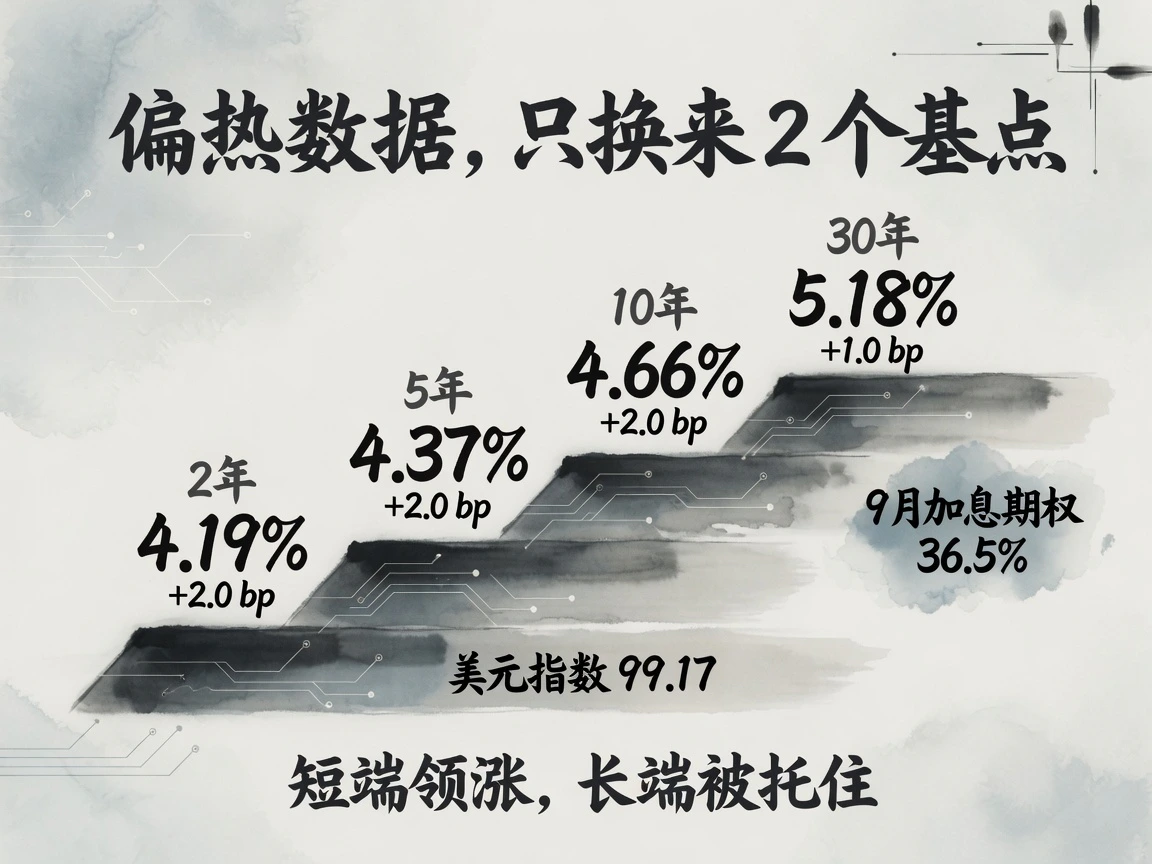
Nominal Treasuries, August 26 close-to-close, official US Treasury end-of-day curve:
| Maturity | August 26 close | August 25 close | Change |
|---|---|---|---|
| 2-year | 4.19% | 4.17% | +2.0 bp |
| 5-year | 4.37% | 4.35% | +2.0 bp |
| 10-year | 4.66% | 4.64% | +2.0 bp |
| 30-year | 5.18% | 5.17% | +1.0 bp |
Treasuries responded selectively to three morning macro releases: a small short-end repricing, with the long end held at elevated levels. July core PCE inflation was 3.3% year on year, flat for several months, while real personal spending was essentially unchanged. The second estimate of Q2 GDP revised prices higher. Durable orders rose an above-expected 1.1%, but almost all growth came from nondefense aircraft, up 12.7%. Two- and five-year yields rising 2.0 basis points merely tested marginal tightening odds. FedWatch put final September 15–16 25 basis-point hike probability at 36.5%, nearly 5 percentage points below the previous 41.4%, after briefly reaching around 44%. The 2-year at 4.19% implied some hike probability in coming months but entirely excluded cuts this year. The dollar index gained 0.25% to 99.17, its largest daily rebound in almost two weeks, consistent with higher short rates.
Long Treasuries did not follow the hike narrative. The 30-year closed at 5.18%, up 1.0 bp, around 13 bp below August 17's 5.31%, a high since 2007, but still near two-decade financing-cost highs. Fiscal deficits and huge supply supported term premiums as government long bonds and AI-infrastructure corporate debt competed for funds. Combined with short-end repricing, this produced higher short yields and a stable, elevated long end. Primary auctions were orderly: $70 billion of new 5-year notes cleared at 4.393%, with a small 0.2 bp tail, the 15th consecutive failure to stop through, and bid-to-cover of 2.37, above the prior month. The previous day's $69 billion 2-year auction cleared at 4.204% and 2.60 coverage. Supply concerns had not become a demand collapse. The August 27 $44 billion 7-year auction, closing at 13:00 US Eastern time, would finish the week's supply and provide the last longer-maturity auction test before September's meeting.
(Separate cutoff snapshot, not a daily change: August 26 20:57–20:58 US Eastern time, 2-year 4.224%, 5-year 4.384%, 10-year 4.662%, 30-year 5.184%; the 2-year was about 3–4 basis points above the official close.)
Macro: Nominal strength, real weakness and an unchanged policy anchor
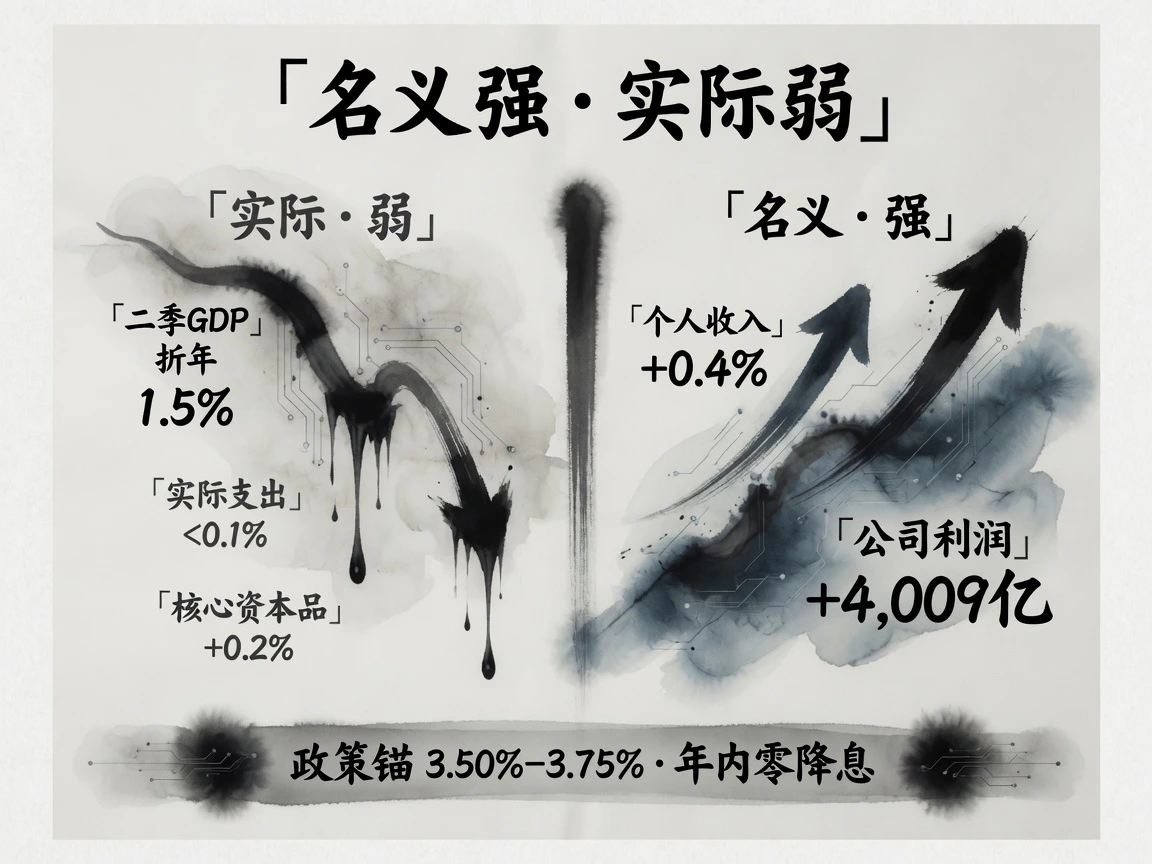
July PCE showed distinctly stagflation-like internals. Within the 0.2% rise in nominal personal spending, services increased $86.2 billion, largely offset by a $49.9 billion decline in goods. Real spending was nearly stagnant, below 0.1% month on month. Personal income rose an above-expected 0.4%. Services prices increased 0.3%, remaining the main source of inflation persistence, while goods and energy prices eased at the margin.
The second GDP estimate left Q2 real growth unchanged at a 1.5% annualized rate, with major revisions concentrated in prices. Core PCE inflation rose from 3.4% to 3.6%, overall PCE was revised up 0.2 percentage point to 5.3%, and domestic purchases prices reached 5.8%. The first estimate of real gross domestic income (GDI) grew 2.2%. Corporate profits increased $400.9 billion from the previous quarter, far faster than Q1's $74.4 billion. Weak 1.5% real growth alongside roughly 5% annualized inflation exposed nominal strength and real weakness. Nominal expansion accumulated more in corporate accounts than in meaningful price concessions.
Unusual orders for Boeing and other aircraft temporarily obscured uneven real momentum. Core capital-goods orders excluding aircraft rose only 0.2%, far below expectations around 0.9%, while Atlanta Fed GDPNow raised Q3 annualized growth to 4.6%. Official backward-looking 1.5% and model-based forward-looking 4.6% readings revealed a deep divergence in macro expectations.
The policy anchor remained firm: a 3.50%–3.75% target range, held by a 9–3 vote in late July with three favoring a hike, and firmly established pricing of no cuts this year. Core PCE at 3.3% year on year for several months underpinned that division: the data supported neither early easing nor overheating sufficient to force an immediate hike. Attention converged on Jackson Hole, August 27–29. Warsh's August 28 10:00 a.m. US Eastern keynote, 22:00 Beijing, without live questions, was his formal debut and the only public glimpse of his reaction function before September 15–16. On tariffs, US 50% duties on around $20 billion of Canadian goods took effect August 22. Canada's August 25 retaliation list covered around $20 billion, with three rate tiers and energy exemptions, effective September 8. Two-way friction raised inflation expectations while restraining cross-border commerce.
Commodities: Oil's third decline slows sharply; gold finds support near $4,600
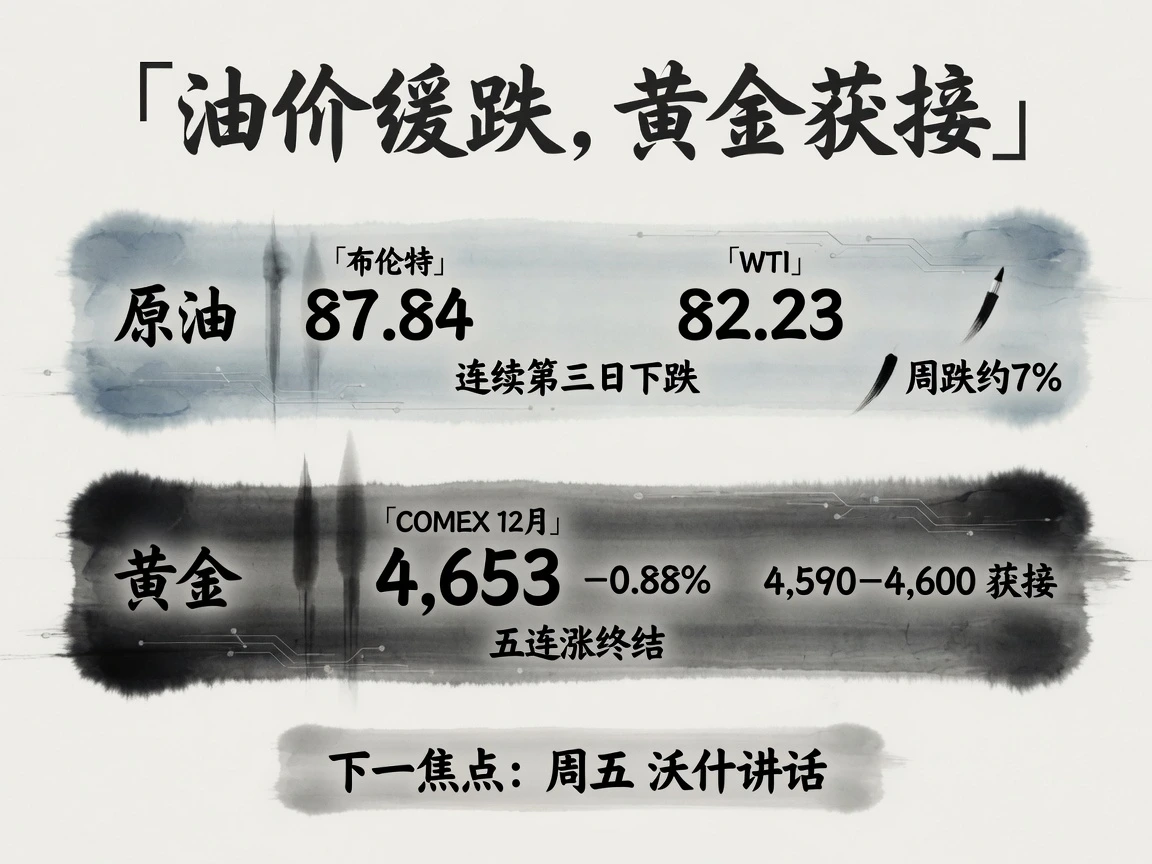
Trading on diplomatic relief from supply fears entered its third day, but oil's decline slowed abruptly. Brent closed at $87.84/barrel, -0.84%, and WTI at $82.23, -0.16%. Both fell for a third session, but declines narrowed more than threefold from Tuesday's -3.9%. Brent was around 7% below the previous Friday's $94.39 high; sustaining that through the weekend would produce its largest weekly loss since June.
Four forces interacted. First, Iran–Oman temporary-corridor talks advanced from broad framework to technical parameters and revenue sharing but lacked an effective date, shifting markets from prolonged-blockade pricing to weekly diplomatic monitoring. Second, actual passage restrained optimism: Kpler counted only five merchant ships Tuesday, a 10-day average of 15 and only two on Monday, far from genuine reopening. Third, EIA commercial crude stocks rose just 95,000 barrels, far below Reuters expectations of 597,000, supporting fundamentals. Fourth, a drone attack halted processing at Russia's fourth-largest refinery. WTI fell much less than Brent: Brent carried the main Hormuz shipping-risk exposure, while minimal US inventory accumulation supported WTI. Nearby Brent–WTI remained around $4.8–4.9, and October WTI retained $1.3–1.4 backwardation to November. Nearby scarcity was real, pricing immediate risk rather than actual supply recovery.
Gold followed a different macro logic. December COMEX futures closed at $4,653.30/ounce, -0.88%, the largest decline since August 18 and an end to five rising sessions. Slightly warm PCE lifted the dollar, yields and intraday September hike expectations. Technically, this looked more like a correction after repeated gains than a reversal. London spot found strong support around $4,590–4,600 and rebounded about 0.6% above $4,619 early in Asia. Fiscal-deficit monetization hedging, ETF inflows and a medium-term weak-dollar cycle left the monetary-credit hedge intact. Warsh's Friday tone remained central: hawkishness could test $4,555 support; a balanced neutral stance could allow consolidation above $4,650 and another challenge to $4,700.
Equities: Nvidia gains 4.5% after hours, reshaping expectations for AI duration
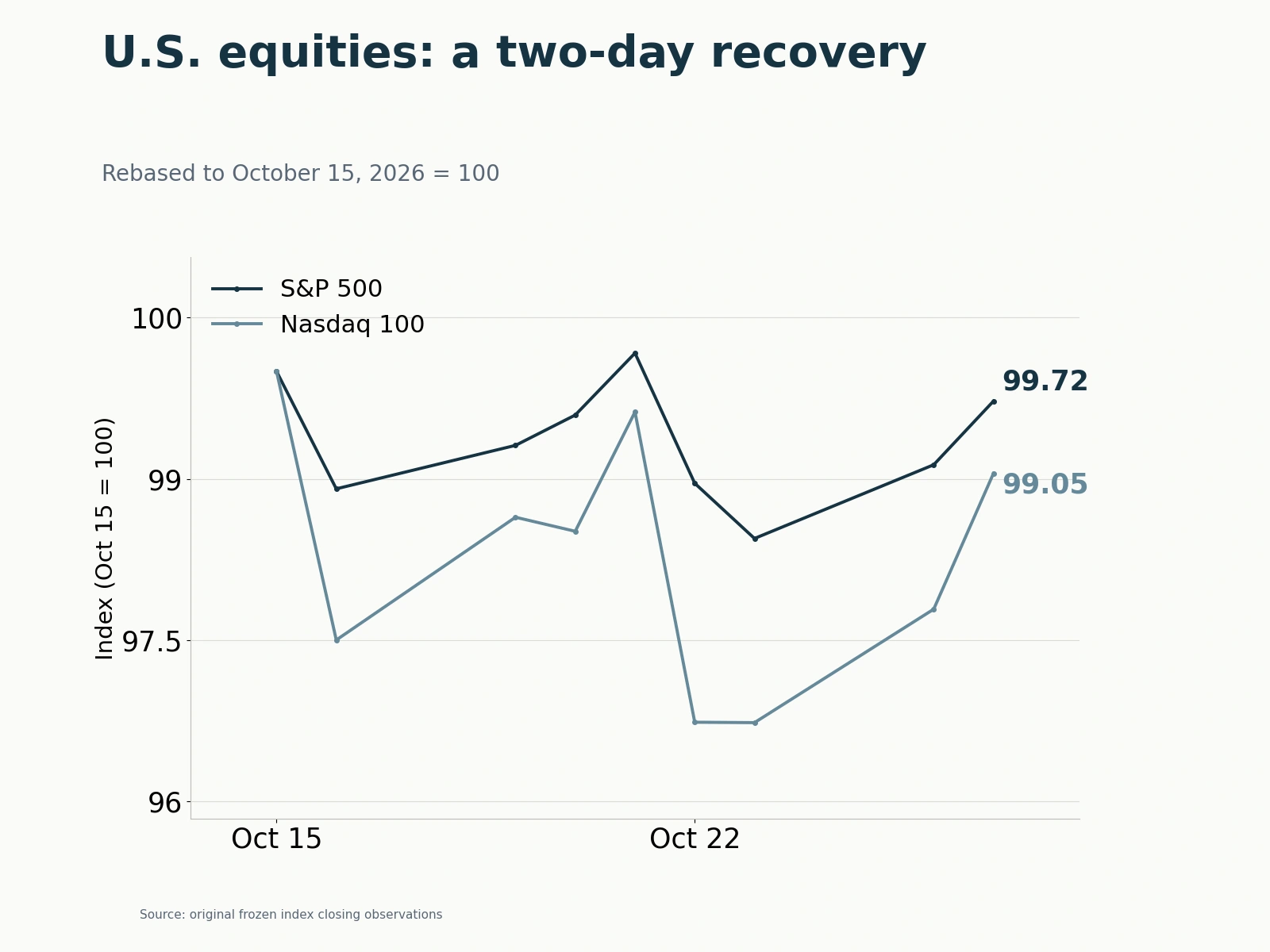
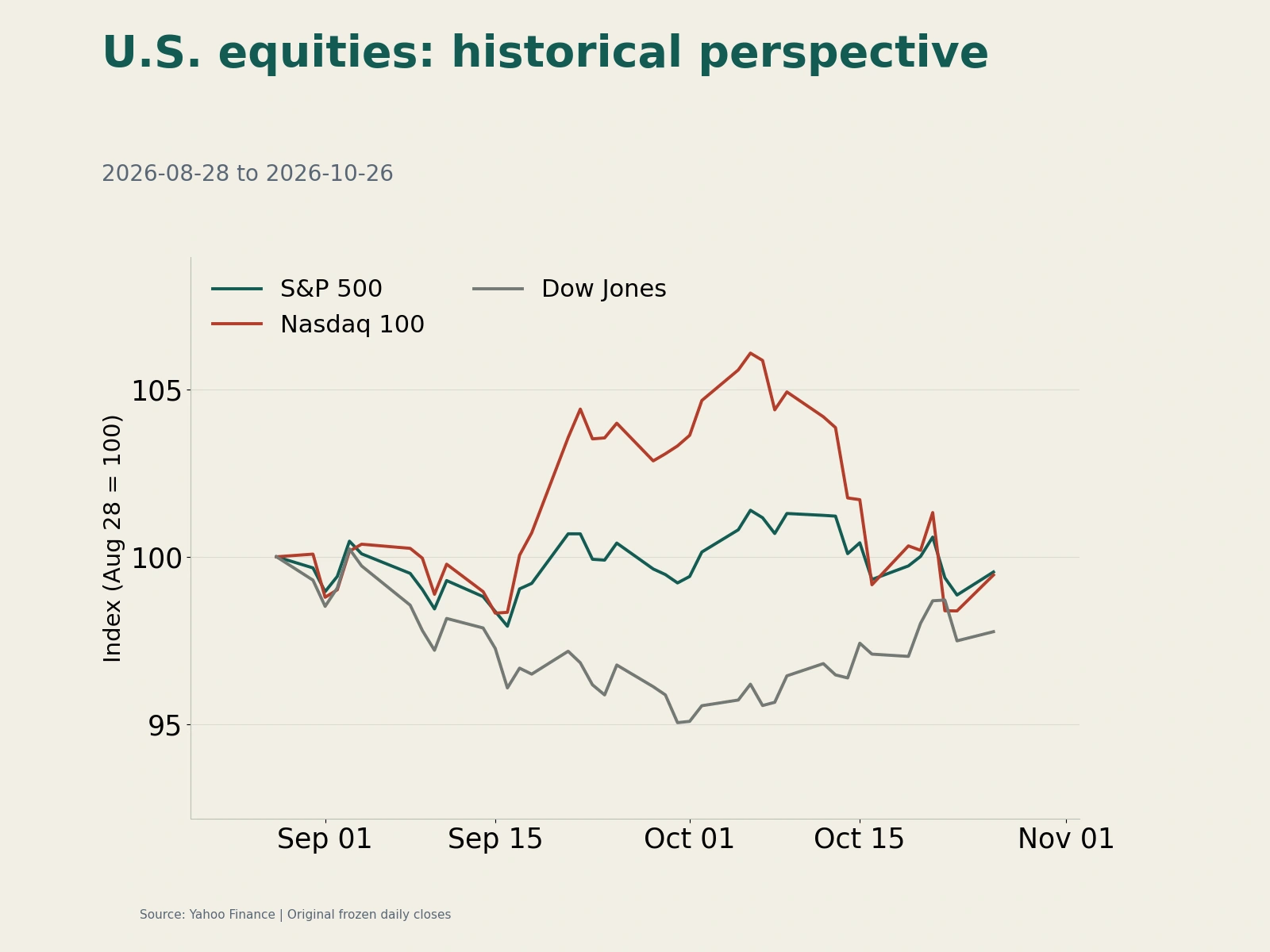
Wednesday's regular US session was quiet, with low-volume narrow trading. S&P 500 -0.02% to 7,675.70; Nasdaq Composite -0.08% to 26,130.20; Dow -0.21% to 53,463.88; Russell 2000 -0.14% to 3,005.90; VIX eased to 15.21. Around 14.2 billion shares traded, well below the 20-day average. Equal-weight S&P outperformed capitalization weighting, and only four of eleven sectors rose. Near-flat stocks despite the 2 bp yield increase showed reluctance to discount minor rate changes before Nvidia and Warsh. Industrials led, with Honeywell +2.3% and C.H. Robinson +5.62%; healthcare lagged. Abercrombie & Fitch surged 35.67% after raising annual guidance partly on one-off tariff refunds, contrasting with lower guidance at Dick's Sporting Goods.
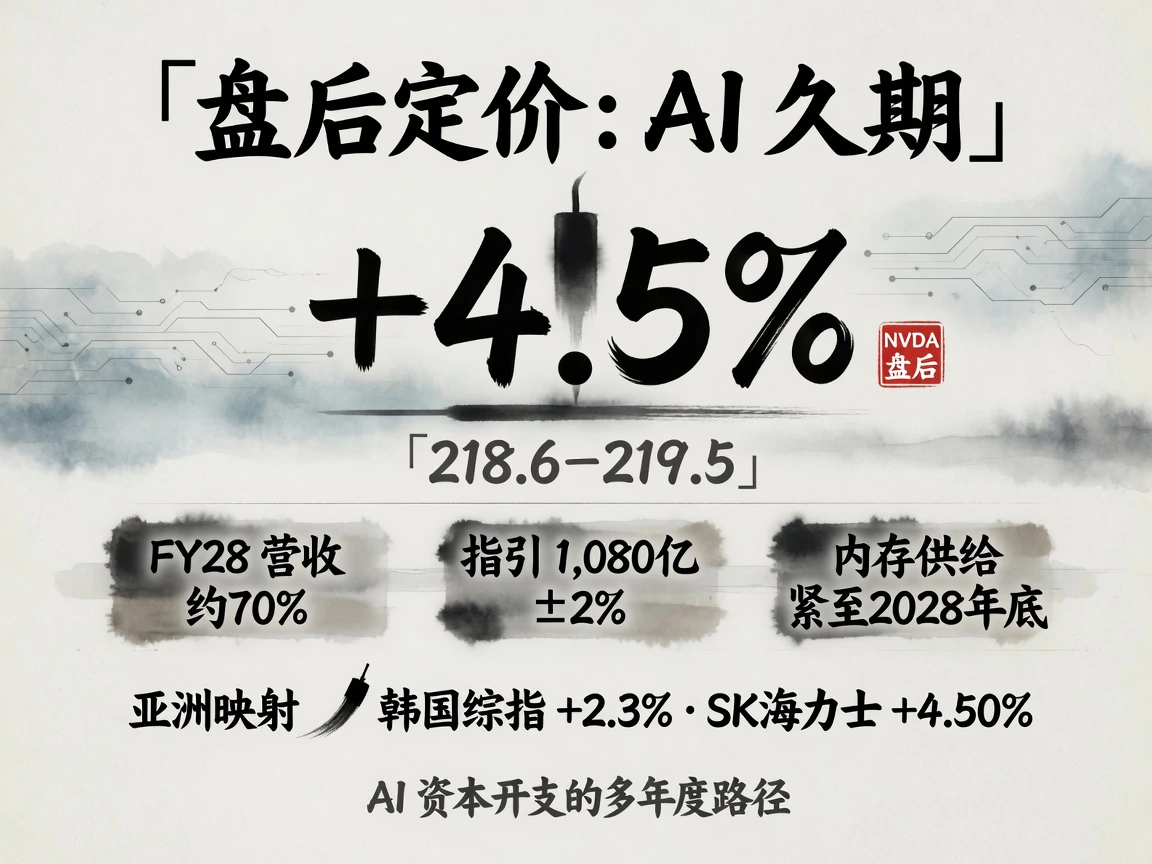
After hours Nvidia took over pricing. Fiscal Q2 revenue was $96.22 billion, up 106% year on year and 18% sequentially. Q3 guidance was $108 billion ±2%, excluding all Chinese data-center revenue. The CFO also gave roughly 70% fiscal-2028 revenue compound-growth guidance for the first time, versus Wall Street's earlier 44%–45%, and warned HBM and other shortages could last through end-2028. After losing 1.59% in regular trading, shares briefly dipped before gaining over 4.5% to $218.6–219.5. Nvidia also announced 2 million additional AWS GPU purchases, multiyear foundry cooperation with SK Hynix and plans for a joint third-party computing-finance platform above $500 billion. Software leaders Salesforce, CrowdStrike and Okta gained 11%–20% after hours, identifying enterprise payments for agents as a verifiable new revenue stream and linking application monetization to underlying token computing.
The report's key contribution was to challenge doubts about sustainable AI capital spending, shifting repricing from one quarter's earnings to multiyear asset duration. Roughly 70% fiscal-2028 growth, shortages through end-2028 and guidance excluding China turned routine earnings into a multiyear growth path constrained by supply bottlenecks. Investors reinterpreted memory inflation, previously feared to erode system margins, as evidence of demand pushing supply limits. Risks still required pricing: media reported Nvidia was providing up to around $105 billion of rent guarantees for one core customer to support self-financed demand. The authenticity of end demand and potential balance-sheet risks required continued attention.
At the cutoff, S&P 500 futures at 7,717 stood about 0.54% above spot, reflecting stronger-than-expected AI news. Thursday's Asian response favored Korea and selected Japanese stocks: KOSPI opened around 2.3% higher, Samsung rose 3.25% and SK Hynix 4.50%, while Nikkei 225's approximately 0.8% opening gain quickly faded. Korea's exposure to memory shortages through 2028 and Nvidia's cooperation news explained its strength. The key at the next US open was whether semiconductors and HBM suppliers retained the after-hours gains, more than their absolute size.
Geopolitics and macro variables: Temporary-corridor talks advance technically; secondary financial sanctions remain pending

Iran–Oman talks moved toward operational parameters: an approximately seven-mile-wide temporary route, no warships, and merchant vessels requiring Iranian permission and continuous monitoring. Iran's deputy foreign minister offered 30–60 days for permanent talks but reiterated that unconditional full reopening was impossible until US obstruction ended. Washington issued no formal response. Previously signaled major designation of a key financial institution before the weekend had not appeared by the cutoff, nor had clearing institutions been named. Markets treated this as orderly risk-premium unwinding without a near-term trigger. Oil's decline slowed, Treasury yields rose 1–2 bp and commodities, bonds and stocks showed no unified haven direction.
Real-economy avoidance and supply-chain adaptation were emerging. Reuters reported at least three large Indian refiners and one multinational energy company planned to stop using 45 controlled tankers blacklisted by Iran. Saudi Aramco meanwhile maintained supplies through Fujairah and STS transfers off Sohar. This helped explain oil's slowing decline: political progress coexisted with actual non-Iranian offshore workarounds. Iran's internal pressure also became clearer. After a record low near 2.05 million rials per dollar on August 25, the free-market currency stabilized weakly. Tehran gasoline demand was about 30% above normal, some stations limited vehicles to 20 liters, and strategic fuel reserves were estimated to last only around 12 days at current consumption. The economic blockade's pressure was visible but had not secured substantive concessions on core positions. Both sides' window lay before November's US midterms; longer fuel queues in Iran or Washington's next sanctions list might break the stalemate.