A September rate hike remains a conditional scenario with a slight edge. Markets are not pricing a one-way chain of strong payrolls, high inflation and inevitable tightening. They are testing a more delicate balance: employment has cooled markedly without collapsing, August headline inflation is likely to rebound on energy, and whether core price pressure broadens again remains unresolved.
Recent rate-market snapshots put the implied probability of a 25-basis-point September hike broadly at 60%–66%, with some intraday readings at 64%–66.1% and earlier observations at 57%–60%. This expresses only a moderate bias, far from certainty.
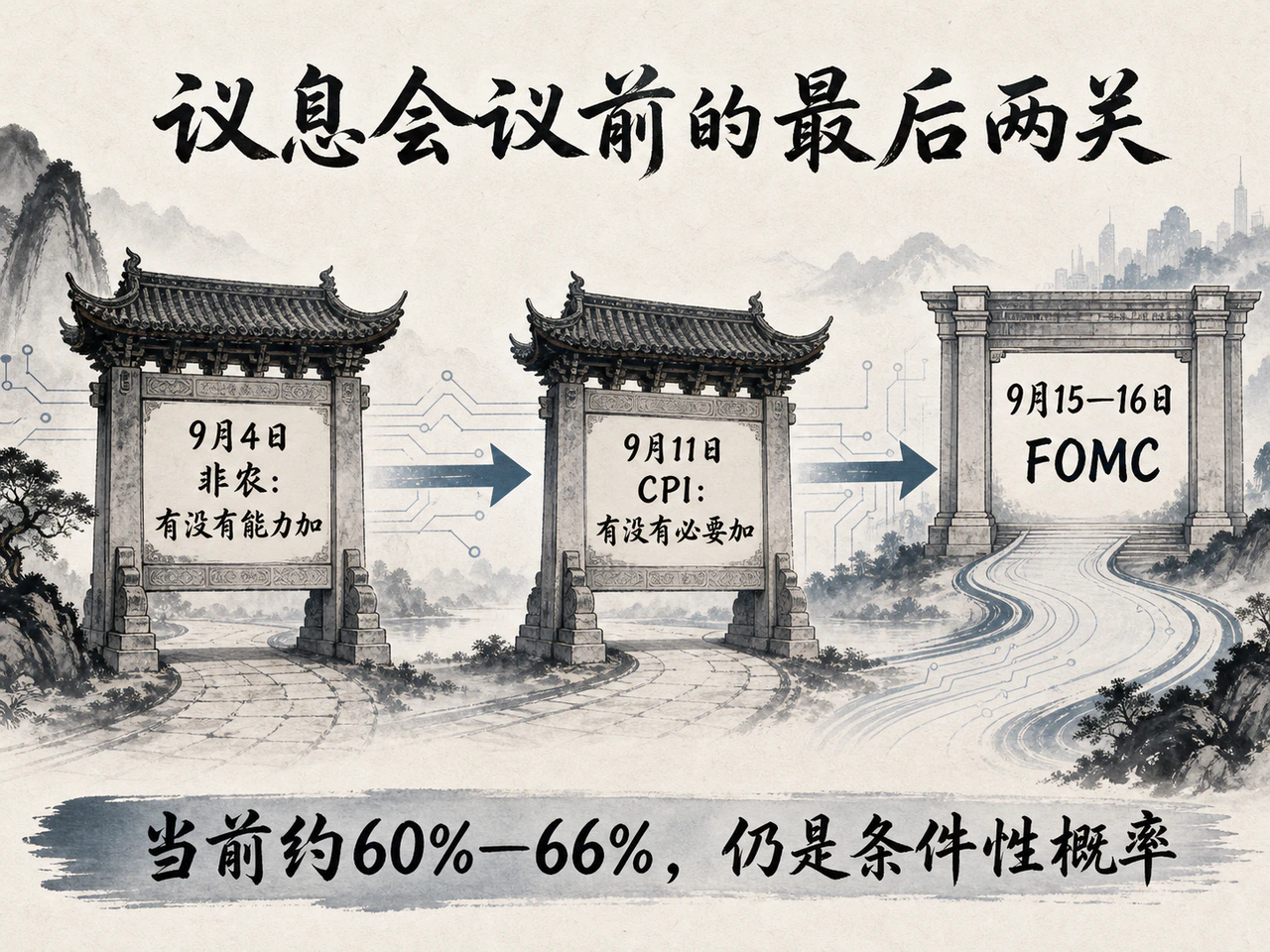
That pricing faces two successive tests: August payrolls at 08:30 US Eastern time on September 4, then August CPI at 08:30 on September 11. With only a few trading days between CPI and the September 15–16 FOMC meeting, inflation will provide the final pre-meeting verdict.
1. What Does the Payroll Consensus Imply?
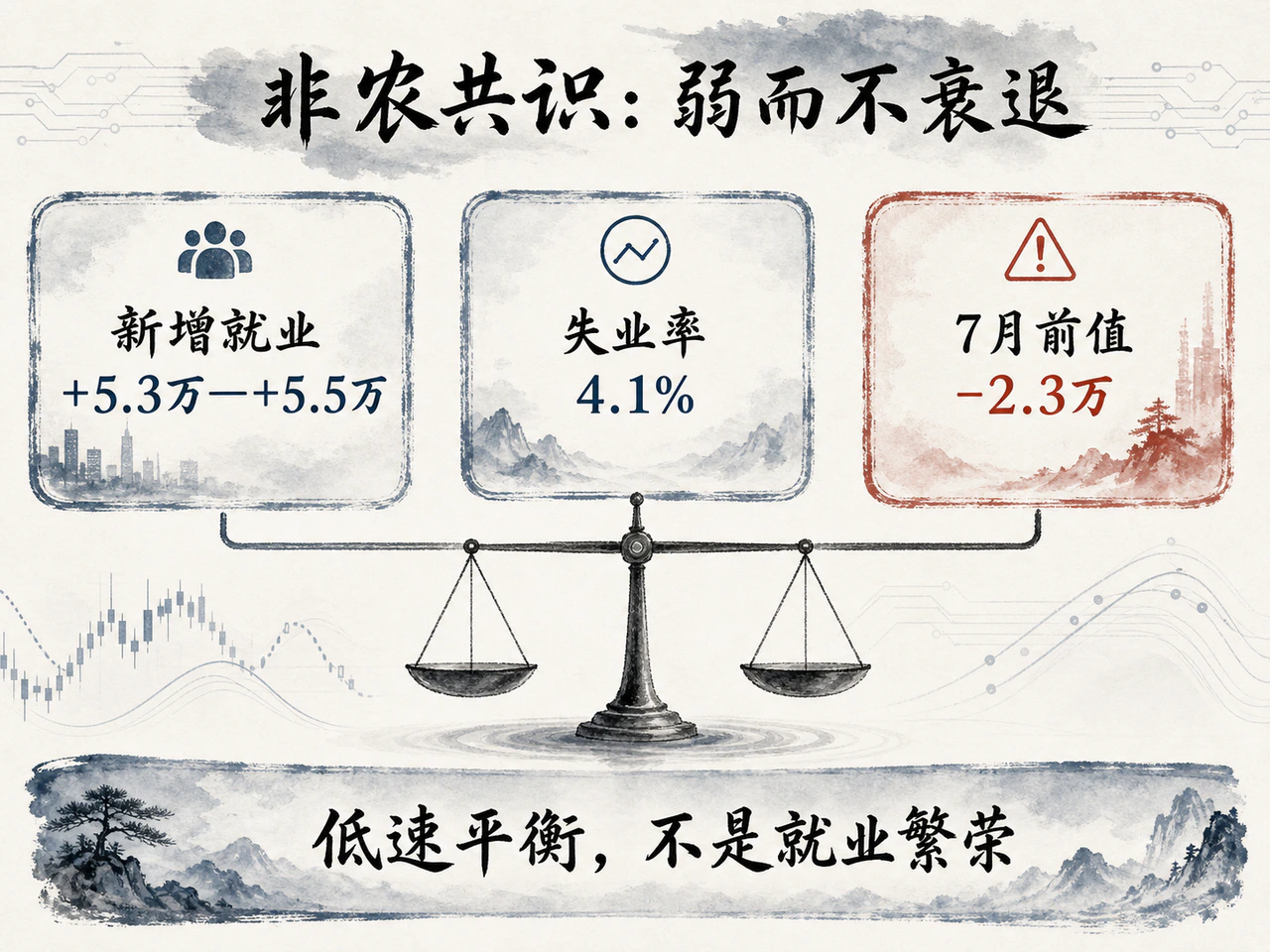
Mainstream expectations currently fall approximately within these ranges:
- August payroll gains of 53,000–55,000;
- Unemployment unchanged at 4.1%;
- July's previous reading was a decline of approximately 23,000.
These are not simply neutral numbers. They form a carefully constructed baseline of weakness without recession.
1. A 55,000 Gain Signals No Boom; It Is the Passing Grade That Keeps Tightening Available
A result near 55,000 would not be read as a return to booming labor demand. It would establish four marginal developments: employment has moved out of July's contraction; hiring remains sluggish; the labor market has avoided two consecutive monthly declines; and the Fed still has room to discuss a hike, but cannot justify it by invoking exceptionally strong employment.
A 55,000 gain is therefore no hawkish result; it mainly keeps a hike on the table. This also explains why two-year yields did not keep rising on August 31 despite FedWatch hike odds above 60%. Markets acknowledge that Warsh's remarks raised the policy hurdle, but doubt that current labor resilience supports a sustained tightening cycle.
2. A 4.1% Unemployment Rate Matters More Than the Absolute Jobs Gain
Only 55,000 new jobs alongside unemployment holding at 4.1% would suggest simultaneous slowing in labor demand and supply. Firms add few positions, but labor supply and participation are not expanding sharply either. Markets have not yet observed the recessionary impulse signaled by a jump in unemployment.
With payrolls between 30,000 and 60,000, unemployment steady at 4.1%, and no deterioration in average hourly earnings or weekly hours, markets would tend to see a low-speed equilibrium rather than recessionary collapse. If jobs met expectations but unemployment rose to 4.2% or even 4.3%, the divergence between household and establishment surveys would break, and the reaction would shift markedly dovish.
3. Historical Revisions Matter More Than This Month's Initial Print
With July already deeply negative, attention will focus on the underlying revisions:
- Whether July's -23,000 is revised substantially further down;
- Whether June is also revised lower;
- Whether the three-month average jobs gain is compressed toward zero;
- Whether underlying private-sector hiring is weaker than the headline total;
- Whether temporary assistance, weekly hours and the employment diffusion index deteriorate broadly.
Even an August headline gain of 55,000 would be treated as evidence of continuing contraction if July were revised to -50,000 or below. If August met expectations and July were revised back into positive territory, the reassessment of labor resilience would directly lift hike odds further.
2. Practical Payroll Thresholds for Markets
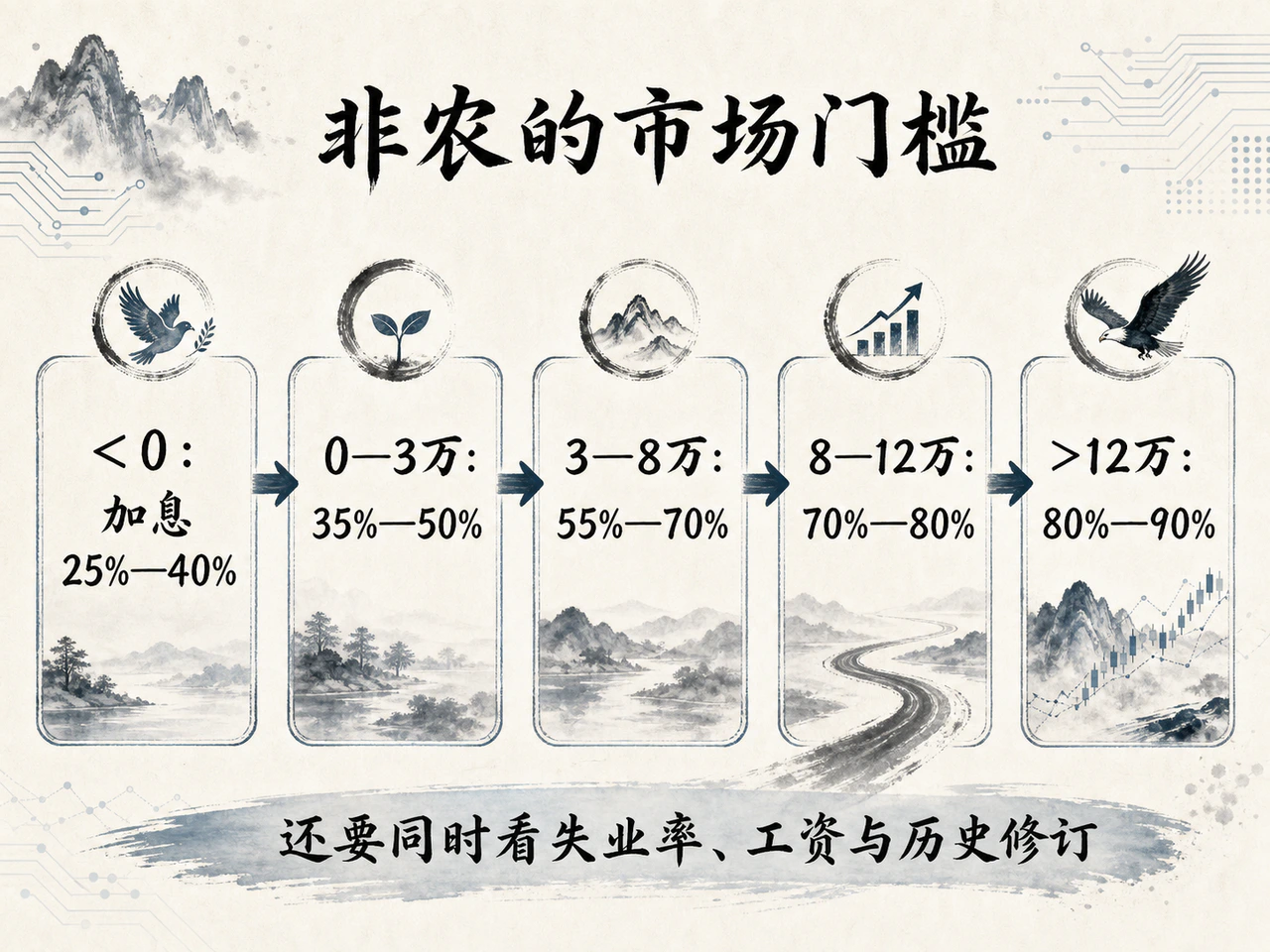
Against current baseline pricing of approximately 60%–66%, different outcomes imply the following marginal policy-probability scenarios:
Clearly Dovish
Payrolls negative again, possibly accompanied by severe downward historical revisions; unemployment rises to 4.2% or above.
Continuing labor-market contraction is confirmed, with September hike odds expected to fall sharply to approximately 25%–40%.
Moderately Dovish
Payroll gains of 0–30,000; unemployment at 4.1%–4.2%.
Labor demand falls well short of expectations, strengthening the case for waiting; hike odds are expected to retreat to 35%–50%.
Broadly in Line
Payroll gains of 30,000–80,000, unemployment holding at 4.1%, and stable pay and hours.
This fits the weak-but-not-recessionary baseline, likely leaving hike odds contested within 55%–70%.
Moderately Hawkish
Payroll gains of 80,000–120,000, unemployment no higher than 4.1%, and no wage weakening.
Labor resilience is reaffirmed, potentially lifting hike odds to 70%–80%.
Clearly Hawkish
Payrolls exceed 120,000, unemployment falls to 4.0%–4.1%, and average hourly earnings rise at least 0.3% month on month.
Provided earlier data are not heavily revised down, hike odds are expected to rise to a dominant 80%–90%.
The most damaging hawkish combination for rates assets is not merely a monthly gain above 100,000, but payrolls above 100,000, upward revisions, unemployment falling to 4.0% or holding at 4.1%, and stabilizing wages and hours. This would substantiate Warsh's claim of continued economic resilience. Typical cross-asset effects would be:
- Two-year yields leading the rise;
- Further flattening of the 2s10s curve;
- A stronger dollar index;
- Pressure on gold;
- Relative weakness in small caps, long-duration technology and highly leveraged borrowers.
The clearest dovish combination would be negative payrolls, downward revisions to both earlier months, unemployment above 4.2%, and weaker pay and hours across the board. With employment materially contracting, the Fed would find it extremely difficult to force through a hike solely on one crude-supply shock.
3. September 11 CPI: No Settled Consensus Yet, but the Main Logic Is Clear
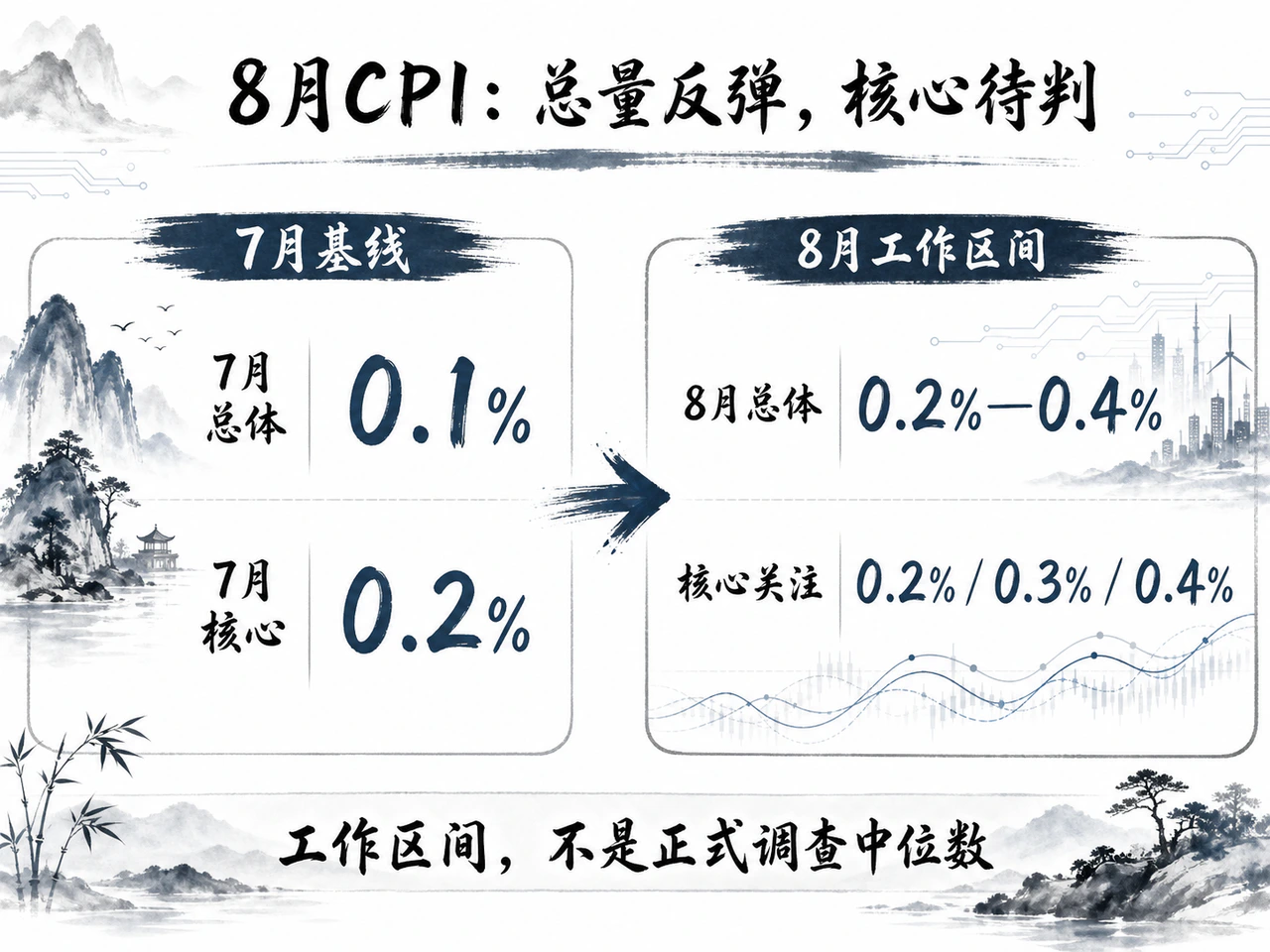
There is still time before CPI, and institutions have not formed a statistically consistent median forecast. The qualitative macro logic, however, is closely aligned:
An August headline CPI rebound is already widely anticipated, mainly because of energy. The decisive question for the Fed is whether monthly core CPI is 0.2% or breaks higher to 0.3%, or even 0.4%.
The July CPI baseline was:
- Headline CPI +0.1% month on month and +3.4% year on year;
- Core CPI +0.2% month on month and +2.5% year on year.
July gasoline prices fell 2.9% month on month, restraining headline inflation. The subsequent recovery in refined-product and spot crude prices means August headline inflation will receive a substantial positive energy contribution.
Alongside energy's rebound, monthly shelter-cost growth is moving back toward its normal center near 0.3%. Health care, shipping and transport, used cars, recreation and electronics also face varying cost pass-through pressure. This defines an analytical working range for August CPI:
- Headline monthly CPI rises from July's 0.1% to approximately 0.2%–0.4%;
- The key monthly core possibilities are 0.2%, 0.3% or 0.4%;
- Annual headline CPI may rise again from 3.4% under combined base and energy effects;
- Whether annual core inflation turns higher from 2.5% matters much more for policy than a one-month headline spike.
4. CPI's Central Question: Second-Round Oil Pass-Through Rather Than the Initial Shock

The September 11 inflation release will test the policy divide between Warsh and Bessent:
Warsh's hawkish case is that the central bank must act if underlying prices lack rapid, clear evidence of returning toward 2%.
Bessent's neutral argument is that the oil surge is fundamentally a supply disturbance; policy should not mechanically hike before confirming second- or third-round effects.
The distribution across CPI components therefore matters more than the headline, particularly in four areas:
First, housing rents.
If primary residence rents and owners' equivalent rent (OER) again settle above 0.3% month on month, the case for core-services disinflation is directly weakened.
Second, core services excluding shelter.
Broad increases in health care, airfares, insurance, personal care and recreation would show price persistence independent of energy.
Third, core goods.
Do consumer electronics, vehicles and durable goods continue absorbing pass-through from tariff expectations, semiconductor component prices and higher supply-chain freight costs?
Fourth, energy's penetration into upstream and final prices.
The central bank can look through oil-price fluctuations alone. But if energy costs spread broadly into logistics, shipping, food processing, basic chemicals, final consumer prices and inflation expectations, Bessent's defense would collapse and support Warsh's case for hikes.
5. Practical CPI Thresholds for Markets
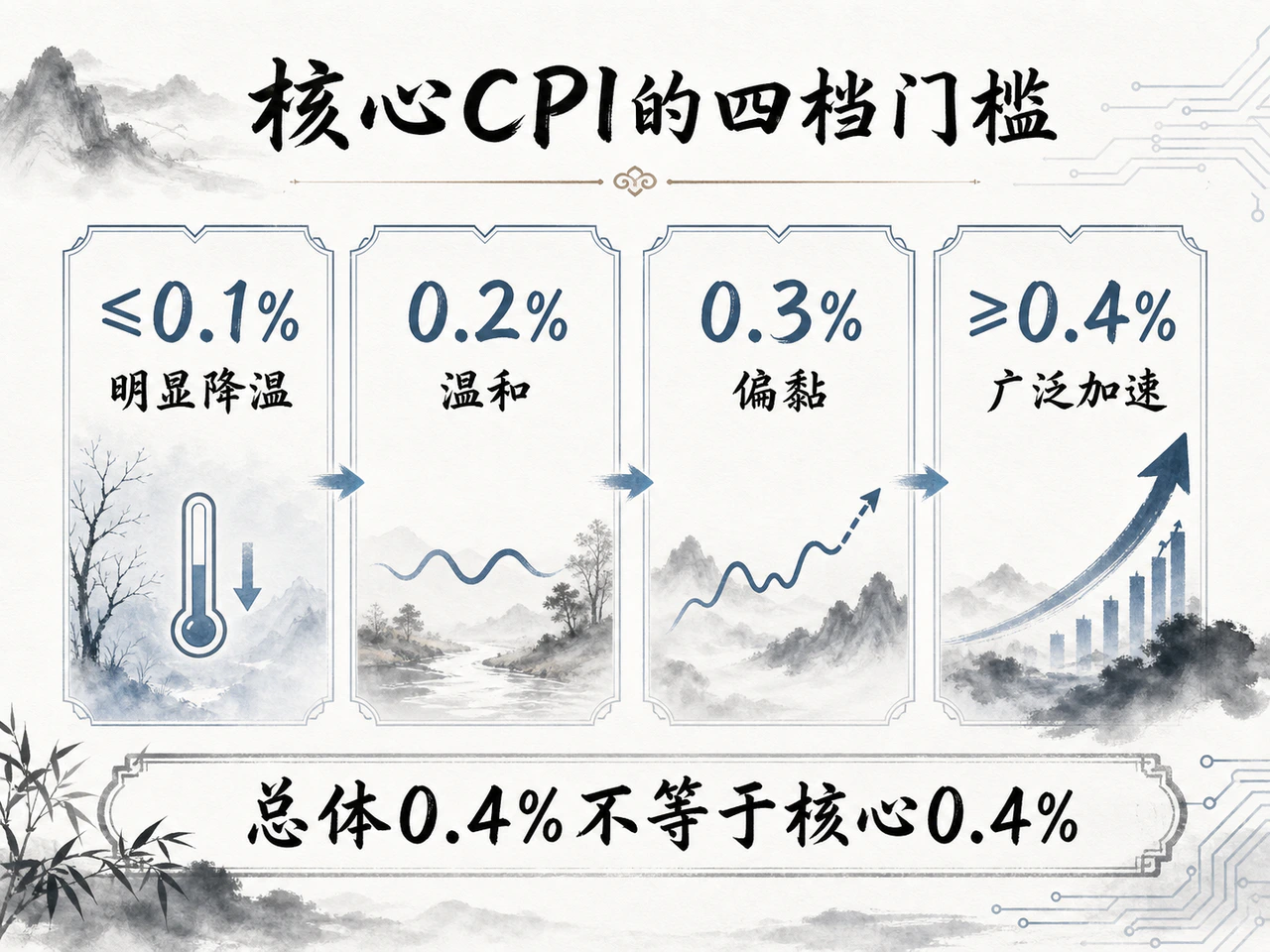
Different monthly core CPI outcomes are expected to produce clear steps in rate-market repricing:
Core Monthly Inflation No Higher Than 0.1%
Disinflation is established. Even with oil lifting headline CPI, the Fed would decisively look through the supply disturbance and September hike pricing would largely unwind.
Core Monthly Inflation of 0.2%
July's moderate disinflation path continues, making hikes much harder to justify. Unless the earlier payroll report is exceptionally strong, this would struggle to shift the rate decision.
Core Monthly Inflation of 0.3%
Underlying inflation shows renewed persistence, broadly maintaining today's roughly 60% probability and a contested bias toward a hike.
Core Monthly Inflation of at Least 0.4%
Broadening core reacceleration is confirmed, with September hike odds expected to jump to 80%–90% or higher.
Headline 0.4% plus core 0.2% is fundamentally different for macro trading from headline 0.3% plus core 0.4%. The first mainly reflects external energy disruption and supports Bessent's patience. The second establishes an underlying inflation rebound and fully meets Warsh's trigger for decisive hikes.
6. Joint Payroll–CPI Pricing Matrix
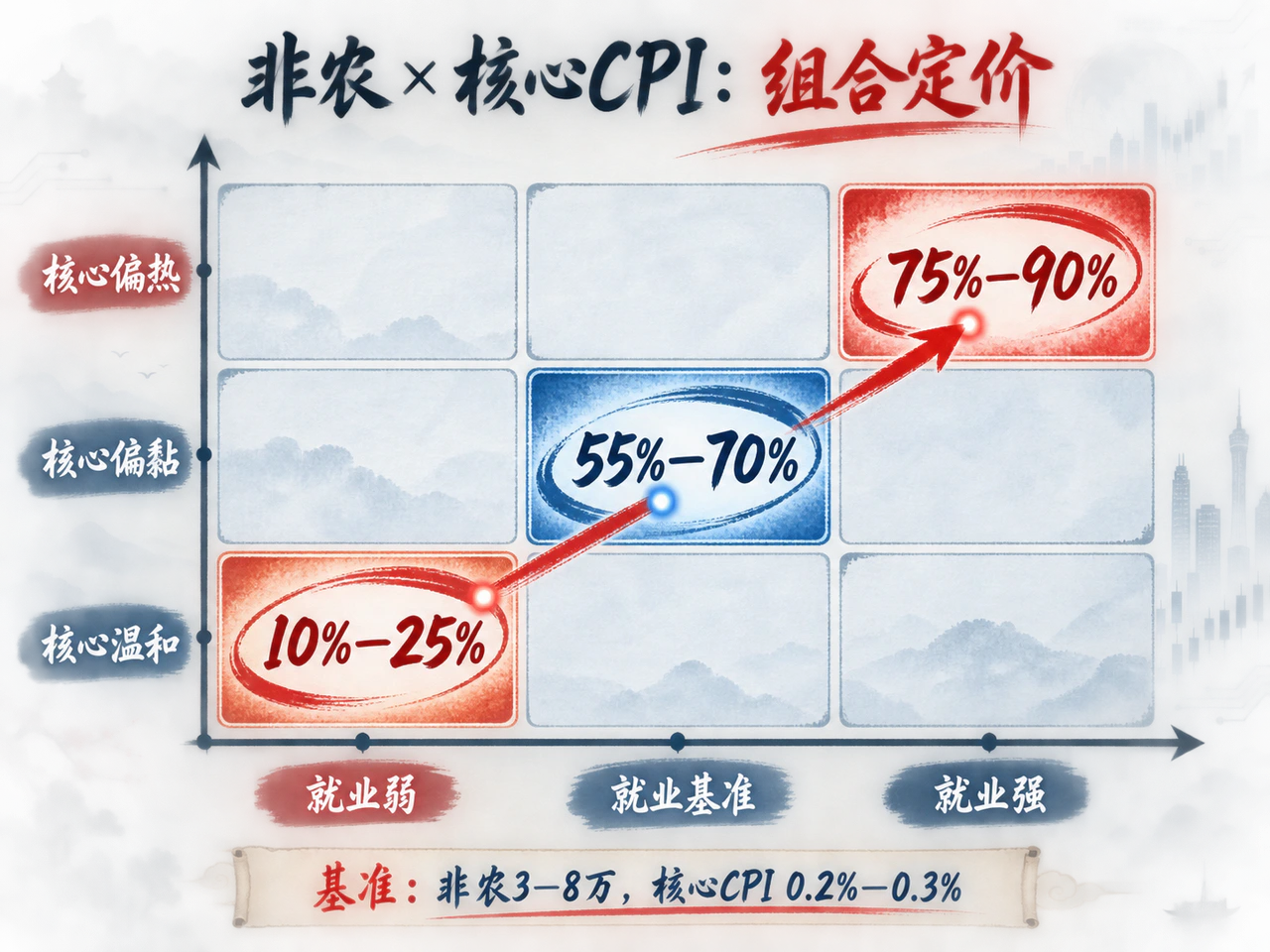
Current hike bets near 60%–66% essentially combine the following baseline:
August payrolls recover to +55,000 and unemployment stays at 4.1%. Energy produces a moderate headline inflation rebound, while monthly core remains within the critical 0.2%–0.3% range rather than becoming uncontrolled.
This baseline would leave September's decision closely contested. Warsh could argue that disinflation has stalled, while dovish voters could counter that labor markets are tired and policy should not overtighten in response to oil.
Scenario 1: Weak Employment, Moderate Core Inflation
- Payrolls at or below zero; unemployment at least 4.2%;
- Monthly core CPI no higher than 0.2%.
Tightening expectations rapidly fade, with hike odds expected to plunge to 10%–25%.
Scenario 2: Employment Meets the Threshold, Core Inflation Is Moderate
- Payroll gains 30,000–80,000; unemployment steady at 4.1%;
- Monthly core CPI no higher than 0.2%.
Employment remains in a low-speed equilibrium and inflation is contained, strengthening the case for holding rates. Hike odds are expected to fall to 30%–45%.
Scenario 3: Employment and Inflation Both Match the Baseline
- Payroll gains 30,000–80,000; unemployment steady at 4.1%;
- Monthly core CPI around 0.3%.
Data provide no one-way signal. Hike odds likely remain contested at 55%–70%, with the full committee's deliberations at the meeting deciding the outcome.
Scenario 4: Strong Employment, Hot Core Inflation
- Payroll gains of at least 100,000; unemployment no higher than 4.1%;
- Monthly core CPI at least 0.3%.
Resilient activity and price pressure reinforce each other, with September hike odds expected to jump to 75%–90%.
Scenario 5: Contracting Employment but High Inflation, or Mini-Stagflation
- Payrolls at or below zero; unemployment at least 4.2%;
- Monthly core CPI at least 0.4%.
This is the most difficult stagflationary policy setting. Rate-futures probabilities may become conflicted, but higher long nominal yields and valuation pressure on risk assets would be more pronounced than one-directional moves at the short end.
The most reasonable baseline remains payroll gains of 30,000–80,000, unemployment holding at 4.1%, a moderate headline inflation rebound, and monthly core at 0.2%–0.3%. September hike odds would remain in a 50%–70% range after payrolls, leaving CPI to deliver the final verdict.
7. Why Cross-Asset Markets Have Not Fully Confirmed a Hike
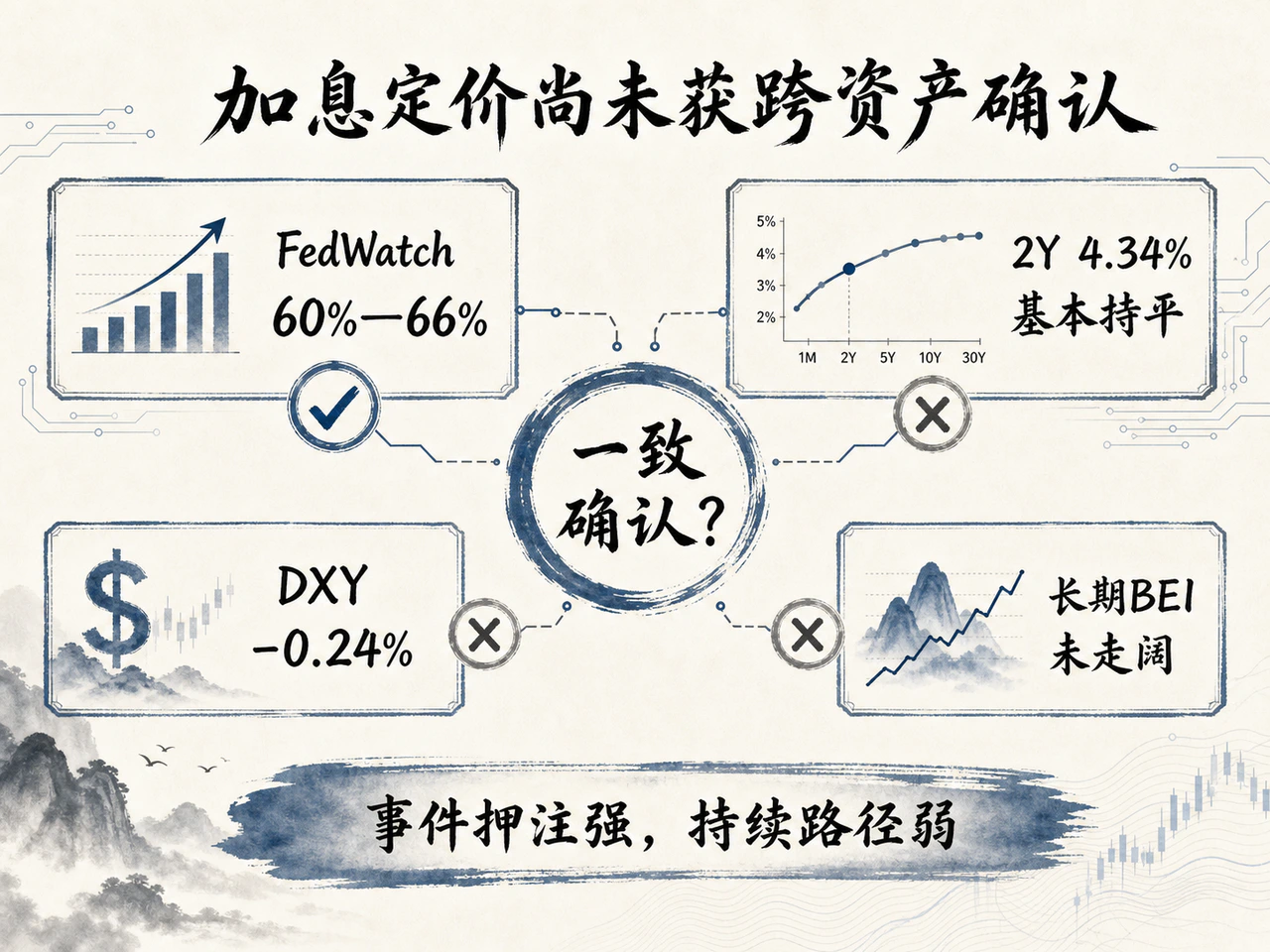
Although FedWatch shows hike odds above 60%, key variables across asset classes have not provided consistent confirmation:
1. Two-Year Treasury Yields Have Not Led Higher
On August 31, the policy-sensitive two-year Treasury yield closed near 4.34%, broadly unchanged for the day. Ten- and 30-year yields instead rose approximately two and three basis points.
A typical imminent-hike trade would see two-year yields leading a bear-flattening curve. Actual trading showed long-end-led steepening. Markets are not yet anchored to continuous tightening. Warsh's remarks raised hike odds, but higher long yields also reflect oil shocks, additional Treasury supply, rebuilding term premiums and repricing of real capital returns.
2. The Dollar Index Lacks Follow-Through
The dollar index slipped approximately 0.24% on August 31. If FX markets were convinced the Fed would soon hike and start another tightening cycle, the dollar would normally strengthen with short rates. The subdued currency response shows hike pricing remains strongly characterized by a discrete event bet.
3. Inflation Compensation Has Not Broadened
Despite strong oil gains, 10- and 30-year Treasury breakeven inflation rates did not widen materially. Higher nominal long rates were driven almost entirely by higher real rates. Fixed income has not fully treated the oil rally as the start of a persistent inflation cycle.
4. Gold Has Not Sustained a Positive Response to Geopolitical Friction
Despite escalating geopolitical tensions, gold traded slightly weaker within a narrow range. Downward pressure from higher real rates and policy discount-rate repricing temporarily outweighed traditional safe-haven premiums, supporting the interpretation of a funding-cost adjustment rather than simple panic-driven haven buying.
The cross-asset message is clear: FedWatch leans hawkish, but two-year Treasuries, the dollar and inflation expectations have not moved in directional alignment.
8. Four Calibration Points before the Releases

The payroll forecast of 53,000–55,000 is not fixed. Several earlier releases can shift expectations before September 4:
- September 1: JOLTS openings and ISM manufacturing, focusing on vacancies, hiring, quits and layoffs, plus manufacturing employment and prices paid;
- September 2: ADP private employment, which offers directional information despite definitions that prevent mechanical mapping;
- September 3: initial jobless claims, ISM nonmanufacturing PMI and Governor Waller's public speech. Services employment and price readings transmit more directly into policy;
- September 10: August PPI, one day before CPI, directly affecting expectations for production, logistics and businesses' cost pass-through.
9. Assessment
The current macro picture rests on three points:
First, payroll expectations are weak but not weak enough to force the Fed to relinquish policy initiative. Gains of 53,000–55,000 with unemployment at 4.1% describe a low-speed equilibrium, neither an overheated boom nor a recessionary collapse.
Second, a headline CPI rebound is expected, but markets currently attribute it to energy. Only core monthly inflation breaking into 0.3%–0.4% with broad goods and services pass-through would turn higher energy prices into a firm basis for Fed hikes.
Third, hike pricing above 60% is a dynamic conditional probability, not a predetermined path. Until short rates, the dollar and inflation compensation confirm together, it matters more whether these markets join a consistent repricing after data than whether FedWatch oscillates between 64% and 66%.
The key policy mappings are:
- Payrolls meet expectations, monthly core 0.2%: hike pricing falls quickly and policy favors a hold;
- Payrolls meet expectations, monthly core 0.3%: a contested outcome, ranging from evenly balanced to slightly hawkish;
- Payrolls exceed 100,000, monthly core at least 0.3%: a September hike receives full cross-asset confirmation;
- Payrolls negative again, monthly core no higher than 0.2%: hike expectations rapidly unwind;
- Payrolls negative, monthly core at least 0.4%: the most difficult mild-stagflation pricing is triggered.
September 4 payrolls test whether the Fed has room to hike; September 11 CPI determines whether it needs to.
Before both tests are resolved, markets lean toward the view that conditions are largely in place, but the final judgment remains open.
The hike-probability scenarios in this article are analytical estimates, not conditional probability quotations published by CME. The article uses information available through September 1, 2026. Prices and consensus will continue changing with JOLTS, ADP, claims, ISM services and PPI.