After Unitree filed for a listing, investors' attention quickly shifted from spectacular robot demonstrations to the underlying financial data.
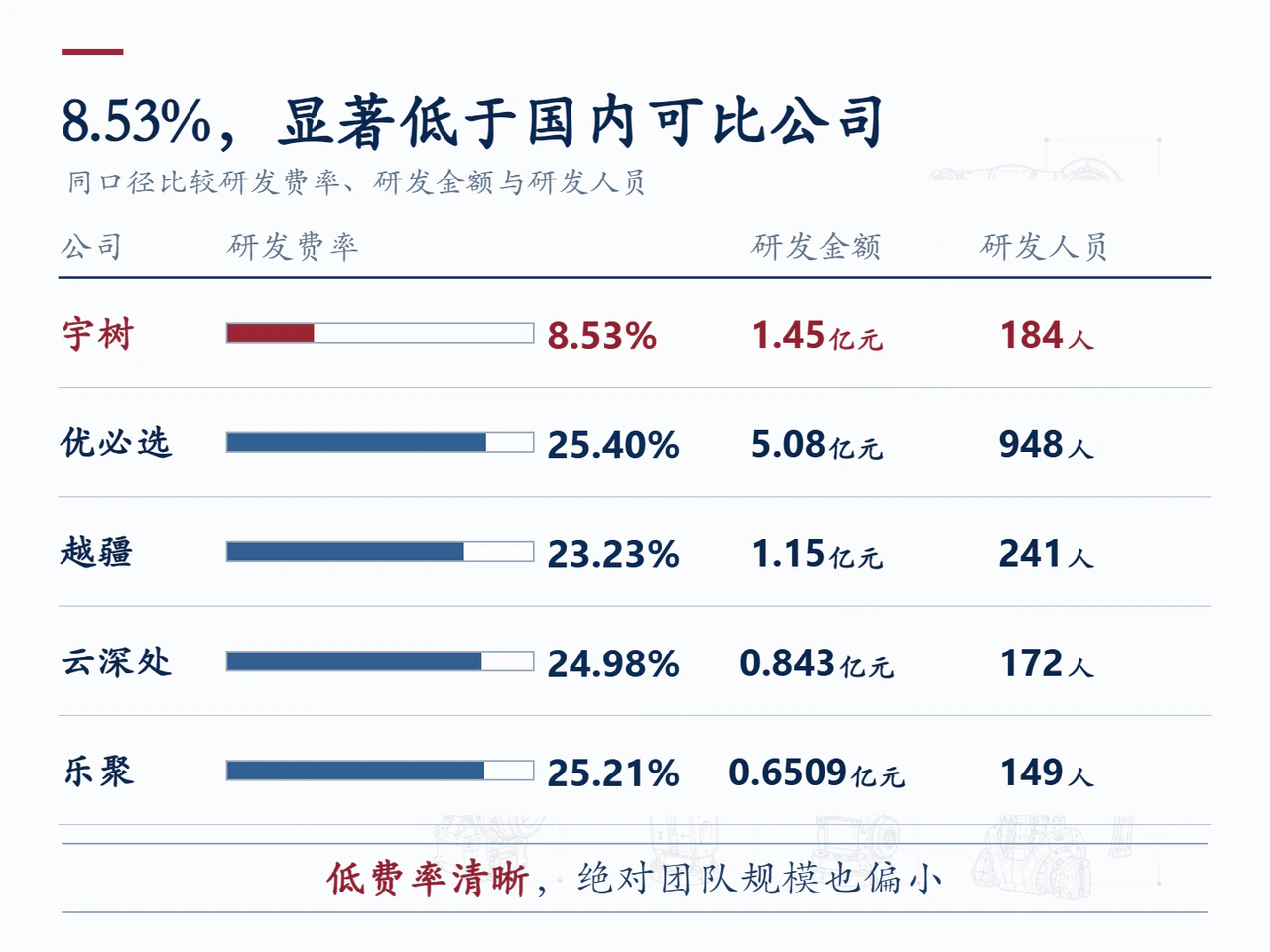
The most striking number was 8.53%. In 2025, Unitree's R&D expense was RMB 145 million, only 8.53% of revenue. At major domestic peers including UBTECH, Dobot, DEEP Robotics and Leju Robotics, R&D ratios generally exceeded 20%–25%. On reported percentages alone, Unitree appeared unusually restrained.
Another set of operating figures pointed in a very different direction. Unitree generated RMB 1.699 billion in 2025 revenue, delivered 5,511 humanoids and 23,037 quadrupeds, and obtained 43.65% of revenue overseas, with an R&D team of just 184. With less than one-fifth of UBTECH's R&D headcount and under 30% of its R&D budget, Unitree achieved comparable revenue and several times its physical legged-robot shipments.
The two sets of figures are not contradictory. They reveal Unitree's first-phase strategy: an exceptionally lean engineering organization produced rare efficiency in product deployment and commercialization. At the same time, the declining ratio, small absolute spending and limited organizational depth fell short of the long-term requirements implied by expansion into full-stack embodied intelligence.
Assessing Unitree's R&D cannot stop at whether 8.53% looks low, nor can early profitability and scaled shipments turn every spending shortfall into a management miracle. Six issues must be understood: whether the accounting definition is sound; whether peers can package ratios in either direction; the lifecycle stage behind the decline; its position among global leaders; whether talent depth can support the next technological step; and how supply-chain cost advantages can become deeper technical barriers.
1. Unpacking 8.53%: R&D expense, total spending and capitalization
Financial analysis often conflates R&D expense, R&D spending and the R&D expense ratio, despite their distinct meanings.
R&D expense is fully expensed in the current income statement and immediately reduces net profit. Total R&D spending is broader, including qualifying amounts capitalized as development expenditure or intangible assets on the balance sheet. The expense ratio measures the income-statement burden relative to revenue. A fuller measure of research intensity includes capitalized spending in the numerator.
Without capitalization, the two measures coincide. With substantial capitalization, the reported expense ratio systematically understates actual resources consumed. Capitalization can be compliant, but excessive accumulation before projects produce reliable cash flows often boosts near-term profit and defers risk into future amortization and impairment.
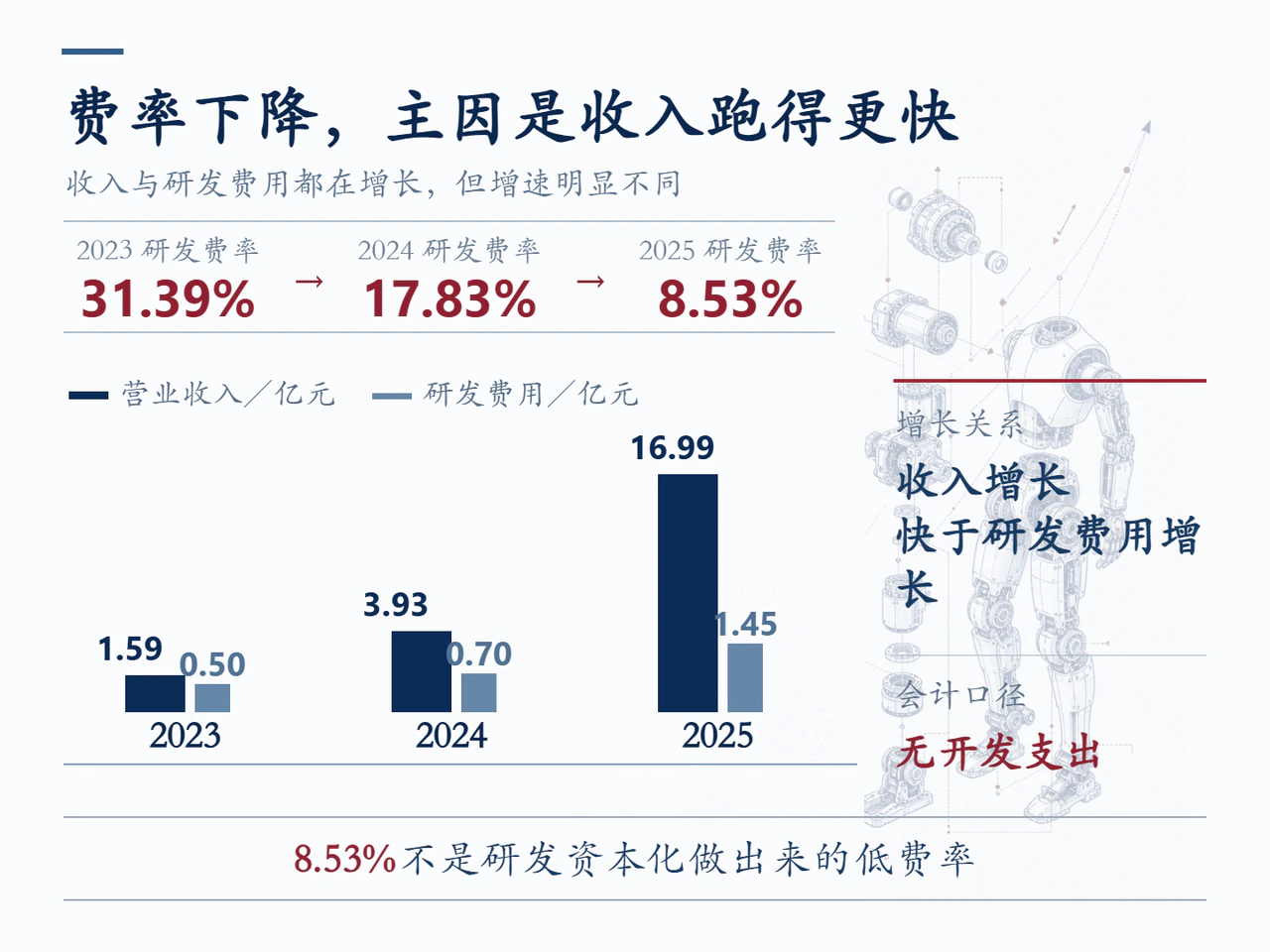
Unitree's 8.53% does not involve this kind of accounting embellishment. Its reporting-period balance sheets contain no development-expenditure balance, with all R&D charged directly to current profit and loss. In other words:
Unitree's R&D expense and total-spending definitions coincide. The 8.53% is a genuine fully expensed measure, with no sign of capitalization being used to suppress the ratio.
The ratio looks low chiefly because revenue, its denominator, expanded explosively. Revenue rose from RMB 159 million in 2023 to RMB 393 million in 2024 and RMB 1.699 billion in 2025, a 226.8% compound annual rate. R&D expense rose from RMB 49.95 million to RMB 70.02 million and RMB 145 million, a 70.4% compound rate. Absolute R&D spending did not stagnate; it grew rapidly, but extraordinary sales growth diluted the percentage.
Of 2025 R&D expense of RMB 145 million, employee compensation was around RMB 85.04 million, or 58.67%; direct materials RMB 28.97 million, or 19.98%; and depreciation and amortization RMB 7.78 million, or 5.37%. Cloud services deserve particular attention: from only around RMB 1.23 million in 2024, spending rose more than tenfold to RMB 15.15 million in 2025, or 10.45%. This clearly corroborates a shift from mechanical bodies, materials and embedded-hardware debugging toward large-scale simulation, computing-intensive training and cloud-control architecture.
The acceleration became more evident in 2026. Media citing the latest disclosures put first-half R&D spending at around RMB 136 million, already close to the whole of 2025. First-quarter figures in the offering document also showed a temporary year-on-year decline in profit excluding nonrecurring items as research headcount and market-development costs surged. The shift in investment had begun, but this recent change could not retrospectively alter the fact that pre-2025 R&D scale was small.
Once definitions are clear, 8.53% establishes a straightforward fact: Unitree's current research intensity is low among peers, but chiefly because of exceptionally effective commercialization rather than accounting techniques. It does not directly prove a fundamental lack of technical depth, nor establish that the existing budget can comfortably support the future full-stack journey.
2. Can R&D ratios be a financial presentation technique?
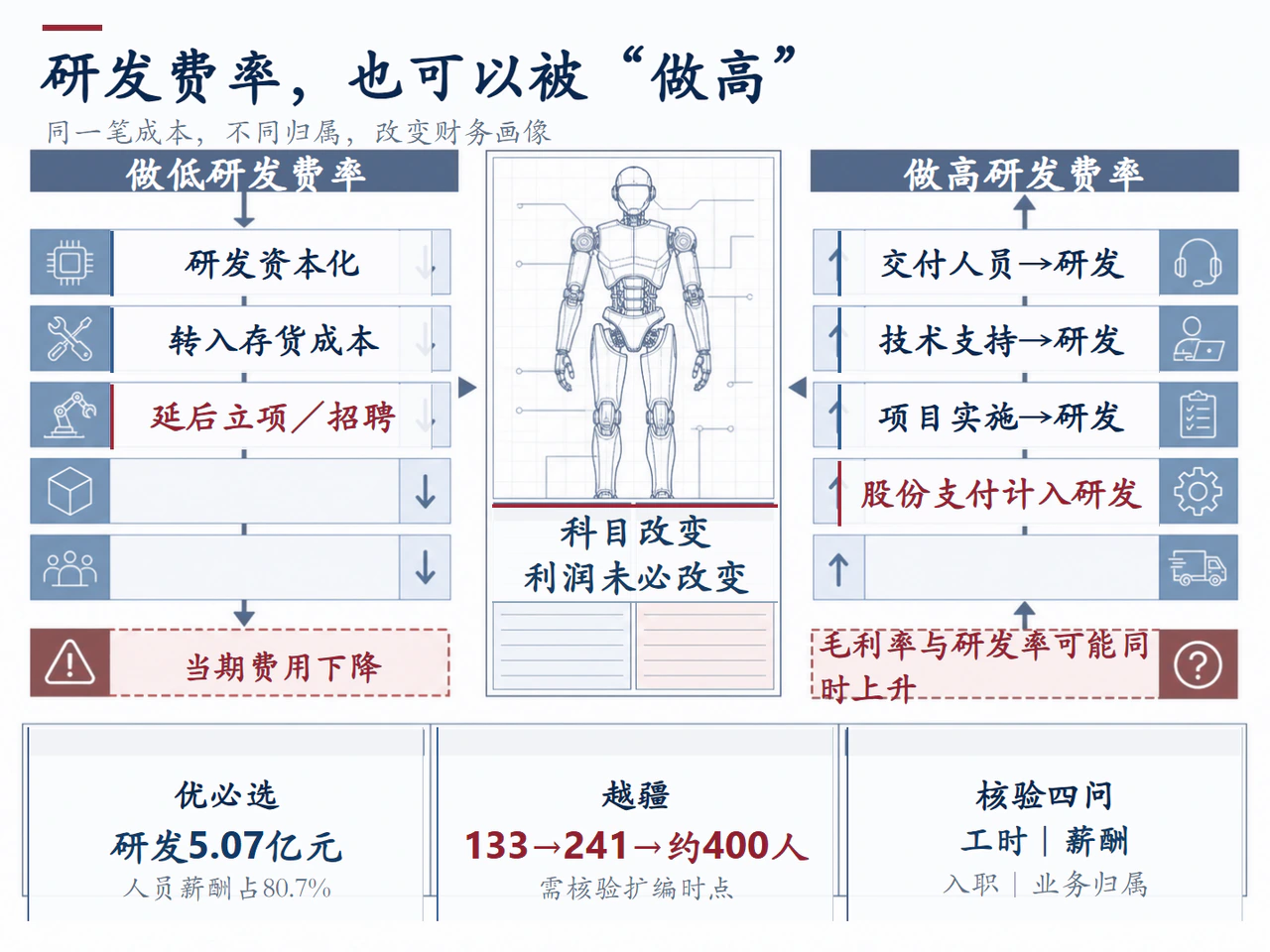
Scrutiny of Unitree often implies suspicion that it understates R&D. Across robotics, however, the reverse presentation incentive also exists. For loss-making hard-technology firms seeking funding or capital-market access, a larger R&D headcount and higher ratio can provide a more attractive financial narrative.
The incentive is simple. Hundreds of millions of renminbi in losses from selling, administration and on-site engineering can suggest commercialization problems or organizational bloat. Labeling the same costs heavy R&D can recast them as strategic investment in the future. The loss is unchanged, but its perceived commercial nature is transformed.
Such reclassification usually occurs at blurred business boundaries. Robotics involves product engineering, prototype assembly, customer customization, on-site commissioning and presales and aftersales technical support. Classifying implementation or support staff as R&D raises the ratio and lowers selling and administrative ratios, giving operating losses a different explanation. Moving engineering costs that should be contract-fulfillment costs into R&D can even raise both gross margin and R&D intensity, creating the appearance of a high-margin, research-heavy technology leader.
R&D personnel definitions can also be flexible. Some peers count everyone assigned to a large R&D center; others count anyone who participated in a project during the year. Unitree requires staff to belong explicitly to the R&D department and devote at least 50% of reporting-period working hours to research. The same engineer moving between customer sites and laboratories may count fully, as a full-time equivalent, or not at all under different definitions. A hiring surge in the fourth quarter can also inflate year-end headcount despite little contribution from those recruits to that year's core results.
UBTECH provides a useful comparison. Its 2025 R&D expense was around RMB 507 million, including RMB 409 million of compensation, or 80.7%, demonstrating real payroll backing rather than fictitious expenditure. But its R&D system spans a group-wide product portfolio of humanoids, education robots, commercial services, smart cleaning and consumer logistics. Its first-half 2026 R&D team of 1,103 cannot all be treated as working on Walker humanoids. Equating group research with dedicated humanoid spending exaggerates the measure. Extensive solutions and custom-integration business further blurs research and implementation, while share-based compensation raises reported R&D without an actual research cash outflow.
Dobot's expansion is also revealing. Its R&D staff rose from 133 at end-2024 to 241 at end-2025 and nearly 400 by June 2026. Yet despite RMB 115 million of 2025 R&D expense, embodied-intelligence revenue was only about RMB 20.04 million. Building talent ahead of frontier demand is normal. Still, as Dobot transitions from collaborative arms to embodied intelligence, pursues an A-share listing after Hong Kong and strengthens its technology narrative, broadly classifying engineering support and application development as frontier embodied research cannot be ruled out.
A rough division by year-end staff gives Unitree around RMB 788,000 of R&D expense per researcher in 2025, versus about RMB 476,000 at Dobot. Geography, hiring dates and allocations of computing and materials limit the comparison, but it sends a clear signal: a thicker staff roster does not necessarily mean more resources per engineer.
Unitree's small staff therefore cannot alone establish unwillingness to invest, nor can competitors' larger teams establish a vast technical lead. The difference is organizational: Unitree follows a small-team, resource-intensive, highly reusable-product approach; UBTECH covers a complex group portfolio; and Dobot is in an expansion phase where headcount growth and technology positioning reinforce each other. Comparisons must strip out the noise of relabeling group R&D as humanoid research and broadening engineering delivery into research.
3. The global landscape: Where Unitree leads and where it does not
Global humanoid robotics remains at an early industrialization stage. Beneath the many competing suppliers are three very different approaches.
The first, exemplified by Unitree, aggressively lowers body hardware costs to create affordable, usable standard platforms for universities, laboratories and developers. The second, represented by UBTECH, Agility Robotics and Boston Dynamics, concentrates on factories and warehouses, measuring high-load work, round-the-clock reliability, automatic charging or battery swaps and deep integration with industrial workflows. The third, including Figure, 1X and Tesla Optimus, prioritizes end-to-end vision-language-action (VLA) models, world models, real physical-task data and generalization across settings.
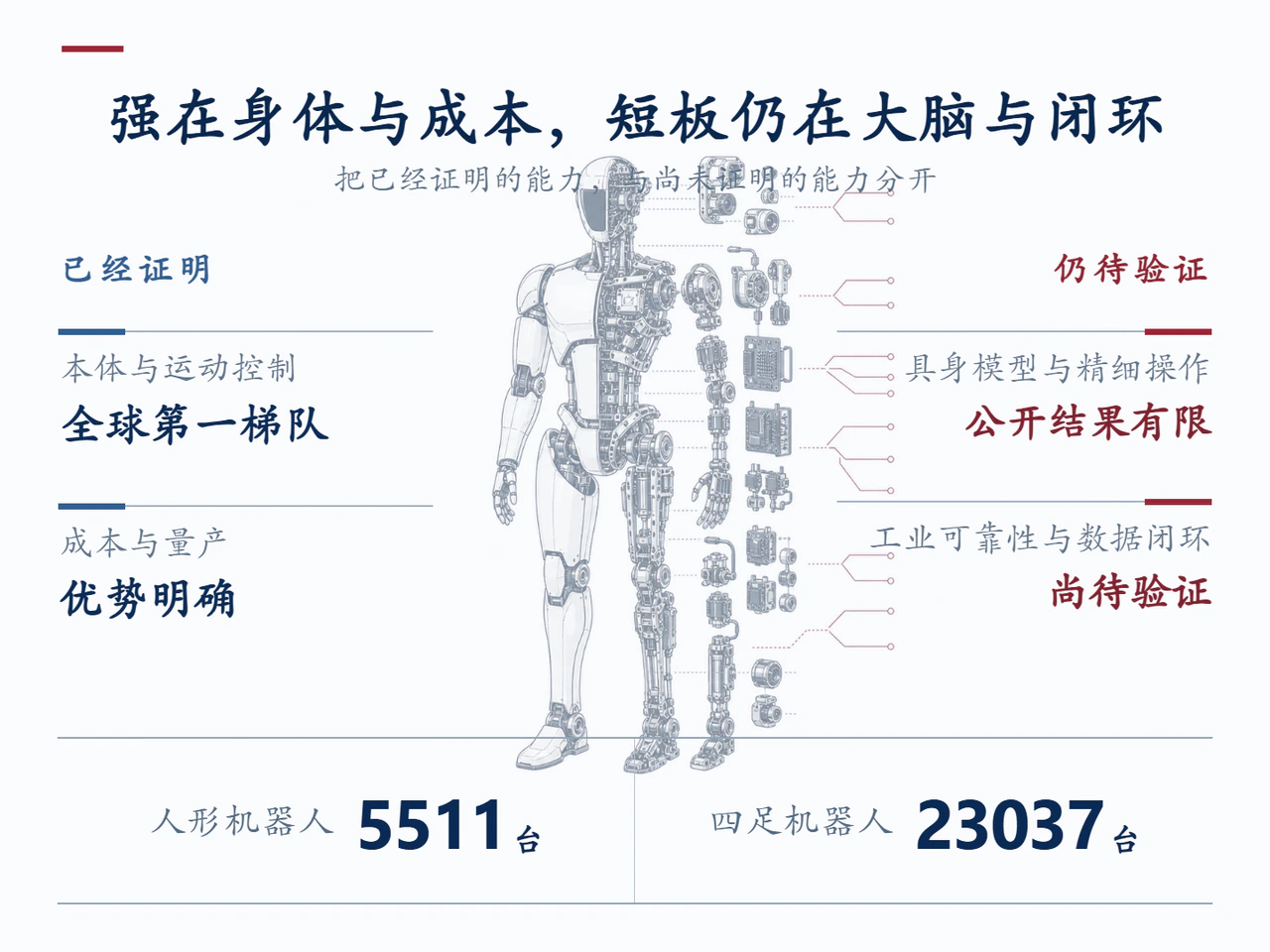
Within that landscape, Unitree's strengths have clear boundaries. It is firmly among global leaders in highly dynamic motion control, electromechanical design, extreme supply-chain cost reduction and scaled standard-product shipments. In sustained heavy-duty industrial work, dexterous manipulation, task generalization in complex unstructured environments and closed-loop embodied-data systems, sufficient deployment evidence remains lacking.
Two authoritative shipment methodologies coexist. One industry survey ranks Unitree first with around 32.4% of global shipments. Omdia instead records 13,317 humanoids worldwide, led by Agibot at 5,168 and Unitree second at 4,200. Differences largely reflect inclusion boundaries: whether wheeled humanoids, educational demonstration platforms and research-only frames are counted.
Under either measure, a commercial consensus is established: by actual 2025 deliveries, Unitree belongs to the very top global humanoid-shipment tier. In nonwheeled, standardized, off-the-shelf sales to global developers and researchers, its value and supply scale are indispensable.
In 2025, Unitree produced 5,716 humanoids, sold 5,511 and recognized sales on 5,215, generating around RMB 868 million in revenue at an average recognized price of RMB 166,400 and gross margin of 63.18%. Quadruped production and sales were 26,032 and 23,037 respectively, generating around RMB 698 million at an average RMB 30,300 and 56.72% gross margin. Overseas revenue reached RMB 732 million, or 43.65%, while the top five customers accounted for only 12.08%, indicating a healthy global long-tail customer base.
These results show Unitree crossing a gap many peers have yet to bridge: moving from a prototype workshop dependent on customization and showroom samples into a mature hardware business with a standardized supply chain, global distribution, aftersales support and strong internal cash generation.
Unitree's products are aggressively positioned. G1 stands 132 cm, weighs 35 kg, offers 23–43 degrees of freedom, carries 2–3 kg per arm, runs for around two hours and starts at only about $13,500. Full-size H1 stands 180 cm, weighs 47 kg, delivers peak joint torque of 360 N·m and runs at up to 3.3 m/s. Mass-market R1 stands 123 cm, weighs 29 kg and lowers the entry price to around $4,900.
R1's strategic importance goes beyond low-price volume. It turns research equipment once costing hundreds of thousands of dollars into an accessible productivity tool for ordinary universities and enthusiasts. A large installed base returns development examples, interface feedback and long-tail operating conditions while reinforcing component-purchasing scale.
Electromechanical movement performance alone, however, is not labor productivity in demanding industrial settings.
Industrial-route comparisons illustrate the difference. UBTECH Walker S2 has around 52 degrees of freedom and three-minute automatic battery swaps designed for automotive lines. Agility's Digit carries 15.9 kg, docks automatically to charge and fits logistics sorting cycles. Boston Dynamics' new electric Atlas stands 1.9 m, weighs 90 kg, has 56 degrees of freedom, sustained 30 kg payload and IP67 protection. Figure 03 emphasizes tactile arrays and end-to-end neural control; 1X's NEO uses tendon-like transmission and a soft exterior for safe human collaboration.
Dancing, backflips, parkour and resisting kicks test electromechanical burst power, dynamic balance and transient control. On a factory floor, the evaluation shifts to mean time between failures (MTBF), repeat-task pass rates, standardized hourly cycles, unplanned downtime, safety interlocks and seamless integration with MES/WMS manufacturing and warehouse systems.
Unitree's public industrial metrics remain weighted toward demonstrative dynamic performance. Universities, researchers, enthusiast developers, commercial performances and entertainment still represent a substantial customer base. It has successfully commercialized humanoids as standardized consumer/developer hardware, but has not demonstrated equally dominant evidence of replacing repetitive labor at industrial scale.
Its competitive position can be stated precisely: strong bodies, low costs, fast iteration and large shipments; stronger in limb movement than precision hands, with genuine industrial intelligence and accumulated application expertise still to develop.
4. Peer comparisons: What can be compared, and what R&D data show
Robotics companies should not be indiscriminately placed in one comparison table.
Domestically, UBTECH and Leju offer complete humanoids and have the greatest business overlap. DEEP Robotics competes directly in quadrupeds, but its humanoids remain early-stage. Dobot's foundation is industrial collaborative arms, making it more useful as a benchmark for organizational efficiency and financial operating cycles.
Overseas, Agility, Boston Dynamics, Figure and 1X are highly comparable in embodied-robotics direction, but mostly private ownership prevents access to complete audited financials. Tesla has Optimus, but its research is embedded in EVs, autonomy and computing infrastructure and cannot be separated. Inovance and Hikvision have broader businesses, but their roughly comparable RMB 200 billion–300 billion market-value range offers a useful reference for mature hard-technology manufacturers' research depth.
Within this classification, differences among listed domestic robotics firms and listing applicants are pronounced.
2025 financial comparison:
- Unitree: revenue RMB 1.699 billion, R&D expense RMB 145 million, ratio 8.53%, net profit excluding nonrecurring items around RMB 591 million;
- UBTECH: revenue RMB 2.001 billion, R&D expense RMB 508 million, ratio 25.40%, annual net loss around RMB 715 million;
- Dobot: revenue RMB 493 million, R&D expense RMB 115 million, ratio 23.23%, net loss excluding nonrecurring items around RMB 124 million;
- DEEP Robotics: revenue RMB 337 million, R&D expense RMB 84.30 million, ratio 24.98%, net profit excluding nonrecurring items around RMB 15.12 million;
- Leju: revenue RMB 258 million, R&D expense RMB 65.09 million, ratio 25.21%, annual net loss around RMB 77.64 million.
Unitree's R&D ratio is less than one-third of peers', with absolute expense only 28.6% of UBTECH's, yet it has an overwhelming advantage in revenue conversion and adjusted profitability. This gap is more than thrift or execution. Years of quadruped development created highly reusable motors, reducers, drive buses and basic kinematics for humanoids. Direct standard-product sales avoided lengthy customized integration and receivables cycles. The Yangtze River Delta's complete electromechanical supply chain and concentrated overseas demand for legged robots in 2025 jointly produced exceptional returns on resources.
The headcount contrast is starker: Unitree 184 researchers, UBTECH 948, Dobot 241, DEEP Robotics 172 and Leju 149. Dividing revenue by year-end research staff gives rough organizational leverage: around RMB 9.23 million in revenue per Unitree researcher, versus RMB 2.11 million at UBTECH, RMB 2.05 million at Dobot, RMB 1.96 million at DEEP Robotics and RMB 1.73 million at Leju.
These figures do not measure an engineer's individual revenue contribution; they embody the combined effects of procurement, mass production and distribution. They nevertheless demonstrate Unitree's exceptional commercialization and product reuse around core research assets.
Compensation data challenge the idea that Unitree reduces costs through cheap engineers. Dividing R&D employee compensation by year-end headcount gives around RMB 462,000 per researcher at Unitree, RMB 432,000 at UBTECH, RMB 274,000 at Dobot and RMB 183,000 at Leju. Year-end timing and benefits prevent treating these as contractual take-home salaries, but they establish highly competitive incentives for Unitree's frontline team.
Educational proportions are also competitive: among Unitree's 184 researchers are five PhDs, 73 master's graduates, 98 bachelor's graduates and eight junior-college graduates. Master's degrees and above represent 42.4%, versus about 45.4% at UBTECH and 46.3% at Inovance on comparable definitions.
The real strategic risk lies in the absolute number of advanced research specialists. Unitree has only 78 master's and doctoral graduates, including five PhDs. UBTECH has around 430; Inovance 3,555, including 94 PhDs; and Hikvision 8,759, including 179 PhDs.
Chassis transmission, servo drives, structural stiffness and reducer optimization are fundamentally classical electromechanical and structural engineering. Experienced engineers' judgment and production refinement can matter more than academic credentials, and Unitree has demonstrated exceptional engineering ability. As competition extends to world models, multimodal spatial-temporal alignment, reinforcement learning and end-to-end precision manipulation, however, leading researchers' depth directly determines tolerance for failed exploration and the reach of technical breakthroughs. Five PhDs imply a very limited buffer in frontier theory and algorithms.
Comparable-market-value manufacturing leaders sharpen this tension. At September 1, 2026 closing values, Unitree was worth around RMB 231 billion, Inovance RMB 167.5 billion and Hikvision RMB 330 billion. In 2025 Inovance spent RMB 4.256 billion on R&D with 7,670 researchers, while Hikvision spent RMB 11.753 billion with 26,806 research and technical staff. Inovance's spending was 29 times Unitree's and its team 42 times; Hikvision's were 81 and 146 times.
These mature leaders span industrial automation, drive and control assemblies, multidimensional sensing and the AIoT chain, naturally making them much larger than a young business. The disparity nevertheless shows Unitree's position: it is trying to support a narrative worth over RMB 200 billion, spanning legged hardware, motion algorithms, multimodal models and global industrial deployment, with a lean midsize technology-startup team.
Overseas figures provide another sobering reference. SEC filings show Agility spent around $74 million on R&D in 2025, 66.7% of operating expense, without scaled revenue yet. Boston Dynamics generated around KRW 150.1 billion in revenue and a KRW 528.4 billion net loss; Norway's 1X had NOK 324 million operating revenue and NOK 649 million EBIT loss. Figure has not published audited accounts, but its $200,000–$400,000 base salaries for leading AI talent are widely known. Tesla's 2025 group R&D was $6.411 billion, with its 6.76% ratio covering vehicles, energy, Dojo and Optimus, rather than a comparable standalone robotics activity.
The comparative picture is therefore clear: Unitree has the lowest ratio and a small absolute budget, but generous per-person incentives and leading commercialization efficiency. Its absolute pool of highly qualified researchers remains exceptionally thin relative to the prolonged technological contest ahead.
5. Looking deeper: Founder, products, capacity, reserves and competitive moats
Unitree's operating efficiency is closely tied to the pure hardware-engineering background of its controller and core team.
Founder Wang Xingxing earned a master's degree at Shanghai University's School of Mechatronic Engineering and Automation. As a student he independently developed XDog, a low-cost, highly dynamic quadruped, then founded Unitree after graduating in 2016. He remains chairman, general manager and CTO. The prospectus identifies only three core technical personnel: Wang; mechanical-structure head Yang Zhiyu, with an automation background, who joined in 2016; and algorithm/software head Zhang Yangguang, also trained in automation, who joined in 2018.
This extremely flat technical decision structure is powerful in a hardware startup. A founder who understands electromechanics can align structure, motor selection, control algorithms and cost targets on one design, with short decision chains and less cross-departmental friction. Long-serving core staff and equity incentives also make product direction more consistent.
As the business broadens, the weaknesses of this strong-core model become exposed. Wang's three roles concentrate strategy, daily operations and core research decisions in one person. Three technical leaders must cover quadrupeds, full-size bipeds, miniature humanoids, proprietary joints, dexterous hands, lidar, motion control, SDK ecosystems and multimodal embodied models. Maintaining old products, trialing hardware, serving industrial customization and iterating algorithms simultaneously creates severe demands and dependence on a few individuals.
Only 184 researchers must be distributed across dozens of specialties: quadrupeds, humanoids, motors and transmissions, drives, dexterous hands, real-time systems, SLAM, reinforcement-learning simulation and production-line introduction. Even with high reuse, each narrow field receives only a handful of full-time engineers.
Unitree's strongest moat has never been an isolated peak specification, but system-level electromechanical software-hardware co-optimization. Extreme dynamic motions depend on precise coordination among power-dense motors, lighter reducers, drive topology, body stiffness, thermal management and high-frequency control loops. Performing difficult sequences within costs measured in tens of thousands of renminbi reflects years of accumulated systems-integration judgment.
The second barrier is extensive component reuse across products and supply-chain strength. Motor modules, brushless-drive architecture, dynamic algorithms and supplier networks proven in quadrupeds can be transplanted modularly into humanoids and dual-arm systems. Stable quadruped cash generation and global distribution support humanoid development with both cash flow and supply infrastructure.
The third barrier is an uncompromising off-the-shelf product mindset. Rather than becoming trapped in custom integration, Unitree designs from the outset like a consumer-electronics company: transparent prices, standardized configurations and ready delivery, enabling global enthusiasts and researchers to order and use. Standardization sharply reduces communication and delivery costs and speeds revenue recognition.
Its deeper moat weaknesses are equally clear:
- Dynamic movement ahead of dexterous work: running fast and jumping high do not imply stable handling of irregular parts or precise assembly;
- Industrial long-cycle reliability lacks sufficient validation: public demonstrations emphasize difficult motions, while continuous operating hours, overall task success, protection ratings and maintenance intervals in demanding industrial settings still need time to prove;
- Foundation-model integration remains early: public results excel in motion-related reinforcement learning, without an overwhelming breakthrough in high-level planning, common-sense reasoning in open environments or end-to-end autonomous manipulation;
- Service and integration capacity faces pressure: inexpensive standard products enable volume, but heavy-duty, high-value industrial customers require a broader and more substantial organization for deployment, tooling integration and maintenance.
Capacity comparisons also need to separate delivered products from paper plans. Unitree's 5,511 humanoids sold in 2025 are verified actual shipments. UBTECH reported thousand-unit-scale deliveries and plans annual capacity of 6,000, while Figure planned 12,000 annually at BotQ. The latter capacity numbers mainly represent future theoretical throughput and cannot negate Unitree's current off-the-shelf supply strength.
Planned uses of listing proceeds reveal a strong intention to address gaps. Of around RMB 4.202 billion in planned investment, research and product projects total RMB 3.577 billion, or 85%. The intelligent-robot model project alone receives RMB 2.022 billion, including RMB 402 million for equipment and computing, RMB 721 million for researchers and RMB 899 million for implementation. Body R&D receives RMB 1.110 billion, new intelligent-robot development RMB 445 million and the manufacturing base RMB 624 million.
These budgets show management's awareness of its weaknesses: substantial spending is intended for multimodal embodied-model training, real-world task sampling and computing infrastructure. The plan spans two to three years, however; a budget is not a delivered technology. The key test is whether the money attracts leading AI-algorithm talent and enables substantive breakthroughs in industrial data.
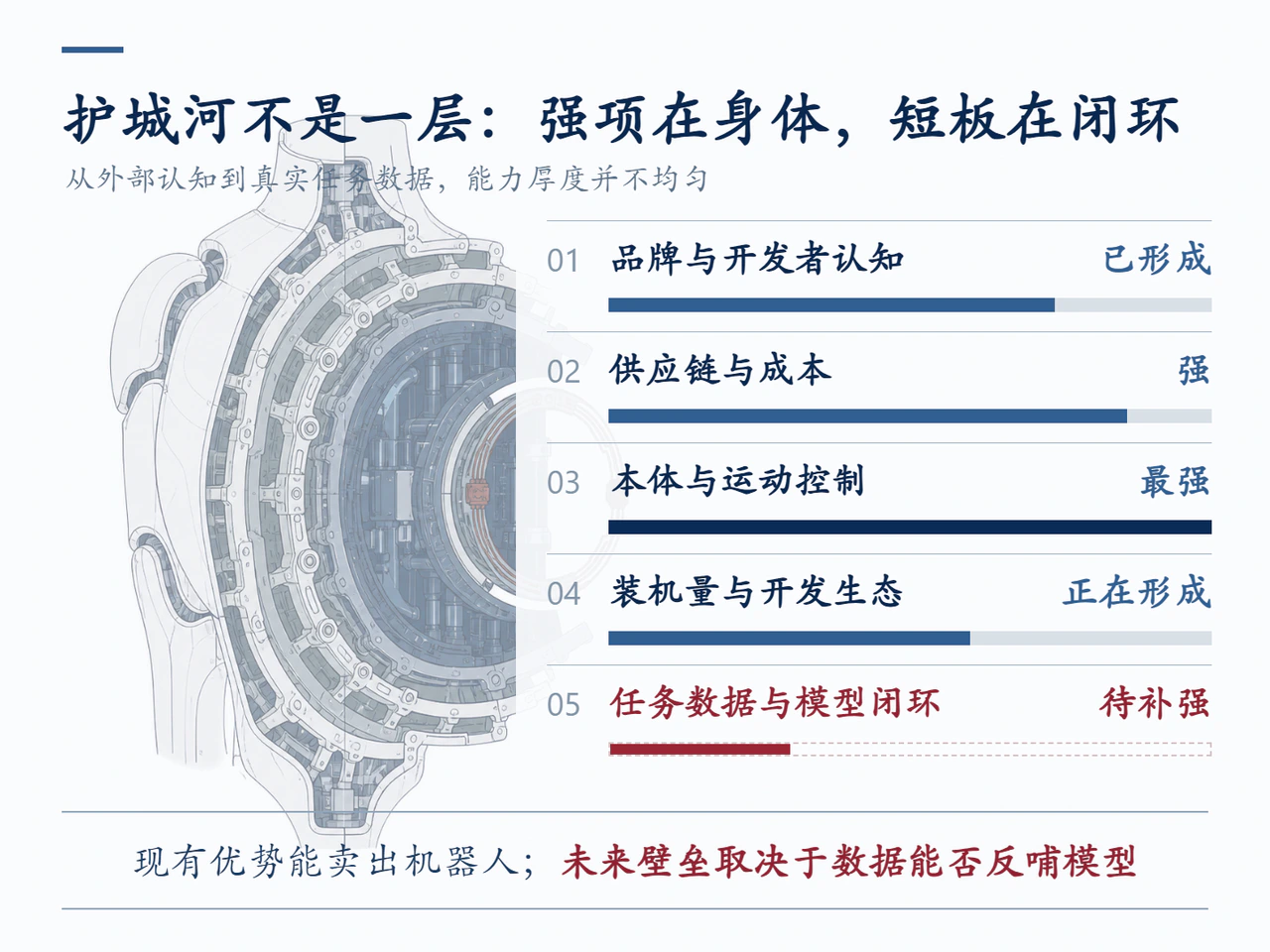
Unitree's five moat layers weaken progressively from outside inward:
- First, strong global developer recognition and social-media visibility;
- Second, exceptional value enabled by China's supply chain;
- Third, deep electromechanical integration and dynamic motion-control expertise;
- Fourth, a developer ecosystem and long-tail feedback from tens of thousands of installed units;
- The fifth and deepest layer—high-value real-world industrial task data and a self-improving task-model loop—is currently the thinnest and the hardest challenge.
Its current strengths remain movement, cost and standardized delivery. General cognition, dexterous hands and complex industrial operating systems still require proof.
6. Returning to the question: Is Unitree's R&D high or low?
After examining the details, one percentage cannot yield a binary verdict.
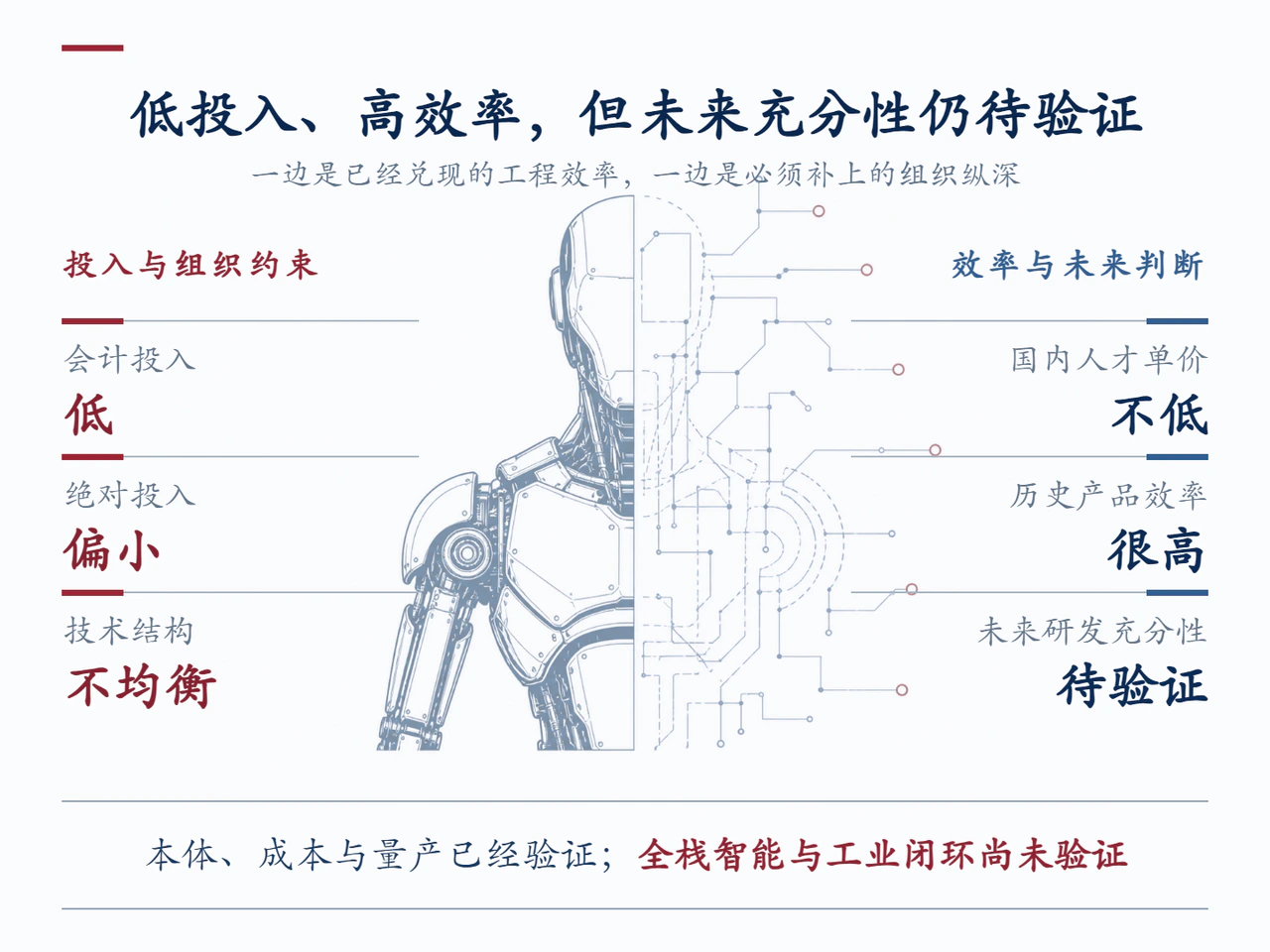
On accounting compliance and reporting authenticity, it is indeed low: 8.53% is far below peers, but reflects full expensing and rapid revenue growth rather than capitalization used to embellish results;
In absolute funding, it is small: RMB 145 million is stretched for a general-robotics pioneer valued above RMB 200 billion when model pretraining, computing procurement and precision-mechanism development compete for resources;
In resource quality, it is not low: RMB 462,000 of research compensation per person and compensation exceeding half of R&D expense place incentives among the domestic leaders, reflecting an elite-team approach;
In talent depth, proportions are respectable but numbers tight: a 42.4% master's/doctoral share is competitive, yet only five PhDs and 78 advanced-degree staff provide little redundancy for foundational breakthroughs;
In commercial conversion, it is exceptionally efficient: 184 researchers support nearly RMB 1.7 billion in revenue and more than 20,000 legged-robot shipments, maximizing mature architecture reuse and standard-product leverage;
In long-term capabilities, strengths and weaknesses are pronounced: globally leading lower-limb movement, burst power and cost reduction coexist with gaps in precision manipulation, industrial reliability and generalized embodied intelligence.
The most objective assessment is therefore more specific than insufficient spending or inadequate technology:
Restrained early investment and exceptional output per researcher; competitive domestic compensation but a thin absolute research organization; established hardware-motion and cost flywheels, with full-stack embodiment and industrial feedback loops still to build.
During the sector's pioneering stage, a small, sharp research team gave Unitree short decision chains, extraordinary cost intuition and rapid iteration, allowing it to break price barriers in quadrupeds and humanoids. As competition moves from making and selling robots to reliably replacing human work in demanding settings over long periods, multimodal cognition, generalized data annotation, algorithmic safety and industrial integration all require sustained efforts by deeper research organizations.
Unitree's accounts and shipment records already demonstrate the remarkable commercial productivity a small elite team can deliver in a particular hardware cycle. In the next phase, it must prove it can preserve agility and cost advantages while expanding organizational depth and technical reserves into a modern industrial R&D system capable of global full-stack competition.