By the morning of September 7, Beijing time, US-Iran naval battle claims remained sharply disputed. Iran's Revolutionary Guards claimed missiles hit and forced a US carrier and destroyer to withdraw; the US maintained the attacks were evaded. Neither account could be independently verified. Weekend economic developments were clearer: Iran announced an economic-war command, while Treasury Secretary Bessent said only approximately 30 million barrels of Iranian oil not yet purchased by China remained.
Military confrontation is intertwining with exports, inventories and shipping restrictions. Each side's capacity to bear prolonged blockade and retaliation costs will shape events, but neither inventory exhaustion timing nor zero exports is established fact.
Competing maritime claims; damage remains unverified
US forces attacked three Iranian tankers Saturday. Washington said M/T Downy at Kharg Island and M/T Stark 1 at Jask were permanently disabled, while empty tanker M/T Kylo sank after multiple hits in the Gulf of Oman. Strike videos were released, but specific damage, crew evacuation and possible spills lacked independent disclosure.
The Revolutionary Guards claimed ballistic missiles damaged a US carrier and another warship enforcing the blockade and forced both to withdraw. CENTCOM acknowledged missiles fired at its ships but said they were successfully evaded. By the reporting deadline, Washington had disclosed no casualties or vessel damage from that attack.
The Guards also claimed to hit a US-made unmanned vessel attempting to enter Iranian waters in Hormuz, releasing video of an explosive-laden projectile striking a boat. Independent hit evidence was absent; public material did not fully identify the target, time or place, preventing an assessment of scale.
The divergent accounts reflect competition over deterrence. Iran emphasizes penetrating the blockade and striking US forces; Washington emphasizes ship safety and enforcement. Confirmed losses, deployment changes and shipping shifts are needed to judge substantive military change.
Iran intensifies threatened responses while regional diplomacy continues
Parliament speaker and chief US negotiator Mohammad Bagher Ghalibaf told a closed session that Iran had severely hit regional US bases and the era of proportional responses was over. He later warned on Telegram that attacks on Iranian interests and security would meet faster, heavier and more painful responses. Public deterrent rhetoric is intensifying, but the cited military results remain Iranian claims.
Iran's Foreign Ministry condemned attacks on Iranian ships as illegal aggression, war crimes and breaches of the UN Charter. These are Iran's legal assertions, not judicial findings.
Diplomacy has not stopped entirely. Foreign Minister Abbas Araghchi spoke separately with Saudi and Turkish counterparts, preserving regional mediation channels. Available information cannot establish whether contacts will bring de-escalation.
Exports and inventories become central to the economic contest
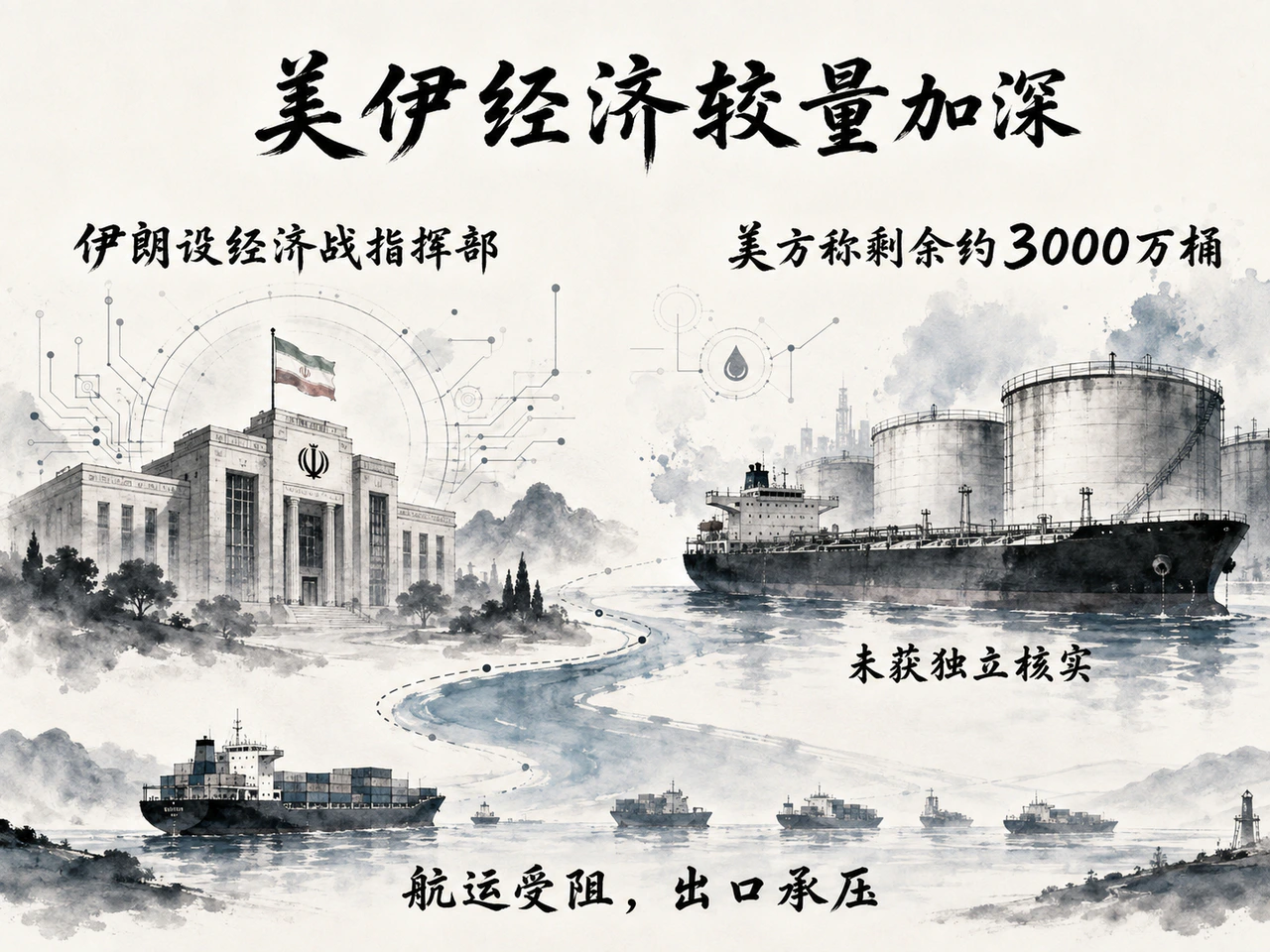
Iran's Economy Ministry announced an economic-war command Sunday to address inflation, unemployment, energy imbalances, sanctions and blockade pressure. Guards spokesman Mohebbi claimed each $1 of Iranian economic loss might cost the US several dollars, citing declining US strategic reserves and lower regional aluminum exports. This reflects an attempt to constrain the blockade through external costs; the cost ratios remain unilateral estimates.
Bessent said on Sunday television that Iranian crude not yet bought by China was probably only around 30 million barrels and would soon run out. This is a US estimate of saleable stocks, not all Iranian inventory, and gives no independently verifiable exhaustion date.
Shipping data illustrate export pressure: August Middle Eastern crude exports were 39% below the January–February baseline of roughly 18.5 million barrels per day, a shortfall near 7.2 million. The peak May gap reached 12.4 million. These regional flow measures cannot directly validate Bessent's inventory estimate.
The same agencies projected Iran's previous roughly 1.68 million barrels per day of exports could fall to zero for an extended period, leaving floating storage important for discounted Chinese sales. Zero is a forecast, dependent on enforcement, bypass transport and stock depletion. Washington said approximately 90 merchant ships had been diverted; another report put the figure at 92.
Hormuz normally carries around 20 million barrels of crude and products daily. A sustained blockade would transmit through export revenue, refinery procurement and transport costs far beyond Iran.
Oil markets await fuller digestion of weekend news
Before Sunday's production meeting, sources expected OPEC+ to retain October policy. The group had gradually restored 1.65 million barrels per day of voluntary cuts, but shipping obstacles separate quotas from physical supply. Even with output capacity, loading, strait passage and arrival remain decisive.
Average US retail diesel had reached approximately $5.85 per gallon September 4. Saturday's tanker strikes and Sunday's output news came after Friday's close and cannot explain earlier gains. By early September 7, the new trading week had only begun; the complete price response remained to be seen.
Lebanon ceasefire friction and US deployment developments
Lebanon's Health Ministry said Sunday's Israeli strikes killed 2 each in Abbasin village and Nabatieh and injured at least 20, including 3 children and 5 women, destroying an empty hospital. Israel described retaliation for Hezbollah drone attacks and said the hospital was a command center. Casualties and hospital-use claims derive from the respective parties and need independent verification.
USS Abraham Lincoln, involved in Iran's blockade and combat, departed Thailand Sunday after a five-day rest, with approximately 5,000 aboard. Legislators said its deployment set a modern US record for continuous time at sea. Whether it would remain in the Middle East was not publicly known.
Foreign ministers from eight countries including Egypt, Saudi Arabia and Jordan jointly condemned Israeli officials' plans to relocate Palestinians from Gaza, calling them contrary to international law. Diplomacy continues, but simultaneous maritime conflict, Lebanese ceasefire friction and Gaza disputes complicate coordinated de-escalation.
Main developments in the past 24 hours
Timeline of public reports and statements. Exact times are Beijing time; entries marked only Sunday lack reliable specific publication times.
| Disclosure time | Main development |
|---|---|
| Sunday, September 6 | Iran's Economy Ministry announces an economic-war command; the Guards claim hits forcing US ships to retreat, while Washington says attacks were evaded. |
| September 6, 16:10 | US reports the third struck tanker sank in the Gulf of Oman and diverted merchant ships reached 92; Iran's foreign minister speaks with Saudi and Turkish counterparts. |
| September 6, 19:30 | Sources expect OPEC+ to leave October production policy unchanged. |
| September 6, 21:00 | Ghalibaf warns attacks on Iran will face faster, heavier and more painful responses. |
| September 6, 22:00 | Iran claims a hit on a US-made unmanned vessel and releases attack footage; independent corroboration is absent. |
| September 6, 22:30 | Bessent says roughly 30 million barrels of Iranian crude not purchased by China remain and will soon be exhausted. |
| September 6, 23:00 | Eight foreign ministers including Egypt, Saudi Arabia and Jordan condemn plans to relocate Gaza Palestinians. |
| September 7, 00:00 | Lebanon reports 4 killed and 20 injured in southern airstrikes; Israel says it responded to Hezbollah attacks. |


