Brent approached $100 a barrel on September 8. Attacks on Saudi energy facilities put alternative export routes outside Hormuz under security pressure too, creating new obstacles to supply recovery. Supply risk continued supporting near-term prices, while the drag of high fuel costs on consumption and economic activity limited the upside.
On Yahoo continuous-futures vendor daily closes, Brent was $99.39 a barrel and WTI $94.35, up 3.23% and 3.14%, respectively, from September 4. The comparison spans the U.S. Labor Day holiday, and the series differs from official exchange settlements for specified contract months.
Alternative export routes face pressure, constraining delivery recovery

Reuters reported on September 8 that Houthi attacks on Saudi energy facilities caused fires at some oil and gas installations. Saudi Arabia had previously shifted some crude westward to the Red Sea to bypass Hormuz disruption. Greater security risks to these facilities weakened the buffer provided by alternative routes.
Alternative transport also faced cost and capacity constraints. The EIA's August outlook said Saudi Arabia could route supplies through the Suez Canal and Egypt's SUMED pipeline, but this took longer, cost more and had limited capacity. Continued disruption at ports, pipelines and refineries would make recovering production difficult to translate quickly into more deliveries.
The sustained supply loss from the attacks remained unclear, depending mainly on outage duration, reduced loadings and alternative routes' capacity. Refinery damage also had two-way effects: tighter product supply but potentially lower local crude-processing demand. Crude, gasoline and diesel therefore faced different supply–demand adjustments.
Quotas stay unchanged; actual supply depends on restarts and transport

On September 6, seven OPEC+ countries kept October production targets at September levels. The previously announced September increment completed the gradual reversal of a 2023 voluntary-cut arrangement. Reuters and Bloomberg nevertheless reported that war still held actual output well below targets. Near-term constraints lay mainly in restarts and transport; sufficient quotas alone could not remove physical tightness.
In August, the EIA had projected fourth-quarter Brent spot prices averaging $78 a barrel, conditional on gradual improvement in Hormuz transport from September. The latest attacks added uncertainty to that recovery assumption. Current prices near $100 and the lower quarterly forecast reflected the distinction between immediate delivery risk and future supply recovery.
Whether oil can remain elevated chiefly depends on the speed of actual export recovery. Delayed loadings, tighter stocks and higher transport costs prolong the supply-risk premium, while better navigation and facility operations ease physical-market pressure.
Inventory and demand data will test the durability of high prices

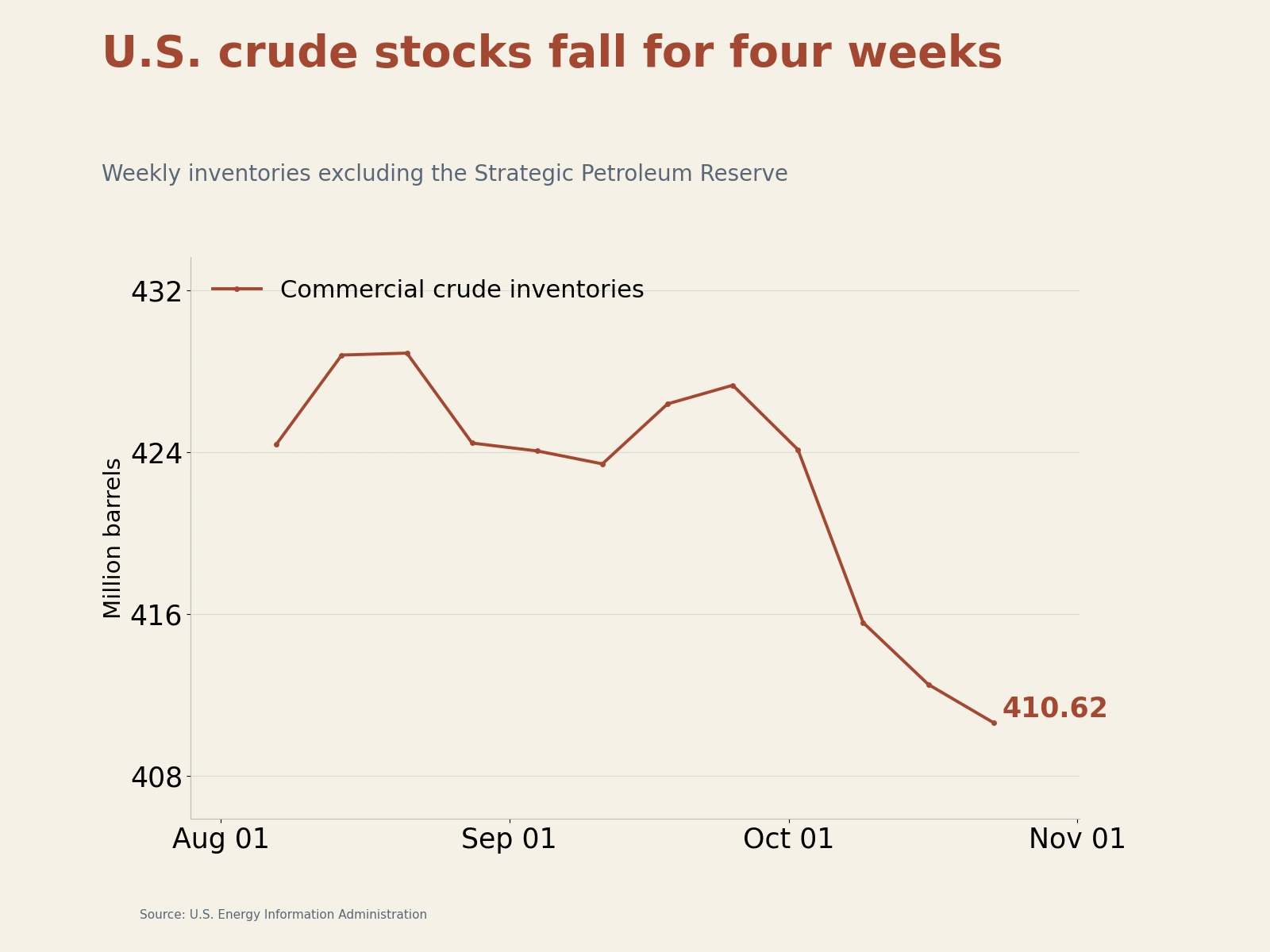
As of 07:32 Hong Kong time on September 9, the EIA's September Short-Term Energy Outlook awaited release on September 9 U.S. local time, while the weekly petroleum report was delayed until September 10 for Labor Day. The latest available inventory report remained the September 2 release for the week ended August 28.
The new outlook would update supply-recovery and demand projections. Weekly inventories should be assessed alongside refinery utilization, imports and product demand. Draws driven by stronger demand support prices, while changes from disrupted imports or refinery outages more often reflect local disturbances in the supply system.
Macro effects on oil were mixed. Vendor daily closes showed the dollar index down 0.33% from September 4, supporting dollar-priced crude. Over the same interval the S&P 500 fell 0.58%, while the Treasury's daily ten-year yield rose from 4.78% to 4.80%. Higher energy and financing costs together would pressure consumers, transport and industrial companies.
In the near term, actual loadings and alternative-route operations still determine supply improvement. Delayed recovery supports oil, while better transport can lower risk premiums. As prices approach $100, demand's ability to bear high costs will also become an important constraint on the next move.