A comprehensive US digital-asset market regulation bill, repeatedly described by political and business leaders as imminent, has once again stalled in Congress.
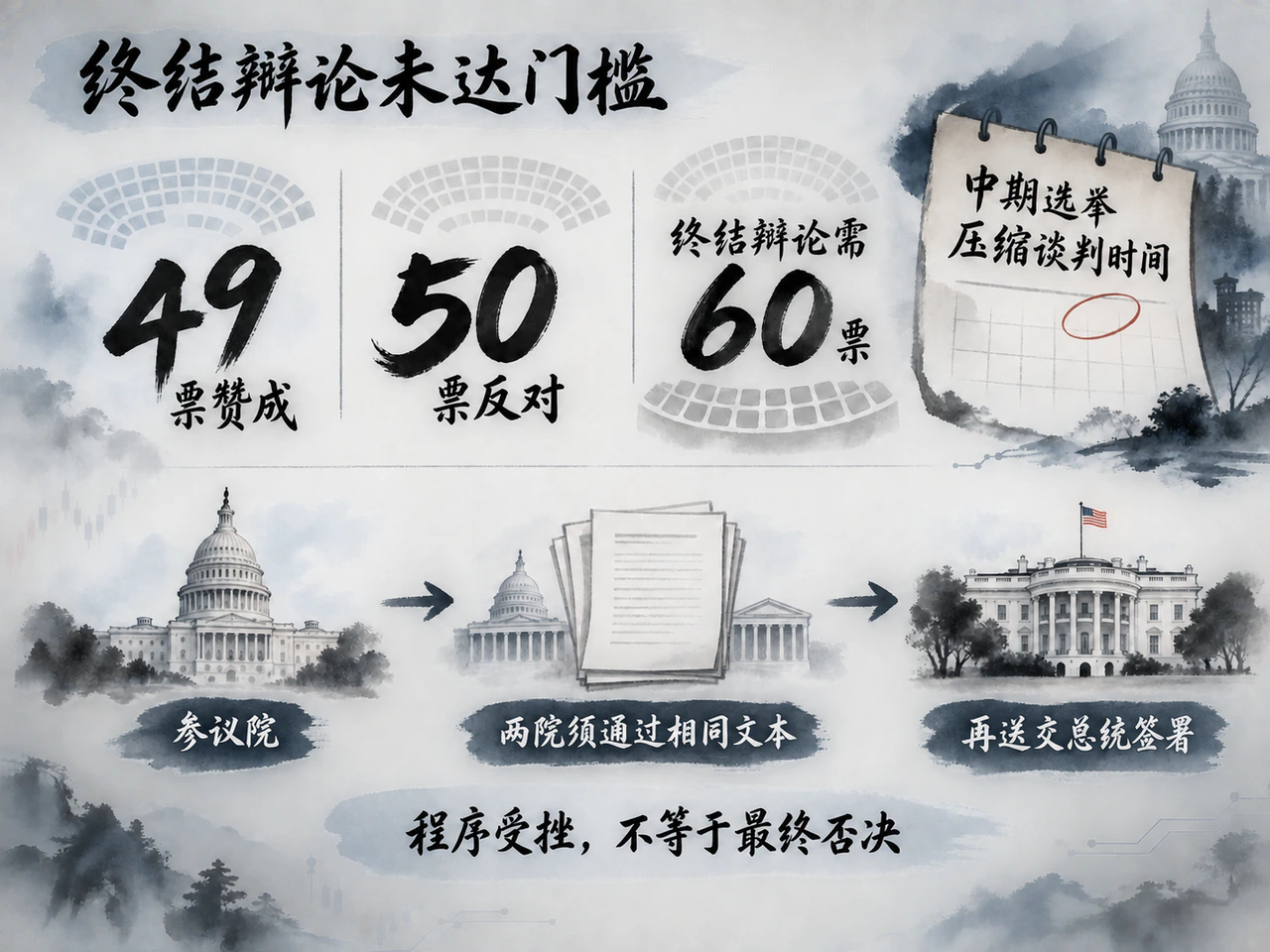
On September 15 US local time, the Senate voted on cloture on the motion to proceed to the CLARITY Act. The result was 49 in favor and 50 against, short of the 60 votes needed to overcome a filibuster. Technically, this was not a final rejection of the bill's substantive text. But against a crowded congressional calendar and tense political cycle, the procedural defeat dealt the legislative process a severe blow. More than a year had passed since the House approved its corresponding version by an overwhelming 294–134 vote in July 2025.
The bill's name, CLARITY, captures its original ambition: to end years of fragmented regulation through enforcement and establish a continuous, predictable federal framework for digital assets' legal status, issuance, circulation, secondary trading and intermediaries. Yet as broad principles become binding statutory details, underlying conflicts do not automatically disappear. They emerge more concretely and disruptively. Whether stablecoins can divert banks' deposit base, what securities obligations crypto platforms should bear, and how political rulemakers should sever family-business ties each constitute a barrier capable of blocking passage.
Washington has reached a surface consensus that digital assets need clear rules. The unresolved issue is the commercial and political price each side will pay. CLARITY's repeated delays reveal the enormous distance between abstract agreement and the allocation of real interests.
1. Stablecoin yields put banks' and platforms' businesses at stake

CLARITY is not solely a stablecoin law. In July 2025, the United States signed the GENIUS Act into law, creating relatively clear rules for issuers of dollar-backed stablecoins, reserve custody and redemption. CLARITY's main task was to clarify the broader spot-market structure. The gray overlap between the two laws nevertheless became the most difficult institutional obstacle in the negotiations.
GENIUS explicitly prohibits stablecoin issuers from paying holders interest or yield directly. Its drafting did not fully extend an equally strict look-through ban to every third-party trading platform, crypto broker or complex decentralized affiliate arrangement. This gap quickly became central to competition between banks and crypto platforms. Banks generally demanded rigid CLARITY provisions closing all routes by which institutions might offer continuing returns to holders under labels such as user rewards, ecosystem incentives or staking subsidies.
The demand has a concrete balance-sheet logic. A dollar-denominated stablecoin redeemable at par becomes a close wealth-management competitor to low-cost bank deposits if structured platform arrangements deliver continuing, interest-like cash returns. Depositors primarily compare transfer convenience and overall returns; calling income activity rewards rather than interest does not change their incentive to move funds. For platforms, such rewards are essential tools for retaining customers, accumulating funds and maintaining secondary-market depth. For smaller banks relying heavily on local deposits to lend, persistent outflows can force a shift to more expensive funding, raising liability costs and directly squeezing net interest margins and the profitability of real-economy lending.
This also explains why crypto has never unconditionally supported legislation simply because it promises regulatory clarity. In January 2026, Coinbase publicly withdrew support for the then-draft over stringent limits on stablecoin yields and platform rewards, after which the Senate Banking Committee postponed its scheduled consideration. Ending prolonged legal uncertainty matters to platforms, but so does preserving core customer-acquisition and profit models. When compliance goals collide with commercial room, leading firms may use their political influence to apply the brakes.
Negotiations briefly advanced in early May. Senators Tillis and Alsobrooks led a compromise distinguishing types of returns: passive yield earned solely by holding stablecoins, and payments economically equivalent to deposit interest, would be prohibited. Commercial rewards tied to genuine platform activity and actual trading frequency would be exempted. Coinbase and others renewed conditional support, and the Senate Banking Committee advanced the draft on May 14 by a bipartisan 15–9 vote.
In financial engineering and legal practice, however, passive holding returns and genuine usage rewards have no naturally clear boundary. If rewards for actual trading are permitted but formulas weight balances and holding periods, sophisticated structures can recreate the disguised interest tools banks fear. Conversely, eliminating every incentive linked to account-asset size would seriously impair platforms' ability to sustain activity. A committee compromise did not remove the two camps' deeper conflicts over balance sheets and business models.
By September, disagreements intensified. On September 10, the American Bankers Association, Independent Community Bankers of America and nearly 80 state banking associations jointly wrote Congress demanding revisions to close every potential disguised-interest loophole. Local institutions elevated a technical dispute into a constituency issue, arguing that community-bank deposits underpin mortgages, small-business credit and agricultural liquidity. Stablecoin yield regulation thus moved beyond an innovation debate into an electoral-economic contest touching senators' local political bases.
An urgently released September 14 draft sought to balance the backlash with an ex-post remedy. Within an 18-month statutory determination period after effectiveness, if the Treasury secretary found through the required process that specified stablecoin arrangements had caused legally qualifying serious adverse changes in community banks' interest-bearing deposits, Treasury would have to issue restrictive rules under administrative procedures. Banks remained dissatisfied. Major lobby groups argued that relying on remedies after serious harm meant cleaning up after irreversible pressure on regional-bank balance sheets, rather than imposing preventive prohibitions. The 18 months was a statutory investigation and determination window, not the duration of a temporary blanket ban.
The claim that stablecoins would necessarily devastate US lending also faced contrary macroeconomic evidence. A Council of Economic Advisers (CEA) model, first disclosed in April and technically elaborated in September, estimated that under its baseline assumptions a complete yield ban would return enough deposits to increase total commercial-bank lending by only about $2.1 billion, or 0.02% of total bank loans. The estimated increase for vulnerable community banks was around $500 million. These were theoretical-model estimates, not empirically verified results after implementation. They did not establish that no individual regional or small bank facing direct competition would suffer local funding outflows.
The gap between academic estimates and commercial lobbying reflects the mismatch between aggregate industry outcomes and individual institutions' survival concerns. An estimated lending increase may be systemically small within a multitrillion-dollar credit market, while deposit migration can be intensely concentrated and create local liquidity risks at smaller institutions with particular depositor profiles, long-duration assets and limited capital access. Conversely, pressure on some small banks cannot simply be equated with deterioration in the entire US financial system's credit intermediation. The impact and who bears it depend on actual stablecoin adoption, how reserve assets flow back through banks, and banks' own pricing responses.
Neither one official model nor a committee compromise could carry CLARITY across the finish line because aggregate stability does not erase harsh distributional gains and losses. Traditional banks and crypto firms may both endorse modernization in principle, but neither wishes to sacrifice customers and liability control to fund a competitor's ecosystem expansion.
2. Regulatory boundaries remain unsettled, while conflicts of interest raise the threshold
Even if a paper compromise on stablecoin yields were technically possible, CLARITY would still face much broader institutional challenges.
(1) Dividing regulatory authority determines compliance costs and investor protection

First is jurisdiction between the SEC and CFTC. This is more than bureaucratic allocation: it reshapes compliance across token issuance, circulation and secondary-market intermediaries. September's Senate draft proposed more exclusive statutory CFTC authority over digital-commodity spot markets and related intermediaries, while retaining SEC oversight of some token-related investment-contract offerings. For businesses, the assigned regulator determines registration, disclosure and operating-compliance burdens. For investors, it determines day-to-day supervision, financial transparency and accountability mechanisms in fraud, depegging or bankruptcy.
(2) Defining DeFi exemptions makes developer protection and risk control difficult to reconcile

DeFi's legal classification is even harder. Should underlying smart-contract authors and open-source developers who neither control customer funds nor can unilaterally intervene in execution bear the same compliance and prudential duties as centralized intermediaries? Exemptions that are too narrow impose technically impossible review obligations on pure software developers and stifle protocol innovation. Exemptions that are too broad create arbitrage routes for nominally decentralized financial entities controlled by identifiable insiders. Through September's final revisions, developer exemptions, related-party review and consumer-protection boundaries remained intensely contested. Opposition had long since extended beyond stablecoin interest.
These institutional divisions make consensus far harder than for GENIUS. Setting standards for one reserve-backed payment instrument is vastly less complex than redrawing authority across the entire digital-asset market. Banks can support legal custody and tokenized settlement while resisting stablecoin competition for demand deposits. Crypto firms can seek federal uniformity while opposing obligations they regard as excessively costly, privacy-invasive or technically impossible. There is no unconditional financial-innovation alliance moving together on every provision.
(3) Who public-office ethics rules cover remains a partisan fault line

Above technical and commercial disputes, the family-business interests surrounding the US presidency cast a sensitive political shadow. With the Trump family deeply involved in World Liberty Financial, the USD1 stablecoin and related governance-token offerings, leading Senate Democrats demanded strict ethical firewalls barring senior officeholders and affiliated businesses from using restructured digital-asset rules for large private gains. In their political reasoning, establishing industry rules and the rulemakers' routes to commercial monetization could not constitutionally be considered separately.
Republican drafters did respond. When the September 14 text appeared, Senator Lummis and other sponsors emphasized that it incorporated 126 substantive Democratic amendments, added a dedicated ethics section for public officials' digital-asset activities and gave state attorneys general an enforcement role. The language covered relevant officials, specified elected persons and spouses, but did not automatically include their children solely because of kinship. Whether that firewall effectively reached the interests involved, and who would enforce it day to day, became a flashpoint in the Senate debate.
Adding ethics provisions did not itself resolve the conflict politically. On September 15, after cloture failed, Senator Booker, deeply involved in earlier bipartisan talks, said in a formal opposition statement that he could not support a framework effectively allowing a sitting president to obtain large private benefits through the bill. This was a legislator's political position and policy judgment, not a legally binding finding of wrongdoing. It nevertheless clearly showed that leading Democrats' concerns about blocking conflicts of interest remained unmet.
(4) Senate votes remain insufficient as the election calendar compresses negotiations
The fragility of bipartisan cooperation had already been clear at the May Banking Committee vote. Alsobrooks, who cast a key Democratic vote in favor, publicly emphasized that committee support meant maintaining negotiating momentum, not a binding promise to support the final bill on the Senate floor. She said substantial work remained on money laundering, illicit finance and senior-official ethics. A committee balance designed to keep talks alive could not automatically become final passage votes among all 100 senators.
September 15's 49–50 result exposed the divide against the 60-vote hurdle. A comprehensive bill reshaping financial power must meet minimum acceptable outcomes for banks, technology companies, regulators and ideologically diverse legislators. Yet a small adjustment to satisfy one group can upset the fragile balance and cause another to reassess its compromise costs. Majority leaders' repeated descriptions of drafts as final could not substitute for support that had not actually formed.
Time pressure amplified these divisions. With the midterm election cycle intensifying, the window for prolonged bargaining and textual adjustment was rapidly closing. Even if the Senate revised its procedural approach and passed its version in the following weeks, both chambers would still need identical text before White House signature. Repeated claims over the past year that passage was only one step away often described clearing just one obstacle in a much longer legislative marathon, with further procedural barriers and political risks ahead.
The September 15 setback should not be equated with CLARITY's permanent demise. But without simultaneous agreement on stablecoin-yield and deposit-competition boundaries, effective ethics safeguards and a stable bipartisan coalition capable of 60 votes, simply rescheduling the bill was highly unlikely to reverse the result fundamentally. A real breakthrough should be judged by whether specific pivotal opponents accept changes to core language, rather than sponsors' unilateral claims of negotiating progress.
A legislative pause does not create a total regulatory vacuum. After the September 15 vote, Banking Committee Chair Scott said the SEC and CFTC should continue clarifying rules within existing authority until Congress completes bipartisan legislation. Administrative interpretations, no-action letters and targeted guidance under current securities and commodities laws cannot, however, provide the same legal durability and defensibility as federal legislation passed by both chambers and signed into law. The risk of changing regulatory commands or reversal under a later administration remains a substantial compliance discount on long-term investment.
CLARITY's historical burden is to fit traditional banks' commercial foundations, technology platforms' survival logic, investor protection and ethical limits on public power into a modern legal system that can withstand bipartisan politics. Negotiating advances have been real, but none has resolved all core differences. Until the underlying allocation of interests and power reaches a final balance, the long-promised comprehensive law will continue its difficult passage through Washington's deeper contest.