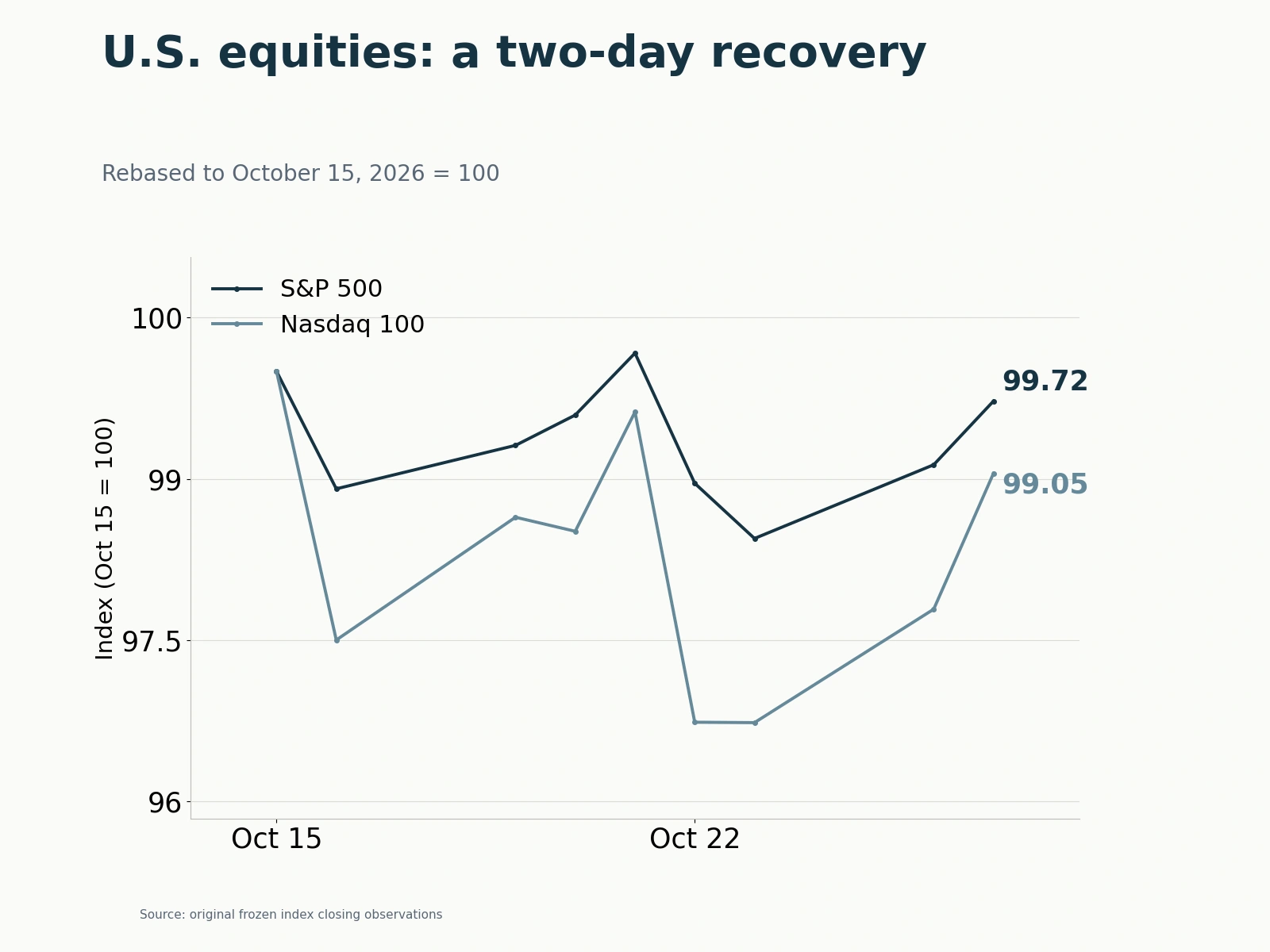
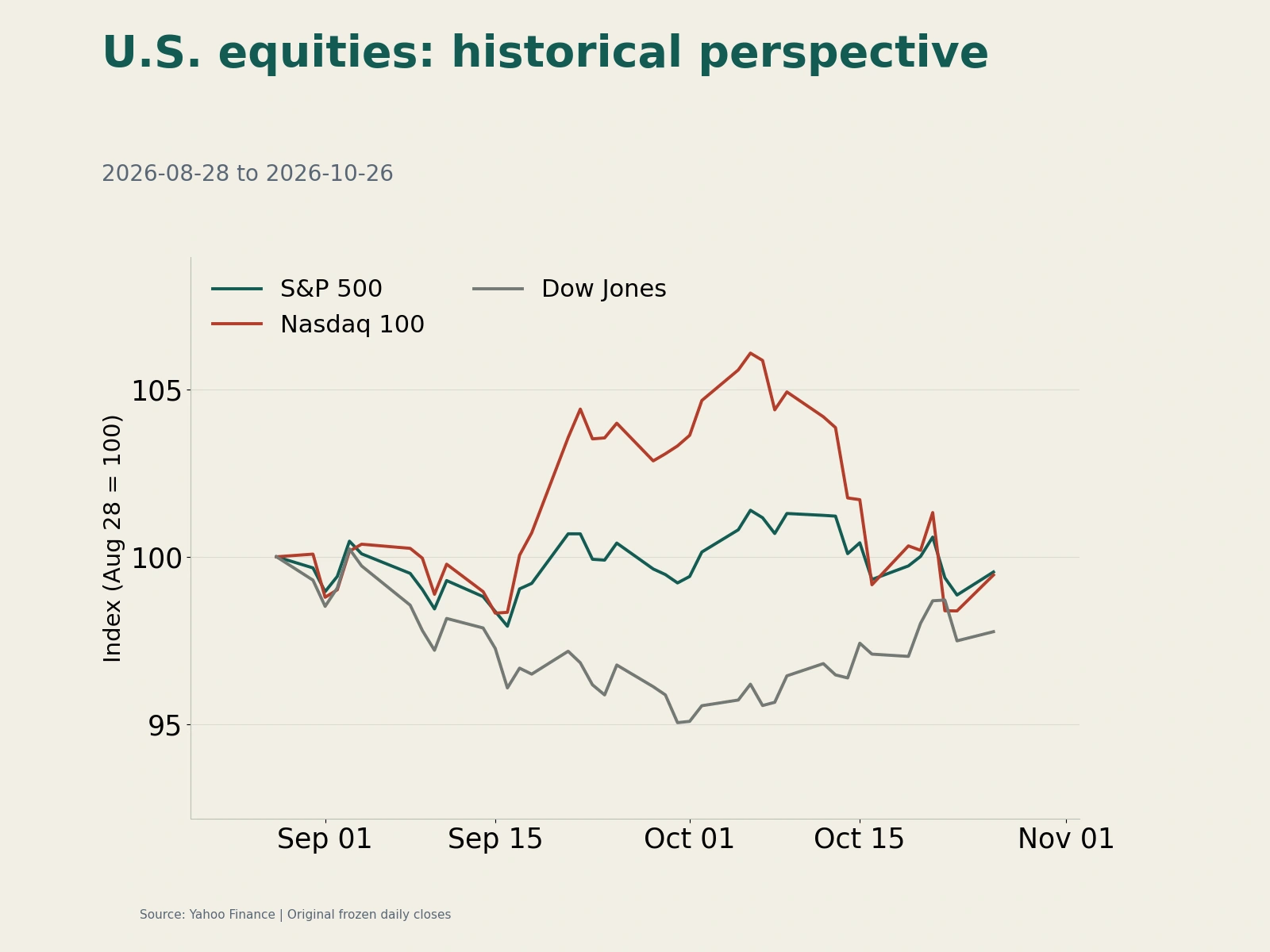
From September 14 to September 20, 2026, global markets diverged sharply under monetary tightening and supportive technology fundamentals. Energy disruption, doubts over AI development and a Fed increase initially hit assets; retreating oil premiums and actual computing orders later supported a moderate recovery. It was uneven: Nasdaq 100 gained 0.94%, S&P 500 slipped 0.08%, and financials and cyclical small caps generally suffered. The two-year Treasury yield reached 4.76%, the ten-year 5.01%, and the dollar index 100.22, up 1.11% for the week. Localized risk appetite improved while the marketwide risk-free cost of capital rose further.
The divide reflected resilient growth versus sticky inflation. Strong U.S. spending supported current corporate revenue but blocked rate-cut expectations and sharply increased real discount rates. Concrete AI-chain orders improved leading technology firms' earnings visibility without offsetting widespread debt-financing pressure. Chinese industrial production accelerated while domestic demand remained weak, and Asian markets faced currency-translation effects and pressure on foreign investors' returns.
Fed hike raises real discount rates; resilient spending flattens the curve
On September 16, the Fed raised the funds target by 25 basis points to 3.75%–4.00%. August retail and food-service sales released that day rose 1.2% month on month versus 0.8% expected. The control group excluding autos, gasoline, building materials and food services rose 1.4% versus 0.4% expected; these are nominal, unadjusted-for-inflation sales. Strong demand led Goldman Sachs and JPMorgan to raise third-quarter annualized real GDP forecasts to 3.0% and 3.5%.
High-frequency labor data reinforced resilience. Initial claims fell to 196,000 in the week ended September 12, versus the prior 206,000 and expected 208,000. Costs also remained sticky: August import prices rose 0.7% month on month, including nonfuel prices up 0.8%, suggesting pressures spreading beyond energy. Demand resilience and imported costs narrowed the easing window, pressuring short and intermediate Treasuries most.
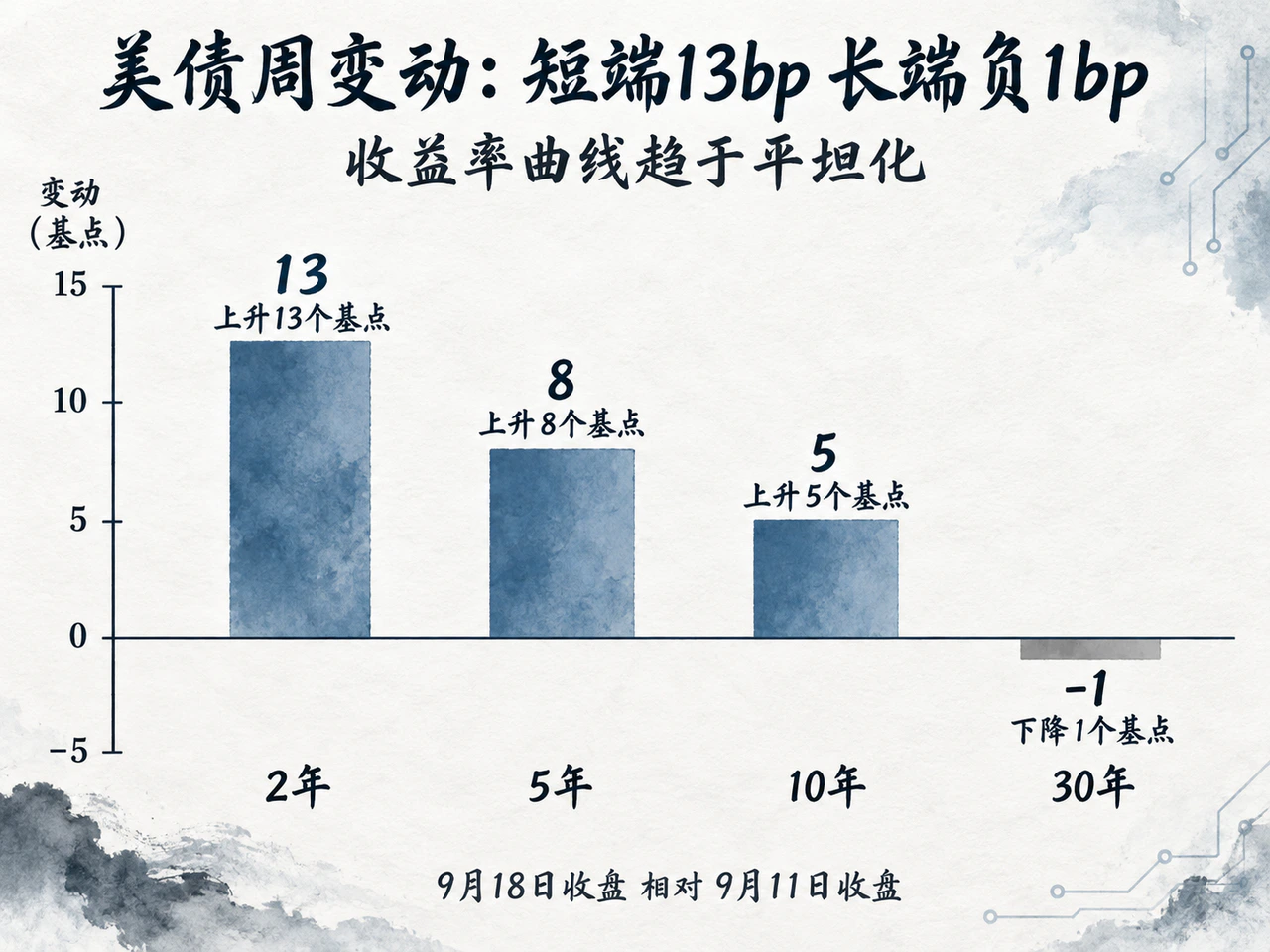
The Treasury curve displayed a classic weekly bear flattening:
| Treasury maturity | September 11 close | September 18 close | Weekly change |
|---|---|---|---|
| 2-year | 4.63% | 4.76% | Up 13 basis points |
| 5-year | 4.78% | 4.86% | Up 8 basis points |
| 10-year | 4.96% | 5.01% | Up 5 basis points |
| 30-year | 5.35% | 5.34% | Down 1 basis point |
The two-year/ten-year spread narrowed rapidly from 33 to 25 basis points. Yields briefly eased Thursday, but Friday reversed the bond-buying recovery and short rates rose again. The 30-year fell one basis point, suggesting allocation demand for ultra-long assets. Five- and ten-year TIPS real yields rose 17 and eight basis points to 2.55% and 2.68%, while inflation compensation, nominal minus real yields, narrowed nine and three basis points. Because compensation also includes inflation-risk and liquidity premiums, its changes cannot simply establish whether inflation expectations are fully anchored. The pattern clearly shows that rising real discount rates drove the restraint.
Despite strong consumption, real-economy divergence deepened. August manufacturing output fell 0.3% month on month and housing permits 2.7%, revealing rate-sensitive weakness. Credit was defensive: investment-grade spreads were 80 basis points on September 15, unchanged from September 11; high-yield spreads widened from 265 to 276 and eased to 270 on September 17. Higher spread levels plus rising benchmarks imply sustained refinancing pressure.
Actual orders ease AI doubts; technology leads while financials and small caps struggle
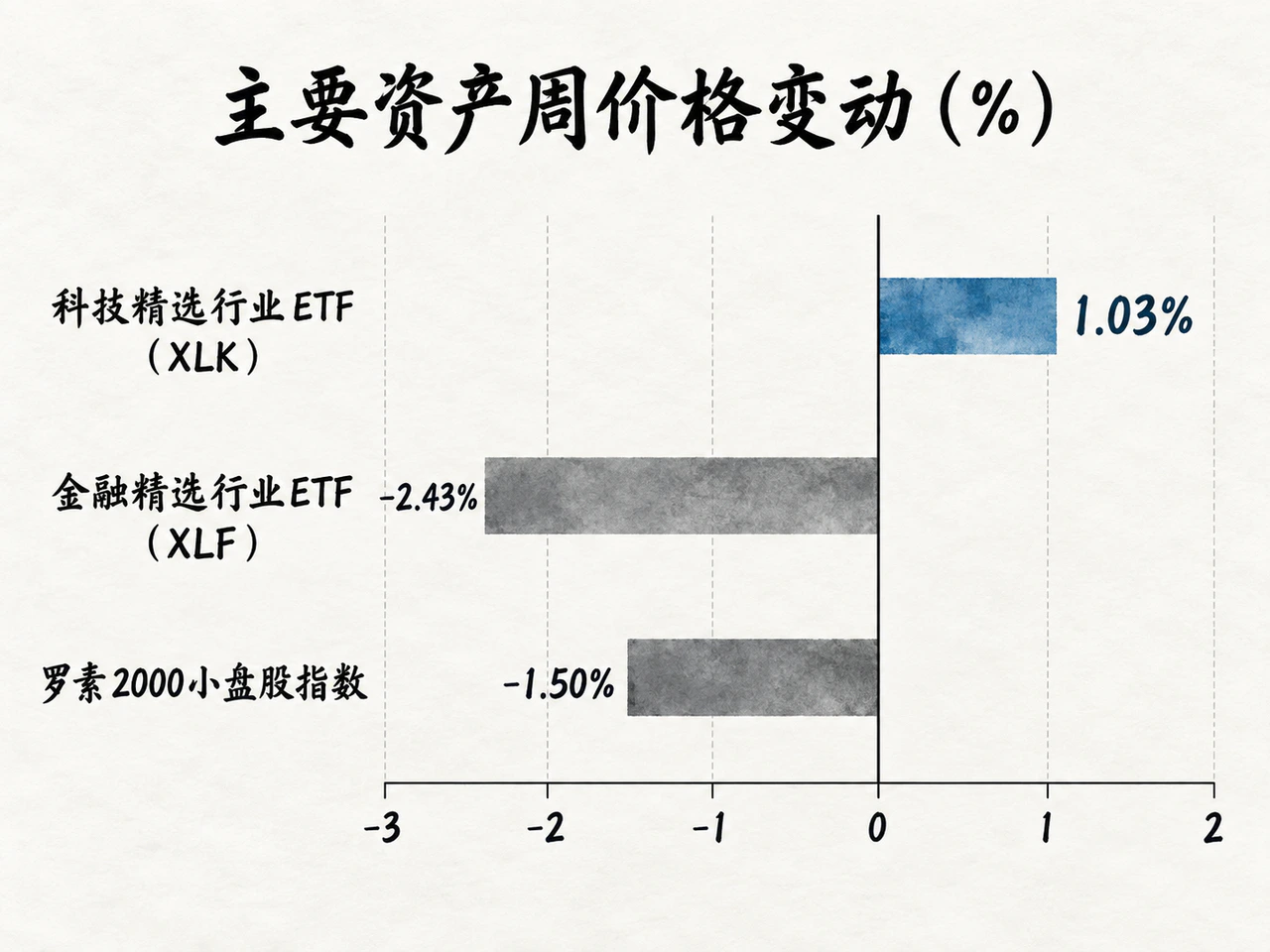
U.S. stocks ended a volatile week with large sector gaps beneath modest headline moves. At September 18's close, S&P 500 was 7,650.50, down 0.08%; Nasdaq 100 29,644.17, up 0.94%; Dow fell 1.69% and Russell 2000 1.50%. Technology ETF XLK rose 1.03%, while financials XLF dropped 2.43%.
Technology showed a clear turning point. Early calls by leaders of Anthropic, OpenAI and xAI to slow development raised fears of computing overinvestment, sending the Philadelphia Semiconductor Index down 5.9% in one session and Nvidia down 3.4%. Later commercial orders dispelled some gloom: Generac agreed to supply Amazon up to $8 billion in data-center backup generators, including about $2.4 billion of core equipment planned over two years. This provided direct evidence of power-capacity expansion. Arm CEO Rene Haas also expressed confidence in a $2 billion AI-chip sales target, saying supply-chain delivery capacity was the present bottleneck.
Orders and midweek oil declines drove a strong technology rebound. S&P 500 recovered from its 7,551.81 midweek low and VIX fell quickly from September 16's 17.71 high to 14.81. Traditional financials remained heavy. Bank of America CEO Brian Moynihan warned early in the week of at least a 10% third-quarter investment-banking fee decline; higher-rate margin benefits did not fully offset financing costs and weaker credit demand. Fed supervision Vice Chair Bowman said September 18 that stress-test reform would be considered in coming weeks, potentially averaging two cycles to smooth capital-buffer volatility, but benefits would take time. The rebound remained largely a localized recovery in leading technology earnings expectations.
Oil's geopolitical premium retreats from highs; short covering lifts gold against headwinds
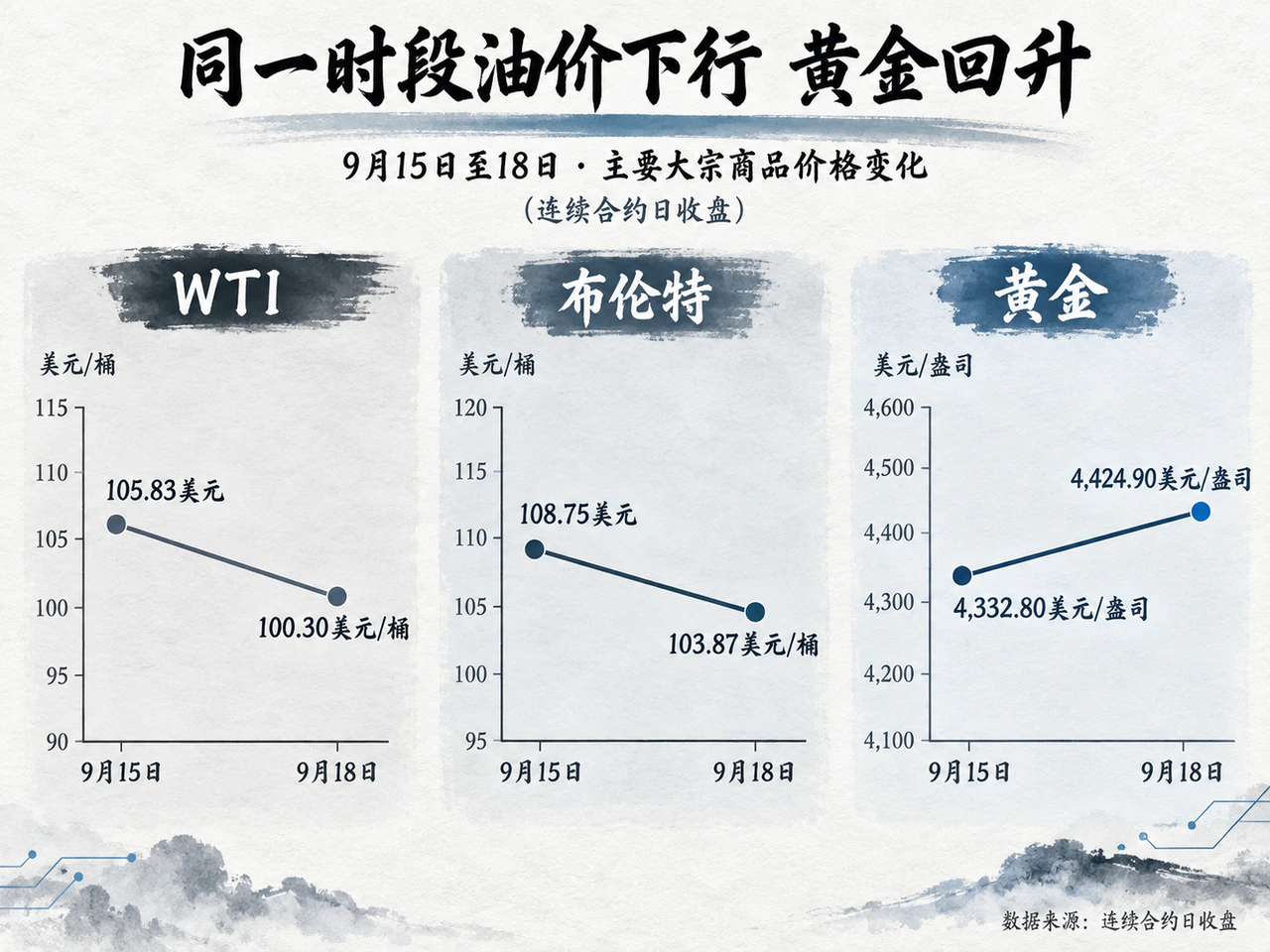
Oil surged and then surrendered gains. The provider's continuous-contract daily closes reached interim highs September 15 of $105.83 a barrel for WTI and $108.75 for Brent, then fell for three sessions. September 18 closes were WTI $100.30, up 0.25% for the week, and Brent $103.87, down 0.71%.
The swings reflected supply risk versus buffers. Early suspension of Yanbu loading and disruption of the Hormuz-bypassing east-west pipeline forced European refiners toward U.S. alternatives, raising premiums. Saudi emergency ship-to-ship supply off Oman's Sohar and efforts to restart the pipeline then contained disruption fears. EIA showed crude stocks down only about 640,000 barrels versus an expected 1.62 million, with unusual gasoline and distillate builds, weakening the buying case and quickly removing premium.
Gold recovered despite the dollar at 100.22 and higher real Treasury yields. The provider's continuous closes rose from $4,332.80 an ounce on September 15 to $4,424.90 on September 18, producing a 0.36% weekly gain. Reuters cited EverBank global-markets president Chris Gaffney saying retreating oil eased inflation concerns and prompted covering of shorts built before the hike. Stable Chinese investment-demand premiums partly offset overseas high rates and weak Indian physical buying, providing marginal support.
China's faster production contrasts with weak demand; strong-dollar translation weighs on Asia
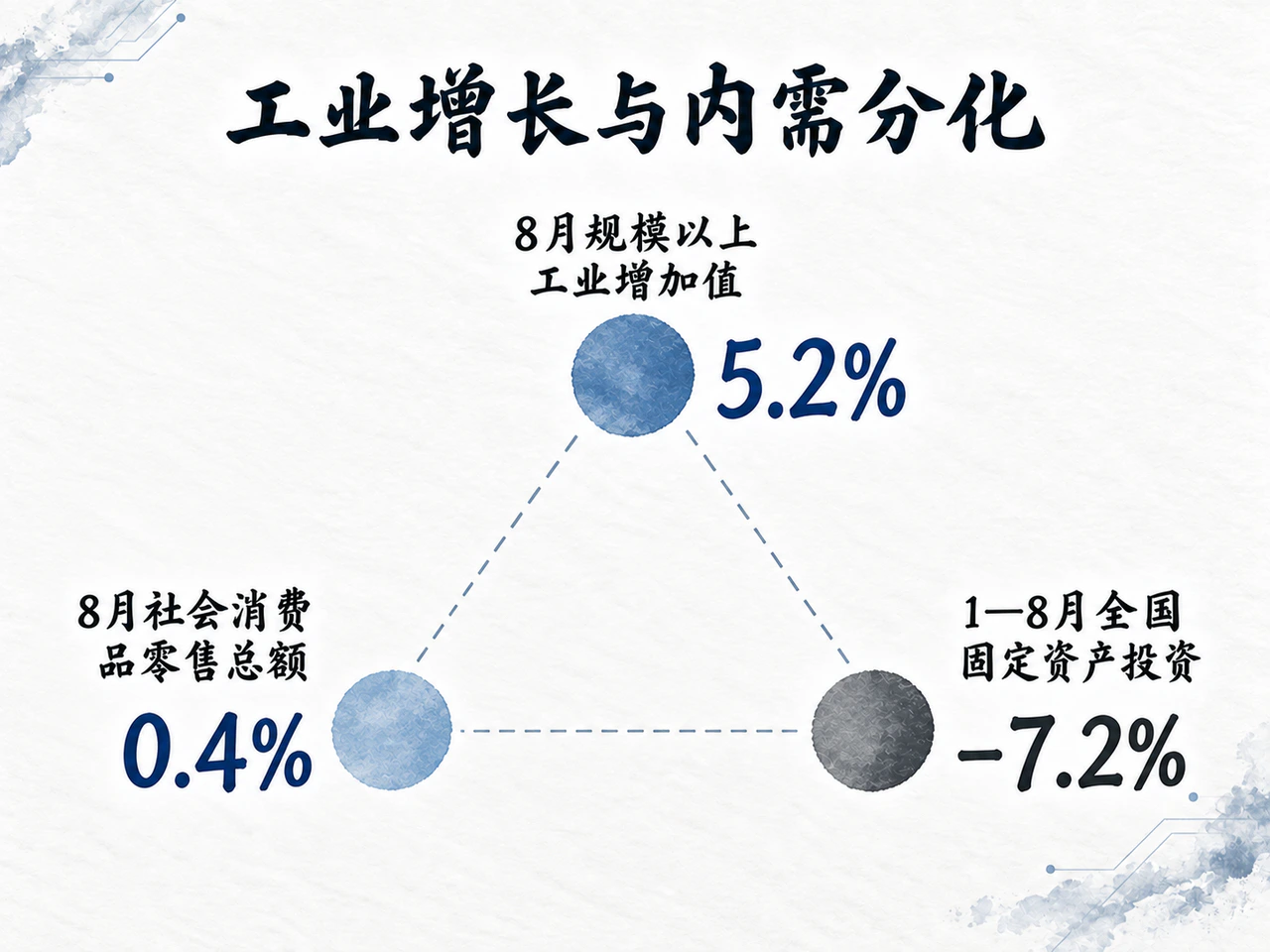
Chinese data diverged between supply and demand. August industrial value added at designated-size firms grew 5.2% year on year versus July's 4.5%; high-tech and equipment manufacturing rose 16.7% and 12.1%. Retail sales rose only 0.4%, while January–August fixed-asset investment fell 7.2%, including property development -19.9%, infrastructure -4.0% and manufacturing -2.3%. Services retail rose 4.9% over January–August, outpacing goods and cushioning consumption structurally.
Fiscal transmission attracted attention. January–August general public-budget spending rose 1.2%, but government-fund budget spending fell 17.0% and state land-use-right transfer revenue 28.6%. Basic livelihood spending advanced steadily while local projects remained constrained by funding recovery cycles, leaving the pace of actual construction work uncertain.
Asia did not fully share the technology rebound. At September 18's close, Nikkei 225 gained 1.57% for the week to 65,018.95, Hang Seng fell 0.22% to 24,750.78 and KOSPI fell 0.23% to 6,894.23. A stronger dollar reduced non-U.S. total returns: USD/JPY rose 1.07% to 156.129 and USD/KRW 2.33% to 1,379.53. Local depreciation diluted dollar-based foreign returns and raised imported commodity costs. On September 17, HKMA followed the Fed with a 25-basis-point increase to a 4.25% base rate, tightening local real-economy and equity financing costs.
European fiscal buffers raise debt costs; post-close Russia and Iran legislation adds repricing uncertainty
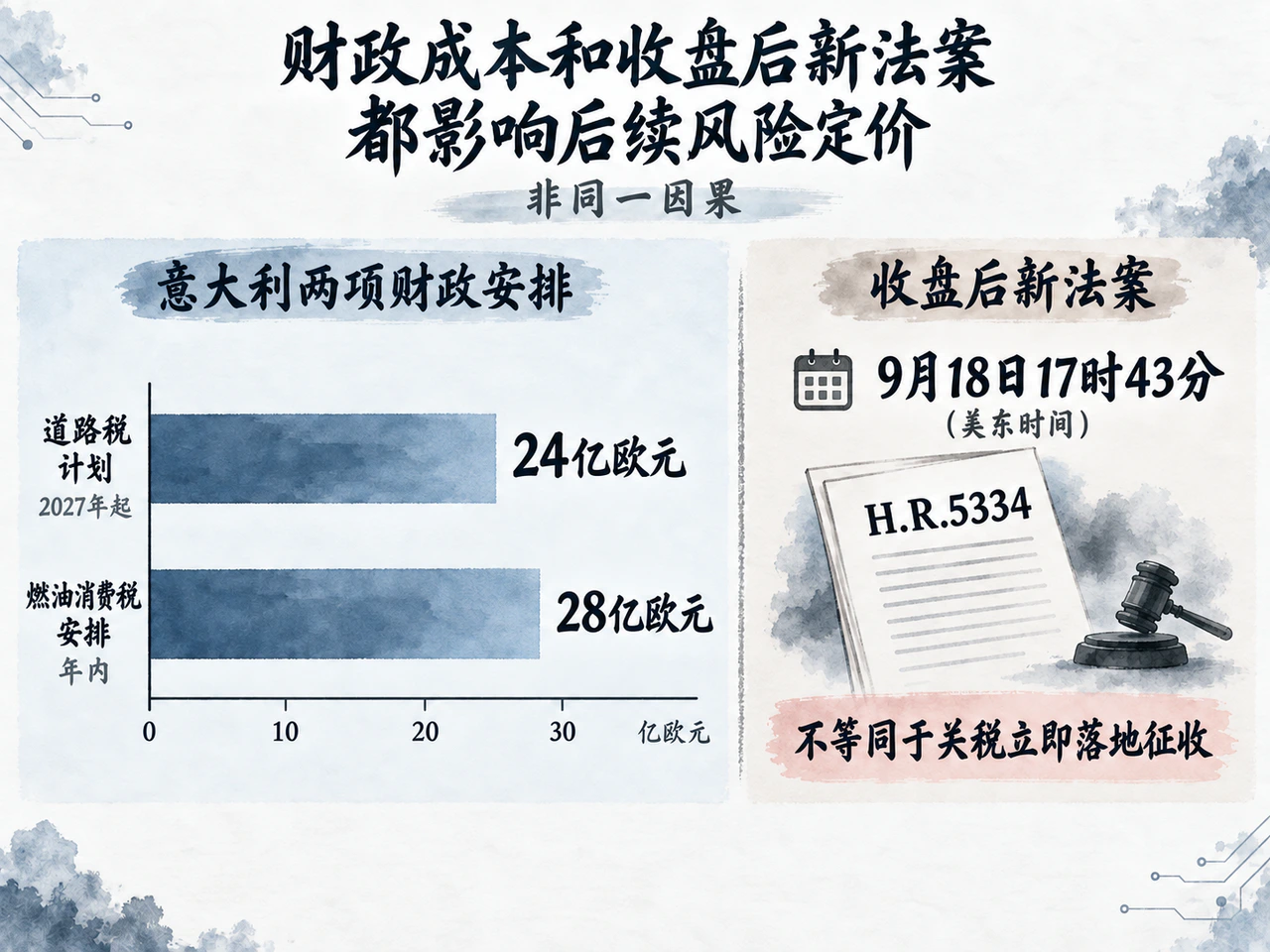
Energy volatility reached sovereign finances. Italy announced plans to remove road tax on 14.5 million cars and motorcycles from 2027, costing about €2.4 billion, and provide another €2.8 billion this year to reduce fuel excise. These living-cost measures shift private energy burdens onto the public balance sheet. Economy Minister Giorgetti warned September 18 that debt-interest costs were rising quickly, underscoring sovereign financing limits on subsidies. EU ambassadors on September 14 technically extended Russian sanctions lists to September 22 to allow more time for a six-month renewal agreement.
Major geopolitical and legal developments after regular trading require attention. At 17:43 Eastern time September 18, the White House confirmed signing H.R.5334, expanding trade-ban, tariff and transaction-restriction powers against Russia-related entities, including tariffs of up to 100% on major Russian oil and gas importers with some natural-gas exceptions. It also extended existing Iranian energy and financial sanctions. Authorization is not immediate collection: targets, exemptions and timing determine actual costs. On September 19, the Houthis claimed strikes on Riyadh targets. Both developments occurred after Friday's major global cash markets closed, so related premiums and supply-chain disruption were not fully reflected in the week's prices and posed potential next-opening risks.