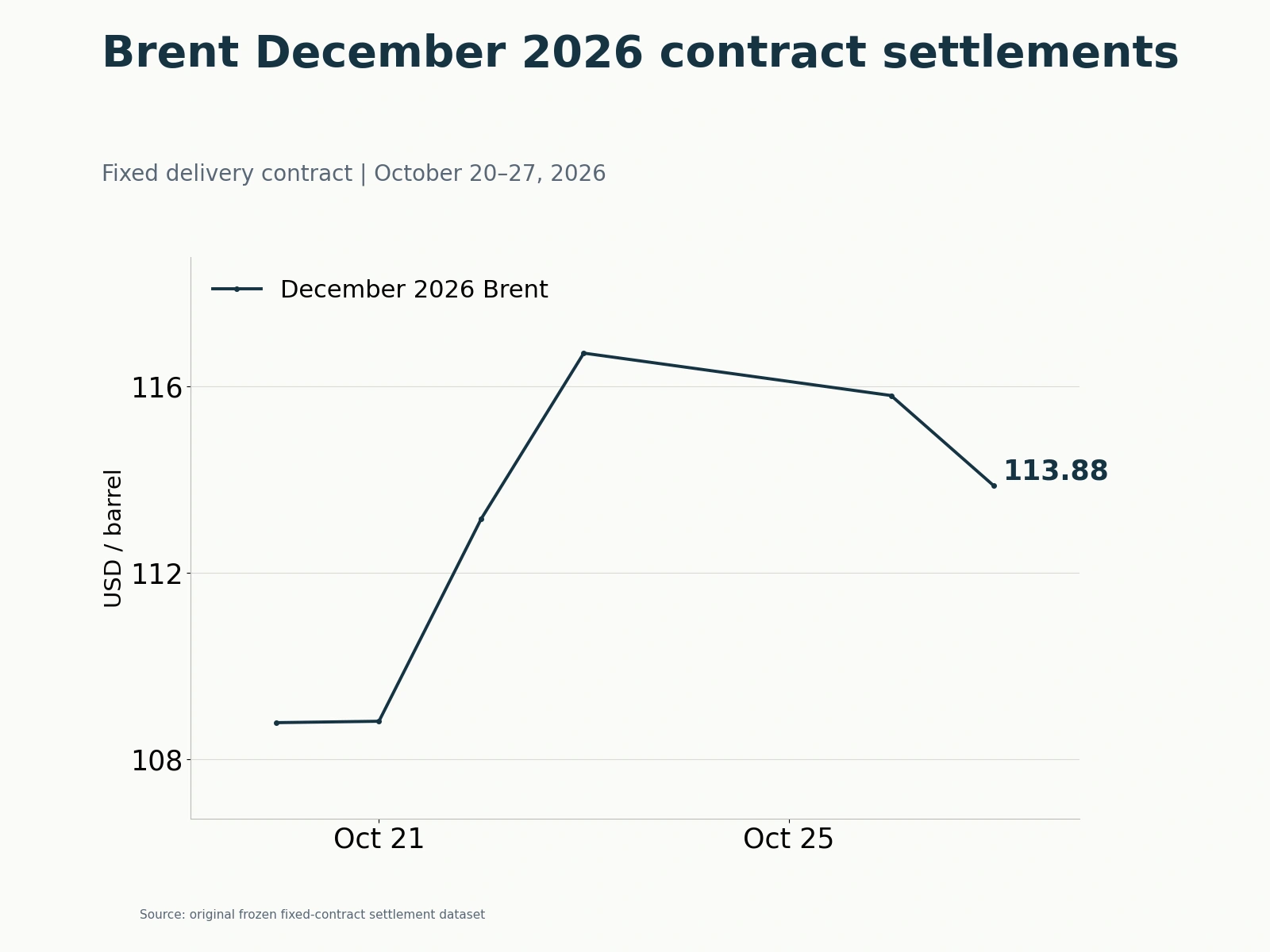
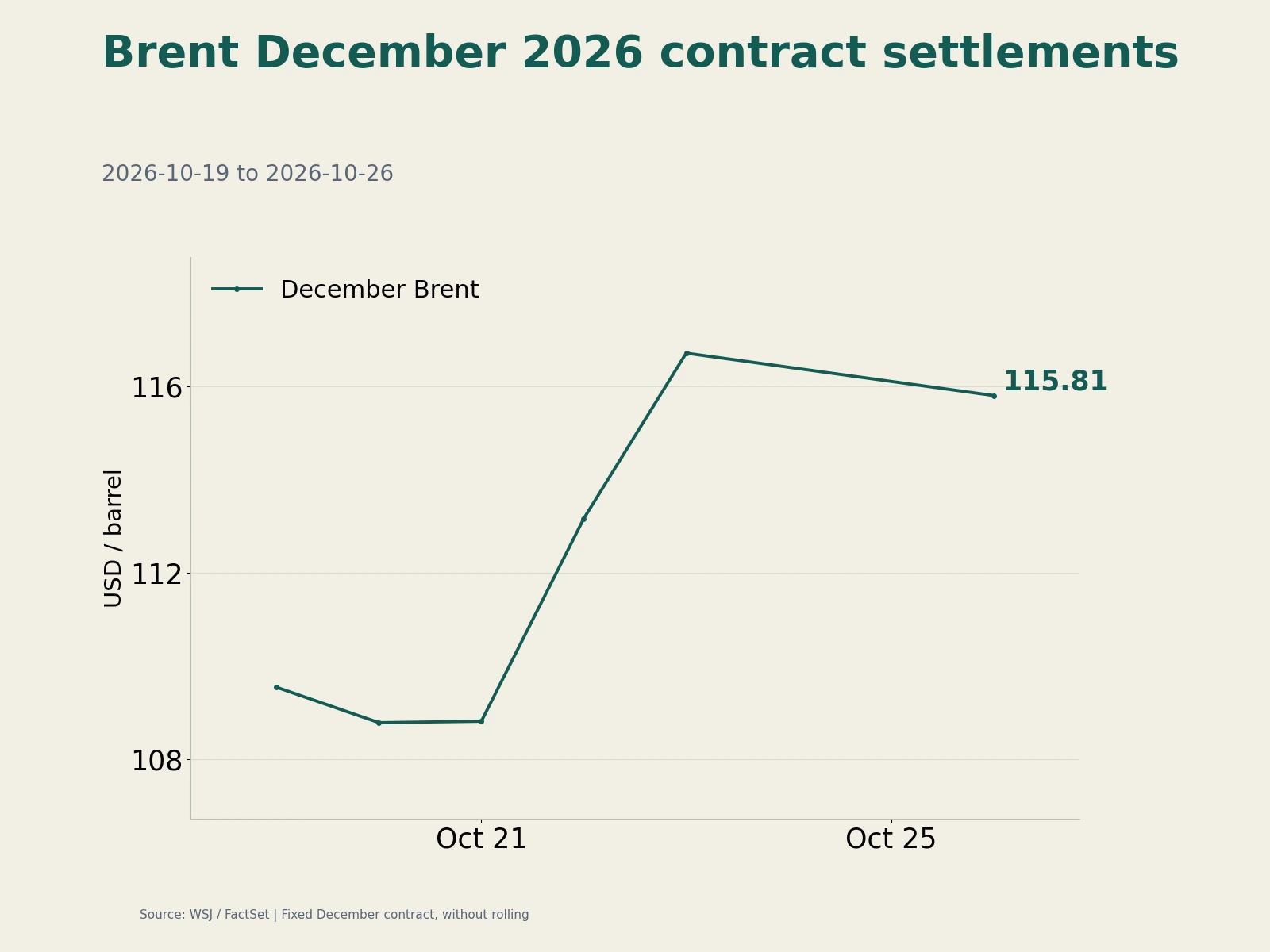
During September 14–20, international crude prices swung sharply higher and then retreated. Early in the week, disruption to Saudi Arabia's East–West pipeline and suspended loadings at Yanbu sharply increased expectations of a supply shortfall following restricted Hormuz passage, sending prices strongly higher. News that Saudi Arabia had begun ship-to-ship (STS) transfers off Oman and expectations of a planned pipeline restart then erased the gains. Crude futures ended the week almost unchanged, but the quiet weekly result concealed intense tension between offshore logistics bottlenecks and immediate physical scarcity.
Using consistent daily closes for continuous contracts from one data source, crude showed a typical failed breakout. Brent and WTI reached local closing highs of $108.75 and $105.83/barrel on September 15, then fell for three consecutive sessions. At the September 18 close, Brent stood at $103.87, down 0.71% from September 11, while WTI was $100.30, up 0.25% on the week. These prices are used only to compare intraweek trends on a consistent basis; they are not official exchange settlements for a specified delivery month.
Disruption to a key alternative corridor blocks deliverable supply; diverted orders support US crude's relative premium
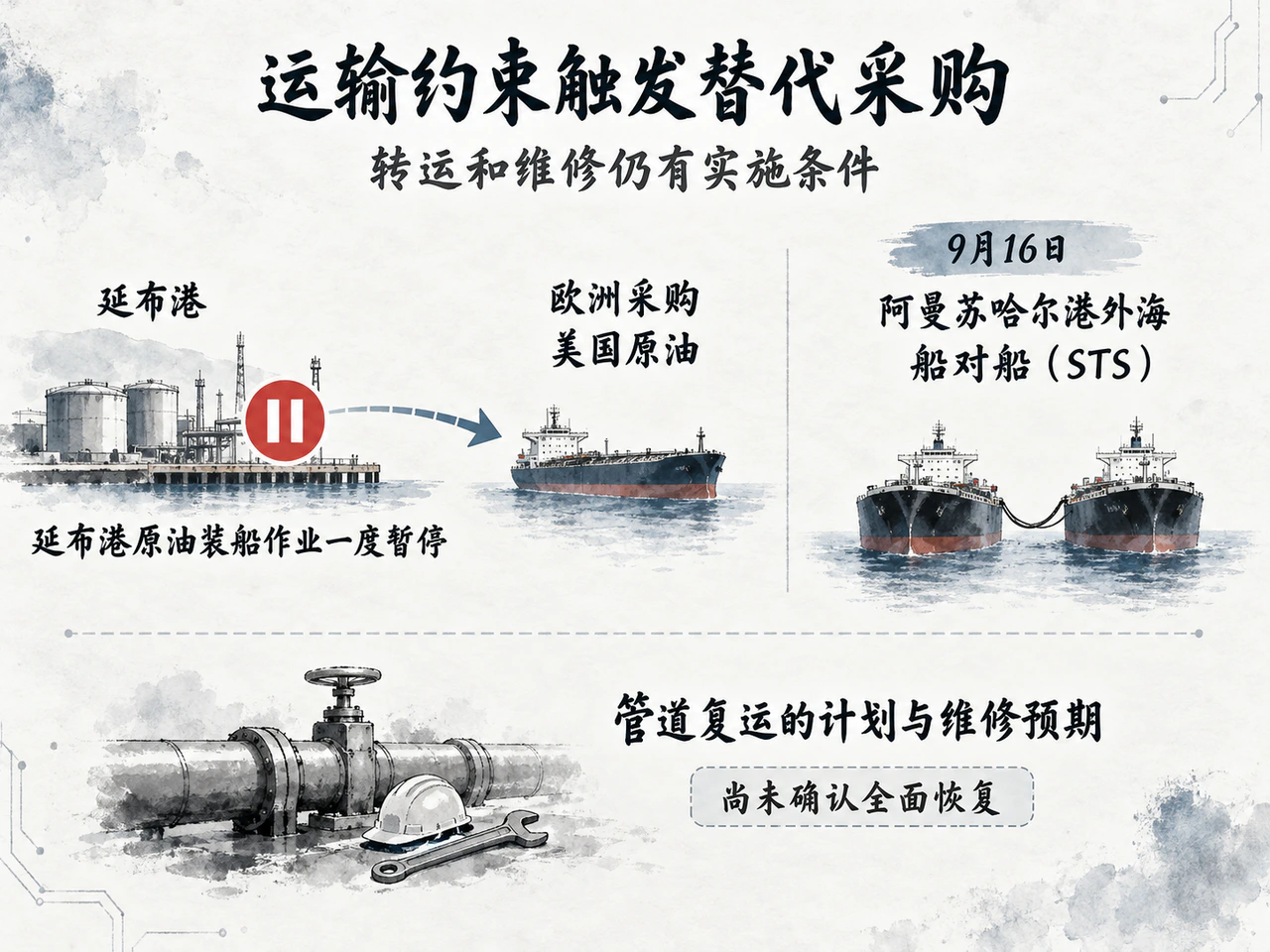
The week's main supply problem centered on Saudi Arabia's strategic export corridor to the Red Sea. With Hormuz under pressure, the East–West pipeline and Yanbu on the Red Sea coast played a crucial role in bypass exports. Reuters reported on September 15, citing shipping sources, that crude loading at Yanbu had temporarily stopped, forcing the cancellation of some cargoes scheduled for late-September delivery to Europe. Disruption to this onshore export lifeline prevented existing production capacity from turning smoothly into physical supplies international buyers could receive, directly increasing feedstock interruption risks for European refineries.
The bottleneck directly reshaped transatlantic trade and explained WTI's relative strength against Brent early in the week. Energy consultancy Lipow Oil Associates said the unexpected disruption at Yanbu made European purchases of US crude much more urgent, with diverted orders directly supporting US light crude. WTI's outperformance at this stage therefore reflected a substitution premium from rerouted trade, rather than a substantive improvement in global final oil consumption.
Sentiment turned on September 16. Reports that Saudi Arabia was maintaining supplies to Asian refiners through offshore STS transfers near Sohar, Oman, prompted markets to recalculate the net export loss and compress earlier geopolitical panic premiums. Offshore transfers inevitably add handling stages and costs, however, and planned pipeline restarts and repair expectations did not amount to fully restored port loadings. By Friday's close, markets were still tracking actual pipeline repairs and the fulfillment of loading obligations.
OPEC+ had already established on September 6 that October production policy would remain unchanged. The binding supply constraint lay in the safety and availability of gathering and export infrastructure, rather than production quotas. Even if policy permitted more output, crude still needed reliable pipelines and ports to become physically deliverable market supply.
Retreating futures diverge from physical premiums; middle distillates face greater pressure than crude
The rapid futures pullback did not resolve immediate physical-market tightness. On September 17, Oilprice cited Saxo Bank head of commodity strategy Ole Hansen as saying that spot Brent and diesel indicated much more acute scarcity than futures. Large nearby premiums—deep backwardation—and elevated refining margins showed buyers still paying heavily for feedstock and products available for immediate delivery. Such scarcity gave delivery time itself a high value, but did not necessarily justify unconditional increases in forward prices.
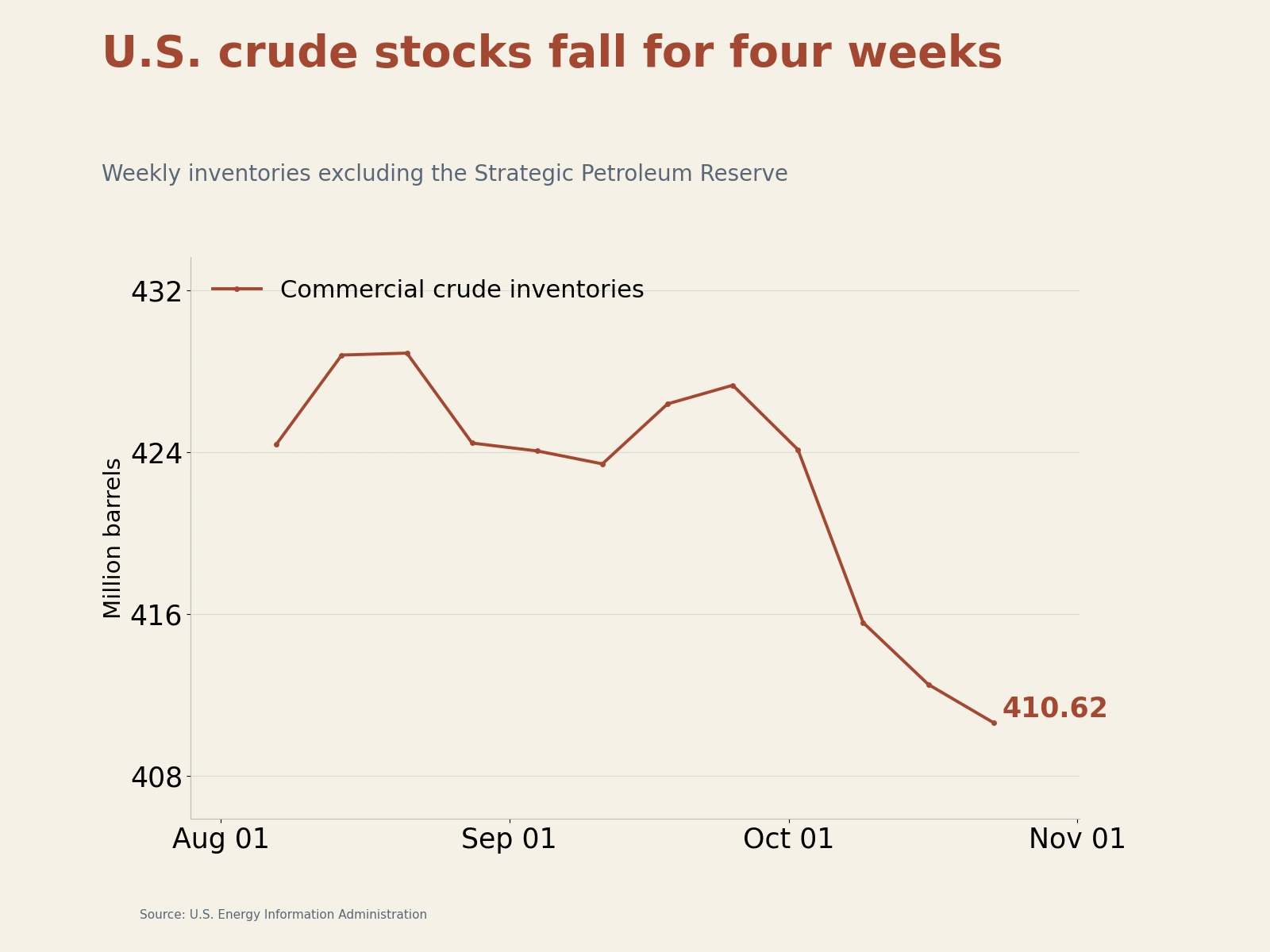
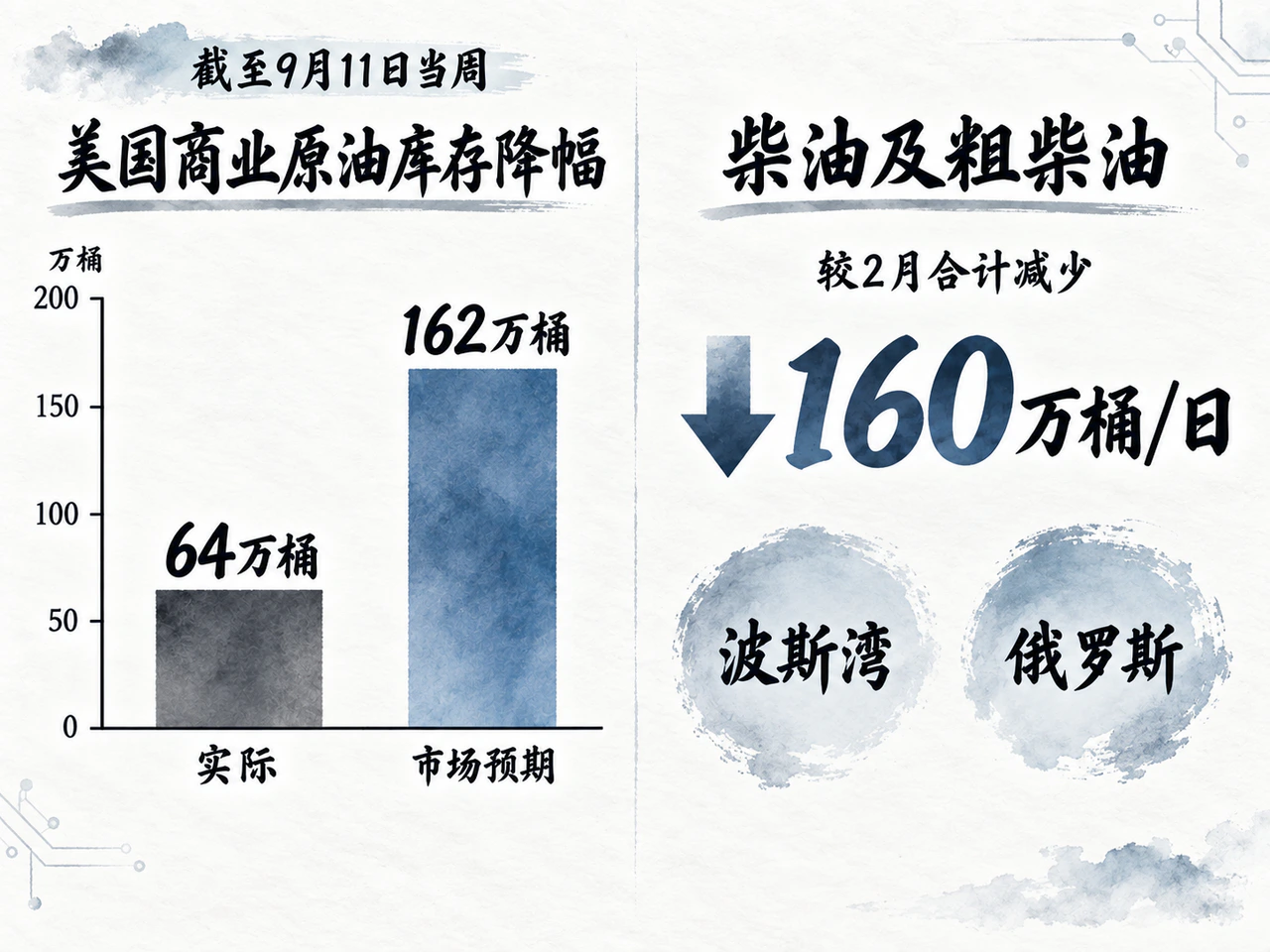
US inventories, by contrast, sent a different marginal signal. According to Reuters, the EIA report released September 16 for the week ended September 11 showed commercial crude stocks falling only around 640,000 barrels, far less than the expected 1.62 million-barrel draw. Gasoline and distillate stocks both increased. There was no broad deterioration in domestic US product fundamentals, providing a microeconomic basis for speculative longs to take profits and futures to retreat later in the week.
A temporary build in one region could not smooth out global refining and logistics bottlenecks. In its September 11 monthly report, the IEA estimated that observable global oil stocks had fallen 95 million barrels in August, while combined Persian Gulf and Russian net diesel and gasoil exports were 1.6 million barrels/day below February. Across the global products chain, disrupted crude movements, refinery processing loads and restricted product shipping transmitted pressure stage by stage, leaving middle distillates such as diesel under far greater structural supply-demand strain than crude feedstock itself.
Macro and financial conditions also capped upside. The dollar index rose 1.11% over the week on the same data-source basis, materially raising non-US buyers' costs. More concerning, the IEA forecast that high fuel prices and supply friction could reduce global oil demand by 2.5 million barrels/day in 2026. This was a forward projection rather than current consumption data, but clearly identified the negative feedback from high inflation and oil prices into final demand. Supply uncertainty could not translate indefinitely into higher market prices.
Shipping-recovery expectations coexist with geopolitical risk; focus shifts to deliveries and demand restraint
Supply and logistics news remained sharply conflicting over the weekend. Bloomberg reported on September 20 that US Central Command commander Cooper said on Saturday that oil and gas transport through Hormuz over the preceding two weeks had recovered to a six-month high. This reflected the US account of improved passage through the main route, but two-week transport volumes differ from daily commercial-vessel transit counts and did not mean the strait had fully normalized.
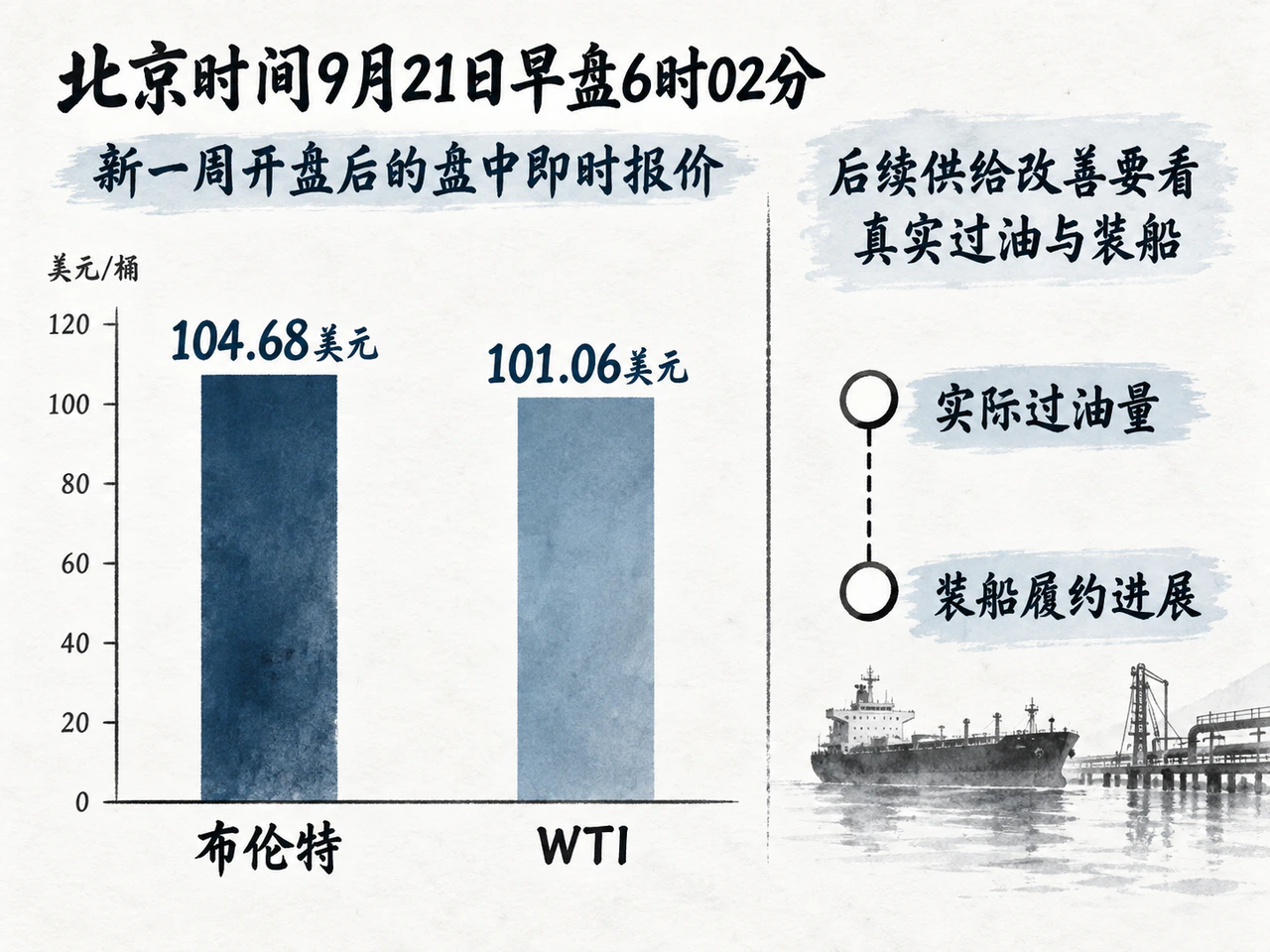
Geopolitical shocks escalated again late in the week. Reuters reported that Yemen's Houthis claimed missile and drone attacks on Riyadh on Saturday. Risk aversion following the report helped intraday Brent and WTI quotations reach $104.68 and $101.06/barrel respectively at 06:02 Beijing time on September 21, after the new trading week opened. These were live quotations in the new week, outside the consistent-source weekly closing-price statistics above.
Four evolving factors will determine subsequent pricing. Actual throughput recovery in Saudi Arabia's East–West pipeline and Yanbu's loading performance will determine whether the geopolitical premium can meaningfully clear. The stability and throughput ceiling of STS operations off Sohar will test the capacity of alternative logistics. Narrowing nearby backwardation and diesel refining margins will show when immediate physical scarcity is truly easing. Finally, product inventory accumulation abroad combined with high-price damage to demand could make macro demand restraint the dominant influence on the price level.