Iran's government confirmed on September 30 that Foreign Minister Abbas Araghchi had submitted Washington's response to a proposed seven-day confidence-building period to the cabinet. Details remained unpublished, and informed officials said the central disagreement concerned the order in which measures would be implemented. As diplomatic contacts advanced, physical navigation threats persisted: the United Kingdom Maritime Trade Operations office reported that day that three merchant ships had been hit in the Strait of Hormuz. Alternative logistics and U.S.-protected nighttime routes helped Gulf crude and refined-product exports recover to 21.8 million barrels a day. But rerouting took longer and cost more, leaving normal commercial navigation through the strait far from restored.
U.S. proposal reaches the cabinet; officials identify implementation sequence as the sticking point

On September 30, Iranian government spokeswoman Fatemeh Mohajerani confirmed that Araghchi had presented the latest U.S. response to President Masoud Pezeshkian at a cabinet meeting. Reuters, citing informed officials, said Qatari mediators delivered it in Doha. The full proposal had not been made public, and markets were closely following the Iranian cabinet's review.
Informed officials said the framework proposed a seven-day confidence-building period to bring the parties back to a strengthened version of the June memorandum of understanding and establish nuclear-program-related steps. With details unpublished, it was not possible to conclude that substantive conditions had been agreed. Officials emphasized that the main blockage concerned implementation order: how to secure reciprocal commitments and who would act first. Qatar's prime minister said that day that free passage through the strait was an economic lifeline for regional states, requiring practical guarantees to restore commercial navigation.
Merchant ships attacked again in Hormuz; alternative routes support 21.8 million barrels a day of Gulf exports
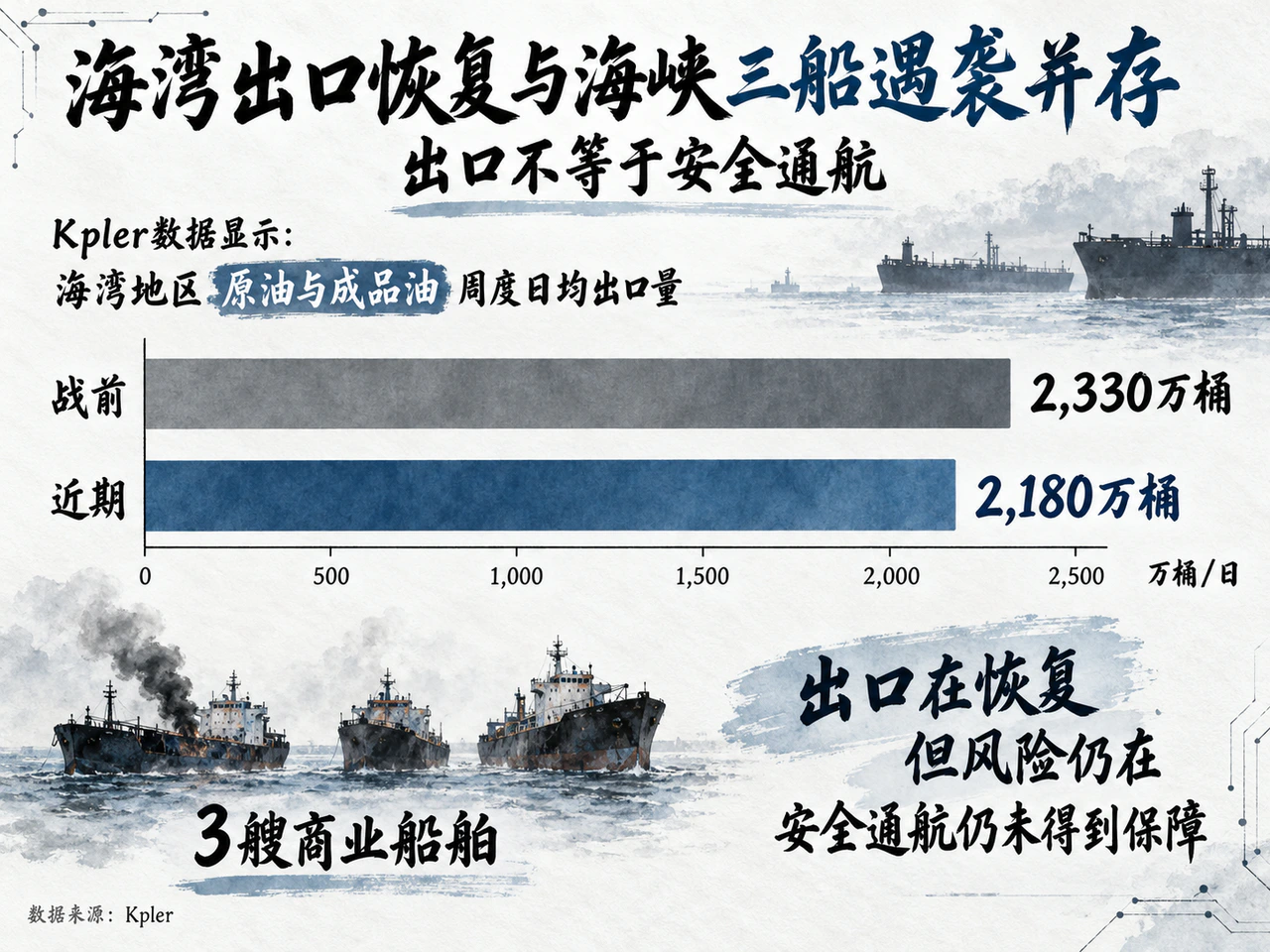
Security risks in the key waterway continued alongside diplomacy. UKMTO reported on September 30 that unidentified airborne objects hit three commercial vessels sailing through Hormuz on September 29, including a crude tanker. Responsibility remained under investigation.
Despite attacks on the main route, Gulf energy exports showed some resilience through diversion. Kpler data put the recent weekly daily average of Gulf crude and product exports at about 21.8 million barrels, approaching the prewar 23.3 million. Volumes were sustained through a diversified alternative logistics network, including land-pipeline diversion to the UAE's Fujairah port, detours via the Red Sea and Suez Canal, and U.S.-protected nighttime passages.
Improved export figures did not mean normal shipping had returned. Alternative routes made crude transport considerably slower and materially increased overall logistics costs. With attack risk on the main route unresolved and security arrangements still unimplemented, structural transit friction remained in the global energy supply chain.
U.S. completes planned Iraq withdrawal as multinational attack-drone cooperation expands
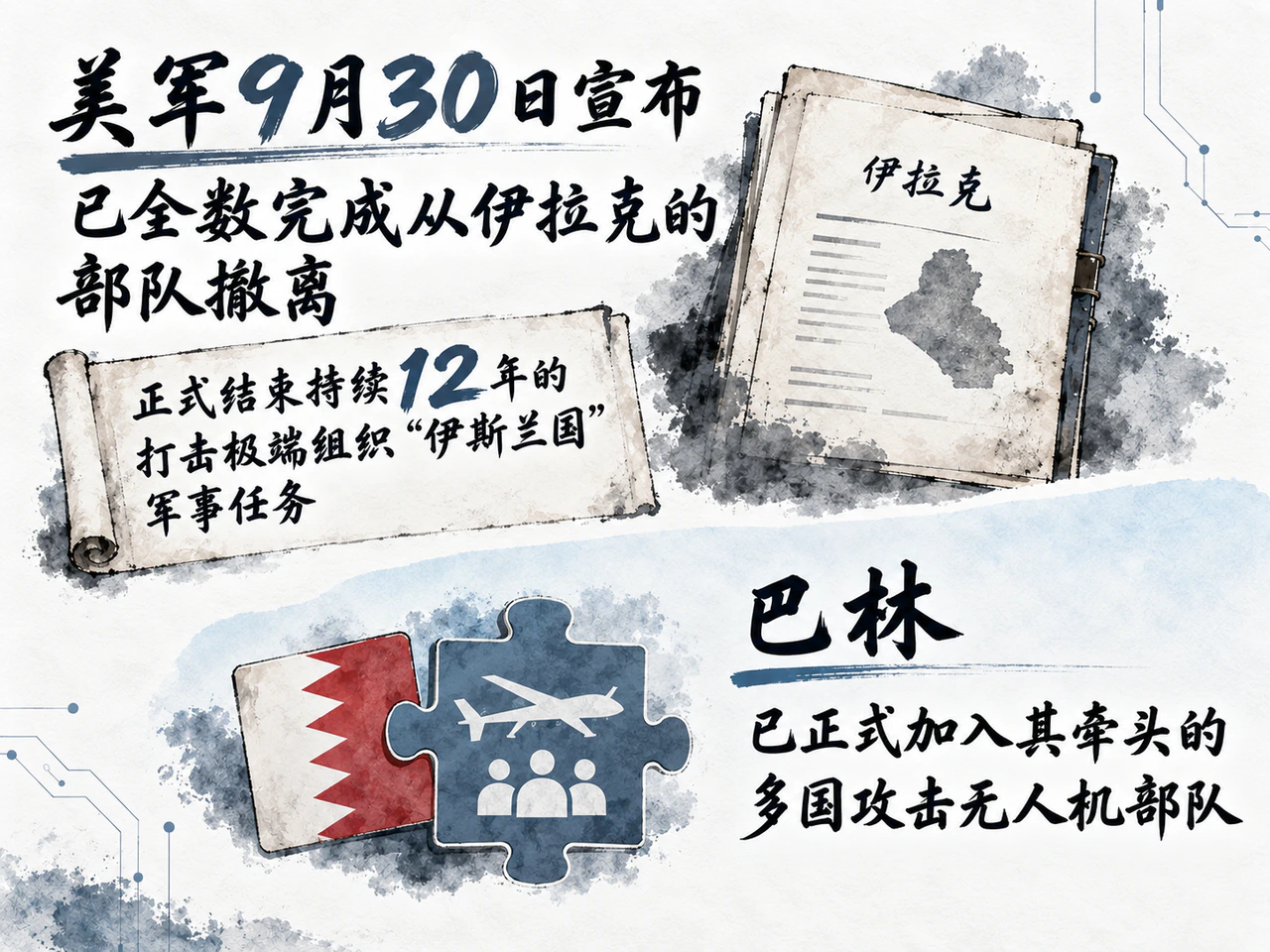
Beyond sea routes and ceasefire proposals, ground-defense arrangements reached an important milestone. On September 30, the U.S. military announced the completion of its full troop withdrawal from Iraq, formally ending the twelve-year mission against Islamic State. The withdrawal implemented an existing U.S.-Iraq security agreement and was a planned defense adjustment, rather than a direct result of current U.S.-Iranian ceasefire talks.
The withdrawal highlighted challenges in controlling armed groups in Iraq. Iran-backed Iraqi factions publicly said they were not bound by any timetable or agreement to surrender weapons to the central government. A Kataib Hezbollah spokesman said there had previously been official contacts over control of weapons, but no clear response had been received. Serious security fragmentation between local armed groups and central authorities persisted.
Multilateral defense cooperation continued to expand. U.S. Central Command announced that day that Bahrain had formally joined its multinational attack-drone force, focused on one-way attack-drone development. Separately, external human-rights organizations including Norway-based Iran Human Rights, IHR, and the U.S.-based Center for Human Rights in Iran, CHRI, released an appeal recording from an Iranian woman on death row. Media could not independently authenticate it. Diplomacy, multinational defense cooperation and complex public controversies remained intertwined, underscoring continued uncertainty in the Gulf's evolving situation.
Key developments
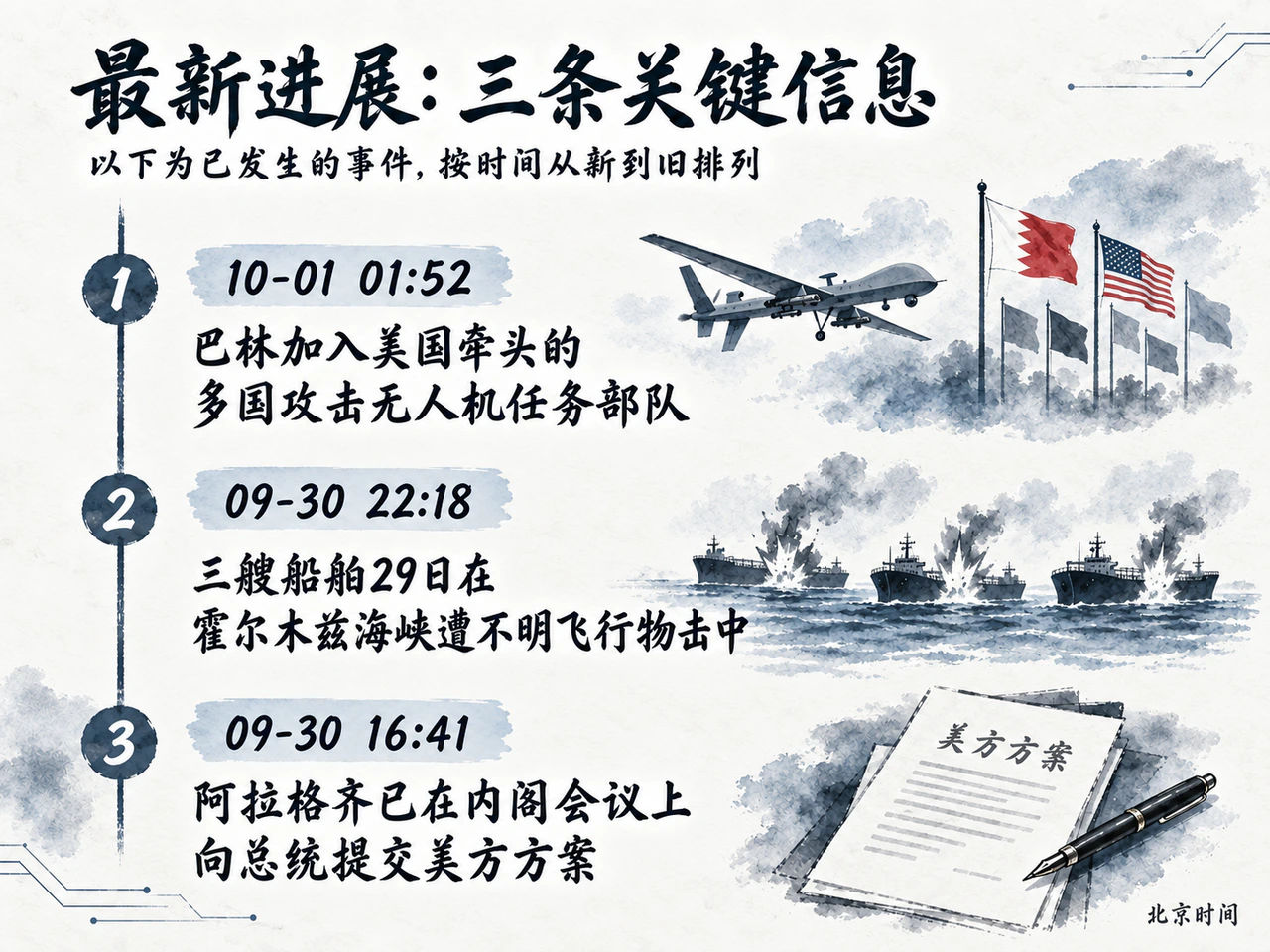
| Key developments — Beijing time |
|---|
| 10-01 01:52Bahrain joined the U.S.-led multinational attack-drone task force focused on one-way attack-drone development. |
| 10-01 00:59Media citing Kpler said alternative routes were restoring Gulf crude and product exports, but transport remained slower and more expensive. |
| 10-01 00:32Britain's prime minister said Iran might have been involved in an incident near RAF Fairford. Iran had previously denied involvement, and the investigation continued. |
| 09-30 23:12Iran-backed Iraqi armed groups said they were not bound by any timetable or agreement to surrender weapons to the state. |
| 09-30 22:18UKMTO reported that three vessels were hit by unidentified airborne objects in Hormuz on September 29. Those responsible were not yet clear. |
| 09-30 21:41Human-rights groups IHR and CHRI released an appeal recording from an Iranian woman on death row. Media had not independently verified its authenticity. |
| 09-30 21:02Iran's president said lasting security in the Gulf and its waterways depended on regional cooperation and shared responsibility. |
| 09-30 17:44The U.S. military announced the completed withdrawal of troops from Iraq under the existing U.S.-Iraq agreement, ending the twelve-year mission against Islamic State. |
| 09-30 16:41Iran's government spokeswoman said Araghchi had presented the U.S. proposal to the president at a cabinet meeting. Details remained unpublished. |
| 09-30 15:29Reuters cited informed officials as saying Qatar had delivered the U.S. response and the main disagreement over the seven-day confidence-building proposal concerned the sequence of measures. |
| 09-30 12:53Qatar's prime minister continued to press for a diplomatic solution, stressing the importance of free passage through Hormuz for regional countries. |


