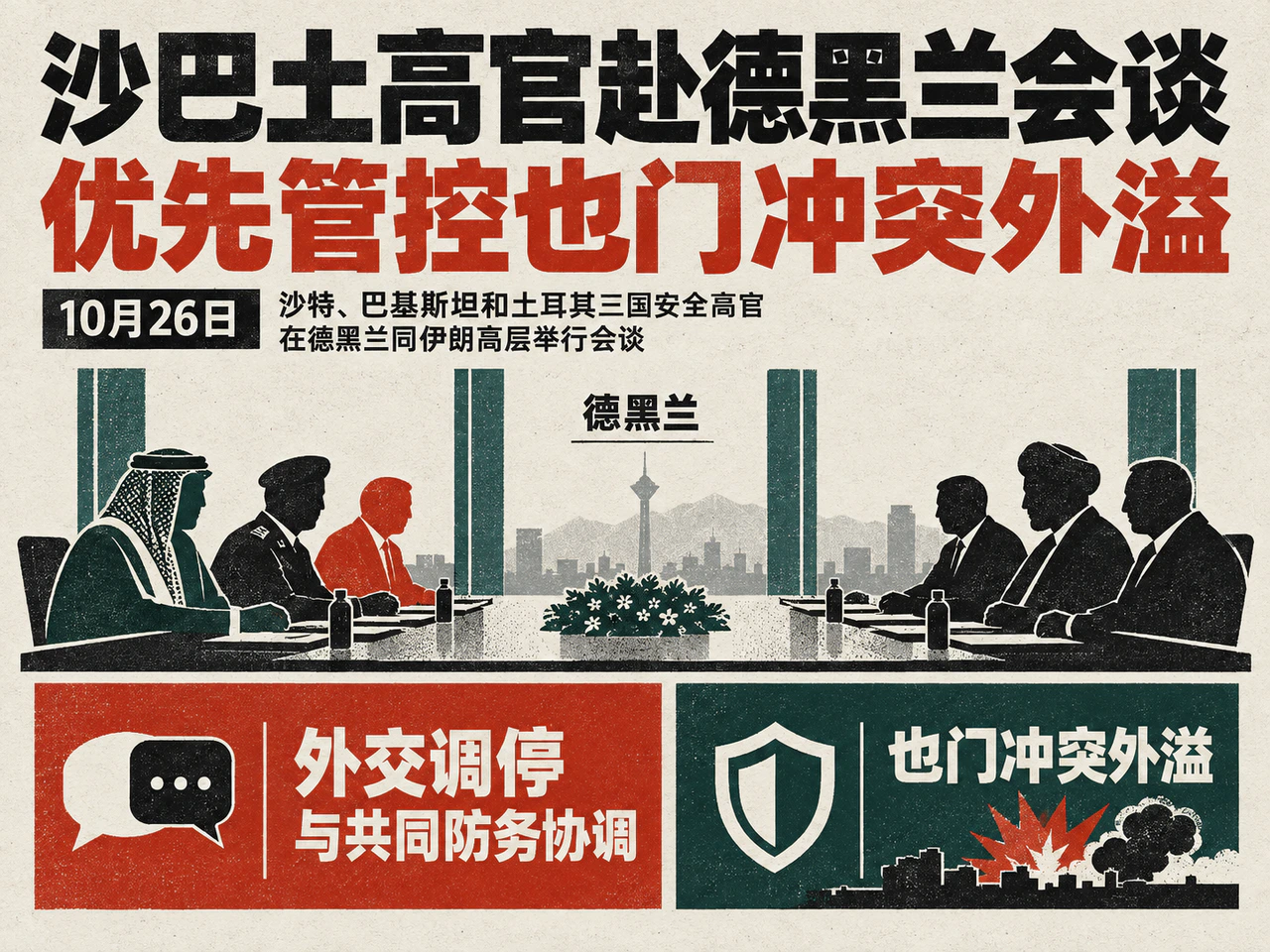
As of 07:32 Beijing time on October 3, Middle Eastern security developments were unfolding along parallel tracks of military readiness and diplomacy. The U.S. military was moving substantial naval forces toward the theater, while Iran's military assessed escalated retaliation plans in the event of another attack. Another merchant-vessel attack in the Strait of Hormuz showed no material improvement in the shipping corridor's security environment. The G7 announced the start of strategic oil-reserve releases the same day, extending risk mitigation to refined-fuel supply.
U.S. deploys naval groups carrying about 9,000 personnel; Iran considers broader potential retaliation
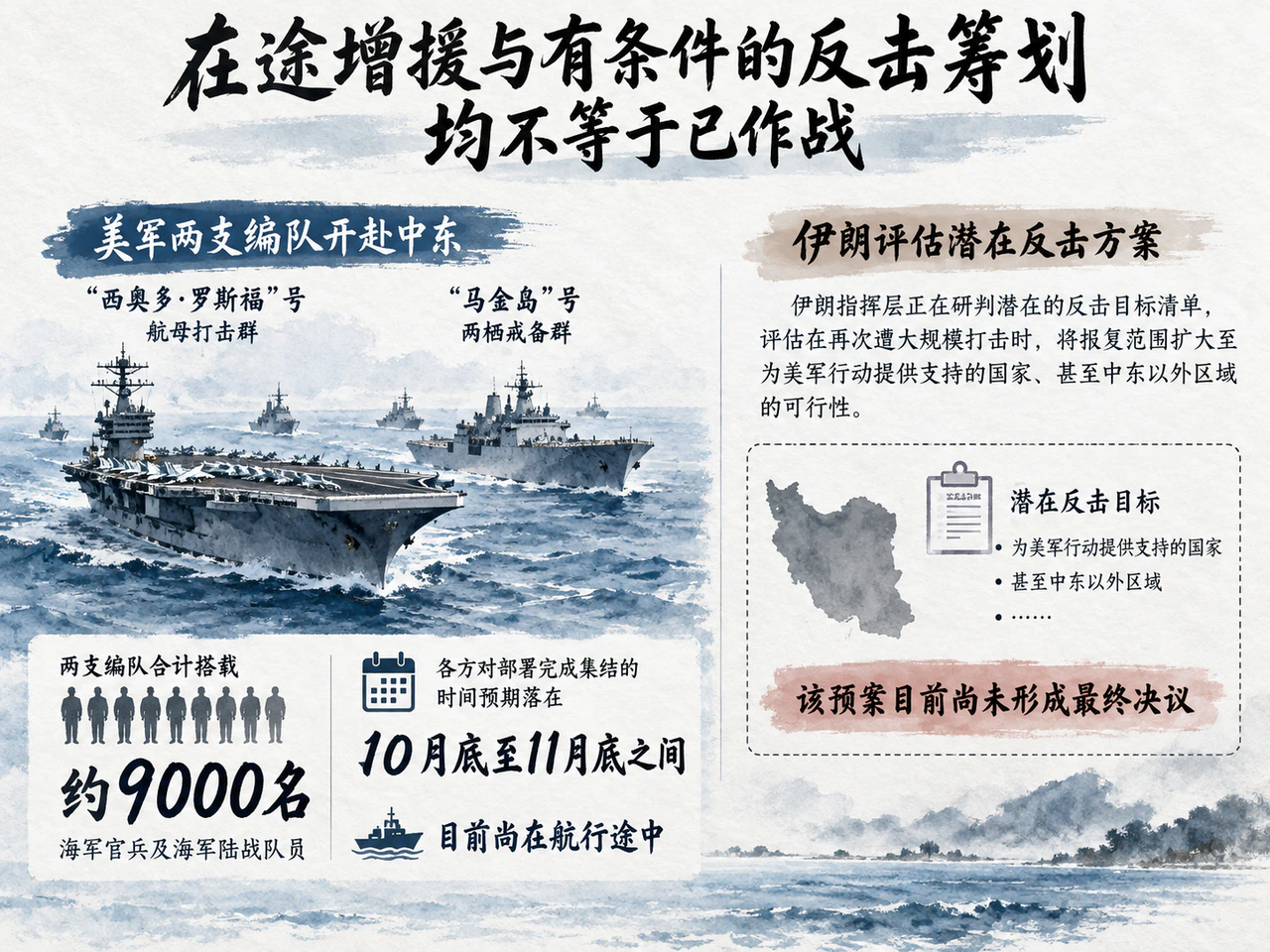
The Associated Press reported on October 2, citing Defense Department officials, that the Theodore Roosevelt carrier strike group and Makin Island amphibious ready group were heading to the Middle East at full speed, carrying about 9,000 sailors and Marines combined. The report detailed the ships and force size, with various expectations for the deployment's assembly ranging from late October to late November. The forces were still en route. The reinforcements expanded U.S. tactical options in the theater, but troop movements themselves did not constitute a settled decision to resume large-scale strikes.
In Tehran, Reuters cited three senior officials and people familiar with the matter as saying Iranian commanders were examining potential targets and assessing whether, if attacked again, retaliation could extend to countries supporting U.S. operations or even beyond the Middle East. The contingency plan was not final. Officials also confirmed that allied armed groups in Lebanon, Yemen and Iraq had been instructed to prepare to support Iran if Washington resumed large-scale strikes. These were conditional readiness measures, rather than cross-regional operations already carried out.
Another merchant vessel attacked near Hormuz; G7 begins a four-month release of 100 million barrels
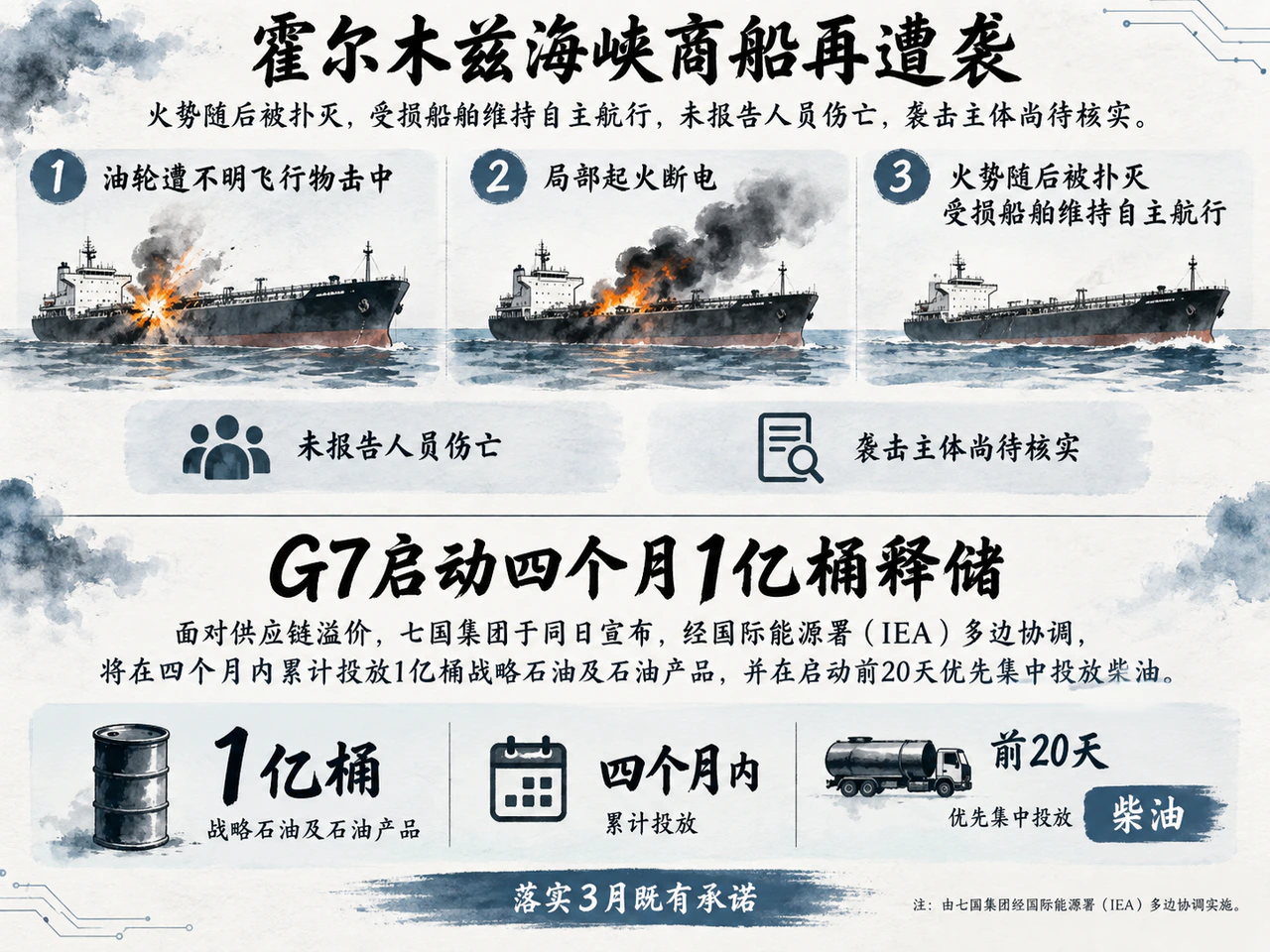
Transport risks in the key waterway received another direct shock. The UK Maritime Trade Operations (UKMTO) said a tanker leaving the Strait of Hormuz on October 2 was hit by an unidentified flying object, causing a localized fire and a total power loss. The fire was subsequently extinguished and the damaged vessel continued under its own power. No casualties were reported and the attacker remained unverified. UKMTO said the incident brought the recent number of attacked merchant vessels in the area to five. The vessel's resumption of navigation avoided an extreme loss, but repeated sudden attacks meant overall transit conditions could hardly be called stable.
Facing supply-chain premiums, the G7 announced that same day that, through multilateral IEA coordination, it would release a cumulative 100 million barrels of strategic oil and petroleum products over four months, concentrating diesel releases in the first 20 days. The official communique explicitly described the release as fulfillment of an existing March 2026 commitment, not an additional net quota outside that mechanism. Reserve supply helps ease marginal fuel shortages, but cannot fundamentally substitute for secure export routes and sustained export capacity.
U.S.-Iran sequencing dispute remains unresolved as related regional clashes continue
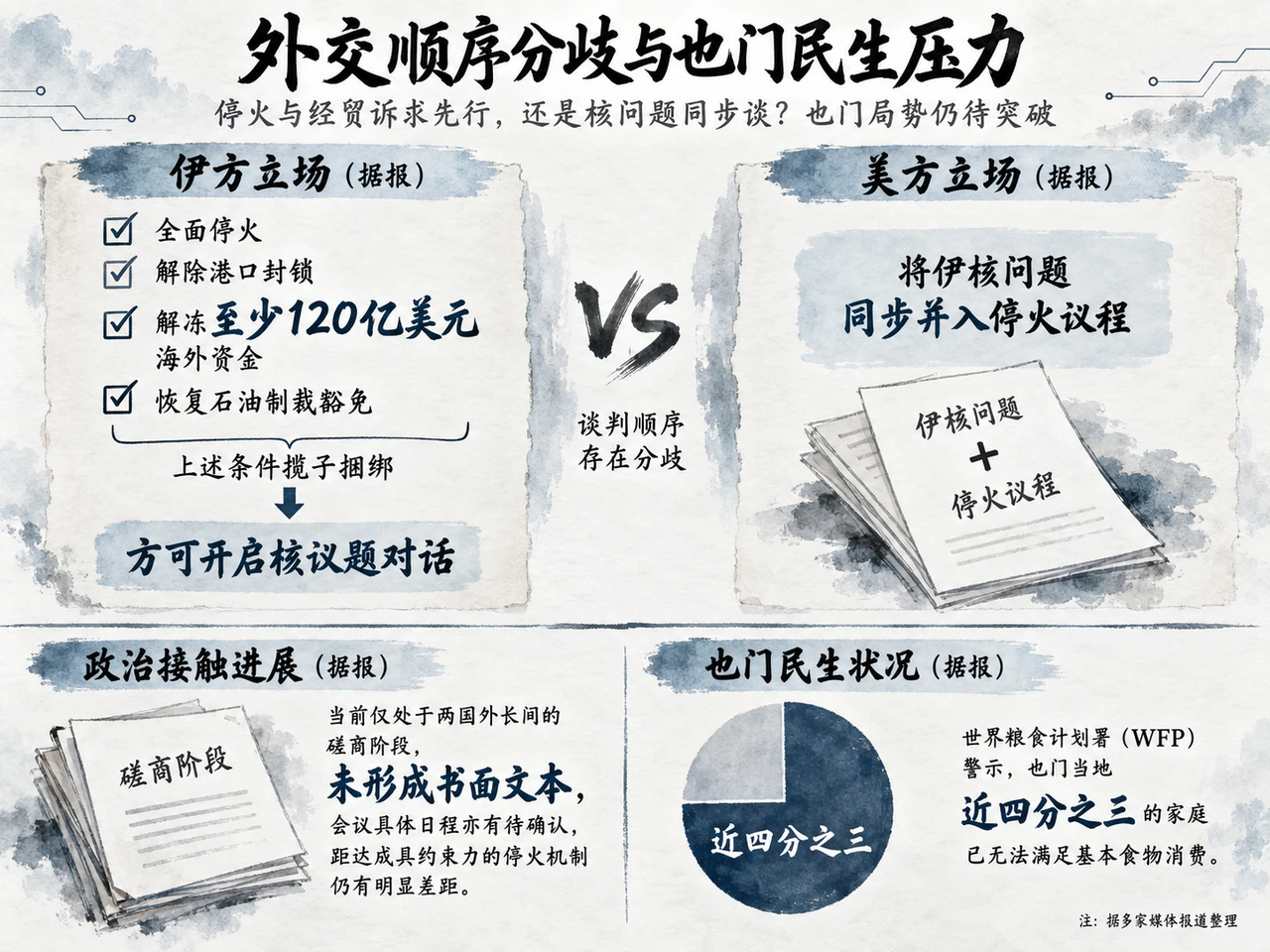
Agenda-setting and the order of implementation remained the central diplomatic obstacle. Iran had transmitted via Qatar a proposal that, if accepted, could reopen the strait and end regional hostilities within seven days, bundling a comprehensive ceasefire, removal of the port blockade, unfreezing of at least $12 billion overseas and restored oil-sanctions waivers. Reuters cited Iranian sources as saying Washington insisted on including the nuclear issue in the ceasefire agenda, while Tehran required economic, trade and unblocking demands to be met before nuclear talks began. Contact channels remained open, but mismatched strategic demands left negotiations deadlocked.
On Yemen, multilateral diplomacy produced limited communication. Pakistan's Foreign Minister Dar confirmed on October 2 that Iran had proposed political consultations to resolve the Houthi issue, with Saudi Arabia, Turkey and Pakistan planning an emergency meeting in Riyadh the following week. Dar stressed that discussions remained at the stage of consultations between two foreign ministers, with no written text and the specific meeting date unconfirmed, still far from a binding ceasefire mechanism.
Related ground fighting continued to intensify humanitarian and defense pressures. The Associated Press reported that Houthi shelling injured several people in a residential area of Taiz, Yemen, on October 2. The World Food Programme (WFP) warned that nearly three-quarters of Yemeni households could no longer meet basic food-consumption needs. Saudi defense authorities said the same day that three ballistic missiles had been intercepted over Khamis Mushait and an unidentified flying object had struck a school in Najran, damaging facilities but causing no casualties.
On nuclear oversight, the U.S. State Department joined several countries in an October 2 statement reaffirming continued implementation of restrictions under existing UN resolutions, blocking cross-border movement of sensitive nuclear-related items and urging Iran to restore full cooperation and compliance with the IAEA. This was diplomatic pressure and a statement of enforcement policy, not evidence of confirmed physical damage to nuclear facilities or a substantive sudden change in nuclear capability.
Key developments
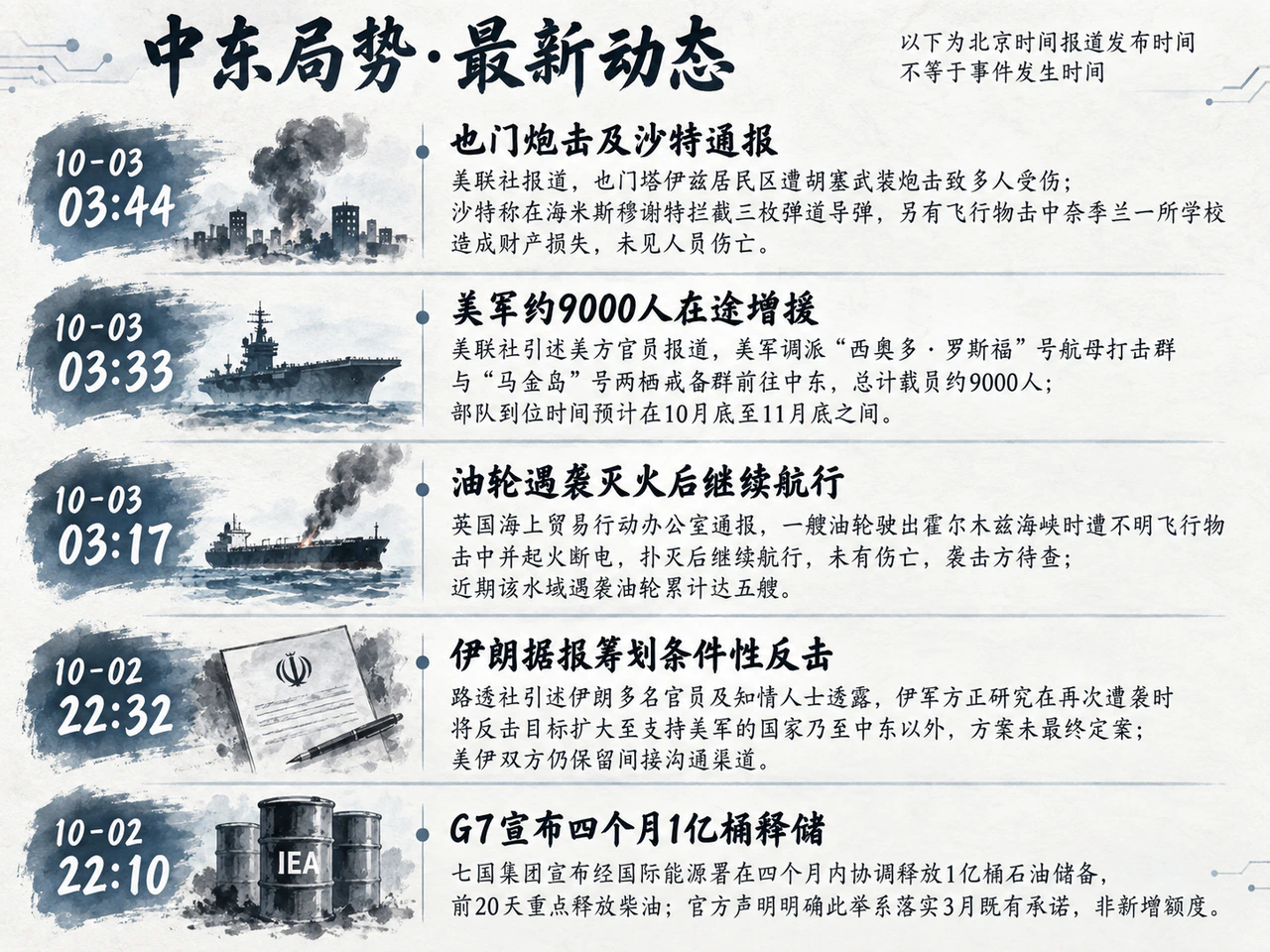
The following entries are in reverse order of report publication time, Beijing time; reporting time is not the same as event time.
| Key developments |
|---|
| 10-03 03:44 Beijing timeThe Associated Press reported several people injured by Houthi shelling in a residential area of Taiz, Yemen. Saudi Arabia said it intercepted three ballistic missiles over Khamis Mushait; another flying object hit a Najran school, causing property damage with no reported casualties. |
| 10-03 03:33 Beijing timeThe Associated Press, citing U.S. officials, reported deployment of the Theodore Roosevelt carrier strike group and Makin Island amphibious ready group toward the Middle East, carrying about 9,000 personnel in total. Arrival was expected between late October and late November. |
| 10-03 03:17 Beijing timeUKMTO reported that an unidentified flying object hit a tanker leaving Hormuz, causing fire and power loss. It resumed sailing after the fire was extinguished; no casualties were reported and the attacker remained under investigation. The recent tally of tankers attacked in the waters reached five. |
| 10-02 22:32 Beijing timeReuters, citing Iranian officials and people familiar with the matter, said Iran's military was studying retaliation against countries supporting the U.S., potentially beyond the Middle East, if attacked again. The plan was not final; indirect U.S.-Iran communication channels remained open. |
| 10-02 22:10 Beijing timeThe G7 announced an IEA-coordinated release of 100 million barrels of oil reserves over four months, emphasizing diesel during the first 20 days. The official statement specified fulfillment of an existing March commitment rather than an additional quota. |