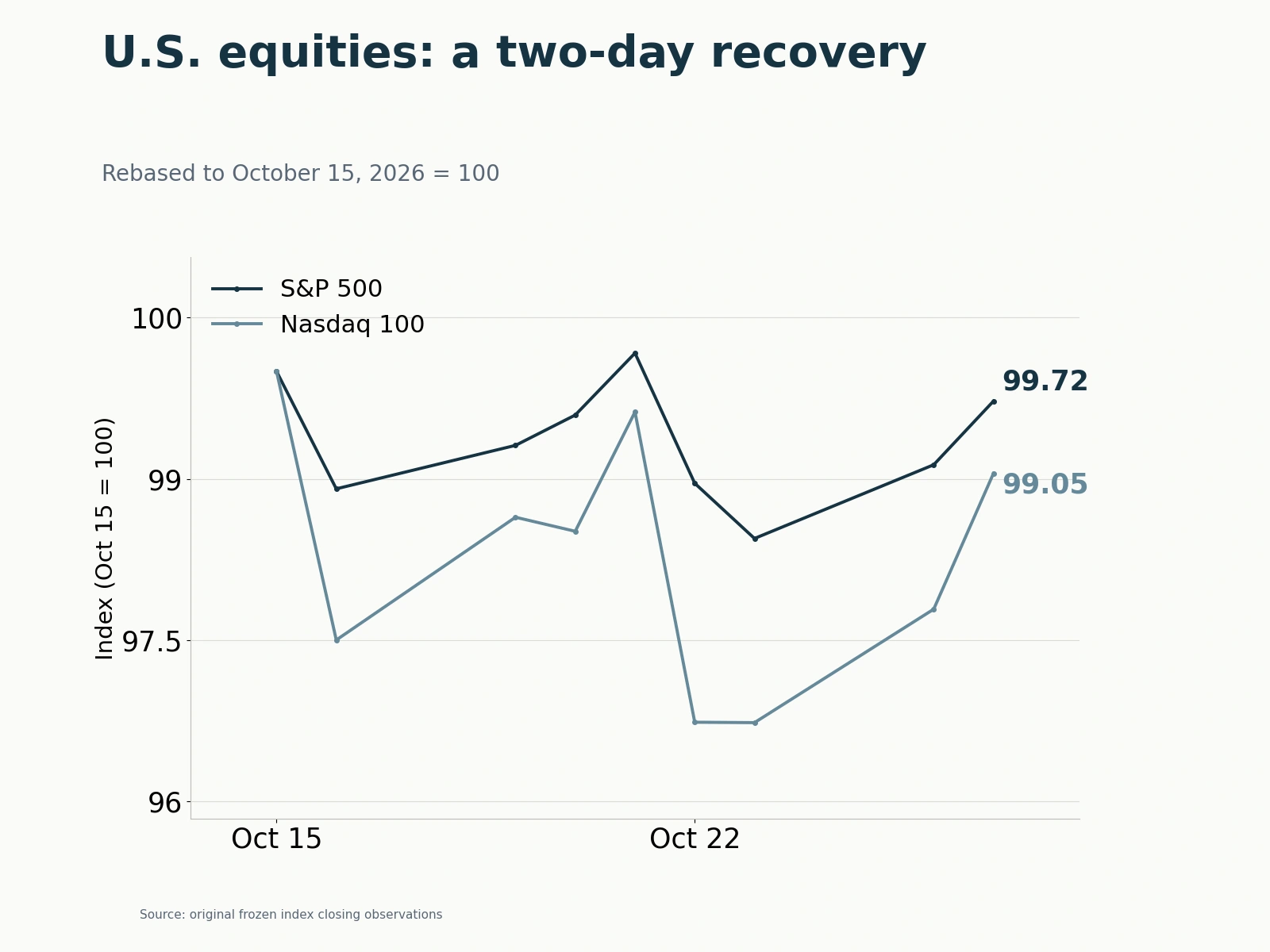
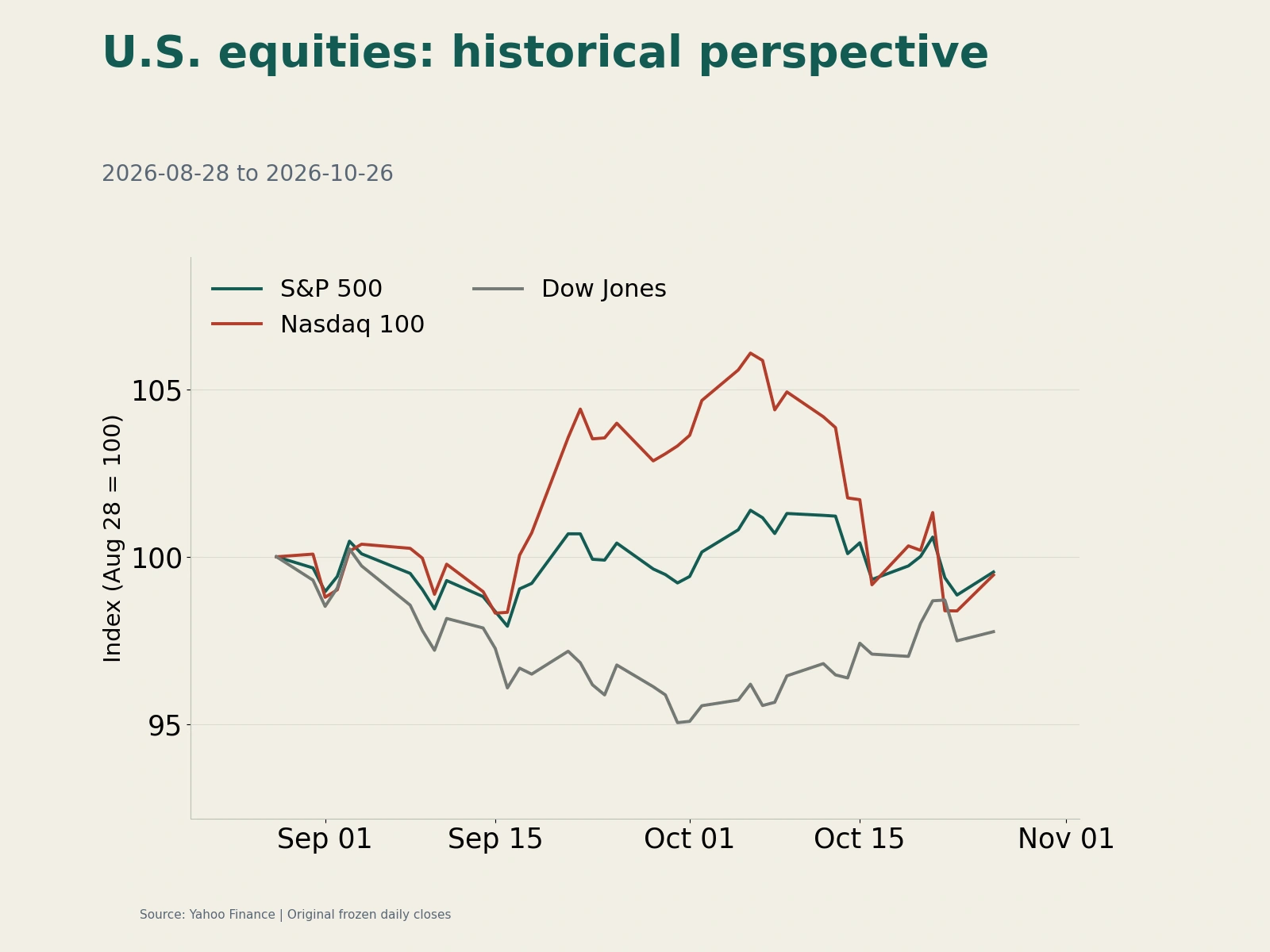
On October 5, 2026, major U.S. equity indices closed higher, crude oil fell about 2%, gold edged up and long-term U.S. Treasuries remained under pressure. Earnings expectations and merger news supported stocks, while improved energy supply pushed oil lower. Service-sector cost pressures and demand for bond financing continued to constrain long bonds. Equity markets' growth expectations strengthened, but long-term financing conditions did not ease in tandem.
This divergence also appeared across sectors and countries. Technology heavyweights led gains, followed by energy and financials, but volume and some internal market indicators did not strengthen together. France's budget dispute raised the risk compensation demanded on its bonds, while Brazil's first-round election results boosted expectations for fiscal adjustment. Earnings delivery, the absorption of financing costs and policy execution were several key threads for understanding the day's moves.
U.S. services continue expanding as cost pressures rise
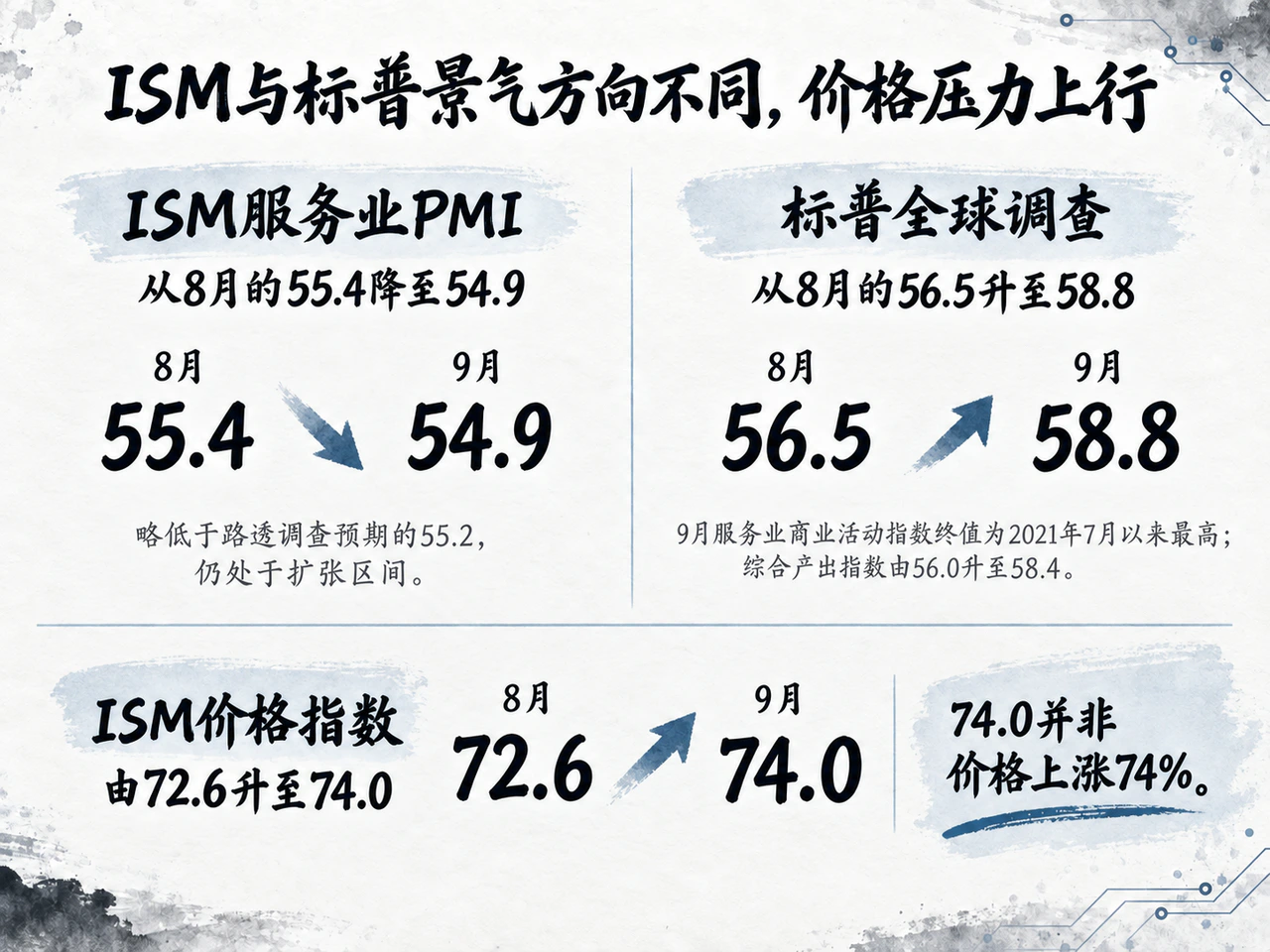
Two U.S. September services surveys released on October 5 gave differing signals on growth rates, but both showed rising cost pressures.
The ISM Services PMI fell from 55.4 in August to 54.9, slightly below the 55.2 expected in a Reuters survey but still in expansion. Business activity fell from 61.7 to 56.5 and new orders from 60.9 to 59.8; employment rose from 47.8 to 50.1 and order backlogs from 55.6 to 56.6. While activity and new-order growth slowed, employment returned to expansion and backlogs increased further.
ISM's prices index rose from 72.6 to 74.0, its highest since July 2022; supplier deliveries increased from 51.3 to 53.2, indicating slower delivery speeds. The prices index measures the distribution of reported price changes: 74.0 does not mean prices rose 74%. ISM said respondents mentioned fuel costs about twice as often as any other individual issue. A construction respondent also said high interest rates continued to constrain homebuyers' financing capacity, with cost pressure and demand constraints present together.
S&P Global's survey instead showed faster growth. Its final September services business activity index rose from 56.5 in August to 58.8, the highest since July 2021, while composite output increased from 56.0 to 58.4. New-order growth accelerated, services hiring grew at its fastest since June 2022, and input costs rose at the quickest pace since November 2022.
The surveys have different samples and index compositions, so their levels should not be compared directly. Despite disagreement over growth's direction, both indicated that services retained expansion momentum and cost pressures had not eased. Reuters quoted Oxford Economics economist Matthew Martin as saying changes in prices, deliveries and backlogs supported further tightening. Barclays economist Jonathan Millar viewed the ISM employment component as consistent with modest fourth-quarter employment growth.
The previous session's weak jobs report reduced bets on further near-term rate increases, while the services surveys reminded markets that inflation remained a constraint. Expectations of a pause thus coexisted with pressure on long bonds. Whether companies can absorb costs through revenue growth or instead need to compress margins or keep raising prices will influence subsequent earnings and inflation.
Long yields rise as this week's $119 billion of Treasury auctions test demand
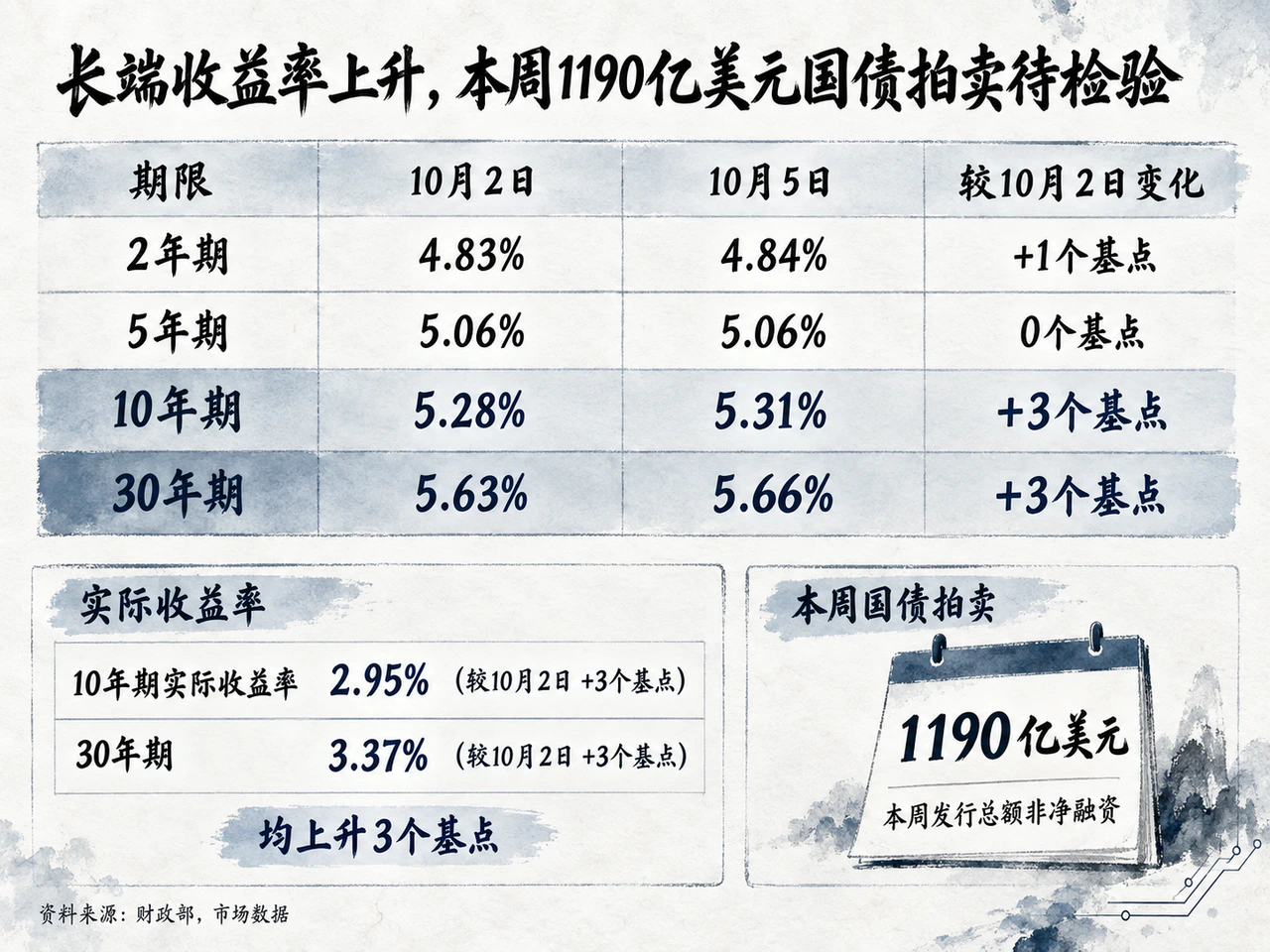
The U.S. Treasury's consistently measured daily yield curve showed October 5's increase concentrated at the long end.
| Maturity | October 2 | October 5 | Daily change |
|---|---|---|---|
| 2-year | 4.83% | 4.84% | +1 basis point |
| 5-year | 5.06% | 5.06% | 0 basis points |
| 10-year | 5.28% | 5.31% | +3 basis points |
| 30-year | 5.63% | 5.66% | +3 basis points |
The 10-year/2-year spread widened from 45 to 47 basis points. The 2-year yield rose only slightly and the 5-year was unchanged, showing no marked increase in expectations of near-term hikes. Larger increases in 10- and 30-year yields suggested that easing short-term policy expectations was not enough to relieve pressure on long-term bond holdings.
Real yields rose in tandem. Treasury data showed the 10-year real yield increasing from 2.92% on October 2 to 2.95%, and the 30-year from 3.34% to 3.37%, both up 3 basis points, matching the corresponding nominal increases. The long-end adjustment therefore could not be attributed entirely to higher inflation expectations. Real yields also include risk compensation; these changes alone cannot distinguish the respective contributions of policy expectations and term premiums.
This week's Treasury auctions would test demand's capacity to absorb supply. The Treasury had announced auctions on October 6-8 of $58 billion of 3-year notes, a $39 billion reopening of 10-year notes and $22 billion of 30-year bonds, totaling $119 billion, all settling October 15. These are gross issuance amounts, not net financing. BBH's October 4 weekly outlook linked global bond selling to the policy path, competition for funds from large technology issuers and sovereign-debt concerns. Whether higher yields attract sufficient buying would be tested by the auction results.
Credit spreads had previously recovered somewhat. ICE BofA data updated October 5 put the October 2 U.S. high-yield option-adjusted spread at 310 basis points, down 14 basis points from October 1, and the investment-grade spread at 85 basis points, down 1. Both remained above September 28 by 8 and 2 basis points, respectively. These figures reflected the preceding Friday's moves. With Treasury benchmarks rising, stable credit spreads would not necessarily reduce issuers' all-in financing costs.
A Hong Kong issuance showed financing channels remained open to some borrowers. BOCOM International disclosed on October 5 that it had completed RMB 1.1 billion and $134 million of subordinated perpetual bond issuance on September 30, subscribed by 20 domestic and overseas investors, including its ultimate controlling shareholder, Bank of Communications. Shareholder support, subordination and perpetual terms made the deal unrepresentative of overall financing conditions. If higher refinancing costs reduce an issuer's incentive to call, investors' actual holding periods may lengthen, combining interest-rate and structural risks.
S&P gains 0.66% as earnings expectations and takeover news support shares
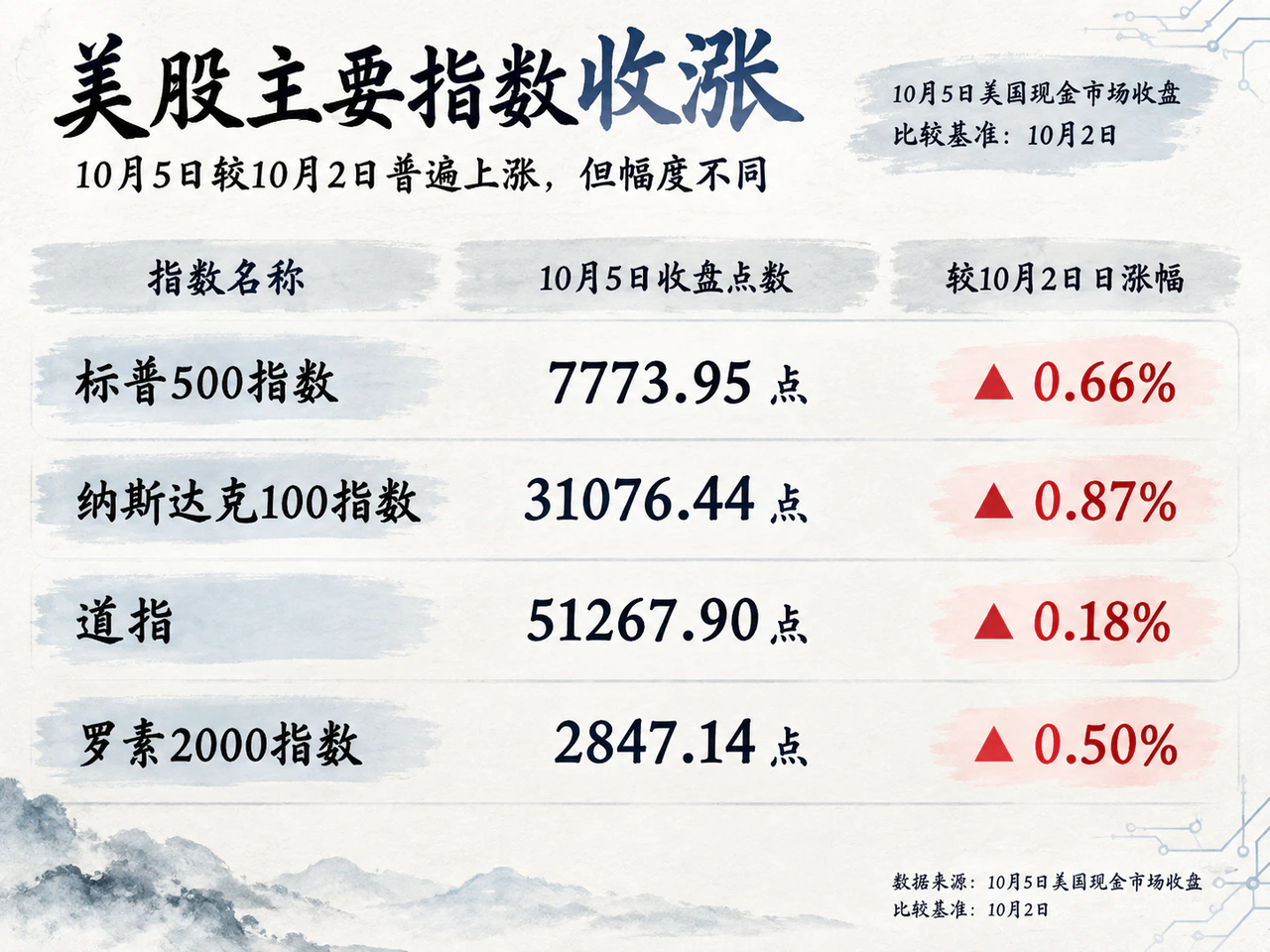
At the October 5 U.S. cash close, the S&P 500 stood at 7,773.95, up 0.66% from October 2; the Nasdaq 100 at 31,076.44, up 0.87%; the Dow at 51,267.90, up 0.18%; and the Russell 2000 at 2,847.14, up 0.50%. Reuters reported Nvidia up 2.1%, Microsoft 1.5%, and Meta and Tesla around 2% each, with technology heavyweights providing important support.
Gains extended to other sectors. Dollar-denominated energy ETF XLE, financial ETF XLF and technology ETF XLK closed up 1.00%, 0.73% and 0.56%, respectively. Energy stocks advanced despite falling oil, showing that the sector did not move in step with that day's crude prices.
There was still divergence beneath the broad gains. Reuters counted advances in 10 of the S&P 500's 11 sectors and an advancing-to-declining constituent ratio of 1.7:1. On Nasdaq, 243 stocks made period lows, more than the 57 making highs. U.S. volume was 16.8 billion shares, below the preceding 20-session average of 17.3 billion, while the VIX rose 0.21 to 15.52. Gains were broad, but volume and some internal measures did not strengthen alongside them.
Earnings expectations supported shares while raising the bar for delivery. Reuters cited LSEG data showing analysts expected S&P 500 third-quarter earnings growth above 30% year on year, mainly from AI-related stocks. CNBC cited a Goldman Sachs October 2 report forecasting 27% annual growth in third-quarter earnings per share. The forecasts had different institutional sources and metric descriptions, and both were expectations. With long-term yields still rising, stocks needed actual revenue, profit and cash-flow growth more than ever.
Takeover news produced sharper differences among individual stocks. Schneider Electric announced on October 5 a proposed all-cash acquisition of PTC at $205 per share, valuing its equity at about $22.6 billion and the enterprise at roughly $23.7 billion, a 42.3% premium to the last preannouncement close. PTC rose around 33% that day. Completion was expected in Q3 2027, subject to shareholder and regulatory approvals.
The buyer faced financing and integration pressure. Schneider planned about EUR 5 billion to EUR 6 billion of equity financing and EUR 16 billion to EUR 17 billion of new debt. CNBC reported its shares had fallen as much as 7.6% after the European open. The target received a takeover premium, while the buyer needed to show returns sufficient to cover financing and integration costs, giving the two share-price responses different foundations.
An after-hours report further highlighted AI investment's funding needs. At 17:47 Eastern time on October 5, Investing.com relayed a Financial Times report that a $60 billion financing arrangement supporting Anthropic's rental of Google chips had begun syndication to other lenders. A $42 billion senior secured loan had Broadcom credit support, while an $18 billion junior tranche without a Broadcom guarantee was expected to follow later. The chips were scheduled for delivery in 2027.
The start of syndication did not mean all financing was complete. Who bears the risk, and the prices at which lenders are willing to take it, would affect subsequent equipment procurement and project returns. Released after the U.S. cash close, this report provided a development to watch in future financing progress.
Oil falls about 2%; gold edges up despite a stronger dollar and higher real yields
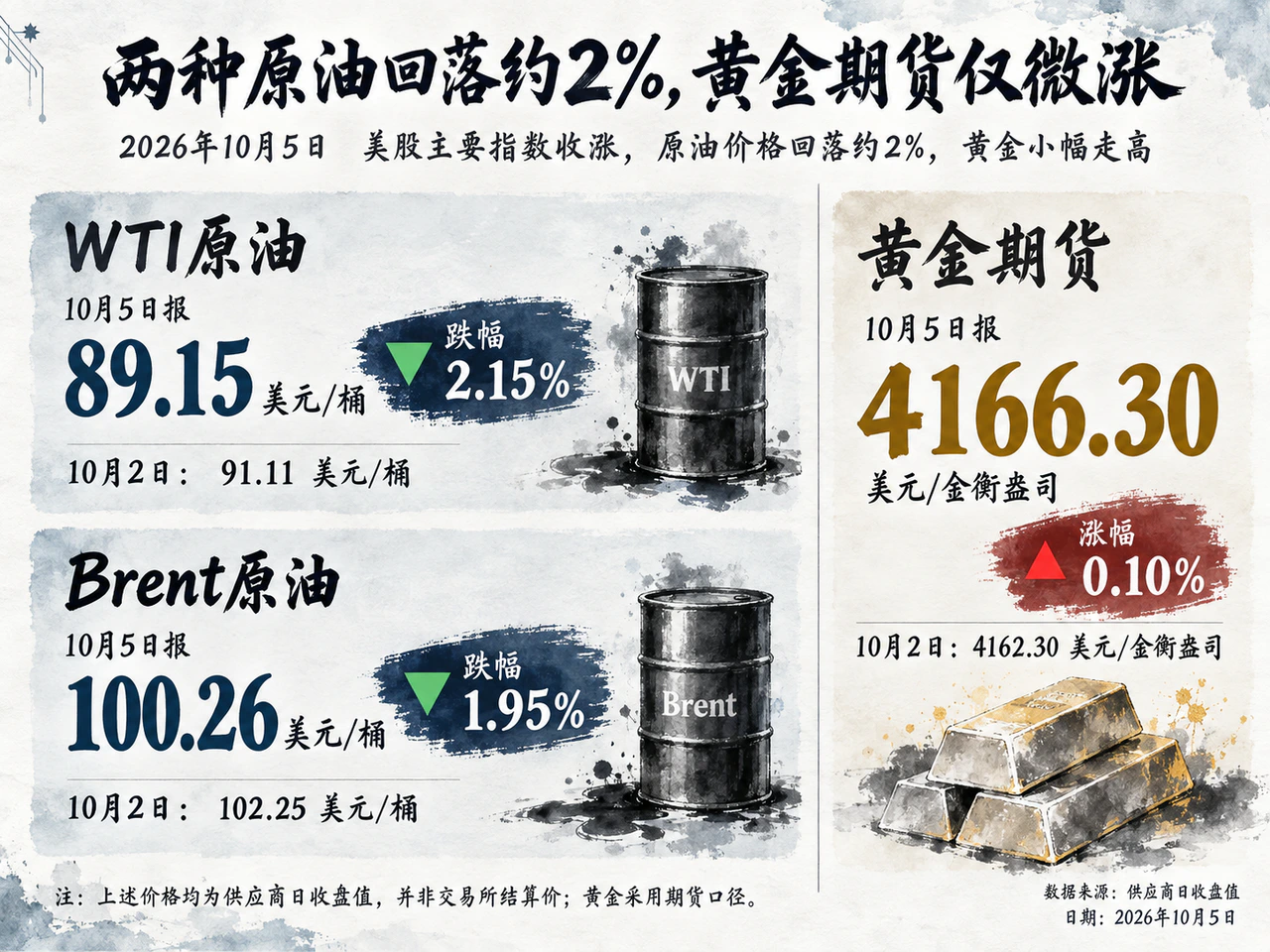
On the continuous-futures provider's daily closing basis, WTI was $89.15 a barrel on October 5, down $1.96, or 2.15%, from October 2; Brent was $100.26, down $1.99, or 1.95%. Gold futures were $4,166.30 per troy ounce, up $4, or 0.10%. All were provider daily closes rather than exchange settlement prices; the gold measure was futures.
Improved available supply was an important reason for oil's decline. Reuters reported on October 5 that Middle Eastern crude exports exceeded prewar levels on four of September's final seven days. The G7's October 2 agreement to release a combined 100 million barrels of crude and diesel from emergency reserves also eased near-term supply concerns. Raymond James analyst Pavel Molchanov cautioned that the extent of overlap with the remaining portion of March's 400 million-barrel release plan was unclear. The amounts cannot simply be added, and pledged releases are not completed deliveries.
Supply recovery remained incomplete. Seven core OPEC+ members decided on October 4 to leave November production targets unchanged. Reuters, citing OPEC data, said their August output was 25 million barrels a day, up 630,000 from July but still about 5 million below February's prewar level. Recovering exports on some individual late-September days did not imply a complete recovery in production and supply chains. Falling oil helps ease new energy-cost pressure but does not immediately remove the existing burdens described in September business surveys.
Gold was influenced by opposing forces. The dollar index rose 0.17% to 102.102 on the provider's daily closing basis, while the 10-year real yield also increased, both weighing on gold. Reuters' gold report linked support to reduced expectations of near-term rate increases, and UBS analyst Giovanni Staunovo identified rising government debt as structural support. Gold's small gain that day was insufficient evidence of large-scale safe-haven inflows.
France's budget dispute pressures bonds; Brazil's election results lift equities
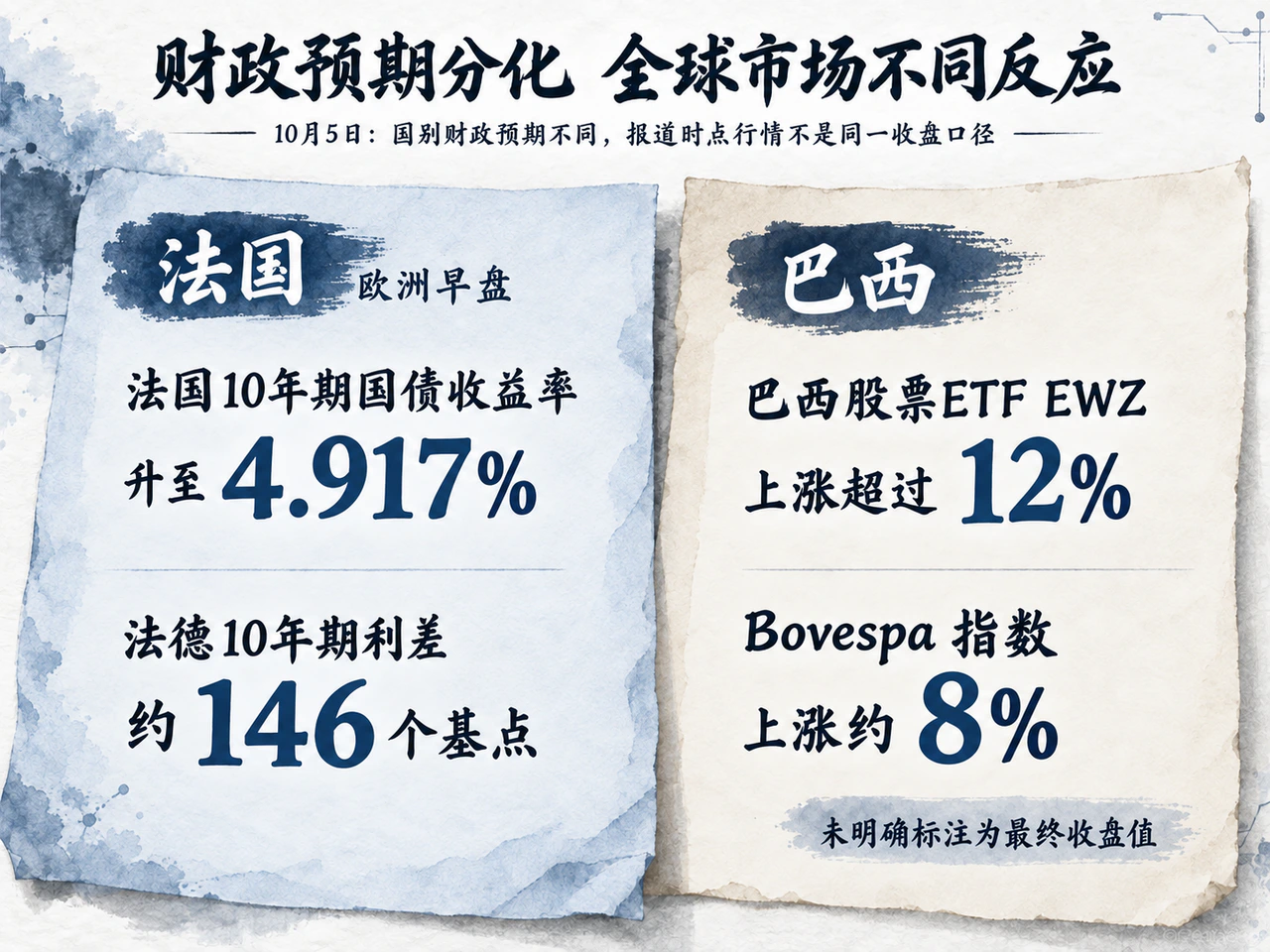
Pressure on French assets stemmed from budget execution. Reuters reported on October 5 that the government was seeking passage of the 2027 budget, with parliamentary divisions making implementation harder. Euronews described a fiscal target of reducing the deficit from 5.4% of GDP to 5%. Citing LSEG, it said France's 10-year yield reached 4.917% in early European trading, with the French-German 10-year spread around 146 basis points. Fiscal adjustment remained to be implemented, and early bond performance reflected investors demanding greater compensation for France's fiscal path.
That same day, Spanish Prime Minister Sanchez called an early election for November 29 after parliament rejected housing measures. Euronews reported Spain's 10-year yield broadly holding at 4.07%-4.09% that morning, with a spread over Germany of around 65 basis points. The election increased policy uncertainty, but Spanish bonds had not at that point experienced pressure comparable with France's.
Brazilian equities rose sharply after first-round election results. Brazil's Superior Electoral Court reported that as of 00:11 local time on October 5, with 99.99% of ballot boxes counted, Flavio Bolsonaro had 47.03% of valid votes and Lula 45.16%, sending both to an October 25 runoff. At the time of CNBC's report that day, Brazil equity ETF EWZ was up more than 12% and the Bovespa around 8%. Neither gain was explicitly identified as a final closing figure.
The reaction centered on the possibility of future fiscal adjustment. UBS Global Wealth Management's Brazil chief investment officer Luciano Telo said the first round increased the likelihood of adjustment over the coming years, but the final result was undecided and the choice of economic team remained an important signal. Ace Capital chief investment officer Fabricio Taschetto warned of possible short-term overreaction, with the real challenge in policy execution. Prices reflected changing expectations; fiscal improvement still needed to materialize.
Trade and sanctions policies also shaped cross-border business conditions. Indian Finance Minister Sitharaman said on October 5 that India-U.S. trade talks had reached a plateau and further concessions were difficult, although negotiations continued. Exporters' access to improved market entry still depended on final tariff rates, product coverage and implementation dates.
A Reuters report published after the U.S. equity close also said the U.S. Treasury had warned that foreign financial institutions continuing to transact with sanctioned Iranian financial institutions could face sanctions without prior notice. This warning directly concerned cross-border settlement and correspondent-account risks; it was not enough to conclude that crude supply had already decreased.
Asian technology depends on orders; domestic-demand improvement depends on actual transactions
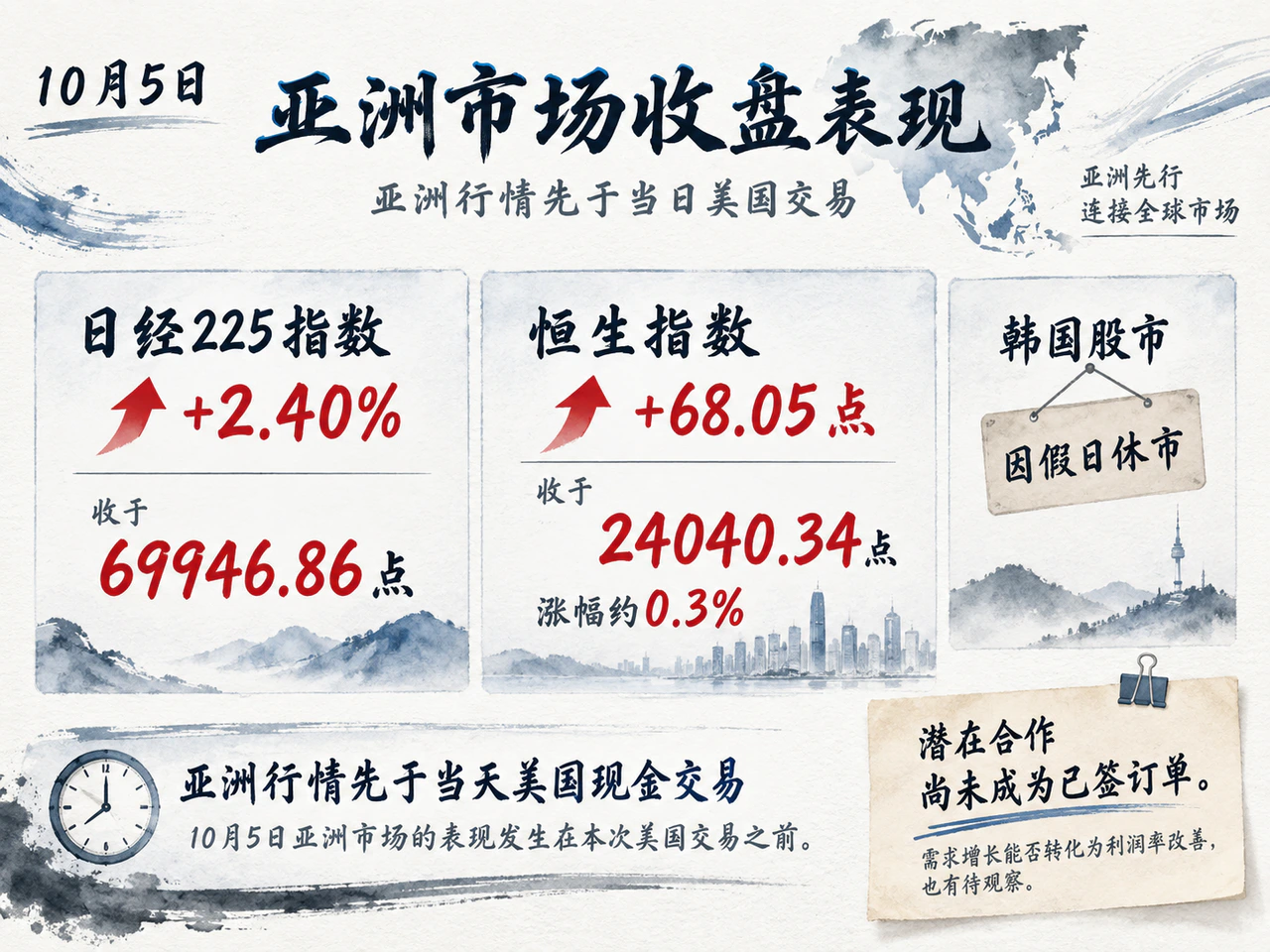
As of 07:31:51 Beijing time on October 6, Hong Kong, Japan and South Korea had not begun regular stock trading. October 5 Asian performance preceded this U.S. cash session: CNBC and Baystreet closing reports put the Nikkei 225 up 2.40% at 69,946.86; Baystreet reported the Hang Seng up 68.05 points to 24,040.34, about 0.3%; South Korea was closed for a holiday. These moves therefore cannot be treated as responses to the subsequent U.S. close.
Expectations for U.S. AI investment can influence Japanese semiconductor equipment, South Korean memory and related technology assets, but actual benefits still depend on customer allocation, procurement and capital spending. In an October 5 review of TSMC developments, TrendForce noted that Musk's response to possible TSMC participation in the Terafab project remained at the discussion stage. TSMC's October 15 earnings briefing would also face questions on capacity expansion, depreciation and overseas construction costs. Potential cooperation had not become signed orders, and whether demand growth would improve margins remained to be seen.
In China, new information during the observation period mainly concerned holiday consumption and feedback on housing-policy implementation. Xinhua reported on October 4, citing the Ministry of Commerce, that during October 1-3 foot traffic and sales in 78 monitored pedestrian streets and commercial districts rose 3.4% and 5.3% year on year. Consumer-goods trade-in programs generated RMB 19.63 billion in sales, benefiting 3.483 million instances of participation. Related automobile, appliance, and digital and smart-product sales were RMB 7.45 billion, RMB 6.50 billion and RMB 4.90 billion, respectively. These data showed active trading in key consumption settings, but policy-related sales were not all incremental consumption.
For housing, an interest-subsidy policy announced September 29 and implemented October 1 reduced eligible households' financing burden through fiscal coverage of part of their interest. It applied to newly issued commercial loans for first-home purchases of no more than 120 square meters and no more than RMB 1.5 million in total price. The subsidy was an annualized 1 percentage point on loan principal for up to 5 years, with a maximum eligible loan of RMB 1 million per household, excluding refinancing of existing loans. The policy's provisional one-year implementation period differed from the maximum five-year subsidy period for an individual loan.
In Securities Times' October 5 on-the-ground Shenzhen report, some agents described recovering inquiries and transactions, while reporters observed uneven demand across new developments and some buyers still viewing properties and comparing prices. Liu Yu's policy analysis argued that support was concentrated more directly in low- and mid-total-price homes and secondhand transactions, with relatively limited stimulus to investment in new-home development.
Whether lower monthly payments produce sustained additional transactions still depends on household income expectations, housing supply and demand, and banks' implementation. Assessing whether related assets' earnings foundations improve requires observing actual transactions after policy implementation. For Asian technology supply chains, AI investment expectations likewise need to translate into orders, revenue and cash flow.