On October 5, international crude prices fell under pressure as some of the previously priced geopolitical supply premium narrowed. Structural problems in refined-product shortages and logistics remained severe. Recovering Middle Eastern crude exports, lower Saudi official selling prices for Asia and the G7's coordinated reserve-release arrangements together drove the day's decline. These marginal supply changes, however, mainly improved tradable upstream crude flows rather than signaling a return to normal in downstream fuel supply chains.
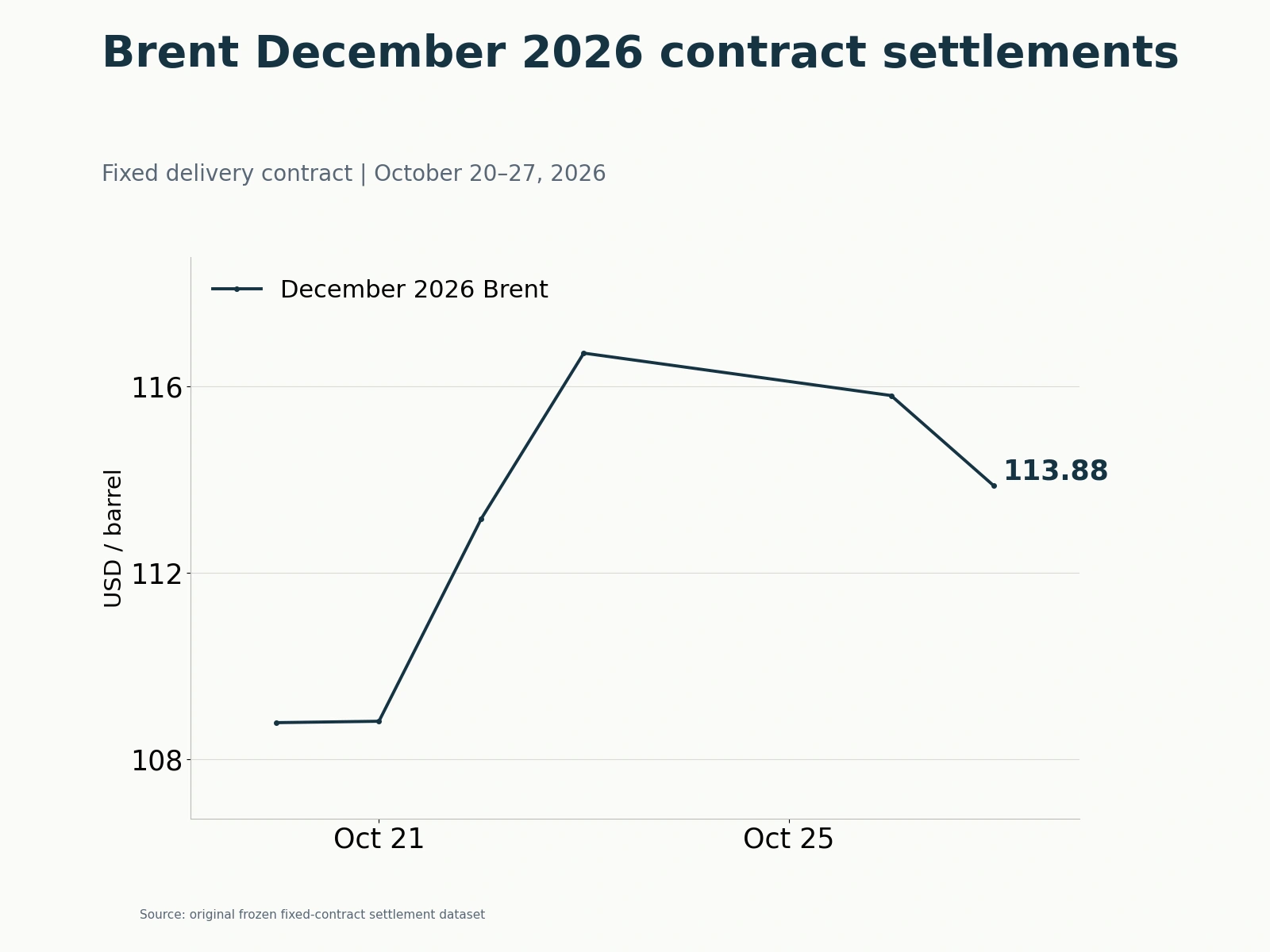
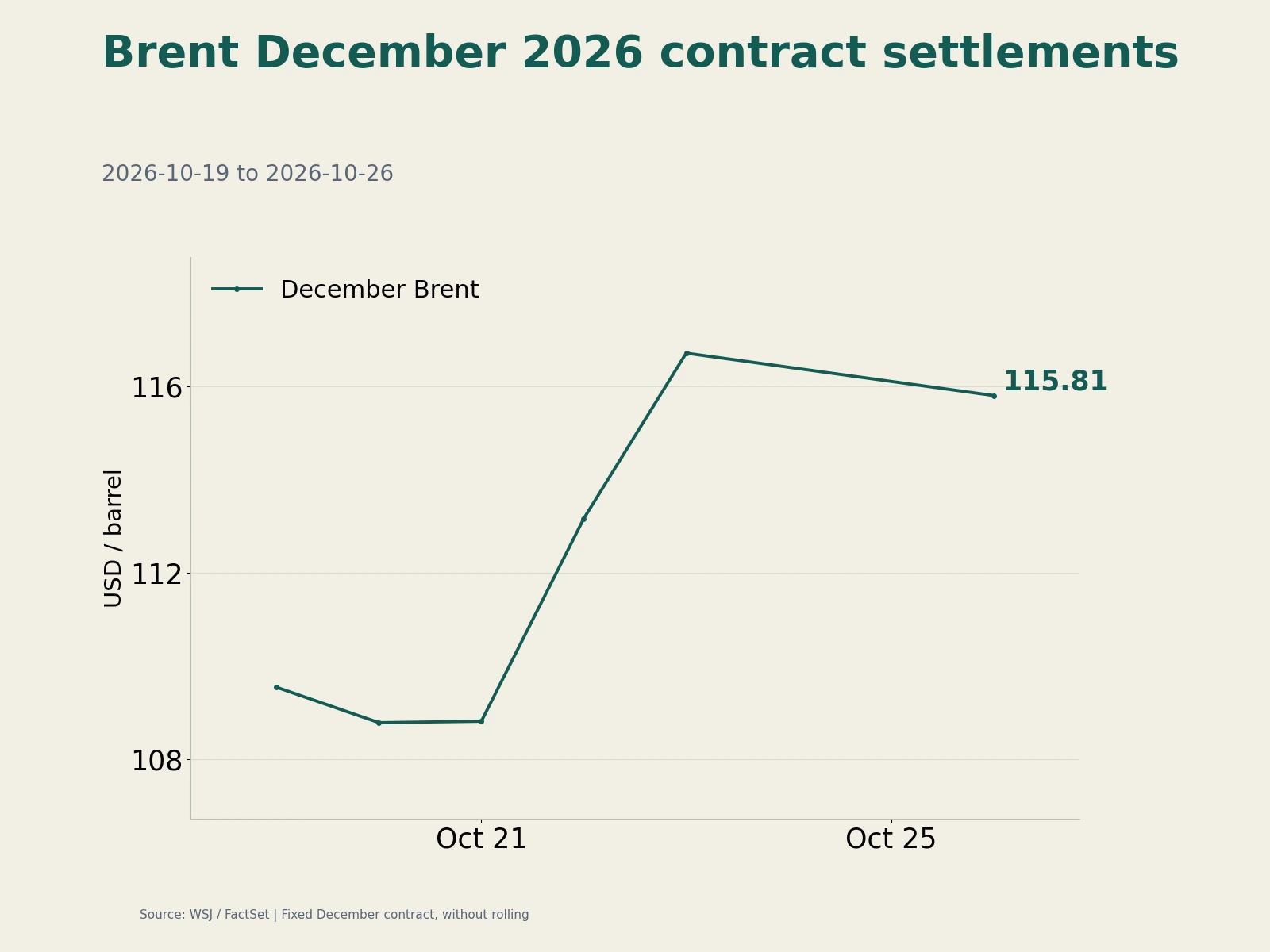
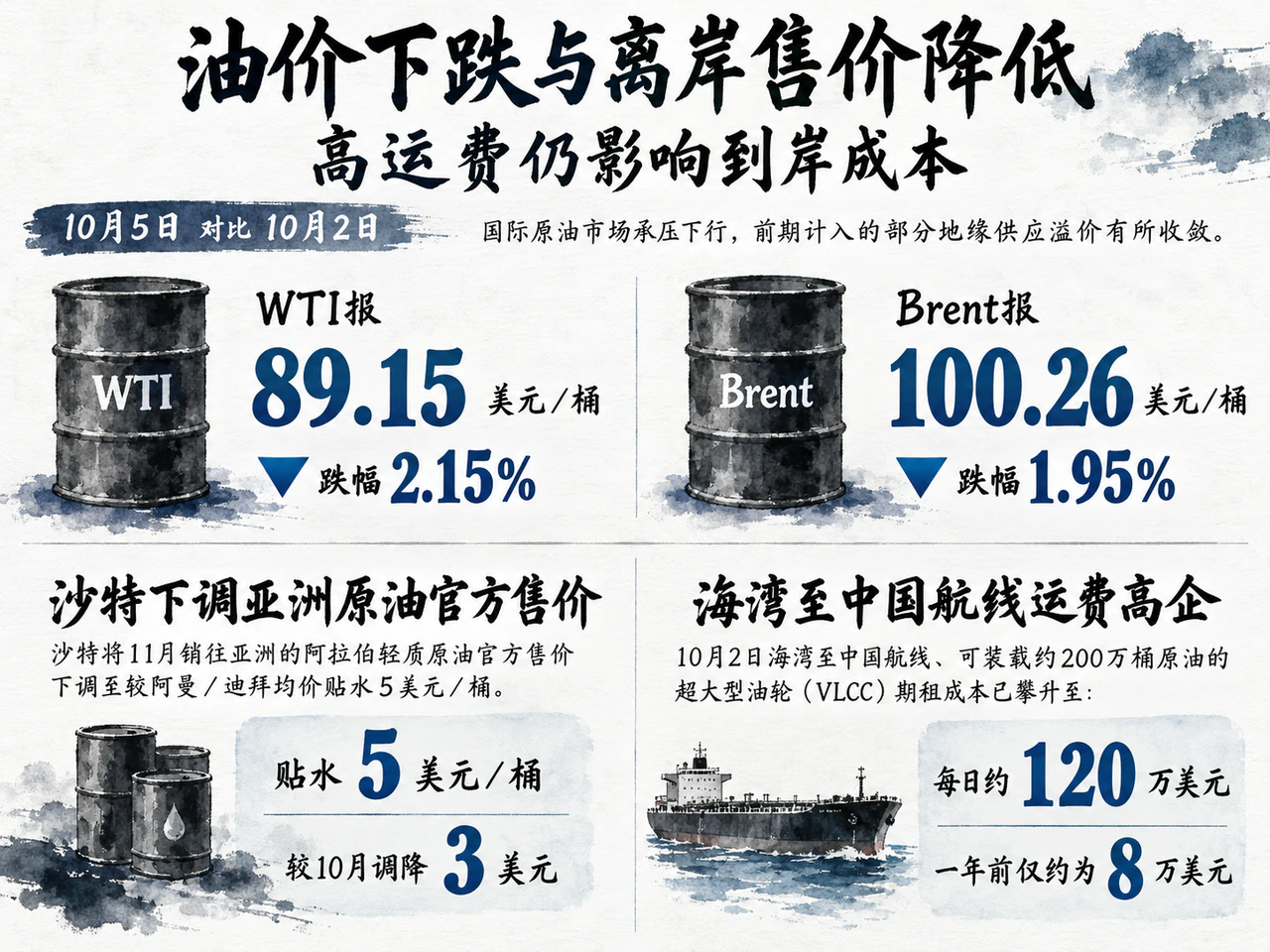
On Yahoo's supplier daily-close basis for continuous contracts, WTI was $89.15/barrel, down $1.96, or 2.15%, from October 2; Brent was $100.26/barrel, down $1.99, or 1.95%. Nearby futures settlements also fell. Qatar News Agency reported settlements of $89.43 for November 2026 WTI and $100.32 for December 2026 Brent, down 1.84% and 1.89% respectively.
Middle Eastern exports exceed prewar levels and Saudi discounts widen, but expensive freight absorbs lower loading prices
Reuters reported on October 5, citing shipping data, that Middle Eastern crude exports exceeded prewar levels on four of September's final seven days. More physical crude was therefore returning to international markets, but this did not mean production capacity or all damaged shipping routes had normalized. At their October 4 meeting, seven participating OPEC+ countries decided to maintain November required production at the level set for September 2026, with no additional production quota. Monday's incremental supply mainly came from recovering exports and inventory use.
Producer pricing adjustments amplified bearish expectations. Official pricing documents obtained by Reuters showed Saudi Arabia reducing its November Arab Light official selling price for Asia to a $5/barrel discount to the Oman/Dubai average, $3 below October and the widest discount since June 2020. Elsewhere, Saudi Arabia raised prices for all grades to northwest Europe by $3/barrel and left US prices unchanged, demonstrating pronounced regional differentiation.
The large Asian reduction could not simply be attributed to a collapse in final demand. Three Asian refining sources told Reuters that it mainly aimed to offset surging shipping costs. Citing LSEG data, the report said the daily time-charter cost for a Gulf-to-China very large crude carrier (VLCC) capable of loading around 2 million barrels had reached approximately $1.2 million on October 2, versus only around $80,000 a year earlier. Expensive freight could offset the benefit of lower free-on-board (FOB) crude prices. Whether buyers ultimately paid less on a landed basis depended heavily on actual freight rates and port demurrage delays.
The G7 also announced on October 2 that an IEA-coordinated release of 100 million barrels of strategic reserves would take place over four months, with substantial diesel volumes concentrated in the first 20 days. Markets continued digesting the news on Monday. The pledged amount was not entirely incremental, however. Bloomberg explicitly reported that the plan included previously committed but undelivered releases, with the precise split between old and new pledges still unclear. Strategic releases could bring supply forward, but could not replace the physical repair of damaged refining units.
Brent's nearby premium holds at $2.74 as diesel draws and refining bottlenecks expose a divided supply picture
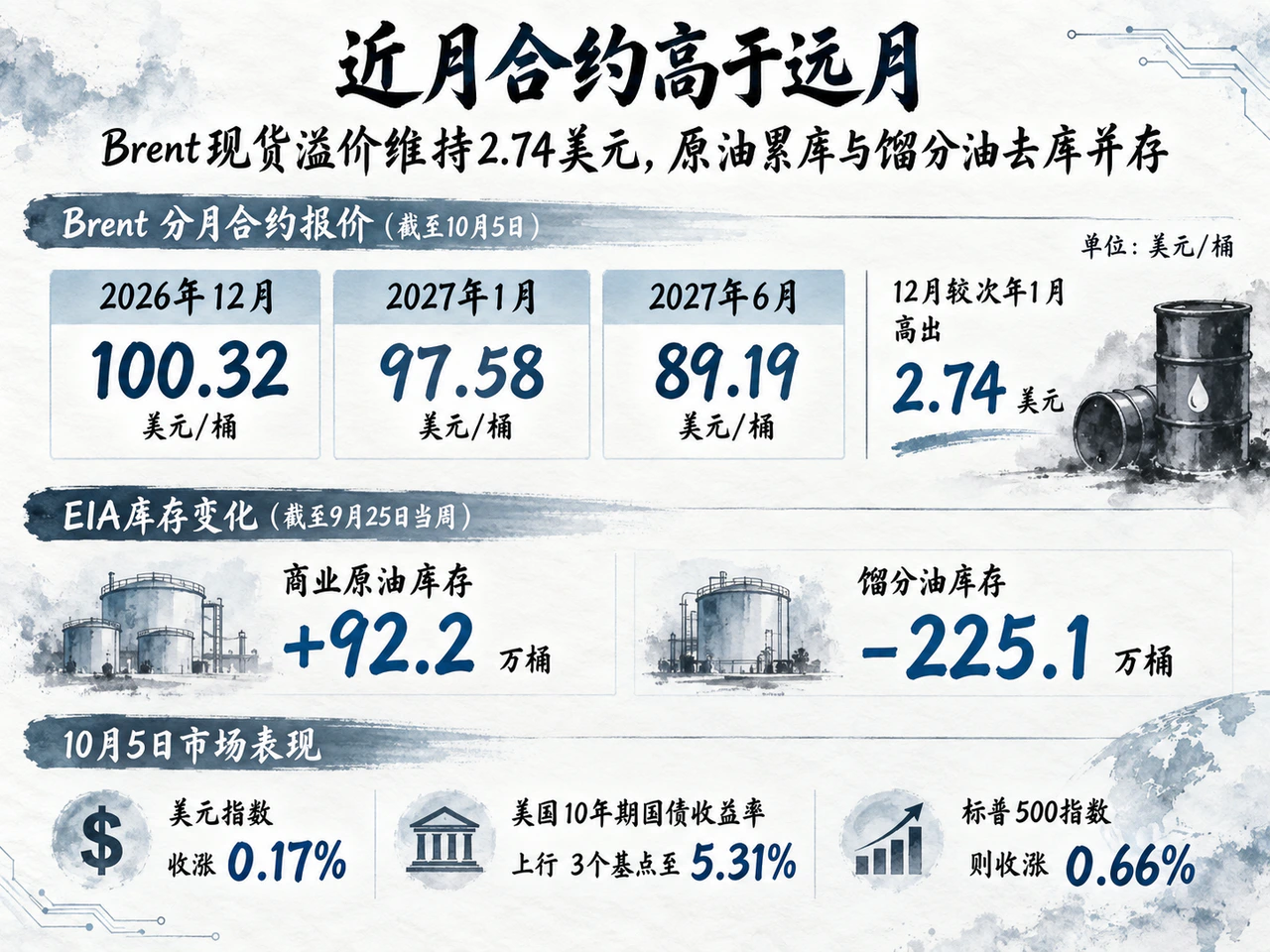
The crude curve showed that near-term physical tightness had not reversed. Investing.com's delivery-month quotations as of October 5 put December 2026, January 2027 and June 2027 Brent at $100.32, $97.58 and $89.19/barrel respectively. December remained $2.74 above the following January, a typical backwardated structure. The downward-sloping curve showed that the market was not extrapolating extreme shortages linearly into next year, while also confirming that current nearby supply was far from abundant.
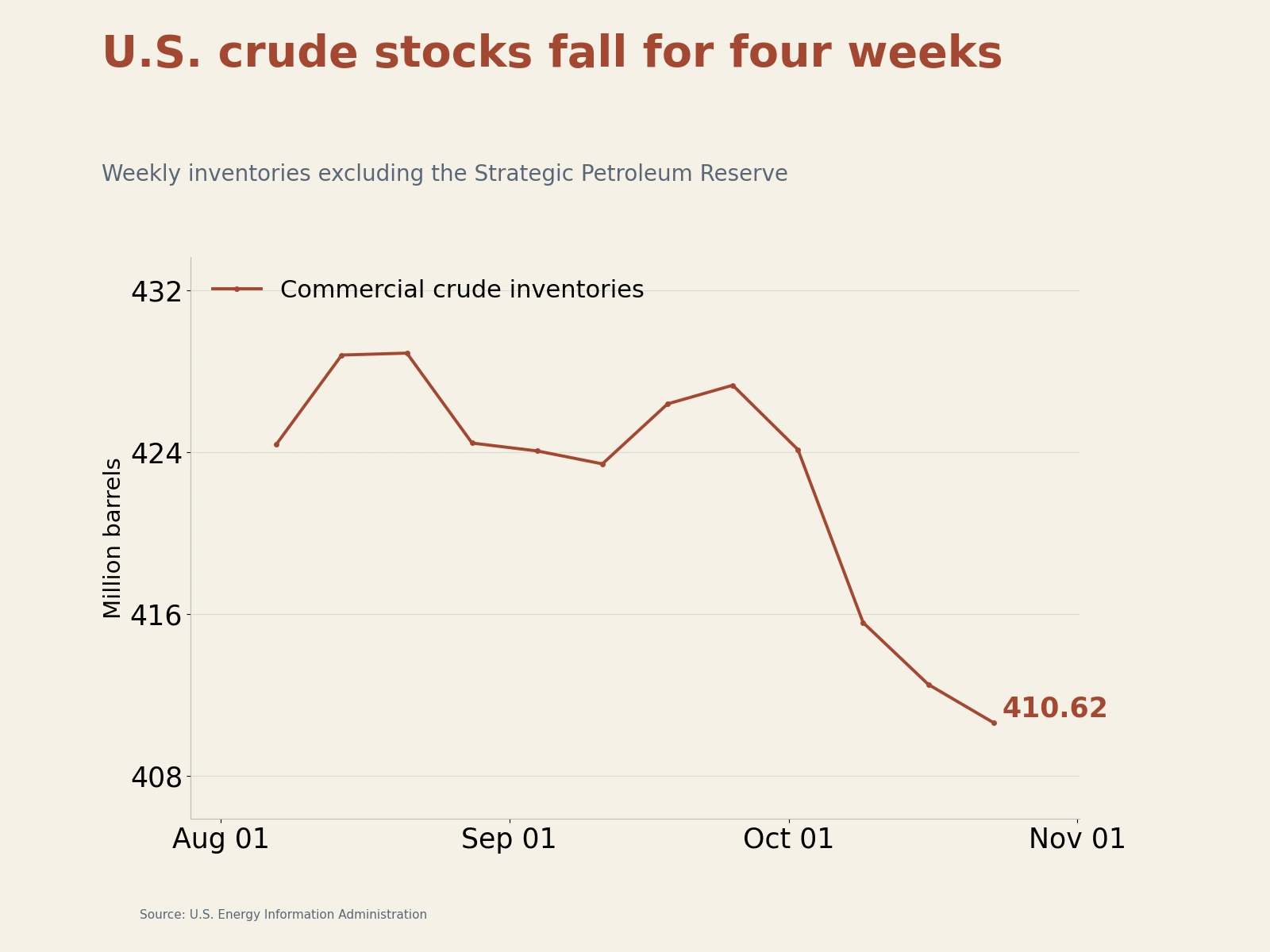
Official US inventory data further illustrated the divide between crude and refined-product fundamentals. EIA figures for the week ended September 25 showed commercial crude stocks rising 922,000 barrels to 427.32 million, gasoline stocks falling 1.684 million and distillates dropping 2.251 million to 105.18 million barrels. Crude builds alongside rapid product draws suggested that bottlenecks had concentrated in refining. Aggregate crude volumes alone could therefore understate actual downstream fuel shortages.
Views within the industry differed substantially on recovery prospects. In London on October 5, Saudi Aramco CEO Nasser said that even if Hormuz fully reopened, rebuilding global inventories while meeting daily consumption could take two years. Kuwait Petroleum's head also emphasized the urgency of restoring refinery output. In contrast to supply-side caution, ConocoPhillips executive chairman Lance suggested that global demand suppressed by this year's crisis might not recover until 2028 or 2029. These different assessments of supply and demand highlighted uncertainty over the rebalancing path.
Macro-financial conditions added another disturbance. On October 5, the dollar index closed up 0.17%, the US 10-year Treasury yield rose 3 basis points to 5.31%, and the S&P 500 gained 0.66%. Equities and bonds did not display broad risk-off liquidation, so oil's fall was difficult to explain solely through avoidance of systemic macro risk. A stronger dollar marginally increased non-US buyers' costs, but the main drivers remained recovering exports, Saudi discounts and prospective reserve releases temporarily easing expectations of physical scarcity.
If the recovery remains confined to crude trade flows while diesel stocks continue falling and shipping rates stay high, the price retreat represents only short-term relief in crude. Sustained supply-chain recovery requires crude passage, shipping turnaround and refinery operations to improve together. Four groups of signals warrant close attention:
- The durability of recovering Middle Eastern crude exports, and whether tanker rates and port waiting times peak and begin falling;
- Actual diesel deliveries in the first 20 days of the G7 release, and the share that is truly additional;
- Whether distillate inventories stabilize in the latest EIA weekly data due October 7;
- Whether Brent's nearby premium—the December spread over the following January—continues narrowing.