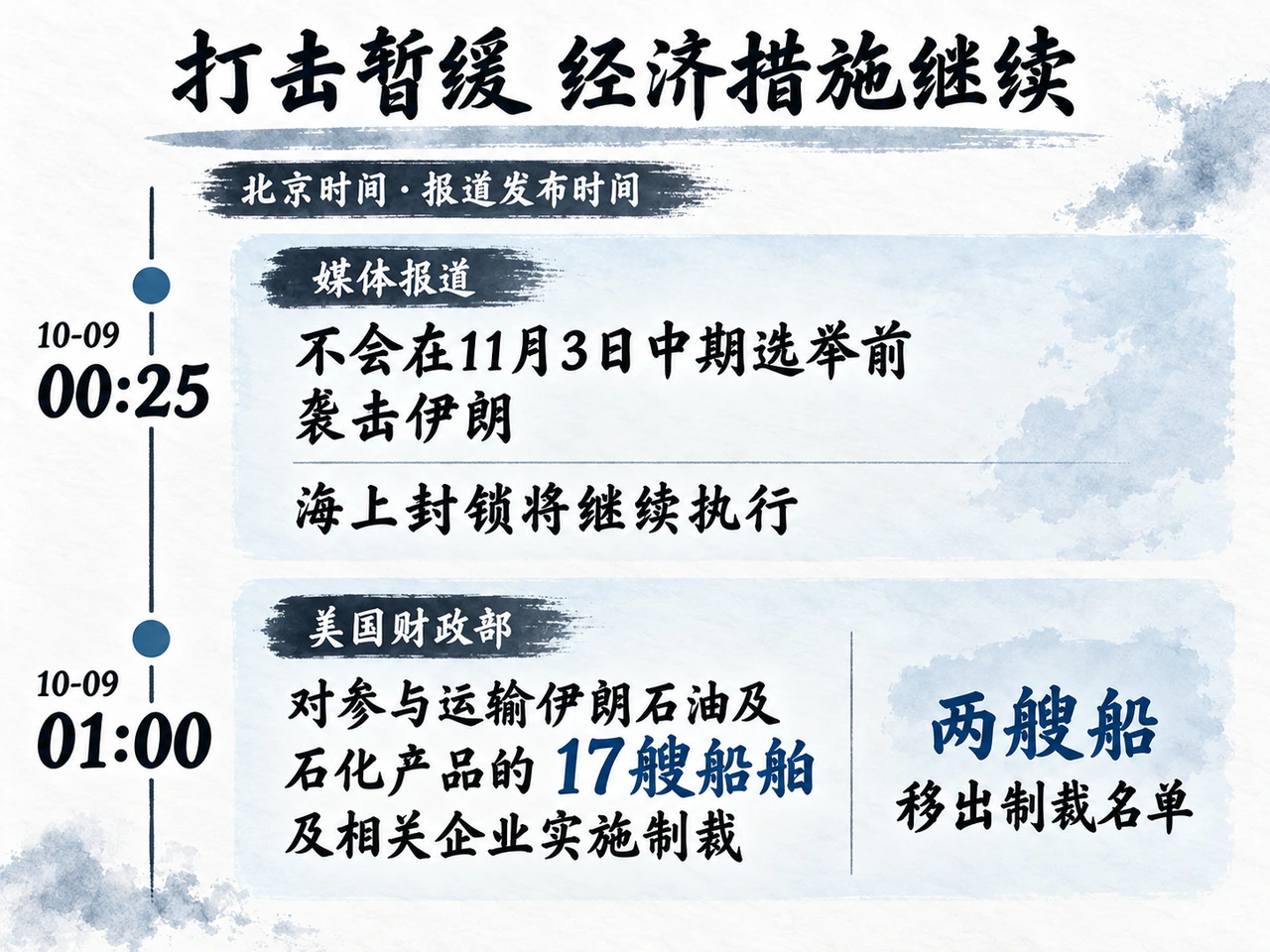
By the morning of October 9 Beijing time, U.S.-Iran confrontation had entered a tactical adjustment. Trump publicly said the United States would not directly strike Iran before the November 3 midterm elections and called current discussions 'productive.' Delaying strikes brought no easing of economic pressure: he explicitly said the blockade of Iranian ports would continue. The U.S. Treasury also sanctioned 17 vessels and associated entities suspected of carrying Iranian crude, petroleum and petrochemicals, while delisting two vessels whose ownership and operations had changed. Washington continued using reduced oil revenue as negotiating leverage.
Iran combined diplomatic contact with security deterrence. Foreign Minister Araghchi said October 8 that Tehran was reviewing the U.S. reply to its proposal and might formally respond within days. Iran's earlier proposal offered to reopen Hormuz within 7 days if its conditions were met. Nuclear differences remained sharp: Atomic Energy Organization head Eslami said Iran would never halt enrichment or surrender its uranium stockpile. Talks on opening maritime routes advanced, constrained by underlying political and security disputes.
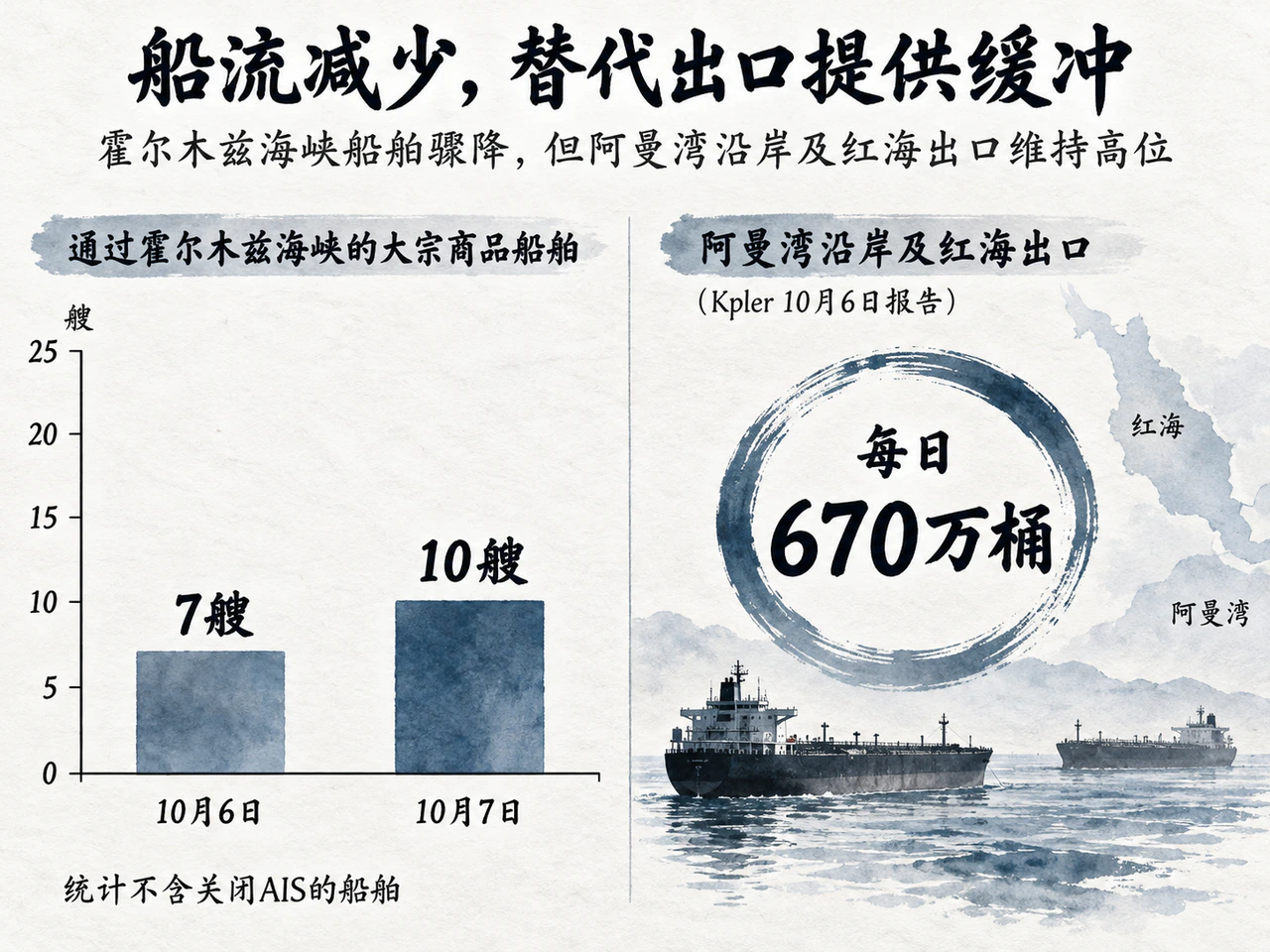
Hormuz commodity traffic falls to single digits; 6.7 million barrels a day of alternative exports provide support
Navigation security is the central channel linking diplomacy to oil markets. Reuters cited regional officials and diplomats on October 8 as saying Iran warned neighboring countries that unauthorized oil export routes would be considered hostile, retaining missiles, drones and ships as deterrents. In a separate October 8 Reuters report, maritime-security sources said the chemical tanker Acers was hit by several projectiles north of Qatar, slightly injuring crew. Actual incidents further reduced shipowners' willingness to transit.
Traffic through the critical route contracted sharply. Kpler recorded just 7 commodity vessels passing Hormuz on October 6, the lowest since July 23, recovering only to 10 on October 7, well below the more-than-20 daily norm on the preceding Sunday and Monday. Vessels with AIS off are excluded. Kpler's October 6 report also showed crude flows through the strait down 27% from the prior week's wartime high, to at least 10.1 million barrels a day. Regional exports did not fall equally sharply: Gulf of Oman coastal and Red Sea routes rose to 6.7 million barrels a day, cushioning shipments and temporarily maintaining overall Middle Eastern crude exports at prewar levels.
Houthis claim Riyadh airport strike as an airliner is damaged; spillover reaches civil aviation
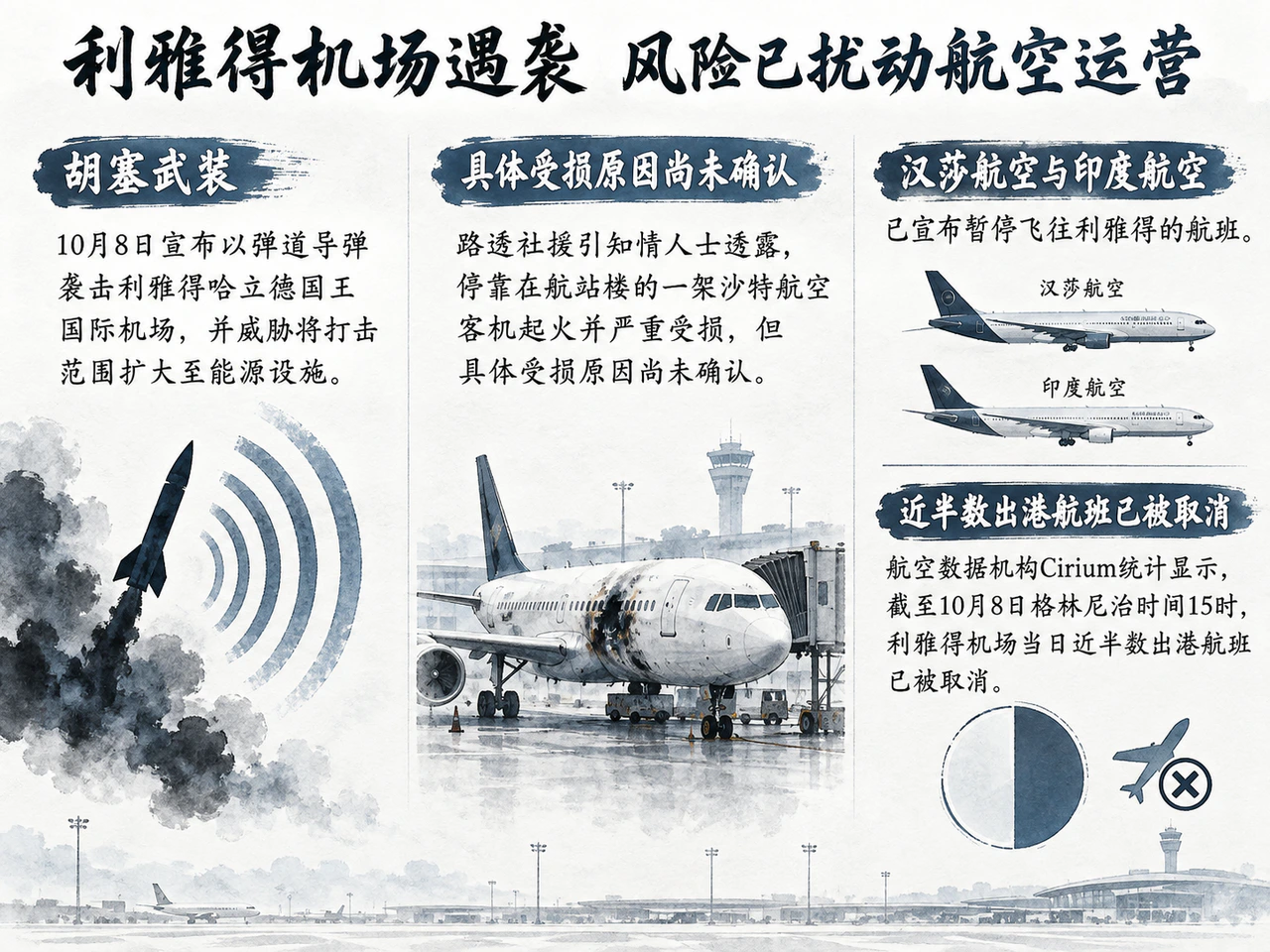
Alongside Gulf maritime pressure, Yemen-front spillover spread inland to core civilian facilities. The Houthis said October 8 they attacked King Khalid International Airport in Riyadh with ballistic missiles and threatened energy facilities. Reuters sources said a Saudia aircraft parked at a terminal caught fire and was seriously damaged, although the specific cause had not been confirmed. Saudi officials also confirmed that interception debris damaged a kindergarten and a medical facility in Riyadh.
Route risks quickly became actual transport disruption. Lufthansa and Air India suspended Riyadh flights. Cirium data showed nearly half the airport's departing flights canceled by 15:00 GMT October 8. Fighting inside Yemen also increased civilian pressure: Asharq Al-Awsat reported suspended school and university classes in Houthi-controlled parts of Taiz, while the blocked Aden–Taiz road disrupted humanitarian aid. Direct strikes were postponed by the election window, but the blockade, sanctions and secondary fronts continued pressing regional logistics and shipping corridors.
Key developments
Items below are in reverse order of report publication; times are Beijing time.
| Key developments |
|---|
| October 9, 02:41 Beijing timeReuters reported a Saudia airliner caught fire and was seriously damaged at Riyadh's King Khalid International Airport; Lufthansa and Air India suspended Riyadh flights. |
| October 9, 01:40 Beijing timeMedia citing Iranian state outlets reported that Atomic Energy Organization head Eslami reiterated Iran would neither stop uranium enrichment nor surrender its stockpile. |
| October 9, 01:02 Beijing timeAsharq Al-Awsat reported that Taiz's emergency committee suspended classes at all levels in Houthi-controlled areas; road interruptions hindered aid. |
| October 9, 01:00 Beijing timeThe U.S. Treasury sanctioned 17 vessels and associated companies carrying Iranian petroleum and petrochemicals and removed two vessels from the sanctions list. |
| October 9, 00:25 Beijing timeMedia reported Trump said the U.S. would not attack Iran before the November 3 midterms and called discussions productive, while retaining the port blockade. |
| October 8, 21:17 Beijing timeReuters reported Iran warned neighboring countries against unauthorized oil export routes; maritime-security sources said Acers was attacked north of Qatar, slightly injuring crew. |
| October 8, 12:02 Beijing timeReuters cited Kpler data showing Hormuz commodity vessels down to 7 on October 6 and 10 on October 7; alternative Gulf of Oman and Red Sea exports kept regional crude supply at prewar levels. |


