The same Ether token, ETH, can be consumed to pay for on-chain computation and storage, staked in the consensus layer to earn validation rewards, or held as a long-term digital investment by institutions and individuals. These mixed attributes take it outside traditional financial-asset categories. Regulatory differences underline the complexity: in March 2026, the U.S. Securities and Exchange Commission classified ETH as a digital commodity in its latest interpretation, while Chinese rules in February 2026 reiterated that Ether is a virtual currency without legal-tender status and prohibited related domestic business. Regulatory classifications mainly establish compliance rules. For secondary-market investors, understanding the underlying asset's economic substance and cash-flow transmission is the essential starting point for assessing long-term value.
Economically, ETH combines commodity utility with some cash-flow-linked characteristics of equity assets. Its divisible, tradable and stakeable price discounts future Ethereum usage, service-pricing capacity and demand for settlement and collateral liquidity within the ecosystem. Unlike traditional securitization, however, Ethereum capitalizes expectations of ecosystem expansion without placing application companies' profits or the real interest earned by on-chain assets in a pool belonging to ETH holders. Ecosystem prosperity and token-holder profits lack the direct claim established by corporate law.
Actual data are testing this transmission gap. Stablecoins, tokenized Treasury funds and Layer 2 networks, or L2s, have expanded Ethereum's activity. Yet Coin Metrics shows that third-quarter 2026 mainnet transactions rose 35.3% year on year to 199.3 million while total network transaction fees in ETH fell 52.2% to 15,696 ETH. The grand narrative of ETH as the next generation of global decentralized financial infrastructure must therefore face equity-style scrutiny: can ETH owners share proportionately in the industry's future economic value as owners of a quality company can?
The answer depends on protocol rules and market transmission. Ordinary holders rely mainly on fee burning that reduces supply and on demand to retain monetary balances to preserve purchasing power. Stakers additionally earn net validation compensation after operating costs, while accepting technical risks and a liquidity discount. Whether industry growth reaches ETH investors depends on how much new application value remains at Ethereum's base layer, how the protocol distributes it and how much optimism the valuation already implies.
1. Without consolidated corporate profits, ETH transmits value through burning, staking and retained monetary balances
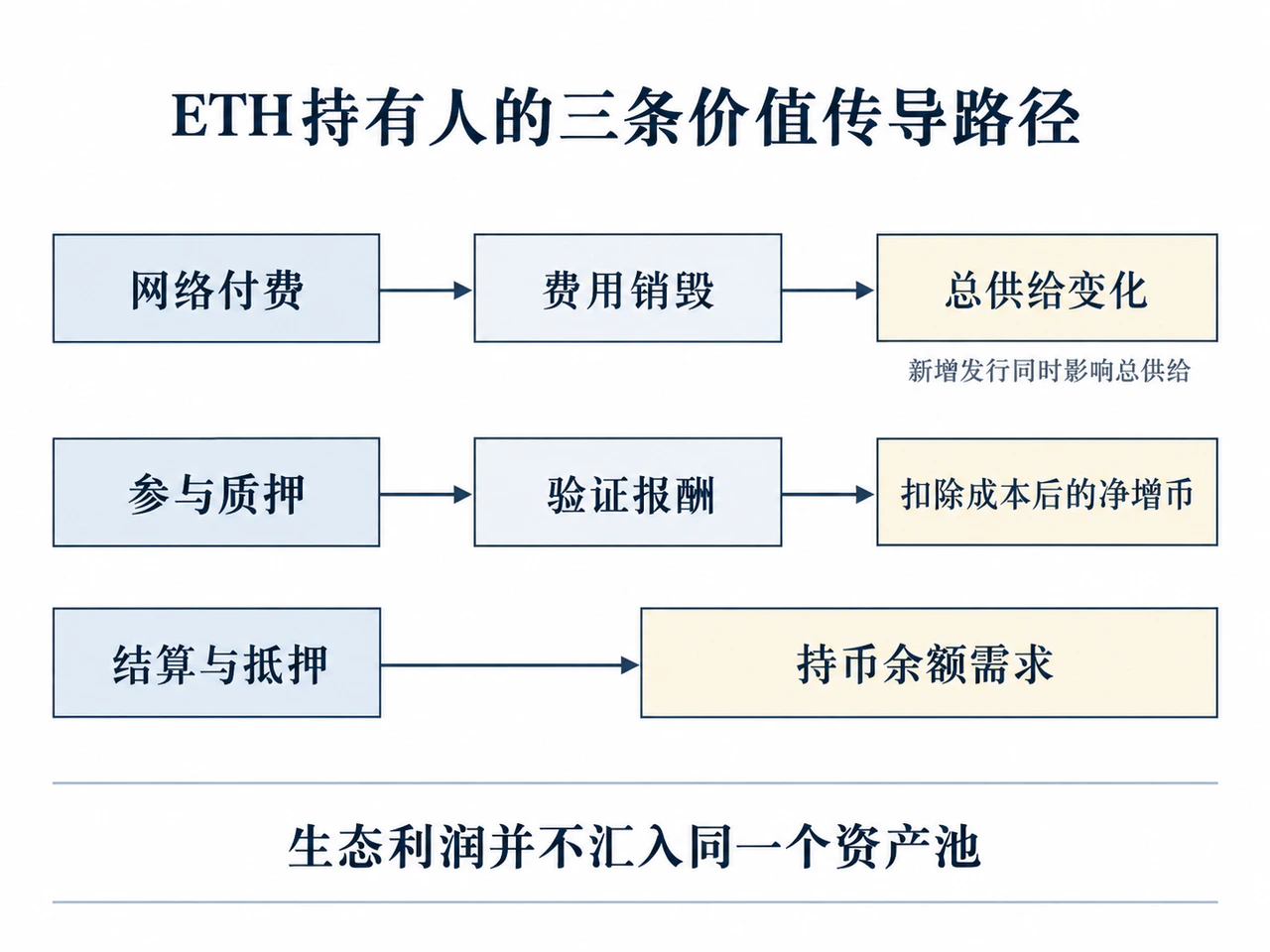
Equity claims consolidated residual profits; ETH holders receive only economic value routed by protocol rules
In corporate finance, common shareholders have a residual claim on the issuer. Revenue from goods and services becomes profit attributable to the parent's shareholders after operating costs, depreciation, amortization, interest and tax. Management can distribute it through dividends or buybacks, or reinvest retained earnings to compound net assets and EPS. Equity research has a clear perimeter: assets, liabilities, revenue and free cash flow within consolidated financial statements.
Ethereum is fundamentally different: it is a distributed network of core protocols, validators, decentralized-application operators, L2 networks and real-world-asset issuers, rather than a corporation. These parties maintain separate fees and income ownership. ETH holders directly own only the native token. Activity affects supply and demand, and rules determine burning and issuance, but profits at applications such as Uniswap or Aave, stablecoin issuers' interest spreads, tokenized funds' underlying interest and even the Ethereum Foundation's portfolio have separate legal and financial ownership. They do not enter an “Ethereum total profit pool.”
| Economic and legal relationship | Ordinary common shareholder | Ordinary ETH holder | Staking ETH holder |
|---|---|---|---|
| Core interest held | Equity in the issuer and a statutory claim to residual assets | Native network utility and monetary asset | Native-asset ownership and a conditional claim to compensation for consensus validation |
| Return transmission | Cash dividends, repurchases and cancellation, reinvested retained earnings and secondary-market valuation changes | Protocol-burning supply contraction, changes in ecosystem reserve demand and token-price changes | Net validation compensation after operating costs and slashing risk, plus token-price changes in fiat currency |
| Operating-income perimeter | All commercial profits within the issuer's consolidated accounts | No consolidated operating-profit pool across the ecosystem | Only issuance, priority fees and MEV distributions directly settled to validator addresses under protocol algorithms |
| Governance and liquidation rights | Voting at shareholder meetings and residual liquidation claims under the articles of association | No claim to governance of ecosystem businesses or liquidation of ecosystem assets | Staked amounts determine consensus weight, but technical upgrades still require coordination of broader social consensus |
| Dilution factors | New shares, convertible-bond conversions and management equity incentives | New validation issuance may dilute the holder's share of circulating supply | Validation-service fees, hardware and software operations, slashing losses, locked-capital liquidity premiums and exit discounts |
This distinction changes the research starting point. Equity analysis asks whether a company can expand its competitive advantages and accumulate per-share economic benefits. ETH research must examine which protocol channels and strategic mechanisms return on-chain value to holders. Ecosystem gross transaction value or total value locked cannot simply serve as the cash-flow basis of a valuation numerator.
Decentralized governance further demonstrates this misalignment. Ethereum Improvement Proposals depend on off-chain coordination among developers, node operators, validators, application teams and users. Owning more ETH gives no statutory counterweight over changes to protocol economics. Core developers often prioritize throughput, lower gas costs, censorship resistance and decentralized security over maintaining or increasing ETH holders' returns per unit of capital. Investors must recognize that the technical roadmap can sacrifice short-term base-layer fee capacity.
EIP-1559 contracts supply through service payments, but differs from cash buybacks and is offset by issuance
Ethereum activated the London hard fork in August 2021, introducing EIP-1559. It separates fees into a base fee, mandatorily burned, and a priority fee or tip paid to the block producer. This directly converts network usage into reduced native-token supply. Blob space, introduced later for batch publication of L2 transactions, has its own fee market and burns all blob fees.
Burning resembles share repurchases and cancellation mathematically: with a fixed personal holding, a smaller total supply increases ownership share. Financially, the paths differ fundamentally. A listed company uses surplus cash or retained earnings to buy shares from willing sellers, creating a defined capital-allocation outcome for remaining shareholders. ETH fees burn when users pay for computation and storage; continuing holders receive no freely spendable cash at that point.
Burning's economic value depends entirely on sustained willingness to pay and its net marginal supply effect. Strong pricing power in secure settlement and data publication can indeed make ETH deflationary. But consensus also continuously issues tokens to validators. Total supply reflects the interaction of burning and issuance; looking only at burning is misleading.
For nonstaking holders, absolute supply contraction raises their supply share but does not directly guarantee fiat purchasing power. Prices also immediately revalue macro liquidity, competition from other chains and long-term uncertainty over protocol changes. The burn rate is therefore a flow measure of current supply-demand imbalance, not something to equate mechanically with a stock dividend yield and add to capital gains.
Staking combines security issuance and ordering income, but token growth faces dilution and price declines
Stakers deposit ETH into the consensus contract and receive compensation for round-the-clock validation and capital exposed to slashing. Returns combine newly issued consensus-layer rewards paid for network security with execution-layer priority fees and maximal extractable value distributed through systems such as MEV-Boost. MEV arises from excess arbitrage and liquidation profits captured by block builders through transaction inclusion, exclusion and reordering.
The economics differ. New issuance compensates security providers through inflation potentially diluting all holders. Priority fees and MEV are real rents paid by users for immediate execution and priority ordering. Validators must deduct hardware and software operating costs, liquid-staking service commissions, possible slashing losses and withdrawal-queue frictions. Issuance increases the ETH balance at particular addresses but redistributes tokens rather than injecting new operating profits from external entities.
The September 2022 Merge, or Paris upgrade, demonstrated how technical changes can reshape token economics. Moving from proof of work to proof of stake abruptly ended large issuance to miners. Using the historical baseline of about 14 million ETH staked at the Merge, Ethereum's official calculation showed daily issuance falling about 88%. This was a technical reduction in the funding cost of security, rather than explosive growth in outside customers' payments.
Staking assessment must distinguish nominal token growth, changes in supply share and final fiat total return. Consider an annual example: an investor starts with 100 ETH, earns a net 4% increase after all staking costs, while network supply rises 1% through issuance and burning. ETH's dollar price falls 20%, and all rewards remain in ETH to year-end.
| Core return and position measure | Ordinary holding | Staking validation |
|---|---|---|
| Year-end ETH holdings | 100.00 ETH | 104.00 ETH |
| Change in share of total network supply | −0.99% | +2.97% |
| Dollar-based total investment return (USD return) | −20.00% | −16.80% |
The exact supply-share formula is “(1 + net token growth) ÷ (1 + supply growth) − 1”; dollar return is “(1 + net token growth) × (ending price ÷ starting price) − 1.” A small increase in supply share offers neither immunity to losses in fiat value nor a statutory claim on real wealth. In this scenario, staking merely cushions the loss, while market-price volatility still dominates the final result.
Settlement and collateral create demand for monetary balances, but faster turnover reduces required holdings
Beyond consumption and staking, ETH has an endogenous monetary premium as the ecosystem's native reserve asset. DeFi applications use it as overcollateralization for lending and derivatives, L2 sequencers stake it to provide finality guarantees, and institutions and individuals use it as liquid reserves against single-application risk. These uses create structural demand for holding balances.
Balance demand is not linearly proportional to application transaction volumes; velocity matters. Suppose a decentralized service protocol consumes $365 million in gas annually. Holding seven days' working capital against gas-price volatility requires a daily retained ETH balance of $7 million. If account-abstraction fee sponsorship, real-time liquidity aggregation and instant conversion shorten coverage to one day, it needs only $1 million. Annual business volume is unchanged, but technical progress and faster turnover sharply reduce the ETH ecosystem entities must hold long term.
Growing stablecoins and tokenized real assets can strengthen ETH's narrative as settlement and collateral infrastructure, but investors must determine how much actual retained balance demand results. Repeated reuse of collateral through restaking or leveraged lending can double-count apparent holdings and create vulnerability to cascading deleveraging. The long-term monetary premium depends on consensus around ETH's irreplaceability as collateral, not simply an inference from external transaction volumes.
2. Scale and value retention diverge: scaling and tokenization have not directly produced L1 holder returns
Third-quarter 2026 mainnet transactions rise 35% while fees fall 52%, challenging a simple growth-to-return relationship
Ethereum's rollup-centric scaling roadmap seeks broader adoption by sharply reducing computational barriers. But operating data through the third quarter of 2026 show a large divergence between capacity usage and base-layer monetization. Coin Metrics' daily mainnet aggregates show 199.3 million transactions in third-quarter 2026, up 35.3% from 147.3 million in the third quarter of 2025. Total ETH-denominated transaction fees, however, more than halved from 32,825 ETH to 15,696 ETH, down 52.2%.
| Core measure (consistent definitions) | Third quarter 2025 | Third quarter 2026 | Year-on-year change |
|---|---|---|---|
| Mainnet execution transactions | 147.3 million transactions | 199.3 million transactions | +35.3% |
| Total network transaction fees, including base, priority and blob fees | 32,825 ETH | 15,696 ETH | −52.2% |
| Average mainnet transaction fee | 0.00022279 ETH per transaction | 0.00007875 ETH per transaction | −64.7% |
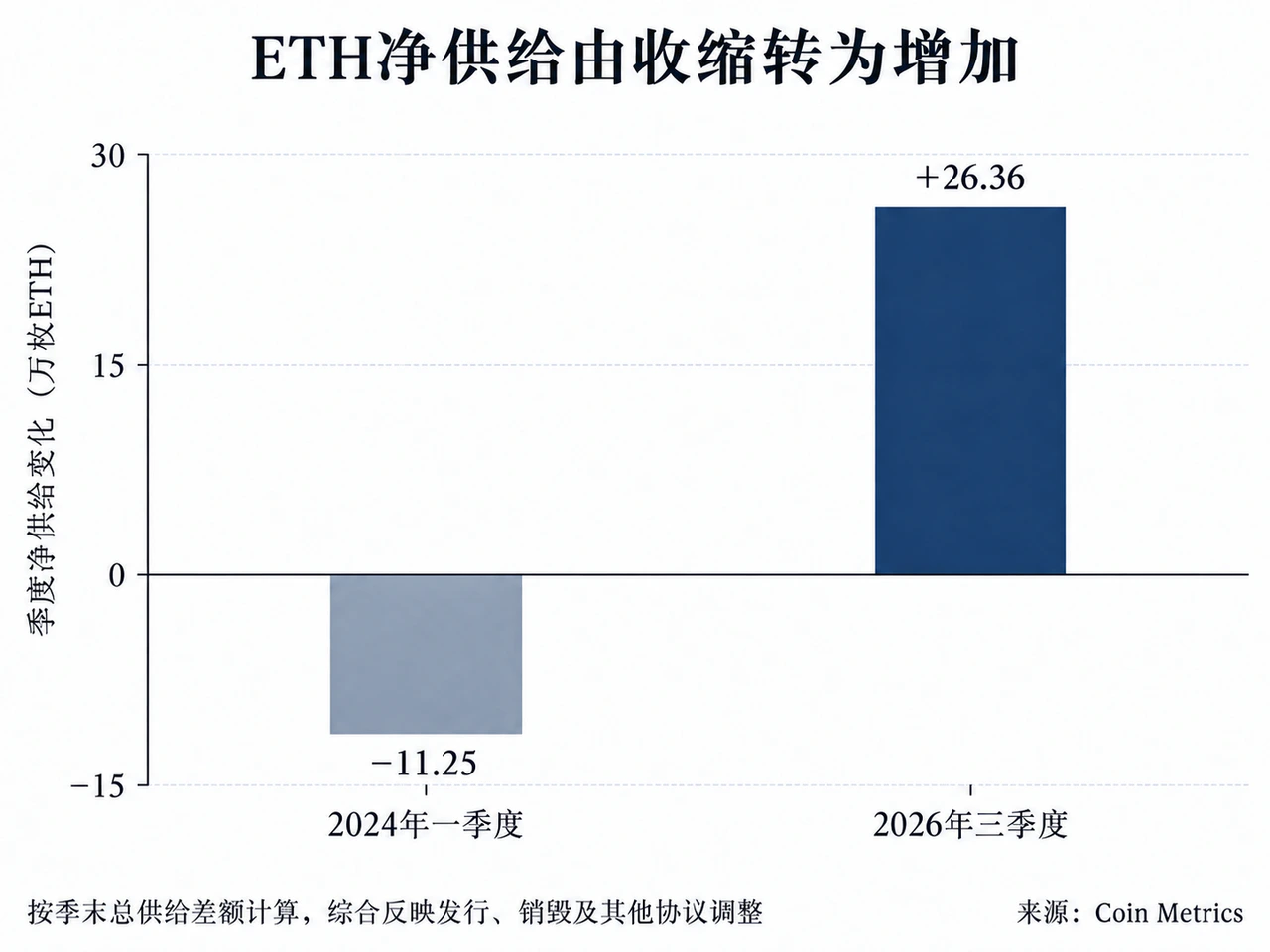
| Net ETH supply change during the quarter | +229,863 ETH | +263,628 ETH | — |
Note: Total fees include mainnet execution base fees, priority fees and blob-space fees, covering both burned amounts and validator receipts. Transaction counts cover L1 mainnet only and exclude internal L2 execution.
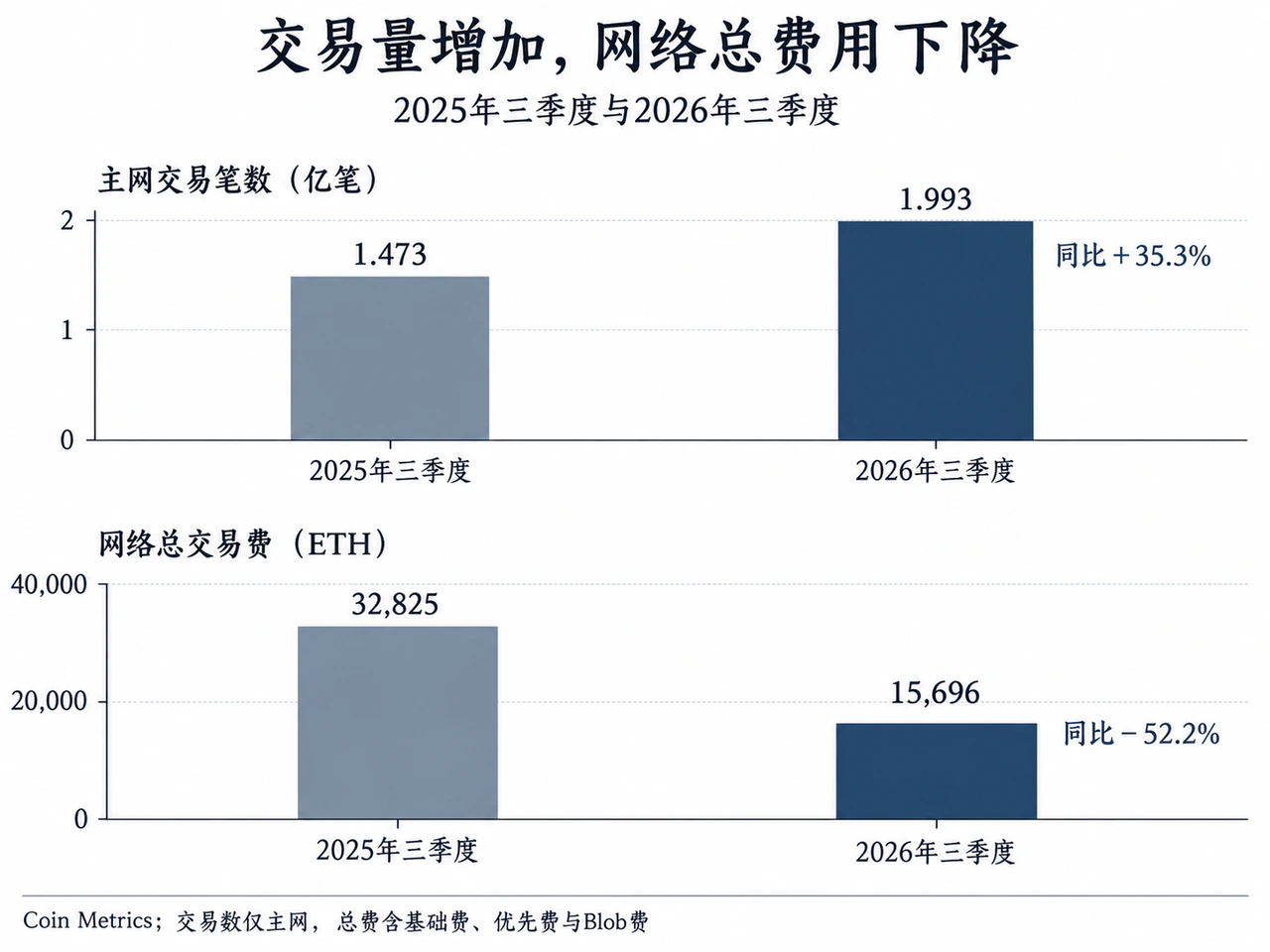
This divergence demonstrates a practical constraint: the unexpectedly steep fall in cost per transaction prevented higher usage from lifting base-layer revenue. Average fees fell 64.7% in a year, so even double-digit transaction growth coincided with a sharp contraction in captured value. The trend was already visible early in the 2024 upgrade cycle: first-quarter mainnet fees reached 380,200 ETH, then fell to 145,000 ETH in the second quarter after Dencun lowered data costs, while transaction counts barely changed.
Fee contraction directly reversed the supply balance. Heavy burning in first-quarter 2024 reduced ETH supply by about 112,500 ETH. In third-quarter 2026, slower burning below regular issuance instead increased net supply by approximately 263,600 ETH, quarterly inflation of 0.216% of starting supply. EIP-1559 did not create unconditional deflation; data refuted the one-way assumption that thriving applications permanently shrink circulating supply.
L2s retain about 95% of user fees, while blob expansion cuts daily burning more than 70%, diluting base-layer capture
L2 architecture reshaped value distribution. Hundreds of millions of frequent transfers, decentralized trades and interactions moved into networks such as Arbitrum, Optimism and Base. L2s periodically submit batched state commitments and proofs to Ethereum. Users' payments enter L2 operators' business cycles in full, while only a small amount returns to mainnet as data-availability fees.
An April 2025 Coin Metrics study documented this diversion. Since Dencun introduced blobs, Base had collected approximately $98 million in user gas fees but paid only about $4.9 million, roughly 5%, to Ethereum for data availability. Sequencer operators retained the other 95% as gross margin before infrastructure costs and commercial profits. Coinbase's 2025 annual report formally included Base sequencer net fees in “other transaction revenue.” While the base layer sacrificed pricing power for scale, external centralized or partly centralized operators captured high-value end-user economics.
Subsequent deliberate increases in data capacity further weakened marginal pricing. Galaxy's comparison of the May 2025 Pectra upgrade found that, over the first five complete days afterward, major rollups' average daily blob purchases rose from approximately 21,200 in the preceding 60 days to 25,600, up 20.8%. Yet average daily ETH burned through L2 data publication fell 70.9%, from 11.22 to 3.26 ETH.
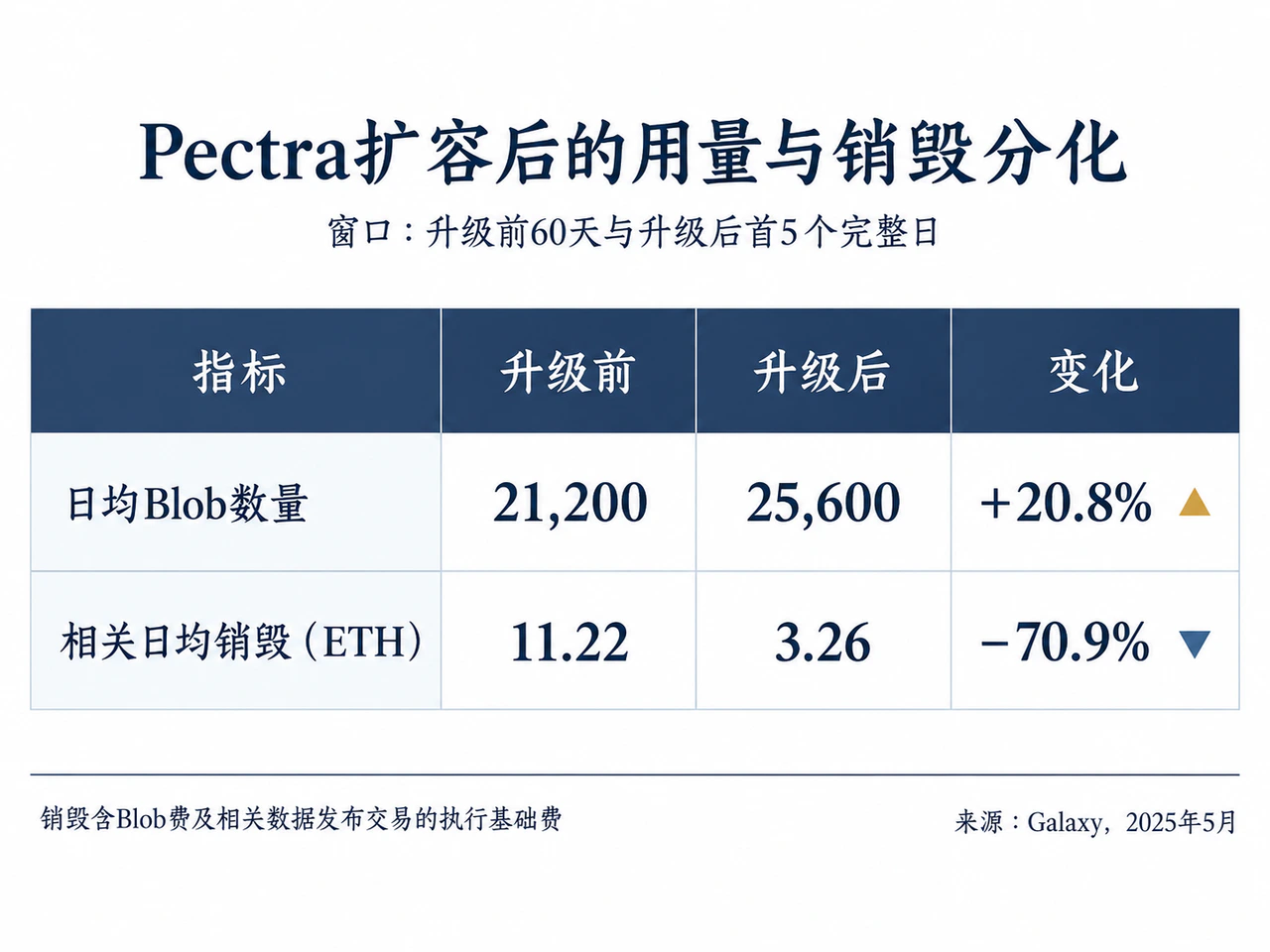
Pectra doubled target blobs per block from three to six. L2 demand growth could not fill the abruptly expanded capacity, keeping bids near the protocol floor. Even though the December 2025 Fusaka upgrade adjusted blob pricing to link dynamically with execution costs and strengthen resource constraints, competing data-availability networks still threatened substitution. Raising fees unilaterally therefore risked driving L2s away.
Financial and crypto researchers differ sharply on this structural contest. Fidelity's November 2025 report was relatively optimistic that evolving mainnet throughput and more decentralized rollups returning to mainnet could strengthen the value anchor. Galaxy's May 2026 report, by contrast, argued that Ethereum's traditional strengths in retaining capital and hosting issuance had substantially diverged over the long term from its native token's fee capacity and capital returns.
BUIDL interest and stablecoin spreads belong to asset owners; the base layer receives only small, infrequent tolls
Real-world assets and institutional tokenization are often seen as engines bringing Ethereum into mainstream finance. In March 2024 BlackRock and Securitize launched BUIDL, its first tokenized fund, on mainnet. Public terms say the fund invests entirely in cash, short-term Treasuries and overnight reverse repos, earns daily interest and distributes corresponding new fund tokens monthly to eligible investors.
Legally, the beneficiaries of Treasury coupons and repo interest are BUIDL shareholders, rather than Ethereum mainnet or ETH investors. Ethereum acts as a distributed global ledger recording ownership transfers, subscriptions and redemptions. Tokenization changes the registration and settlement medium without turning underlying capital returns into disposable income for ETH holders.
Major compliant stablecoins follow the same contractual logic. Circle's fourth-quarter 2025 results showed $733 million in reserve interest income and $770 million in total revenue and reserve income. After $461 million of distribution, compliance, operating and transaction-channel costs, most net operating profit belonged directly to Circle shareholders. Across this vast stablecoin circulation, Ethereum received only very limited gas expenditure for initial minting, transfers, settlement and congested contract interactions.
| Economic value arising from on-chain industry growth | Primary legal and commercial beneficiary | Specific transmission to ETH value |
|---|---|---|
| Underlying interest from tokenized Treasuries, such as BUIDL | Fund shareholders and managers | Small base-layer gas fees from subscriptions, redemptions and transfers, or very-low-turnover DeFi collateral balances |
| Reserve spreads from compliant stablecoins, such as USDC | Stablecoin issuers, such as Circle, and distribution partners | Small base fees consumed in on-chain transactions and some base liquidity retained for cross-protocol settlement |
| dApp transaction commissions | Application treasuries, governance-token holders or core development teams | Operating spending on computation and storage purchased from Ethereum's base layer or L2s |
| Gas markups charged to end users by L2s | L2 sequencer operators, such as Coinbase/Base and Offchain Labs | Blob batch-publication and state-settlement fees paid to mainnet at the lowest competitive market price |
| Ethereum mainnet base fees and blob fees | Protocol-controlled sink: permanently burned directly | Indirectly increases relative token scarcity by marginally reducing total supply, assuming unchanged new issuance |
| Validator priority fees and MEV block distributions | Independent staking validators, liquid-staking pools and delegators | Additional ETH balances for particular staking accounts after hardware costs, operating depreciation and protocol fees |
This distribution ladder shows that expanding on-chain AUM or TVL alone cannot establish excess ETH returns. Tens of billions of dollars of tokenized Treasuries or stablecoins sitting in low-turnover multisignature contracts may contribute only a few ordinary transfer fees. Holders benefit from service growth only when these assets generate dense interactions in lending collateral, derivatives liquidation and cross-chain liquidity matching, with exclusive reliance on Ethereum base-layer settlement security.
Borrowing equity-research discipline: three separate statements and reverse valuation instead of terminal-value-heavy models
Ethereum's lack of a consolidated entity makes simple price-to-sales or price-to-earnings multiples largely ineffective. Equity research's central discipline is to look through apparent revenue, identify competitive barriers and measure returns per unit of shareholder capital. Applying it to ETH requires three progressive, separate economic schedules:
- Service Revenue Table: Separate actual purchased volumes and marginal unit fees for execution computation, consensus validation and blob data availability. Remove temporary fee spikes driven by speculative excitement, subsidized acquisition or abnormal congestion to identify organic demand with lasting willingness to pay.
- Value Distribution & Supply Table: Divide captured fees into mandatory burning, validator income and external leakage. Combine these with the consensus issuance curve, which varies with total stake, and deduct losses associated with slashing and delayed withdrawals to estimate precise net supply growth under different utilization scenarios.
- Holder Return Table: Abandon the assumption that ETH is homogeneous. Separate ordinary spot holders, independent-node stakers, liquid-staking participants and investors using regulated spot instruments. Calculate each group's net token growth after liquidity discounts, commissions, technical frictions and exit losses, then assess equity returns under a common macro price stress test.
This framework avoids common valuation traps. There is no legal entity consolidating all dApp income for pro-rata distribution. Network market capitalization divided by mainnet fees cannot directly replace conventional multiples. In particular, a DCF must not discount protocol issuance as new cash flow and then use it to justify the existing market cap; that is circular reasoning.
Terminal value poses a greater challenge. A Fidelity educational ETH model published in 2023 showed terminal value's present value accounting for 72.8% of total target valuation under its baseline discount assumptions. Apparent numerical precision was dominated by perpetual-growth and distant future fee-monopoly assumptions. With rapidly evolving chain infrastructure and modular chains eroding base-layer pricing power, excessive reliance on conventional DCF price targets can become an abstract exercise.
A more practical buy-side tool is reverse-engineering valuation. Rather than predict an elusive fair price, start with the observed market price and capitalization and infer the assumptions embedded in them: how much genuine future base-layer paid demand, how much reserve demand from mainstream institutions and how strong a defense of value capture must Ethereum sustain?
Through third-quarter 2026, the evidence showed expanding mainnet transactions had not raised fee capacity proportionately. Lower burning re-exposed ordinary holders to inflation dilution, while modest staking rewards offered little shelter from large fiat drawdowns. Ethereum's ability to expand its ecosystem and attract applications had significantly outpaced its mechanism for monetizing those gains in the base-layer token. Sharing industry growth is possible for ETH investors, but transmission suffers substantial attenuation. Only by applying the scrutiny used for quality companies' capital-allocation efficiency, looking through narratives and calculating how much application prosperity remains irrevocably with holders, can investors understand the asset through complex cycles.
This article is research analysis and does not constitute specific investment advice.