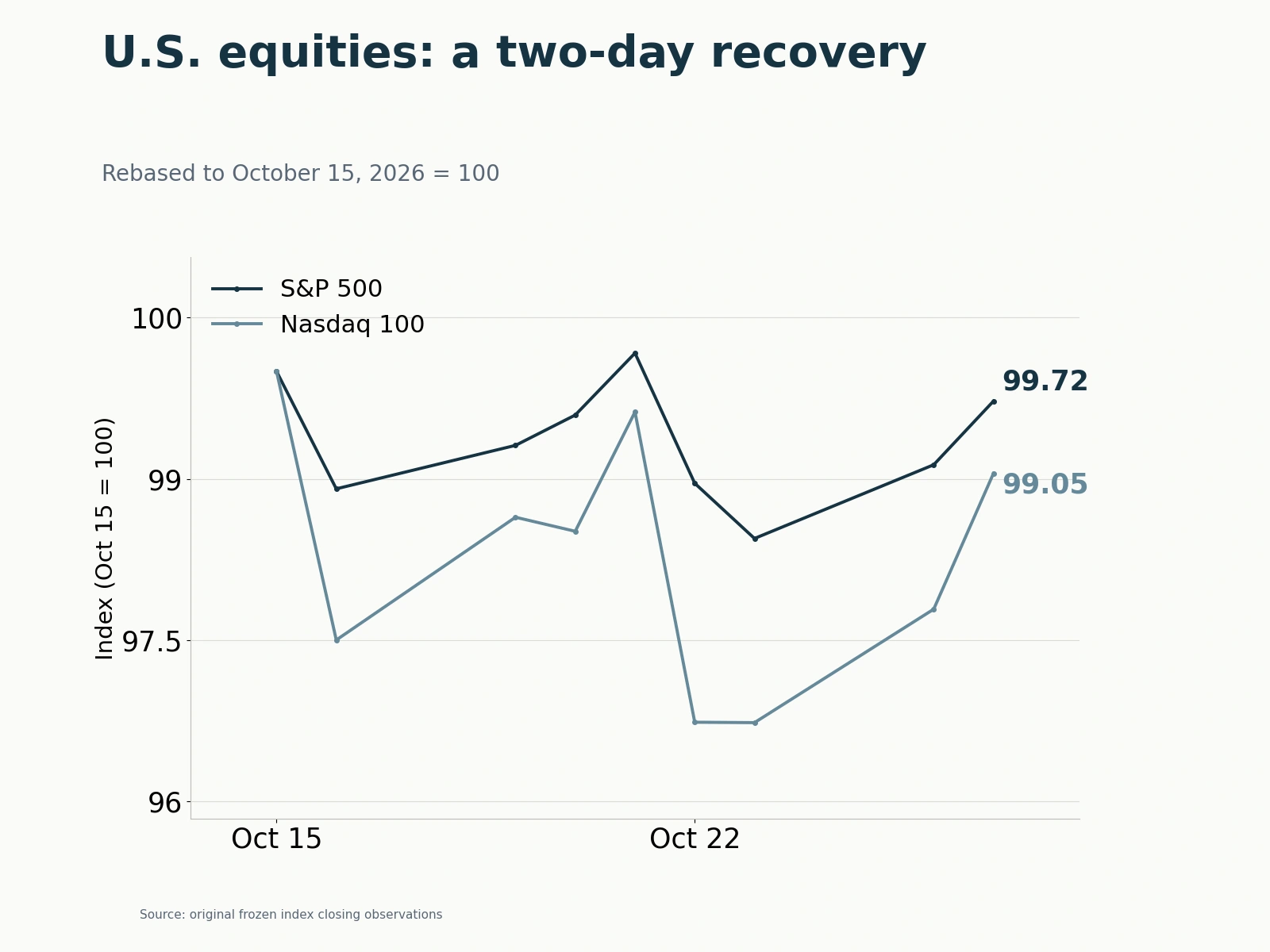
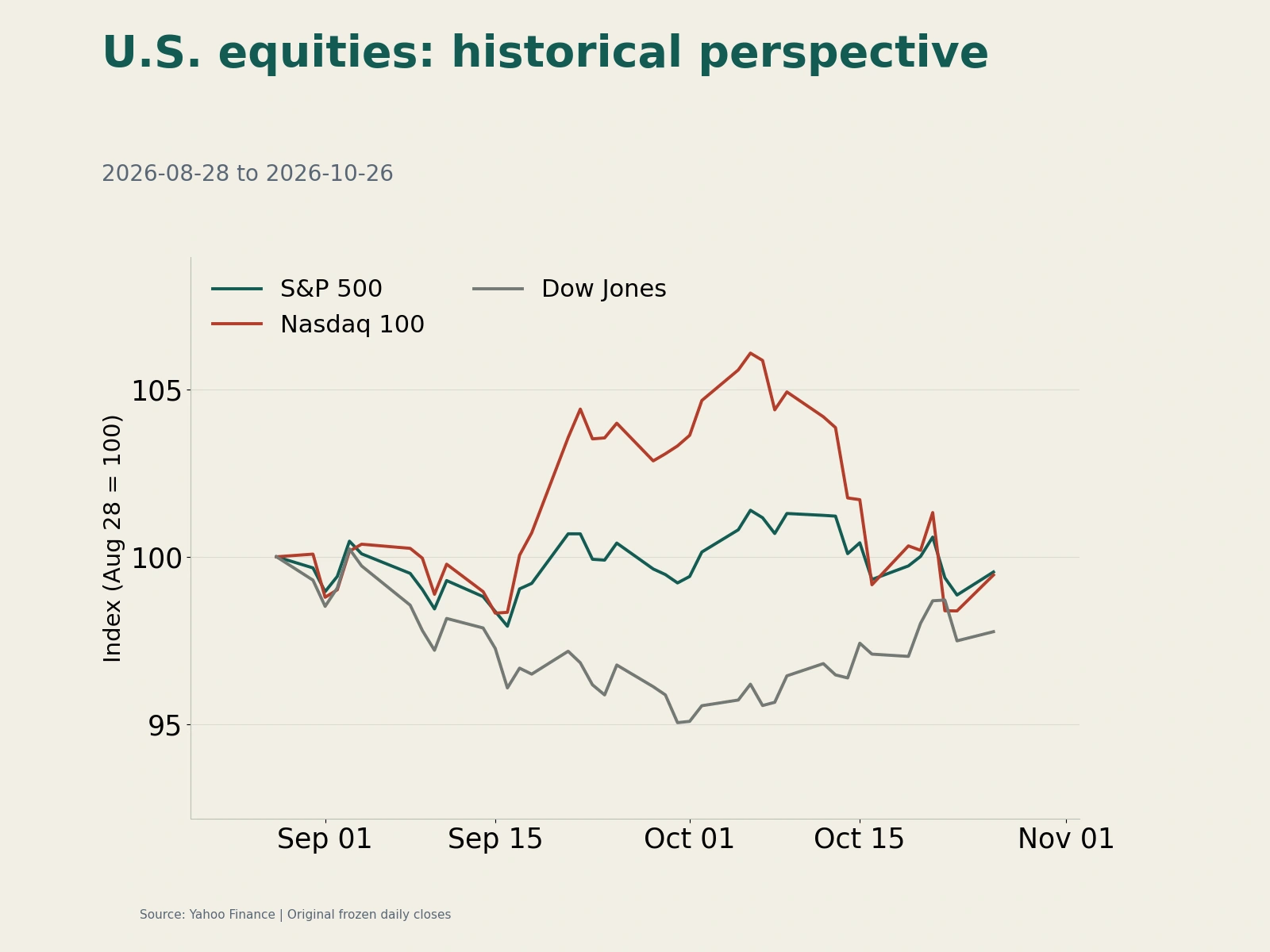
On October 9, 2026, all major U.S. stock indexes closed higher, with the S&P 500 gaining 0.59% and financials leading. Gold rebounded 1.52%, while crude erased early losses to finish marginally higher. AI commercialization prospects and the third-quarter earnings outlook improved risk appetite, but weaker University of Michigan consumer sentiment and a second consecutive monthly increase in inflation expectations drove a short-end-led rise in Treasury yields, with real rates also increasing.
At the U.S. cash-market close, the Dow Jones Industrial Average was up 0.83% at 51,654.95, the S&P 500 up 0.59% at 7,811.54, the Nasdaq 100 up 0.51% at 30,883.15 and the Russell 2000 up 0.46% at 2,806.98. The VIX fell 0.57 points to 14.84. Sector ETFs diverged: financials ETF XLF gained 0.92%, technology ETF XLK 0.51%, while energy ETF XLE fell 0.25%.
Rising inflation expectations lift short yields; higher real rates weigh on valuations
The University of Michigan's preliminary October consumer-sentiment index fell to 46.3, below September's 48.1 and the Reuters consensus of 47.8. Current conditions weakened sharply from 50.9 to 44.7, while expectations edged up from 46.3 to 47.3. The main drag was the impact of high prices and borrowing costs on conditions for buying durable goods. Confidence deteriorated particularly among lower-income households and those with fewer stock assets.
Inflation expectations rose across the board. One-year expectations increased from 4.6% to 4.7%, and five-year expectations from 3.4% to 3.5%, both rising for a second consecutive month. Pressure on purchasing power increases growth risk, while rebounding inflation expectations restrict the room for monetary easing.
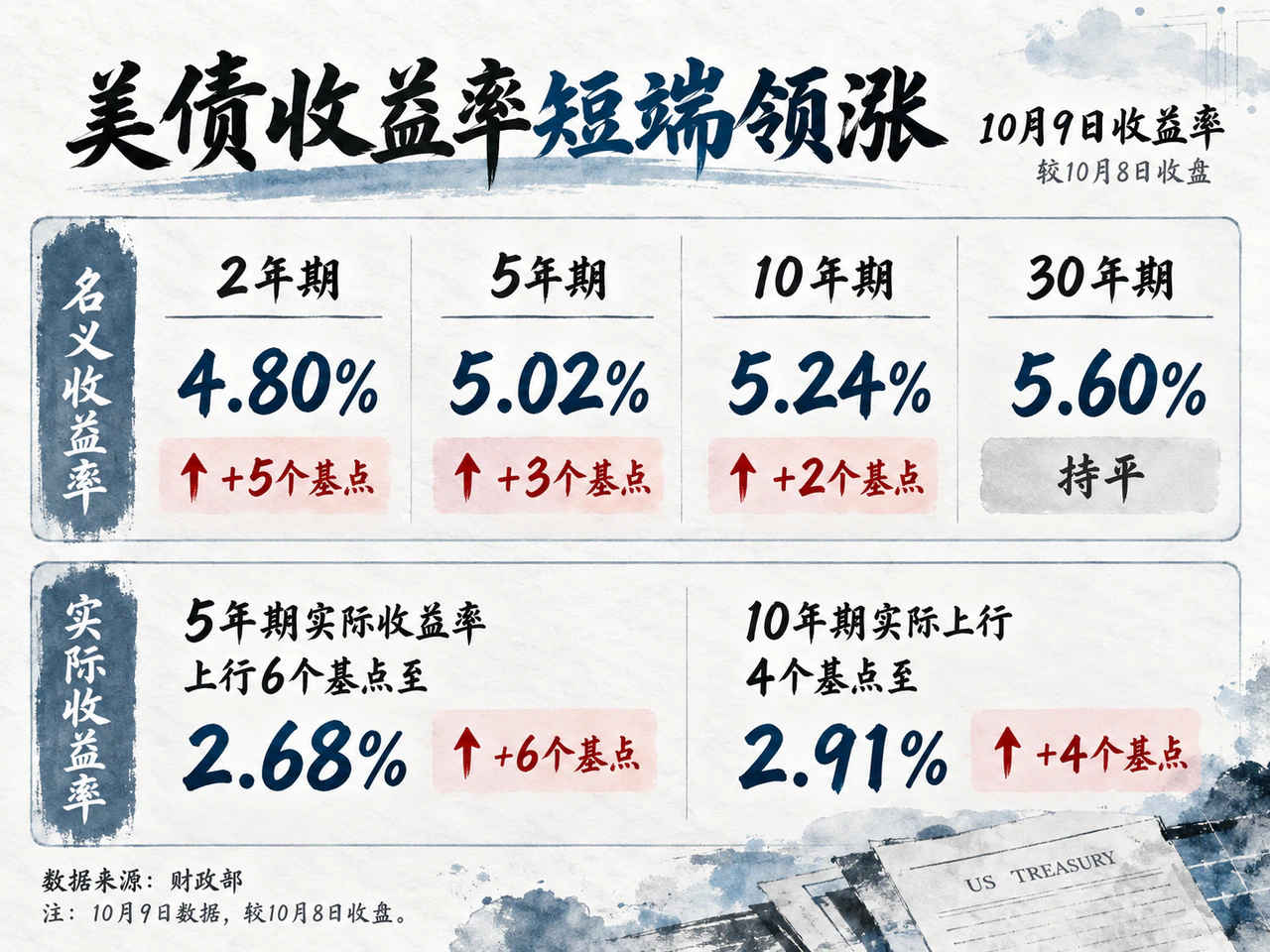
Inflation expectations drove a short-end-led rise in the Treasury curve. The Treasury's daily nominal par yield curve showed:
| Maturity | October 9 yield | Daily change |
|---|---|---|
| 2-year | 4.80% | +5 basis points |
| 5-year | 5.02% | +3 basis points |
| 10-year | 5.24% | +2 basis points |
| 30-year | 5.60% | Unchanged |
The ten-year/two-year spread narrowed from 47 to 44 basis points. Bloomberg reported that elevated energy costs, inflation worries and rate-hike expectations lifted yields, expressed directly in the underperformance of the policy-sensitive short end. Reuters noted that weak September payroll growth and below-consensus inflation in the preceding two months had previously lowered expectations for an October hike. Disagreement over the policy outlook had not fully disappeared.
Long-dated Treasuries were relatively stable because of allocation demand. Quartz reported solid demand for this week's $39 billion ten-year and $22 billion thirty-year auctions. Indirect bidders, representing overseas central banks and institutions, received more than 72% of the thirty-year issue, above the roughly 68% average of the preceding ten auctions. ING argued that attractive absolute yields were drawing long-term buyers, limiting increases at the ultra-long end.
Real rates rose more sharply than nominal rates. Treasury figures showed the five-year real yield up six basis points to 2.68% and the ten-year real yield up four to 2.91%. Both increases exceeded those of their nominal counterparts, materially raising the return threshold for long-term project investment.
Fiscal deficits and debt supply increased risk premiums over a longer horizon. The Congressional Budget Office's preliminary estimate put the federal deficit for fiscal 2026, ended September 30, at $1.993 trillion, $218 billion wider year on year. Net interest spending increased $115 billion, about 11%. Bloomberg reported that the New York Fed model's ten-year term premium had risen a cumulative roughly forty basis points since mid-September to near 0.98%. Fiscal supply-demand imbalances and a higher term premium were obstructing the transmission of economic slowing into lower long-term borrowing costs.
Markets are closely watching U.S. September CPI, due at 8:30 a.m. Eastern time on October 14. The release will directly test the actual pressure behind higher consumer inflation expectations and determine how tightly inflation constrains the Fed.
AI revenue targets support risk appetite, while company fundamentals diverge sharply
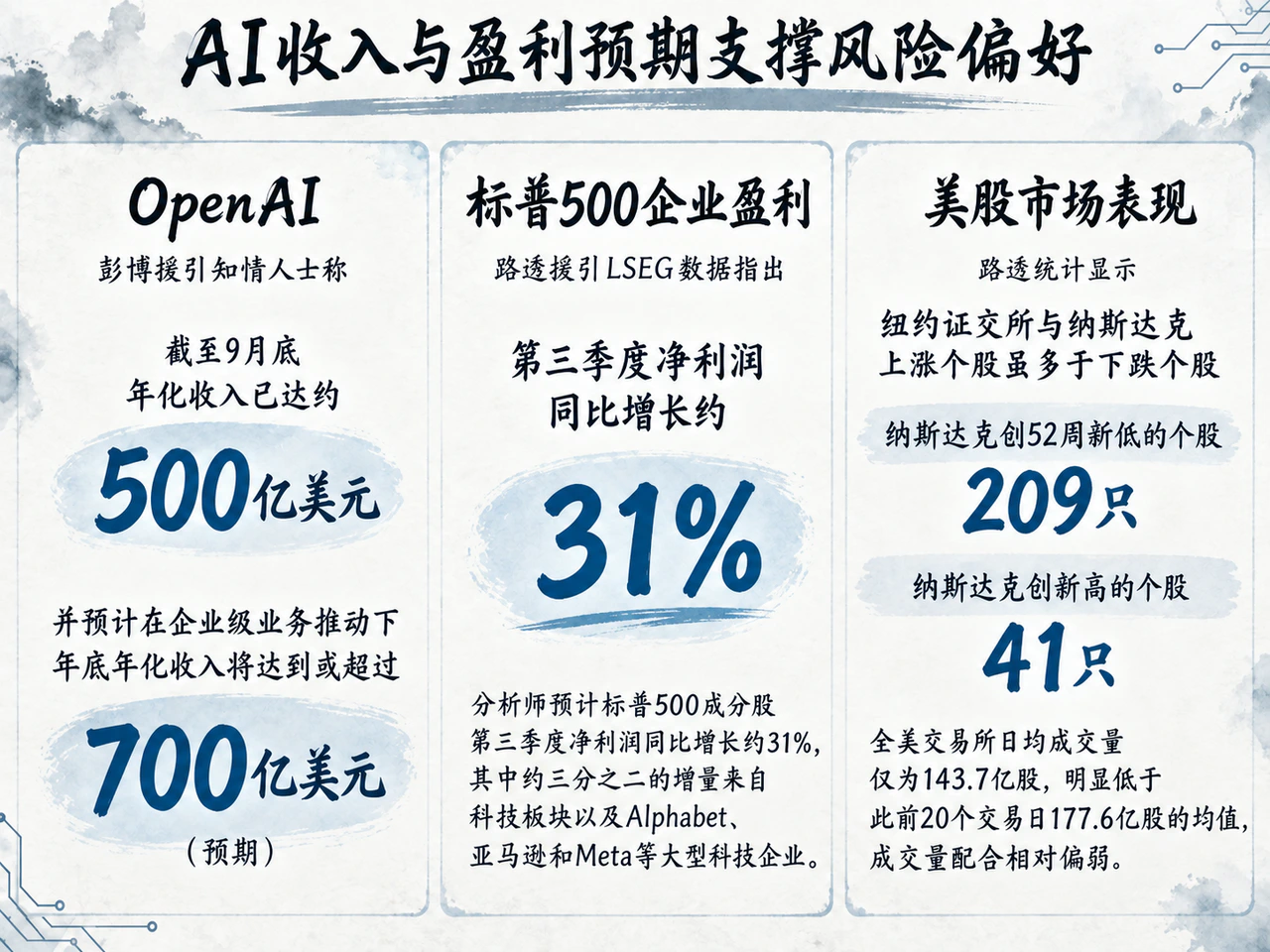
Improved guidance from AI leaders provided the main catalyst for U.S. technology stocks. Bloomberg, citing people familiar with the matter, said OpenAI's annualized revenue had reached about $50 billion by the end of September and was expected to reach or exceed $70 billion by year-end, driven by enterprise business.
Expectations for the approaching third-quarter earnings season were also high. Reuters cited LSEG data showing analysts expected S&P 500 net profit to grow about 31% year on year, with around two-thirds of the increment coming from the technology sector and large technology companies including Alphabet, Amazon and Meta. Semiconductor third-quarter earnings were expected to rise about 136%, slower than the second quarter's 158%, but still a core support for the market. Ameriprise chief market strategist Anthony Saglimbene warned that as the AI capex cycle lengthens, scrutiny of ultimate returns on investment is increasing substantially. Financials led that day, with attention on upcoming major U.S. banks' third-quarter net interest income and credit quality.
Market breadth behind the index gains was uneven. Reuters statistics showed more advancing than declining shares on both the NYSE and Nasdaq, but 209 Nasdaq stocks made 52-week lows, far above the 41 making highs. Total U.S. exchange volume was only 14.37 billion shares, well below the 17.76 billion average of the previous twenty sessions, providing relatively weak volume confirmation.
Company-specific news produced sharp share-price moves:
- Apple fell 1.1%, primarily after media reports that it had cut component-production orders for the iPhone 18 Pro and Pro Max. The reports cited rising memory-chip costs and pressure to increase end-product prices.
- Telecom operators plunged: T-Mobile US, AT&T and Verizon fell between 8.8% and 13.3% after SpaceX announced an agreement to acquire nationwide 800MHz low-band spectrum. Investors feared satellite direct-to-device competition could reshape the traditional telecom giants' market. The deal still required FCC approval.
- Health insurer Humana surged 11.6% after federal data showed that plans covering 95% of its Medicare Advantage members received four stars or more in the 2027 ratings.
Manufacturing trade rules were also clarified. Commerce Department guidance refined the definition of U.S. content for metal tariffs on Canadian and Mexican products under USMCA, including qualifying U.S. components and specified metal input values. Scheduled for formal publication and effect on October 14, the rule could marginally improve costs for manufacturers with highly localized supply chains.
Hurricane disruption offsets geopolitical easing; dip buying lifts gold back above $4,220
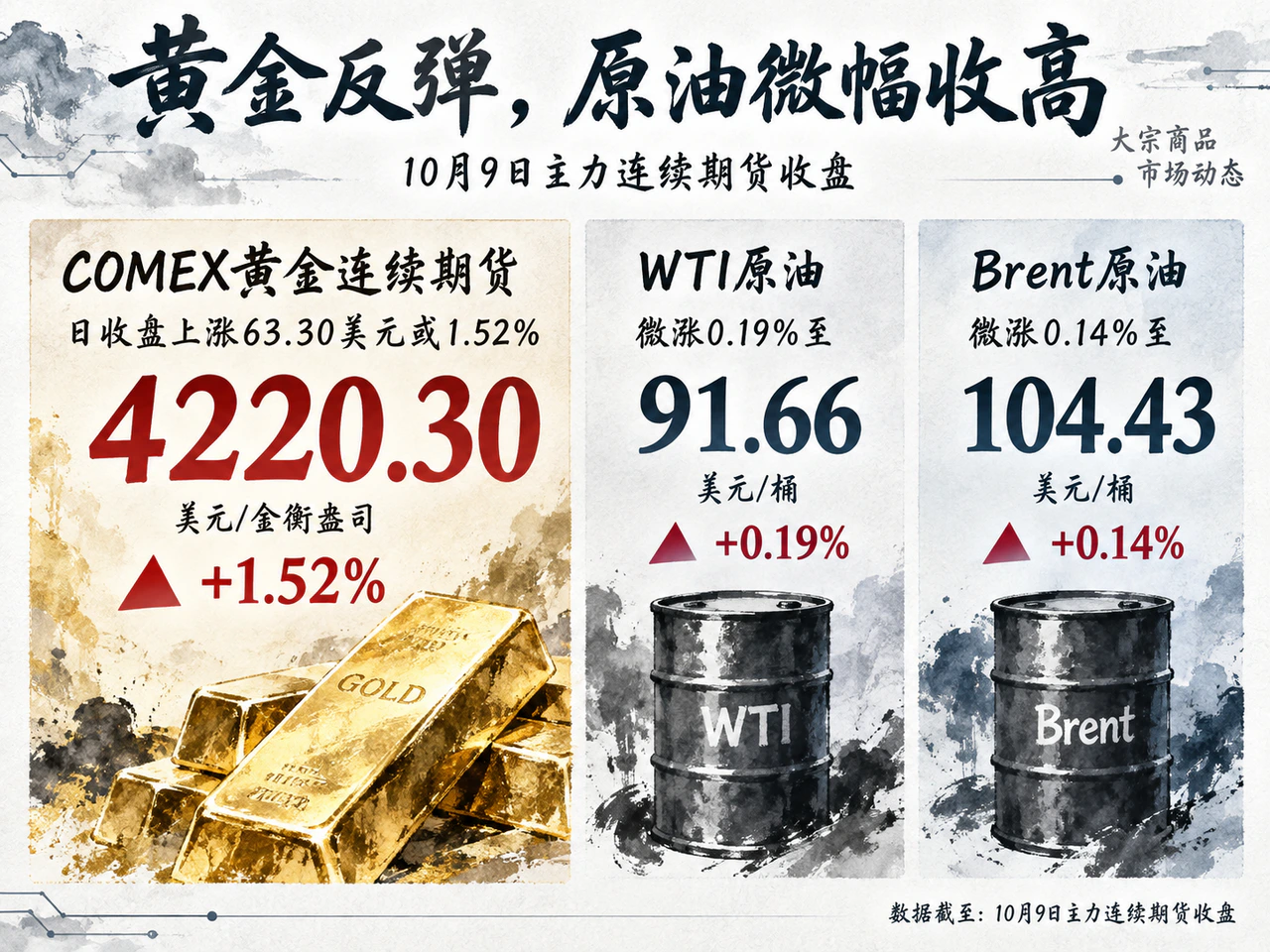
Commodities consolidated in volatile trading. At the October 9 front-month continuous-futures close, WTI edged up 0.19% to $91.66 a barrel and Brent 0.14% to $104.43. Crude recovered its early losses, reflecting the contest between near-term supply disruption and expectations of medium- to long-term geopolitical easing.
On geopolitics, Reuters noted that Trump's statement the previous day that he would not attack Iran before the midterm elections initially reduced risk premiums. A complete easing of Middle Eastern supply risk still depended on negotiations and navigational safety through Hormuz.
Extreme weather severely disrupted supply. Reuters reported that the threat of Hurricane Isaias shut about 1.5 million barrels a day of U.S. Gulf of Mexico production, roughly 72% of expected regional output, up from 1.3 million barrels a day the day before. Weather models shifted the storm's track east, however, prompting Earth Science Associates to lower its cumulative production-loss estimate from 9 million to 7.2 million barrels. S&P Global Energy also reduced refining capacity directly threatened from 2.5 million barrels a day early in the week to less than 500,000. Actual shutdowns and lower expected losses offset one another in prices.
Refined-product supply policy loosened. Trump announced that Russia would immediately supply more than 300,000 tonnes of diesel to international markets, another 500,000 tonnes in November, then a further 1 million, with an additional 3 million depending on refinery conditions. The Treasury issued a temporary general license that day authorizing related Russian diesel transactions and imports through April 7, 2027. The Associated Press reported a fall in diesel futures, while Russia said U.S.-bound shipments could begin as early as October. Michael Lynch of the Energy Policy Research Foundation said that if these cargoes were merely diverted from other customers to the United States, the effect on net global diesel supply and prices would be relatively limited.
Airline results directly illustrated fuel costs' squeeze on profits. Delta's third-quarter adjusted operating revenue was about $17.6 billion, up 16%, but adjusted fuel expenditure surged 62% to about $4.1 billion, more than $500 million above July guidance. Even with premium-cabin revenue up 18% and fourth-quarter revenue growth expected at 20%, high fuel bills severely eroded operating leverage.
Gold was stronger. COMEX continuous gold futures closed up $63.30, or 1.52%, at $4,220.30 a troy ounce. Despite a 0.09% rise in the dollar index to 102.231 and higher Treasury real yields, gold rebounded for a second consecutive session, driven mainly by technical dip buying. StoneX analyst Rhona O'Connell said the round $4,000 level had established effective psychological support, but a sustained breakout would require a new fundamental catalyst.
Physical demand remained cautious at high prices. Reuters' weekly survey showed slower end buying in India after gold's rebound. Dealers' maximum discount to the official tax-inclusive benchmark narrowed from $14 an ounce the previous week to $6, mainly because of lower imports, traders said. Following the holiday, China's market maintained a premium of about $10 an ounce to international prices, with subdued spot trading.
Credit risk premiums remain divergent; China adds fiscal tools to support domestic demand
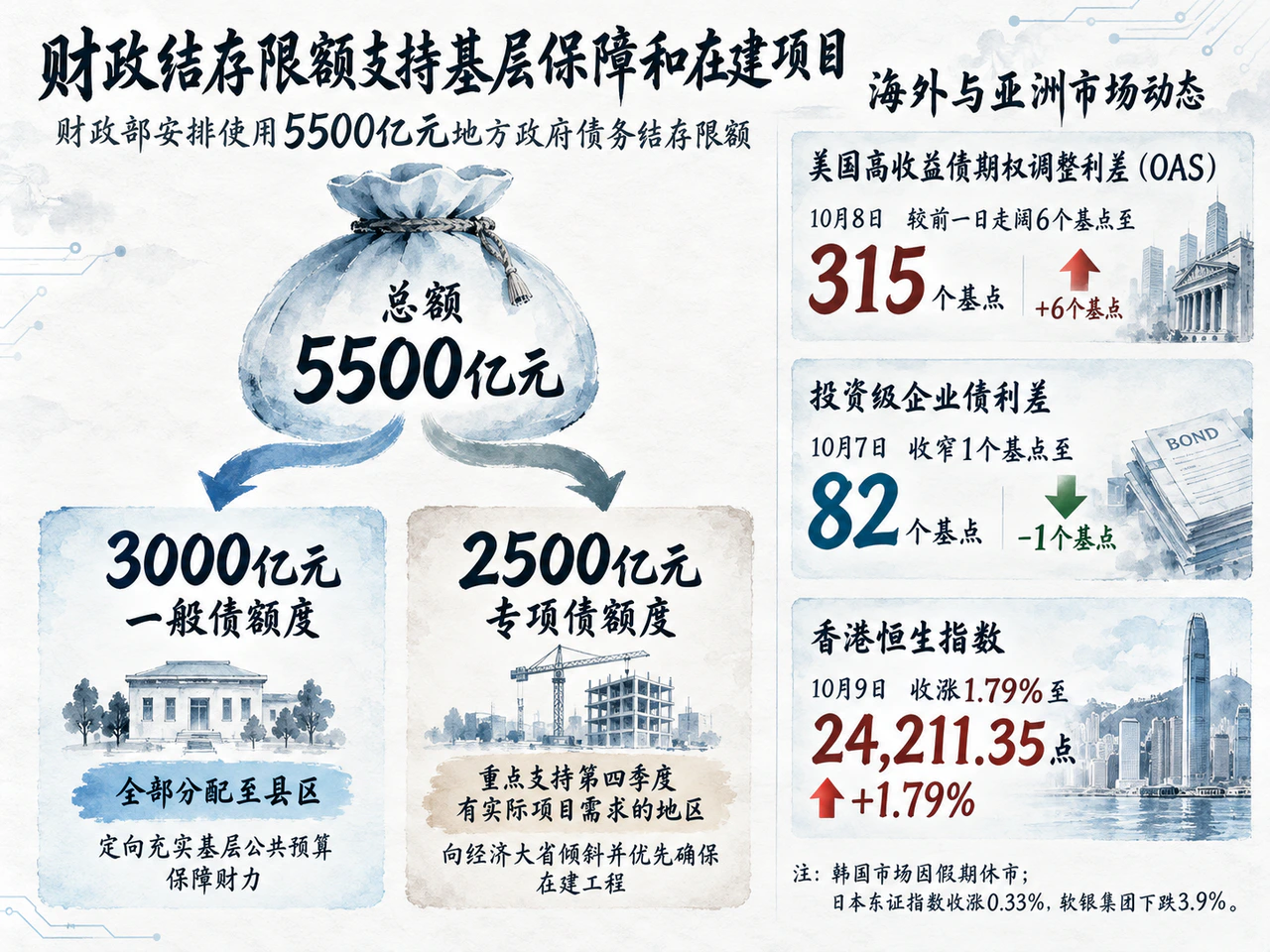
Dollar credit spreads diverged. On October 8, U.S. high-yield OAS widened six basis points from the previous day to 315, while investment-grade corporate spreads narrowed one basis point to 82 on October 7. This reflected increasing demands for credit-risk compensation from lower-rated borrowers.
Asian data-center financing illustrated this liquidity constraint. Bloomberg reported that Singapore digital-infrastructure company DayOne was in preliminary talks with banks over a $500 million bond issue and was planning a U.S. IPO, while partner Firmus withdrew its Australian listing plan. In capital-intensive industries, debt financing increasingly depends on project-completion progress, tenant credit ratings and secured cash flows. Offshore renminbi issuance provides an alternative: Bloomberg data showed year-to-date issuance above RMB1 trillion, exceeding the previous full year. But offshore currency-hedging costs of about 3% limit the all-in financing advantage for dollar borrowers without renminbi business expenditure.
China stepped up macroeconomic support for domestic demand. The finance ministry allocated RMB550 billion of unused local-government debt quota. All RMB300 billion of general-bond quota went to counties and districts to strengthen grassroots public-budget resources. RMB250 billion of special-bond quota prioritized regions with actual fourth-quarter project needs, tilted toward major economic provinces and ongoing construction. CITIC Securities chief economist Ming Ming said using existing debt-limit headroom served both local livelihoods and key investment, without a separately earmarked debt-resolution quota. Monetary measures complemented this: the central bank's September operations provided a net RMB200 billion through the medium-term lending facility and RMB100 billion through open-market government-bond transactions, supporting reasonable liquidity conditions.
Transmission from asset prices and leverage structures to end demand was visible in households. China Index Academy data showed average daily new-home floor-space transactions in 25 key cities up 33.8% year on year during October 1–7, with existing-home unit transactions in eleven key cities up 42.8%. It also expected continued near-term price adjustment in existing homes. The Fed's newly released 2025 Survey of Consumer Finances showed structural divergence: between 2022 and 2025, median real household income rose 7% and median real net worth 2%, but the share of heavily indebted households whose debt payments exceeded 40% of income rose from 6.5% to 8.6%. Median stock assets among stock-owning households rose 36%, providing a wealth cushion for affluent consumption. ING economist James Knightley said high-net-worth household spending remained supported by equities, with correspondingly greater spillover risk from stock-market volatility.
Asian equities began pricing global macroeconomic and industry news earlier in their local sessions. On October 9, Hong Kong's Hang Seng closed up 1.79% at 24,211.35 and Japan's Topix rose 0.33%. SoftBank Group fell 3.9% under the influence of technology sentiment, while South Korea was closed for a holiday. Asia's technology supply chain faced a pull between stronger AI-computing capex expectations and concerns over order cuts in traditional consumer electronics. Whether those demands offset one another ultimately depends on realized supply-chain orders and corporate net margins.