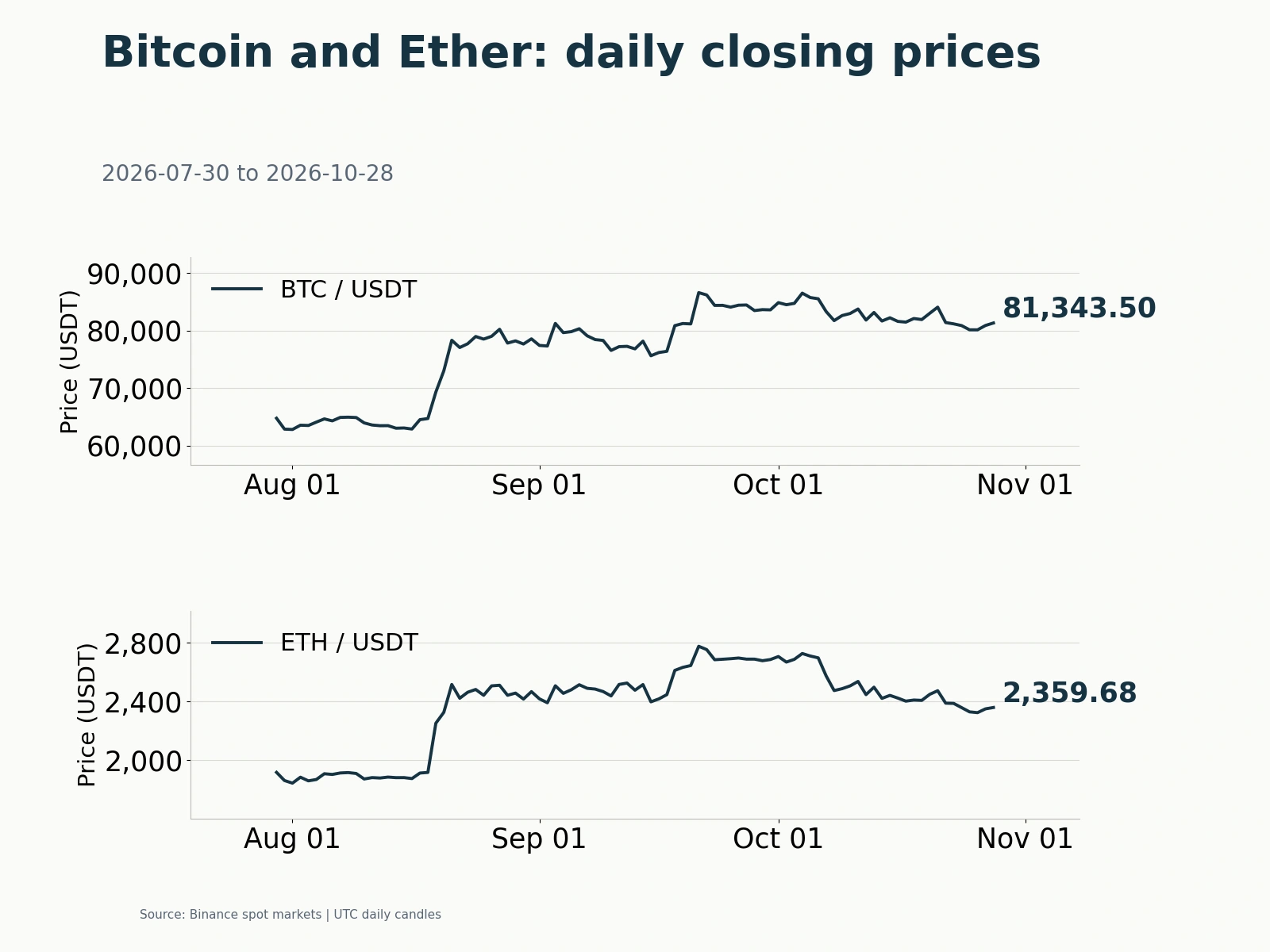
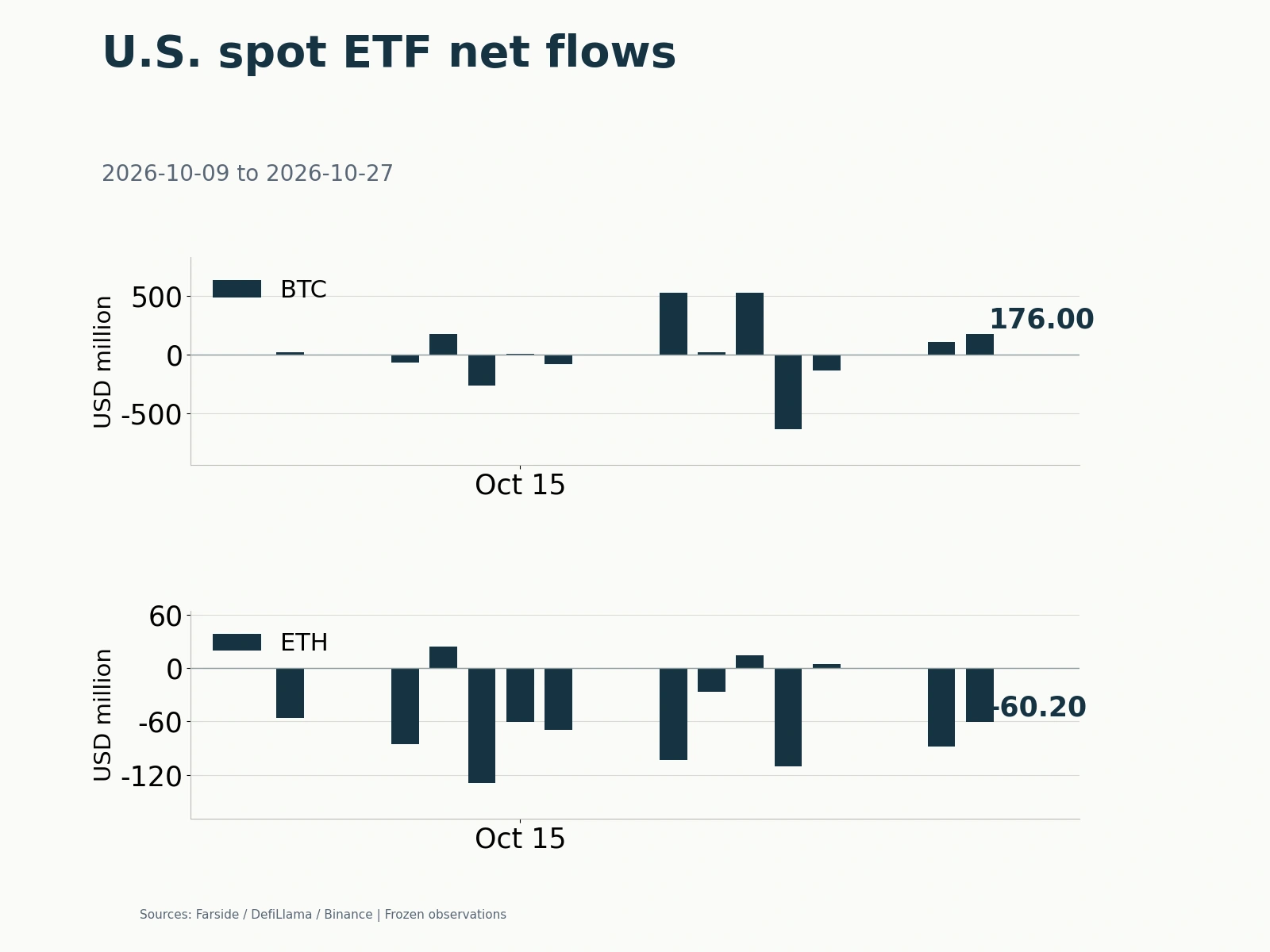
As the weekend began, crypto funding conditions showed pockets of stabilization. Spot Bitcoin ETFs recorded small net subscriptions, ending consecutive outflows, while Ether ETFs continued to lose funds. During the full October 10 UTC session, Binance Bitcoin and Ether perpetual open interest measured in coins was almost unchanged, and funding rates stayed in a neutral range near zero. Allocation flows, onchain stablecoin supply and exchange derivatives showed marked divergence overall: marginal funding pressure had eased, but incremental risk appetite remained cautious.
Bitcoin ETFs gain a modest $21.1 million; funding supply shows no broad recovery
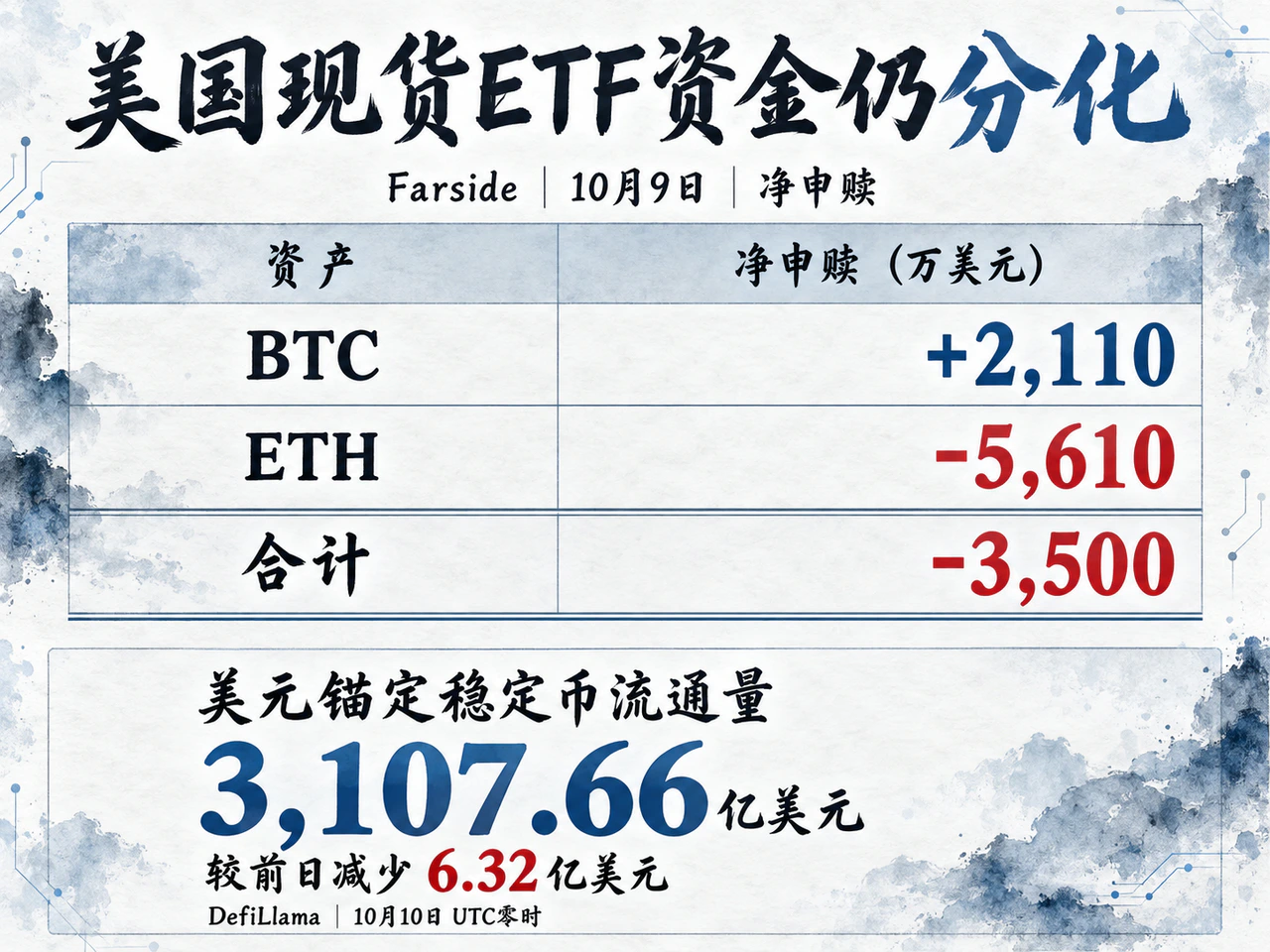
Farside data showed combined net inflows of $21.1 million into U.S. spot Bitcoin ETFs on the October 9 Eastern-time trading day, reversing two consecutive days of outflows. The return of funds was highly concentrated in a few leading products: BlackRock IBIT received $22.4 million, VanEck HODL $2.3 million, and Fidelity FBTC lost $3.6 million, with all other ETFs recording zero net flows that day. Allocation flows showed isolated replenishment rather than broad subscriptions across the product range.
The one-day inflow was far too small to fill the earlier funding gap. Spot Bitcoin ETFs lost $484.9 million on October 7 and $244.1 million on October 8, a combined $729 million. Friday's $21.1 million replenishment was only about 2.9% of those two days' outflows. Across October 5-9, net weekly outflows still totaled $678.9 million. Friday's positive flow relieved tension over one-way withdrawals, but reversing the weekly outflow trend would require evidence of sustained subsequent subscriptions.
Ether's funding conditions were under greater pressure. U.S. spot Ether ETFs lost $56.1 million on October 9, entirely from BlackRock ETHA, with zero net flows in other products. All five sessions of the week saw net outflows, totaling $542.2 million in redemptions. Combining the two asset groups, Friday still recorded a $35 million net outflow. Almost all the marginal funding improvement accrued to Bitcoin, while spot Ether ETFs had yet to attract an effective offsetting bid.
Onchain dollar liquidity also contracted slightly. DefiLlama's sample put total dollar-pegged stablecoin circulation at about $310.766 billion as of 00:00 UTC on October 10, down $632 million, or about 0.20%, from the same time on October 9. Stablecoin supply had slipped modestly for several days from its October 7 high of $312.554 billion.
Spot ETFs and stablecoin supply represent two funding gateways into crypto: the former reflects allocation appetite through regulated traditional securities channels, while the latter directly supports onchain market depth, collateralized borrowing and settlement. Small inflows from outside exchanges coexisted with a slightly shrinking onchain liquidity pool, showing that improvements remained confined to particular channels. A comprehensive recovery in liquidity structure still required stablecoin supply to stop declining and expand, and Ether ETF redemptions to slow materially.
Binance perpetual open interest is broadly flat in coin terms; month-end calls cluster at $95,000
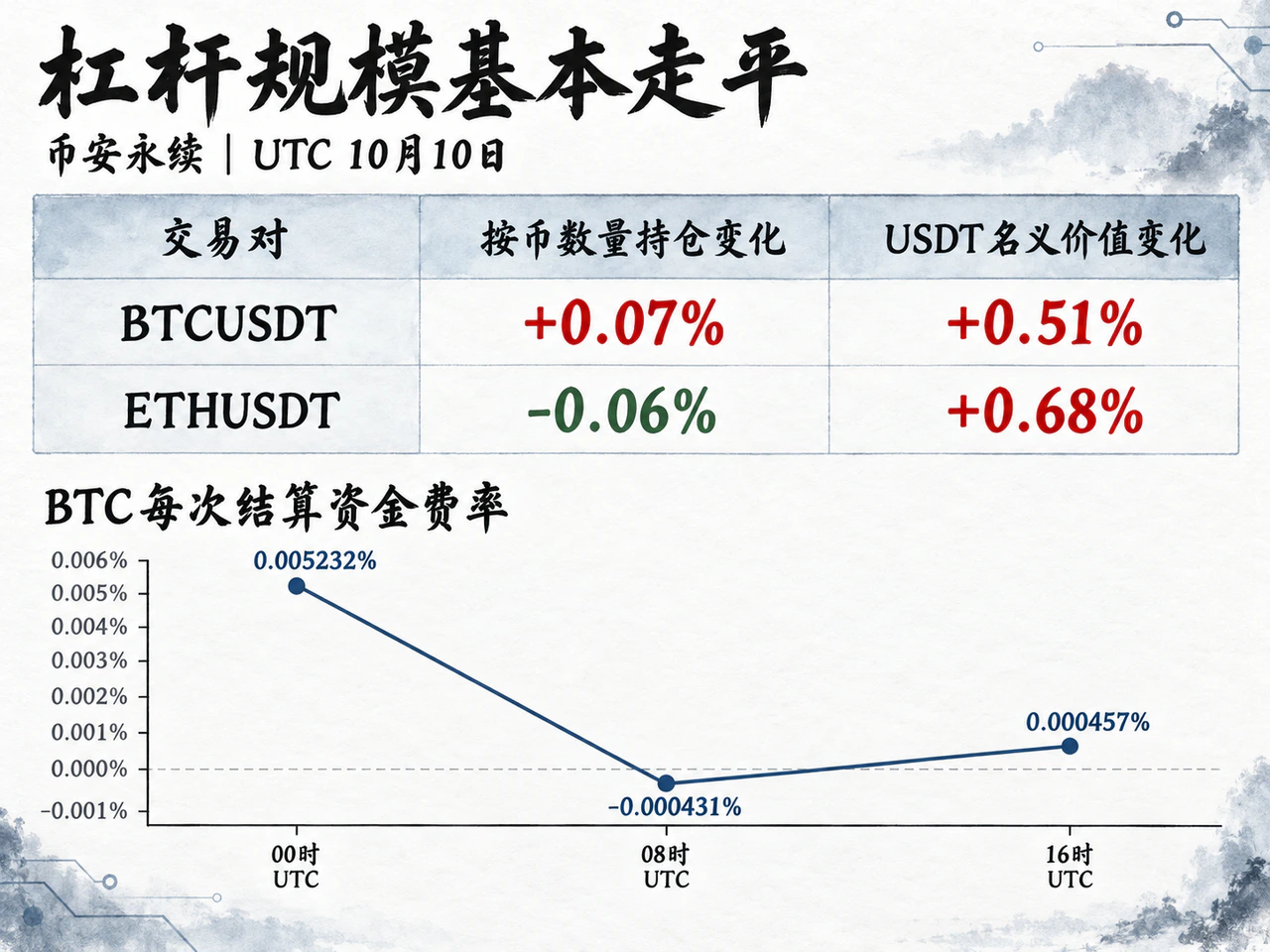
From 00:00 UTC on October 10 to 00:00 UTC on October 11, Binance BTCUSDT perpetual open interest edged up from 92,528.779 BTC to 92,592.853 BTC, just 0.07%. ETHUSDT open interest edged down from 2.343498 million ETH to 2.342164 million ETH, around 0.06%. Measured in coin quantities, positions in both major contracts were almost completely stagnant.
Over that period, the USDT notional value of Bitcoin and Ether open interest rose 0.51% and 0.68%, respectively. Flat coin quantities with slightly higher USDT values indicated that the rise in open-interest value mainly reflected higher token prices rather than substantial new leveraged positions. Speculative chasing of the price rebound was highly restrained.
Funding rates and basis further corroborated the restrained leverage. At the October 10 settlements of 00:00, 08:00 and 16:00 UTC, BTCUSDT perpetual funding rates were 0.005232%, -0.000431% and 0.000457%, respectively, briefly turning negative before returning close to zero. ETHUSDT rates were 0.005576%, 0.000499% and 0.002995%, in a neutral-to-low range overall. As of 00:00 UTC on October 11, Binance Bitcoin perpetuals traded about 51.45 USDT below the spot index, a basis of approximately -0.06%. The mild discount and low funding costs reinforced one another, showing derivatives speculators were not indiscriminately adding leverage to buy.
Options showed a clear concentration in month-end expiries. Bitcoin.com News, citing CoinGlass data as of October 10, said Bitcoin calls accounted for 60.24% of total open interest. On Deribit, calls expiring October 30 with a $95,000 strike had open interest of 25,030.6 BTC. The high concentration at that specific strike made related month-end position adjustments worth watching. Open positions may represent directional trades, covered calls or portfolio hedges, so their distribution alone cannot establish bullish or bearish direction or imply prices must reach that level. The large concentration nevertheless provides an important reference for month-end derivatives positioning.
Overall, funding conditions remained characterized by a limited, weak recovery: spot Bitcoin ETFs reversed daily withdrawals, and speculative perpetual leverage stayed moderate and restrained, but Ether ETFs and stablecoin supply remained weak. If spot ETF inflows expand and gradually replenish earlier outflows alongside stable derivatives leverage, the price recovery will have a stronger funding base. If spot demand falters and the rally again relies on exchange leverage to increase notional positions and funding rates, funding fragility could intensify once more.
Click Read Original for full details.