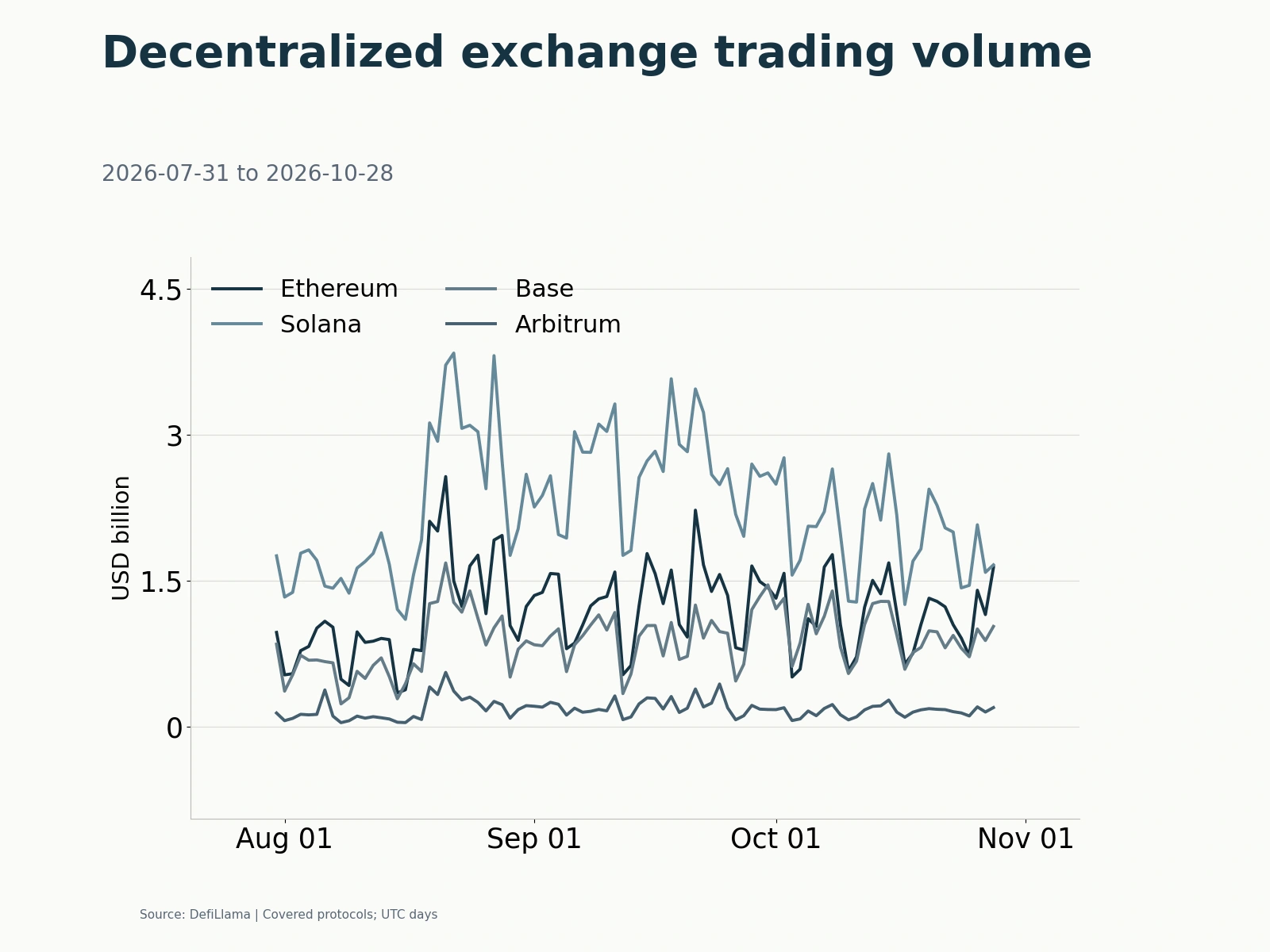
While the stock of on-chain capital remained resilient, spot trading activity contracted markedly. DefiLlama's returned UTC daily data for October 10 showed decentralized exchange (DEX) volume falling 15.94% from the previous day to $6.153 billion. In contrast, dollar-denominated total value locked (TVL) on Ethereum, Solana and Base all recovered. Weaker trading frequency and turnover demand are revealing operating pressure in the on-chain ecosystem before it appears in the stock of deposited assets. Although use cases in payments, lending and real-world asset tokenization (RWA) continue to expand, turning retained assets into sustainable trading turnover and protocol fees has become a core test of public chains' commercial quality.
Major-Chain TVL Rises but Turnover Slows; Layer 2 and RWA Utilization Continues to Diverge
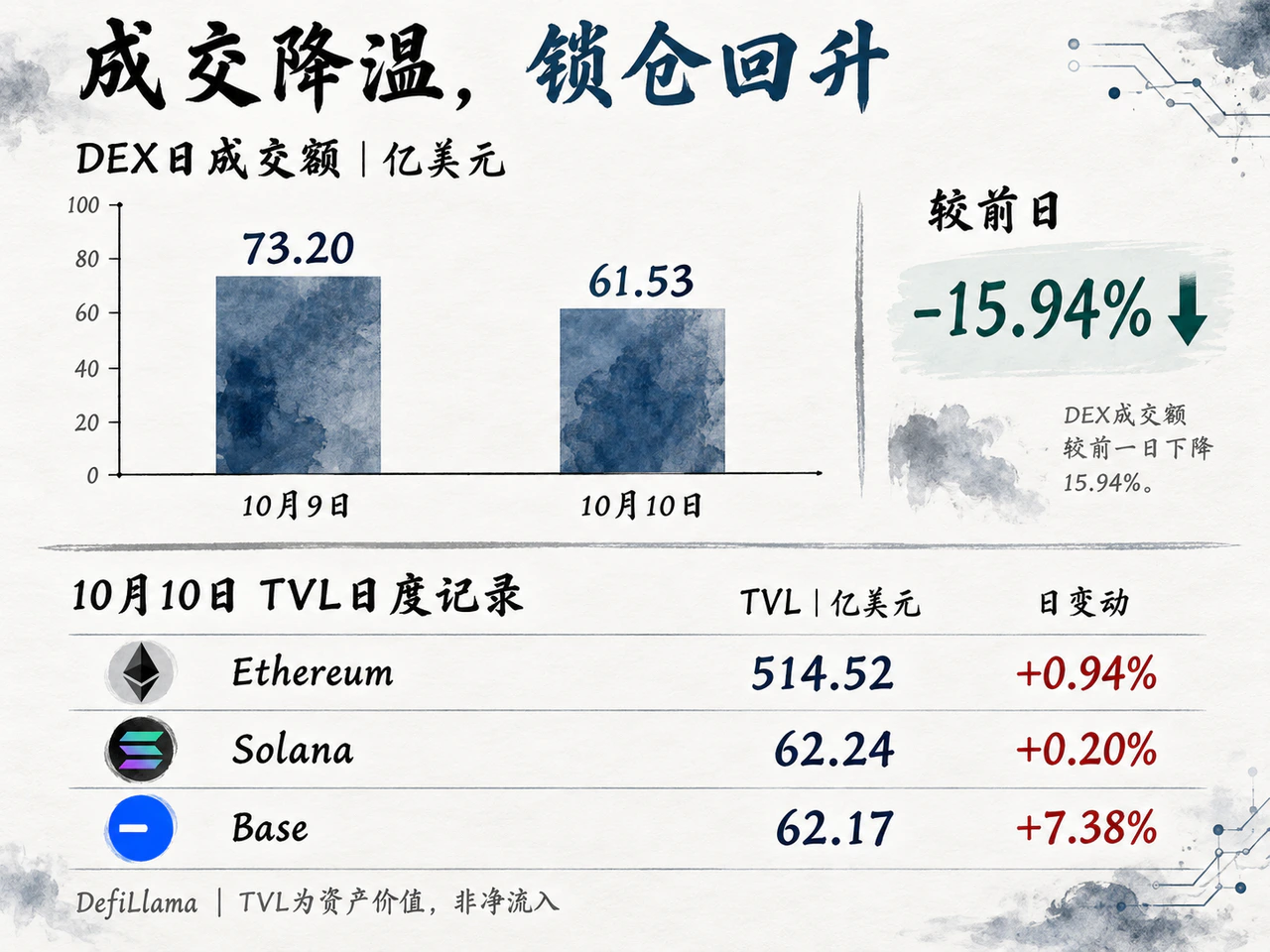
The recovery in capital balances was uneven across chains. DefiLlama's daily records labeled October 10, which are not strict closing observations, showed Ethereum TVL rising 0.94% to $51.452 billion, Solana edging up 0.20% to $6.224 billion, and Base increasing 7.38% to $6.217 billion, a stronger recovery than other ecosystems. Dollar TVL on all three is also affected by underlying token prices, so changes in asset value do not directly equal actual net capital inflows. TVL measures only the stock of retained assets; trading volume and network fees relate more directly to turnover frequency and commercial monetization.
Actual activity differed significantly among Layer 2 networks. L2BEAT data as of October 10 put Base at a relatively high 83.75 user operations per second (UOPS), compared with 17.33 on OP Mainnet and 16.20 on Arbitrum One. Application mix and automated scripts can affect UOPS, but the figures also reflect structural differences in how rollups attract ecosystem activity.
Networks are extending infrastructure and asset categories into settlement and real-world assets. TRON founder Justin Sun said on October 10 that quantum-resistant signatures had been deployed on the Nile testnet, with mainnet rollout to follow when appropriate, aiming to strengthen long-term security for large stablecoin settlements. In RWA, CCN cited Token Relations and RWA.xyz data showing $2.46 billion of RWA on XRPL at end-September, including $2.2 billion in energy-related commercial commitment assets JMWH and $189.9 million in short-term Treasury product OUSG. Bringing real-world assets on-chain is only the first step in retaining assets; sufficient secondary liquidity, collateral demand and regular settlement determine whether they can keep contributing on-chain economic returns.
Robinhood Chain's Weekly Transactions Fall 20%; Billion-Dollar Balances Face a Test of Sustained Fee Generation
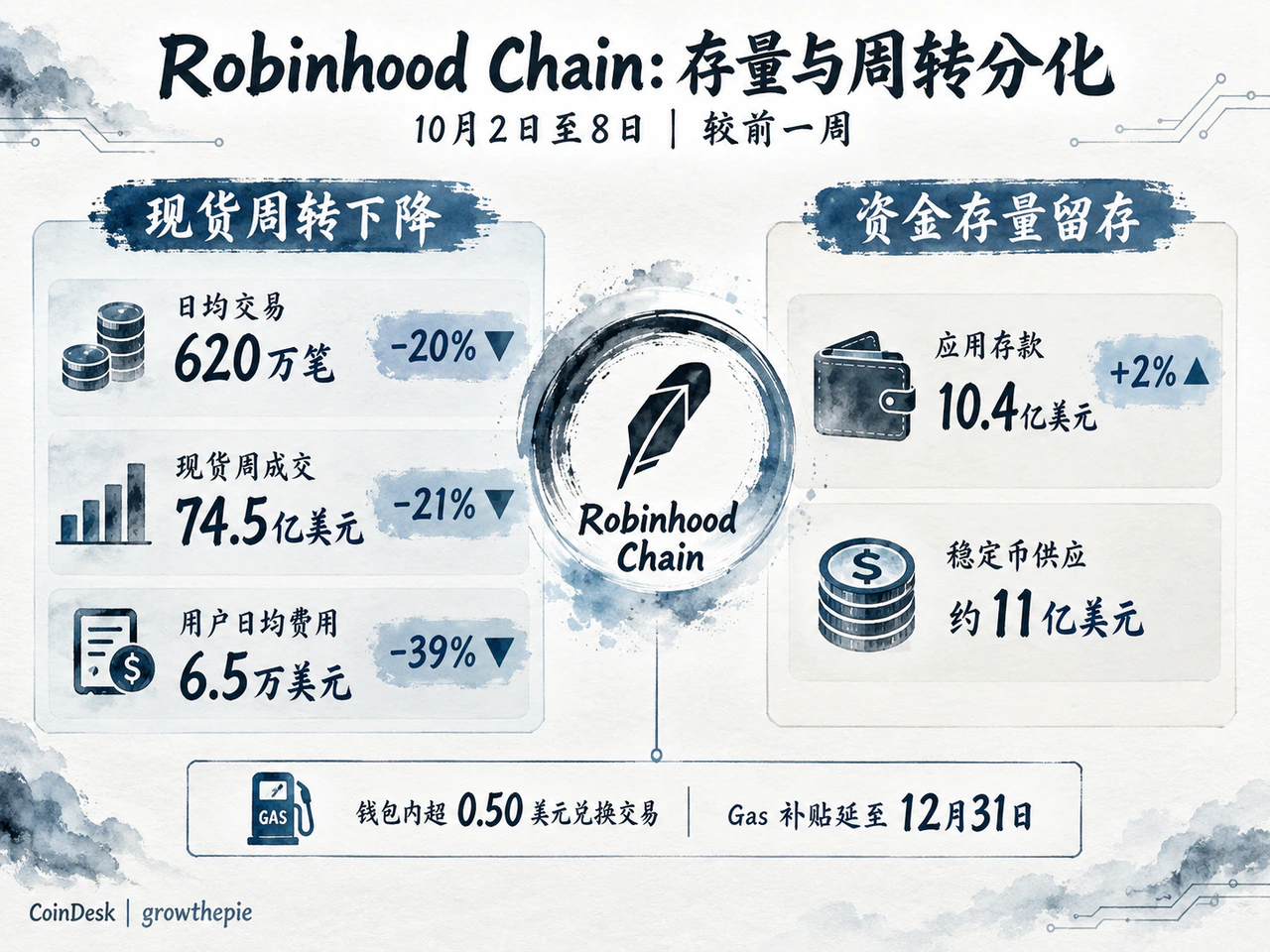
Weekly data for Robinhood Chain, a closely watched recent application-chain example, show the industry's pattern of stronger capital retention than actual turnover. Using growthepie data, CoinDesk calculated that daily transactions during October 2–8 fell to approximately 6.2 million, down 20% from the preceding week and 42% from the mid-September peak of 10.8 million. Daily active addresses fell to 322,000, down 31% from mid-September.
Lower activity fed directly into spot volume and fees. During that week, network DEX spot turnover was $7.45 billion, with Uniswap accounting for approximately 77%, down 21% from $9.46 billion the previous week. Average daily user fees fell to around $65,000, down 39% week on week. Simultaneous contractions in transaction frequency, spot volume and total fees show the chain entering an adjustment phase after an earlier burst of trading.
Underlying deposits and derivatives trading showed greater persistence. Deposits in the network's lending and trading protocols rose 2% against the trend to $1.04 billion that week, while on-chain stablecoin supply held near $1.1 billion. Rolling seven-day perpetual volume through October 9 reached $7.35 billion, up 26%. Despite slower spot turnover, stable deposit value and divergence between spot and perpetual trading provided a base of capital for the network.
Network-fee sustainability nevertheless faces two structural constraints. First, the fee base has a strong burst-peak effect. growthepie's third-quarter report showed that 74% of Robinhood Chain's $51 million in quarterly fees arose in just the 12 days from August 30 to September 10. Excess fees driven by short-lived congestion are a poor basis for linear extrapolation of normal activity. Second, demand depends on platform subsidies. CoinDesk reported that Robinhood extended its gas subsidy for wallet swaps above $0.50 per transaction to December 31. Some actual network fees are therefore paid by the platform, and genuine users' willingness to pay has yet to face a fully market-based test.
The on-chain economy is moving beyond a simple contest to attract assets and maximize TVL toward the harder questions of turnover efficiency and internally generated cash flow. For public chains and application chains alike, once billions in assets have accumulated, the true dividing line for valuations and ecosystem advantages is whether frequent trading and stable fees can persist without subsidy-driven stimulus.
Click Read Original for full details.