Institutional digital-asset infrastructure is extending further into payments. Anchorage Digital acquired corporate-payments provider Routable, Samsung plans to introduce USDC remittances and transfers in Samsung Wallet, and Hong Kong licensed platform OSL is bringing tokenization to the distribution of an arbitrage-oriented fund. Stablecoin issuance, custody and settlement capabilities are moving rapidly into corporate payments, mass-market smartphones and wealth-management channels. Competition is expanding toward real payment access points, efficient conversion and redemption across currencies, and sustained compliant delivery.
By the morning of October 12 Beijing time, these developments, disclosed from October 5 to October 11, were at different stages: the acquisition was completed, consumer software features were scheduled to open later this month, and a capital-markets reverse merger pointed to a longer delivery timetable. As business scope expands, regulatory constraints and technical-integration requirements rise together. Monetization depends on how deeply the underlying solutions improve traditional financial workflows and fiat on- and off-ramp friction.
Use-case penetration: corporate finance systems and consumer wallets become central settlement channels
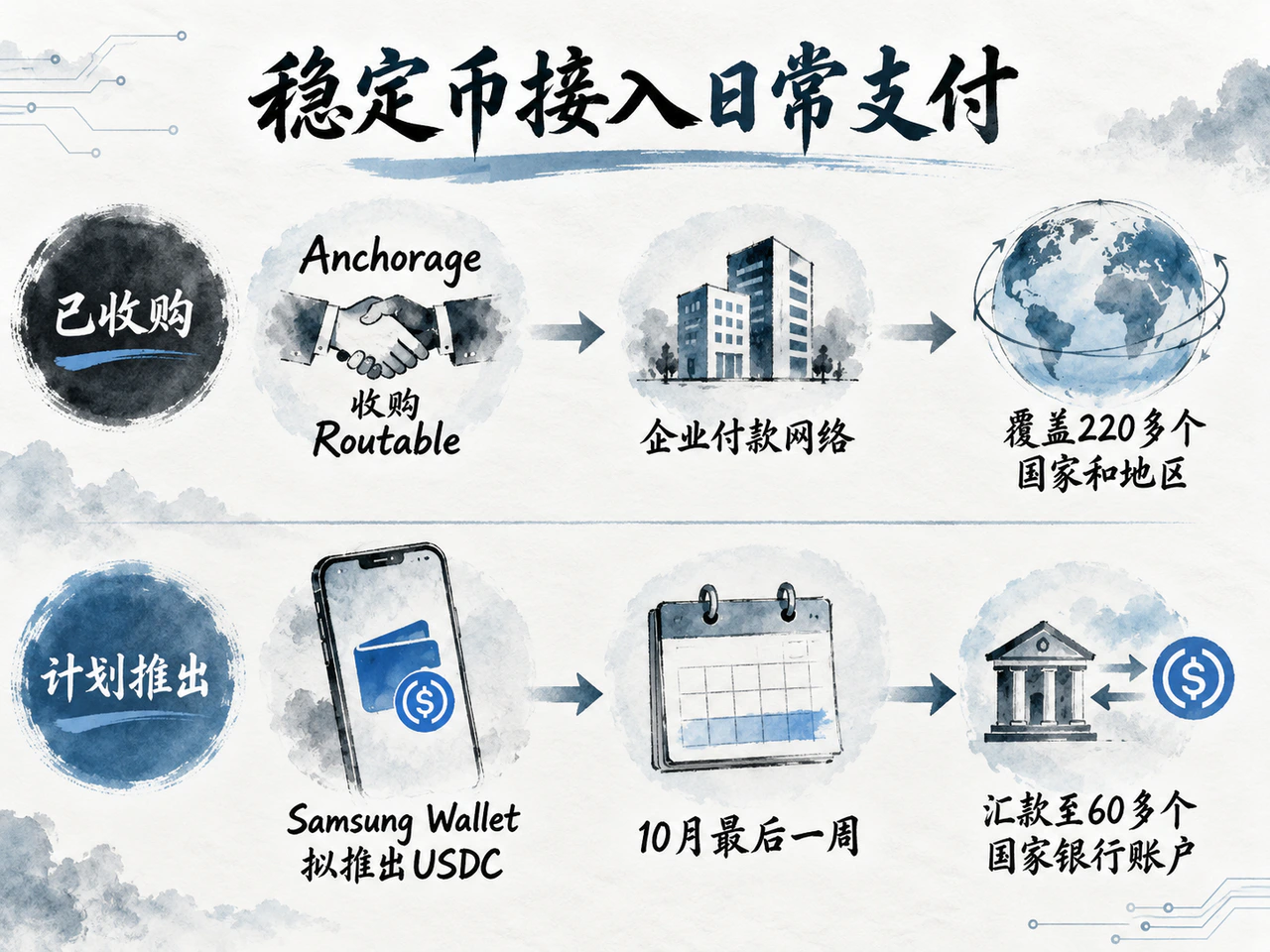
Corporate settlement has long faced a disconnect between on-chain tokens and off-chain accounting. Although blockchain settlement can theoretically improve cross-border efficiency, suppliers, contractors and creators often insist on fiat settlement, while businesses must address recipient identity verification, tax reporting and reconciliation audits. Anchorage Digital's October 6 announcement of its Routable acquisition aims to add a corporate-disbursement network covering more than 220 countries and territories, together with tax-compliance components, to its existing crypto-native custody, stablecoin issuance and settlement infrastructure. Disclosures say both parties currently serve their existing clients separately, with integrated products rolling out over coming quarters. The deal's effectiveness depends on materially reducing total cross-border payment friction and settlement times for businesses, beyond expanding a list of supported countries on paper.
For consumer devices, Samsung announced a specific personal-payments timetable on October 7. Samsung Wallet plans to offer USDC features to eligible U.S. Galaxy users in the final week of October, supporting transfers to compatible on-chain wallets and local-fiat remittances to eligible bank accounts in more than 60 countries. Samsung's figure of 82 million devices refers to compatible U.S. devices; activation remains subject to age, know-your-customer verification and system-account requirements. Bastion supplies stablecoin-account infrastructure, while Coinbase Prime Vault provides sub-custody. Integration into a system wallet reduces friction from managing seed phrases and separate apps, but cross-border remittances still incur banking-channel fees based on destination and amount. Meaningful business expansion will depend on actual consumer activation and habitual payment use.
Capital markets are also supporting expansion of the underlying payment networks. FDUSD issuer First Digital signed a business-combination agreement on October 6 with Nasdaq SPAC KOYN at a pre-money equity valuation of $250 million. Closing is expected in the first half of 2027, subject to shareholder votes and regulatory approval. Figures show First Digital generated approximately $87 million in revenue for the fiscal year ended June 2025, but its promoted Finance District ecosystem has yet to contribute material revenue. The interest-spread earnings model of existing stablecoins and the commercial potential of the emerging payment ecosystem require separate valuation assessments.
Regulatory boundaries: licensed distribution defines access, while anti-money-laundering oversight looks through agent networks
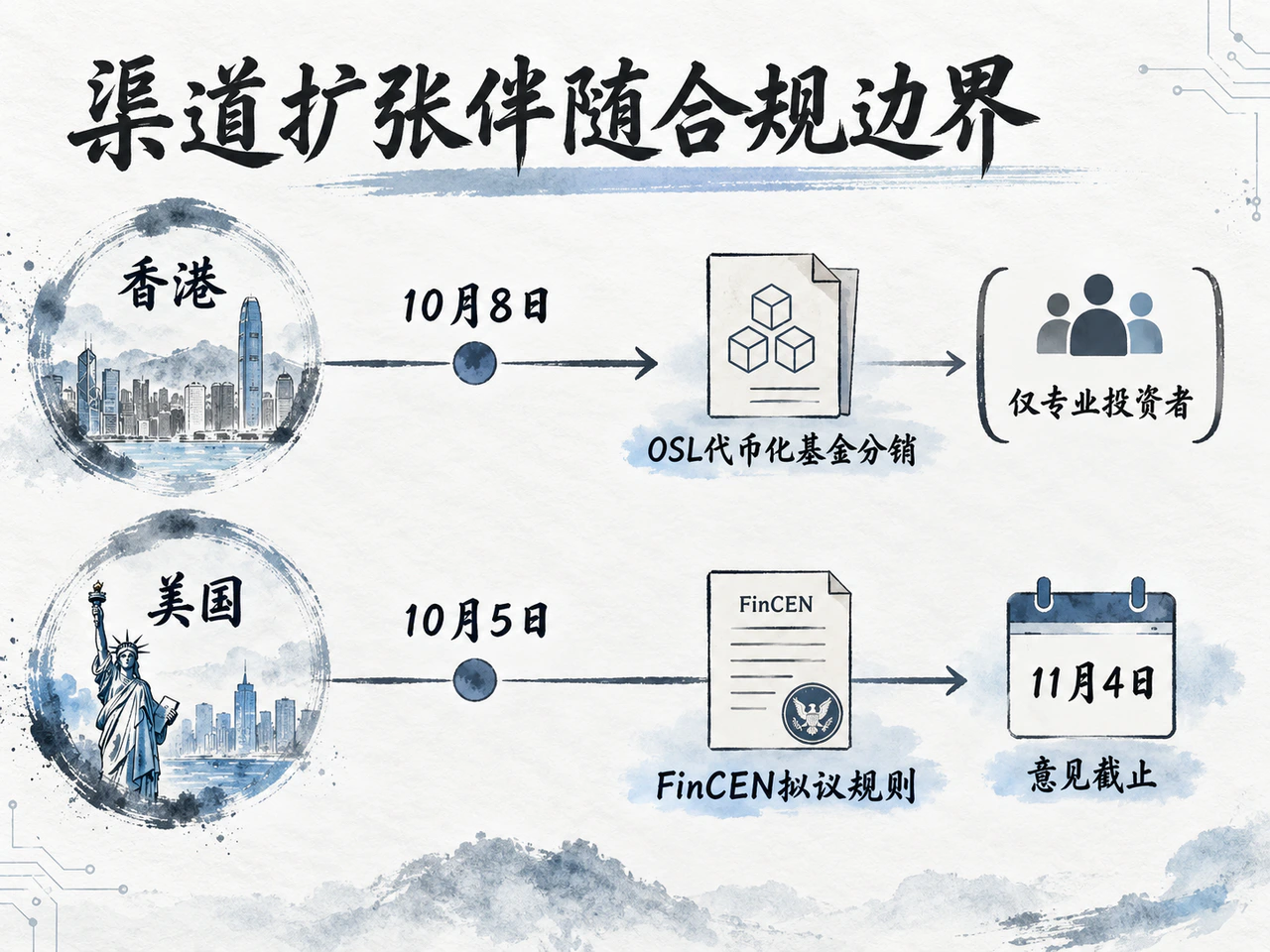
In asset-management and investment channels, the precise scope of regulatory authorization directly determines the audience for tokenized products. On October 8, Hong Kong licensed virtual-asset platform OSL announced on-chain tokenization, custody and distribution services for 2WA's USDGO Plus SP fund. The fund had already launched within the 2WA ecosystem in August. The substantive development that week was its connection to a Hong Kong licensed channel, enabling verified Hong Kong professional investors, or PIs, to subscribe and redeem within the OSL HK app.
The fund uses stablecoins as underlying assets and seeks market-neutral returns from crypto-derivatives funding-rate differentials. This ties liquidity-reserve risk to strategy market risk: underlying stablecoin reserves and custody determine redemption conditions, while derivatives counterparty risk and funding-rate fluctuations drive strategy returns. Negative market funding rates would directly pressure performance. OSL drew strict boundaries in its announcement: the fund is not authorized by Hong Kong's Securities and Futures Commission under Section 104 of the Securities and Futures Ordinance and is limited to professional investors. Neither the relevant stablecoin issuers nor OSLDS holds a license for the relevant regulated activities under Hong Kong's Stablecoins Ordinance; OSLDS acts solely as a permitted offeror. Overseas dollar-related compliance status, Hong Kong platform distribution licenses and permission under stablecoin legislation are separate regulatory categories and cannot substitute for one another.
Alongside these commercial-channel boundaries, U.S. financial regulators are intensifying look-through screening along cross-border fund flows. On October 5, FinCEN published a proposed rule classifying transactions associated with overseas subagent companies controlled by the A7 network as a primary money laundering concern involving Russian illicit finance. It proposes prohibiting covered financial institutions from providing specified money-transmission services, with public comments due November 4. Regulators are looking through layers of agents to close opportunities for regulatory arbitrage in cross-border funding channels.
From corporate payments and smartphones to fund distribution, rapid channel expansion is forcing institutions to integrate identity checks, transaction monitoring, segregated custody and fiat settlement into a closed operating system. Stablecoin competition has moved beyond simply comparing license counts or reported reserves toward real-use delivery and resilience. Over coming weeks, the actual rollout of Samsung's payment features, delivery of Anchorage's integrated products, and real subscriptions to tokenized investment products within regulatory limits will be key tests of the quality of this payment-infrastructure expansion.
Click Read Original for the full details.