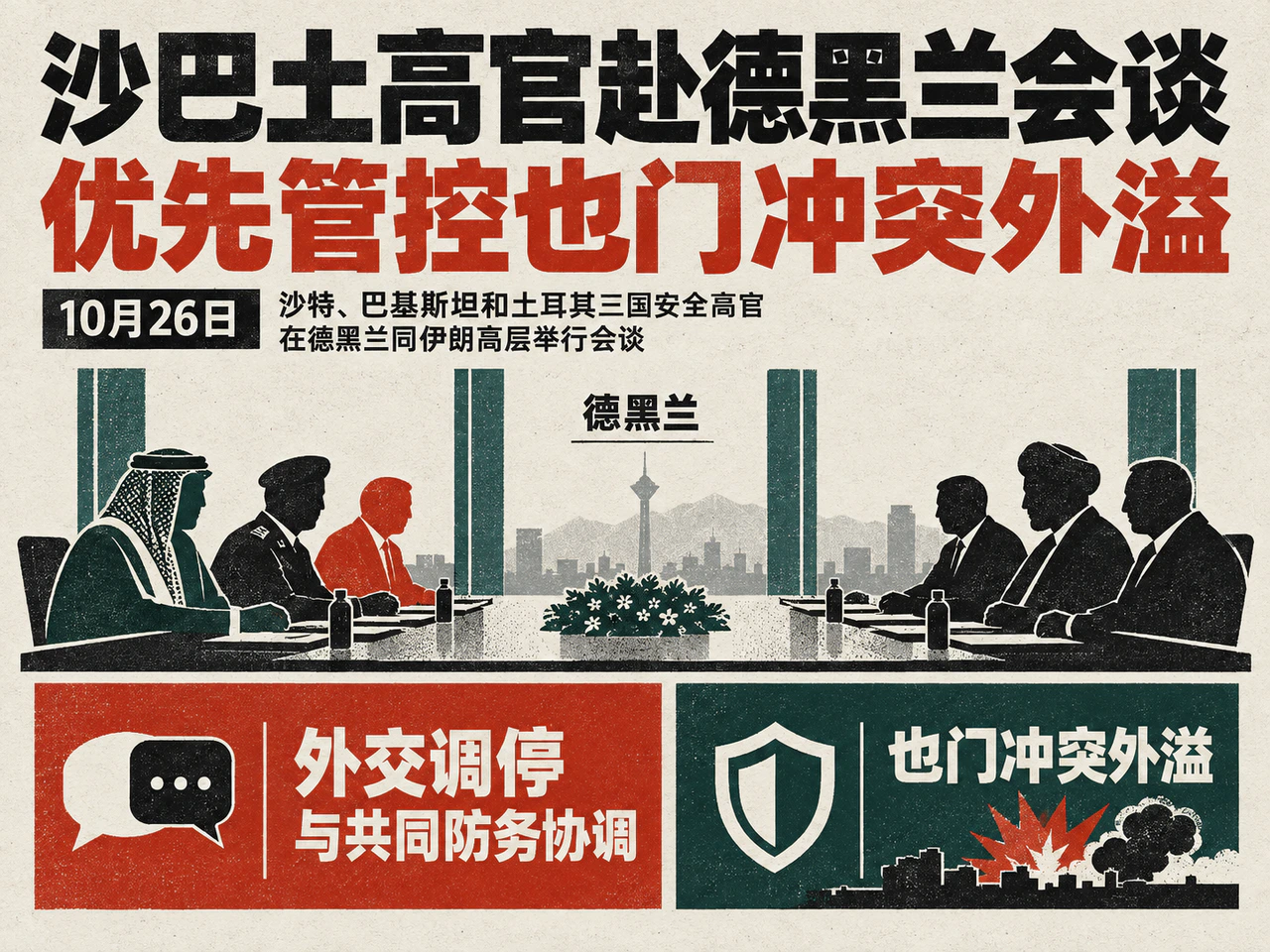
The week of October 5–11 exposed a divide in Middle Eastern geopolitics: diplomatic channels remained open while physical disruption at sea and in the air deepened. President Trump said the United States would not attack Iran before the November 3 midterm elections, but its maritime blockade continued. The two sides exchanged proposals through intermediaries yet remained stuck over ceasefire sequencing and economic preconditions. Against cautious political overtures, actual conflict increasingly struck transport networks. Attacks on commercial vessels in Hormuz caused casualties and reduced crude flows by nearly 40% from prewar levels. Fighting in Yemen spilled into major Saudi aviation hubs, causing civilian casualties and prompting international flight suspensions. The practical costs of geopolitical friction were spreading from a maritime energy chokepoint to wider regional transport and movement of people.
U.S. softens zero-enrichment language, but blockade leaves ceasefire terms misaligned
Technical language on nuclear negotiations shifted slightly early in the week. In an interview published October 6, Vice President Vance called for a “meaningful” reduction in Iran's uranium-enrichment capability, focusing on highly enriched nuclear fuel. Compared with the White House's earlier insistence on complete zero enrichment, this left some operational room for verification and technical compromise. Tehran nevertheless insisted on retaining domestic enrichment rights and wanted arrangements such as diluting highly enriched uranium left to later negotiations. Differences remained over sequencing and the technical core.
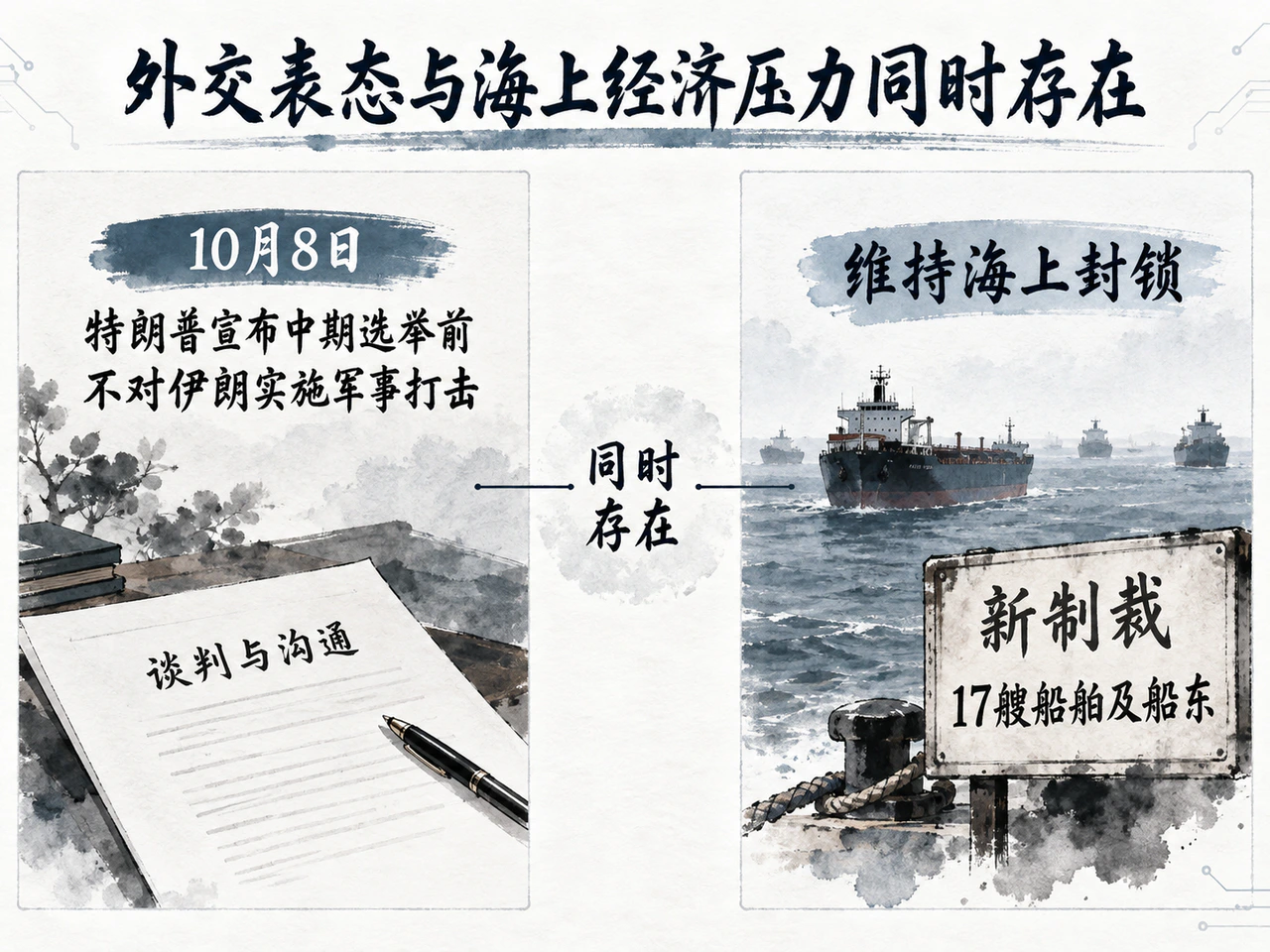
The central disconnect concerned the linkage between security guarantees and economic conditions. Iran explicitly demanded restoration of the memorandum of understanding reached in June and subsequently broken, as well as U.S. support for temporary Hormuz routes coordinated with Oman. On October 8, Foreign Minister Abbas Araghchi confirmed that messages were still passing through mediators and Tehran was assessing the U.S. reply. Trump announced the same day that he would not strike Iran before the midterms. While ruling out a direct near-term military escalation, the United States explicitly maintained the blockade and announced new sanctions on 17 vessels and shipowners involved in Iranian oil transport.
Sanctions and the blockade provided U.S. economic leverage, while liquidity pressure was emerging inside Iran. Its central-bank governor said that week that the bank had supplied $2 billion of foreign exchange to the market, but cumulative provision through early October, about $24.9 billion, was down around 12% year on year. As the sides wore each other down over fiscal revenues, FX reserves and navigation rules, the absence of a concrete mechanism linked to lifting the blockade made technical diplomatic contacts difficult to turn into substantive de-escalation.
Hormuz crude flows fall to 8.5 million barrels a day as actual losses raise the threshold for passage
Navigation risks had become damaged ships and human casualties. On October 5, the tanker On Peace was attacked while transiting Hormuz, injuring 12 Indian crew members; ten were medically evacuated by Oman's navy. On Tuesday, UKMTO reported another tanker hit by an unidentified projectile. By Friday, Gem No.2 was attacked and caught fire off the UAE, while Iran's Revolutionary Guard said it had struck the LPG carrier NV Sunshine for using a non-designated route.
Interceptions and attacks expanded over the weekend. U.S. Central Command said it disabled the propulsion system of a Panamanian cargo ship in the Gulf of Oman on suspicion of violating the blockade of Iranian ports. On Sunday, UKMTO reported another tanker attacked while leaving the strait, while the UAE rescued 22 crew from a burning tanker offshore; the fire's cause was not disclosed. Repeated physical attacks and enforcement interceptions sharply raised the risk premium for commercial shipping.
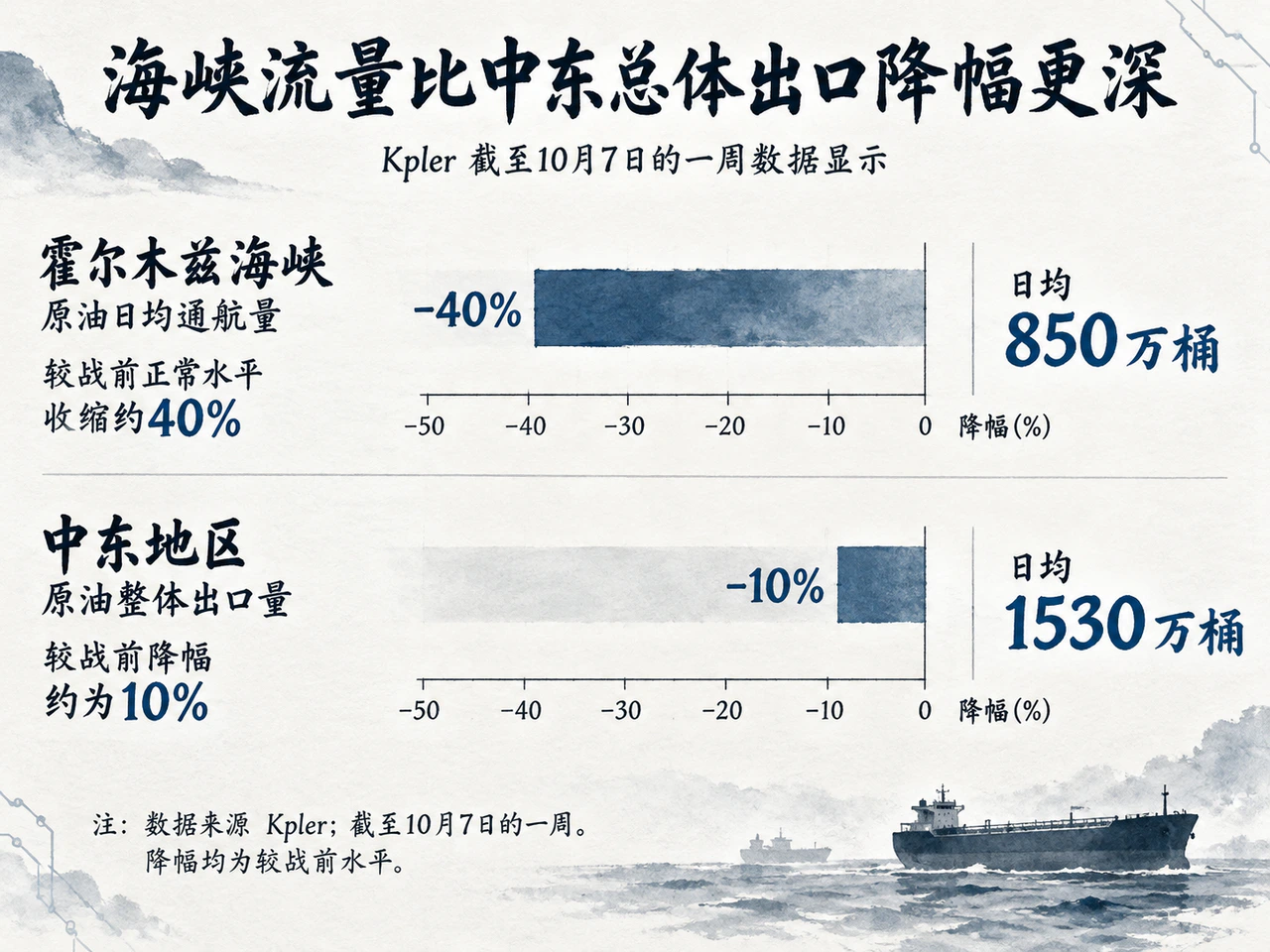
Shipping data directly reflected reduced willingness to transit. Kpler's data for the week through October 7 showed Hormuz crude flows averaging 8.5 million barrels a day, around 40% below normal prewar levels. Total Middle Eastern crude exports averaged 15.3 million barrels a day, down about 10% from prewar levels. The much steeper fall through the strait suggests that some cargoes were trying alternative routes, but the 40% contraction and repeated attacks indicated high operational friction and insurance costs for commercial shipping.
Yemen war spills into aviation hubs; Riyadh and Dammam attacks trigger international flight suspensions
Alongside maritime disruption, advances on the ground in Yemen had not eliminated the Houthis' ability to launch long-range attacks beyond the country. On October 9, Saudi Arabia's ambassador to Yemen said Saudi-backed government forces had recaptured Bab el-Mandeb and Mayun Island. The Houthis had previously denied losing them, leaving actual control disputed. Long-range attacks on Saudi civil-aviation hubs nevertheless escalated sharply during the week.
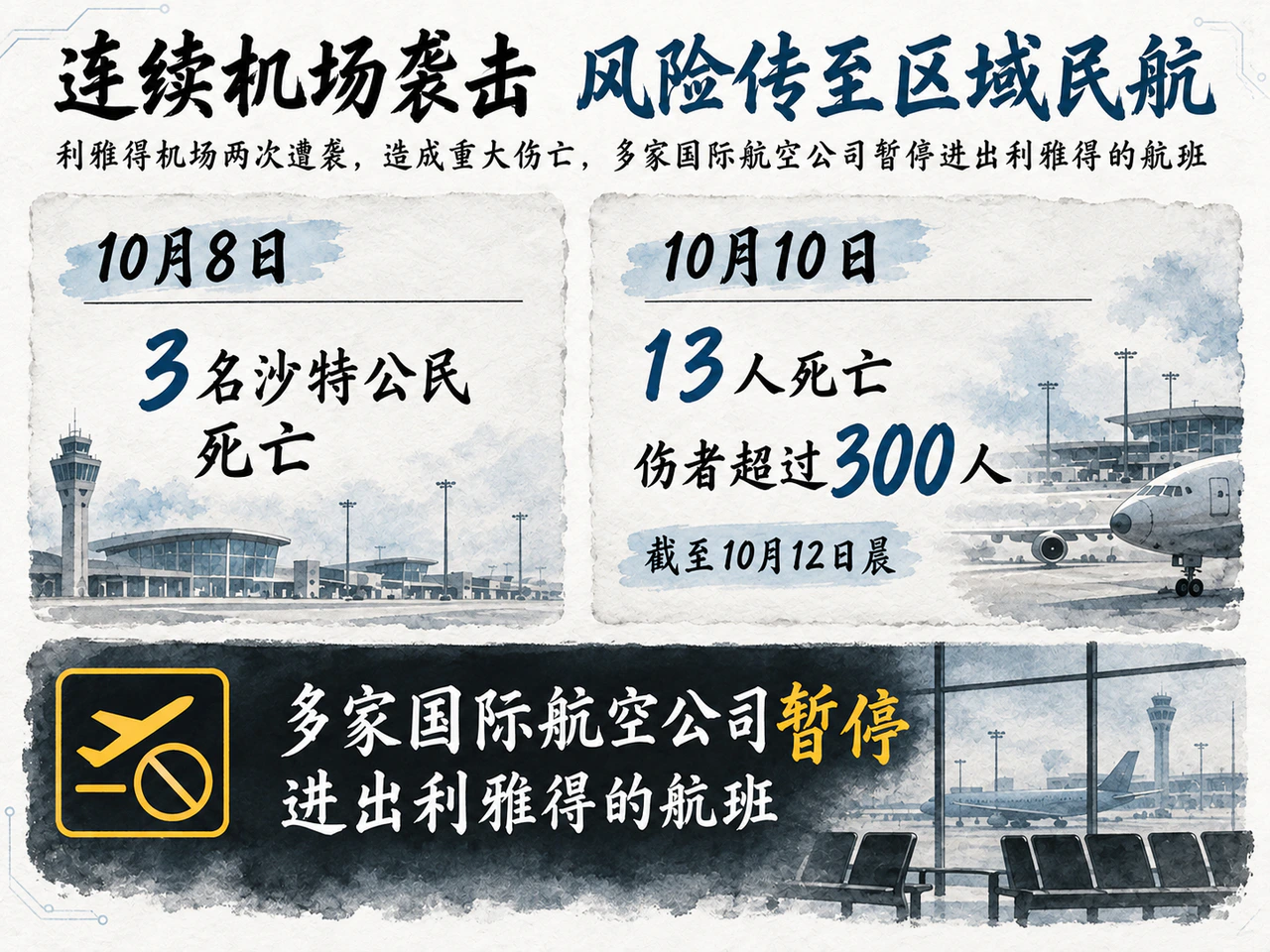
Attacks directly damaged major civilian transport nodes. Saudi civil-aviation authorities confirmed two attacks on Riyadh's King Khalid International Airport on October 8, killing three Saudi citizens and hitting an empty passenger aircraft. The attacks triggered a civil-aviation chain reaction: the European Union Aviation Safety Agency updated its airspace-risk warning and several international airlines suspended flights to and from Riyadh. Another severe attack hit the airport on October 10. By the morning of October 12, the death toll from that attack had risen to 13, with more than 300 injured. King Fahd International Airport in Dammam, a major eastern Saudi city, subsequently also reported an attack, with damage still being assessed.
Attacks on core airports overturned expectations that geopolitical risk would remain confined to sea lanes, extending the conflict to travel and commercial logistics in regional cities. Post-week developments showed that communication had not completely closed: reports on the morning of October 12 Beijing time said the Saudi and Iranian foreign ministers discussed de-escalation by phone and Iran offered to help Saudi–Yemeni contacts. Yet Iran's Supreme National Security Council chief also said that day that the latest U.S. reply remained insufficient, with differences over seven proposed conditions. As maritime and aviation facilities continued sustaining real damage, whether political statements could quickly produce effective security guarantees was central to lowering transport-corridor risk premiums.
Key developments
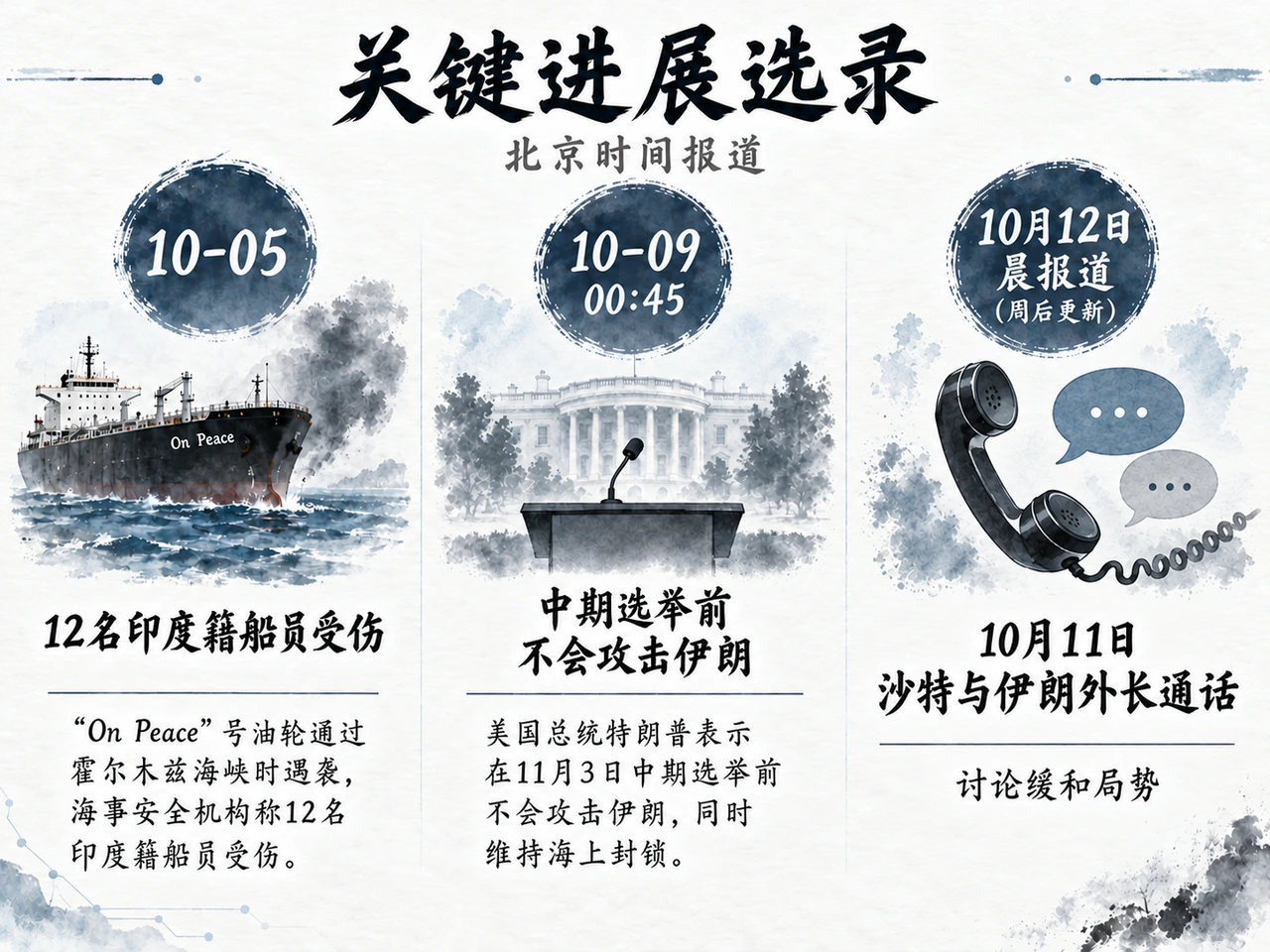
Items below are in reverse order of reporting time in Beijing; entries with only a confirmed event date are listed by date. October 12 morning entries are post-week updates.
| Key developments |
|---|
| 10-12 05:13 Beijing timeSaudi and Iranian foreign ministers discussed de-escalation by phone; Iran offered to help Saudi Arabia and Yemen begin dialogue. |
| 10-12 02:55 Beijing timeSaudi civil-aviation authorities confirmed an attack on Dammam's King Fahd International Airport; damage was still under assessment. |
| 10-12 02:16 Beijing timeIran's Supreme National Security Council chief said the U.S. reply remained insufficient, with issues among seven conditions still requiring clarification. |
| 10-12 00:53 Beijing timeThe Saudi-led coalition reported another projectile hit on the domestic terminal of Riyadh's King Khalid International Airport. |
| 10-11 22:04 Beijing timeUKMTO reported that a tanker leaving Hormuz was hit by an unidentified projectile. |
| 10-11 22:04 Beijing timeUAE authorities announced the offshore rescue of 22 crew from a burning tanker, without disclosing the cause of the fire. |
| 10-11 22:04 Beijing timeThe head of Iran's Atomic Energy Organization stressed that development of the country's nuclear industry would continue. |
| 10-11 08:43 Beijing timeU.S. Central Command said it disabled a Panamanian cargo ship's propulsion system in the Gulf of Oman to enforce the blockade; its crew were unhurt. |
| 10-10 Beijing timeAn attack on Riyadh airport caused major civilian casualties. By Reuters' follow-up on Monday morning, 13 deaths and more than 300 injuries had been confirmed. |
| 10-10 02:01 Beijing timeMedia cited Kpler data showing Hormuz crude flows averaging 8.5 million barrels/day in the week through October 7, about 40% below prewar levels. |
| 10-10 02:01 Beijing timeThe tanker Gem No.2 was hit by a projectile and caught fire off the UAE. |
| 10-10 00:35 Beijing timeSaudi Arabia's ambassador to Yemen said government forces had recaptured control of Bab el-Mandeb and Mayun Island; the Houthis had previously denied losing territory. |
| 10-09 23:36 Beijing timeIran's Revolutionary Guard said it struck the LPG carrier NV Sunshine for attempting to transit Hormuz on a non-designated route. |
| 10-09 21:29 Beijing timeSeveral international airlines suspended Riyadh flights, and the European Union Aviation Safety Agency updated its risk warning for parts of Saudi airspace. |
| 10-09 19:09 Beijing timeSaudi civil-aviation authorities confirmed two October 8 attacks on Riyadh airport, killing three Saudi citizens and hitting one empty passenger aircraft. |
| 10-09 01:56 Beijing timeThe U.S. Treasury announced sanctions on 17 vessels and their shipowner entities involved in Iranian oil transport. |
| 10-09 00:45 Beijing timePresident Trump said he would not attack Iran before the November 3 midterm elections, while maintaining the maritime blockade. |
| 10-08 22:19 Beijing timeForeign Minister Araghchi said the two sides were still exchanging views through intermediaries and Tehran was assessing U.S. feedback. |
| 10-07 07:45 Beijing timeOman confirmed the medical evacuation of ten injured crew from the attacked tanker On Peace. |
| 10-07 06:30 Beijing timeIran's central-bank governor said it had injected $2 billion in foreign exchange into the market; cumulative FX provision through early October was down about 12% year on year. |
| 10-06 Beijing timeIn an interview, Vice President Vance called for a substantive reduction in Iran's enrichment capability, focusing on highly enriched nuclear fuel. |
| 10-05 Beijing timeThe tanker On Peace was attacked while transiting Hormuz; a maritime-security agency said 12 Indian crew were injured. |