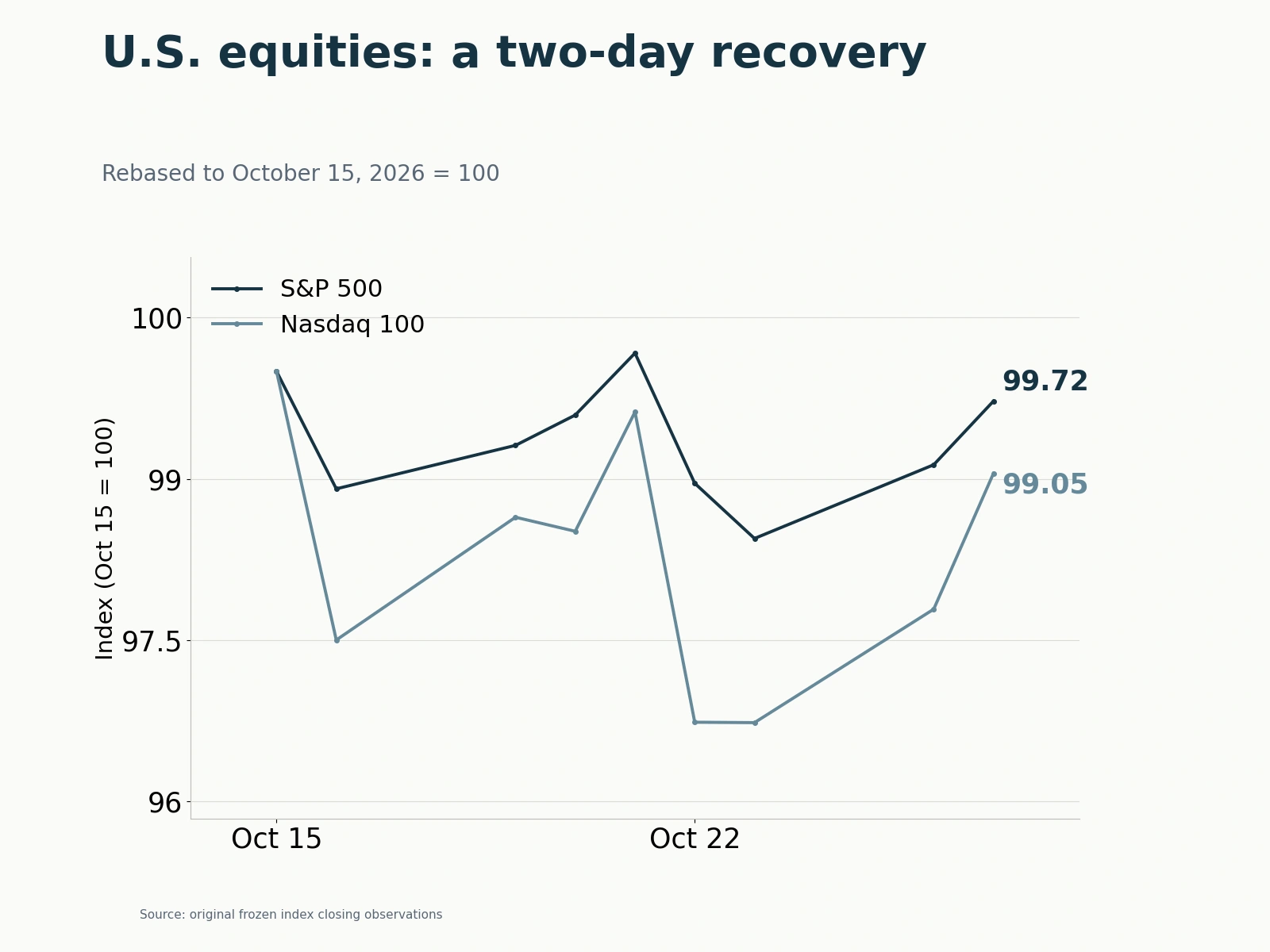
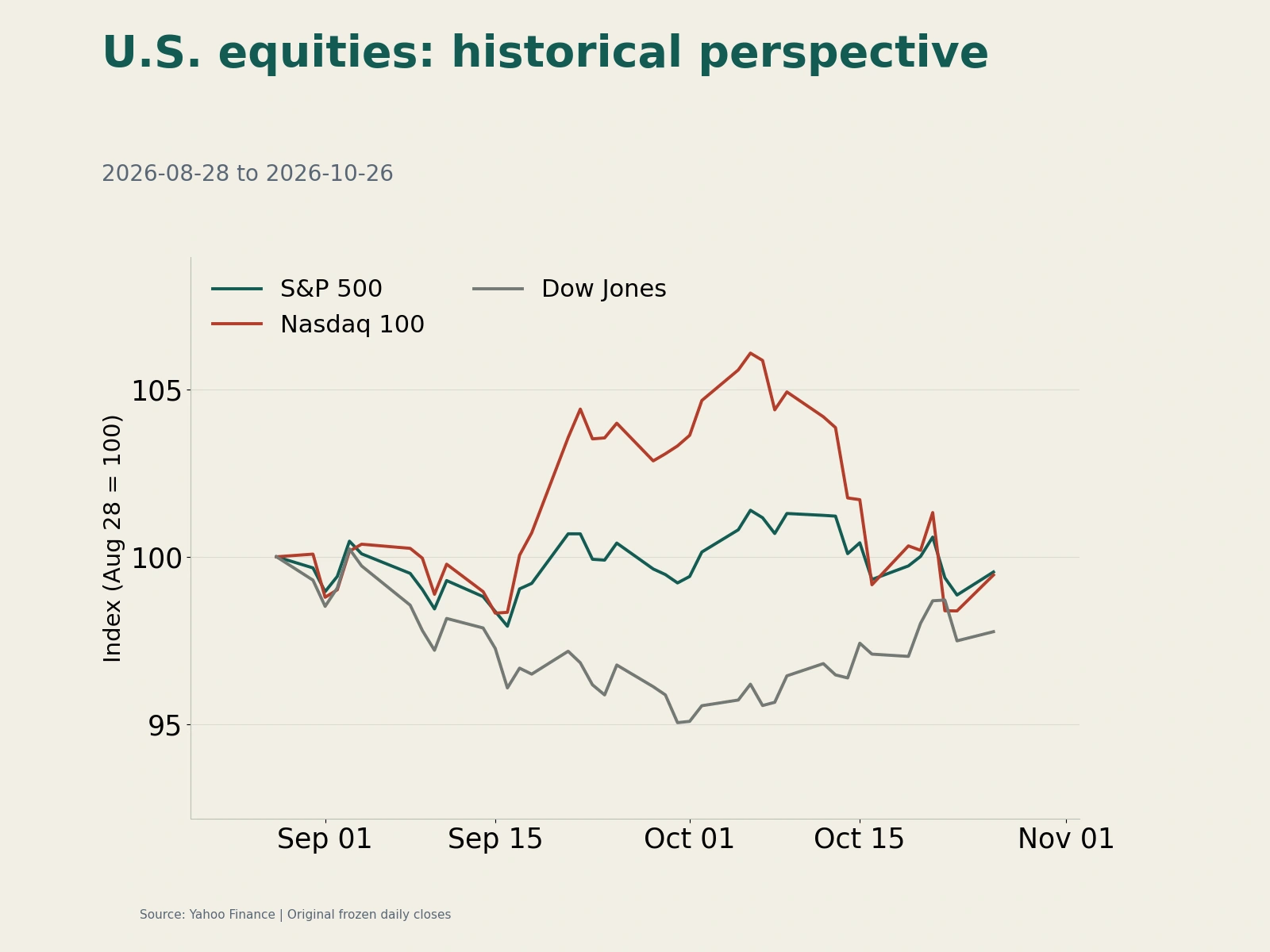
Global financial markets diverged markedly on October 12, 2026. Major US indexes split, with chip weakness pulling the Nasdaq 100 down 0.71% while the Dow Jones Industrial Average rose 0.38%. Geopolitical and supply disruptions lifted international oil, taking Brent above $106, while gold retreated. The US cash Treasury market was closed for a holiday; BlackRock upgraded short Treasuries to overweight, highlighting high yields' increasing appeal to allocation-driven investors. As major US banks began reporting earnings and September US and Chinese inflation releases approached, companies' ability to deliver profits under cost pressure became a central pricing benchmark.
Memory competition sends Micron down nearly 4%; Nasdaq 100 weakens ahead of bank earnings
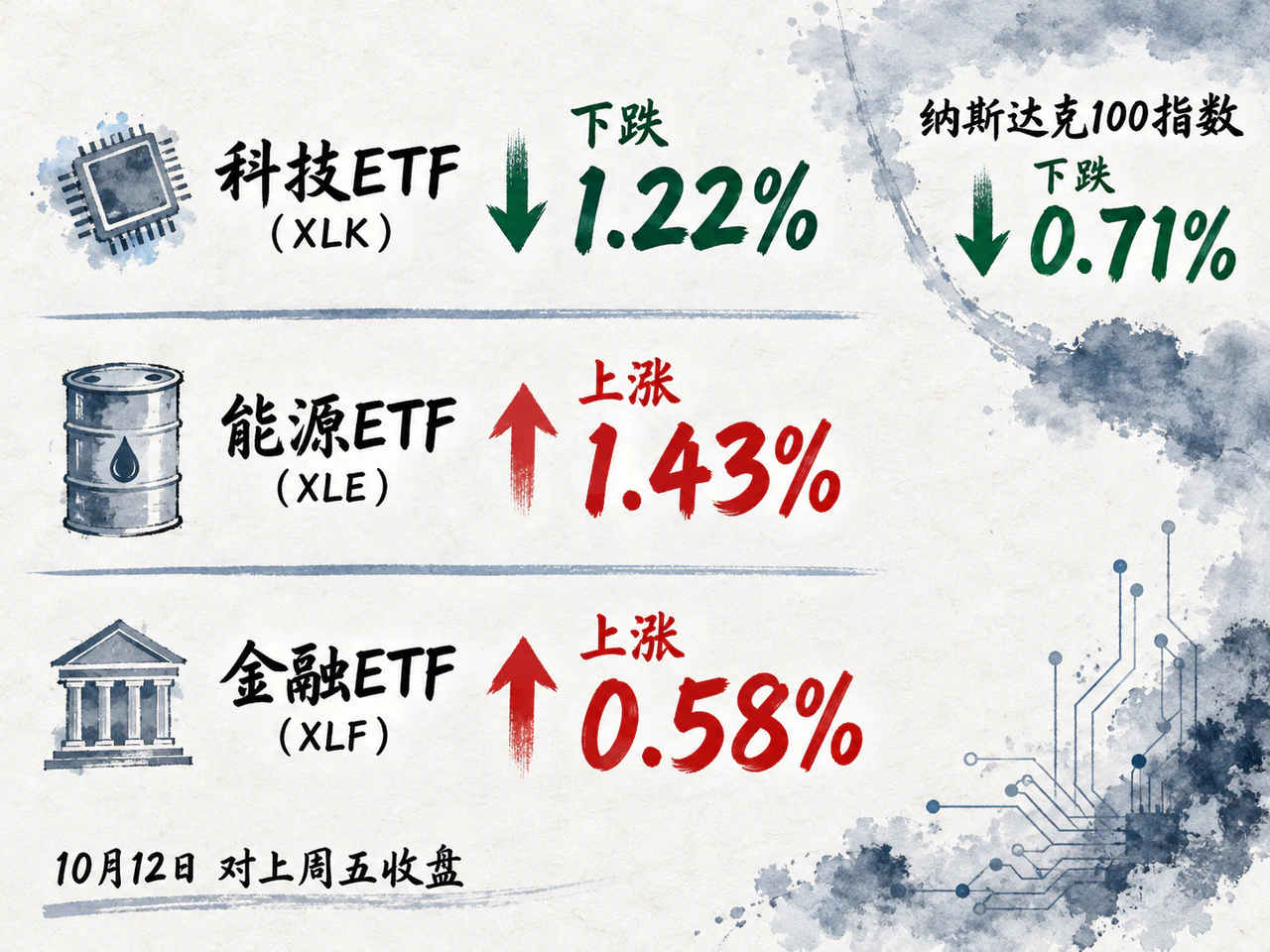
Major US indexes were mixed, with pronounced sector divergence. The S&P 500 slipped 0.055% to 7,807.24; the Dow rose 0.38% to 51,850.55; the Nasdaq 100 fell 0.71% to 30,664.70; and the Russell 2000 lost 0.45% to 2,794.48. Sector ETFs contrasted sharply: technology XLK fell 1.22%, energy XLE rose 1.43% and financials XLF rose 0.58%. The VIX edged up 0.37 points to 15.21.
Changing hardware supply expectations pressured semiconductor valuations. According to Yahoo Finance, ChangXin Memory Technologies disclosed progress over the weekend in a memory-cell design improving density and planned year-end server-memory products using that architecture. Expectations of additional competition sent Micron down 3.88% to $989.04. Software and platforms offered a contrast: Meta released Muse Wonder and Muse Wonder Full, commercializing them through developer and subscription services and lifting its shares more than 3%. Divergence within AI's value chain is becoming clearer: chips face capacity and pricing tests while downstream platforms accelerate monetization.
Asia-Pacific equities reflected the same split. The Hang Seng edged up 0.2% to 24,271 while Hang Seng Tech fell 0.7% to 4,169; banks and insurers supported the market while chip and AI stocks weakened. South Korea's KOSPI slumped 3.65% to 6,384.24, with heavyweights Samsung Electronics and SK Hynix down 4.39% and 4.52%. Foreign investors net sold approximately KRW 2.0169 trillion that day. The heavily weighted memory industry and energy-import costs jointly squeezed earnings prospects. Japan's cash equity market was closed for Sports Day.
Financials await a key earnings test. JPMorgan, Goldman Sachs, Citi and Wells Fargo are due to report on October 13. Markets generally expect year-on-year quarterly profit growth, but with a high second-quarter base, persistently high rates and slower large capital-market transactions, sequential trends and management guidance will be central. Goldman strategists recently upgraded global equities from neutral to overweight over the next 3 months, citing valuation adjustments and healthy earnings prospects. Major banks' revenue mix and credit costs will offer the first empirical test.
Treasury curve flattens as BlackRock adds short bonds and Tencent plans offshore notes
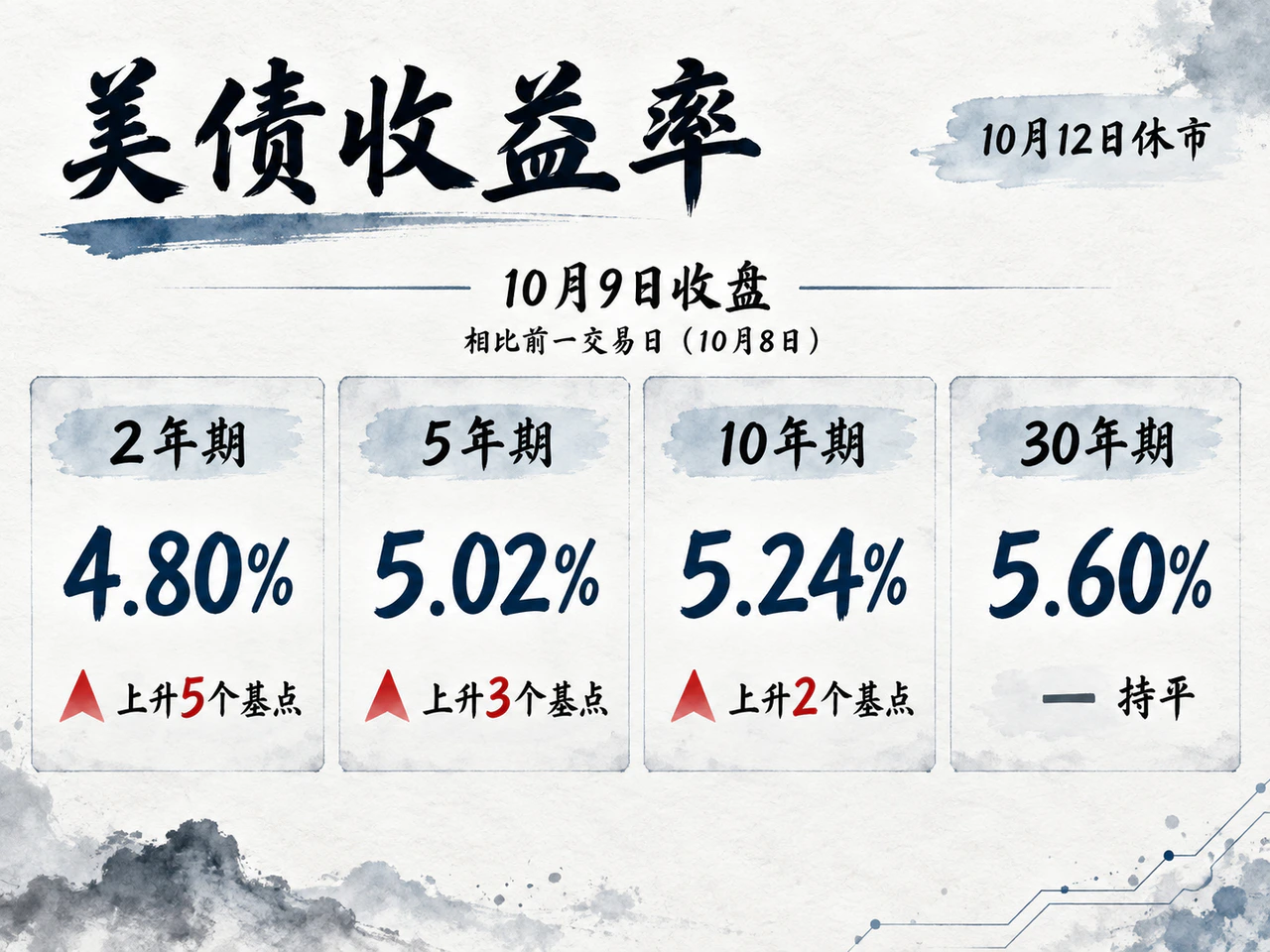
US cash fixed-income markets were closed October 12 for Columbus Day. The latest official benchmark yields, at the October 9 close, showed a pronounced short-end increase: 2-year yields rose 5 basis points to 4.80%; 5-year 3 basis points to 5.02%; 10-year 2 basis points to 5.24%; 30-year yields were unchanged at 5.60%. The 2s10s spread narrowed further from 47 to 44 basis points as the curve shifted upward and flattened.
Elevated yields are prompting major asset managers to reposition. In its October 12 weekly commentary, BlackRock Investment Institute upgraded short Treasuries to overweight and moved long Treasuries to neutral, funded mainly by reductions in US equities and agency mortgage-backed securities (MBS). It said compensation from short Treasury coupon income had improved significantly and markets might be overpricing further Fed tightening. A policy-expectations reversal could therefore add price-recovery potential at the short end. For longer Treasuries, BlackRock attributed most of the approximately 110-basis-point year-to-date rise in 10-year yields to higher real rates, reflecting competition for capital and the macro policy environment.
Credit spreads diverged slightly. ICE BofA data through October 8 showed US investment-grade corporate option-adjusted spreads unchanged at 82 basis points, while high-yield spreads widened 6 basis points to 315, reflecting greater required risk premiums for weaker issuers.
In offshore financing, Tencent Holdings announced on the Hong Kong exchange October 12 that it proposed international notes for professional investors under its global medium-term note program and would seek a Hong Kong listing; no binding agreement had yet been reached. Financial results showed first-half 2026 capital expenditure of RMB 96.3 billion, already above full-year 2025's RMB 88.3 billion and versus RMB 45.9 billion in the comparable 2025 period. Spending chiefly covered IT infrastructure, data centers, land-use rights and intellectual property. Tencent said cash and equivalents, operating cash flow and term deposits could cover at least the next 12 months of operations and capex. Nevertheless, high-quality companies optimizing liability duration through offshore bonds during heavy capex cycles offer a window on global pricing of major technology credit in a high-rate environment.
Brent breaks $106 while gold weakens; markets focus on September US inflation
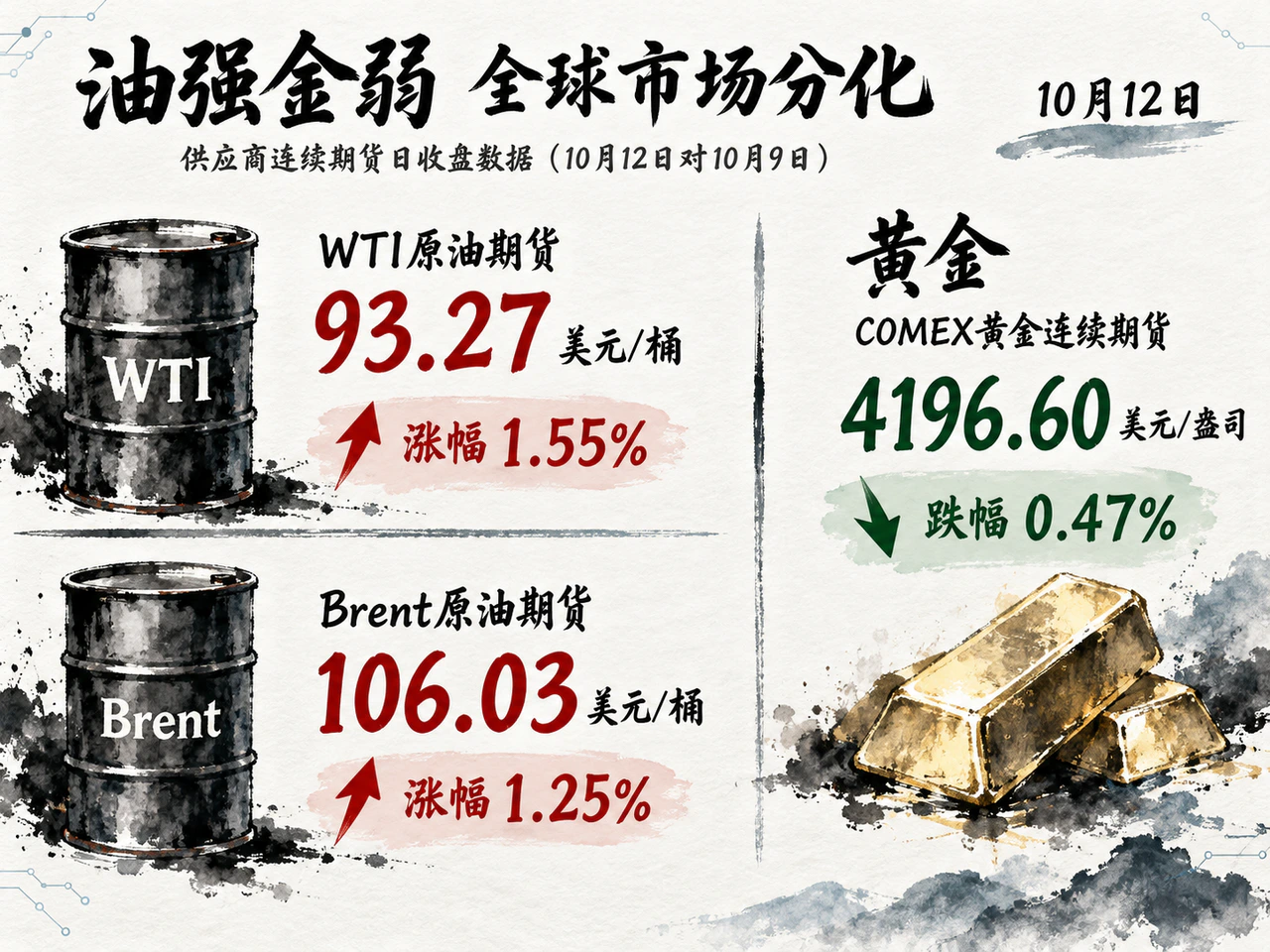
Commodities showed strong oil and weak gold. Vendor continuous-futures closes for October 12 put WTI at $93.27 a barrel, up $1.42 or 1.55%; Brent at $106.03, up $1.31 or 1.25%; and COMEX gold at $4,196.60 an ounce, down $19.70 or 0.47%. The dollar index rose 0.35% to 102.572.
Supply risk premiums and delivery constraints dominated crude trading. Although temporary US easing of Russian diesel sanctions added a supply channel, Reuters reported uncertainties over refinery operations and implementation of related agreements. Middle Eastern maritime-security incidents continued disrupting freight costs and physical deliveries, keeping geopolitical premiums elevated. Goldman's weekend research said Gulf crude exports had broadly returned to prewar levels, but low global stocks and restocking needs limited premium compression. It raised its December average Brent forecast from $85 to $90 while retaining an $80 average baseline for 2027. Demand looked tired: on October 12 OPEC's secretary general projected 2026 global crude demand growth of 400,000 barrels per day, below 1.4 million at the start of the year, with some demand deferred into 2027. Near-term supply and logistical bottlenecks support oil, while persistently high costs may suppress end consumption.
Gold was pressured mainly by the strong dollar and interest-rate risks. With the dollar index rising, markets generally stayed defensive ahead of key macro releases. High oil prices' second-round inflation risk increased concern about how long high rates would persist, raising the opportunity cost of non-yielding assets.
Focus shifts to upcoming US inflation indicators. September CPI is scheduled for October 14 at 8:30 a.m. US Eastern time, followed by PPI the next day. ADMISI expects headline CPI of +0.6% month on month and +3.6% year on year; core CPI of +0.2% and +2.5%; and retail sales growth of 0.3% month on month versus August's 1.1%. These forecasts depict energy lifting headline prices, stable core inflation and gradually slowing final consumption. Accelerating energy pass-through into core inflation would directly affect policy-rate expectations in the second half of the month.
NEV export rebate to fall to 9%; RMB 550 billion of unused debt quota supports domestic demand
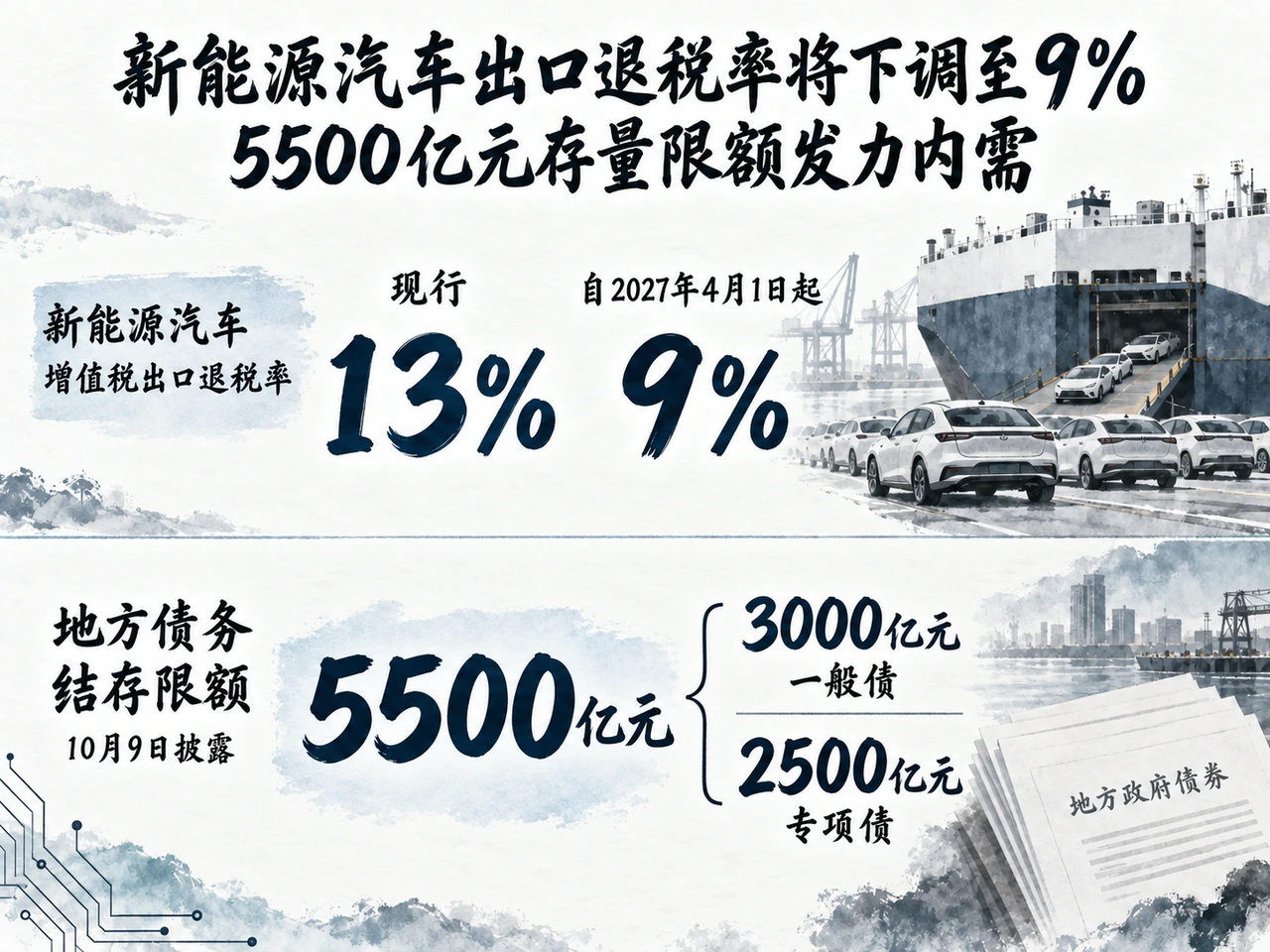
China's foreign-trade policy is undergoing a structural adjustment. The Ministry of Finance and State Taxation Administration announced October 12 that, from April 1, 2027, the VAT export rebate for new-energy vehicles will fall from 13% to 9%, while rebates for products including e-cigarette equipment will be abolished. Eligibility follows the export date on customs declarations. The 4-percentage-point cut narrows export tax support. A substantial transition gives exporters room to adjust overseas prices and delivery schedules; some orders may ship before implementation, while the medium-term change will test automakers' overseas pricing power and margin resilience.
Monetary liquidity and fiscal measures jointly support domestic demand. On October 12, the PBOC conducted RMB 50 billion of 7-day reverse repos at an unchanged 1.40%, resulting in a net RMB 250 billion withdrawal against RMB 300 billion of maturities. Fiscally, deployment accelerated for the RMB 550 billion of unused local-government debt quota disclosed October 9: RMB 300 billion in general-debt quota was fully allocated to county and district governments to sustain fiscal operations, while RMB 250 billion of special-debt quota targeted areas with real fourth-quarter project needs, seeking rapid conversion into actual construction activity.
China's price indicators also enter their release window: the National Bureau of Statistics will publish September CPI and PPI October 14. Bank of America expects higher energy and industrial-goods prices to lift annual CPI from August's 0.8% to 0.9% and PPI from 3.8% to 4.3%. If upstream input costs drive prices while consumption improvement lags, downstream manufacturers' margin recovery will still depend on fiscal-project execution and sustained effective demand.
China and Europe reach hybrid-car export quota framework; energy costs raise European business uncertainty

Trade showed interim signs of easing. Euronews reported a provisional China-EU framework under which China would limit hybrid-vehicle exports to Europe and ease rare-earth export licensing. The proposed four-year arrangement would set a base quota of 350,000 Chinese hybrid vehicles annually with a 6% annual adjustment mechanism. The news supported further gains in European autos. It partly reduces competitive pressure on European manufacturers and stabilizes critical raw-material supply, while requiring Chinese exporters to manage overseas product portfolios and distribution profitability more carefully.
European business expectations remain overshadowed by energy costs. Bloomberg, citing the Banque de France's October 12 survey, said September uncertainty indexes for French industry and services reached their highest since April, and construction its highest since March, with companies widely concerned about high fuel costs and weak demand. German Chancellor Friedrich Merz proposed cutting electricity tax to the EU legal minimum, while Italian Prime Minister Giorgia Meloni planned to seek greater fiscal-spending flexibility at this week's EU summit. Subsidies and tax relief can share operating costs in the short term, but deficit constraints limit their scope. With energy and trade interacting, the durability of sector recoveries remains to be seen.