By the morning of October 14, Beijing time, the previous 24 hours had shifted the Middle East conflict's focus squarely toward energy hubs and transport arteries. After the Saudi-led coalition struck fuel facilities in Yemen, an attack set fire to a Saudi Aramco administrative building in Saudi Arabia's Eastern Province. Almost simultaneously, merchant ships were attacked in Hormuz and the suspension of operations at Riyadh's main international airport was extended. Threats to onshore energy infrastructure, airspace restrictions and maritime chokepoint risks combined to raise pressure on regional business and logistics supply chains sharply.
Coalition strikes Yemeni fuel facilities; Aramco office hit and Riyadh airport closure extended to the 17th
On October 13 local time, the Saudi-led multinational coalition issued evacuation warnings for parts of Sanaa, then launched targeted airstrikes on fuel storage and transfer facilities in Sanaa and western Yemen. The coalition said the sites directly supported Houthi military operations. Houthi-affiliated media subsequently confirmed attacks on oil facilities west of the capital, while local witnesses reported loud explosions.
Houthi spokesman Yahya Saree had publicly threatened severe retaliation against Riyadh if Sanaa were bombed and demanded evacuation around Saudi Aramco facilities, naming Aramco headquarters, Riyadh refinery and King Khalid International Airport. The Saudi coalition subsequently announced interceptions of drones and cruise missiles over Riyadh and southern airspace, and ballistic missiles over Dhahran and Haradh. Debris fell in residential areas of Dhahran.
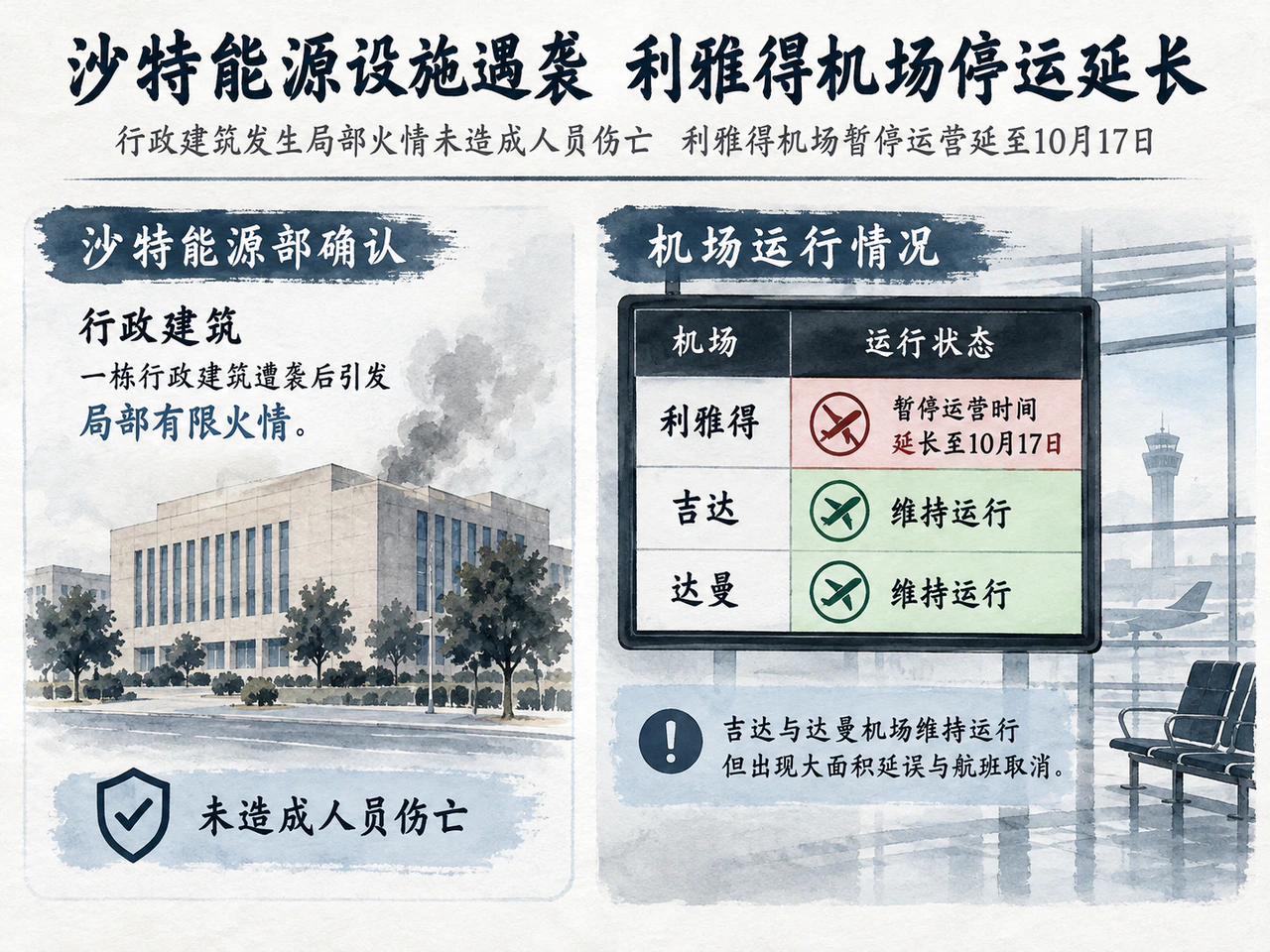
Saudi Arabia's Energy Ministry confirmed that an attack on an Aramco administrative building in the Eastern Province caused a localized, limited fire without casualties. Security risks also directly disrupted aviation. The US mission in Saudi Arabia announced on the 13th that King Khalid International Airport's closure was extended to October 17. Jeddah and Dammam airports remained operational but faced extensive delays and cancellations, and US government employees needed special authorization to use any Saudi airport. Britain also updated its travel advice, urging citizens to avoid nonessential travel to Riyadh and other locations.
Two merchant ships hit in Hormuz as multilateral diplomacy seeks to prevent wider conflict
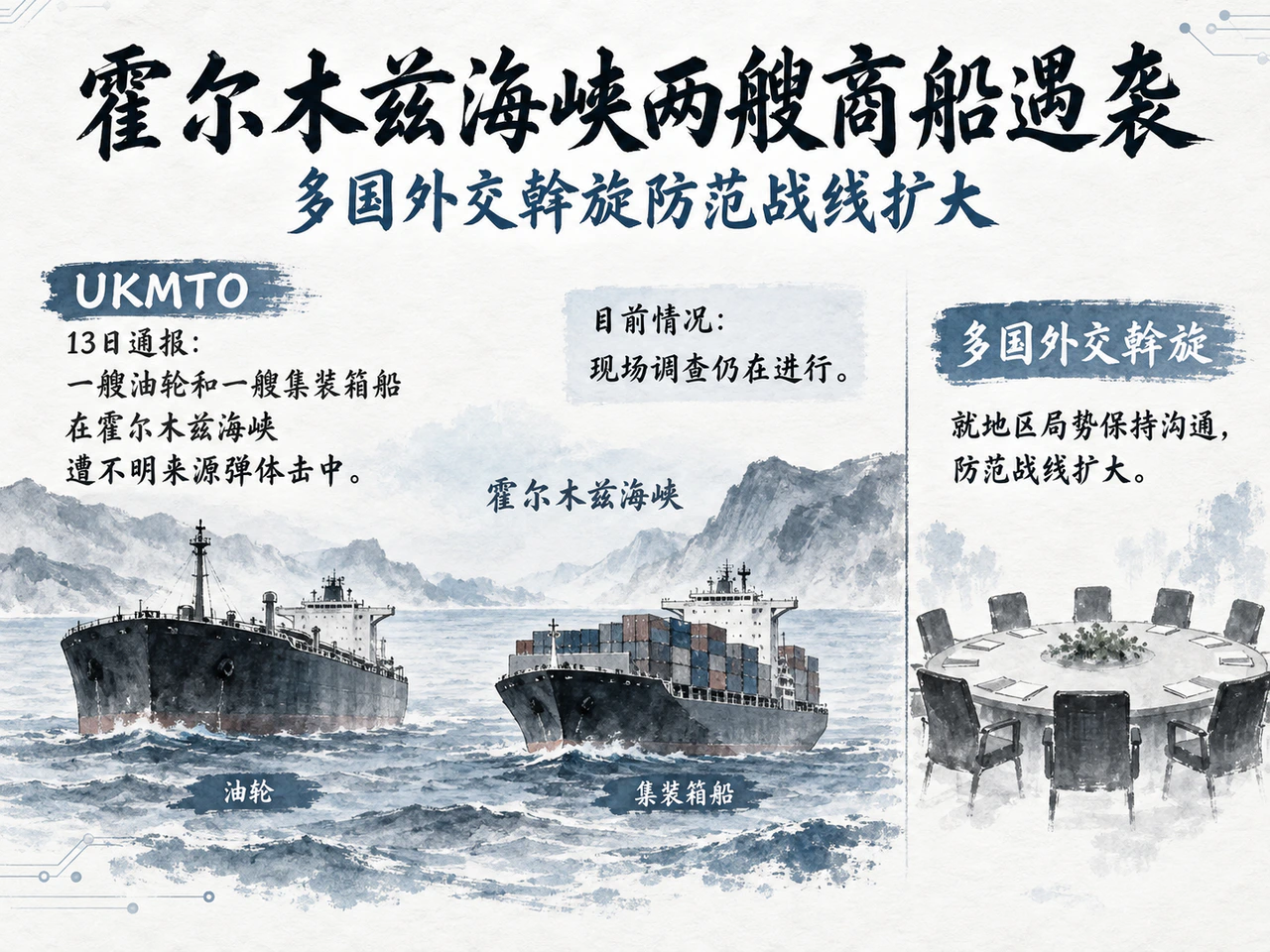
Risks to maritime energy routes also emerged. UK Maritime Trade Operations, or UKMTO, reported on the 13th that a tanker and container ship in Hormuz had been hit by projectiles of unknown origin, with investigations continuing. The US-based Institute for the Study of War assessed that day that Iran might be targeting tankers conducting ship-to-ship transfers in and around the strait to disrupt energy export routes.
The maritime chokepoint risk caused serious concern among neighboring states. Qatar's Emir Tamim told the Shura Council on the 13th that parties should intensify efforts to restore navigation in the Gulf and Hormuz and protect regional energy, water and civilian infrastructure. He stressed that safeguarding sovereignty and security was compatible with preventing expansion of the conflict.
Multilateral diplomacy developed quickly. Egyptian Foreign Minister Abdelatty called Iranian Foreign Minister Araghchi, urging an immediate halt to strikes inside Saudi Arabia and diplomatic resolution of differences. Saudi Crown Prince Mohammed spoke with Turkish President Erdogan, who supported Saudi security and stability. Trump publicly condemned Houthi attacks on Saudi Arabia but gave no clear answer when asked whether the US would directly join Saudi military operations. Iran's government spokesman also announced on the 13th that limited foreign exchange would prioritize essential imports and some lower-priority projects would be halted. Official figures showed domestic fuel consumption down 7% year on year and compressed natural gas consumption up 12%.
More than 200,000 displaced in Yemen; cholera surges in the southwest as aid funding strains
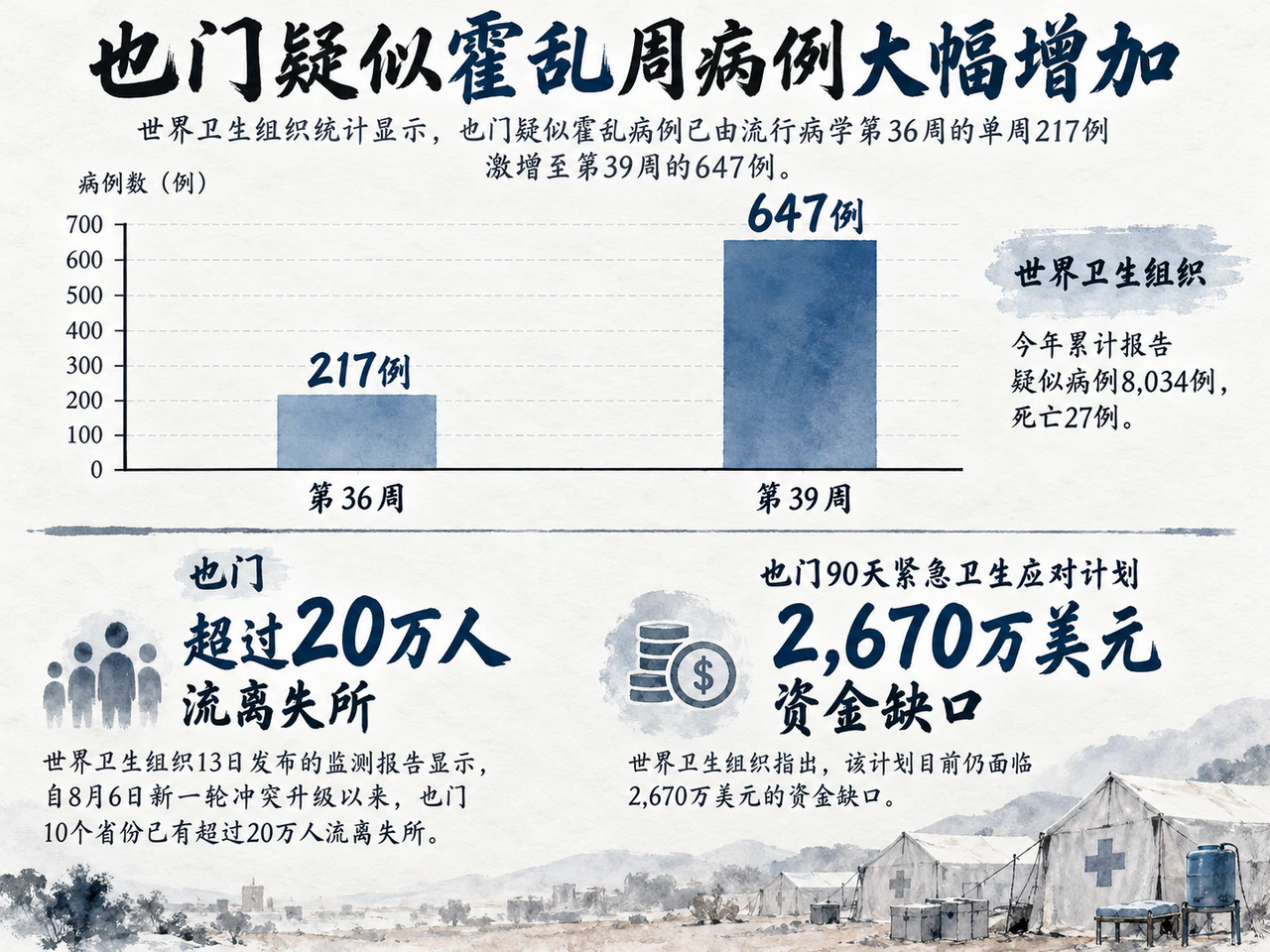
The substantial expansion of fighting was causing a severe public-health and humanitarian crisis in Yemen. A WHO monitoring report released on the 13th showed that more than 200,000 people across 10 governorates had been displaced since renewed escalation on August 6.
Large-scale forced displacement, shortages of safe drinking water and disrupted basic health services directly accelerated disease transmission. WHO figures showed suspected cholera cases surging from 217 in epidemiological week 36 to 647 in week 39. The year-to-date total was 8,034 suspected cases and 27 deaths. Five southwestern governorates receiving large displaced populations accounted for 92% of reported cases nationwide.
WHO further reported that around 500 health facilities in 9 conflict-affected governorates lacked support from external partners, while its 90-day emergency health response plan for Yemen still faced a $26.7 million funding gap. Disrupted infrastructure and logistics made it difficult for the health system to treat war injuries while controlling epidemics. Humanitarian relief and restoration of basic livelihoods depended heavily on improved ceasefire and access conditions.
Key developments
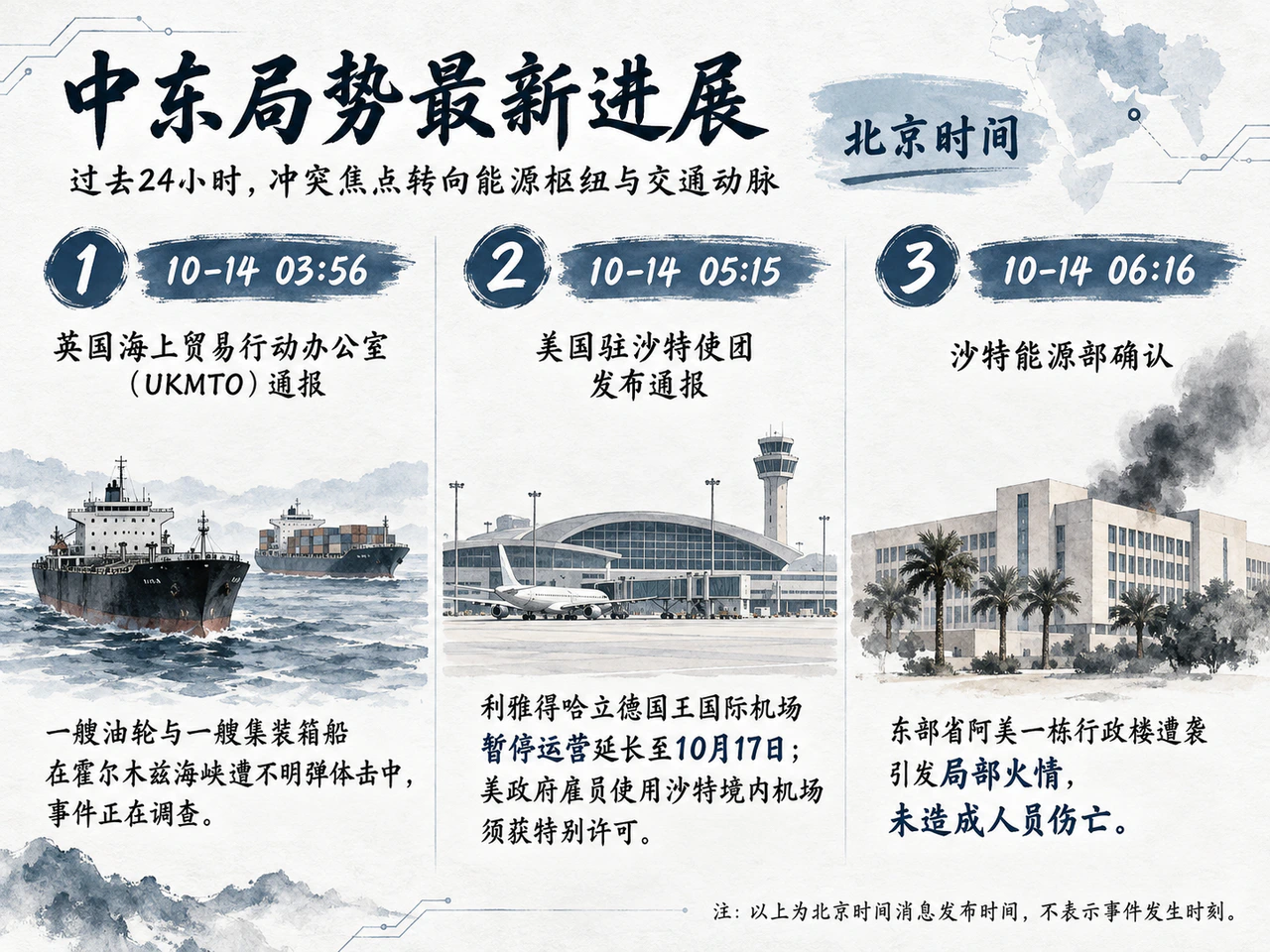
Listed in reverse publication order, all in Beijing time; date-only reports retain dates only.
| Key developments |
|---|
| 10-14 06:16Saudi Arabia's Energy Ministry confirmed a localized fire after an attack on an Aramco administrative building in the Eastern Province, with no casualties. |
| 10-14 05:15The US mission in Saudi Arabia announced that the closure of Riyadh's King Khalid International Airport had been extended to October 17; US government employees needed special permission to use Saudi airports. |
| 10-14 04:59The Saudi-led coalition confirmed strikes on fuel facilities in Sanaa and western Yemen, saying they supplied Houthi military operations. |
| 10-14 03:56UKMTO reported that a tanker and container ship were hit by unidentified projectiles in Hormuz; investigations were ongoing. |
| 10-14 03:33The Saudi-led coalition said it intercepted ballistic missiles heading toward Dhahran and Haradh and several drones and cruise missiles over Riyadh and the south; debris fell in Dhahran residential areas. |
| 10-14 02:45ISW assessed that Iran might be targeting tankers conducting ship-to-ship transfers in and around Hormuz to disrupt maritime energy routes. |
| 10-14 02:21Saudi Arabia's Foreign Ministry said Crown Prince Mohammed spoke with Turkish President Erdogan, who supported Saudi security and stability. |
| 10-14 02:02Britain's MI5 chief said Iran-related threats were shifting toward harder targets such as military facilities; Iran demanded evidence for allegations involving Fairford air base. |
| 10-14 01:37WHO said Yemen's weekly suspected cholera cases rose from 217 in week 36 to 647 in week 39; more than 200,000 people had been displaced since the August 6 escalation. |
| 10-14 01:14Britain updated travel advice, urging citizens to avoid nonessential trips to Riyadh and other Saudi locations. |
| 10-14 00:43Trump publicly condemned Houthi attacks on Saudi Arabia but gave no clear answer on whether the US would join Saudi military operations. |
| 10-14 00:08Houthi-affiliated media said oil facilities west of Sanaa were hit by airstrikes; witnesses reported loud explosions. |
| 10-13 23:37Houthi spokesman Saree warned people to evacuate around Saudi Aramco facilities, listing them as potential targets. |
| 10-13 22:44Saree threatened retaliation against Riyadh if Sanaa were attacked, specifically naming Aramco headquarters, Riyadh refinery and King Khalid International Airport. |
| 10-13 21:43The Saudi-led coalition issued evacuation warnings to civilians in parts of Sanaa ahead of targeted airstrikes. |
| 10-13 20:47The Saudi-led coalition said it intercepted and destroyed 3 incoming drones north of Riyadh. |
| 10-13 18:34Egyptian Foreign Minister Abdelatty called Araghchi, urging an immediate end to attacks on Saudi Arabia and progress toward a political settlement. |
| 10-13 18:01Houthi-affiliated television reported airstrikes on Kamaran Island, Al Qanawis district and Al Jawf governorate, and claimed a Saudi drone was shot down in Saada. |
| 10-13 17:33Iran's government spokesman said limited foreign exchange would prioritize essential imports and lower-priority projects would be suspended. Domestic fuel consumption fell 7% year on year, while compressed natural gas consumption rose 12%. |
| 10-13Qatar's Emir Tamim urged intensified efforts to restore Gulf and Hormuz navigation and protect energy, water and civilian infrastructure. |