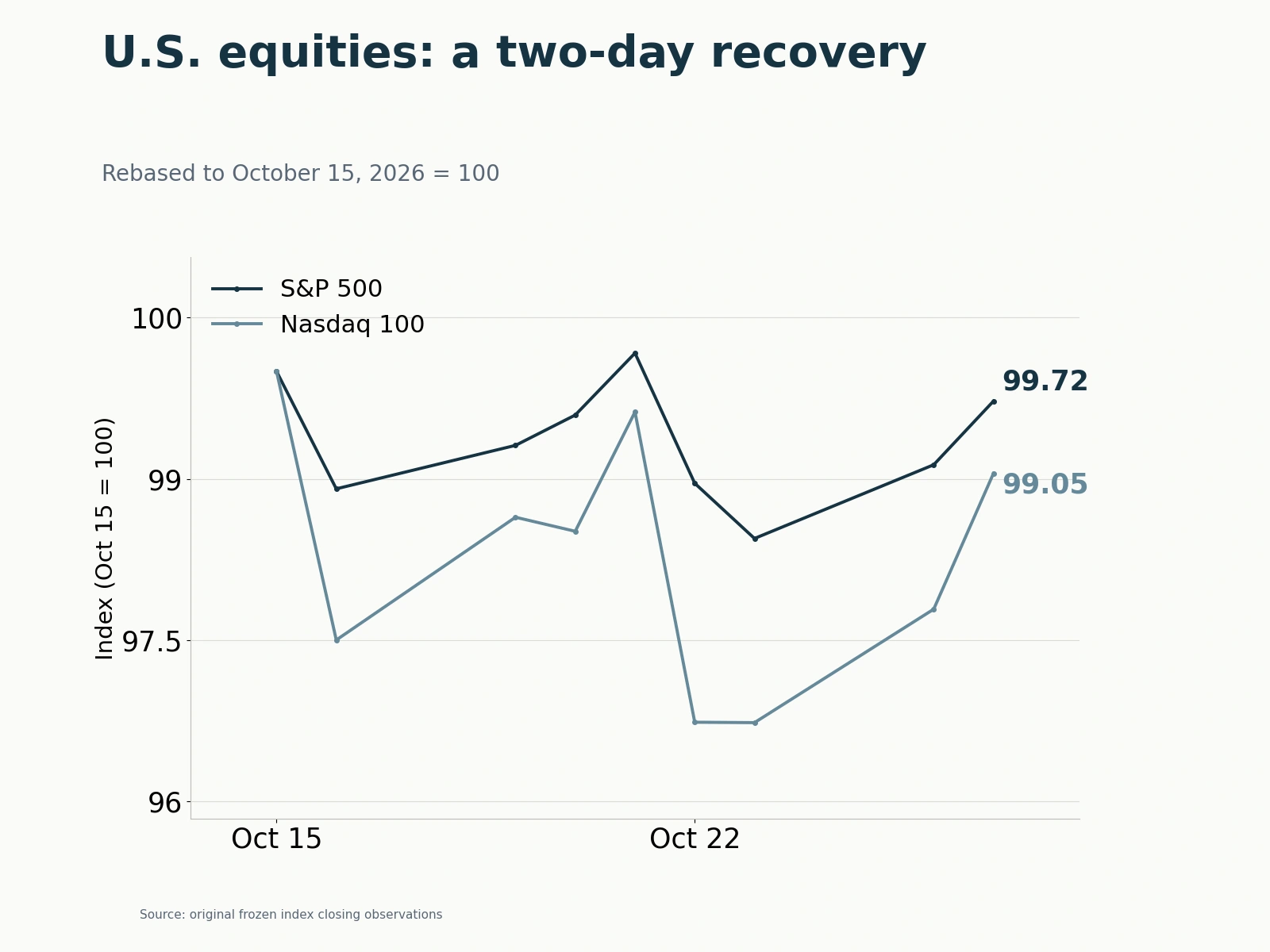
On October 15, 2026, US producer inflation accelerated markedly, yet Treasury yields fell across maturities, led by the long end. Trading attention is shifting from inflation readings alone toward the constraints high rates impose on the real economy. Although price pressure has not eased, investors have begun assessing how expensive financing erodes household purchasing power, corporate capital spending and debt-servicing capacity. Cross-asset pricing diverged sharply. The S&P 500 rose 0.33%, the Dow Jones Industrial Average 1.08% and the Russell 2000 1.38%, while the Nasdaq 100 slipped 0.05%. Money favored traditional blue chips, financials and small caps, while financing burdens at highly leveraged AI businesses weighed on technology. The 10-year Treasury yield fell nine basis points to 5.10%; a weaker dollar helped gold rebound, while international oil prices were mixed as US inventory draws interacted with shipping-policy expectations.
10-Year Treasury Yield Falls Nine Basis Points to 5.10%; Lower-Rated High-Yield Spreads Widen
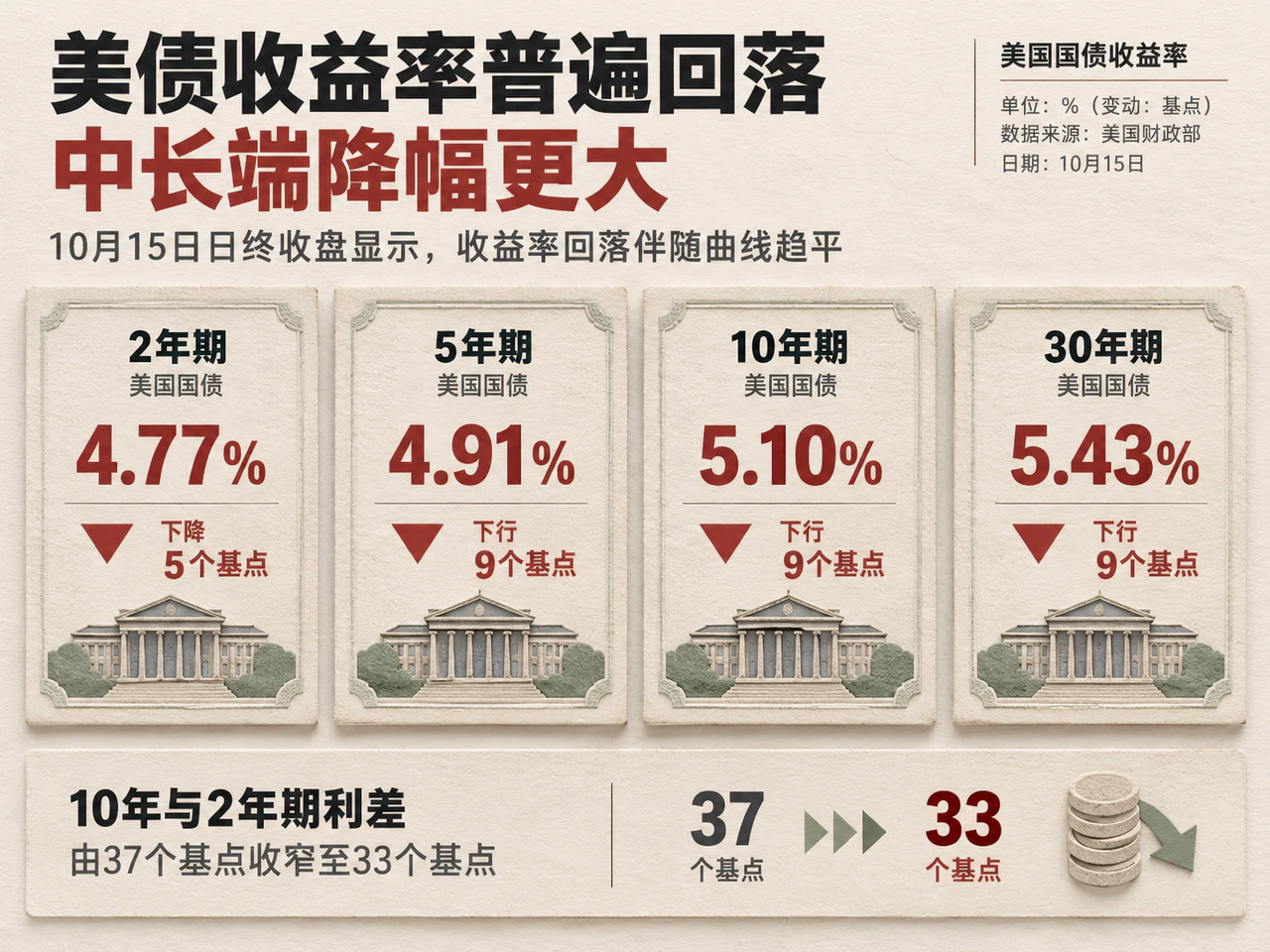
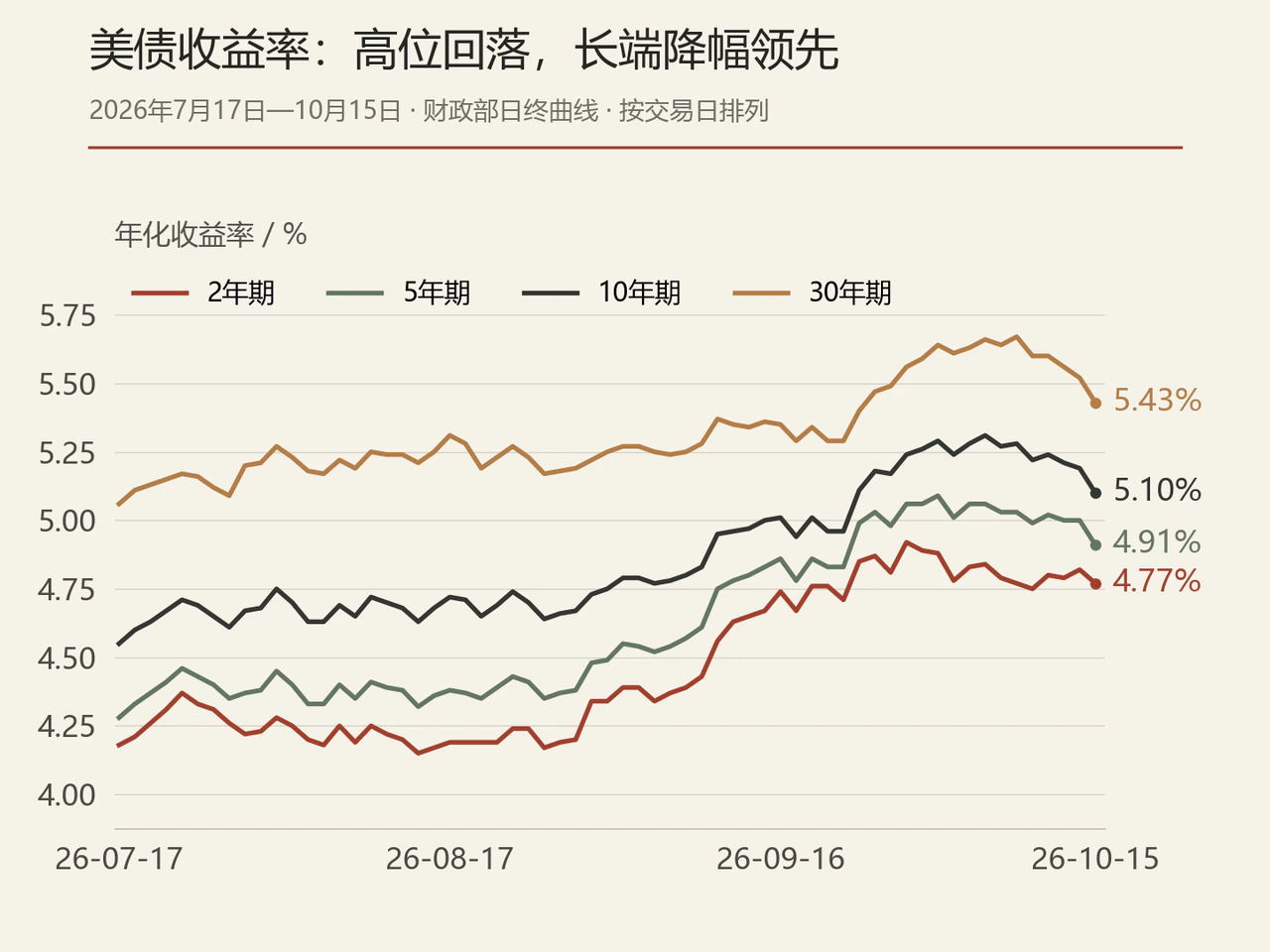
The US Treasury's October 15 end-of-day curve put the two-year yield at 4.77%, down five basis points from the previous session. Five-, 10- and 30-year yields were 4.91%, 5.10% and 5.43%, respectively, each down nine basis points. The 10-year/two-year spread narrowed from 37 to 33 basis points. Yields fell as the curve flattened, with intermediate- and long-duration Treasuries leading the rally.
The Treasury recovery has continued for several days. Since October 5, the 10-year yield has fallen a cumulative 21 basis points from 5.31%, while the two-year has declined only seven basis points. Nevertheless, 10- and two-year yields remain 35 and 43 basis points above August 31, respectively. Businesses and households still face elevated financing costs after the earlier rapid increase.
Strong price and nominal retail data did not prevent bonds from rising. Dow Jones Newswires attributed Treasury buying mainly to concerns that high borrowing costs were eroding growth, particularly debt-financed AI capital spending. Scotiabank said the same day that some investors were reassessing bonds' appeal relative to equities. Larger declines in long yields than short yields confirmed renewed demand for duration. By midday, rates markets still favored an unchanged Fed stance at the October meeting. CIBC research further argued that this year's rise in nominal rates primarily reflected higher real financing costs and fiscal and policy uncertainty, while long-run inflation expectations remained relatively stable. High yields make Treasuries more attractive but also raise the hurdle for corporate expansion.
Credit markets were already reflecting differentiation in borrower quality under high rates. Released on October 15 for the October 14 close, the ICE BofA US High Yield Option-Adjusted Spread (OAS) rose to 325 basis points, nine basis points wider than October 13 and 14 wider than October 9. Citing October data, Allianz Global Investors said the yield compensation over Treasuries for high-yield debt rated CCC and below had reached approximately 12.5 percentage points, well above roughly 8.2 points a year earlier, while higher-rated credit spreads had widened only moderately this year. Falling benchmark rates may support dollar-bond valuations, but credit performance remains highly dependent on issuers' cash-flow quality, debt structures and refinancing pressure.
Energy Drives September US PPI Up 1.3% Month on Month; Retail Control Group Rises Just 0.1%
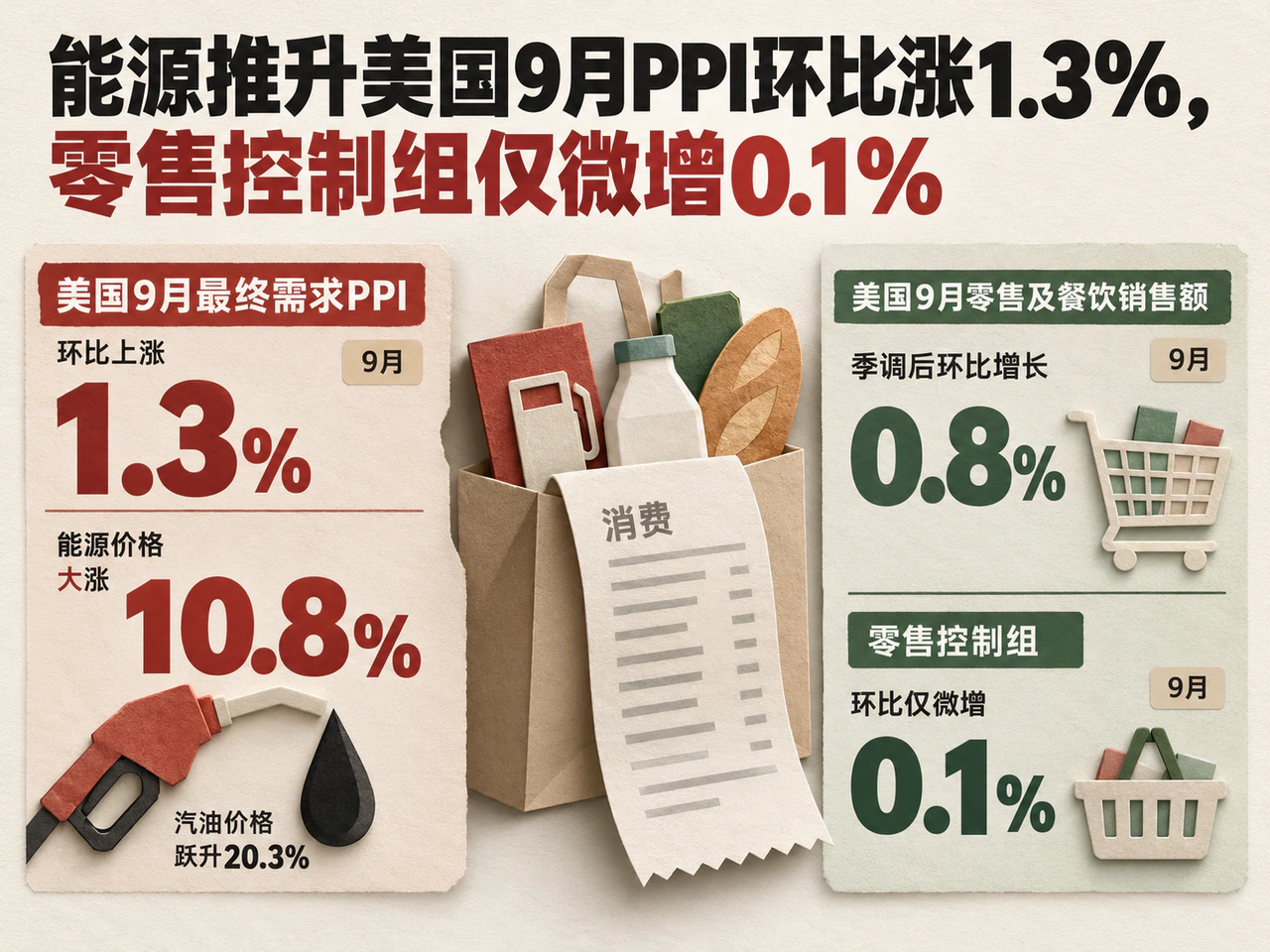
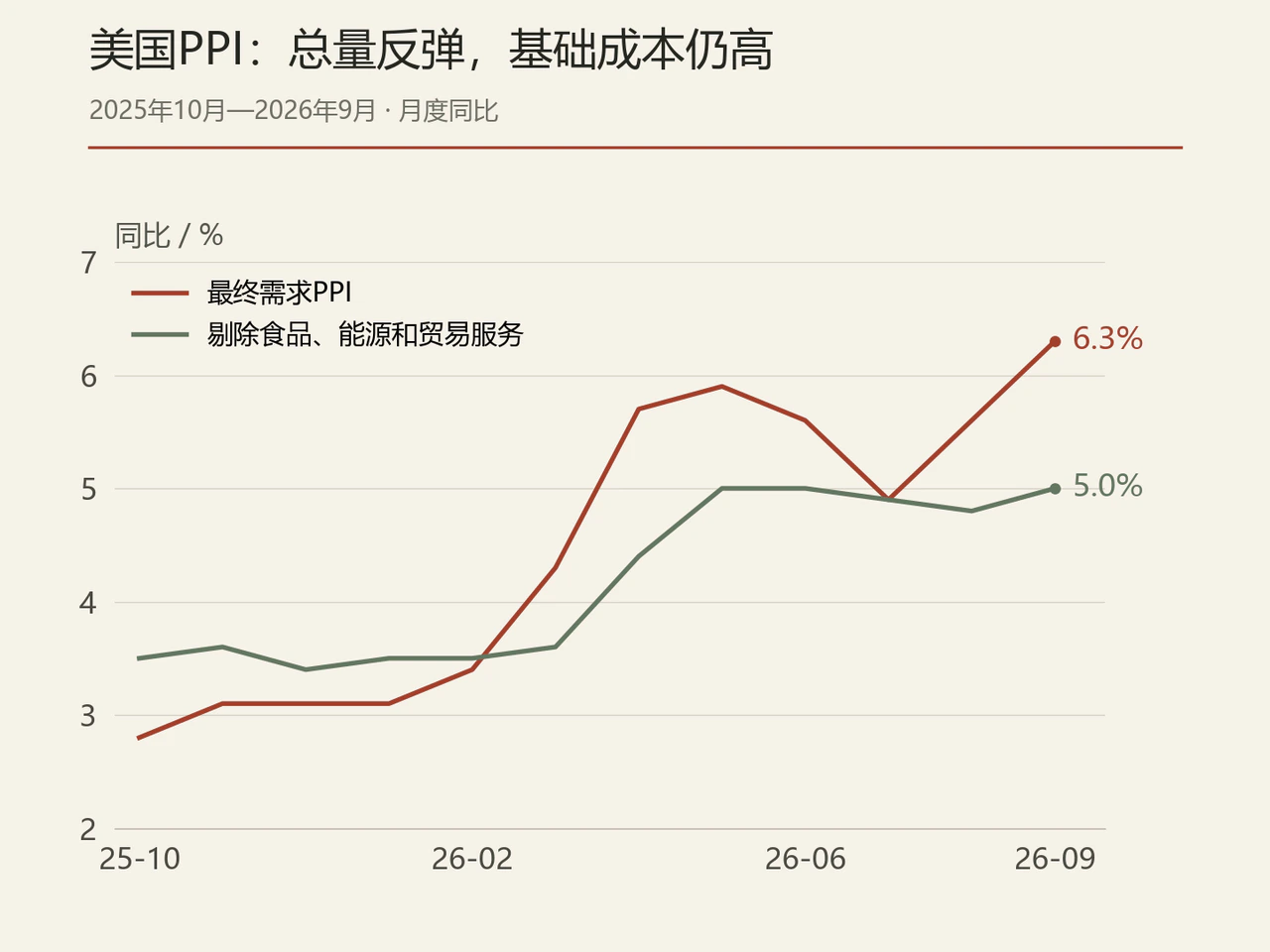
US September final-demand PPI, released October 15, rose 1.3% month on month, far above the 0.5% expected in a Reuters survey and the largest monthly gain since March 2022. August's increase was also revised from 0.4% to 0.5%. Annual PPI inflation accelerated from 5.6% in August to 6.3% in September, extending the rebound underway since July.
Surging energy prices were the main driver. Final-demand goods prices rose 2.6% in September, with energy up 10.8%, including a 20.3% jump in gasoline, accounting for more than 80% of the goods-price increase. Cost pressure also spread to services: service prices rose 0.8%, including a 3.4% increase in transportation and warehousing. Final-demand PPI excluding food, energy and trade services still rose 0.5% month on month and 5.0% year on year. Where downstream demand is constrained, costs that cannot readily be passed on are gradually squeezing corporate margins.
Retail data released the same day exposed slowing real consumption momentum beneath strong nominal growth. US retail and food-service sales reached $745 billion in September, up a seasonally adjusted 0.8% month on month against a Reuters forecast of 0.3%; August's gain was revised to 1.3%. Because these are nominal amounts unadjusted for prices, higher energy prices substantially distorted the headline. Gas-station sales rose 6.4%, but retail sales excluding autos and gas stations increased only 0.2%. The retail control group, which excludes autos, gasoline, building materials and food services and is more closely linked to GDP personal consumption, edged up just 0.1%, sharply slower than August's 1.2%. Although food-service sales rose 1.1% and furniture, electronics and appliances, and online retail also grew, expensive gasoline was effectively crowding out household spending on other goods.
Labor-market resilience continued to cushion household incomes. Initial US jobless claims totaled 199,000 in the week ended October 10, up 1,000 from the previous week's revised 198,000; the four-week average was 198,500. Continuing claims fell to 1.71 million in the week ended October 3. Low layoffs supported households' ability to keep spending, with consumption constraints showing mainly in weaker real purchasing power and differences across categories.
Regional Fed manufacturing surveys likewise showed divergent growth alongside rising costs. New York's October general business conditions index jumped from 7.6 to 25.5, with new orders at 23.2. Philadelphia's general activity index fell from 37.8 to 20.9, while new orders dropped from 29.2 to 4.3. Both remained in expansion, but activity differed markedly. At the same time, the New York and Philadelphia prices-received diffusion indexes rose to 30.6 and 40.1, respectively, the latter its highest since May 2025. Variable demand intertwined with price pressure complicates the Fed's growth–inflation trade-off at its October 27–28 meeting.
Strong TSMC Results Fail to Dispel CoreWeave Debt Concerns; US Equities Rotate toward Traditional Sectors
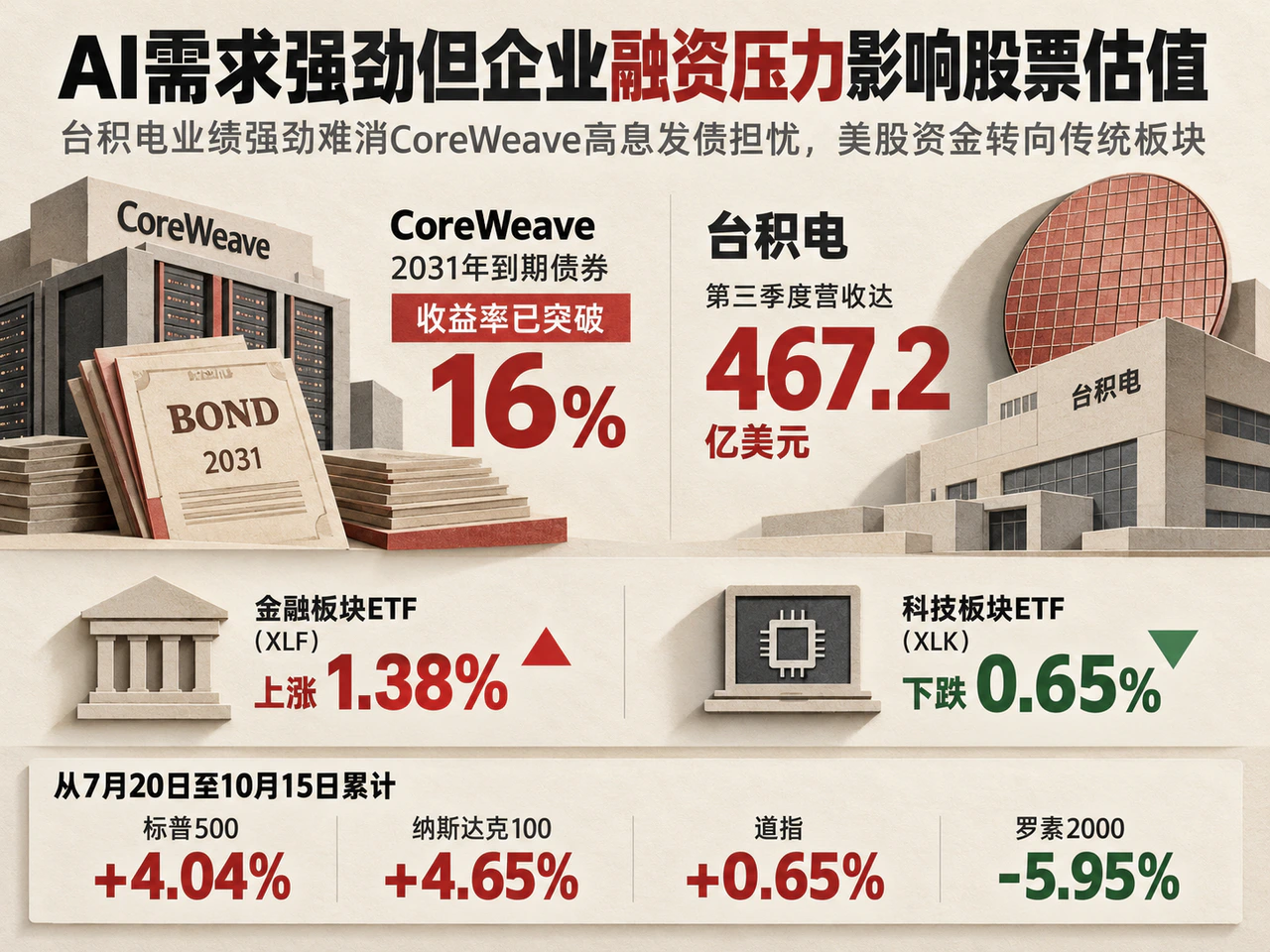
The US equity recovery was uneven. The Dow closed at 52,177.69, the S&P 500 at 7,744.06 and the Nasdaq 100 at 29,935.59. Among sector ETFs, financials (XLF) rose 1.38%, technology (XLK) fell 0.65% and energy (XLE) lost 1.58%. The VIX eased from 16.87 to 16.46, indicating calmer broad-market volatility, but institutional sector rotation became more apparent.
Compute operator CoreWeave brought AI expansion's debt risks into focus. The Associated Press reported that it needed to repay $4.41 billion of principal in the second half of this year and $6.18 billion in 2027, against cash of only a little over $5.5 billion at end-June. Reuters reported on October 15 that yields on its bonds issued in April and maturing in 2031 had exceeded 16%, with total company debt around $50 billion. In August, CoreWeave raised its full-year capital-spending forecast by $4 billion to as much as $39 billion, while analysts expected annual revenue of only nearly $13 billion. Although management said contracted business covered debt obligations, investors remained deeply concerned about whether the timing of contracted revenue could match large upfront investment and clustered maturities.
After plunging more than 15% in the previous session, CoreWeave faced early pressure on October 15 before closing up 5.94%. But the intraday rebound in the leveraged compute business failed to lift the broader chip sector: Nvidia and TSMC's American depositary receipts (ADRs) still fell nearly 2%. Investors feared that financing constraints at downstream compute customers would ultimately slow equipment procurement and affect order realization for upstream hardware suppliers.
Current operating demand at the foundry level remained strong. TSMC reported third-quarter revenue of $46.72 billion, above prior guidance of $44.6 billion–$45.8 billion, with gross margin of 66.4% and operating margin of 58.7%. Fourth-quarter revenue guidance was $52.3 billion–$54.3 billion, with the midpoint approximately 14.1% above the third quarter, and gross-margin guidance remained high at 65%–67%. Strong earnings alongside weak shares highlight the market's shift from current orders alone toward the funding sources and returns on future AI projects.
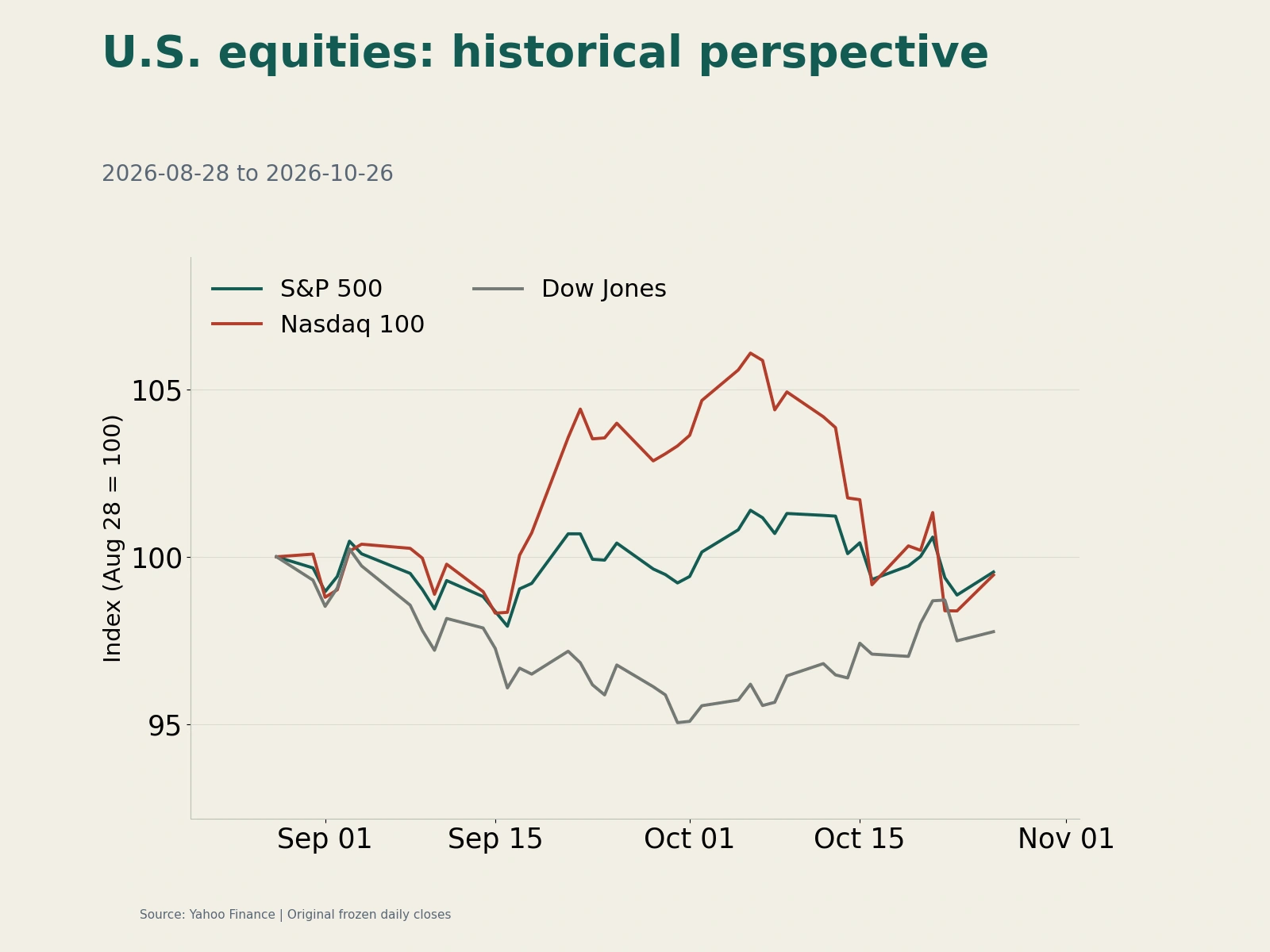
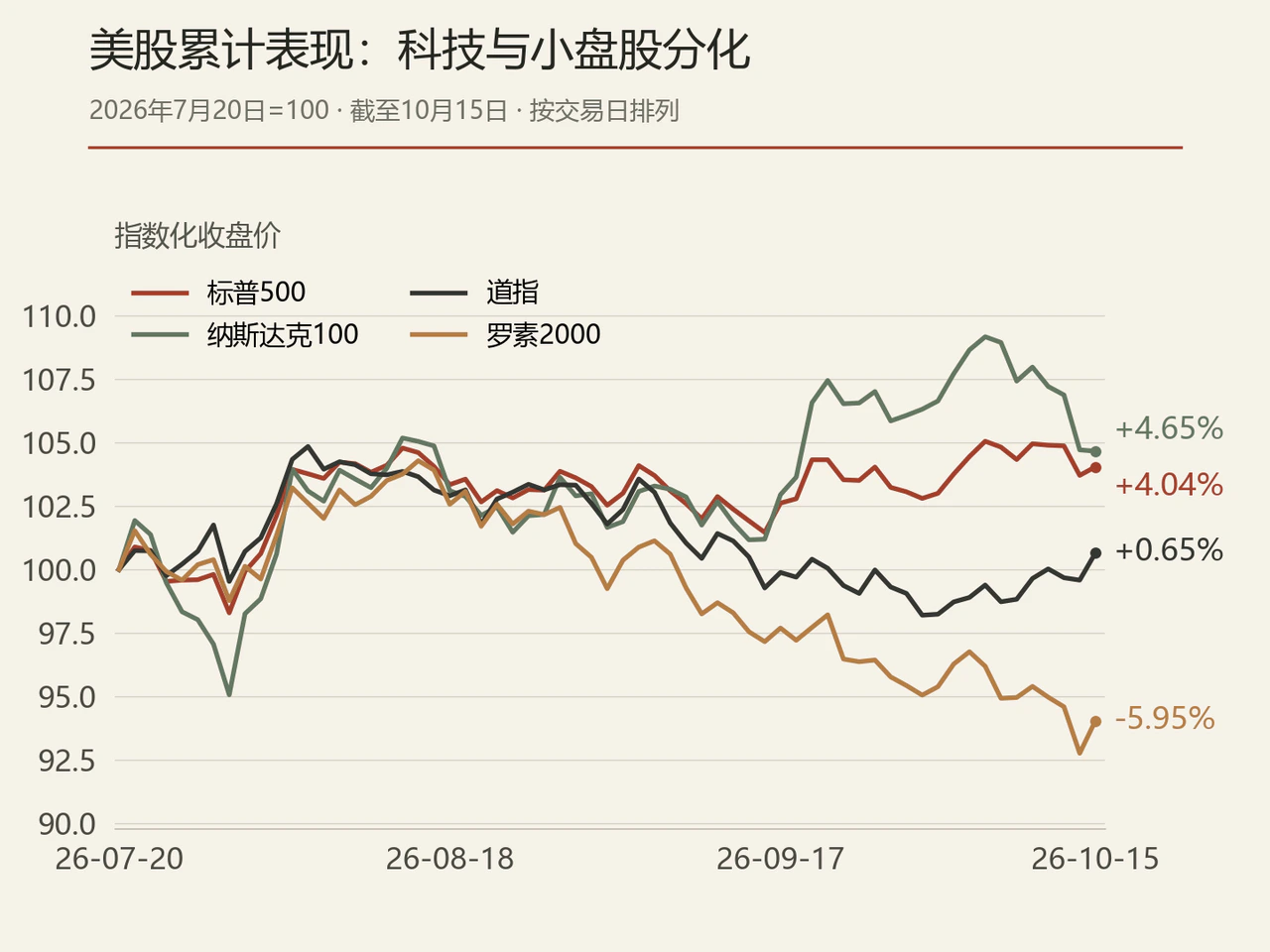
Outside technology, traditional businesses with more predictable earnings and less reliance on continual external financing became havens. Marsh beat analysts' revenue and profit forecasts and was up 4.9% intraday, according to an AP report in the US Eastern afternoon. Health care, consumer staples and some previously oversold apparel stocks held up well. Deutsche Bank upgraded Walmart to Buy and raised its target from $113 to $136, arguing that high inflation favored its low-price advantage and market-share growth. From the July 20 close through October 15, the S&P 500 and Nasdaq 100 gained approximately 4.04% and 4.65%, the Dow edged up 0.65%, and the Russell 2000 fell 5.95%. The day's leadership by small caps and traditional sectors partly reflected catch-up demand in earlier laggards; its sustainability still depends on financing conditions and earnings delivery.
Weaker Dollar Lifts Gold 1.86%; US Crude Draws and Shipping Easing Expectations Split WTI and Brent
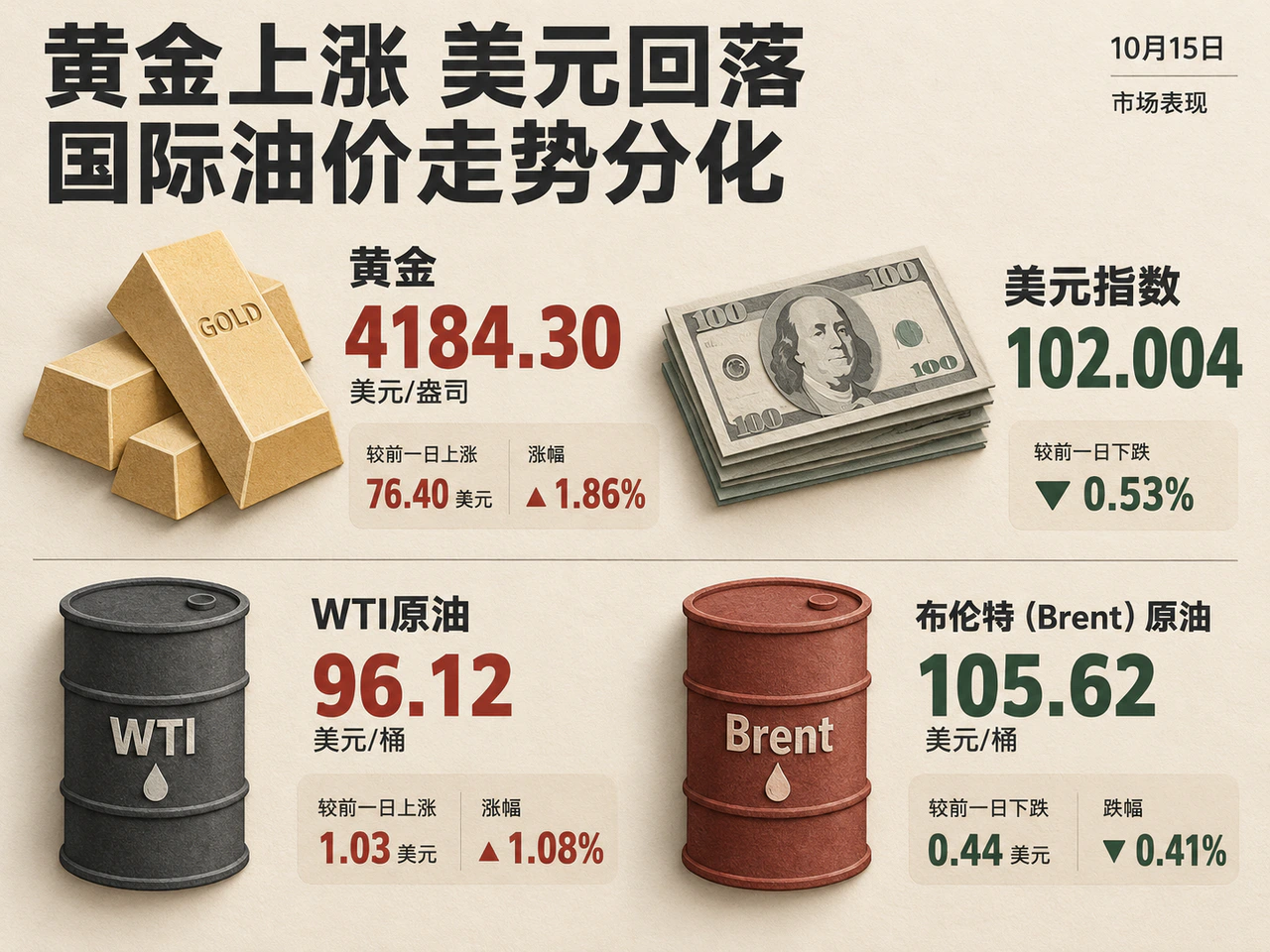
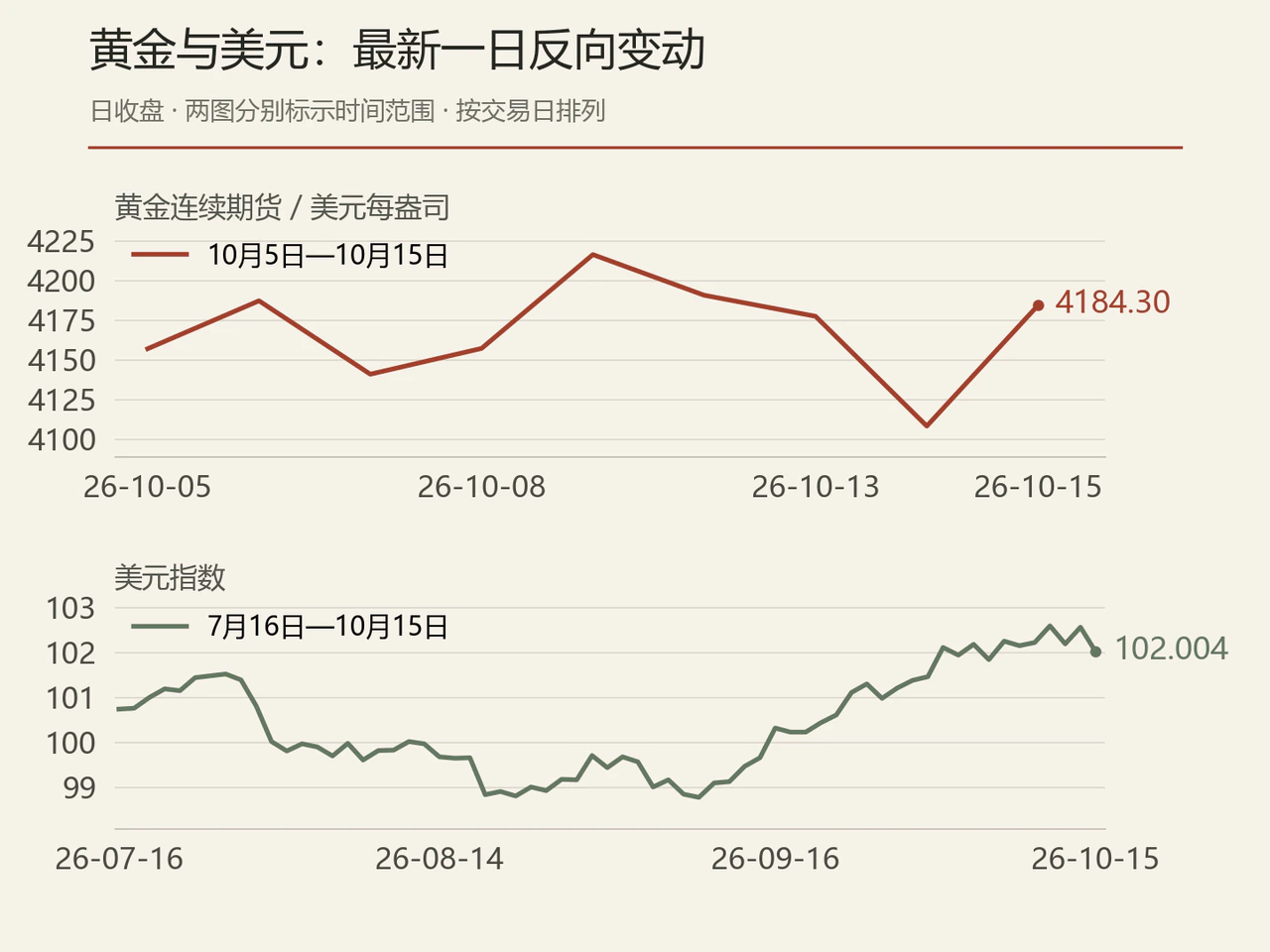
Easier currency and rate conditions supported precious metals. The dollar index fell 0.53% to 102.004 on October 15, and lower nominal Treasury yields helped gold rebound sharply. On the data provider's daily close for continuous futures, gold rose $76.40, or 1.86%, to $4,184.30 an ounce, recovering from October 14's $4,107.90 but remaining below October 9's $4,216.30, reversing part of its recent decline.
On the same basis, international oil prices diverged: WTI rose $1.03, or 1.08%, to $96.12 a barrel, while Brent fell $0.44, or 0.41%, to $105.62. A larger-than-expected US inventory draw supported WTI's relative strength. Reuters cited Energy Information Administration (EIA) data showing commercial crude stocks fell 8.6 million barrels to 415.6 million in the week ended October 9, far more than the expected 288,000-barrel decline, while distillate stocks also fell.
Changing shipping-policy expectations compressed Brent's premium. The US government was discussing easing restrictions on some sanctioned tankers vessel by vessel, allowing transfers to compliant operators for carrying nonsanctioned oil. Reuters reported that forward freight agreement prices fell on the news, narrowing WTI's discount to Brent. Lower freight costs improve US crude's competitiveness on a delivered overseas basis, but actual added capacity remains constrained by vessel age, classification, insurance and sanctions in other jurisdictions. Kpler estimated that of roughly 160 US-sanctioned very large crude carriers (VLCCs), only about 24 could realistically return to international trade after excluding older ships and those belonging to certain operators.
On supply, IEA member countries agreed on October 15 to accelerate remaining strategic-reserve release commitments under the joint action launched in March, following approximately 330 million barrels already released. This included getting more than 20 million barrels of diesel to market as quickly as possible to ease fuel-supply and refining-chain strains. Reports of merchant ships attacked near Hormuz nevertheless showed that geopolitical shipping risks continued supporting oil's risk premium. A substantive easing in energy inflation still depends on actual improvements in physical supply.
Chip Selling Hits Japanese and Korean Stocks; China's Central Bank Expands Outright Reverse Repos to Support Liquidity
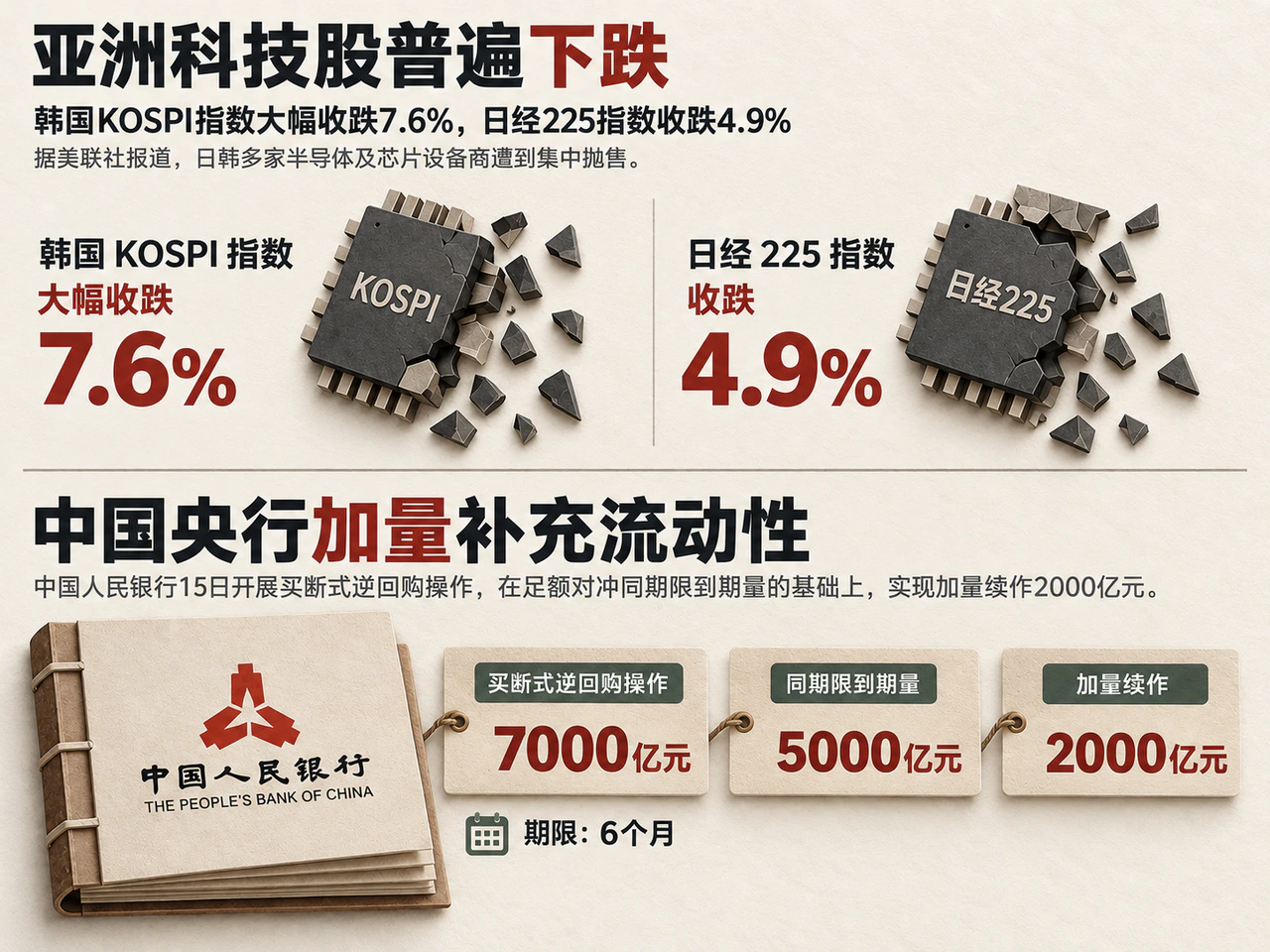
Before the US session, Asia-Pacific stocks had already faced technology selling on October 15. AP reported that South Korea's KOSPI closed down 7.6% and the Nikkei 225 down 4.9%. Sharecast reported that Hong Kong's Hang Seng fell approximately 1.1%, while SoftBank Group lost more than 9% and semiconductor and chip-equipment firms across Japan and Korea faced concentrated selling. The heavy weight of semiconductor and AI-hardware supply chains in Japanese and Korean benchmarks can magnify financing difficulties at overseas compute customers and shifting capital-spending expectations into systemic local equity corrections. Hong Kong technology and growth stocks faced both cooling overseas risk appetite and high funding costs.
Amid external volatility and domestic funding needs, Chinese monetary policy continued adding medium- and long-term liquidity buffers. On October 15, the People's Bank of China conducted 700 billion yuan of six-month outright reverse repos, fully offsetting 500 billion yuan of same-tenor maturities and adding 200 billion yuan. People's Daily Online cited China Merchants Union chief economist Dong Ximiao as noting that 2.4 trillion yuan of three- and six-month outright reverse repos and MLF funding matured in October. Government-bond settlement payments and late-month tax outflows added to banks' funding demand. Early provision of medium-term funds helps smooth liquidity disruptions from bond issuance and tax payments; its eventual growth impact depends on disbursement of bond proceeds and accompanying credit.
In offshore dollar bonds, cross-border enforcement of claims on defaulted Chinese developers advanced. On October 15, a New York State appellate court upheld summary judgment for BFAM and other investors against Glory Health Industry. The case concerned approximately $335 million of notes issued in 2022, in which the plaintiffs held 26.54% of beneficial interests. The court recognized the investors' litigation authorization obtained through prime brokers and Euroclear procedures. The ruling clarifies a procedural route for offshore bondholders to exercise contractual recourse, although actual recovery still depends on subsequent asset enforcement and the issuer's resources.
US and India Finalize Phase-One Trade Framework; High Rates Squeeze UK Fiscal Headroom

Beyond market pricing, major economies are using trade negotiations and fiscal adjustments to address elevated energy, transport and debt costs. India's trade secretary said on October 15 that negotiations on the first phase of a US–India trade agreement were complete and both sides were drafting legal text. India hoped to sign quickly to secure more stable tariff arrangements. The final tariff rates, product coverage and effective date will directly affect the recovery in Indian export orders and manufacturing investment expectations.
European leaders met in Brussels the same day to discuss trade defense, high energy prices and the EU's 2028–2034 long-term budget. Draft conclusions called for full use of trade-defense instruments while maintaining dialogue. On energy, governments discussed the Commission's proposal to delay methane-emission restrictions on oil and gas imports by one year. Slower environmental compliance implementation could ease energy procurement costs for European industry, but expanding protection could also raise raw-material costs and reshape cross-border supply-chain orders.
The UK faces a more direct squeeze on fiscal room from high interest rates. A Reuters survey of 19 economists found that, because of higher borrowing costs, respondents expected headroom under the fiscal rules to have fallen sharply from £23.6 billion in March to £10 billion–£12 billion, and believed the October 28 budget should restore it to £15 billion–£16 billion. The Institute for Fiscal Studies (IFS) offered a milder estimate: if inflation's boost to nominal wages and income-tax revenue offset most increases in debt interest and welfare spending, headroom could remain near £20 billion. The disagreement centers on how revenues and spending respond differently to inflation and interest rates, reflecting the broader pressure governments face in balancing debt service and growth under high rates.