On October 16, US card-issuing platform Marqeta and Hong Kong fintech Finloop separately disclosed progress in stablecoin payments. Marqeta expanded its Coinbase partnership to connect stablecoin balances to card spending networks, while a Finloop subsidiary and partners completed a Hong Kong dollar stablecoin payment. Their routes differ, but both seek to connect custody, fiat conversion and merchant settlement so digital assets can enter consumers' and merchants' existing payment systems directly.
Marqeta and Coinbase connect stablecoin balances to card spending
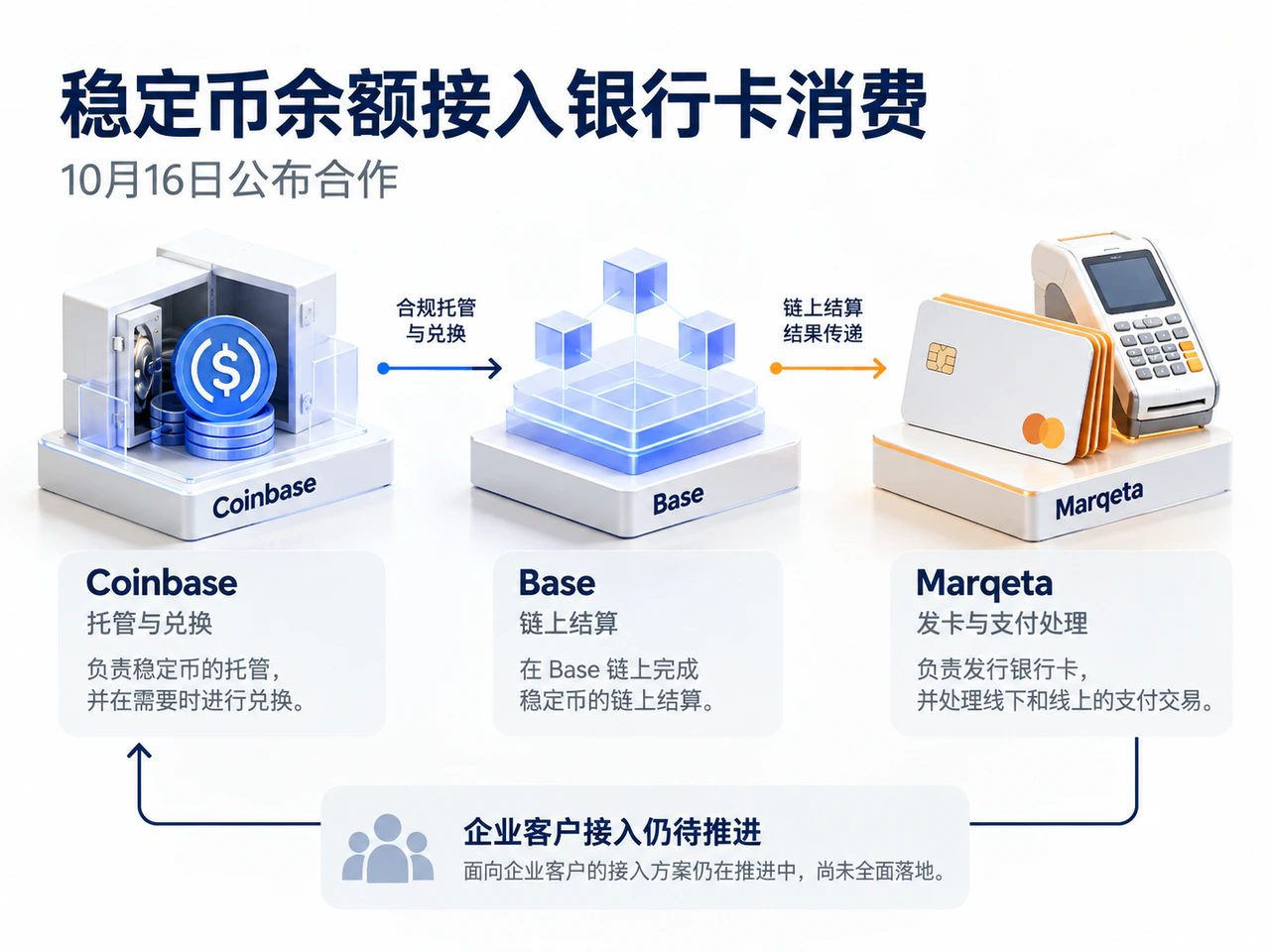
Marqeta announced on October 16 that it was partnering with Coinbase to offer stablecoin-based card solutions to crypto-native and traditional businesses. Coinbase will custody stablecoin balances and convert digital assets into fiat, with its associated Base network providing on-chain settlement infrastructure. Marqeta will handle card issuance, payment processing and relationships with partner banks and card networks.
The partnership extends their existing business. Marqeta previously issued crypto-backed cards for Coinbase; the new solution is intended to make that capability available to Marqeta's business customers. Companies can fund card programs around the clock, and cardholders can spend stablecoin balances through existing card-acceptance networks. The announced framework and expected functionality still require corporate onboarding and operational validation before scaling.
The model aims to reduce conversion friction between on-chain assets and traditional payments. Cardholders maintain stablecoin balances while merchants continue receiving payments through card networks; Coinbase and Marqeta coordinate custody, fiat conversion, clearing and settlement in the background. Established card-acceptance networks thus become distribution channels for everyday stablecoin spending, and corporate customers gain a single integrated solution without separately connecting custodians, conversion providers and issuers.
Traditional banks are also building underlying custody capabilities. On October 16, Bitcoin Magazine, citing Reuters, reported that Deutsche Bank was weeks away from launching cryptoasset custody and planned to expand into Asia the following year. Its previously announced custody plans for European corporate and institutional clients still required relevant regulatory procedures. For traditional financial institutions, compliant custody and account systems form the foundation for accommodating broader digital-asset flows.
Hong Kong's Finloop and partners complete HKDAP transaction with merchant HKD settlement
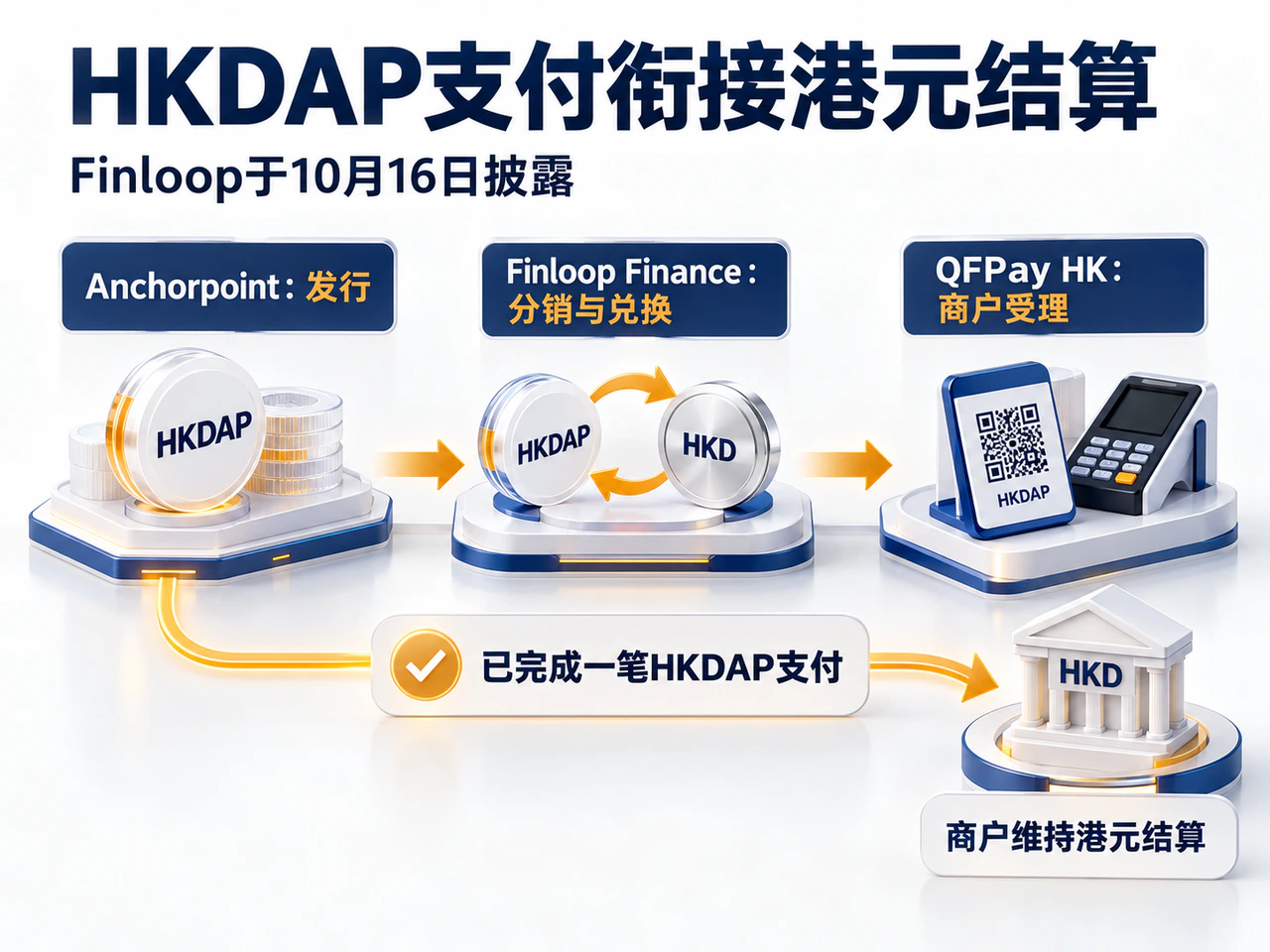
In Hong Kong, licensed stablecoins are moving into specific merchant-payment uses. The Hong Kong Monetary Authority had issued stablecoin-issuer licenses to Anchorpoint and HSBC on April 10, effective that day. Finloop announced October 16 that its subsidiary Finloop Finance had formed a three-party partnership with Anchorpoint and QFPay HK, and that Finloop Finance and QFPay HK had completed a payment using the Hong Kong dollar stablecoin HKDAP. According to the company, the solution allows merchants to accept compliant digital assets such as HKDAP while retaining existing HKD settlement processes.
Each partner has a distinct role: Anchorpoint issues HKDAP; Finloop Finance acts through Beta Access as an authorized HKDAP distributor, providing subscription, redemption, conversion, trading and settlement services; QFPay HK handles merchant payment acceptance. Background providers centrally manage stablecoin liquidity, redemption and compliant conversion, allowing merchants to expand payment options without changing daily HKD-based treasury practices. Efficiency depends on clearing and settlement coordination between issuer, distributor and acquirer.
The US and Hong Kong examples show stablecoin commercialization shifting from issuance alone toward consumer spending and acquiring networks. Whether through card networks or local acquiring channels, the central logic is to expand acceptance using existing financial infrastructure. These partnerships remain at product-announcement or first-transaction validation stages. Sustainable revenue will depend on corporate onboarding, merchant coverage and the emergence of frequent repeat transactions.
Click Read Original for further details.