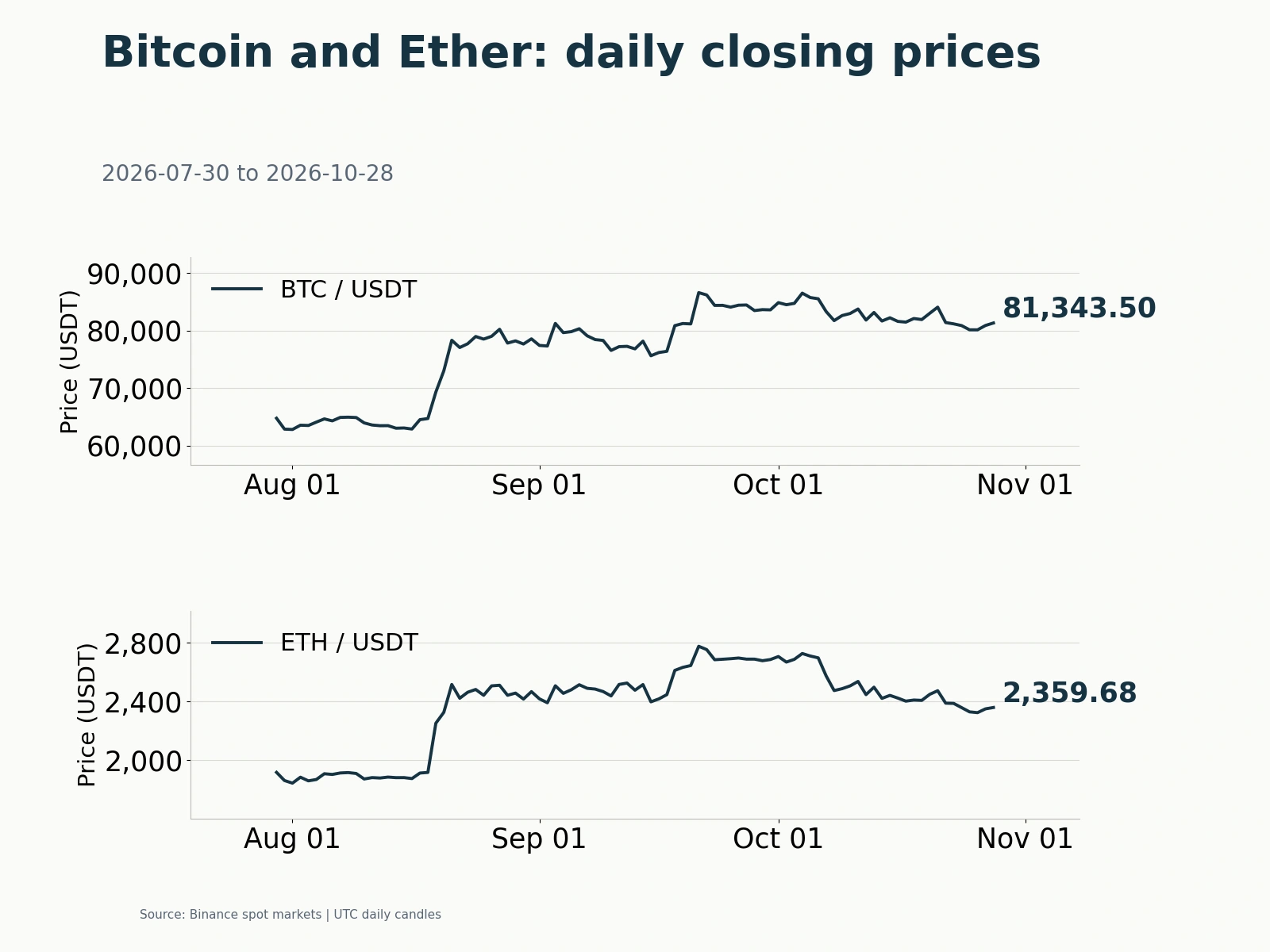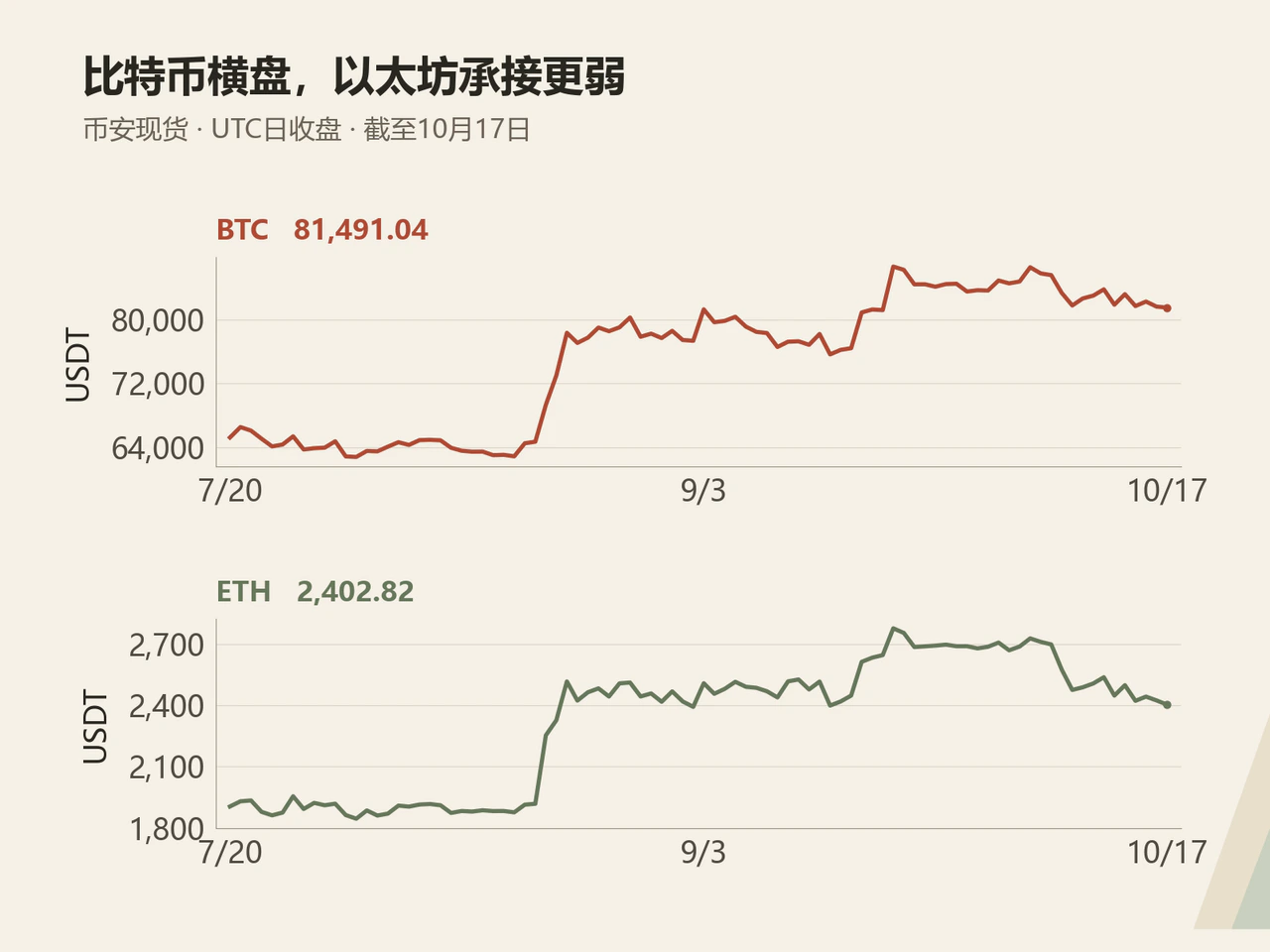
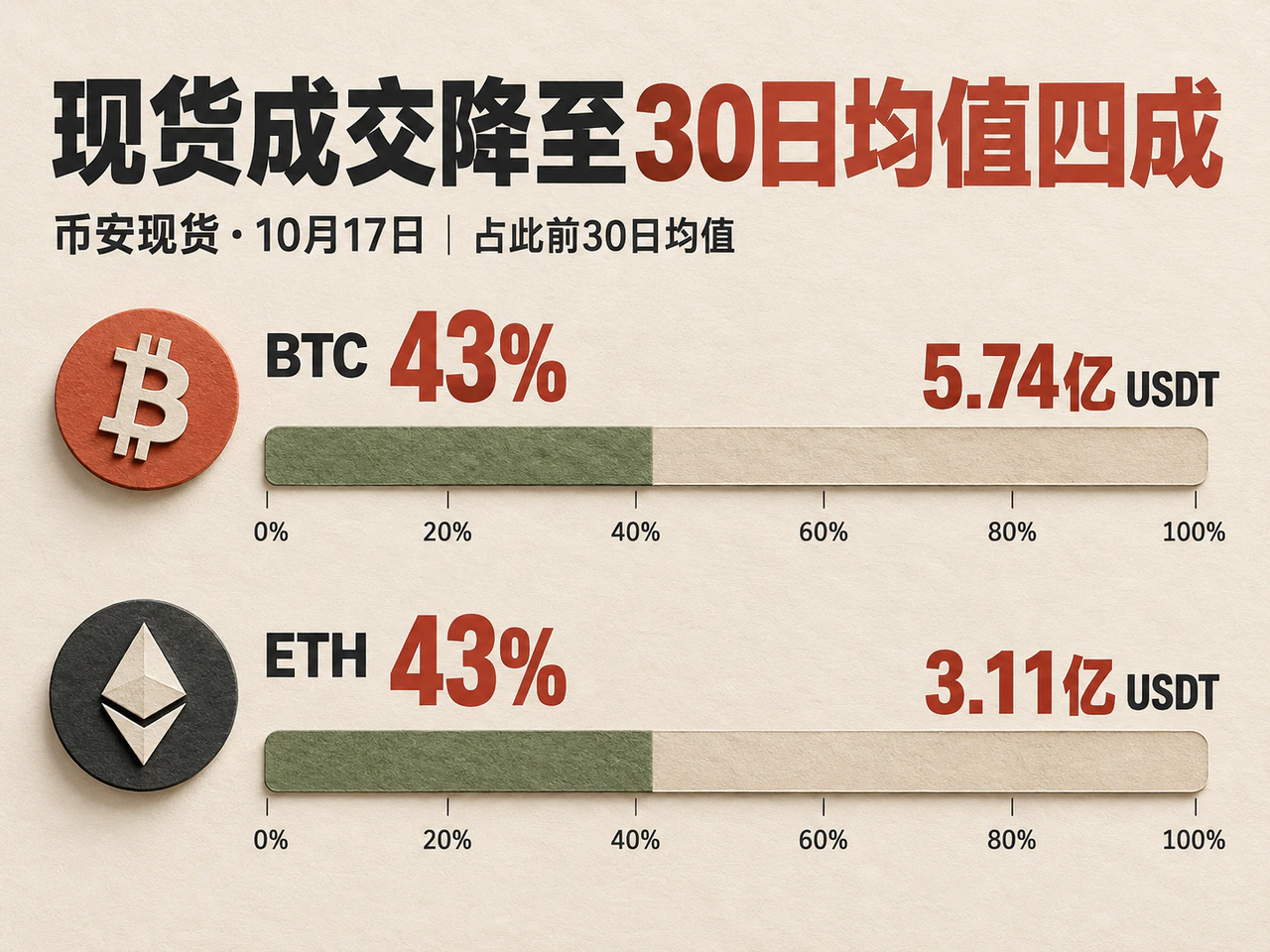
Bitcoin consolidated narrowly near 81,000 USDT while most other major cryptoassets weakened. As of 8 a.m. October 18, Beijing time, using Binance spot USDT quotations and UTC daily closes, all ten highly liquid spot assets tracked here ended the complete October 17 session lower. Bitcoin stood at 81,491.04 USDT, down 0.15%, and Ether at 2,402.82 USDT, down 0.85%; turnover in each was below half its preceding 30-complete-session average. Following this week's US inflation-data shock, the market entered low-volume consolidation. Investors' relative defensive preference for Bitcoin had yet to become broad buying. Actual buying support deserves more attention than the seasonal narrative that October usually brings gains.
All ten major coins decline; BTC and ETH turnover falls to about 40% of 30-day averages
Intraday behavior diverged markedly. Bitcoin reached 81,770.01 USDT and fell as low as 80,819.66, a high-low range of just 1.16% of its previous close. Ether fluctuated between 2,356.79 and 2,441.66 USDT, an intraday range of 3.50%. Both recovered from their lows, but Ether was more volatile and closed weaker.
The other eight major tokens tracked on the same platform all fell: BNB closed at 718.02 USDT, down 0.49%; SOL at 103.47, down 0.94%; XRP at 1.2941, down 1.33%. DOGE and AVAX each lost nearly 2%; ADA and LINK declined 2.70% and 2.95%, respectively; SUI lost 4.38%. None of the ten sample assets gained, with Bitcoin's near-flat close masking selling pressure elsewhere.
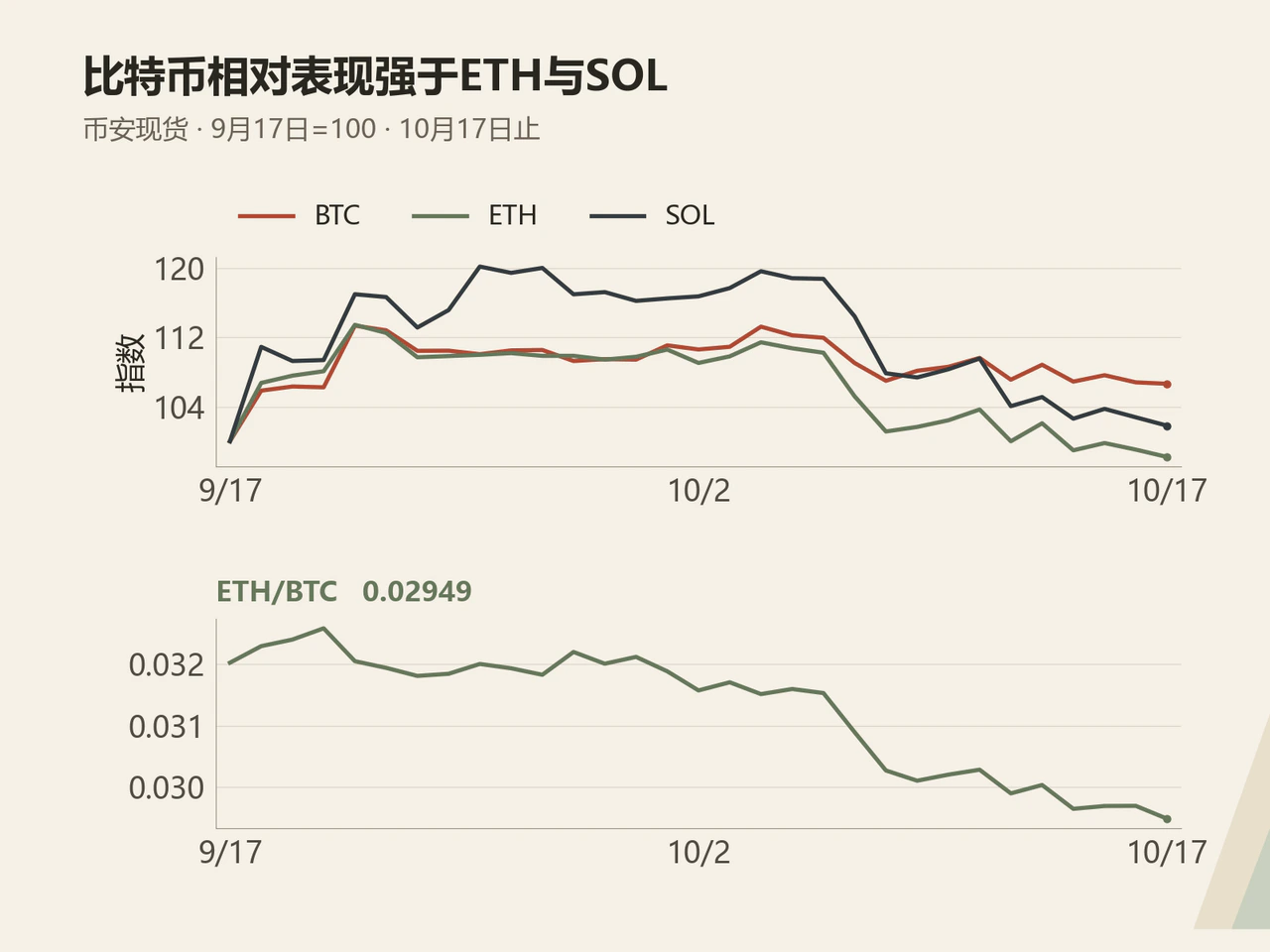
Ether has underperformed Bitcoin for some time. Based on contemporaneous USDT closes, ETH/BTC fell to 0.02949, down 7.93% over 30 days. Bitcoin gained 6.64% over the same period while Ether lost 1.82%. Amid broad market pressure, the ratio reflects stronger relative buying support for Bitcoin and distinctly weaker demand for non-Bitcoin assets.
Over a longer horizon, some of the weakest-performing public-chain tokens are giving back earlier strong gains. SUI and AVAX remained up 31.71% and 28.33%, respectively, over 30 days, but both had retreated substantially since late September. Large accumulated unrealized profits combined with shrinking short-term positions may have amplified recent intraday declines.
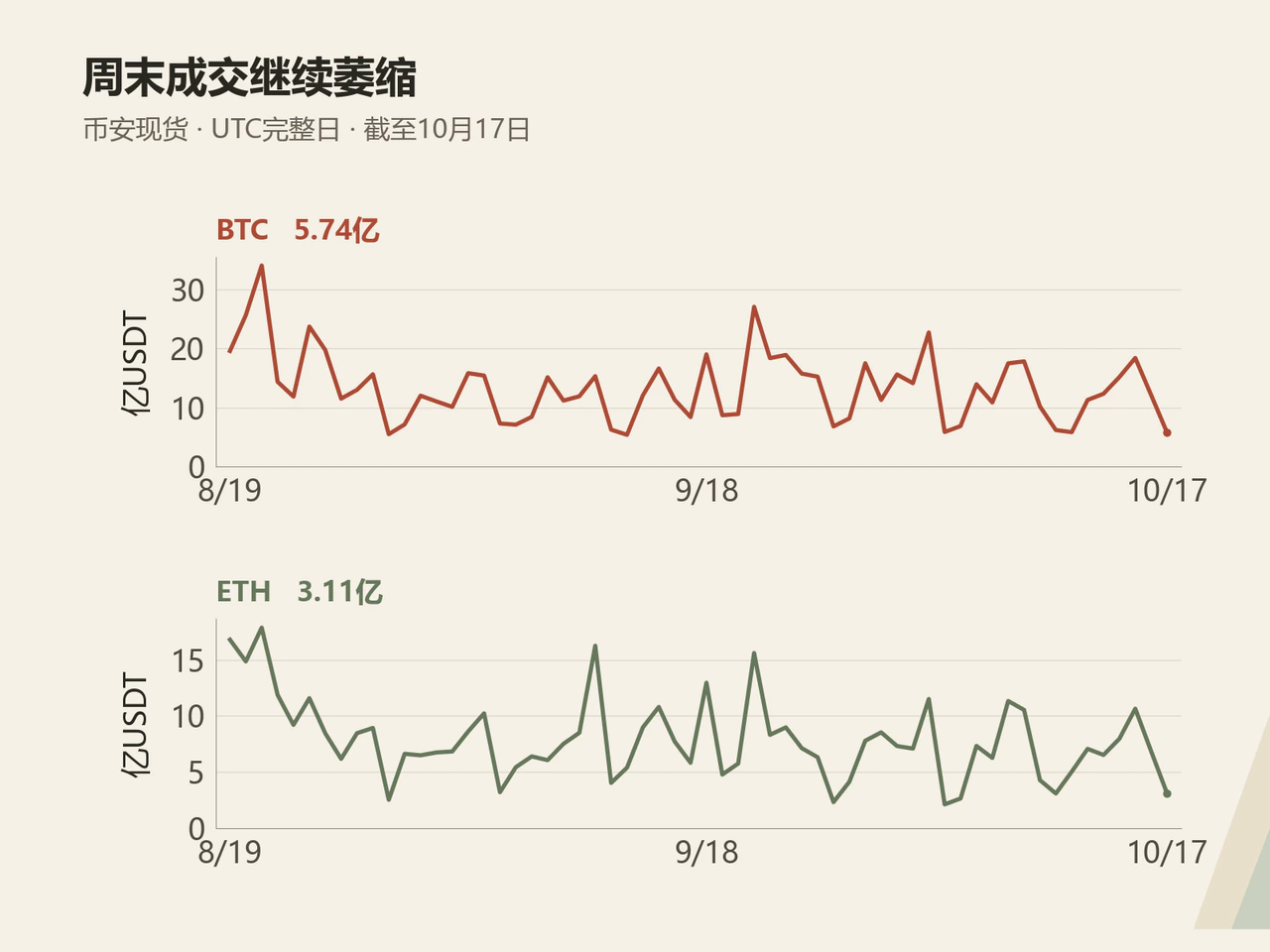
Shrinking turnover is the market's weakest link. On October 17, Bitcoin turnover was 574 million USDT and Ether turnover 311 million, only 47.5% and 45.4% of the previous day's levels, respectively, and both approximately 43% of their preceding 30-day averages. Although weekends typically bring seasonally lower trading, Bitcoin turnover was still below each of the preceding four Saturdays and 16.4% below their average. Stabilizing prices with thin trading mean a recovery still needs sustained volume growth and a broader set of coins strengthening.
Sticky inflation and weak crypto buying leave ETH and SOL down over 10% this month
Macroeconomic inflation pressure continues to constrain risk appetite. US Bureau of Labor Statistics data released October 14 showed September CPI rising 0.6% month on month and 3.7% year on year. Gasoline jumped 9.1% on the month, contributing more than half the headline increase; core CPI rose 0.3%. Rebounding energy prices raised headline inflation while core inflation remained sticky, making it difficult to bet on rapid monetary easing merely on signs of slower growth. High rates increase the relative appeal of cash and bonds and the cost of leveraged crypto positions. Price gains require incremental allocation flows; existing investors have limited room to add positions on their own.
Even marginally easier external financial conditions have not brought a matching improvement in crypto demand. In October 17 commentary, StoneX analyst Julian Pineda said the recent retreat in the dollar and US Treasury yields had not materially benefited crypto, with investor participation still insufficient. Lower risk-free rates improve the trading environment, but renewed incremental buying still depends on the assets' own appeal and investors' willingness to bear risk.
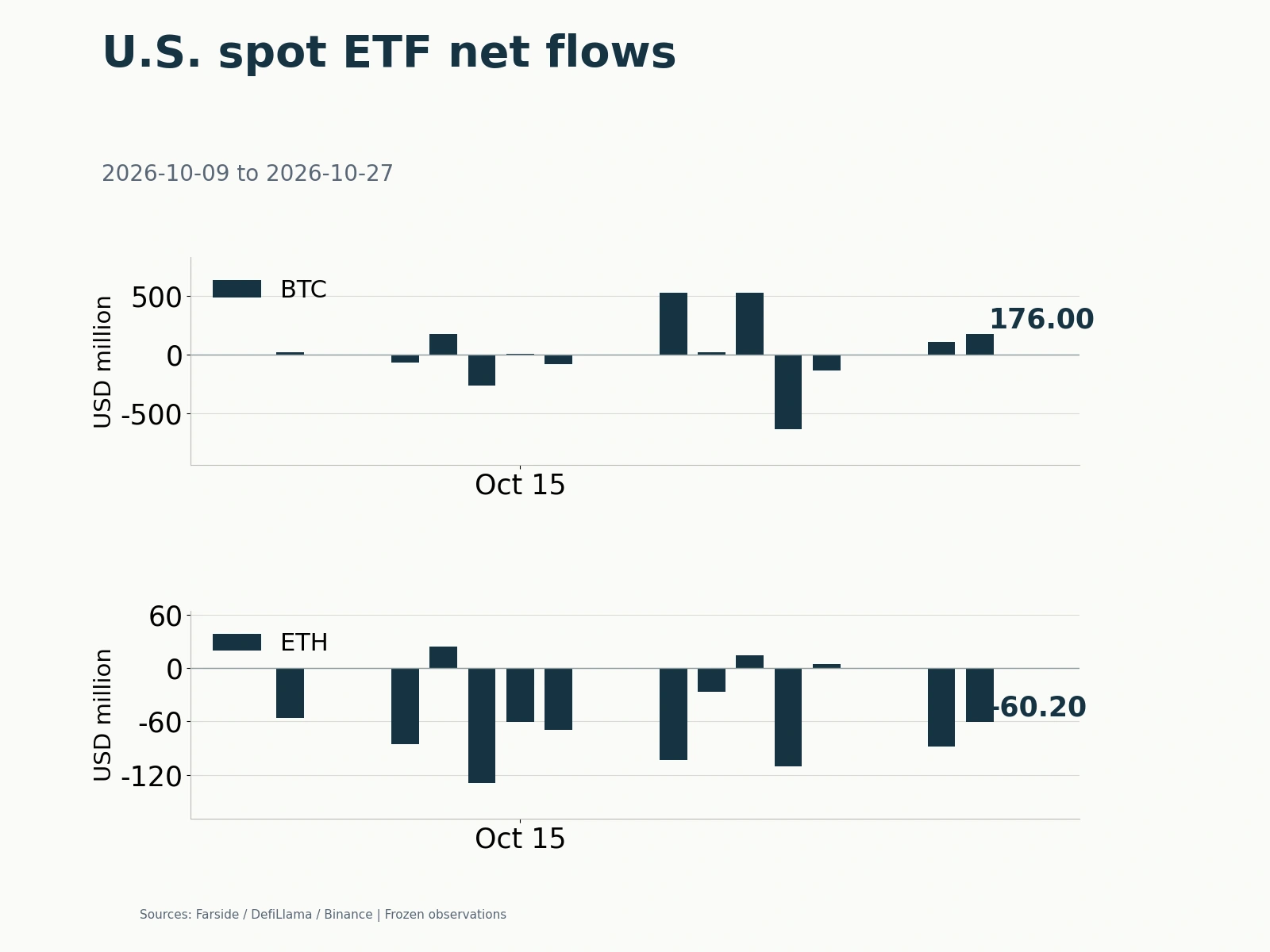
Public sentiment and actual flows also diverge. On October 17, 24/7 Wall St. cited Santiment statistics showing positive Ethereum discussions on social platforms still outnumbering negative ones, even as Ether ETFs recorded continued outflows over the preceding several US sessions. Online enthusiasm had not translated into commensurate buying, corroborating the persistent weakness in ETH/BTC.
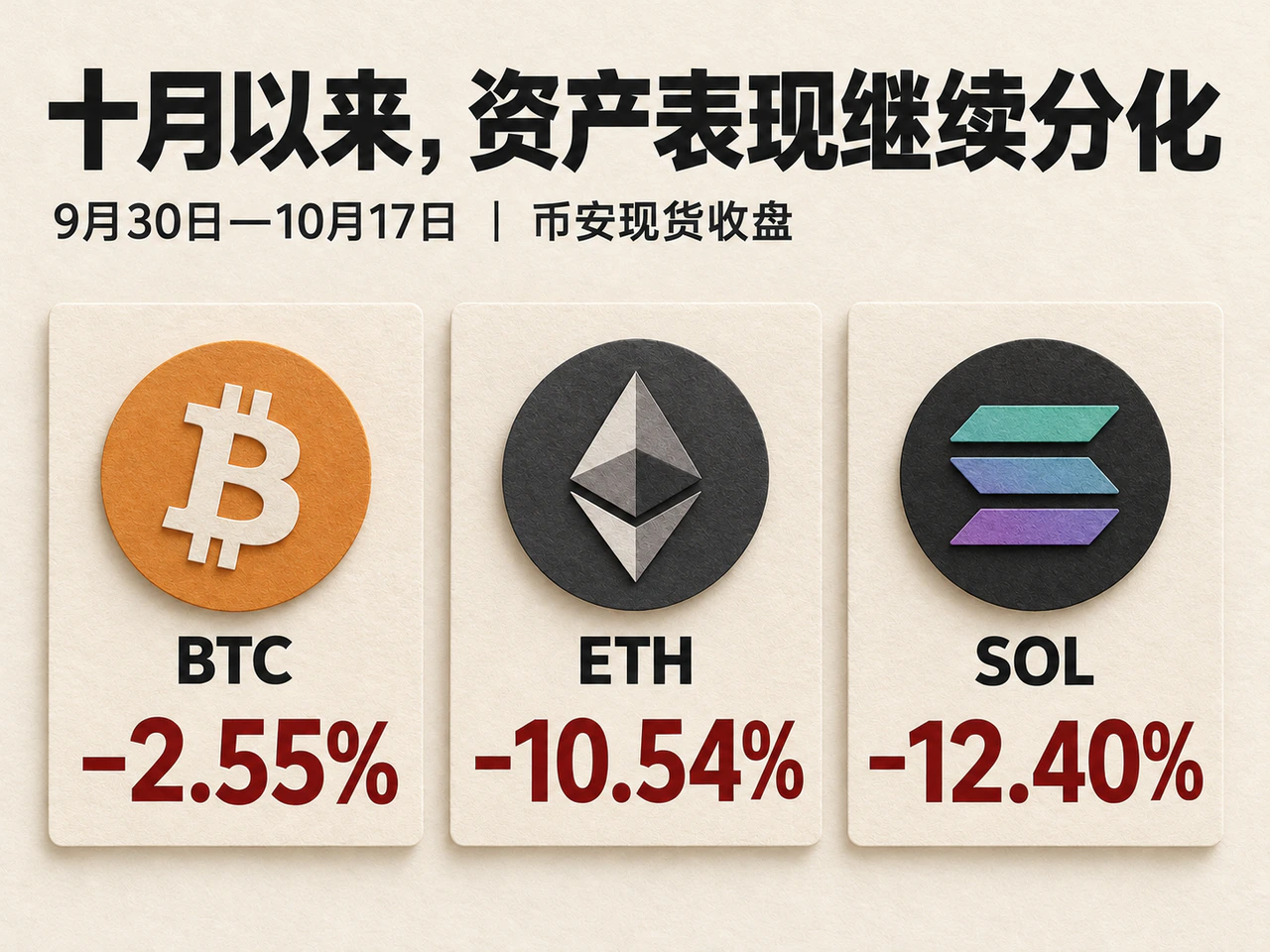
With buying insufficient, the seasonal expectation of an October rally is being tested. Using a consistent Binance close-to-close basis from September 30 through October 17, Bitcoin had lost 2.55% in October, Ether 10.54% and Solana 12.40%. A calendar effect alone cannot fill a funding gap, and Bitcoin's relative resilience has yet to spread into a general recovery among major coins.
In the near term, escaping a defensive posture depends mainly on whether recovering spot turnover accompanies broader participation in gains and whether ETH/BTC stabilizes. If Bitcoin alone maintains its price while other majors weaken, the market remains a fragile recovery driven by existing capital. A rebound will have a firmer foundation only when improving spot activity, stabilizing relative prices and better institutional flows reinforce one another.
Click Read Original for further details.