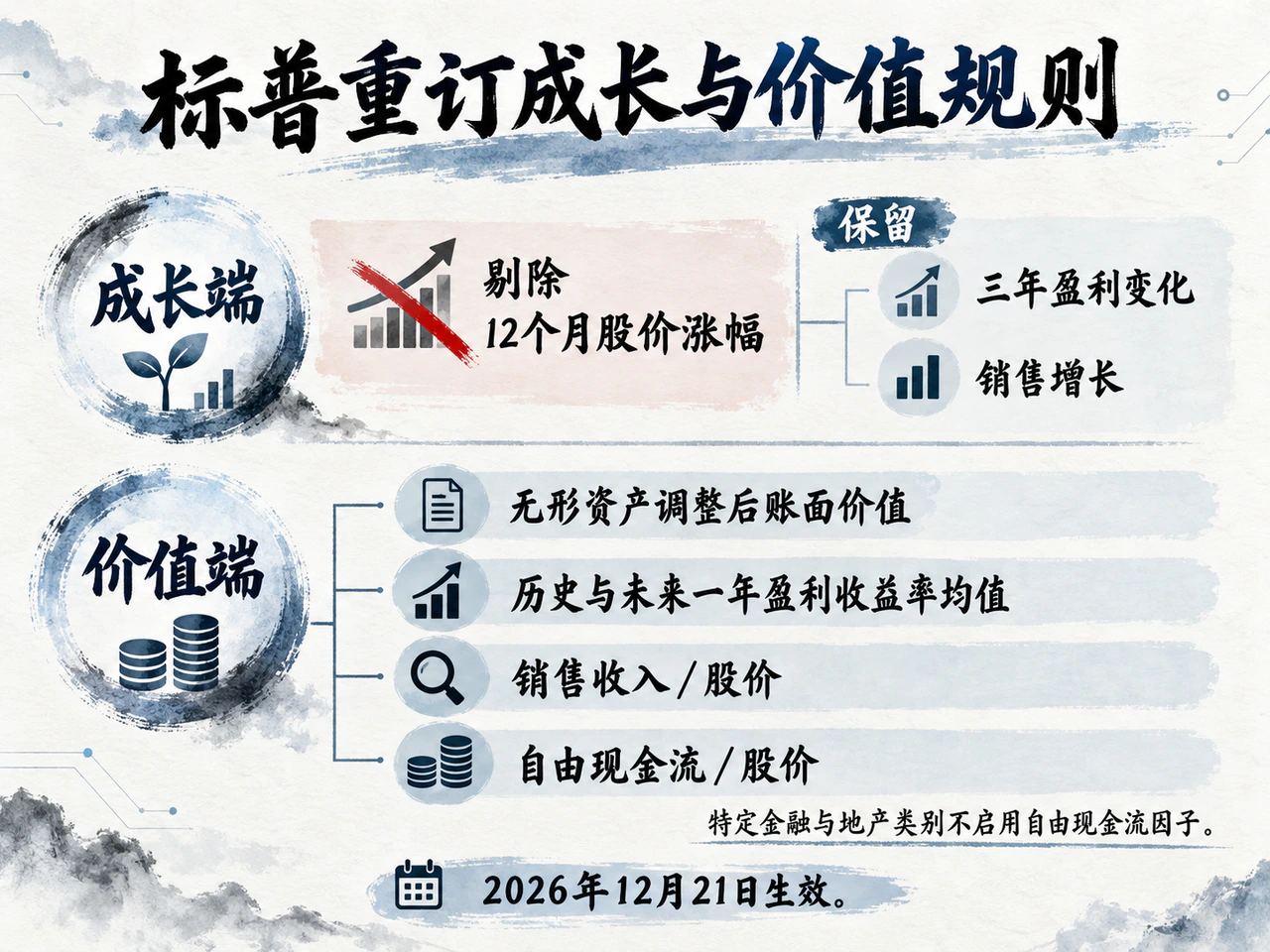
Indonesian stocks fell more than 5% again in early trading on October 19, reaching six-year lows, after the Jakarta Composite Index had already plunged 11.6% in the previous session on October 16. To give the market time to absorb information, Indonesia tightened the daily Auto-Rejection Lower Limit for applicable stocks from 15% to 7%, effective October 19. Yet the central issue behind the consecutive collapses extends well beyond short-term price volatility: international institutions are reassessing whether Indonesia's stock market still has the institutional foundations required for sustained allocations against global benchmarks.
The catalyst for this reassessment was MSCI's earlier launch of a public consultation on downgrading Indonesia from Emerging Market to Standalone Market status. If adopted, Indonesian securities would remain tradable but would leave the routine allocation universe of the relevant composite indexes. As of the afternoon of October 19 Beijing time, the consultation was ongoing and no final decision had been made. Feedback is due by April 30, 2027, with a final decision to be announced no later than June 30; the implementation schedule also remains under discussion. The violent selling is essentially the market pricing in a future contraction in the pool of international buyers.
Indonesia's central test is whether it can restore confidence in its market's investability. Transparent ownership, sufficient genuinely tradable free float and fair price formation directly determine how much international capital is willing to hold and the risk premium it requires. International index eligibility converts these underlying governance issues into binding institutional allocation constraints. If withdrawal pressure persists, the shock could spread from secondary-market equities to the exchange rate, sovereign borrowing and corporate financing. Existing macroeconomic and foreign-reserve buffers can buy time, but only substantive repairs to market governance can turn that window into sustained capital supply.
1. OJK Penalizes Three Placement and Trading Violations; Identifying Related Holdings Is Key to Lifting MSCI's Freeze

When international index providers calculate constituent weights, they do not simply use total market capitalization. They exclude shares locked up over the long term by controlling shareholders and other strategic investors, as well as portions subject to foreign ownership restrictions, to reflect actual free-float market value. For international institutions managing large sums, the depth of shares genuinely available to enter and exit positions in the secondary market matters far more than registered total share capital.
If public holdings that appear dispersed on paper are secretly controlled by the same interest group through concealed accounts, institutions will seriously overestimate the market's true capacity. When target positions based on nominal free float far exceed the shares independent investors can actually trade, large portfolio adjustments cause severe price impacts. If related parties also coordinate trades to manipulate prices and volume, apparently active turnover cannot provide genuine liquidity. In such an environment, fund managers may reduce allocations even when they approve of a listed company's fundamentals, because they cannot execute transactions reliably.
Enforcement investigations disclosed by Indonesia's Financial Services Authority (OJK) on October 16 gave concrete form to this institutional weakness. OJK found that BREN and CUAN had prearranged shares during their public offerings for a group of entities connected to their controlling shareholders. These parties obscured their identities to obtain large allocations, resulting in highly concentrated ownership and severely restricted actual market free float. OJK imposed administrative fines of 500 billion rupiah and 100 billion rupiah on the responsible parties in the two placement cases, respectively. A separate case disclosed the same day involving manipulation of DSSA share trading drew an even larger fine of 1.5 trillion rupiah.
These penalties show that regulators have begun addressing misconduct, but also expose the limitations of simply raising nominal public ownership requirements. If regulators cannot identify the relationships behind accounts, dispersed accounts do not equate to dispersed control, and paper rules increasing public shareholding will struggle to create genuinely tradable supply.
MSCI's consultation document likewise targets lasting market-governance mechanisms. Its central demands include stable and reliable shareholder disclosure, strict implementation of the 1% ownership disclosure threshold and the highly concentrated shareholding framework, and effective enforcement against coordinated trading and free-float manipulation. MSCI's scrutiny extends beyond existing index constituents and leading large caps to the entire market ecosystem. Since January, MSCI has already frozen a range of index adjustments for Indonesian securities, suspending increases in Foreign Inclusion Factors (FIF), increases in included share counts, new constituent additions and migrations to larger capitalization segments.
Indonesia must therefore cross a crucial threshold between issuing short-term penalties and winning back long-term trust: can regulatory reform durably reverse entrenched trading abuses across the market and convince international institutions they will not recur once the index freeze is lifted? Market governance determines more than the fate of individual offending companies; it determines whether allocations to the country's assets are operationally executable.
2. Standalone Status Could Trigger $5.6 Billion in Passive Outflows; No Receiving Index Pool to Cushion Early Selling

Although MSCI has not made a final exclusion decision, capital-withdrawal pressure is already materializing. The mechanism stems from asset-management mandates and performance constraints. Passive funds directly tracking emerging-market indexes must tightly control tracking error; if Indonesia is removed from the relevant composite indexes, they must eliminate Indonesian exposure according to the effective schedule. Active funds using the same benchmark retain discretion, but an Indonesian holding previously treated as a normal benchmark allocation would become an off-benchmark overweight requiring specific explanation to investors and acceptance of deviation risk.
Research on global fund allocations by economists Raddatz, Schmukler and Williams confirms that benchmark composition not only directly directs passive flows but also materially influences active funds' cross-country allocations. It also identifies a two-stage impact around announcement and implementation: downgrade expectations first depress asset prices, while mandatory portfolio adjustments when the change takes effect create a second wave of selling pressure. Some excessive price impact reverses only after implementation. Although alert investors can sell ahead of the change, arbitrage capital may not be able to absorb all prospective selling at the initial announcement.
According to a Goldman Sachs estimate cited by Reuters on October 19, full removal of Indonesia from the relevant MSCI indexes would trigger approximately $5.6 billion in mandatory passive outflows. Active funds benchmarked to these indexes also hold more than $8 billion of Indonesian equities. The passive figure is a potential selling flow under a specific exclusion scenario; active holdings are a stock of exposure. Whether those managers stay, reduce holdings or buy against the trend depends on their investment judgment and product mandates.
The ultimate price decline, market-capitalization loss and net foreign remittance caused by potential selling also depend on buyers' capacity to absorb it. Domestic institutions, funds using other benchmarks and capital free of these allocation constraints may step in once prices offer a margin of safety. But if concentrated selling is too large relative to actual free float and the available buyer pool, the market can clear only at deeper discounts. With ample buying capacity, the adjustment can instead be absorbed more smoothly.
Loss of index eligibility is fundamentally different from an ordinary market decline. With unchanged constituents and no net fund subscriptions or redemptions, a market or stock that underperforms naturally shrinks in weight in both a capitalization-weighted index and a replicating fund's portfolio, requiring no additional selling. The present risk concerns whether Indonesian securities remain within the investable universe at all, triggering systematic reductions through an eligibility change.
This also explains the current disagreement among Wall Street institutions. Goldman Sachs emphasizes potential selling caused by a rule change. BNY Investments notes that foreign exposure to Indonesian equities had already been cut sharply, potentially limiting further downside from selling, while acknowledging the continuing difficulty of attracting new funds. These views describe two sides of the same predicament: smaller existing positions can ease future passive rebalancing pressure, but a shortage of incremental buying also weakens the market's ability to recover valuations.
Historical reclassifications show more clearly how the destination of a downgrade determines channels for capital entry. In 2021, MSCI downgraded Pakistan from Emerging Market to Frontier Market because its market capitalization and stock liquidity no longer met the criteria, while explicitly stating that its Market Accessibility still met emerging-market standards. Although emerging-market index funds sold, frontier-market index funds provided a receiving pool, even though the timing and size of the two groups' adjustments did not align perfectly.
That same year, MSCI moved Argentina directly to Standalone Market status because of prolonged capital controls. Although the MSCI Argentina Index included only offshore-listed securities and remained technically replicable, overall market accessibility no longer met classification requirements. Compared with a move to Frontier Market, standalone status means losing the corresponding buyer pool of composite-index funds.
MSCI's direct proposal to consult on Standalone Market status for Indonesia underscores the severity of its market-governance and price-formation deficiencies. If adopted, Indonesian equities would lose access to passive capital through standard composite indexes, leaving existing positions heavily dependent on active investors' independent judgments. To retain emerging-market status and secure the lifting of the index-adjustment freeze in place since January, Indonesia must deliver governance reforms that withstand scrutiny.
3. Indonesia's MSCI Weight Falls by More Than Half to 0.43%; Financials, over 70% of the Index, Bear the Brunt
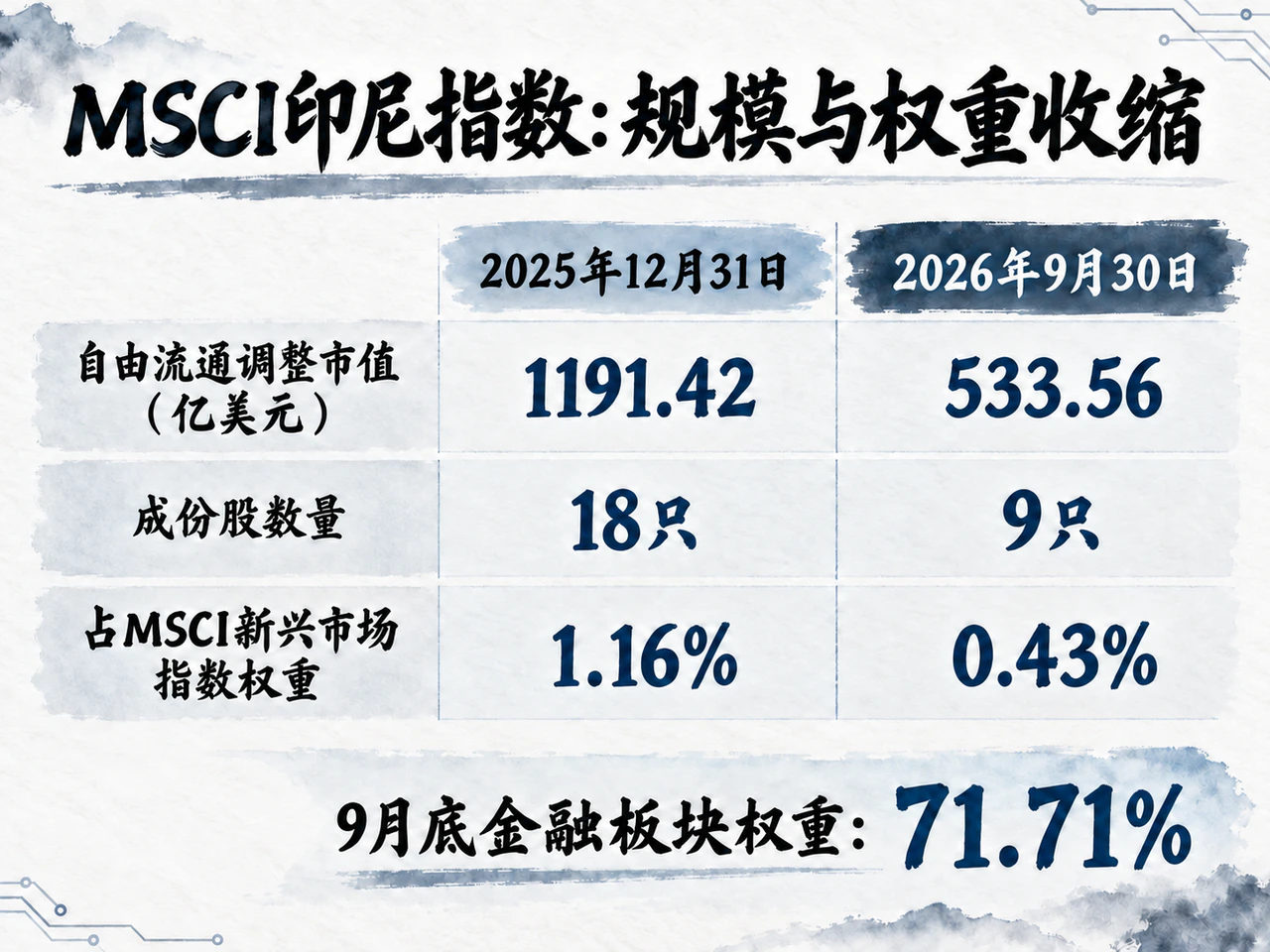
Data disclosed in MSCI's consultation document show that Indonesia's size and weight in global investment benchmarks had already contracted substantially from the end of last year, even before the formal downgrade consultation began.
| Indicator | December 31, 2025 | September 30, 2026 |
|---|---|---|
| MSCI Indonesia Index free-float-adjusted market capitalization, US$ billion | 119.142 | 53.356 |
| Number of constituents | 18 | 9 |
| Weight in the MSCI Emerging Markets Index | 1.16% | 0.43% |
In just three quarters, the MSCI Indonesia Index's free-float-adjusted market capitalization fell approximately 55.2%, and its constituent count halved to nine. This contraction reflected falling share prices and currency movements as well as constituent removals and changes to free-float factors. The effect on new global capital is especially direct: of every $100 of incremental capital allocated according to MSCI Emerging Markets Index weights, the amount going to Indonesia fell from $1.16 at the end of last year to $0.43 at the end of September. Even before any formal loss of emerging-market status, its channel for new global benchmark capital had narrowed sharply.
The index's extreme sector concentration meanwhile places financials at the center of the storm. At the end of September, financial stocks accounted for 71.71% of the MSCI Indonesia Index. Although companies involved in penalties and governance disputes span several industries, a country-level index downgrade or allocation reduction would fall indiscriminately on the heavily weighted financial stocks remaining in the index, even if these leading institutions have sound operating fundamentals and compliance records. Strong individual fundamentals may attract some long-term buyers at lower prices, but cannot exempt a stock from passive trading shocks caused by country benchmark changes.
Sustained valuation pressure on financial stocks would first worsen shareholder returns and equity financing conditions in the banking system. For banks needing to raise capital through new share issues, a valuation discount means raising less capital from the same number of shares. If external capital replenishment becomes constrained, regulatory capital-adequacy floors could force banks to curtail their capacity for new lending. The severity of transmission from secondary-market share prices to real-economy credit depends on each bank's existing capital buffers and urgency of refinancing.
4. Q2 Current-Account Deficit Widens to 3.3% of GDP: Can $146.3 Billion in Reserves and Bond Inflows Stop Cross-Market Contagion?
The transmission of equity selling pressure to currency and bond markets first depends on where withdrawn money goes. Foreign investors selling Indonesian stocks initially receive rupiah cash. Direct net demand for foreign exchange arises when they then convert local currency into foreign currency and other sources of FX supply cannot offset it. If the proceeds instead move into Indonesian government bonds, the pressure remains within equities and need not generate an equivalent FX purchase. Moreover, MSCI equity reclassification does not automatically alter Indonesian government bonds' eligibility in international bond indexes.
Cross-market contagion is driven by the interaction of asset returns, exchange-rate expectations and cross-asset risk budgets. Rupiah depreciation directly erodes unhedged foreign investors' dollar returns, prompting them to require a higher risk premium for expected depreciation and currency volatility. Hedged investors must assess their net yield spread after FX hedging costs. A wider country-governance risk premium also raises the yield compensation bond investors demand. Higher rates can help retain cross-border capital, but simultaneously raise the financing hurdle for the government and domestic companies.
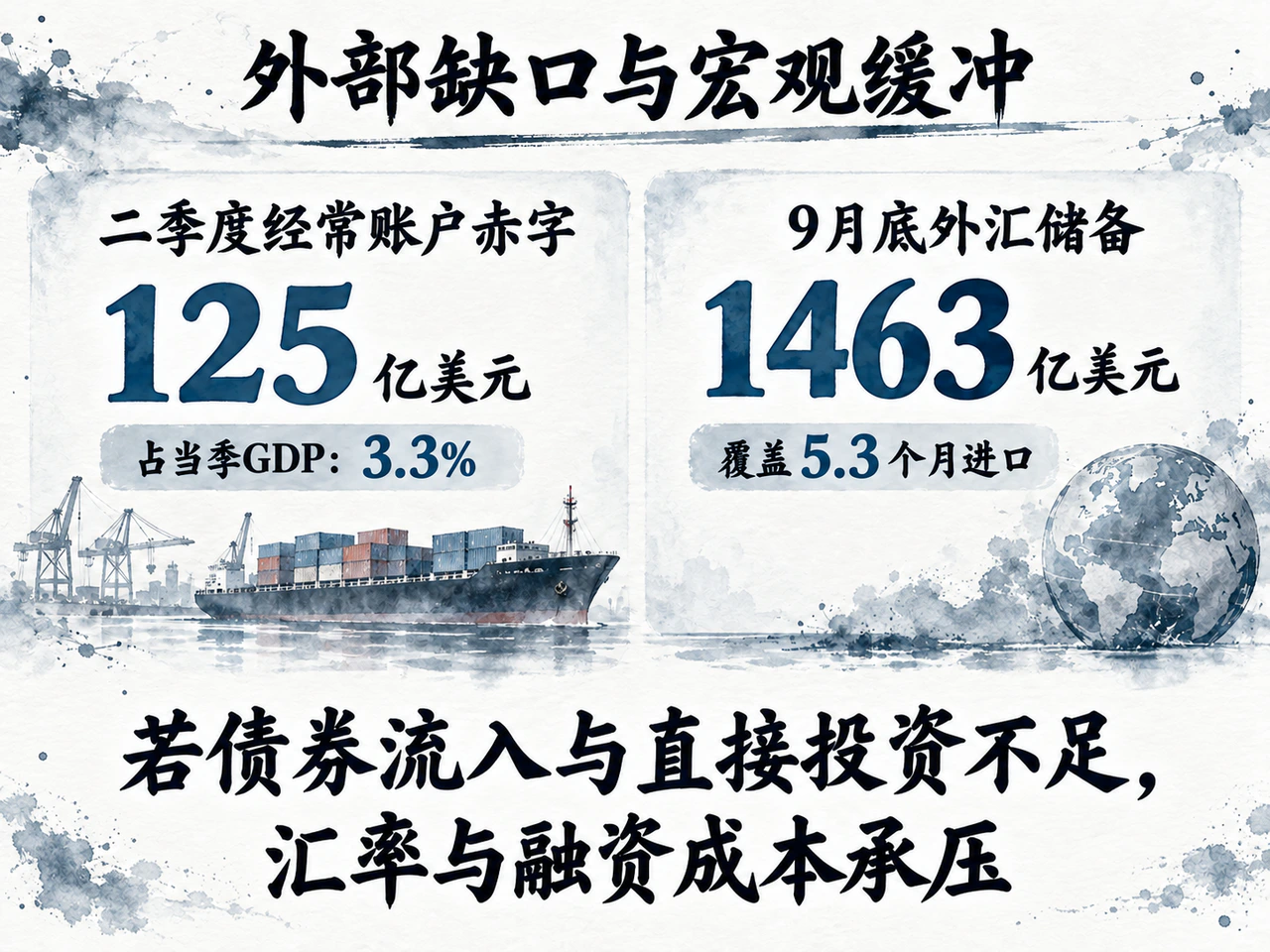
Indonesia's current balance-of-payments structure makes this policy trade-off more binding. Central-bank figures released in August showed that higher oil, gas and other commodity import costs, together with increased income payments abroad, widened the second-quarter current-account deficit to $12.5 billion, or 3.3% of quarterly GDP, substantially above the first quarter's $3.6 billion, or 1.0% of GDP. Increased foreign direct investment (FDI) and portfolio inflows produced a $12 billion capital and financial account surplus, narrowing the overall balance-of-payments deficit to $900 million.
These figures show that financing the current-account deficit with a capital-account surplus is essential to Indonesia's external balance. If the current-account deficit persists and, after equity funding channels narrow, bond inflows and direct investment fail to fill the gap, external imbalances must be absorbed through currency depreciation, reserve depletion or weaker domestic demand. Conversely, as long as bond and direct-investment channels remain open, the impact of equity withdrawals may stay localized.
Earlier data suggest Indonesia retains some external buffers. At the end of September, foreign exchange reserves stood at $146.3 billion, broadly unchanged from $146.5 billion at the end of August and sufficient to cover 5.3 months of imports. In the third quarter through September 21, portfolio investment still recorded net inflows of $400 million, supported by government global bond issuance and foreign purchases of local-currency government bonds. Foreign equity reductions and bond inflows therefore coexisted during the earlier adjustment. Whether bonds and other channels can continue to offset the shock after the October 19 stock-market collapse requires subsequent flow data on a comparable basis.
Monetary policy is also walking a tightrope between external stability and growth. Bank Indonesia kept its policy rate at 5.75% at the September meeting. It used spot and onshore and offshore forward FX interventions and hedging incentives to stabilize the currency and foreign investor confidence, while continuing macroprudential support for bank lending. September inflation was 3.28% year on year, still within the central bank's target of 2.5% plus or minus one percentage point, or 1.5%–3.5%. The core policy problem is therefore balancing external financing stability with domestic demand, rather than runaway inflation.
Prudent debt maturities and currency composition also slow transmission. Bank Indonesia's end-August figures released in October showed government external debt was almost entirely long term, and private external debt predominantly so. The International Monetary Fund (IMF) also noted in its January report that approximately 70% of Indonesian public debt was issued domestically in local currency. Long external maturities and a high local-currency share of public debt substantially reduce concentrated short-term external repayments and currency-mismatch risk. Even if secondary-market government yields rise, existing fixed-rate debt does not reprice immediately. Higher interest burdens feed through gradually via new issuance, refinancing and floating-rate debt, buying policymakers time.
A chronic tightening of domestic financing conditions warrants closer attention than acute sovereign debt risk. If equity valuations and liquidity remain depressed, impaired equity financing may force some corporate capital projects toward bank loans or bonds. At the same time, if government securities and central-bank instruments must offer higher yields to attract domestic and foreign capital, private projects face crowding out and higher funding costs. Large companies and those with ample collateral or foreign-currency revenue may find alternatives, while firms dependent on continuous capital-market funding are more constrained. The equity index eligibility crisis could ultimately reshape corporate capital spending and project selection by raising real financing costs.
5. A 7% Daily Downside Limit Can Only Delay Clearing; Liquidity Recovery Requires Improvement in Three Governance and Funding Indicators
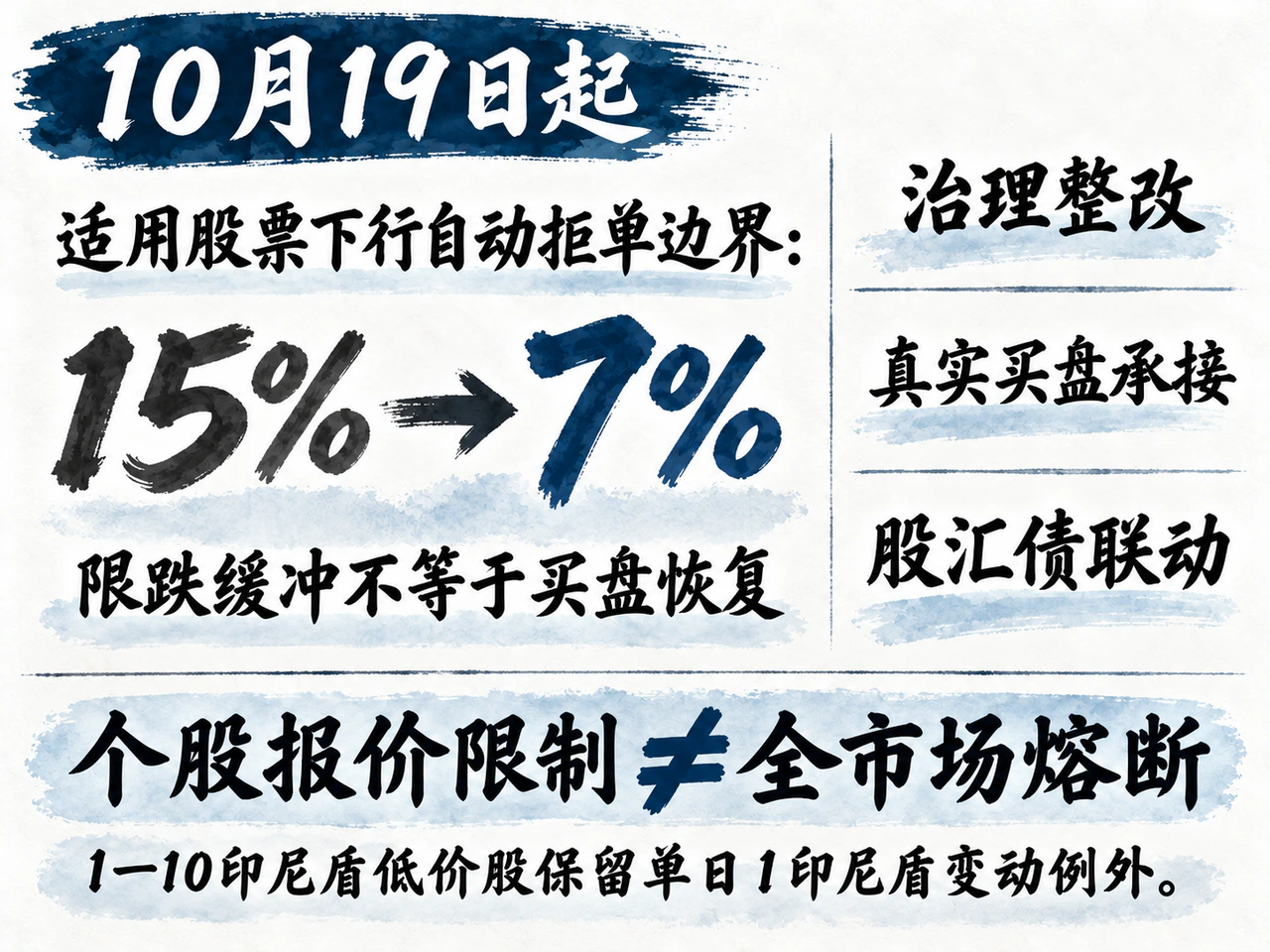
The new 7% downside rule introduced on October 19 applies to the daily lower order-price boundary for individual eligible stocks relative to their reference prices. Sell orders beyond a 7% decline are automatically rejected, while orders within the range can still match normally. Very low-priced shares trading at 1–10 rupiah retain an exception allowing an absolute daily change of one rupiah. This individual-stock quotation limit is separate from the market-wide circuit-breaker suspension triggered when the Jakarta Composite falls by a specified amount.
Tightening the daily downside boundary can stretch out the adjustment period but cannot create buyers. If selling at the lower limit consistently far exceeds buying, pressure simply becomes queued limit-down orders, dried-up trading and further declines on subsequent days. Stabilizing quoted prices and restoring liquidity must therefore be observed separately: administratively narrowing the permitted range can temporarily restrain paper losses, but genuine stabilization requires investors to be willing and able to trade normally in a continuous market.
Whether Indonesia can emerge from this crisis will be determined by three interlocking sets of indicators:
- Can governance reforms win credibility? Major-shareholder disclosures, identification of related parties behind accounts and enforcement must advance consistently across a broader market, turning nominal free float on paper into shares effectively available for secondary-market trading.
- Can the secondary market regain genuine buying support? Domestic and long-term investors must be able to absorb foreign selling smoothly, with substantive improvements in bid-ask spreads, executable depth, and the functioning of IPOs and follow-on financing.
- Does localized selling spill into the macroeconomy? Equity withdrawals could become a cross-market feedback loop of local-currency government bond outflows, persistent rupiah depreciation and reserve depletion, forcing monetary and fiscal policy to pay a higher price.
If governance reform advances constructively, leading to a favorable MSCI consultation outcome and a return of real buying, the current event-driven valuation discount could gradually unwind. If reform remains verbal and international institutions persistently shrink Indonesian allocations, even strong macroeconomic and debt buffers that avert an acute balance-of-payments crisis will not prevent high financing costs and slower capital formation from dragging on growth. Indonesia must win more than a one- or two-session defense of its stock index. It needs to rebuild global capital's trust in the market's underlying rules, convincing investors that transparent ownership information and genuine price signals allow funds to enter and leave in an orderly way.
Click Read Original for full details.