On October 19, regulation of U.S. payment stablecoins and institutional infrastructure advanced together. Comments on the Treasury's proposed GENIUS Act rules were due that day. Mastercard launched a tool to identify risks before funds move on-chain, AnchorWatch's trust company began operations, and Deutsche Bank disclosed crypto-custody plans for Germany and Asia. As regulatory timelines and entry requirements become clearer, financial institutions are extending their focus beyond licensing to practical operations such as transaction screening, distributed key control and custody pricing.
Treasury sets out phased stablecoin access dates; Mastercard introduces pre-chain risk identification

The Treasury's public consultation on proposed rules implementing Section 3 of the GENIUS Act closed on October 19. The proposal focuses on defining when payment stablecoins are issued, offered or sold in the United States and clarifying digital-asset service providers' compliance duties. For cross-border business, the issuer's registration, customer location and platform's target users directly determine the rules' scope. The finalized rules will provide specific operating criteria for institutions.
Under the Treasury's previously disclosed timetable, the act was expected to take effect on January 18, 2027. Issuing payment stablecoins in the United States would then generally require the appropriate federal or state authorization. For foreign stablecoins offered in the United States by service providers, issuers must have the technical ability to comply with lawful orders, follow those orders and observe applicable reciprocal arrangements. A separate authorization restriction on stablecoin sales to persons in the United States would apply from July 18, 2028. The phased dates provide different transition periods for domestic issuance, cross-border services and sales-channel adjustments.
As compliance requirements became more detailed, Mastercard launched its Stablecoin Security risk-identification offering on the same day, with initial partners including Borderless.xyz and Keyrails. The company said it combines traditional payment-message information with blockchain analytics to identify fraud, sanctions and financial-crime risks before funds move on-chain. APIs allow direct integration into institutions' existing anti-fraud, compliance-review and case-management systems.
In cross-border trade settlement, banks need to verify the payment's purpose, source of funds and receiving route together; a single blockchain address cannot reconstruct the full transaction. Integrating off-chain payment data and on-chain analytics into existing controls helps institutions conduct stablecoin settlement within their established management systems. Mastercard planned an initial North American launch, followed by global commercialization in 2027.
AnchorWatch launches custody with distributed control and capped fees; Deutsche Bank plans a launch within weeks
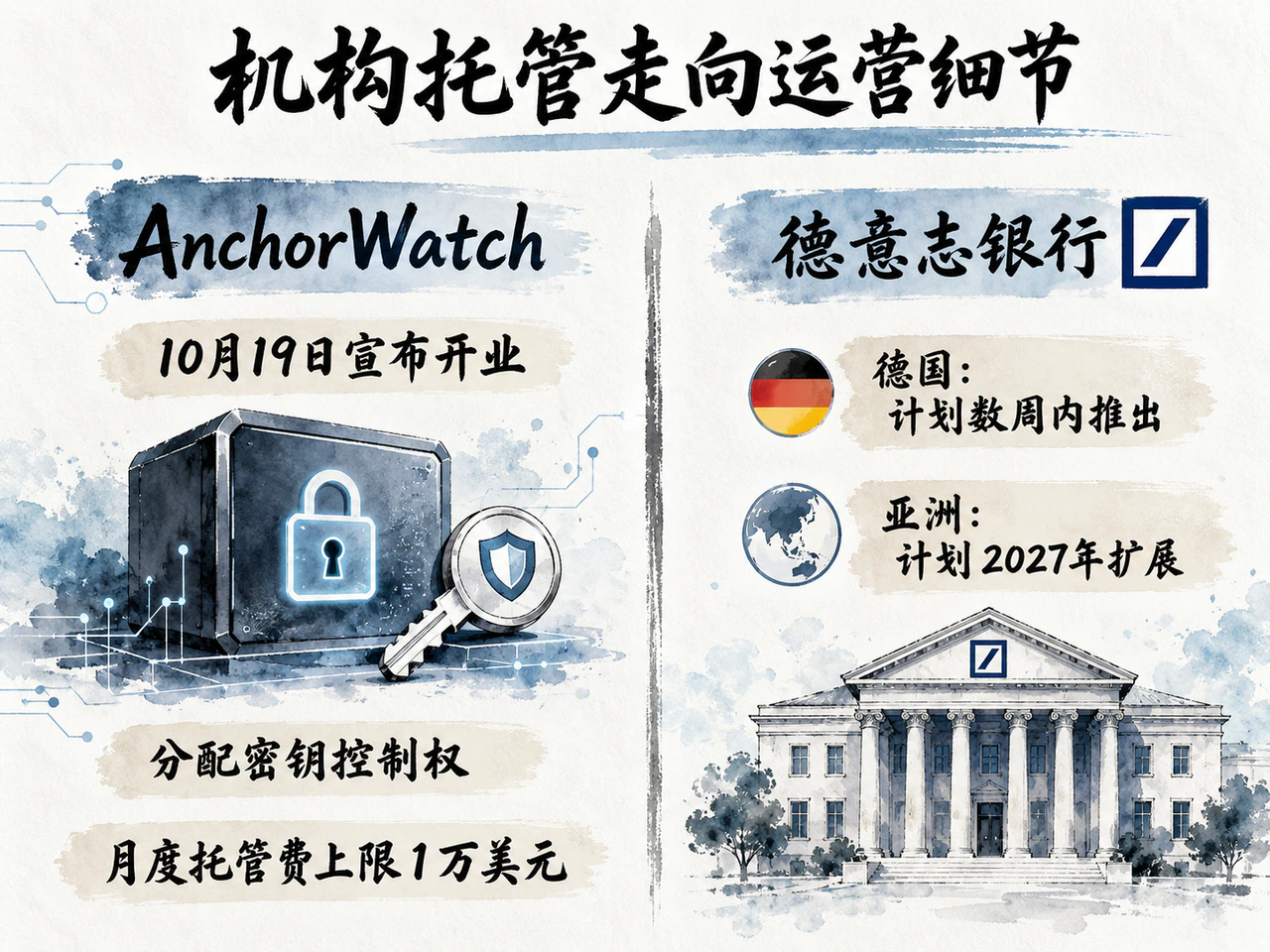
On the custody side, AnchorWatch announced on October 19 that its Nevada-chartered AnchorWatch Trust Company had officially launched qualified Bitcoin custody. Its announcement described two key-control arrangements: the trust company holds the necessary keys while client executives or trustees hold additional keys; alternatively, control is distributed among AnchorWatch, U.S.-based BitGo and Isle of Man-based CoinCorner. Clients may also apply for optional insurance in their own names, subject to underwriting and policy conditions.
By identifying who controls assets, authorizes transactions and bears insured risks, the structure clarifies custody responsibilities. The trust uses fixed-dollar pricing tiers with a monthly custody-fee cap of $10,000. Once the cap is reached, further holdings or Bitcoin price increases do not raise the fee. Compared with asset-based percentage charges, this provides large long-term holders with a capped-cost alternative.
Traditional banks are also expanding their services. CoinDesk, citing Reuters on October 19, reported that Deutsche Bank planned to launch crypto custody in Germany within weeks, initially covering Bitcoin, Ether and stablecoins including USDC, EURC and EURAU. It planned to expand into Asia in 2027, without disclosing specific markets. The report also described the bank's work on stablecoin conversion, tokenized deposits and digital-bond issuance, using custody as an entry point connecting payments and capital markets.
As the U.S. stablecoin timetable becomes clearer, institutional digital-asset services are moving from early market-access positioning to competition over operational detail. Payment networks emphasize interfaces connecting on-chain and off-chain compliance checks; specialist custodians and commercial banks differentiate themselves through distributed key control, fee caps and integrated financial services. Progress will depend on the efficiency of compliance-system integration, the reliability of multiparty custody operations and sustainable service costs.
Click Read Original for more details.