On October 19, political pressure from weekend street protests spread rapidly into French financial markets. Reuters reported during the session that France's 10-year government-bond yield jumped 13 basis points to around 4.9%, while shares in BNP Paribas and Société Générale both fell about 3%. Public demands over living costs and public services are pressuring the government to maintain spending, while bond investors want strict expenditure restraint and deficit reduction. With government debt at 119% of GDP and interest costs continuing to rise, France's room for policy maneuver is narrowing sharply.
France's central problem is translating fiscal consolidation on paper into policies that parliament can pass, the administration can implement and successive budgets can sustain. Markets worry that even substantial savings listed in a draft budget may be heavily diluted by political resistance in the streets and parliament, compounded by slowing growth. Rising sovereign yields then increase future refinancing costs, making the next round of fiscal balancing still harder.
As of the afternoon of October 20, Beijing time, France's sovereign financing channels were functioning normally. The selling pressure primarily reflected a repricing of the government's capacity to execute fiscal consolidation. Whether that reassessment becomes a systemic financial crisis depends on whether lost budget credibility combines with tighter bank funding and disorderly bond trading to create a negative feedback loop.
1. The France–Germany Spread Widens to 146 Basis Points as Political Resistance Raises France's Risk Premium

The same Reuters report showed Germany's 10-year government-bond yield rising 4 basis points to 3.45% during October 19 trading. France's 10-year spread over Germany consequently widened to 146 basis points, or about 1.46 percentage points. European bond markets were broadly under pressure, but selling in French government bonds was considerably heavier than in core markets.
French nominal government-bond yields can be divided into two components. One is the common euro-area interest-rate benchmark, reflecting expectations of future policy rates, inflation and long-end term premiums. The other is country-specific compensation for France's fiscal and political outlook. A higher common benchmark raises financing costs across the euro area; a sharply wider France–Germany spread shows investors demanding a larger additional premium from France.
The spread also incorporates liquidity differences, bond supply, and the convenience premium attached to German government bonds as safe-haven assets and high-quality collateral, so it cannot simply be equated with France's sovereign default probability. Still, simultaneous moves across assets clearly confirmed rising risk pricing. Alongside French bonds underperforming Bunds and bank shares leading declines, French sovereign credit default swap (CDS) quotes rose to around 82 basis points on October 19. This remained below the earlier high of about 89 basis points on October 2, while the 146-basis-point bond spread had not exceeded the early-October extreme near 160 basis points. Pressure was building again, but had not breached the month's earlier risk boundary.
The weekend protests prompted repricing because tax increases, limits on benefit growth and public-spending cuts all require political authorization and sustained execution. Mounting opposition in the streets directly weakened investor confidence that the budget would be implemented as proposed. Even before future additional interest payments entered current fiscal accounts, secondary-market prices had incorporated the risk of policy obstruction.
2. An Extra €12 Billion in Interest Absorbs More Than Half the Spending Effort as the 2027 Debt Ratio Could Approach 122%

The latest quarterly figures from France's national statistics agency, INSEE, show general government debt—including central government, local government and social-security entities—reaching €3.5955 trillion at the end of the second quarter of 2026, or 119.0% of GDP.
Although France's deficit fell from 5.8% of GDP in 2024 to 5.1% in 2025, its debt ratio continued rising. A narrower deficit merely slows new borrowing. With the government still issuing debt on a net basis, nominal GDP growth was insufficient to dilute the outstanding debt stock.
After a brief improvement in 2025, France's deficit is expected to rebound to 5.4% of GDP in 2026. The government's draft 2027 budget, submitted in early October, aims to bring it back down to 5.0%, assuming real GDP growth recovers to 1.0%. The High Council of Public Finances (HCFP) judged that growth assumption optimistic. The government seeks substantial fiscal tightening while relying on a rebound in domestic demand, particularly private investment, to support growth, even though tighter financing conditions themselves discourage business investment.
On spending, the draft would freeze the civil-service pay index and limit increases in some basic pensions and other social benefits. These measures directly affect households' real incomes and conflict with protesters' demands over living costs and public services. On revenue, an additional corporate tax on large companies would be extended for another year. Although its burden would be reduced by 30% relative to the original arrangement, affected companies would still need to incorporate the continuing tax into cash-flow and capital-spending plans.
The 2027 budget therefore faces constraints from both political execution and economic growth. Spending restraint and tax increases improve the fiscal accounts but weigh on aggregate demand in the short term. If the budget bill fails to pass or implementing regulations do not take effect, the government must find alternatives with an equivalent fiscal yield to preserve its deficit target.
Expanding interest expenses further dilute the consolidation effort. The HCFP estimates that the 2027 proposal involves roughly €23 billion of adjustment in primary spending, excluding interest. This measures spending reductions relative to a baseline, rather than an absolute year-on-year fall in public expenditure. Interest expenses, however, are expected to increase by €12 billion that year, leaving only about €11 billion of net consolidation on the spending side.
Even substantial expenditure restraint would therefore deliver only limited deficit improvement. The council notes that, under the government's proposal, France's debt-to-GDP ratio would still approach 122% in 2027. With primary deficits continuing to increase the debt stock, the primary-balance improvement required to stabilize the ratio will grow further if the average effective financing cost of the entire debt stock gradually exceeds nominal economic growth. This explains why markets focus on the sustainability of the medium-term fiscal path, rather than merely whether a single annual budget can pass.
3. An Average Maturity Above Eight Years Cushions Current Interest Costs, but €340 Billion of 2027 Issuance Will Embed Higher Rates Over Time

A secondary-market 10-year yield approaching 5% does not mean that all outstanding French debt will pay 5% next year. At the end of September, the average remaining maturity of marketable central-government debt was 8 years and 158 days, with medium- and long-term debt averaging more than 9 years. Ordinary fixed-rate government bonds pay coupons set at issuance. A yield surge immediately reduces their market value, but the government's actual cash interest cost rises gradually as maturing debt is refinanced and new debt issued. Short-term Treasury bills reprice more quickly as they roll over, while inflation-linked bonds transmit price-index changes to principal and interest through a different mechanism.
The relatively long average remaining maturity buys France time to repair its finances, but also creates delayed and cumulative interest pressure. Even if secondary-market yields stop rising, budget interest expenditure can continue increasing as low-coupon maturing debt is repeatedly replaced by higher-cost new borrowing.
Agence France Trésor (AFT) has announced €340 billion of medium- and long-term government-bond issuance for 2027, net of buybacks and including refinancing of maturing debt. Central-government financing needs in 2027 are €28 billion higher than the revised 2026 figure. Of that increase, €19.4 billion comes from larger medium- and long-term redemptions. Debt issued in response to the public-health crisis and energy shock is beginning to reach a refinancing peak.
Using the €340 billion medium- and long-term issuance cohort planned for 2027, a uniform 1-percentage-point increase in financing rates would add approximately €3.4 billion to annualized interest costs once the whole cohort had been issued. Actual first-year cash interest would also depend on issuance dates, coupons and premiums or discounts. Higher rates thus enter the budget through successive annual issuance cohorts, rather than repricing the entire debt stock at once.
Primary-market financing is still proceeding smoothly. On October 19, AFT successfully issued €7.245 billion of short-term Treasury bills. Bid-to-cover ratios across maturities ranged from 2.16 to 2.51, meaning bids exceeded twice the amount offered at each maturity. Bill auctions cannot fully represent demand for long-term sovereign bonds, but they demonstrate that France is not experiencing a financing interruption. The current contest concerns how much risk premium investors demand and whether France can sustain that funding cost over time.
4. High Repo Leverage Could Amplify Bond Volatility as Funding Pressure Spreads to Banks and Domestic Firms
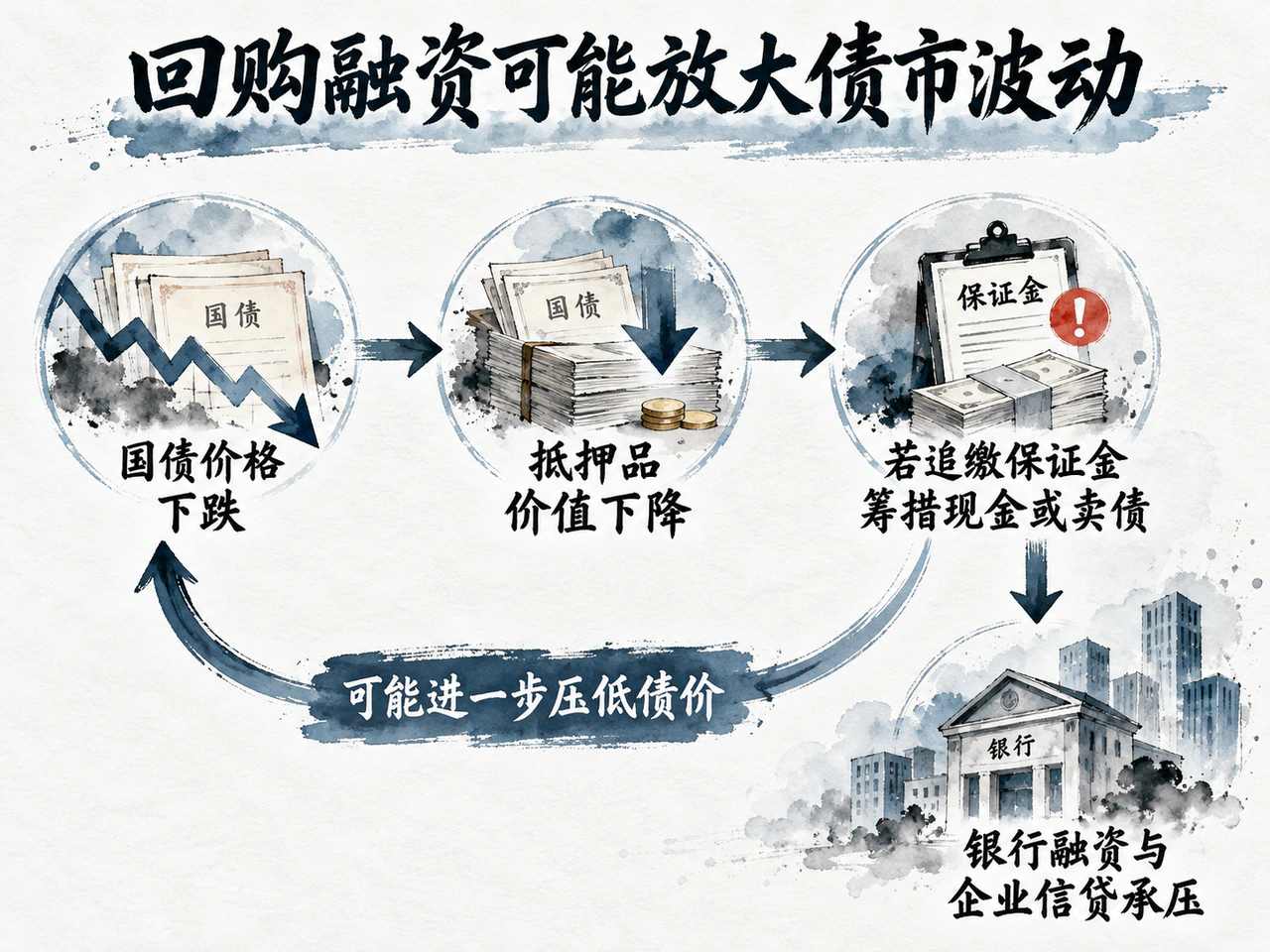
The transmission of soaring sovereign yields into the real economy proceeds mainly through three channels: bank-asset valuations, money-market funding and corporate credit.
On banks' asset side, fixed-rate sovereign bonds lose value as yields rise. When mark-to-market losses enter the income statement and consume regulatory capital depends on accounting classification, interest-rate hedges and whether bonds are actually sold. Unrealized losses on bonds measured at amortized cost do not directly reduce regulatory capital, but a sale at a discount realizes those losses. Falling French bank shares therefore primarily reflect pressure on earnings expectations and valuations, rather than an immediate, proportionate evaporation of regulatory capital.
Transmission through wholesale funding is often faster. Banks and nonbank financial institutions commonly borrow in repo markets against French government-bond collateral. Lower bond prices directly reduce the cash that a given quantity of bonds can raise. If counterparties simultaneously increase collateral haircuts or demand additional margin, holders must find cash or sell assets. In its June financial-stability report, the Banque de France explicitly warned that hedge-fund activity in French sovereign repo markets commonly involved high leverage, short-term funding and concentrated trades, making it liable to amplify volatility. If margin calls and forced liquidation are triggered, a bond decline originating in fiscal concerns can become a cash-raising, deleveraging and further-selling loop. Repo funding terms and actual forced position reductions therefore warrant close monitoring.
When the sovereign risk premium feeds into banks' own funding quotes or makes them manage their balance sheets more cautiously, businesses face higher rates on new loans, tighter credit limits and worse bond-issuance terms. Firms with weak cash flows, concentrated debt maturities and heavy dependence on French domestic bank credit are particularly sensitive. Weaker operations and capital spending then erode the tax base, feeding back into government fiscal pressure.
The effects also vary significantly by company type and exchange-rate channel. Overseas revenue can cushion slowing domestic demand for large French multinationals, but their parent-company funding, taxes and financial services remain constrained by conditions at home. Banks, domestic services companies and globally diversified industrial firms therefore face quite different revenue and financing constraints. Similarly, the euro's response to French bond selling depends on cross-border capital flows. Investors switching from French bonds into German or other euro-area bonds are still reallocating within the same currency. Additional depreciation pressure on the euro emerges only if risk spreads to confidence in the euro area as a whole, prompting reductions across currencies and foreign-exchange hedging.
5. France Remains in the Excessive Deficit Procedure: ECB Tools Address Market Disorder Rather Than Guaranteeing Fiscal Outcomes

Compared with the euro-area debt crisis of 2011–2012, the European Central Bank now has a more complete set of anti-fragmentation tools. The Transmission Protection Instrument (TPI), established in 2022, specifically addresses a deterioration in member-state financing conditions that is unwarranted by fundamentals and seriously threatens the transmission of common monetary policy.
In this episode, investors have fundamental grounds for demanding more compensation because of France's fiscal outlook. If margin calls and forced selling then produce a liquidity squeeze beyond what fundamentals justify, however, the situation could become a transmission disorder requiring central-bank assessment. Because fundamental repricing and liquidity dysfunction can coexist, the ECB cannot decide mechanically whether to activate TPI from a single yield or spread level.
TPI's fiscal eligibility test is not a simple rule that a deficit above 3% of GDP disqualifies a country. Under ECB rules, a country can enter the assessment if it is not subject to the EU's Excessive Deficit Procedure (EDP), or, if it is subject to that procedure, has not been judged to have failed to take effective action in response to corrective recommendations. The ECB then considers severe macroeconomic imbalances, debt sustainability, structural reforms and fiscal commitments before exercising its overall judgment on whether intervention is appropriate.
France's current compliance position sits on this delicate boundary. In June 2026, the European Commission found that France had taken effective action and decided to hold its excessive deficit procedure in abeyance, but did not close the procedure. The same document still assessed medium-term fiscal sustainability risks as high. Recognition of near-term corrective action can therefore coexist with concern about the medium-term debt trajectory. Meeting some procedural conditions does not automatically secure central-bank bond purchases.
Operationally, TPI has no preset purchase limit, but activation is entirely at the discretion of the ECB Governing Council. Purchases can be terminated if the council judges persistent selling to reflect a deterioration in the country's own fundamentals. Another tool, Outright Monetary Transactions (OMT), requires a formal assistance program involving institutions such as the European Stability Mechanism (ESM), with strict policy conditions. The ECB can therefore act to interrupt self-reinforcing panic, but it will not perform France's fiscal consolidation or guarantee cheap financing for any fiscal path.
History shows that credible policy commitments can substantially reduce panic-driven pricing. A 2014 ECB event study estimated that OMT-related announcements in 2012 lowered Italian and Spanish 2-year sovereign yields by about 200 basis points, while comparable French and German yields were essentially unchanged. Countries then suffering severe fragmentation in monetary-policy transmission were highly sensitive to intervention commitments. Because the severity of the crisis and country circumstances were different, that historical decline cannot simply be applied to France today.
The euro area has also established unified banking supervision, and the Banque de France's assessment this year found domestic banks' businesses diversified and their solvency and liquidity buffers still sound. These defenses reduce the likelihood that sovereign volatility rapidly becomes a banking crisis. Yet transmission links between sovereign financing, repo collateral and bank lending remain. A stronger central-bank toolkit improves the response to market disorder; France must ultimately restore fiscal sustainability through its own policy adjustment.
6. Institutions Disagree on Sovereign-Crisis Risk: Budget Execution, Spreads and Bank Funding Provide Three Signposts

Institutional disagreement over the French bond outlook centers on whether consolidation can actually be implemented and whether current asset prices adequately compensate for the risk.
In an October 19 interview, Mike Bell of RBC BlueBay Asset Management warned that France faced a real risk of a sovereign debt crisis, with the central concern being the difficulty of securing political authorization for necessary austerity. BlackRock's weekly commentary published the same day maintained a neutral view on French government bonds, arguing that elevated political and fiscal risks were already substantially reflected in prices and that conditions were unlikely to worsen materially. KBRA's head of sovereign ratings, Ken Egan, also noted that recent auctions continued to demonstrate solid underlying allocation demand.
These differences correspond to three separate constraints. The fiscal path determines long-term repayment capacity; secondary-market prices determine whether risk compensation is sufficient; and primary-market auctions and functioning financial intermediaries determine whether current financing can roll over smoothly. Assessing an escalation in French bond risk requires considering all three together.
First, can the 2027 budget secure political support that permits implementation, and if parliamentary compromises weaken some tax and savings provisions, can the government provide alternatives with equivalent fiscal effects? Second, does the France–Germany spread keep widening beyond earlier highs, and do subsequent auctions require greater price concessions? Third, does sovereign-bond pressure spread to bank bond funding, repo collateral terms and corporate lending rates? Crisis risk will rise materially if tightening financing channels and deteriorating budget credibility intensify together.
Conversely, if budget negotiations gradually produce a credible outcome and primary-market financing stays smooth, yields near 5% would more strongly represent an available risk premium. Actual bond returns would still depend on the common euro-area rate path and position duration. Even a narrowing France–Germany spread would not necessarily raise French bond prices if the overall European rate level continued moving higher.
France's immediate task is to use the buffer provided by an average debt maturity above 8 years to turn its deficit targets into a sustainable revenue-and-spending path. Bond markets have already begun charging for uncertainty over implementation. Whether France can prevent that financing bill from growing year after year will determine whether this pressure remains a repricing of country risk or further erodes its financial system and real economy.
Click Read Original for the full details.