By the morning of October 21 Beijing time, institutional digital-asset initiatives continued to extend into securities trading and corporate treasury management, with attention focusing on rules for on-chain securities and the boundaries of custody licensing. On October 20, Andrew Cuomo, co-chair of OKXICE, the proposed joint platform of OKX and Intercontinental Exchange, responded to objections from some listed companies to on-chain trading of their shares. The same day, disclosed details of corporate financial-services provider Ramp's application to the Office of the Comptroller of the Currency (OCC) for a national trust-bank charter drew market attention. Both developments show that expansion depends on turning custody, cross-market pricing, transmission of shareholder rights and regulatory status into workable arrangements.
16 listed companies oppose on-chain trading of their shares on OKXICE

CoinDesk reported that the number of issuers opposing trading of their shares on the proposed OKXICE platform had reached 16, with Microsoft, Alphabet and Goldman Sachs joining the list. Cuomo responded on October 20 that companies choosing to wait and see was consistent with the design of the experimental framework. Because the objections concern a particular venue, each issuer's position on other stock-tokenization arrangements still needs to be assessed separately.
According to OKXICE's public documents, the platform operates under a temporary conditional exemption and remains subject to SEC oversight; its trading mechanism differs from U.S. national securities exchanges. Its proposed design would allow accounts that pass identity and wallet verification to trade in liquidity pools. Third-party tokenization arrangements would require underlying shares to be held one-for-one and shareholder rights to be transmitted through the relevant institutions.
Concentrated issuer objections have changed the pace at which trading platforms can advance stock tokenization on their own. After proposing a trading model, a platform must explain to the market and issuers how on-chain prices connect with conventional securities markets, how investors receive dividends and voting rights, and who handles abnormal trading and corporate actions. Connecting on-chain trading with traditional securities requires consistency across custody, token issuance, trading and transmission of shareholder rights. A weak connection anywhere diminishes the practical value of round-the-clock trading, whose commercial appeal also depends on reliable asset backing and liquidity.
Issuer objections expose these disagreements before the platform expands and directly affect the range of tradable securities and institutional acceptance. More useful indicators than simply adding proposed stock names are changes in the objector list, adjustments to platform rules and institutional acceptance of the links between on-chain trading and conventional markets.
Ramp applies to the OCC for a national trust-bank charter
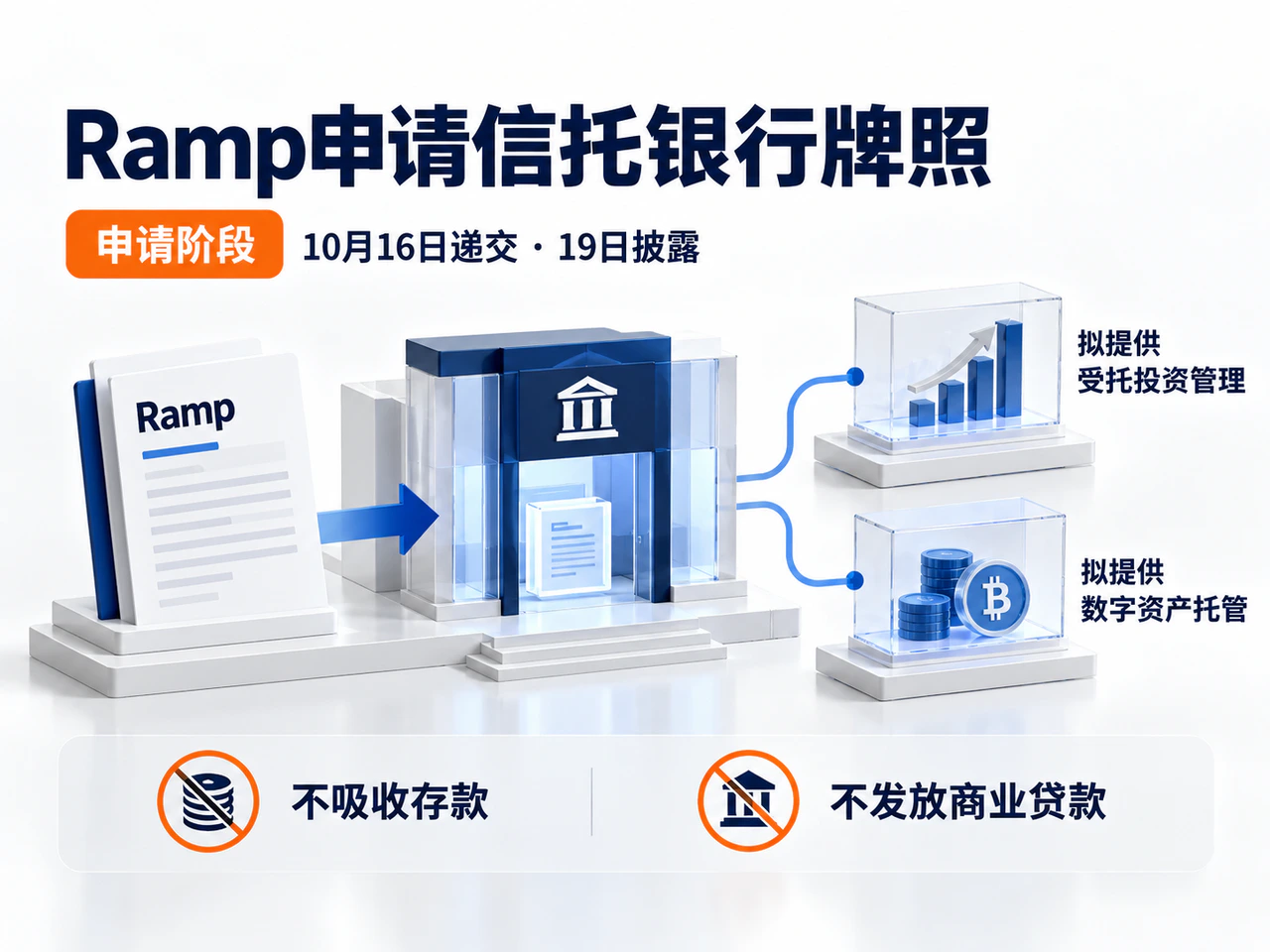
In corporate services, digital-asset custody is moving into treasury management. FinTech Futures and Banking Dive reported on October 20 that Ramp submitted its national trust-bank charter application to the OCC on October 16 and disclosed it on October 19. Under the application, the proposed entity would offer fiduciary investment management and digital-asset custody, without taking deposits or making commercial loans.
This scope directly connects with Ramp's existing corporate spend-management business. Companies managing cards, bills, procurement and funds need consistent links between safekeeping, authorized transactions and financial records if they incorporate digital assets into the same workflow. The application signals the provider's intention to integrate underlying custody into corporate financial products, although final arrangements remain subject to regulatory approval and implementation.
Industry debate over crypto firms seeking trust-bank charters continues. Banking Dive reported that the Independent Community Bankers of America sued the OCC this month, questioning the legal basis and regulatory requirements for certain crypto trust-bank charters. Digital-asset industry groups countered that restricting such charters would suppress competition. The dispute centers on permitted activities, regulatory burdens and competitive conditions among different institutions.
Taken together, recent developments in tokenized-stock platforms and corporate custody are assigning specific financial responsibilities: who safeguards underlying assets, who transmits shareholder rights, which clients may participate and which services require a license. Clearer arrangements make it easier for institutions to assess compliance costs and practical usability. The next phase of progress will therefore appear increasingly in executable rules and customer use, alongside new-product announcements.
Click Read Original for full details.