By the morning of October 21, Beijing time, diplomatic mediation and military deployments over Iran were proceeding together, but the sequence of lifting the blockade, restoring shipping and opening nuclear talks remained unresolved. Senior Pakistani military and civilian officials arrived in Tehran to mediate, and Qatar confirmed continued US-Iran contacts. Iran, however, insisted on lifting the port blockade, ending oil sanctions and achieving regional ceasefires as preconditions, and rejected transferring enriched nuclear material abroad. Meanwhile, the US continued sending a carrier strike group and Marines to the Middle East, while Tehran reiterated that any attack would meet a response of equivalent force.
US-Iran contacts continue on the sidelines; Tehran demands an end to the blockade and retention of nuclear material at home

Al Jazeera and Reuters, citing Iranian media, reported that Pakistani army chief Munir arrived in Tehran on October 20 with Interior Minister Naqvi, his fifth visit to Iran since the April ceasefire. Munir discussed mediation and regional conditions with President Pezeshkian and separately met Foreign Minister Araghchi and parliament speaker Qalibaf. Qalibaf said the US must first meet Iran's conditions, proposed the previous month, for reopening the Strait of Hormuz: lift the blockade of Iranian ports, remove sanctions on its oil exports and end hostilities on every regional front, before it could gain Tehran's trust.
Iran's position on the central nuclear question had not softened. Supreme National Security Council secretary Rezaei stressed that all enriched nuclear material would remain in Iran and reiterated that negotiations would not begin before Iranian conditions were met. Foreign Ministry spokesman Baghaei also said that day that Iran had not begun nuclear talks with the US, so there were no details to discuss with Russia or other countries. He nevertheless said Iran would keep pursuing diplomacy as long as it offered a chance to prevent escalation.
At the Global Security Forum in Doha, Qatari Foreign Ministry spokesman Ansari confirmed that US-Iran negotiations were continuing and both sides remained in contact. Qatar's statement did not contradict Iran's denial that nuclear talks had begun: they referred to different levels and subjects of engagement. Communication remained at the stage of conveying proposals and coordinating ceasefires, with concrete implementation arrangements still separating it from substantive nuclear negotiations. Iran demanded that Washington address the blockade and security guarantees first, while the destination of enriched material touched one of the hardest areas for compromise. Further mediation depended on turning these demands into commitments executable in stages.
Mine threats persist in Hormuz; Iran's temporary route has no IMO approval
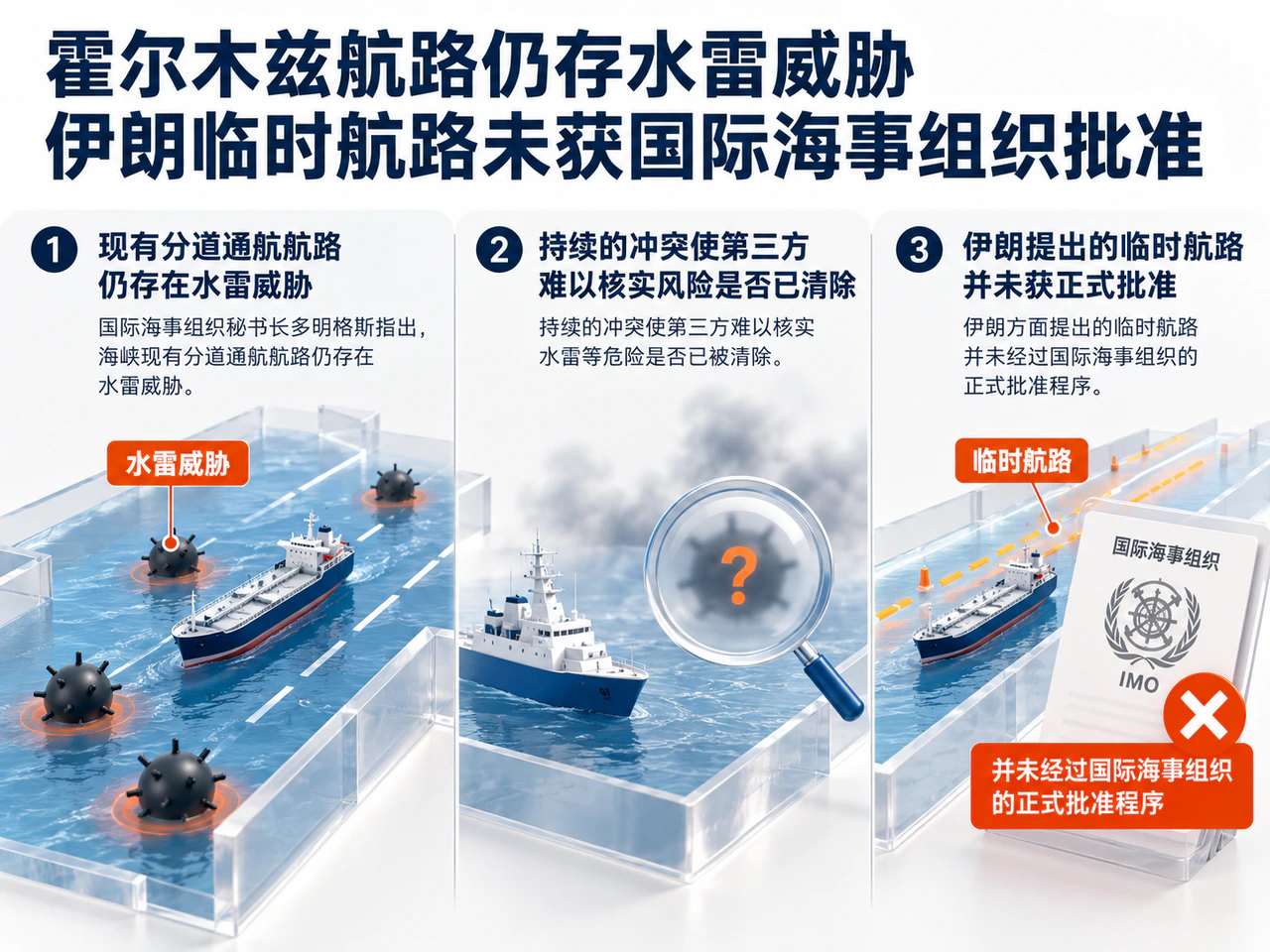
Beyond political bargaining, reopening the Strait of Hormuz faced practical navigation-safety obstacles. In an interview published by Fox News on October 20, International Maritime Organization secretary-general Dominguez said mine threats remained in the existing traffic-separation lanes and continuing conflict made it difficult for third parties to verify whether hazards had been cleared. Iran's proposed temporary route had also not gone through the IMO's formal approval process.
Even a political agreement to reopen the strait would therefore leave substantial practical work before normal merchant shipping could resume. Route-compliance confirmation, hazard removal and shipowners' safety assessments all require executable arrangements. Diplomatic progress can improve expectations, but the speed of transport recovery depends on when those safety and technical conditions are fulfilled.
US carrier rotation moves toward the Middle East; Iran reiterates proportional retaliation as Yemen mediation stalls
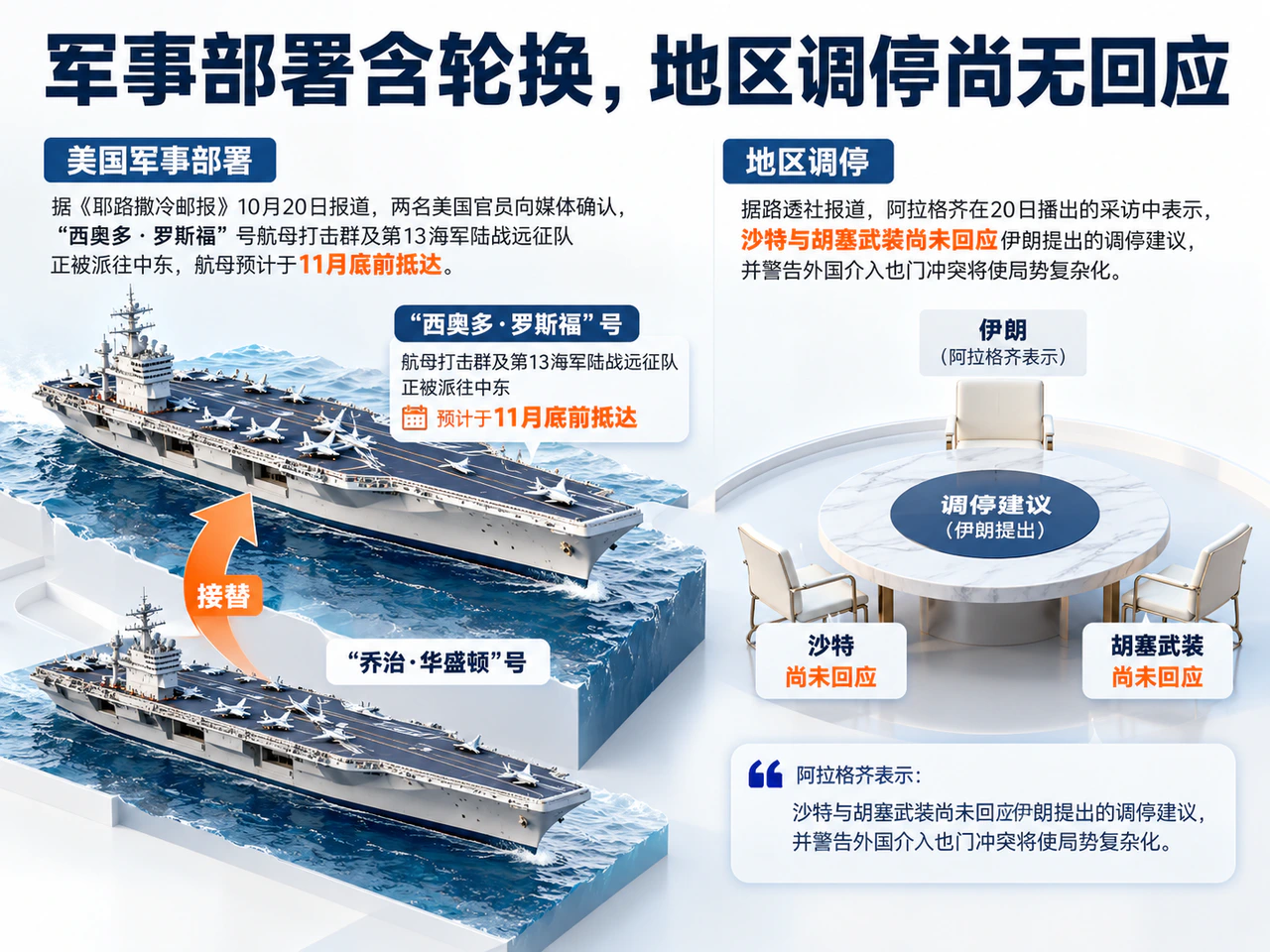
Military preparations and deterrence did not cool while diplomacy continued. The Jerusalem Post reported on October 20 that two US officials confirmed the Theodore Roosevelt carrier strike group and 13th Marine Expeditionary Unit were being sent to the Middle East, with the carrier expected to arrive before the end of November. Citing the US Naval Institute, the report said it would replace the George Washington. The deployment included a rotation while preserving Washington's military options; its eventual force size and operational use depended on subsequent deployments.
Tehran responded to US military movements mainly through deterrent statements. Asked about a possible US strike on the Pickaxe Mountain facility, Baghaei said any attack would receive a response of at least equal force and denied any arrangement under which Iran would acquiesce without retaliation. Each side retained negotiating channels while using military signals to raise the other's cost of force or delay.
The Yemen stalemate further complicated coordination. Reuters reported that Araghchi said in an interview broadcast on the 20th that Saudi Arabia and the Houthis had not responded to Iran's mediation proposal, warning that foreign intervention in Yemen would complicate matters. Qatar also advocated simultaneous de-escalation across conflict fronts. With regional ceasefires included in Iran's negotiating demands, results from US-Iran engagement also depended on choices by Saudi Arabia, the Houthis and others. Progress through a single channel could not resolve this interlocking set of issues alone.
Key developments

| Key developments (Beijing time) |
|---|
| 10-21 05:41Reuters reported that Iranian Foreign Minister Araghchi said in an interview broadcast on the 20th that Saudi Arabia and the Houthis had not responded to Iran's mediation proposal, warning that foreign intervention in Yemen would complicate the situation. |
| 10-21 02:26Fox News published an interview with IMO secretary-general Dominguez: existing Hormuz traffic-separation routes still faced mine threats, and Iran's proposed temporary route had not received formal IMO approval. |
| 10-21 01:06Reuters, citing Iranian media, reported that Pakistani army chief Munir met Iran's president, foreign minister and parliament speaker. Qalibaf demanded that the US first meet conditions for reopening the strait; Rezaei stressed that enriched nuclear material would remain inside Iran. |
| 10-20 23:50The Jerusalem Post cited US officials as saying that the Theodore Roosevelt carrier strike group and 13th Marine Expeditionary Unit were being sent to the Middle East, with arrival expected by late November. US Naval Institute information said the carrier would replace the George Washington. |
| 10-20 22:39Al Jazeera reported Munir's arrival in Tehran, his fifth visit to Iran since the April ceasefire, accompanied by Pakistani Interior Minister Naqvi. |
| 10-20At Doha's Global Security Forum, Qatari Foreign Ministry spokesman Ansari confirmed continued US-Iran contacts and advocated simultaneous de-escalation across regional conflict fronts. |
| 10-20Iranian Foreign Ministry spokesman Baghaei said any US attack would receive a response of at least equal force. He denied that nuclear talks had begun with the US while emphasizing continued diplomacy to prevent escalation. |


