As of October 21, the latest Reuters poll showed that 54 of 78 economists expected the Bank of Japan to raise its policy rate from 1.25% to 1.50% by the end of this quarter. For global investors holding dollar bonds or borrowing in dollars, this shift in Japan's interest-rate environment had implications far beyond the timing of the next increase.
Japan is the largest foreign holder of U.S. Treasuries. When an economy that has long exported savings and supplied low-cost funding for international financial transactions raises its required domestic return, the benchmark for comparing global capital allocations changes. Even if U.S. growth, inflation and Federal Reserve expectations remain unchanged, an improvement in Japanese government bonds' relative returns after currency hedging and risk adjustments may force Treasuries to offer higher yields to attract buyers.
This repricing first appears in marginal capital flows: where new money goes, whether maturing investments are rolled over, and how much compensation investors demand to hold long-dated dollar bonds. If the yen strengthens at the same time, it directly changes the currency return on dollar assets, forcing institutions to adjust hedges and leveraged positions. Treasuries, dollar credit and the dollar exchange rate thus face different repricing pressures, ultimately affecting government and corporate financing costs around the world.
1. Japan's 10-year yield approaches 3%: how global allocation demand affects the U.S. long-end term premium

The sustained recovery in Japanese long-term rates is reshaping relative value in global bond markets. On the official end-of-day yield curves for October 20, nominal Japanese 10- and 30-year government yields, before currency-hedging costs, reached 2.927% and 3.992%, respectively; equivalent U.S. Treasury yields were 5.12% and 5.42%. Compared with January 5, the year's first common trading day, Japan's 10-year yield had risen approximately 82 basis points and the U.S. yield 95 basis points. Although both countries' long yields had declined from the start of October, their much higher year-to-date levels remained intact. For long-term allocators, a Japanese 10-year yield near 3% and a 30-year yield near 4% offered a domestic income option fundamentally different from the zero-rate era.
In pricing terms, Treasury yields can be divided into expectations of future short-term rates and the term premium investors require for bearing long-term interest-rate volatility. Federal Reserve policy directly drives the former; global savings allocations, bond supply and the market's ability to absorb risk jointly determine the latter.
Bond and currency markets usually trade ahead of policy expectations. If a Bank of Japan increase merely delivers an already priced path, the incremental impact on the announcement day is often limited. Institutions instead tend to rebalance gradually as insurance premiums arrive, bonds mature and annual allocation plans unfold. Policy changes that depart from expectations, unexpectedly high inflation or bond-supply shocks are more likely to trigger immediate repricing. Economists' surveys outline the broad direction of policy; the force of the market response depends on the gap between the eventual outcome and existing prices.
Assuming U.S. bond supply and the monetary-policy path are unchanged, more attractive Japanese bonds may draw some new insurance premiums, pension cash flows and maturity proceeds that would otherwise have gone into Treasuries. Global bond funds outside Japan will also reassess allocations between the two markets. Marginal crowding out therefore extends beyond the repatriation of Japanese money: Japanese bonds' competitiveness within the global pool of capital has changed.
The Treasury market can find replacement buyers, but their willingness to pay and constraints differ markedly. Commercial banks face capital and liquidity requirements; mutual and hedge funds face duration, drawdown and position limits; institutions also have different liability currencies and maturity preferences. When marginal demand weakens at the existing yield, Treasury prices must fall until higher yields attract replacement capital. Because markets often trade ahead of this expectation, repricing usually precedes large net sales in official statistics.
Even with unchanged expectations for U.S. short-term rates, higher Japanese rates can therefore depress Treasury prices by raising term premiums, imposing mark-to-market losses on existing holders and increasing borrowing costs for the U.S. Treasury and companies issuing or refinancing debt. Even if other favorable factors strengthen Treasuries, the Japanese counterweight can limit how far their yields decline.
The market on December 20, 2022 provides a clear historical reference. The Bank of Japan kept its short-term policy rate at -0.1% but widened the permitted fluctuation band for the 10-year government yield. Japan's official 10-year yield jumped 15 basis points that day. The U.S. 2-year yield remained at 4.25%, while both the 10- and 30-year yields rose 12 basis points. Although a single day's moves also incorporate other information, the divergence between a steady short end and rising long yields clearly illustrated transmission from Japanese policy to global long-term rates.
An International Monetary Fund study provides cross-country empirical support. Using high-frequency price changes around 151 Bank of Japan meetings in 2010–2023 and distinguishing bond-purchase shocks from forward-guidance shocks, it examined sovereign markets in 38 economies. It found that Japanese bond-purchase policy significantly affected U.S. term premiums, with an especially pronounced immediate response in Treasuries that subsequently faded. Overseas bond markets with greater Japanese investor participation experienced stronger spillovers. The transmission strength of the present round of conventional rate increases, however, depends on today's different positions, bond supply and market conditions.
2. September return comparisons favor Japanese bonds; Japan sold short maturities and bought long ones in August as institutions diverged
The rising opportunity cost of dollar assets ultimately depends on genuinely comparable returns after currency treatment. For a dollar investor buying Japanese bonds without a currency hedge, total return depends on both the bonds' own return and the yen. A hedged investor must convert future yen receipts into dollars at a forward exchange rate. Japanese institutions buying Treasuries face the mirror image of this mechanism.
Currency forwards mainly reflect short-term interest-rate differentials but can deviate from theoretical parity because of dealers' funding supply and demand, capital usage and bid-ask spreads. When dollar short rates exceed yen rates, a dollar investor buying yen assets and fixing the forward conversion back into dollars can usually earn an additional return from the forward discount. Conversely, a Japanese investor buying dollar assets and hedging conversion back into yen must pay substantial hedging costs.
A Bank of Japan short-rate increase therefore creates two opposing forces. It raises the cost of borrowing yen to invest in dollar assets, while narrowing the U.S.–Japan short-rate differential reduces Japanese institutions' currency-hedging costs on dollar bonds. It also reduces the forward-return enhancement available to dollar-based funds buying and hedging Japanese bonds.
The rise in Japan's long yields thus becomes crucial to the strength of asset substitution. For a dollar fund using rolling short-term currency hedges, the approximate return on Japanese bonds can be understood as their yield to maturity plus the U.S.–Japan short-rate differential, adjusted for actual cross-currency funding costs. From the perspective of new allocations, assume the dollar yield curve, cross-currency funding costs and other risks remain unchanged. If Japan's long yield rises 50 basis points and its short rate rises 25 basis points, the approximate dollar-hedged holding yield improves by about 25 basis points relative to dollar bonds. If both rise 25 basis points, the higher long yield and lower forward-hedging enhancement roughly cancel out. This relative-value shift can arise entirely from Japan's own yield curve, without a Federal Reserve increase.
These calculations describe only approximate current return conditions for new money. Existing holders first suffer mark-to-market bond losses when rates rise. Short-term currency hedges must also be rolled at new market prices, so today's hedging cost does not lock in a decade's total return. Moreover, if Japanese long yields rise mainly because of fiscal expansion or growing inflation risk, the higher nominal yield itself includes compensation for additional risk.
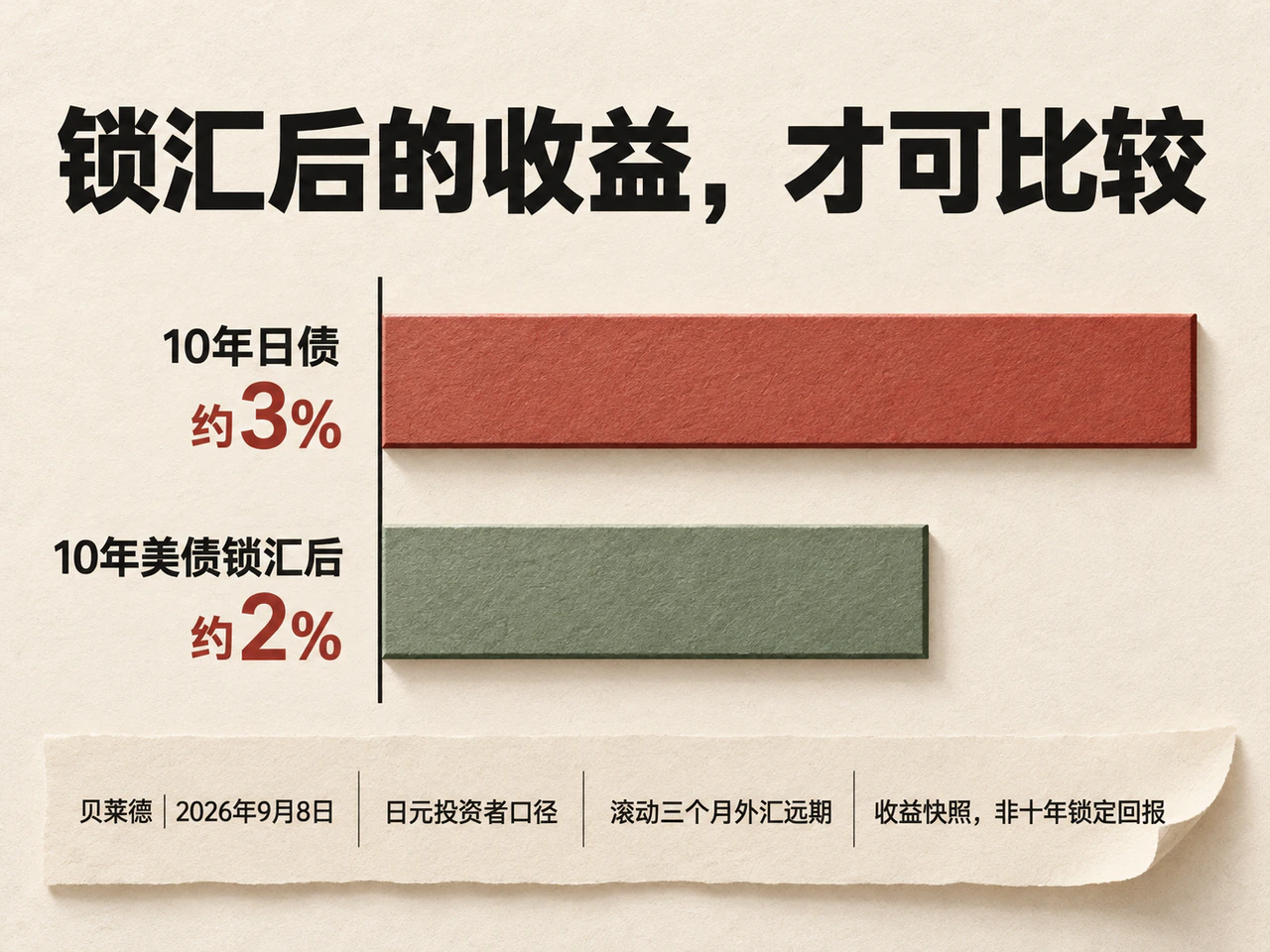
Even allowing for these constraints, the yield inversion between Japanese bonds and hedged Treasuries has practical significance. BlackRock research dated September 8 showed that, from a yen investor's perspective, Japan's 10-year yield was then around 3%, while the yield on 10-year Treasuries hedged through rolling three-month currency forwards was only about 2%. This comparison changes with bond prices and hedging costs, but domestic long bonds were already competing meaningfully with hedged dollar bonds.
Institutions' differences in this environment mainly concerned the pace of rebalancing and their risk tolerance. BlackRock identified recovering Japanese yields as a key variable for marginal Treasury demand. A Reuters institutional survey in September, however, found some investors still worried that further Japanese yield increases would create unrealized losses and preferred to wait for a clearer entry point. Existing portfolios must balance liability-duration matching, risk limits and routine cash-flow needs.
Treasury International Capital data released on October 16 likewise showed structural divergence rather than an indiscriminate Japanese selloff of Treasuries. In August, Japan's total Treasury holdings declined from $1.104 trillion in July to $1.068 trillion, with market-value changes including price revaluation. By maturity, however, Japan actually made net purchases of $11.858 billion in long-term Treasuries, defined as securities with original maturities exceeding one year, while reducing Treasury-bill holdings by $48.878 billion, estimated from month-end position changes and including maturities not reinvested. Over January–August, cumulative net purchases of long-term Treasuries were $389 million, essentially flat, while bill holdings shrank approximately $107.9 billion. Lower total holdings thus did not correspond to large net sales of long-term Treasuries. Net transaction data record only settled purchases and sales. The key to assessing crowding out in marginal Treasury pricing remains the yield Japanese money requires to keep buying and whether new purchases have slowed.
Trading differences among Japanese institutions reinforce this picture. In April–September, among institutions designated to report to Japan's Ministry of Finance, banks and other deposit-taking institutions net disposed of approximately ¥7.17 trillion in overseas medium- and long-term bonds, covering foreign bonds across countries and currencies and including redemptions. Trust accounts, by contrast, made net purchases of approximately ¥10.02 trillion, leaving all institutions combined as net buyers. Life insurers' yen liability-matching needs, commercial banks' capital constraints and pension funds' allocation rules can produce opposite overseas trading directions during the same Japanese tightening cycle.
From the broader balance-of-payments perspective, Japan's global supply of capital is also being redistributed across asset classes. At the end of June, Japan's net external assets totaled ¥561.09 trillion. External debt-security assets were approximately ¥370.20 trillion, alongside direct investment, equities, loans and foreign-exchange reserves. Retained earnings of Japanese companies' overseas subsidiaries count as Japanese investment income but can remain abroad for reinvestment. Japanese national savings can therefore continue financing global production and operations while new money allocated to particular dollar bonds declines.
3. Yen appreciation can hit leveraged carry trades far harder than a single rate increase and trigger different rebalancing responses
Beyond repricing interest-rate differentials, yen strength directly alters dollar assets' local-currency returns. For unhedged holders measuring wealth in yen, even rising dollar-bond prices may fail to offset currency losses.
For an unleveraged example, suppose a dollar bond earns a 3% dollar total return over a holding period while USD/JPY falls from 150 to 142.5, a 5% decline in the quote. The yen return becomes a loss of 2.15%, calculated as 1.03 times 0.95 minus 1. If the dollar bond itself falls 4%, the same currency move widens the yen-denominated loss to 8.8%.
Institutions with different objectives respond very differently to currency losses. Selling Treasuries and converting the proceeds into yen reduces both Treasury holdings and dollar currency exposure. Retaining the bonds while adding forwards that sell dollars and buy yen reduces only currency exposure, without directly generating spot Treasury selling. For fully hedged positions, the translation loss on dollar assets is broadly offset by forward gains; attention shifts to bond-price changes, roll costs and alternative-asset returns. Pensions following fixed allocation weights may even move in the opposite direction: yen appreciation reduces the yen market value of foreign assets, pushing their portfolio weight below target and prompting purchases to rebalance. Whether yen strength causes selling or buying therefore depends on whether the holder prioritizes yen accounting profit and loss, currency exposure or portfolio weights.
Highly leveraged carry accounts borrowing yen to hold unhedged dollar assets, by contrast, face hard liquidation constraints. Yen debt principal and interest are fixed obligations, so a reduction in the yen value of dollar assets directly erodes equity. Carry accrues slowly over time, while currency swings can erase months of interest income within a short period.
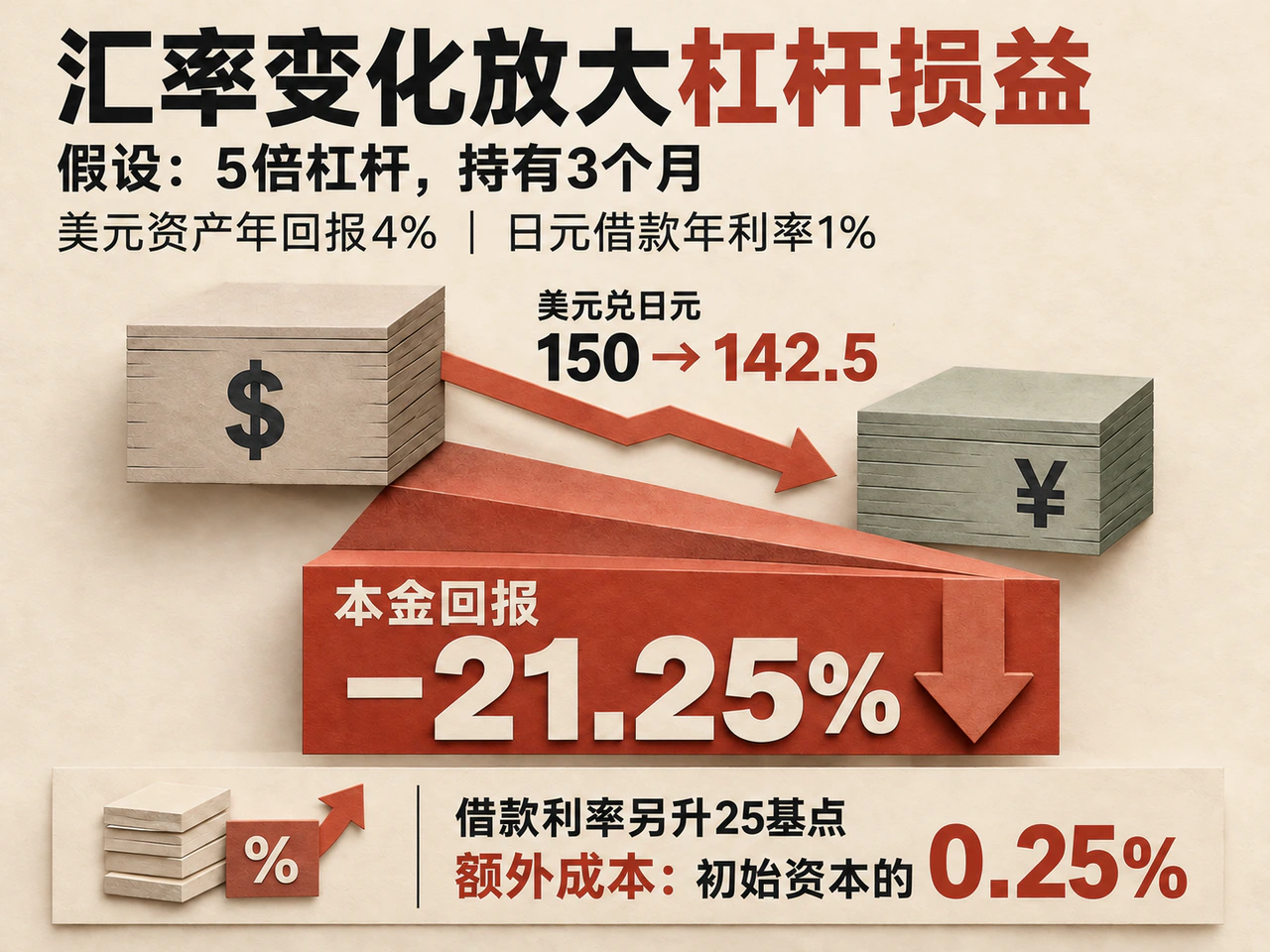
A hypothetical quarterly example illustrates the difference in scale. Suppose an investor combines ¥3 million of equity with ¥12 million of borrowing to build a ¥15 million portfolio, five times equity, invested in dollar assets earning 4% annual simple interest. Yen borrowing costs 1% annually and the holding period is three months. If USD/JPY falls from 150 to 142.5, conversion and debt repayment at quarter-end leave equity of ¥2.3625 million, a quarterly principal loss of 21.25%. By comparison, increasing the annual yen borrowing rate by 25 basis points for the entire quarter adds only ¥7,500 of interest, just 0.25% of initial equity.
In this example, the damage from currency movement vastly exceeds the direct additional interest cost of a single rate increase. If the underlying dollar assets also fall, or surging volatility prompts lenders to raise margin requirements, leveraged accounts must sell assets and buy yen to repay debt. That yen buying can push the currency higher, intensify other unhedged accounts' losses and create a deleveraging spiral.
The resulting selling pressure on global bonds depends on where carry positions are actually held. Yen carry trades span Treasuries, credit, equities and high-yielding currency assets, with many positions established directly through currency forwards and futures. Their unwind often creates cross-asset and cross-market shocks. Potential liquidation volumes cannot simply be inferred from Japan's total external assets.
4. Safe-haven buying may cushion Treasury selling, while dollar credit and MBS face wider spreads and duration extension
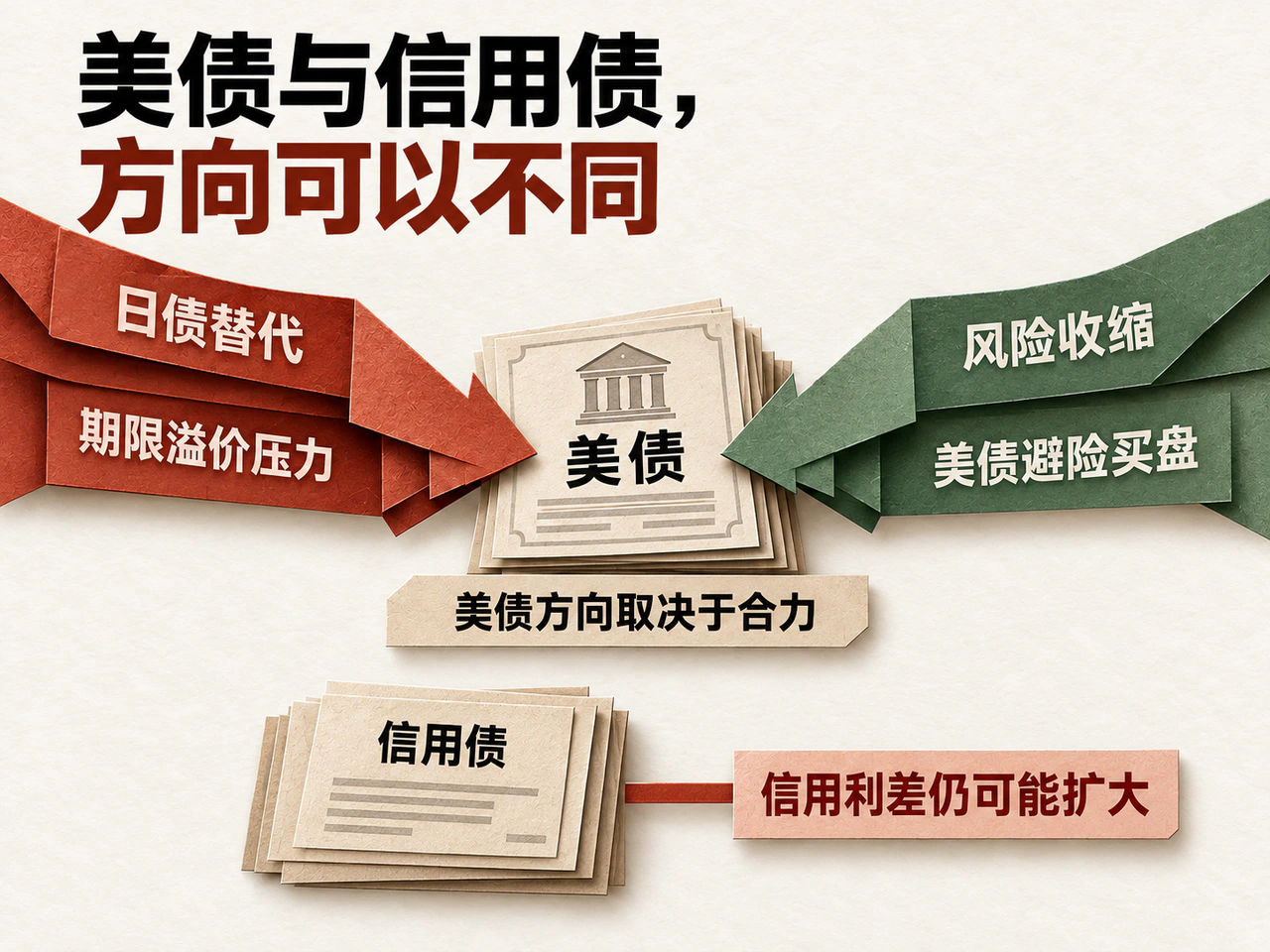
When rising Japanese rates interact with currency volatility, Treasuries and dollar credit may move in very different directions. Substitution into Japanese domestic assets weakens demand for Treasury duration, but a global retreat from risk triggered by a sharp yen rise can stimulate safe-haven Treasury buying. The balance between these forces determines the final direction.
The turbulence of August 2024 is a classic case in which the safe-haven effect prevailed. A hawkish Bank of Japan increase in late July, a sharply stronger yen and subsequently weaker-than-expected U.S. payroll data led markets to mark down growth and rate expectations together. Carry unwinds amplified global equity and currency volatility, yet government yields generally fell across major advanced economies. The Bank for International Settlements recorded a 26-basis-point fall in the U.S. 2-year yield on August 2 that year, as stronger rate-cut expectations, safe-haven inflows and short covering jointly lifted Treasury prices.
This contrasts sharply with December 2022. A stand-alone repricing of Japan's long end often lifts long Treasury yields. But if Japanese policy changes coincide with weakening U.S. growth and global deleveraging, larger safe-haven and rate-cut buying can dominate even when some yen-funded accounts are forced to sell Treasuries.
Dollar corporate bonds face a tougher two-part pricing constraint. Their yields combine the equivalent Treasury benchmark with credit and liquidity premiums. If the external shock mainly makes global long-term risk-free funding more expensive, rising benchmark yields directly depress fixed-rate corporate prices. If financing conditions also tighten, investors demand wider credit spreads; simultaneous increases in benchmark yields and spreads significantly raise corporate financing costs. Even when recession trading drives Treasury yields lower, credit spreads often widen sharply. Long investment-grade bonds, which are more sensitive to duration, may benefit from lower benchmarks. High-yield companies and vulnerable emerging-market issuers, heavily dependent on operating cash flow and refinancing access, can still suffer falling bond prices and impaired issuance during a Treasury rally.
In U.S. housing finance, rising rates can also create negative feedback through prepayments. Higher market rates reduce households' incentive to refinance or repay mortgages early. Agency mortgage-backed securities receive cash flows more slowly, mechanically extending their effective duration. Institutions tightly managing duration must then sell Treasuries or hedge with interest-rate swaps, amplifying long-end volatility. Agency MBS have very low credit risk, but their tendency to extend as rates rise prevents them from being simple equivalents to Treasuries. The extent of amplification depends on prevailing positions and hedging needs.
For global dollar-bond investors, the central assessment has two parts: whether Japan's rate changes raise the term compensation required to hold dollar duration, and whether they erode borrowers' credit quality and market liquidity. The first determines the level of risk-free benchmark rates; the second determines the additional risk premium credit assets must pay above them.
5. Keeping bonds and hedging currency can weaken the dollar while Treasuries rise; narrower nominal yield gaps do not guarantee a stronger yen
Yen appreciation directly means a lower USD/JPY exchange rate, but the broad dollar index and dollar moves against other currencies require separate analysis. For non-U.S. borrowers worldwide, debt-service pressure depends on the dollar's price relative to their local-currency income, rather than its value against the yen.
When yen carry unwinds coincide with a contraction in global dollar debt, yen-funded accounts urgently need yen while dollar borrowers urgently need dollar cash. Both demands can coexist, often strengthening both currencies against risky and emerging-market currencies. A company with local-currency revenue and dollar liabilities can face a heavier actual debt burden even as USD/JPY falls sharply, so long as its own currency depreciates against the dollar.
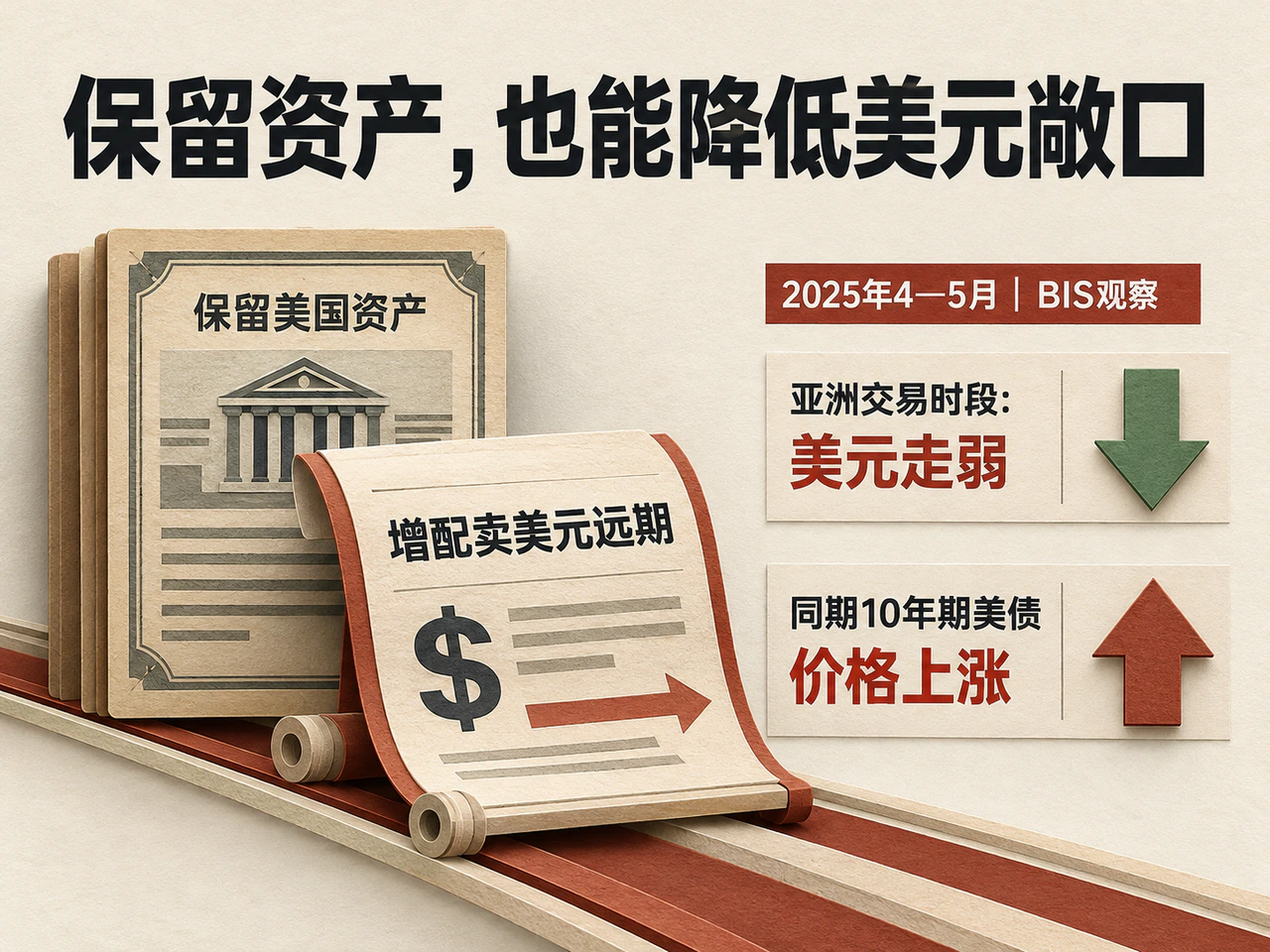
International investors can also manage dollar currency exposure separately from Treasury exposure. BIS research on April–May 2025 found that some non-U.S. institutions retained U.S. assets while increasing currency hedges. Spot dollar losses were concentrated in Asian trading hours, when 10-year Treasury prices actually rose. The microeconomic mechanism is that, after institutions sell dollar forwards, dealers hedge their own risk by selling dollars in the spot market. This depresses the currency without requiring Treasury sales. It offers a middle course for rebalancing: retain Treasury coupon income while removing dollar currency risk. If expectations of yen appreciation strengthen, Japanese institutions may likewise keep their bonds and hedge the currency, supporting retained investment in Treasuries while hedge-related selling weighs on the dollar.
A weaker spot dollar does not necessarily imply easier dollar cash funding. Dollar funding costs depend not only on Federal Reserve rates but also on dealer balance-sheet capacity, FX swap pricing and collateral terms. A Japanese institution hedging dollar assets through FX swaps is, economically, borrowing term dollars against yen collateral. Currency hedging and dollar cash funding use the same dealer funding and risk capacity. If hedging demand surges while intermediary balance sheets are constrained, swap-implied dollar funding costs may rise sharply despite a weaker currency. However, BIS follow-up research on April 2025 explicitly found no signs of dollar funding stress then: dealers absorbed much of the demand through internal matching and risk management. In more extreme conditions, a surge in hedging orders alongside shrinking intermediary risk capacity could produce a weaker spot dollar and more expensive dollar funding at specific maturities. Selling Treasuries for dollar cash, selling dollars for yen, and retaining Treasuries while adding currency hedges therefore have very different market consequences.
Conversely, the reason Japan's long yields rise also determines whether yen appreciation can last. Credible monetary normalization that improves real returns supports the yen. If higher long yields mainly reflect fiscal concerns or fears of uncontrolled inflation, investors may demand larger Japanese risk premiums while cutting yen exposure. The IMF's Japan country report in April documented this phenomenon: after mid-2025, the yen continued depreciating even though the U.S.–Japan nominal 10-year yield gap narrowed by more than 100 basis points. Assessing Japan's effect on the dollar therefore requires distinguishing policy paths, term premiums and currency risk. A narrower nominal sovereign-yield gap alone does not establish that capital must flow into yen.
At a deeper level, the dollar's international role rests on institutions independent of any single interest-rate move. Trade invoicing, cross-border bank credit, eligible collateral systems and central-bank crisis liquidity arrangements jointly create its network effects. More attractive Japanese bonds can change marginal global allocation weights, but deeper substitution within dollar funding depends on the evolution of that underlying infrastructure and market functionality.
6. Sovereign refinancing and $14.7 trillion in offshore credit: transmission to financing in the global real economy
Japan's renewed increase in required long-term returns coincides with a major debt-rollover cycle for sovereign and corporate issuers. The OECD estimated central-government marketable gross borrowing in its member countries at approximately $17 trillion in 2025, of which $13.5 trillion, nearly four-fifths, refinanced existing debt. The daily test for global bonds is not merely absorbing new fiscal deficits, but the rates at which vast amounts of maturing debt can be renewed.
The buyer base for sovereign debt has also changed profoundly. Across the United States, euro area and Japan combined, OECD data show domestic central banks' share of government-bond holdings fell from approximately 30% in 2021 to approximately 20% in 2025. Although the Federal Reserve ended balance-sheet runoff in December 2025 and major central banks now follow different balance-sheet paths, price-sensitive private investors have taken a greater role in marginal sovereign pricing than during the pandemic.
Different dimensions of financing conditions continue to pull against one another. In its Global Financial Stability Report released October 13, the IMF said that, after the first quarter, support from corporate valuations outweighed the tightening effect of rising rates. Overall global financial conditions remained accommodative, though some emerging markets faced substantial pressure. Higher Japanese rates operate within that broader pricing framework: they raise the return threshold for some international capital to keep buying dollar bonds, while improving corporate earnings, buyers elsewhere and risk appetite provide a cushion.
Existing fixed-rate government coupons do not immediately reset when market yields rise. Rate pressure therefore feeds gradually into U.S. fiscal spending through new issuance, refinancing and floating-rate debt. If fiscal authorities increase the Treasury-bill share to lower current interest costs, they shorten debt duration and expose future budgets more frequently to new market rates.
Global companies face similarly urgent rollover repricing. Higher sovereign yields raise corporate benchmarks directly, so new debt costs more even if credit spreads stay low. OECD data show that 65% of global nonfinancial companies' investment-grade bonds maturing in 2026–2028 have coupons no higher than 4%. As debt issued in the low-rate era matures in concentration, companies must reassess interest coverage, free cash flow and returns on capital expenditure. In capital-intensive industries with long payback periods, including property, infrastructure and energy pipelines, higher long-term discount rates directly reduce project values and raise hurdle rates. If borrowing costs rise mainly because external funding supply contracts and term premiums increase, rather than stronger real demand and productivity, companies lack revenue growth to absorb the financial cost and are more likely to postpone marginal capital spending and capacity expansion.
In trade and industry, yen appreciation also increases Japan's purchasing power for foreign goods and services and reshapes international competition through relative export prices. Specific effects depend on companies' overseas production footprints, procurement currencies and final pricing power. Financial assets reprice much faster than factories and supply chains can relocate. Japanese rate and currency changes therefore first affect global financing prices and risk allocation, then gradually reach real investment and international trade.
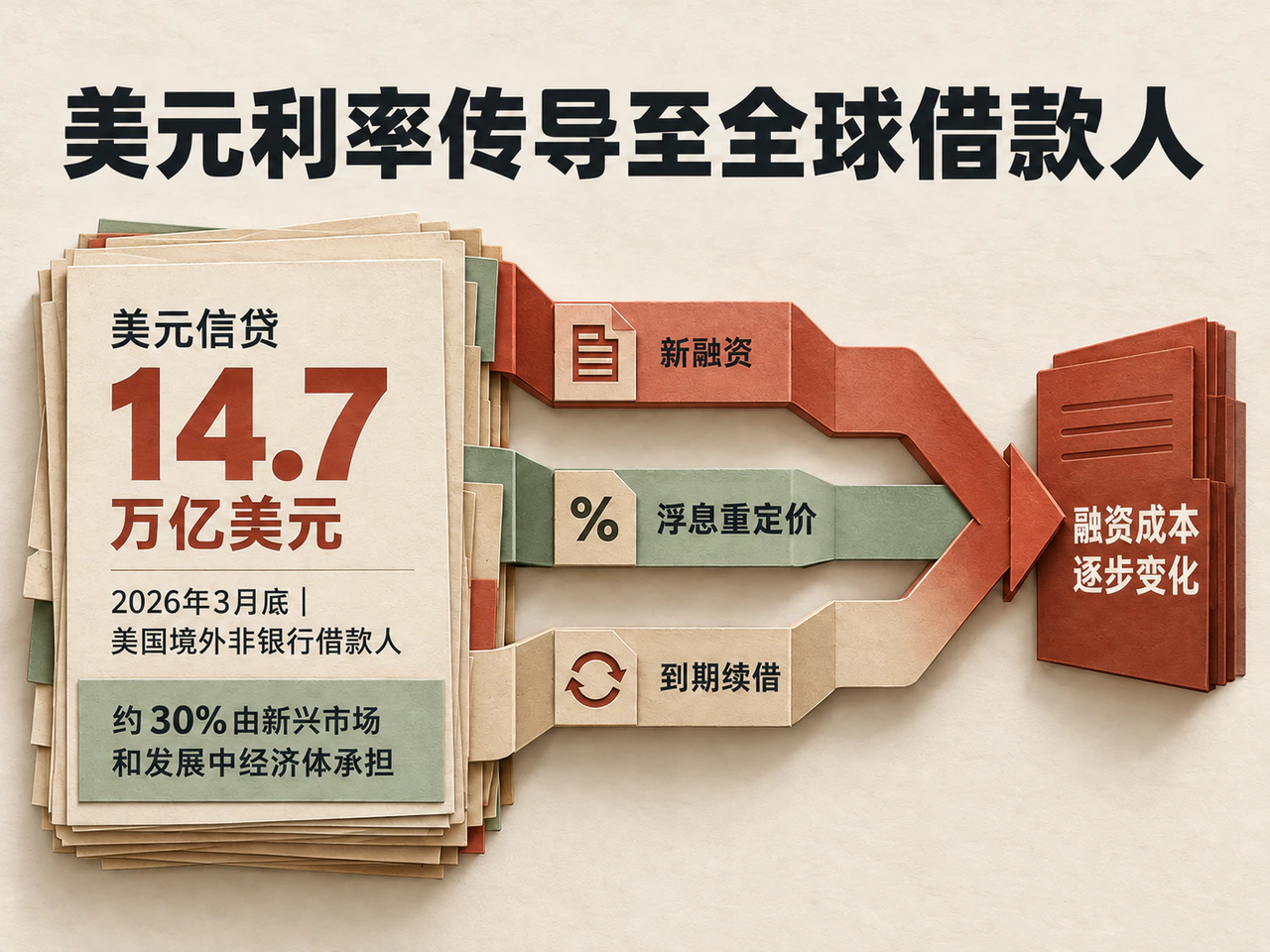
This chain extends far beyond the United States. BIS data put dollar credit to nonbank borrowers outside the United States, including bank loans and international bonds, at $14.7 trillion at end-March 2026; approximately 30% was owed by borrowers in emerging-market and developing economies. A higher dollar yield curve gradually enters offshore financing quotes and balance sheets through new borrowing, floating-rate resets and refinancing. Borrowers with local-currency income, dollar liabilities and concentrated near-term maturities can face a triple squeeze from higher benchmarks, wider credit spreads and local-currency depreciation. Those with substantial dollar revenue, longer debt duration or effective currency hedges are more resilient. Global allocation funds increasing low-risk yen-asset weights may also reassess emerging-market local-currency bonds, affecting local rates and currencies even where issuers have no dollar debt.
Global capital allocation consequently applies stricter tests to maturity profiles, credit quality, liquidity and revenue currencies. Japanese rate normalization intensifies competition for long-term global funding. Which countries and companies ultimately pay higher risk premiums depends on whether stable cash flows and resilient balance sheets withstand the high-rate environment.
7. Yen futures are now net long 50,000 contracts: three scenarios and three sets of indicators for the new equilibrium
Looking ahead, the key to judging the global impact of Japanese normalization is identifying the combination of macroeconomic conditions and trading behavior through which it unfolds.
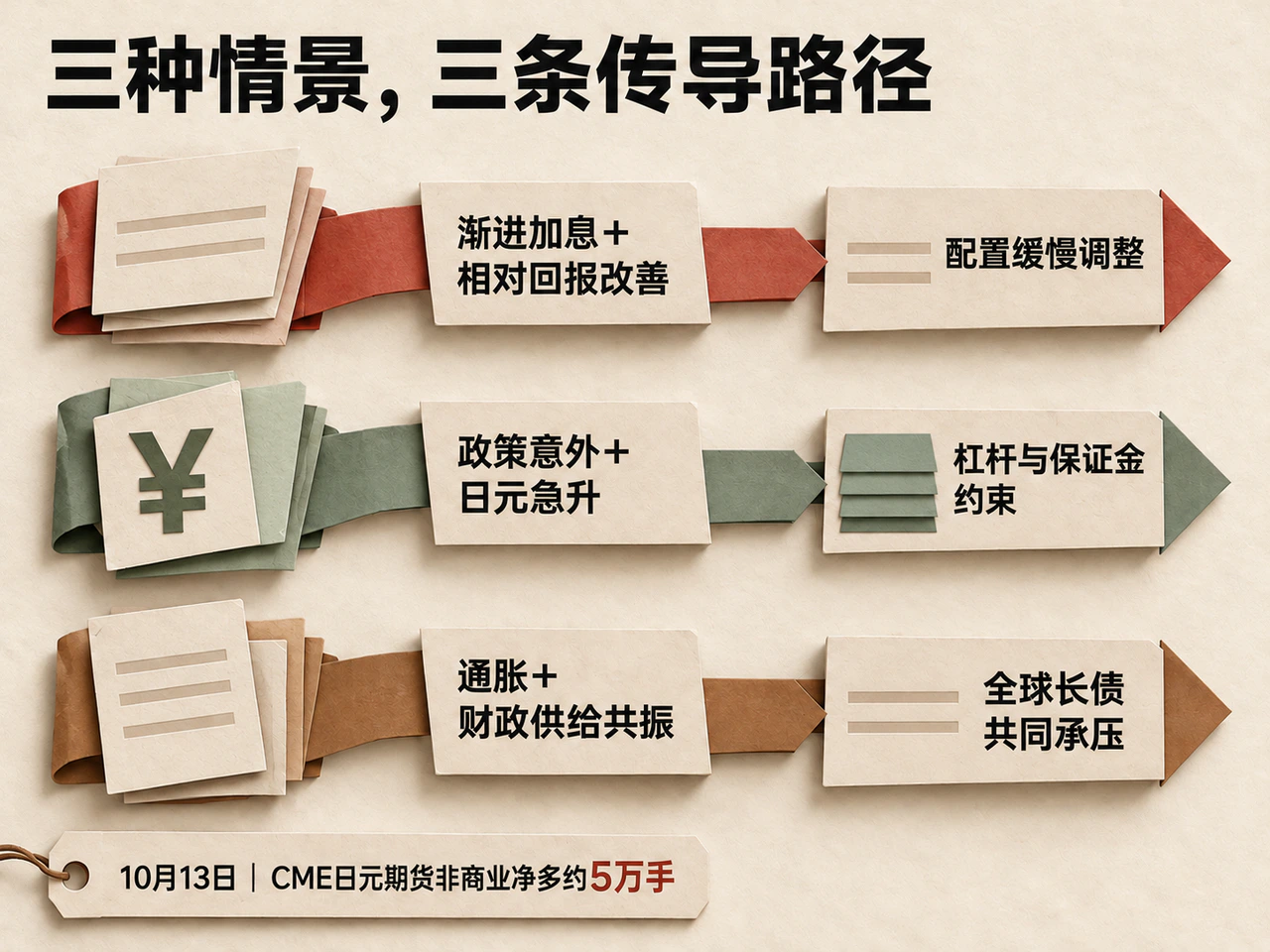
The first scenario is gradual normalization. If the Bank of Japan raises rates steadily along a path sustainable for wages, inflation and growth, while Japanese bonds' hedged and risk-adjusted relative returns keep improving, long-term institutions have time to rebalance smoothly through new cash flows and maturing investments. Treasuries mainly face moderate pressure as marginal buyers demand higher term premiums; U.S. government and corporate borrowing costs rise gradually with refinancing, and orderly price adjustment accommodates replacement capital.
The second scenario combines a policy surprise with a sharp yen rise. Leverage and margin mechanisms then dominate the short-term shock, with risk assets, credit spreads and currency volatility affected first. Whether Treasuries rally depends on whether safe-haven demand and Federal Reserve cut expectations outweigh carry liquidation. Visible exchange-traded speculative positions differ substantially from summer 2024: as of October 13, noncommercial accounts in CME yen futures were net long approximately 50,000 contracts, rather than showing the extreme crowded net shorts seen before that summer's storm. Assessing a sudden yen rise therefore requires considering the policy surprise, new position changes and OTC funding exposures together, rather than simply applying past short-covering volumes.
The third scenario is synchronized global inflation and fiscal-supply pressure. If higher Japanese yields form part of a broader increase in long-term inflation and fiscal deficits, Treasuries and other major sovereign long bonds will also require greater term-risk compensation. The impact reaches public finances, mortgages and corporate capital spending more widely. Meanwhile, high overseas rates or Japan's own fiscal risk premium may prevent sustained yen strength.
U.S. economic and policy developments run through all three scenarios. Slower U.S. growth and inflation that strengthen Federal Reserve cut expectations support Treasuries internally and lower Japanese institutions' dollar hedging costs. Conversely, persistently high U.S. rates make competition for long-term capital and corporate refinancing pressure harder to relieve.
In practice, investors can distinguish forms of repricing through three groups of indicators covering prices, positions and financing. First, track the shape of U.S. and Japanese yield curves and actual hedged yield differences to measure Japanese bonds' substitution advantage. Second, monitor Japanese net Treasury transactions by maturity and absorption by other global buyers to assess real demand changes. Third, watch the pace of yen appreciation, dollar credit spreads and FX swap funding conditions to determine whether adjustment remains an orderly reallocation or has become forced deleveraging.
The most far-reaching effect of Japanese normalization is to restore a significant opportunity cost to long-term savings and low-rate yen funding. Dollar-bond issuers must offer more attractive terms to compete for that capital, while dollar-asset holders must reconsider their mix of duration, credit and currency risk. Yen strength can accelerate rebalancing, while Treasuries' safe-haven role can change the short-term direction. Global capital pricing thus faces a broader set of constraints than a focus on the Federal Reserve alone can capture.
This article is for research and discussion only and does not constitute investment advice.